
Introduction to Data Management Lecture 2 Big Picture
Introduction to Data Management Lecture #2 (Big Picture, Cont. ) Instructor: Chen Li 1
Announcements v v We added 10 more seats to the class for students on the waiting list Deadline to drop the class: tomorrow (Friday) Sign up on Piazza today For general questions, use Piazza not email § Email: add “CS 122 A” in the subject v Form a group of 3 students by coming Tuesday § Approval needed for groups of 1 or 2 people v v Discussion session switch allowed, and you need to figure out how to do it officially Assignment 1 to be released this week (you have two weeks to do it) 2
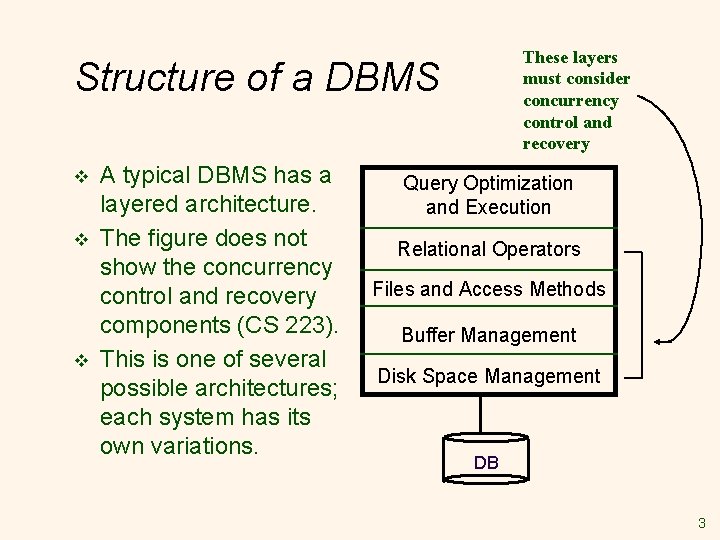
These layers must consider concurrency control and recovery Structure of a DBMS v v v A typical DBMS has a layered architecture. The figure does not show the concurrency control and recovery components (CS 223). This is one of several possible architectures; each system has its own variations. Query Optimization and Execution Relational Operators Files and Access Methods Buffer Management Disk Space Management DB 3
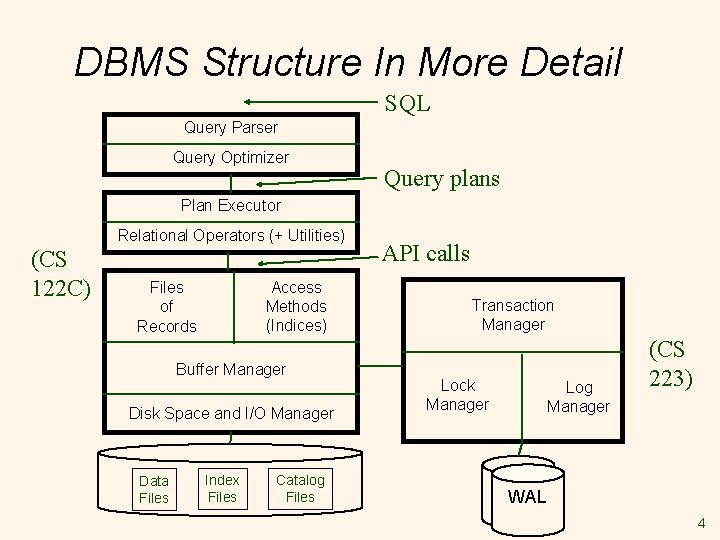
DBMS Structure In More Detail SQL Query Parser Query Optimizer Query plans Plan Executor Relational Operators (+ Utilities) (CS 122 C) Access Methods (Indices) Files of Records Buffer Manager Disk Space and I/O Manager Data Files Index Files Catalog Files API calls Transaction Manager Lock Manager Log Manager (CS 223) WAL 4
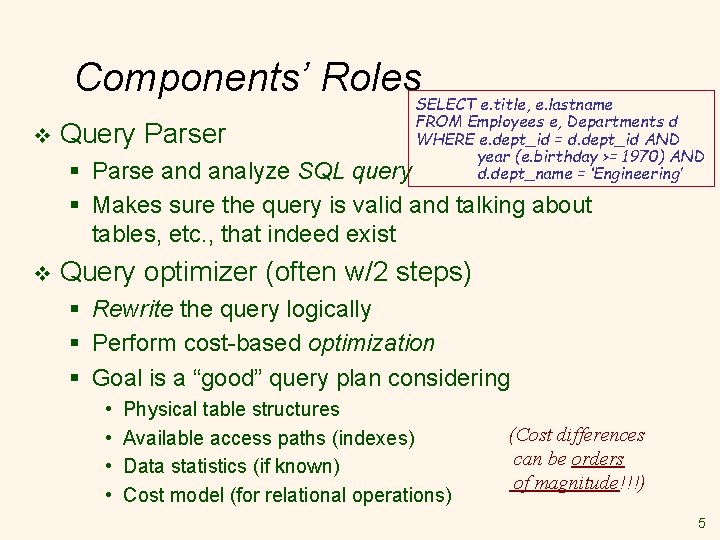
Components’ Roles v Query Parser SELECT e. title, e. lastname FROM Employees e, Departments d WHERE e. dept_id = d. dept_id AND year (e. birthday >= 1970) AND query d. dept_name = ‘Engineering’ § Parse and analyze SQL § Makes sure the query is valid and talking about tables, etc. , that indeed exist v Query optimizer (often w/2 steps) § Rewrite the query logically § Perform cost-based optimization § Goal is a “good” query plan considering • • Physical table structures Available access paths (indexes) Data statistics (if known) Cost model (for relational operations) (Cost differences can be orders of magnitude!!!) 5
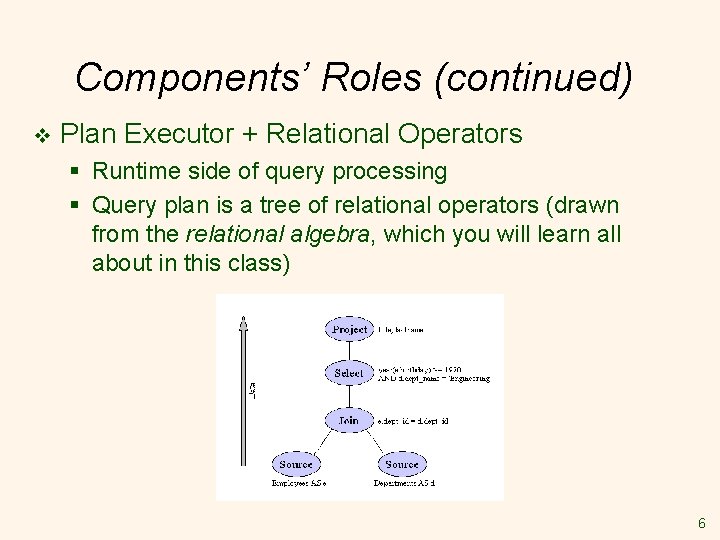
Components’ Roles (continued) v Plan Executor + Relational Operators § Runtime side of query processing § Query plan is a tree of relational operators (drawn from the relational algebra, which you will learn all about in this class) 6
Components’ Roles (continued) v Files of Records § OSs usually have byte-stream based APIs § DBMSs instead provide record-based APIs • Record = set of fields • Fields are typed • Records reside on pages of files v Access Methods § Index structures for lookups based on field values § We’ll look in more depth at B+ tree indexes in this class (as they are the most commonly used indexes across all commercial and open source systems) 7
Components’ Roles (continued) v Buffer Manager § § § v The DBMS answer to main memory management! All disk page accesses go through the buffer pool Buffer manager caches pages from files and indices “DB-oriented” page replacement scheme(s) Also interacts with logging (so undo/redo possible) Disk Space and I/O Managers § Manage space on disk (pages), including extents § Also manage I/O (sync, async, prefetch, …) § Remember: database data is persistent (!) 8
Components’ Roles (continued) v System Catalog (or “Metadata”) § Info about physical data (volumes, table spaces, …) § Info about tables (name, columns, types, … ); also, info about their constraints, keys, etc. ) § Data statistics (e. g. , value distributions, counts, …) § Info about indexes (types, target tables, …) § And so on! (Views, security, …) v Transaction Management § ACID (Atomicity, Consistency, Isolation, Durability) § Lock Manager for Consistency+Isolation § Log Manager for Atomicity+Durability 9
Miscellany: A Few Terms v Data Definition Language (DDL) § Used to express views + logical schemas (using a syntactic form of a data model, e. g. , relational) v Data Manipulation Language (DML) § Used to access and update the data in the database (again in terms of a data model, e. g. , relational) v Query Language (QL) § Synonym for DML or its retrieval (i. e. , data access or query) sublanguage 10
Miscellany (Cont’d. ): Key Players v Database Administrator (DBA) § The “super user” for a database or a DBMS § Deals with things like physical DB design, tuning, performance monitoring, backup/restore, user and group authorization management v Application Developer § Builds data-centric applications (CS 122 b!) § Involved with logical DB design, queries, and DB application tools (e. g. , JDBC, …) v Data Analyst or End User § Non-expert who uses tools to interact w/the data 11
A Brief History of Databases v v v Pre-relational era: 1960’s, early 1970’s Codd’s seminal paper: 1970 Basic RDBMS R&D: 1970 -80 (System R, Ingres) RDBMS improvements: 1980 -85 Relational goes mainstream: 1985 -90 Distributed DBMS research: 1980 -90 Parallel DBMS research: 1985 -95 Extensible DBMS research: 1985 -95 OLAP and warehouse research: 1990 -2000 Stream DB and XML DB research: 2000 -2010 “Big Data” R&D (also including “No. SQL”): 2005 -present 12
So Now What? v Time to dive into the first real topic: § Logical DB design (ER model) Read the first two chapters of the book v Now - on to DB design…! v 13
Entity–relationship (ER) model v v v Peter Chen (March 1976). "The Entity. Relationship Model - Toward a Unified View of Data". ACM Transactions on Database Systems 1 (1): 9– 36 http: //dl. acm. org/citation. cfm? doid=320434. 32044 0 Peter Chen: "The entity-relationship model adopts the more natural view that the real world consists of entities and relationships. It incorporates some of the important semantic information about the real world. " 14
Overview of Database Design v Conceptual design: (ER Model used at this stage. ) § § § What are the entities and relationships in the enterprise? What information about these entities and relationships should we store in the database? What are the integrity constraints or business rules that hold? A database schema in the ER Model can be represented pictorially (using an ER diagram). Can map an ER diagram into a relational schema (manually or using a design tool’s automation). 15
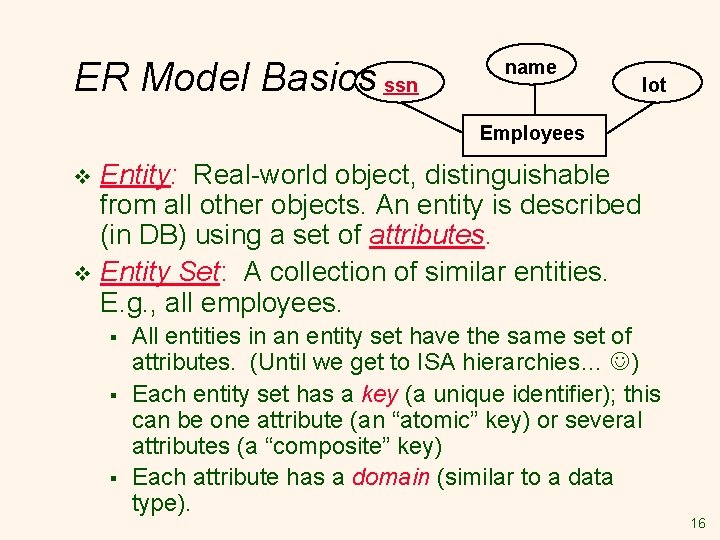
ER Model Basics ssn name lot Employees Entity: Real-world object, distinguishable from all other objects. An entity is described (in DB) using a set of attributes. v Entity Set: A collection of similar entities. E. g. , all employees. v § § § All entities in an entity set have the same set of attributes. (Until we get to ISA hierarchies… ) Each entity set has a key (a unique identifier); this can be one attribute (an “atomic” key) or several attributes (a “composite” key) Each attribute has a domain (similar to a data type). 16
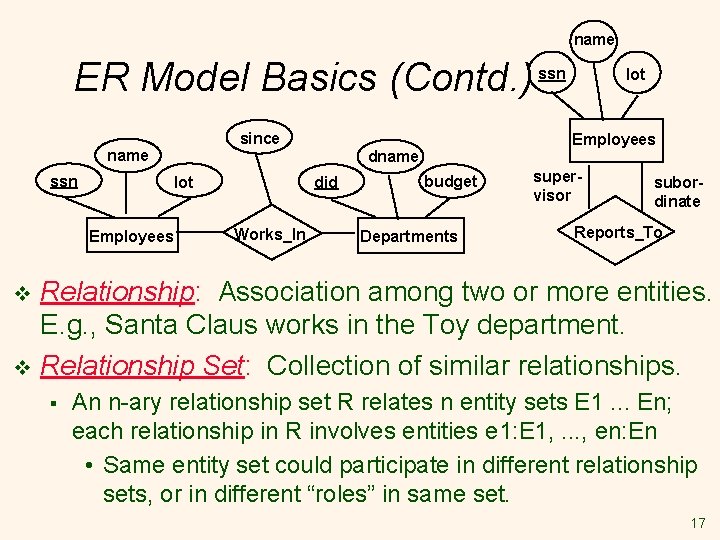
name ER Model Basics (Contd. ) since name ssn lot Employees Works_In lot Employees dname did ssn budget Departments supervisor subordinate Reports_To Relationship: Association among two or more entities. E. g. , Santa Claus works in the Toy department. v Relationship Set: Collection of similar relationships. v § An n-ary relationship set R relates n entity sets E 1. . . En; each relationship in R involves entities e 1: E 1, . . . , en: En • Same entity set could participate in different relationship sets, or in different “roles” in same set. 17
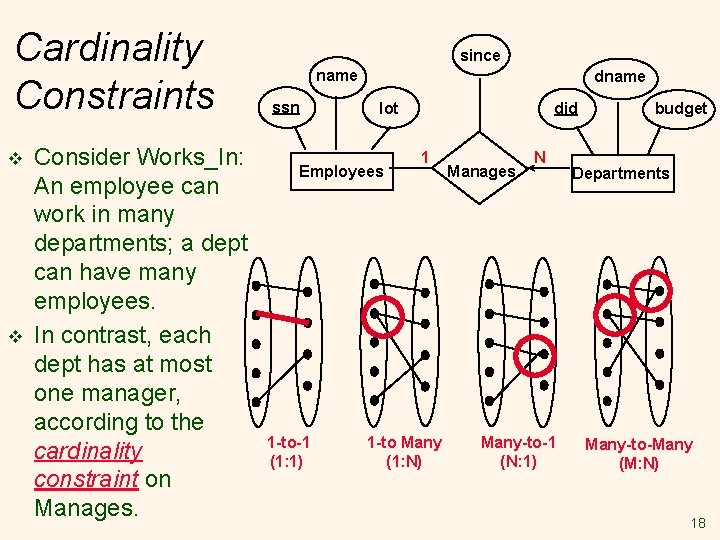
Cardinality Constraints v v Consider Works_In: An employee can work in many departments; a dept can have many employees. In contrast, each dept has at most one manager, according to the cardinality constraint on Manages. since name ssn dname lot Employees 1 -to-1 (1: 1) did 1 1 -to Many (1: N) Manages N Many-to-1 (N: 1) budget Departments Many-to-Many (M: N) 18
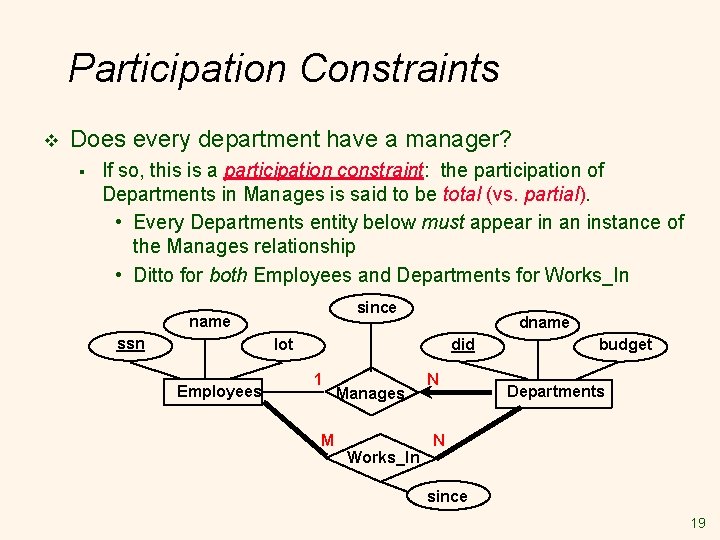
Participation Constraints v Does every department have a manager? § If so, this is a participation constraint: the participation of Departments in Manages is said to be total (vs. partial). • Every Departments entity below must appear in an instance of the Manages relationship • Ditto for both Employees and Departments for Works_In since name ssn dname did lot Employees 1 M Manages Works_In N budget Departments N since 19
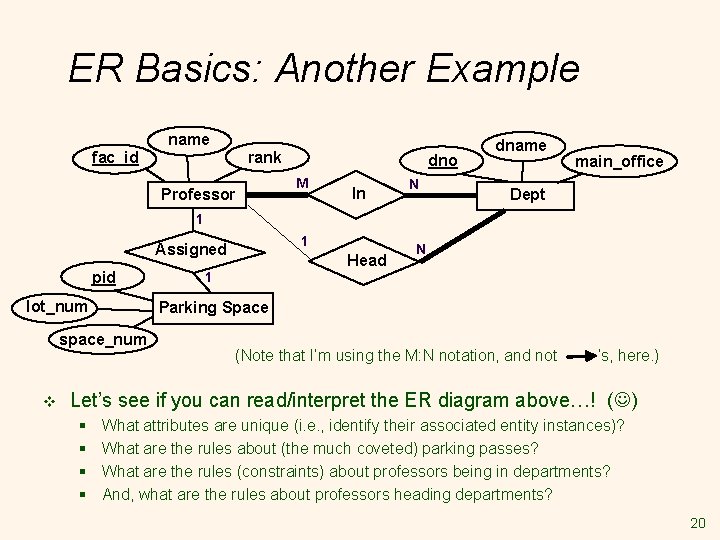
ER Basics: Another Example name rank fac_id Professor dno M In N dname main_office Dept 1 1 Assigned pid lot_num 1 N Parking Space space_num v Head (Note that I’m using the M: N notation, and not ‘s, here. ) Let’s see if you can read/interpret the ER diagram above…! ( ) § § What attributes are unique (i. e. , identify their associated entity instances)? What are the rules about (the much coveted) parking passes? What are the rules (constraints) about professors being in departments? And, what are the rules about professors heading departments? 20
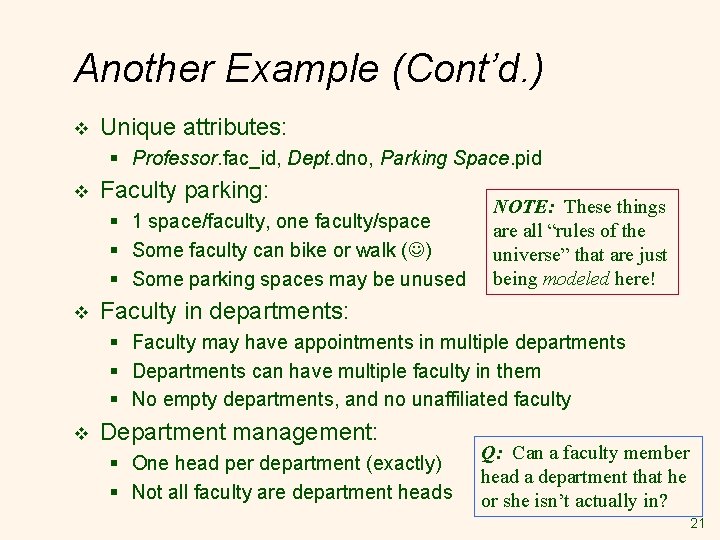
Another Example (Cont’d. ) v Unique attributes: § Professor. fac_id, Dept. dno, Parking Space. pid v Faculty parking: § 1 space/faculty, one faculty/space § Some faculty can bike or walk ( ) § Some parking spaces may be unused v NOTE: These things are all “rules of the universe” that are just being modeled here! Faculty in departments: § Faculty may have appointments in multiple departments § Departments can have multiple faculty in them § No empty departments, and no unaffiliated faculty v Department management: § One head per department (exactly) § Not all faculty are department heads Q: Can a faculty member head a department that he or she isn’t actually in? 21
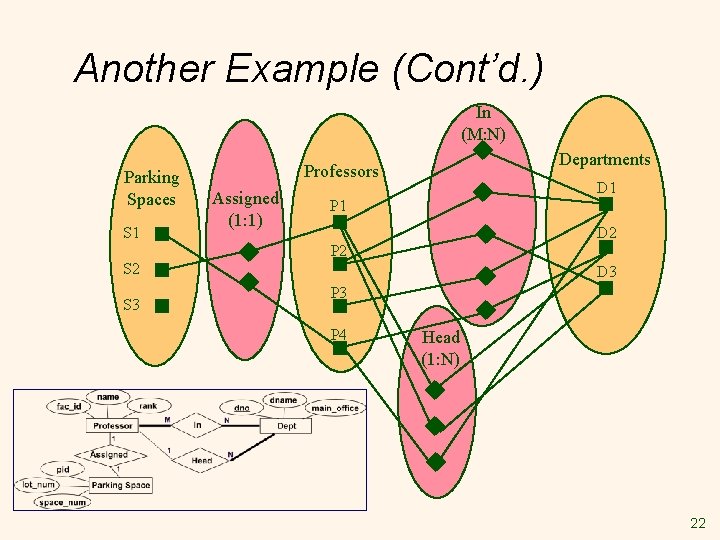
Another Example (Cont’d. ) In (M: N) Parking Spaces S 1 S 2 S 3 Professors Assigned (1: 1) P 1 P 2 P 3 P 4 Departments D 1 D 2 D 3 Head (1: N) 22
- Slides: 22