
Introduction to Data Analysis using Python Yongqi Pang






- Slides: 19
Introduction to Data Analysis using Python Yongqi Pang
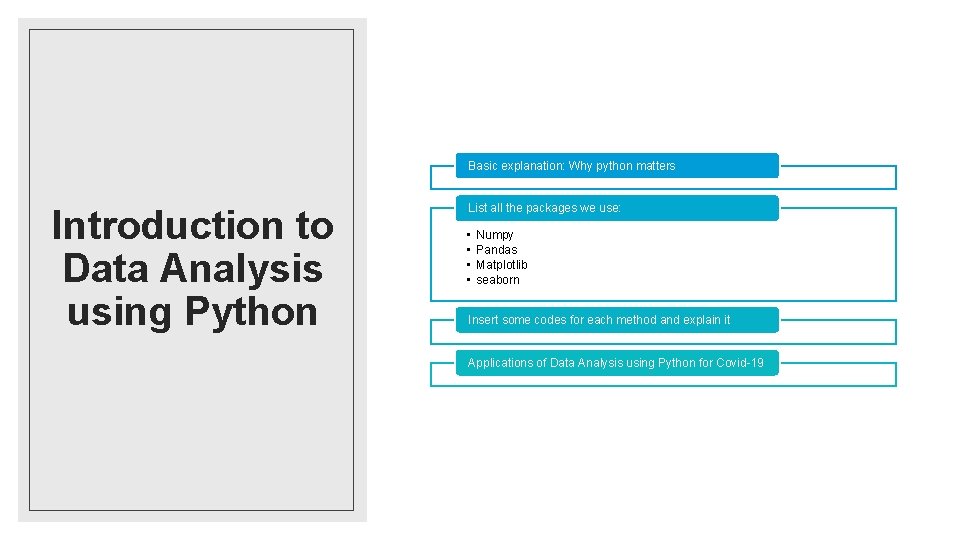
Basic explanation: Why python matters Introduction to Data Analysis using Python List all the packages we use: • • Numpy Pandas Matplotlib seaborn Insert some codes for each method and explain it Applications of Data Analysis using Python for Covid-19
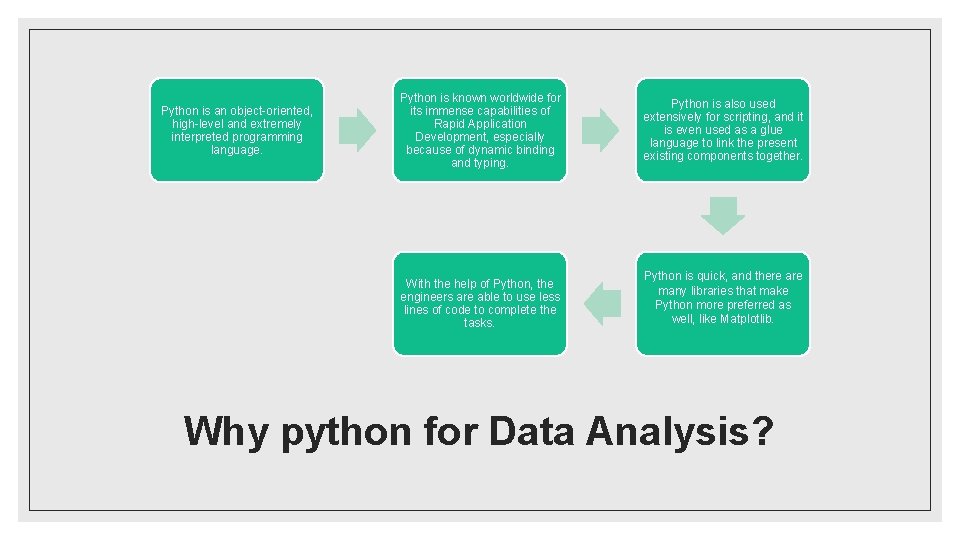
Python is an object-oriented, high-level and extremely interpreted programming language. Python is known worldwide for its immense capabilities of Rapid Application Development, especially because of dynamic binding and typing. With the help of Python, the engineers are able to use less lines of code to complete the tasks. Python is also used extensively for scripting, and it is even used as a glue language to link the present existing components together. Python is quick, and there are many libraries that make Python more preferred as well, like Matplotlib. Why python for Data Analysis?
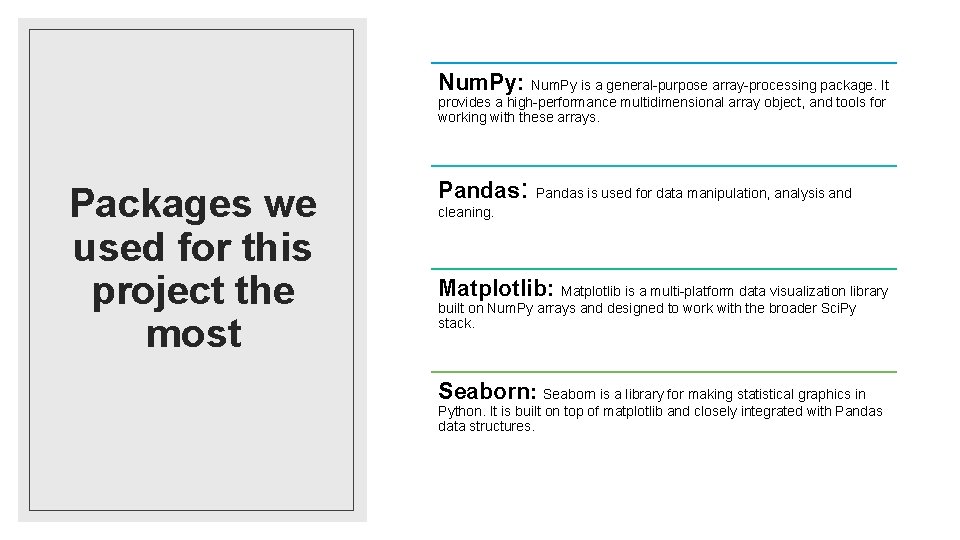
Num. Py: Num. Py is a general-purpose array-processing package. It provides a high-performance multidimensional array object, and tools for working with these arrays. Packages we used for this project the most Pandas: Pandas is used for data manipulation, analysis and cleaning. Matplotlib: Matplotlib is a multi-platform data visualization library built on Num. Py arrays and designed to work with the broader Sci. Py stack. Seaborn: Seaborn is a library for making statistical graphics in Python. It is built on top of matplotlib and closely integrated with Pandas data structures.
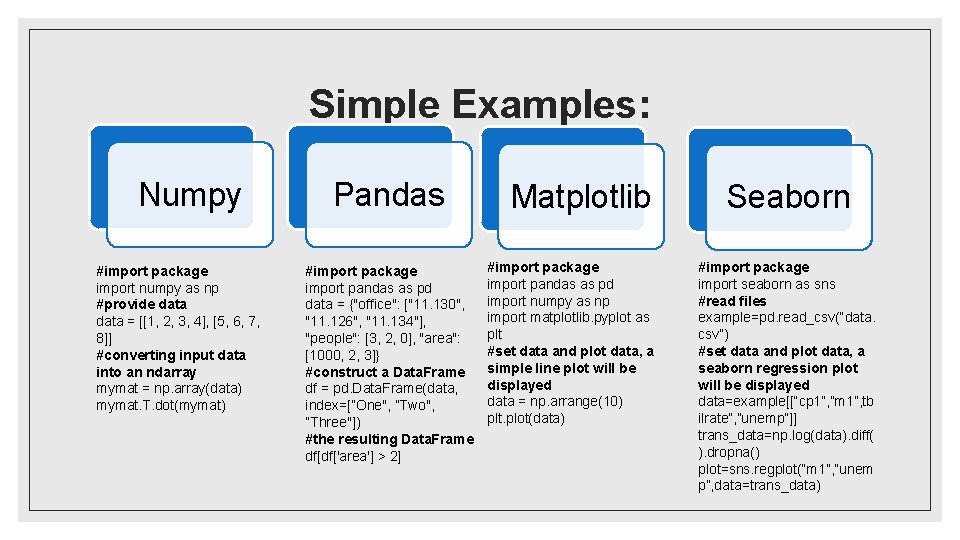
Simple Examples: Numpy #import package import numpy as np #provide data = [[1, 2, 3, 4], [5, 6, 7, 8]] #converting input data into an ndarray mymat = np. array(data) mymat. T. dot(mymat) Pandas #import package import pandas as pd data = {"office": ["11. 130", "11. 126", "11. 134"], "people": [3, 2, 0], "area": [1000, 2, 3]} #construct a Data. Frame df = pd. Data. Frame(data, index=[”One", ”Two", ”Three"]) #the resulting Data. Frame df[df['area'] > 2] Matplotlib #import package import pandas as pd import numpy as np import matplotlib. pyplot as plt #set data and plot data, a simple line plot will be displayed data = np. arrange(10) plt. plot(data) Seaborn #import package import seaborn as sns #read files example=pd. read_csv(“data. csv”) #set data and plot data, a seaborn regression plot will be displayed data=example[[“cp 1”, ”m 1”, tb ilrate”, ”unemp”]] trans_data=np. log(data). diff( ). dropna() plot=sns. regplot(“m 1”, ”unem p”, data=trans_data)
Links ◦ This is the link of google Colab file which contains all the codes that I have wrote: https: //colab. research. google. com/drive/ 1 J 3 s. Ewi. Gilhs. KXU 9 H 1 J_ZBFw. NJaz. Zv. N 1 H ◦ Please check it out for details.
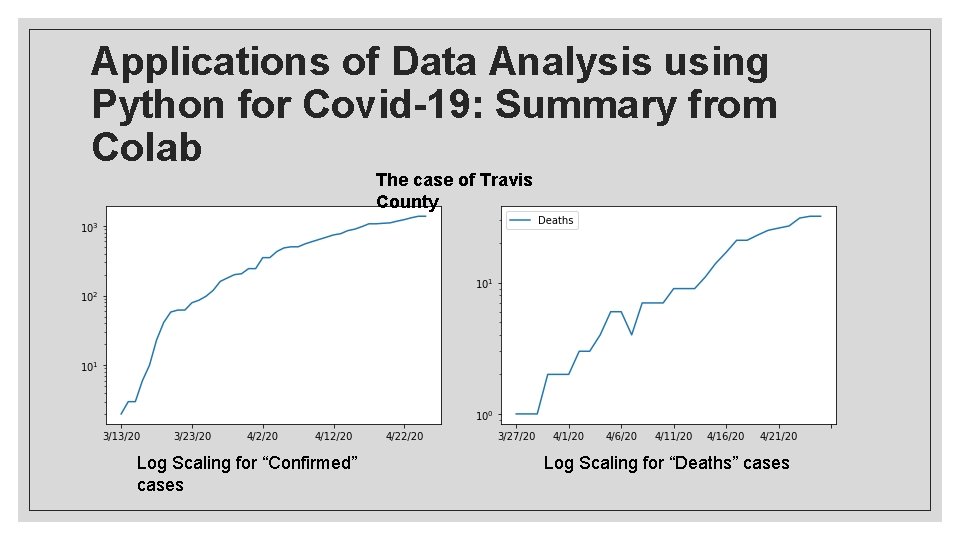
Applications of Data Analysis using Python for Covid-19: Summary from Colab The case of Travis County Log Scaling for “Confirmed” cases Log Scaling for “Deaths” cases
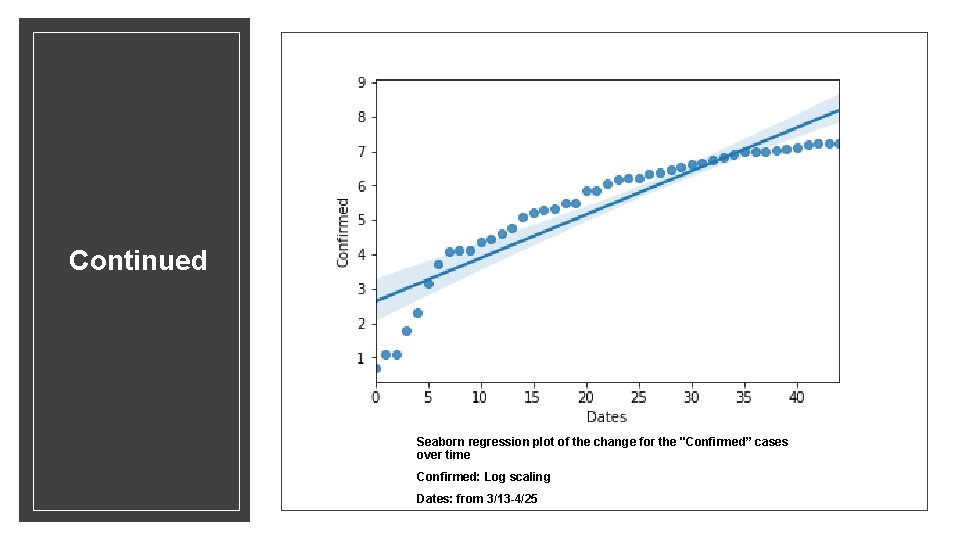
Continued ◦ Seaborn regression plot of the change for the "Confirmed” cases over time ◦ Confirmed: Log scaling ◦ Dates: from 3/13 -4/25
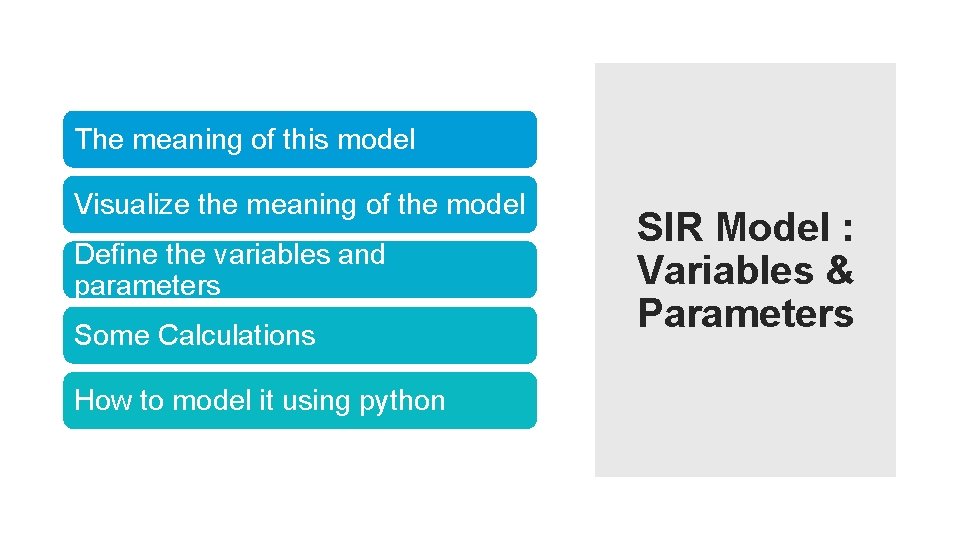
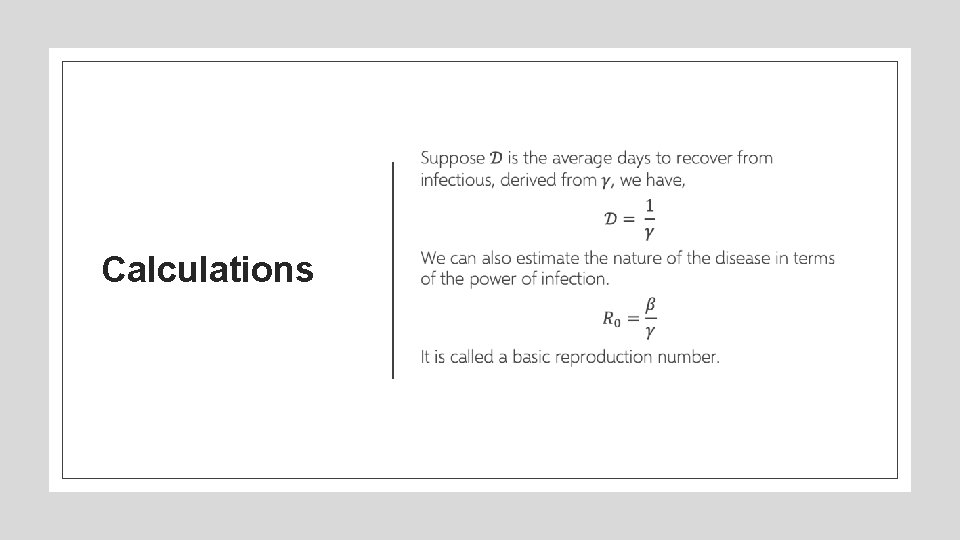
The meaning of this model Visualize the meaning of the model Define the variables and parameters Some Calculations How to model it using python SIR Model : Variables & Parameters
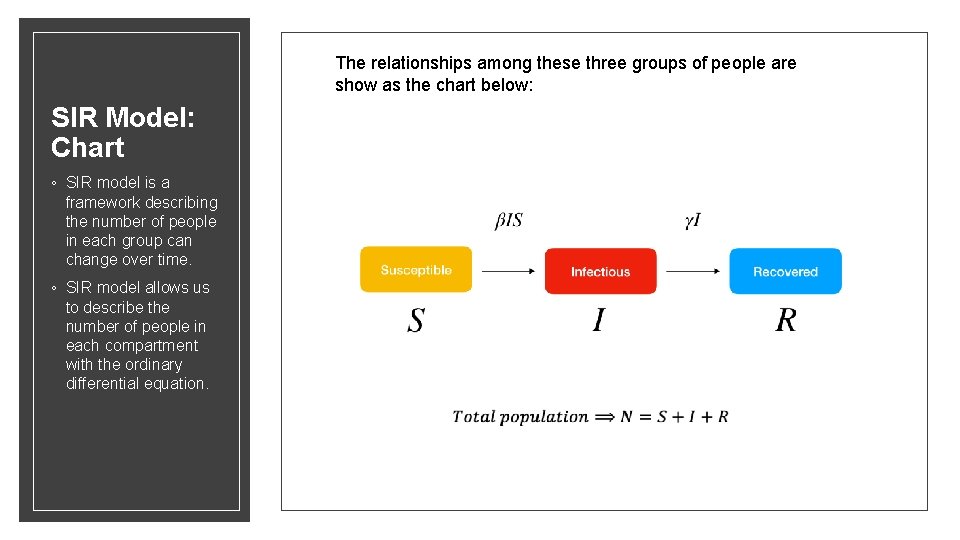
What is SIR model • SIR model is a kind of compartmental model describing the dynamics of infection disease. The model divides the population into compartments, Each compartments is expected to have same characteristics. SIR represents the three compartments segmented by the model. • S~ Susceptible • I~ Infectious • R~ Recovered Susceptible is a group of people who are vulnerable to exposure with infectious people. They can be patients when the infection happens. Infectious is a group of people who are infected. They can pass the disease to the susceptible people and can be recovered in a specific period. Recovered represents the group of people who get immunity so that they are not susceptible to the same illness anymore.
The relationships among these three groups of people are show as the chart below: SIR Model: Chart ◦ SIR model is a framework describing the number of people in each group can change over time. ◦ SIR model allows us to describe the number of people in each compartment with the ordinary differential equation.
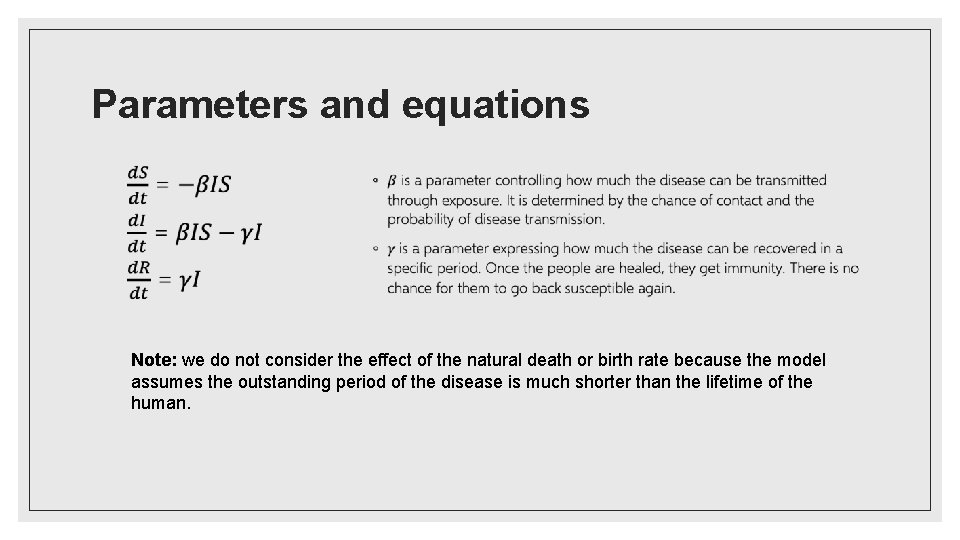
Parameters and equations ◦ Note: we do not consider the effect of the natural death or birth rate because the model assumes the outstanding period of the disease is much shorter than the lifetime of the human.
Calculations
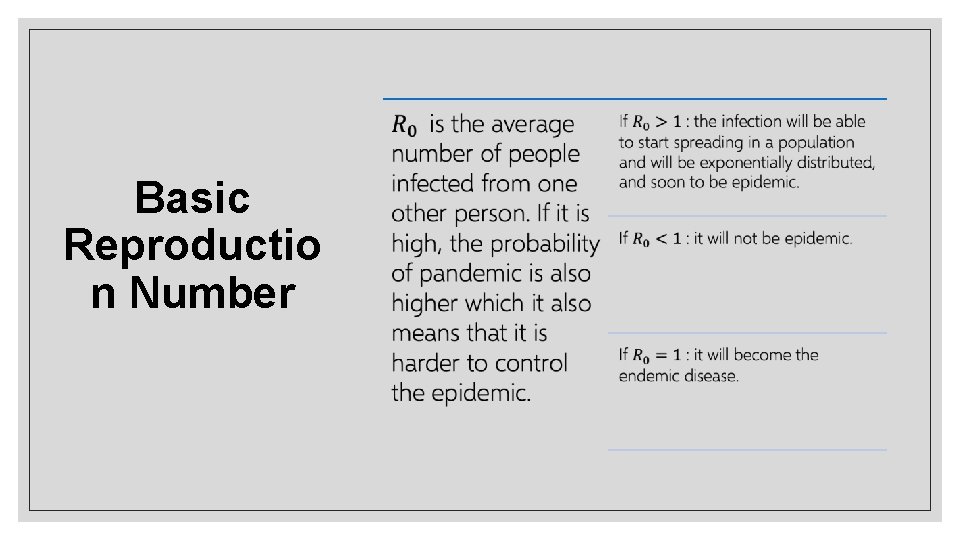
Basic Reproductio n Number
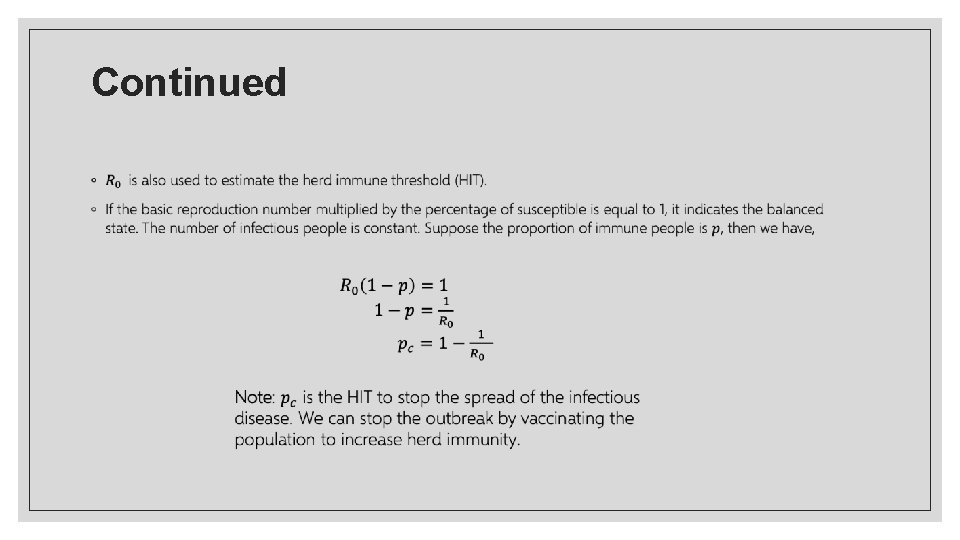
Continued ◦
RUNNING THE MODEL THROUGH PYTHON ◦ When beta =0. 21, gamma=0. 0529 When beta = 0. 21, gamma = 0. 00529
◦ When gamma is smaller, the graph on the right shows that recovered rate is much lower than the recovered rate on the left graph. Conclusion ◦ When the gamma is smaller, the infection rate of right graph is on a higher peak. ◦ When gamma is smaller, the days we use to stop the pandemic is longer.
EXTRA INFORMATION My Practice problem for Num. Py package study
◦ Mc. Kinney, Wes. Python for Data Analysis Data Wrangling with Pandas, Num. Py, and IPython / Wes Mc. Kinney. Second edition. Beijing: O’Reilly, 2017. Print. Reference