
Introduction to Cyberethics Issues for ICT Professionals School
Introduction to Cyber-ethics Issues for ICT Professionals School of Architecture, Computing, and Engineering University of East London 5 March 2014 Dr Josephine Anne Stein Principal Research Fellow in Innovation Studies emerita Law and Social Sciences/LSS E-mail: jastein 9@gmail. com
Overview n Ethical issues for ICT professionals n Definitions and basic concepts n Western moral tradition and evolution n What is the relevance of ethics to ICTs? n Cyber-ethics issues and dilemmas n Practical approaches to applying ethics 5. 3. 2014 JA Stein 2
Ethical issues for ICT professionals n Data protection and other legal matters n Hacktivism n Business computer ethics n Surveillance at work n Ethics in the Cloud n Online privacy 5. 3. 2014 JA Stein 3

British Computer Society Code of Conduct n Public interest – Awareness of legal environment – Avoid discrimination n Duty to relevant authority – Compliance and expert judgement – Confidentiality and disclosure – Manage task within time and budget n Duty to the profession n Professional competence and integrity 5. 3. 2014 JA Stein 4
Definitions: Ethics n The study and philosophy of human conduct, with emphasis on the determination of right and wrong. The basic principles of right action especially with reference to a particular profession (New International Webster’s Dictionary 1996) n a code of behaviour, especially of a particular group, profession or individual. The moral fitness of a decision, course of action, etc. (Collins Dictionary 5. 3. 2014 2002) JA Stein 5
Why ‘Cyber-ethics’? n Computer ethics – Customised or bespoke software (machines) n Internet ethics – Netiquette (www, email) (content) n Cyber-ethics – LAN Internet Cloud (environment) 5. 3. 2014 JA Stein 6
Definitions: Morality n the quality of being moral; that which renders an action right or wrong; the practice of moral duties apart from religion; virtue. . . ethics (Chambers Dictionary 1998) n a set of shared rules, principles and duties applicable to all members of a group or society which we follow in our day-to-day living. . . They help us to distinguish between right and wrong (E Turner) 5. 3. 2014 JA Stein 7
Moral philosophy and applied ethics n Moral Philosophy or “metaethics”: philosophical reflection on the nature of moral judgement – critical analysis, identifying moral principles n Applied ethics: practical approaches to understanding real-world moral issues, making explicit beliefs and values based on philosophical principles: – – 5. 3. 2014 – individual rights and autonomy ownership authority and relativism objectivity, trust, privacy JA Stein social distribution of responsibility, damage and 8
The nature of authority n Expertise and subjectivity – validated knowledge and credentialed expertise – scientific method, experience, opinion who is qualified concerning moral judgement? n An authority or someone in authority? – is doing the right thing about avoiding punishment? – is authority conferred or earned? – when and why does one reject authority? n From power-based to rule-based to value-based morality 5. 3. 2014 JA Stein 9
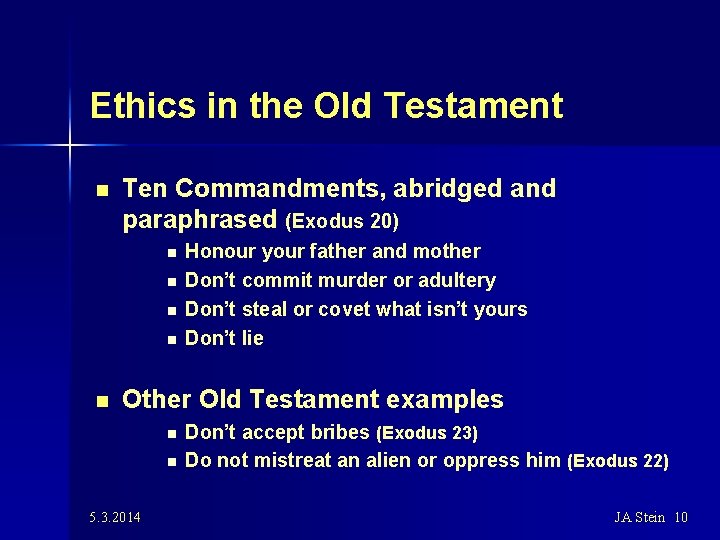
Ethics in the Old Testament n Ten Commandments, abridged and paraphrased (Exodus 20) n n n Honour your father and mother Don’t commit murder or adultery Don’t steal or covet what isn’t yours Don’t lie Other Old Testament examples n n 5. 3. 2014 Don’t accept bribes (Exodus 23) Do not mistreat an alien or oppress him (Exodus 22) JA Stein 10
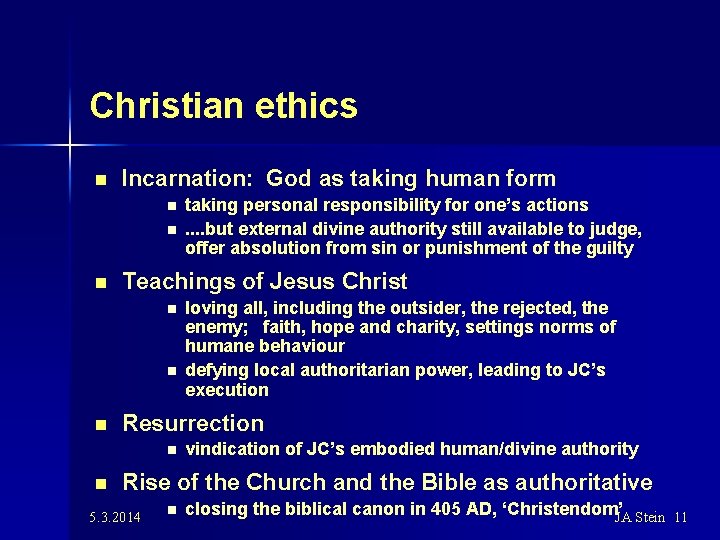
Christian ethics n Incarnation: God as taking human form n n n Teachings of Jesus Christ n n n loving all, including the outsider, the rejected, the enemy; faith, hope and charity, settings norms of humane behaviour defying local authoritarian power, leading to JC’s execution Resurrection n n taking personal responsibility for one’s actions. . but external divine authority still available to judge, offer absolution from sin or punishment of the guilty vindication of JC’s embodied human/divine authority Rise of the Church and the Bible as authoritative 5. 3. 2014 n closing the biblical canon in 405 AD, ‘Christendom’JA Stein 11

The rise of secular humanism n Reformation and Protestantism (16 th century) n n n Enlightenment (18 th century) n n rise of rationality and human-centred philosophy Modernism (early 20 th century) n n Martin Luther and the rebellion against corruption Henry VIII and the Church of England triumph of “progress” in delivering prosperity now instead of promises in “eternity” or afterlife, based on universal scientific principles Postmodernism (mid-late 20 th century) n 5. 3. 2014 rejection of the “grand narrative” in favour of “constructed identity”, anti-realism and pluralism JA Stein 12
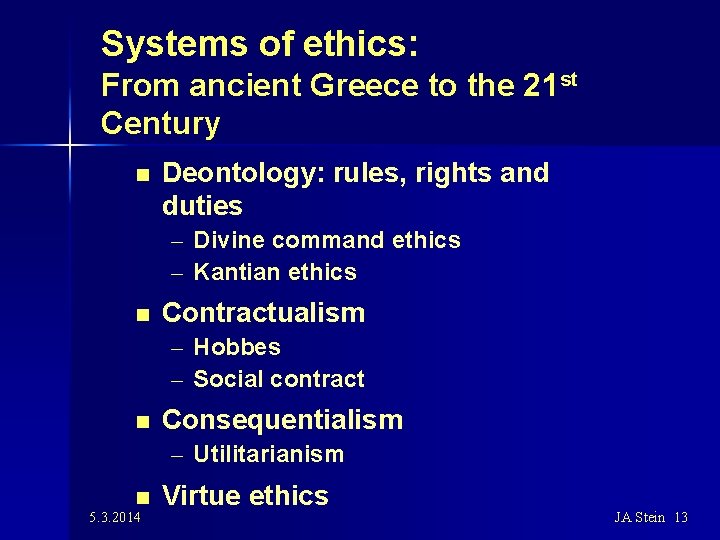
Systems of ethics: From ancient Greece to the 21 st Century n Deontology: rules, rights and duties – Divine command ethics – Kantian ethics n Contractualism – Hobbes – Social contract n Consequentialism – Utilitarianism n 5. 3. 2014 Virtue ethics JA Stein 13
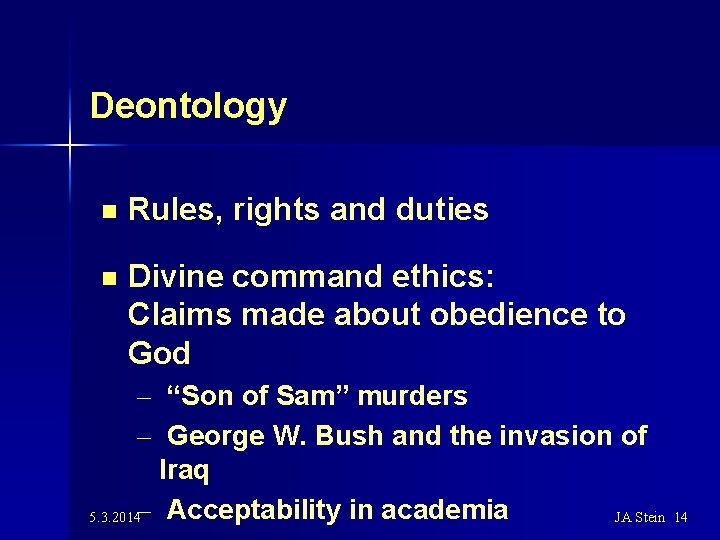
Deontology n Rules, rights and duties n Divine command ethics: Claims made about obedience to God – “Son of Sam” murders – George W. Bush and the invasion of Iraq 5. 3. 2014– Acceptability in academia JA Stein 14
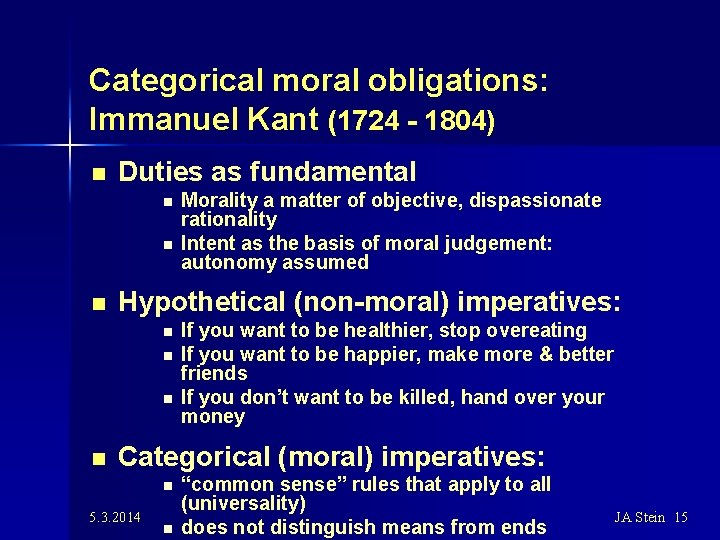
Categorical moral obligations: Immanuel Kant (1724 - 1804) n Duties as fundamental n n n Hypothetical (non-moral) imperatives: n n Morality a matter of objective, dispassionate rationality Intent as the basis of moral judgement: autonomy assumed If you want to be healthier, stop overeating If you want to be happier, make more & better friends If you don’t want to be killed, hand over your money Categorical (moral) imperatives: n 5. 3. 2014 n “common sense” rules that apply to all (universality) does not distinguish means from ends JA Stein 15
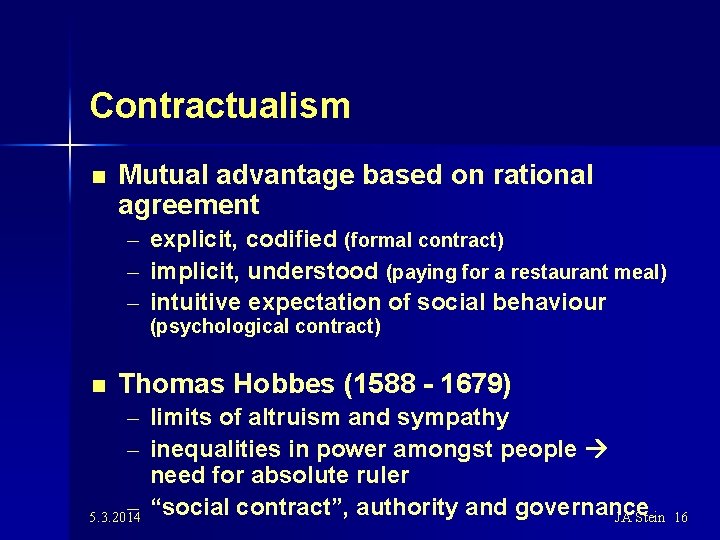
Contractualism n Mutual advantage based on rational agreement – explicit, codified (formal contract) – implicit, understood (paying for a restaurant meal) – intuitive expectation of social behaviour (psychological contract) n Thomas Hobbes (1588 - 1679) – limits of altruism and sympathy – inequalities in power amongst people need for absolute ruler – “social contract”, authority and governance 5. 3. 2014 JA Stein 16
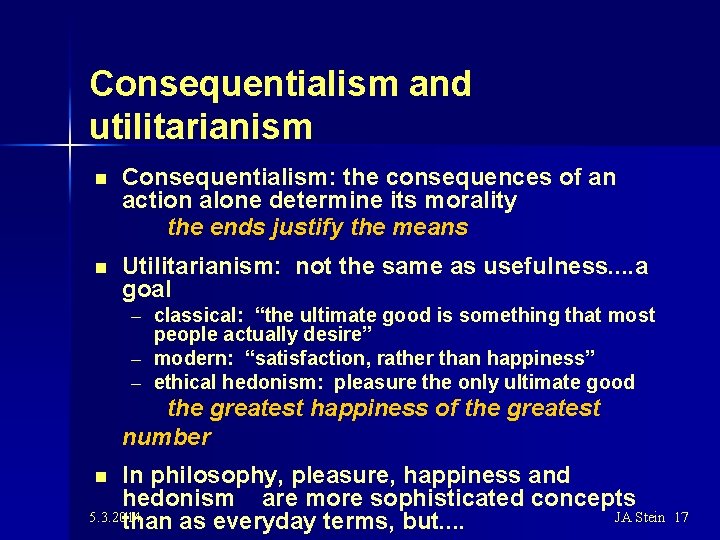
Consequentialism and utilitarianism n Consequentialism: the consequences of an action alone determine its morality the ends justify the means n Utilitarianism: not the same as usefulness. . a goal – classical: “the ultimate good is something that most people actually desire” – modern: “satisfaction, rather than happiness” – ethical hedonism: pleasure the only ultimate good the greatest happiness of the greatest number In philosophy, pleasure, happiness and hedonism are more sophisticated concepts 5. 3. 2014 JA Stein than as everyday terms, but. . n 17
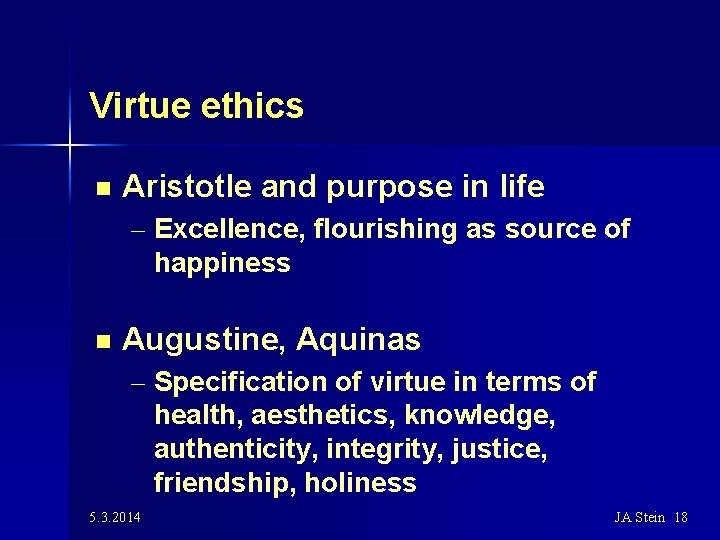
Virtue ethics n Aristotle and purpose in life – Excellence, flourishing as source of happiness n Augustine, Aquinas – Specification of virtue in terms of health, aesthetics, knowledge, authenticity, integrity, justice, friendship, holiness 5. 3. 2014 JA Stein 18
Computer ethics n Postwar period: n n Microcomputers, networking and personal computers n n n the rise of ‘artificial intelligence’ and fears of social domination by computers large-scale computation enabling greater lethality of military weaponry large-scale data manipulation enabling the centralisation of social control (especially government): privacy and dignity software and IPRs hacking Internet and bandwidth n n privacy and protection from malicious individuals dependency in the age of informational capitalism Cloud computing 5. 3. 2014 n JA Stein 19
Conceptualising computers and ethics § Software § Hacking § the Internet § the Cloud “Computer and information technology creates new possibilities; it instruments human action in new ways. The ethical issues that are thereby created are not out of the realm of human under-standing, but they have unique features with which we must come to grips. ” (Johnson) 5. 3. 2014 JA Stein 20
Computers and society: the case of software n Software (Johnson) – A series of mental processes that cannot be owned, an internal structuring of a computer that forms a part of the machine, or a standalone product with commercial value? – Traditionalist view: adapt existing tools such as patents and copyright? But can this approach capture the novel features and their (sometimes unintended) applications? n Social context: moral, cultural, political ideas “the study of computer ethics turns out [to] be the study of human beings and society -- our goals and values, our norms of behavior, the way we organize ourselves and assign rights and responsibilities” 5. 3. 2014 JA Stein 21
Are computer ethical issues unique? n New entities: programmes, software, microchips, Websites, video games (MMORPGs), the Cloud n Scale of organised activity: data collection, calculation, statistical analysis n Scale of calculations: new types of knowledge in fields such as meteorology, economics, military technology n Inherent unreliability of computer systems: new ways of thinking about risk, accountability and liability Power and pervasiveness: dependency on 5. 3. 2014 computers for all aspects of modern living, n JA Stein 22
Practical applications of ICT ethics n Personal choices: careers, ownership of consumer goods n Protection of children and vulnerable people in our care n Policy, regulation and law – – – n both public and corporate policies gender, race, disability, equality and dignity issues regulation of service provision and content intellectual property rights to privacy Conduct of democracy Codes of professional conduct 5. 3. 2014 n JA Stein 23
Data Protection Act (1984) n DPA requirements include – Registration of personal data – Description of purpose of use – Person responsible for subject access requests n Eight principles Fairness, specification of purpose, appropriateness, adequacy, accuracy, timeliness, accessibility and security 5. 3. 2014 JA Stein 24
Data Protection Act (1998) n Implementing European standards as per the Legal protection of databases Directive (1996) n Registration n Enlargement of jurisdiction to cover more types of data systems – Manual data – Videotapes, CDs, etc. Information Commissioner empowered to issue fines from 6 April 2010 JA Stein 25 5. 3. 2014 n
Implications of the Data Protection Act for ICT professionals n Awareness of requirements for registration; exemptions n Treatment of personal data n Use and disclosure of data n Adequate but not excessive n Accuracy and timeliness 5. 3. 2014 JA Stein 26
Data protection and the Internet (I) n Exemptions for personal use of data n DPA Section 55 at work – Pornographic websites – Sexually explicit e-mails n Disclosure of data to third parties 5. 3. 2014 JA Stein 27
Data protection and the Internet (II) n Web site cookies, application forms and transparency n Confidentiality and public services n Use of personal data for secondary purposes – Authorisation – Public interest disclosure – Informed consent 5. 3. 2014 JA Stein 28
Computer Misuse Act (1990) n Unauthorised access to a computer n Unauthorised modification of data held on a computer n Hacking n Infecting computers with viruses n Attempt to control international computer crime 5. 3. 2014 JA Stein 29
File-sharing, IPRs… and Democracy n Napster mp 3 file sharing started in 1999 and was shut down in 2001 by judicial order More than 60% of Internet traffic p 2 p sharing music, movies, books and games (June 2010) n Encryption and IP address migration n Piratbyrån - The Pirate Bay: 25 million visitors/month (2008) – only hosts bit-torrents and not files so cannot be shut down – but conspiracy case n Market economy vs. capitalism (concentrated power) n Democracy and Human Rights: Piratpartiet and JA Stein 5. 3. 2014 n 30
Digital Economy Act (2010) n Copyright/anti-piracy – Compels ISPs to report persistent offenders – Powers to restrict or cut off Internet access granted to the Secretary of State to instruct ISPs – Ofcom enforces ISPs obligations – Control of content: n n n Video game classification Copyright material on websites The controversy continues – Implementation wrt piracy delayed until 2015 JA Stein 31 5. 3. 2014
Professional responsibility v. Legal responsibility n Compliance with the law n Contribution to the formulation of law and professional practice – Technological expertise – Ethical/professional judgement n Disclosure (whistleblowing) n What if the law itself is ethically wrong? 5. 3. 2014 JA Stein 32
Business computer ethics n Ethical behaviour as essential to maintaining trust that is the basis for doing business: – clients, customers and suppliers – competitors, especially when collaborating – employees, shareholders and stakeholders empirical observation: “ethical behaviour works” (Langford) n Computers pervasive in all aspects of business, and businesses of all sizes are highly dependent upon them Computers allow very complex processes to take place which are not transparent to 5. 3. 2014 JA Stein n 33
Regulation of Investigatory Powers Act (2000) n allows monitoring of email by employers n legalises interception of email by the security services 5. 3. 2014 JA Stein 34
Cloud computing and cyberethics n Control and responsibility – Users relinquish control over both computation and data – Dispersed responsibility for data and computational integrity – Disappearance of geographical and functional boundaries – Multi-purpose, multi-use – Accountability? 5. 3. 2014 JA Stein 35
Online Privacy : Why is it important? n Personal autonomy, security and dignity n Freedom of association n Political freedom and democracy n Intellectual property n Commerce and employment n Protection from cyber-crime 5. 3. 2014 JA Stein 36
What does secrecy mean in a virtual social environment? 5. 3. 2014 n Privacy n Anonymity n Identity n Security n Confidentiality JA Stein 37
Privacy Theories of privacy: – Non-intrusion privacy: being free from interruption and interference – Seclusion privacy: personal privacy and being alone – Control/access privacy: having control over information about oneself – Limitation privacy: contextdependent limits to access to one’s 5. 3. 2014 JA Stein 38 personal information
Internet privacy n Datagathering and cyberstalking n Dataveillance n Merging electronic records n Personal data mining n Search engines n Social networking online What is properly personal and private, and what is in the public domain? 5. 3. 2014 JA Stein 39
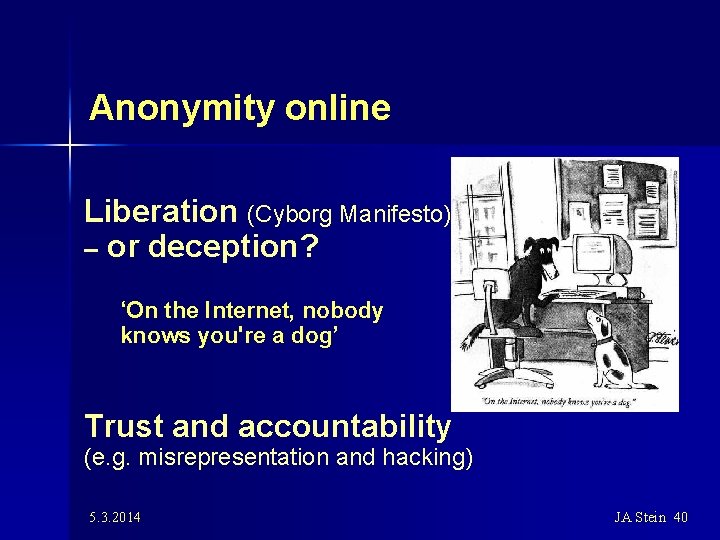
Anonymity online Liberation (Cyborg Manifesto) – or deception? ‘On the Internet, nobody knows you're a dog’ Trust and accountability (e. g. misrepresentation and hacking) 5. 3. 2014 JA Stein 40
Identity in the virtual world n Personal, social and legal identity n Aliases n Constructed identities n Digital effigies 5. 3. 2014 JA Stein 41
Security: a highly emotive topic n Technological security (PETs) n Identity theft, impersonation and fraud n Surveillance and “counterterrorism” n Psychological and sociological origins (“existential insecurity”; “risk society”) 5. 3. 2014 JA Stein 42
Confidentiality and trust n Friendship, kinship n Caring professions – Medical – Social – Educational – Religious n Employment n Social contracts, social capital 5. 3. 2014 JA Stein 43
Evolution of virtual society n Communities – Personal / family / diaspora – Occupational / professional – Interest group n Organisations and institutions 5. 3. 2014 – e-government – e-commerce JA Stein 44
The social regulation of the virtual world n Regulating human behaviour – Individual – Institutional – Social n Social values of the Internet – Development of expectations of identity in a postmodern medium – Confidence in secure transactions (financial, personal) – Anarchy, communism (Linux, open source software, 5. 3. 2014 freeware) JA Stein 45
Secrecy and governance in the virtual world n Technological approaches are insufficient n Formal and informal approaches to the governance of the www n Social norms differ according to national, religious, ethnic and other distinctive features of various societies – including online 5. 3. 2014 JA Stein 46
Promoting an ethical approach and the problem of moral philosophy n Internet ethics is derived from Western moral philosophy, thus based on Judeao-Christian and European cultural heritage n The foundations of different ethical frameworks cannot be fully rationalised – and therefore, conceptualisations of ethical standards and approaches to governance (e. g. deontology, utilitarianism, notions of human rights etc. ) don’t lend themselves to multicultural rationalisation 5. 3. 2014 JA Stein 47
Universal ethics n Values? (worth, esteem, etc. ) – Is privacy an intrinsic social value or is it instrumental ? n Truly universal ethics are based on virtues: – Honesty and trustworthiness – Benevolence and generosity – Excellence – Courage – Honour and respect – Justice 5. 3. 2014 JA Stein 48
Virtual and virtuous ? n Honesty and trustworthiness: Wikipedia n Benevolence and generosity: on-line petitions and appeals n Excellence: peer-reviewed journals n Courage: resistance to political oppression n Honour and respect: netiquette n Justice: ? 5. 3. 2014 JA Stein 49
Virtual secrecy? n No technological solutions to social problems, but no legal solutions either n Tailoring secrecy to purpose – Protection of legitimate confidentiality in professional and business/financial world – Protection of personal privacy and dignity – Social scepticism wrt identity – education Informal and informed cooperative social promotion of on-line virtue 5. 3. 2014 JA Stein 50
Psychology of moral autonomy (Lawrence Kohlberg) n n n Preconventional level: self-benefit and the avoidance of punishment Conventional level: family, group or social norms uncritically accepted as standards of morality Postconventional level: individual recognition that right and wrong is not reducible to self-interest or social convention – autonomous individuals who think for themselves and do not assumes that customs are always right 5. 3. 2014 JA Stein 51 – seek to live by general, universal principles
Limits to rationalism n Feminist critique: “ethics of care” (Carol Gilligan) – context-dependent on maintaining personal relationships: masculine ethics based on abstract rights and rules contrasted with feminine context-oriented reasoning n Persistence of religious morality in contemporary society – empirical observation that religious experience (including conversion) is attributed to God – impossible to acquire religious belief through reasoning – fundamentalism mainly in text-based religions: no moral ambiguity -- also balanced ‘scripture, tradition and reason’ n Computer Power and Human Reason (Joseph Weizenbaum) – Decision vs. choice 5. 3. 2014 – Judgement, compassion and wisdom JA Stein 52
Moral Heuristics n n Is it honourable? Is there anyone from whom we would like to hide the action? Is it honest? Does it violate any agreement, actual or implied, or otherwise betray a trust? Does it avoid the possibility of conflict of interest? Are there other considerations that might bias your judgement? n Is it within your area of competence? Is it possible that your best effort will not be adequate? n Is it fair? Is it detrimental to the legitimate interests of others? n Is it considerate? Will it violate confidentiality or privacy, or otherwise harm anyone or anything? n Is it conservative? Does it unnecessarily squander time 5. 3. 2014 JA Stein 53 or otherwise valuable resources? n
Example: Ethical analysis of plagiarism n Identify and list as many different forms of plagiarism as possible n Select four of the most egregious forms of plagiarism n What are the main ethical issues? n Identify the stakeholders n What ethical principles apply? n What formal guidelines apply? n What are the long-term implications, including prevention strategies? 5. 3. 2014 JA Stein 54
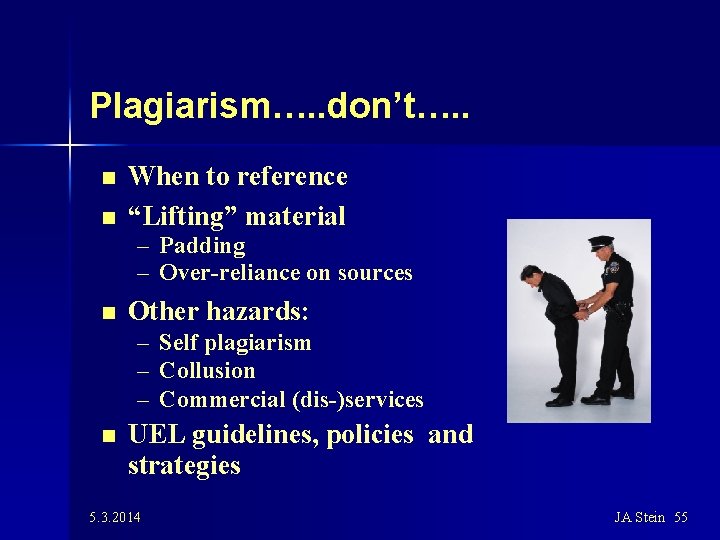
Plagiarism…. . don’t…. . n n When to reference “Lifting” material – Padding – Over-reliance on sources n Other hazards: – Self plagiarism – Collusion – Commercial (dis-)services n UEL guidelines, policies and strategies 5. 3. 2014 JA Stein 55
- Slides: 55