
INTRODUCTION TO CURRENT TRANSFORMER PERFORMANCE ANALYSIS Hands on


- Slides: 75
INTRODUCTION TO CURRENT TRANSFORMER PERFORMANCE ANALYSIS Hands on workshop developed for field relay techs practical approach
Yellow Brick Road • • • INTRODUCTION DEFINITIONS PERFORMANCE CALCULATIONS RATIO SELECTION CONSIDERATIONS VARIOUS TOPICS TEST
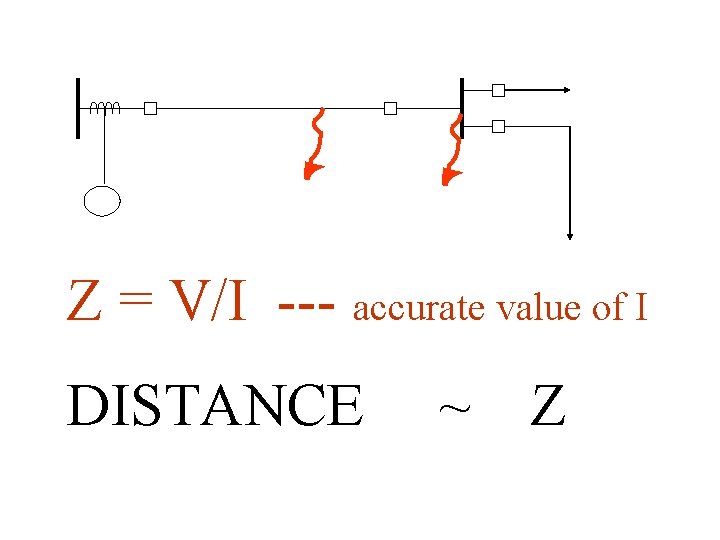
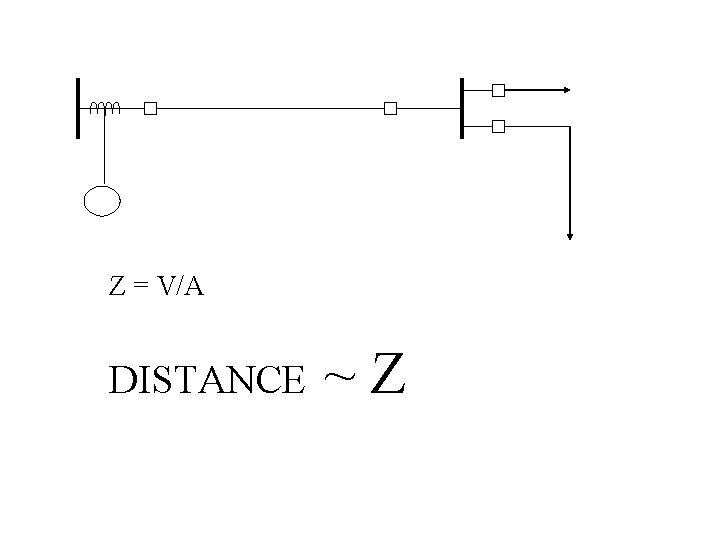
Z = V/I --- accurate value of I DISTANCE ~ Z
INTRODUCTION • IEEE Standard Requirements for Instrument Transformers C 57. 13 • IEEE Guide for the Application of Current Transformers Used for Protective Relaying Purposes C 37. 110
INTRODUCTION • Bushing, internal to Breakers and Transformers • Free standing, used with live tank breakers. • Slipover, mounted externally on breaker/transformers bushings. • Window or Bar - single primary turn • Wound Primary • Optic
MAGNETO-OPTIC CT • Light polarization passing through an optically active material in the presence of a magnetic field. • Passive sensor at line voltage is connected to substation equipment by fiber cable. • Low energy output used for microprocessor relays • Eliminates heavy support for iron.
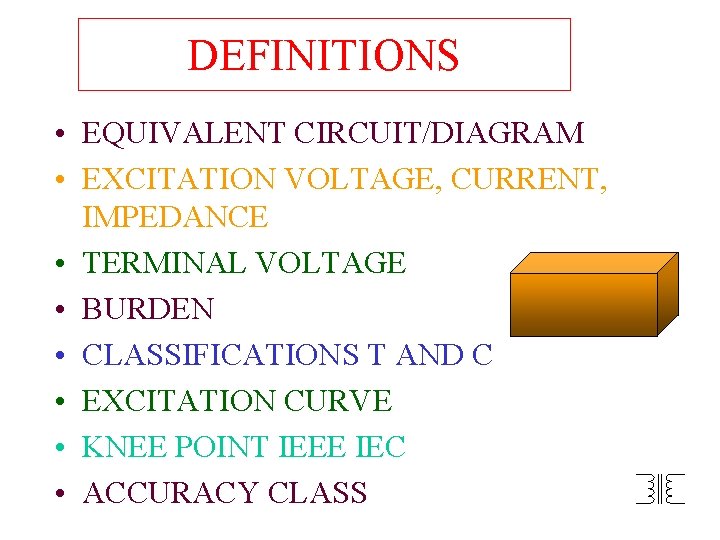
DEFINITIONS • EXCITATION CURVE • EXCITATION VOLTAGE • EXCITATION CURRENT • EXCITATION IMPEDANCE
DEFINITIONS • EQUIVALENT CIRCUIT/DIAGRAM • POLARITY • BURDEN • TERMINAL VOLTAGE • CLASSIFICATIONS T AND C
DEFINITIONS • KNEE POINT • RELAY ACCURACY CLASS • MULTI-TAPS ACCURACY • SATURATION ERROR - RATIO/ANGLE
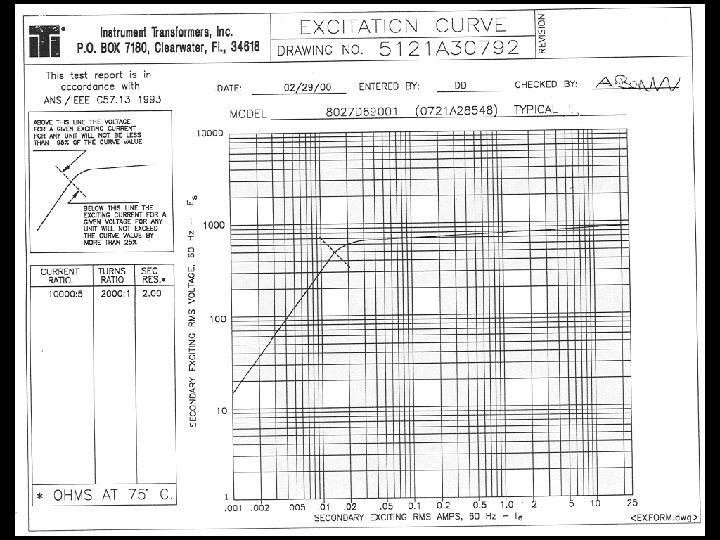
EXCITATION CURVE
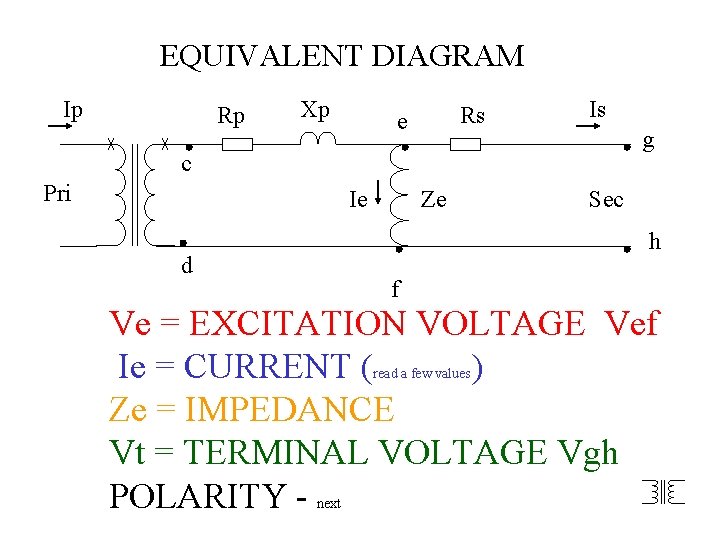
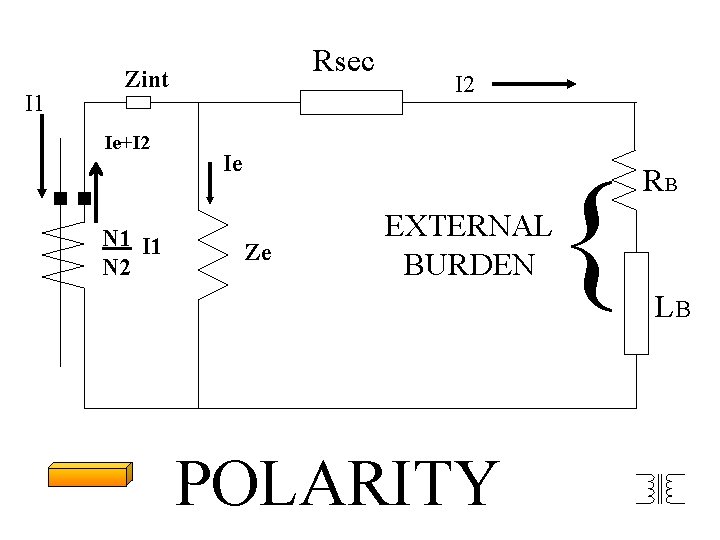
EQUIVALENT DIAGRAM Ip Rp Xp Rs e Is g c Pri Ie Ze Sec h d f Ve = EXCITATION VOLTAGE Vef Ie = CURRENT ( ) Ze = IMPEDANCE Vt = TERMINAL VOLTAGE Vgh POLARITY read a few values next
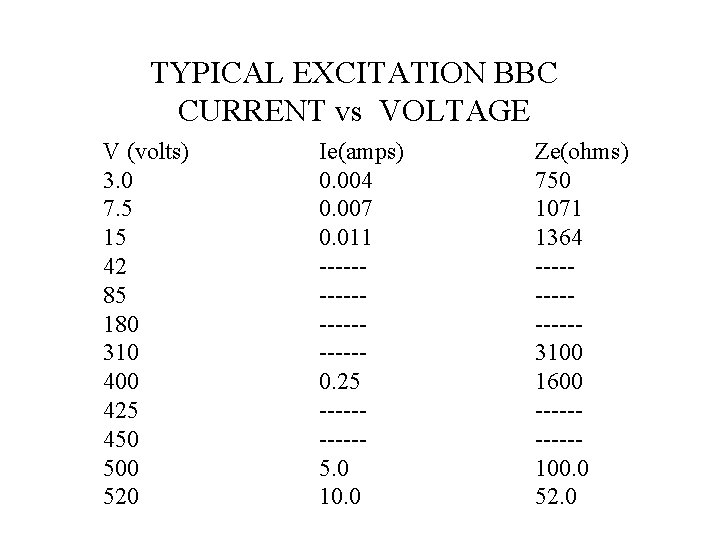
TYPICAL EXCITATION BBC CURRENT vs VOLTAGE V (volts) 3. 0 7. 5 15 42 85 180 310 400 425 450 500 520 Ie(amps) 0. 004 0. 007 0. 011 ----------0. 25 -----5. 0 10. 0 Ze(ohms) 750 1071 1364 -------3100 1600 -----100. 0 52. 0
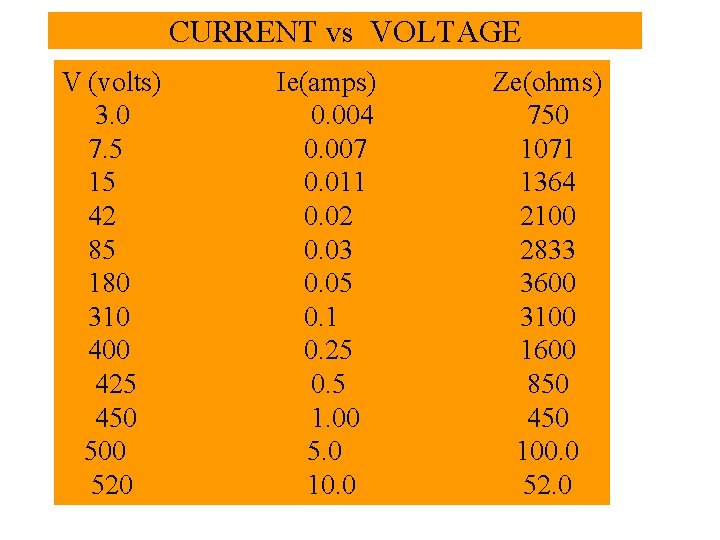
CURRENT vs VOLTAGE V (volts) 3. 0 7. 5 15 42 85 180 310 400 425 450 500 520 Ie(amps) 0. 004 0. 007 0. 011 0. 02 0. 03 0. 05 0. 1 0. 25 0. 5 1. 00 5. 0 10. 0 Ze(ohms) 750 1071 1364 2100 2833 3600 3100 1600 850 450 100. 0 52. 0
I 1 Rsec Zint Ie+I 2 N 1 I 1 N 2 Ie Ze { RB EXTERNAL BURDEN POLARITY LB
DEFINITIONS • • • EXCITATION CURVE EXCITATION VOLTAGE EXCITATION CURRENT EXCITATION IMPEDANCE EQUIVALENT CIRCUIT/DIAGRAM BURDEN - NEXT
BURDEN • The impedances of loads are called BURDEN • Individual devices or total connected load, including sec impedance of instrument transformer. • For devices burden expressed in VA at specified current or voltage, the burden impedance Zb is: • Zb = VA/Ix. I or Vx. V/VA
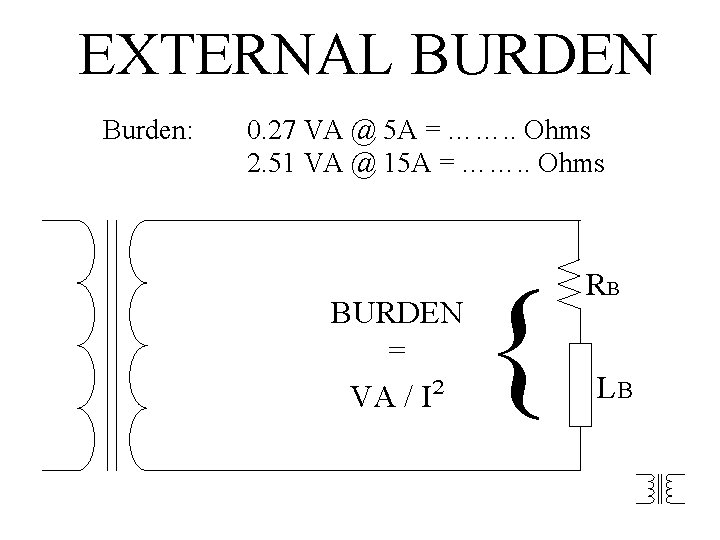
EXTERNAL BURDEN Burden: 0. 27 VA @ 5 A = ……. . Ohms 2. 51 VA @ 15 A = ……. . Ohms BURDEN = VA / I² { RB LB
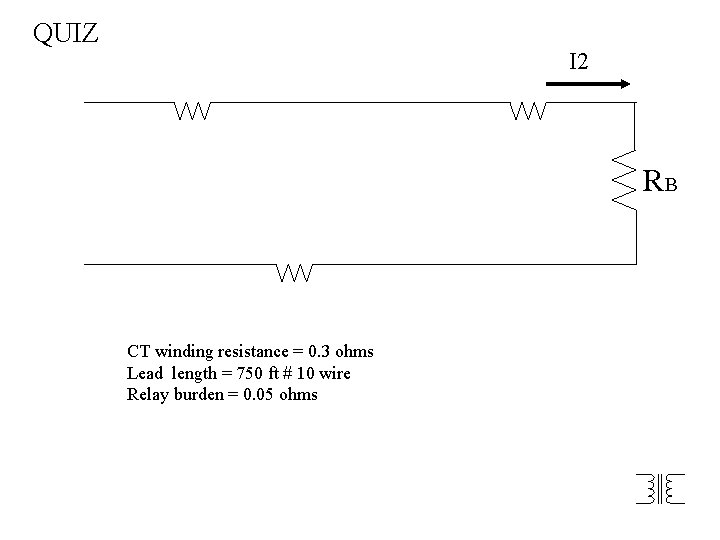
QUIZ I 2 RB CT winding resistance = 0. 3 ohms Lead length = 750 ft # 10 wire Relay burden = 0. 05 ohms
DEFINITIONS • CLASSIFICATIONS T AND C
ANSI/IEEE STANDARD FOR CLASSIFICATION T & C • CLASS T: CTs that have significant leakage flux within the transformer core - class T; wound CTs, with one or more primarywinding turns mechanically encircling the core. Performance determined by test.
CLASS C • CTs with very minimal leakage flux in the core, such as the through, bar, and bushing types. Performance can be calculated. KNEE POINT
DEFINITIONS • KNEE POINT IEEE IEC - effective saturation point • Quiz- read a few knee point voltages and also at 10 amps Ie.
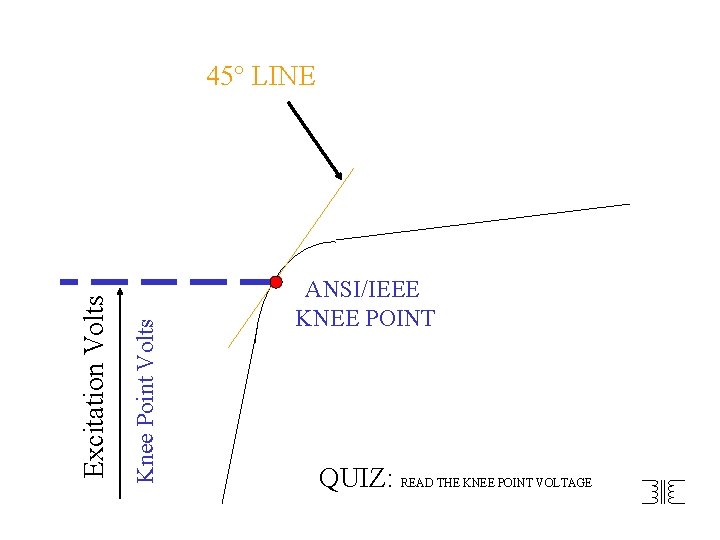
Knee Point Volts Excitation Volts 45° LINE ANSI/IEEE KNEE POINT QUIZ: READ THE KNEE POINT VOLTAGE
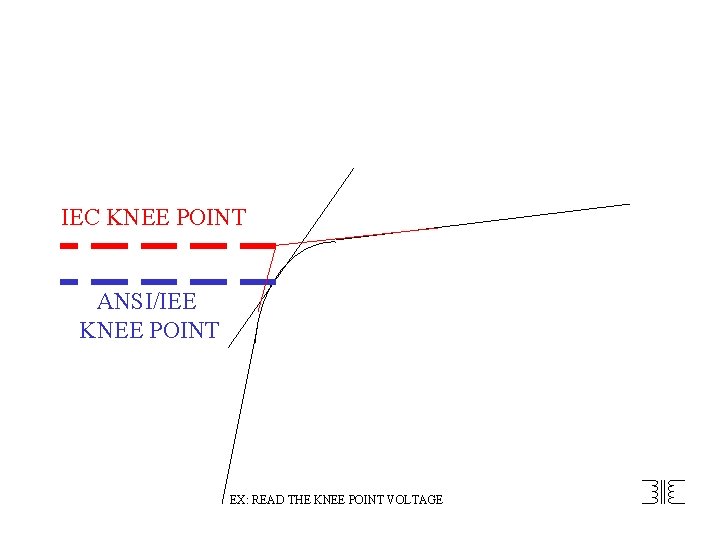
KNEE POINT OR EFFECTIVE POINT OF SATURATION • ANSI/IEEE: as the intersection of the curve with a 45 tangent line • IEC defines the knee point as the intersection of straight lines extended from non saturated and saturated parts of the excitation curve. • IEC knee is higher than ANSI - ANSI more conservative.
IEC KNEE POINT ANSI/IEE KNEE POINT EX: READ THE KNEE POINT VOLTAGE
DEFINITIONS • EQUIVALENT CIRCUIT/DIAGRAM • EXCITATION VOLTAGE, CURRENT, IMPEDANCE • TERMINAL VOLTAGE • BURDEN • CLASSIFICATIONS T AND C • EXCITATION CURVE • KNEE POINT IEEE IEC • ACCURACY CLASS
CT ACCURACY CLASSIFICATION The measure of a CT performance is its ability to reproduce accurately the primary current in secondary amperes both is wave shape and in magnitude. There are two parts: • Performance on symmetrical ac component. • Performance on offset dc component. Go over the paper
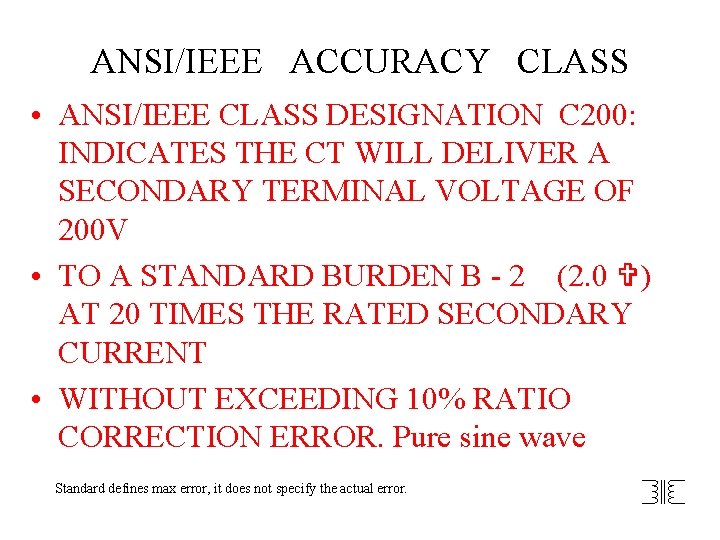
ANSI/IEEE ACCURACY CLASS • ANSI/IEEE CLASS DESIGNATION C 200: INDICATES THE CT WILL DELIVER A SECONDARY TERMINAL VOLTAGE OF 200 V • TO A STANDARD BURDEN B - 2 (2. 0 ) AT 20 TIMES THE RATED SECONDARY CURRENT • WITHOUT EXCEEDING 10% RATIO CORRECTION ERROR. Pure sine wave Standard defines max error, it does not specify the actual error.
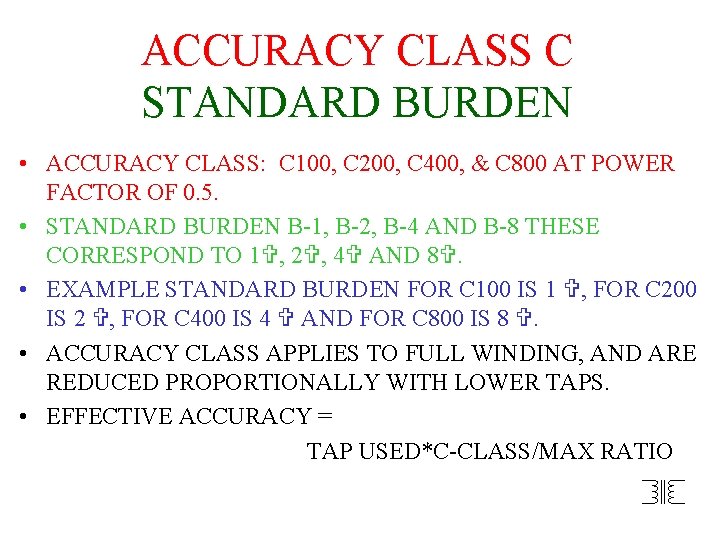
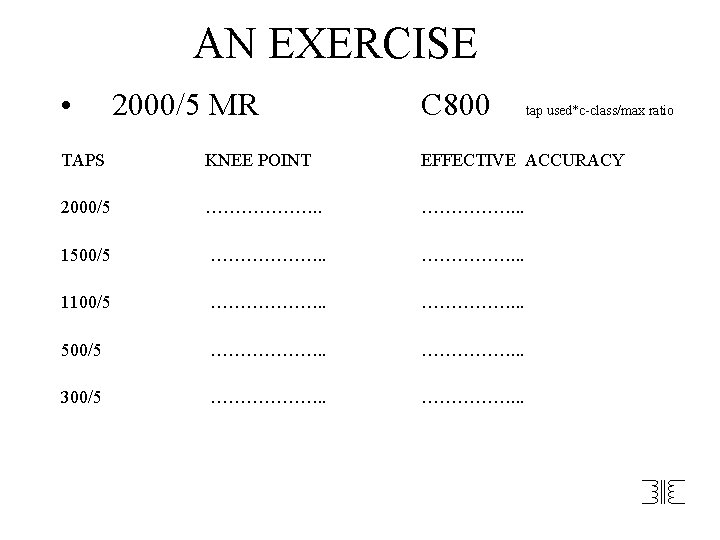
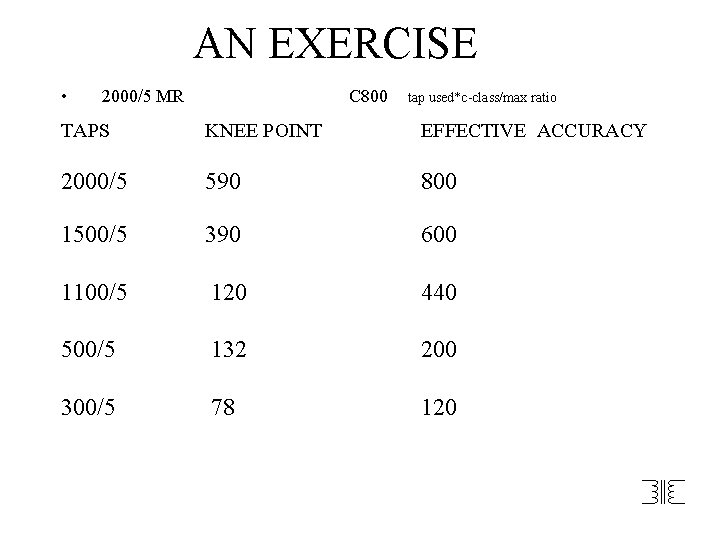
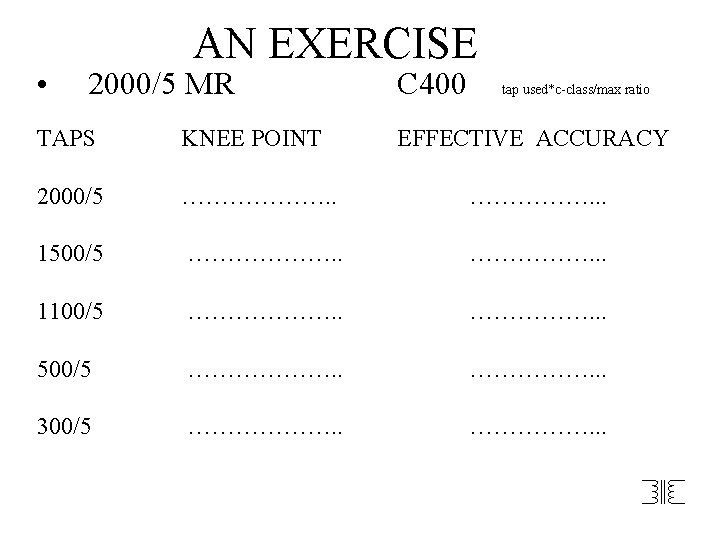
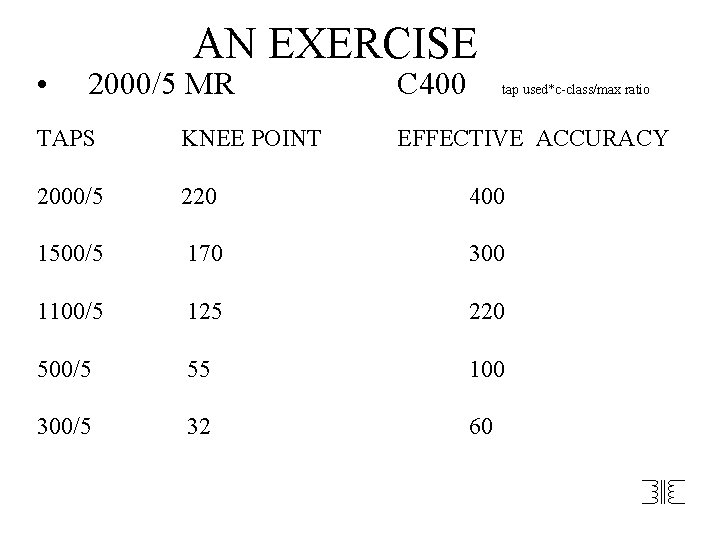
ACCURACY CLASS C STANDARD BURDEN • ACCURACY CLASS: C 100, C 200, C 400, & C 800 AT POWER FACTOR OF 0. 5. • STANDARD BURDEN B-1, B-2, B-4 AND B-8 THESE CORRESPOND TO 1 , 2 , 4 AND 8. • EXAMPLE STANDARD BURDEN FOR C 100 IS 1 , FOR C 200 IS 2 , FOR C 400 IS 4 AND FOR C 800 IS 8 . • ACCURACY CLASS APPLIES TO FULL WINDING, AND ARE REDUCED PROPORTIONALLY WITH LOWER TAPS. • EFFECTIVE ACCURACY = TAP USED*C-CLASS/MAX RATIO
AN EXERCISE • 2000/5 MR C 800 tap used*c-class/max ratio TAPS KNEE POINT EFFECTIVE ACCURACY 2000/5 ………………. . . 1500/5 ………………. . . 1100/5 ………………. . . 500/5 ………………. . . 300/5 ………………. . .
AN EXERCISE • 2000/5 MR C 800 tap used*c-class/max ratio TAPS KNEE POINT EFFECTIVE ACCURACY 2000/5 590 800 1500/5 390 600 1100/5 120 440 500/5 132 200 300/5 78 120
• AN EXERCISE 2000/5 MR C 400 tap used*c-class/max ratio TAPS KNEE POINT EFFECTIVE ACCURACY 2000/5 ………………. . . 1500/5 ………………. . . 1100/5 ………………. . . 500/5 ………………. . . 300/5 ………………. . .
• AN EXERCISE 2000/5 MR C 400 tap used*c-class/max ratio TAPS KNEE POINT EFFECTIVE ACCURACY 2000/5 220 400 1500/5 170 300 1100/5 125 220 500/5 55 100 300/5 32 60
CT SELECTION ACCURACY CLASS POINT OF SATURATION : KNEE POINT IT IS DESIRABLE TO STAY BELOW OR VERY CLOSE TO KNEE POINT FOR THE AVAILABLE CURRENT. Recap
ANSI/IEEE ACCURACY CLASS C 400 • • • STANDARD BURDEN FOR C 400: (4. 0 ) SECONDARY CURRENT RATING 5 A 20 TIMES SEC CURRENT: 100 AMPS SEC. VOLTAGE DEVELOPED: 400 V MAXIMUM RATIO ERROR: 10% IF BURDEN 2 , FOR 400 V, IT CAN SUPPLY MORE THAN 100 AMPS SAY 200 AMPS WITHOUT EXCEECING 10% ERROR.
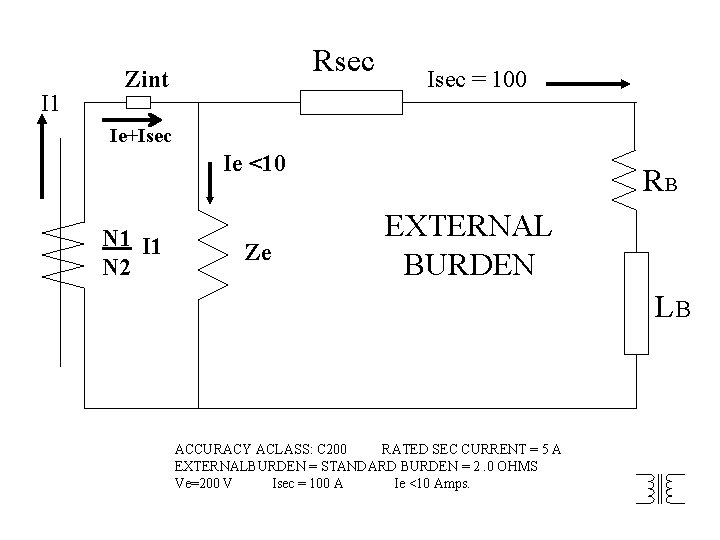
I 1 Rsec Zint Isec = 100 Ie+Isec Ie <10 N 1 I 1 N 2 Ze RB EXTERNAL BURDEN LB ACCURACY ACLASS: C 200 RATED SEC CURRENT = 5 A EXTERNALBURDEN = STANDARD BURDEN = 2. 0 OHMS Ve=200 V Isec = 100 A Ie <10 Amps.
PERFORMANCE CALCULATIONS
BUT THE REST OF US “SHOW US THE DATA”
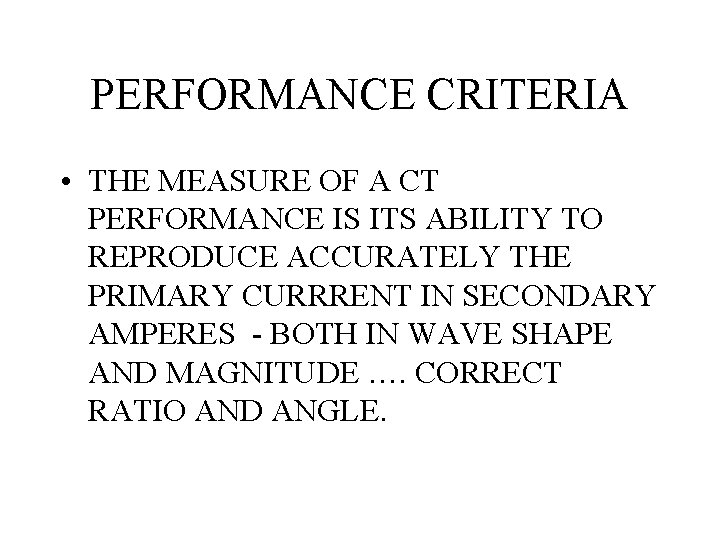
PERFORMANCE CRITERIA • THE MEASURE OF A CT PERFORMANCE IS ITS ABILITY TO REPRODUCE ACCURATELY THE PRIMARY CURRRENT IN SECONDARY AMPERES - BOTH IN WAVE SHAPE AND MAGNITUDE …. CORRECT RATIO AND ANGLE.
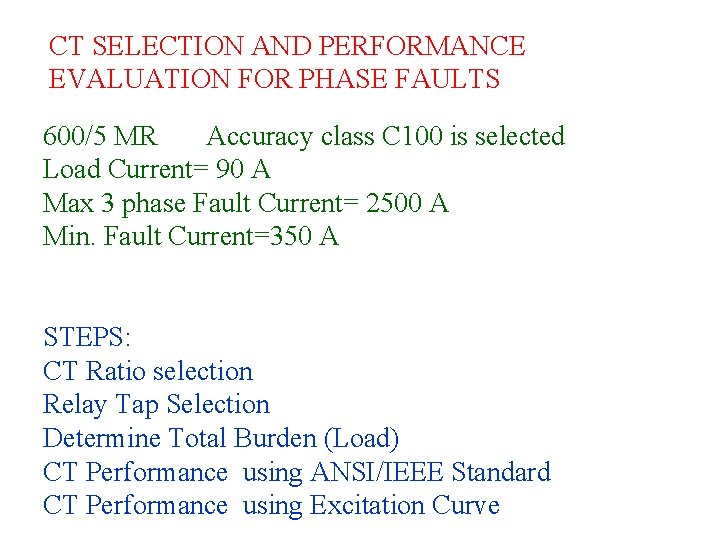
CT SELECTION AND PERFORMANCE EVALUATION FOR PHASE FAULTS 600/5 MR Accuracy class C 100 is selected Load Current= 90 A Max 3 phase Fault Current= 2500 A Min. Fault Current=350 A STEPS: CT Ratio selection Relay Tap Selection Determine Total Burden (Load) CT Performance using ANSI/IEEE Standard CT Performance using Excitation Curve
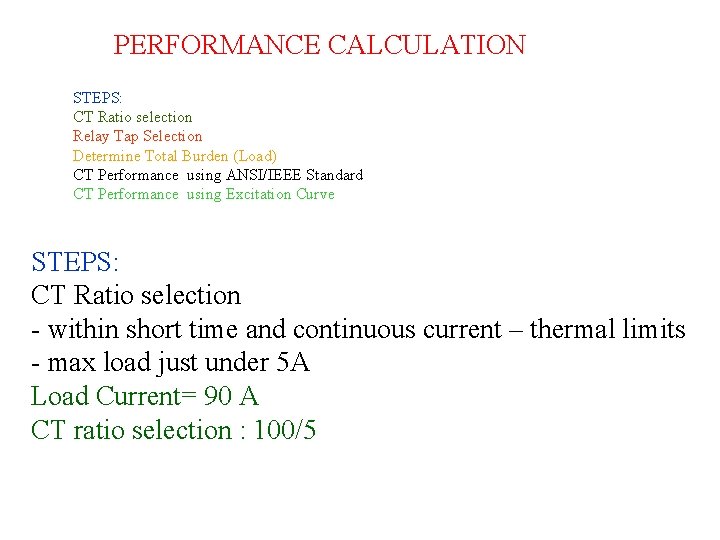
PERFORMANCE CALCULATION STEPS: CT Ratio selection Relay Tap Selection Determine Total Burden (Load) CT Performance using ANSI/IEEE Standard CT Performance using Excitation Curve STEPS: CT Ratio selection - within short time and continuous current – thermal limits - max load just under 5 A Load Current= 90 A CT ratio selection : 100/5
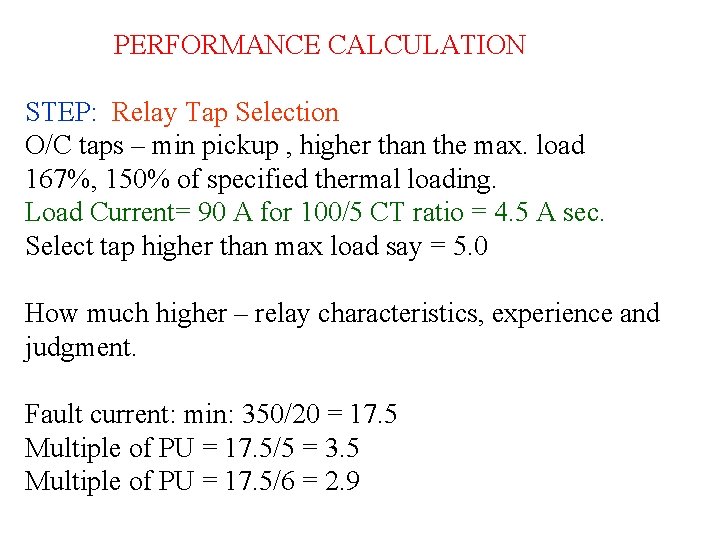
PERFORMANCE CALCULATION STEP: Relay Tap Selection O/C taps – min pickup , higher than the max. load 167%, 150% of specified thermal loading. Load Current= 90 A for 100/5 CT ratio = 4. 5 A sec. Select tap higher than max load say = 5. 0 How much higher – relay characteristics, experience and judgment. Fault current: min: 350/20 = 17. 5 Multiple of PU = 17. 5/5 = 3. 5 Multiple of PU = 17. 5/6 = 2. 9
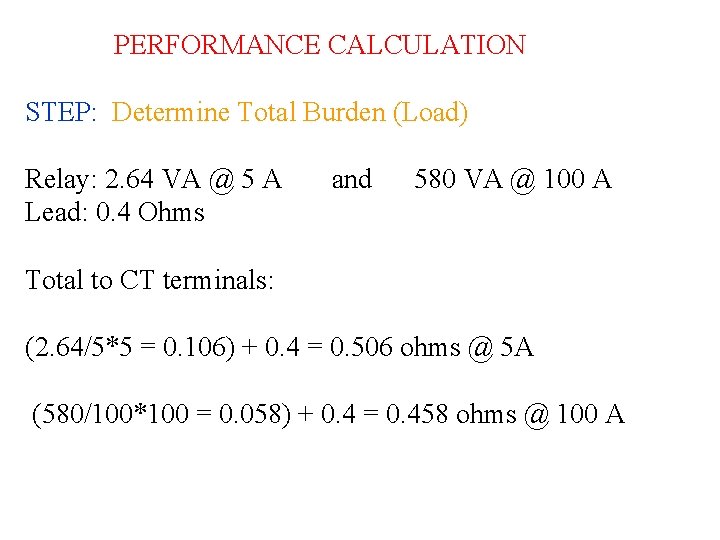
PERFORMANCE CALCULATION STEP: Determine Total Burden (Load) Relay: 2. 64 VA @ 5 A Lead: 0. 4 Ohms and 580 VA @ 100 A Total to CT terminals: (2. 64/5*5 = 0. 106) + 0. 4 = 0. 506 ohms @ 5 A (580/100*100 = 0. 058) + 0. 4 = 0. 458 ohms @ 100 A
PERFORMANCE CALCULATION STEPS: CT Ratio selection Relay Tap Selection Determine Total Burden (Load) CT Performance using ANSI/IEEE Standard CT Performance using Excitation Curve
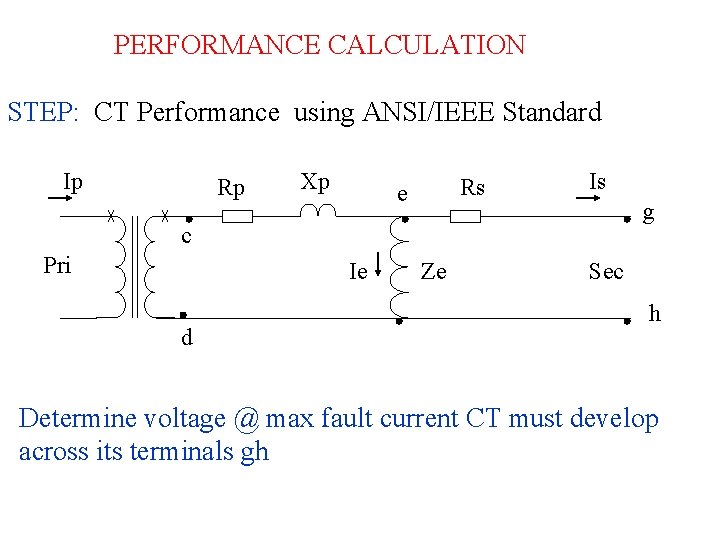
PERFORMANCE CALCULATION STEP: CT Performance using ANSI/IEEE Standard Ip Rp Xp Rs e Is g c Pri Ie d Ze Sec h Determine voltage @ max fault current CT must develop across its terminals gh
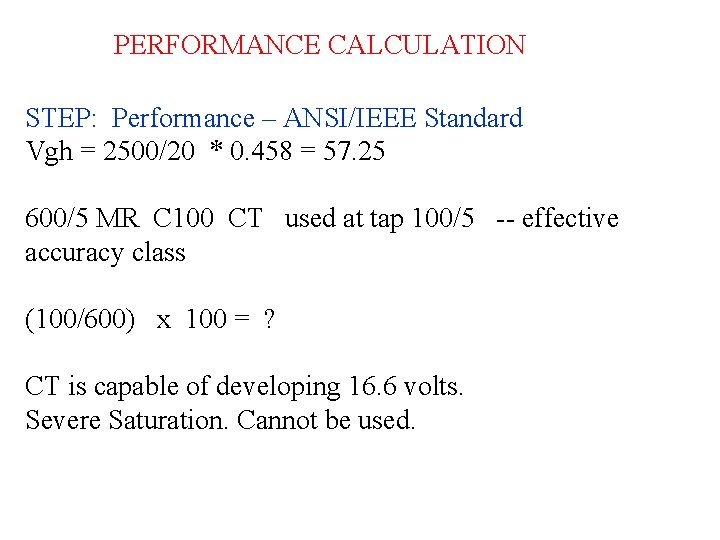
PERFORMANCE CALCULATION STEP: Performance – ANSI/IEEE Standard Vgh = 2500/20 * 0. 458 = 57. 25 600/5 MR C 100 CT used at tap 100/5 -- effective accuracy class (100/600) x 100 = ? CT is capable of developing 16. 6 volts. Severe Saturation. Cannot be used.
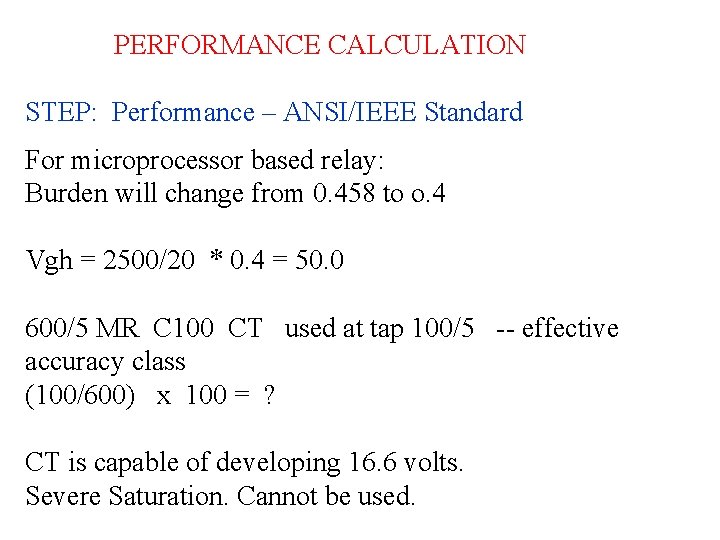
PERFORMANCE CALCULATION STEP: Performance – ANSI/IEEE Standard For microprocessor based relay: Burden will change from 0. 458 to o. 4 Vgh = 2500/20 * 0. 4 = 50. 0 600/5 MR C 100 CT used at tap 100/5 -- effective accuracy class (100/600) x 100 = ? CT is capable of developing 16. 6 volts. Severe Saturation. Cannot be used.
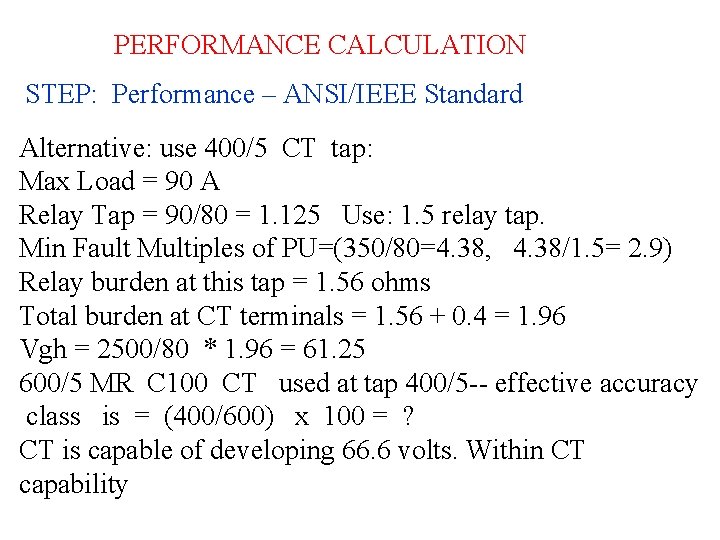
PERFORMANCE CALCULATION STEP: Performance – ANSI/IEEE Standard Alternative: use 400/5 CT tap: Max Load = 90 A Relay Tap = 90/80 = 1. 125 Use: 1. 5 relay tap. Min Fault Multiples of PU=(350/80=4. 38, 4. 38/1. 5= 2. 9) Relay burden at this tap = 1. 56 ohms Total burden at CT terminals = 1. 56 + 0. 4 = 1. 96 Vgh = 2500/80 * 1. 96 = 61. 25 600/5 MR C 100 CT used at tap 400/5 -- effective accuracy class is = (400/600) x 100 = ? CT is capable of developing 66. 6 volts. Within CT capability
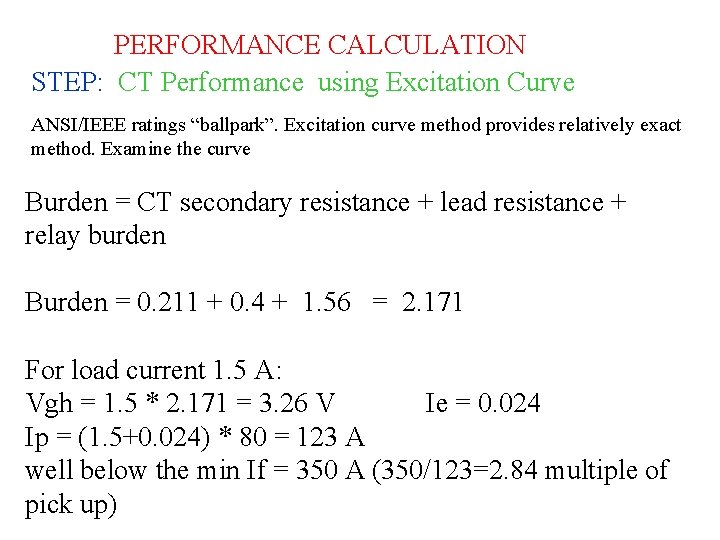
PERFORMANCE CALCULATION STEP: CT Performance using Excitation Curve ANSI/IEEE ratings “ballpark”. Excitation curve method provides relatively exact method. Examine the curve Burden = CT secondary resistance + lead resistance + relay burden Burden = 0. 211 + 0. 4 + 1. 56 = 2. 171 For load current 1. 5 A: Vgh = 1. 5 * 2. 171 = 3. 26 V Ie = 0. 024 Ip = (1. 5+0. 024) * 80 = 123 A well below the min If = 350 A (350/123=2. 84 multiple of pick up)
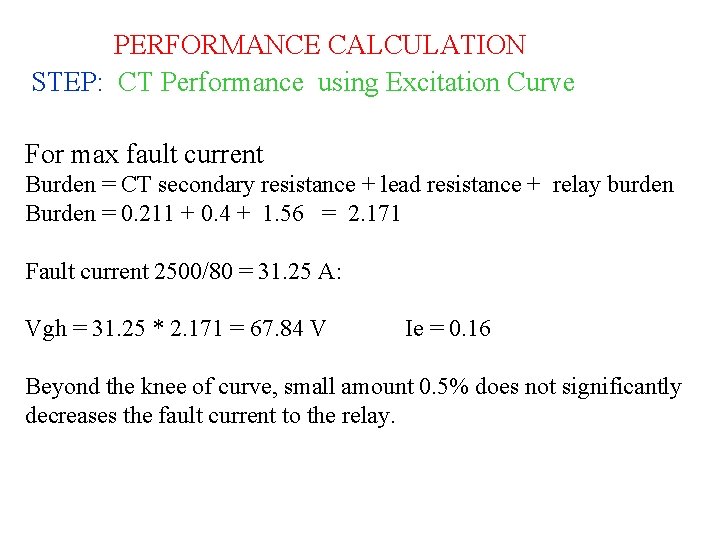
PERFORMANCE CALCULATION STEP: CT Performance using Excitation Curve For max fault current Burden = CT secondary resistance + lead resistance + relay burden Burden = 0. 211 + 0. 4 + 1. 56 = 2. 171 Fault current 2500/80 = 31. 25 A: Vgh = 31. 25 * 2. 171 = 67. 84 V Ie = 0. 16 Beyond the knee of curve, small amount 0. 5% does not significantly decreases the fault current to the relay.
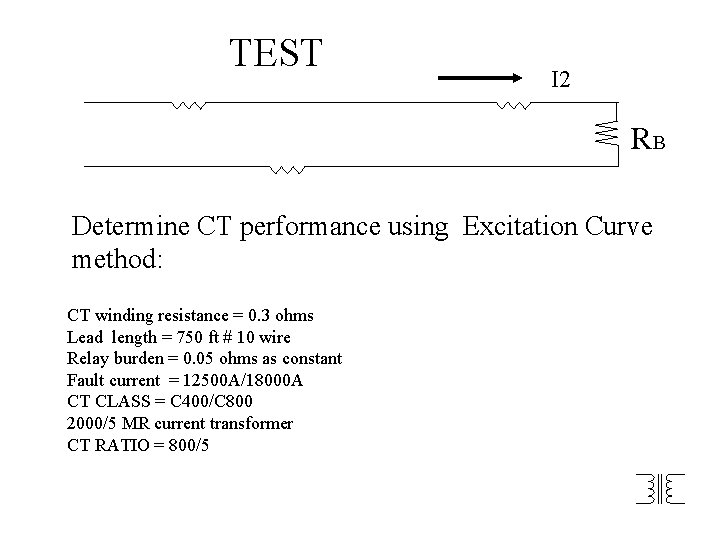
TEST I 2 RB Determine CT performance using Excitation Curve method: CT winding resistance = 0. 3 ohms Lead length = 750 ft # 10 wire Relay burden = 0. 05 ohms as constant Fault current = 12500 A/18000 A CT CLASS = C 400/C 800 2000/5 MR current transformer CT RATIO = 800/5
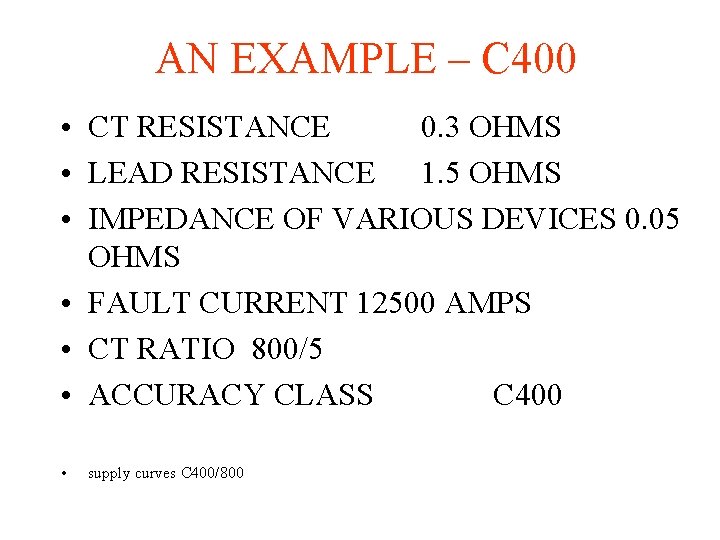
AN EXAMPLE – C 400 • CT RESISTANCE 0. 3 OHMS • LEAD RESISTANCE 1. 5 OHMS • IMPEDANCE OF VARIOUS DEVICES 0. 05 OHMS • FAULT CURRENT 12500 AMPS • CT RATIO 800/5 • ACCURACY CLASS C 400 • supply curves C 400/800
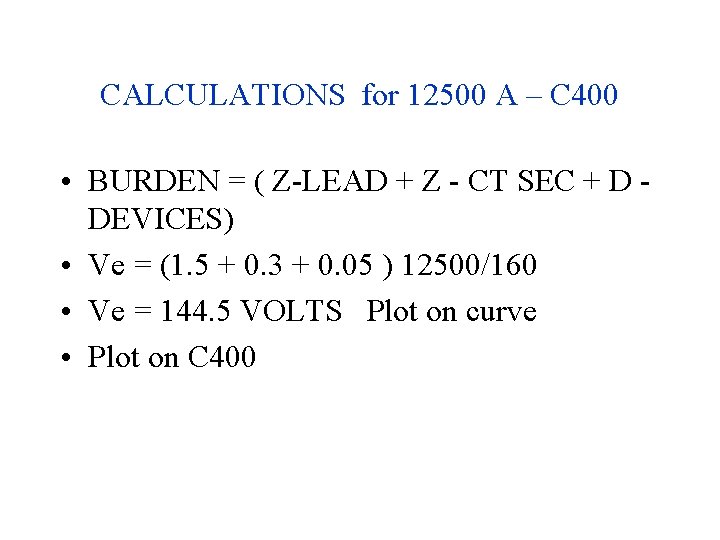
CALCULATIONS for 12500 A – C 400 • BURDEN = ( Z-LEAD + Z - CT SEC + D DEVICES) • Ve = (1. 5 + 0. 3 + 0. 05 ) 12500/160 • Ve = 144. 5 VOLTS Plot on curve • Plot on C 400
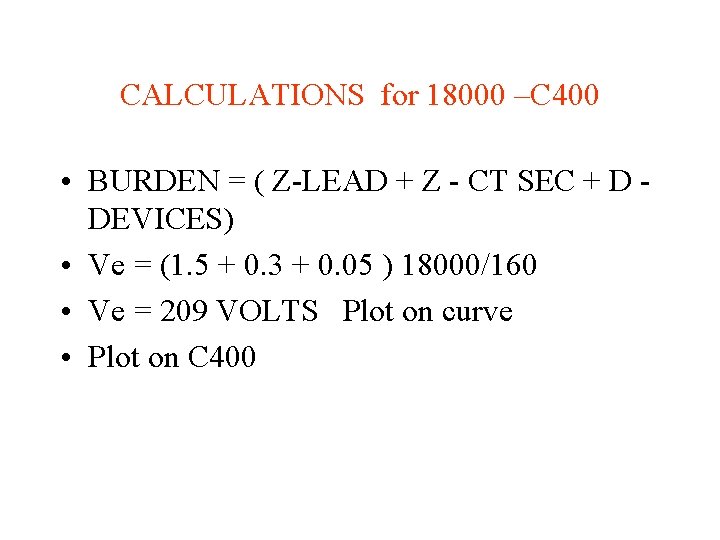
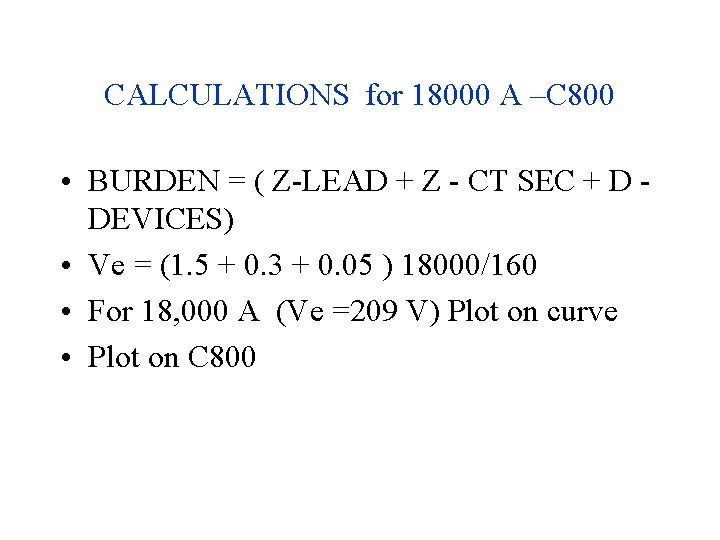
CALCULATIONS for 18000 –C 400 • BURDEN = ( Z-LEAD + Z - CT SEC + D DEVICES) • Ve = (1. 5 + 0. 3 + 0. 05 ) 18000/160 • Ve = 209 VOLTS Plot on curve • Plot on C 400
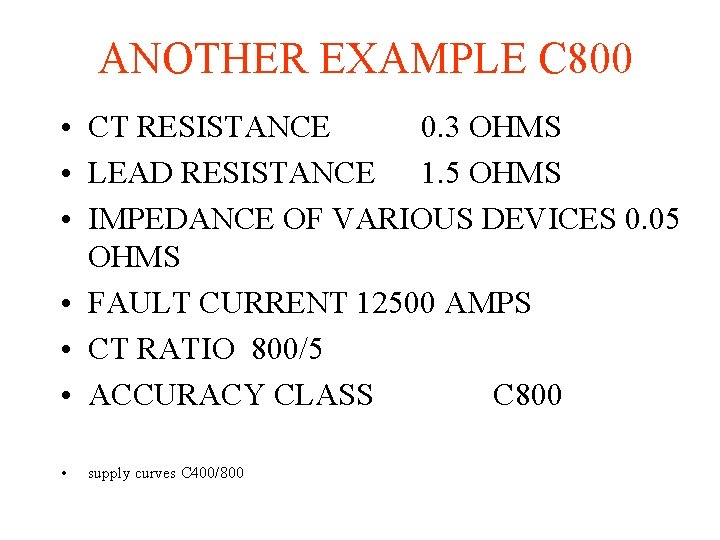
ANOTHER EXAMPLE C 800 • CT RESISTANCE 0. 3 OHMS • LEAD RESISTANCE 1. 5 OHMS • IMPEDANCE OF VARIOUS DEVICES 0. 05 OHMS • FAULT CURRENT 12500 AMPS • CT RATIO 800/5 • ACCURACY CLASS C 800 • supply curves C 400/800
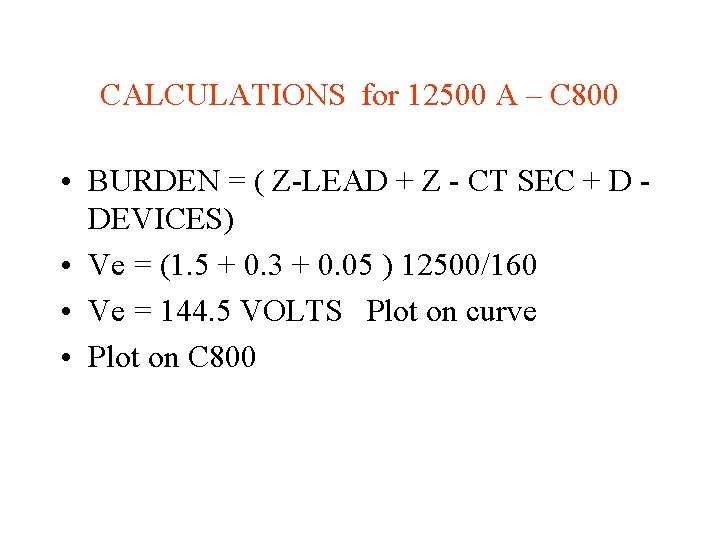
CALCULATIONS for 12500 A – C 800 • BURDEN = ( Z-LEAD + Z - CT SEC + D DEVICES) • Ve = (1. 5 + 0. 3 + 0. 05 ) 12500/160 • Ve = 144. 5 VOLTS Plot on curve • Plot on C 800
CALCULATIONS for 18000 A –C 800 • BURDEN = ( Z-LEAD + Z - CT SEC + D DEVICES) • Ve = (1. 5 + 0. 3 + 0. 05 ) 18000/160 • For 18, 000 A (Ve =209 V) Plot on curve • Plot on C 800
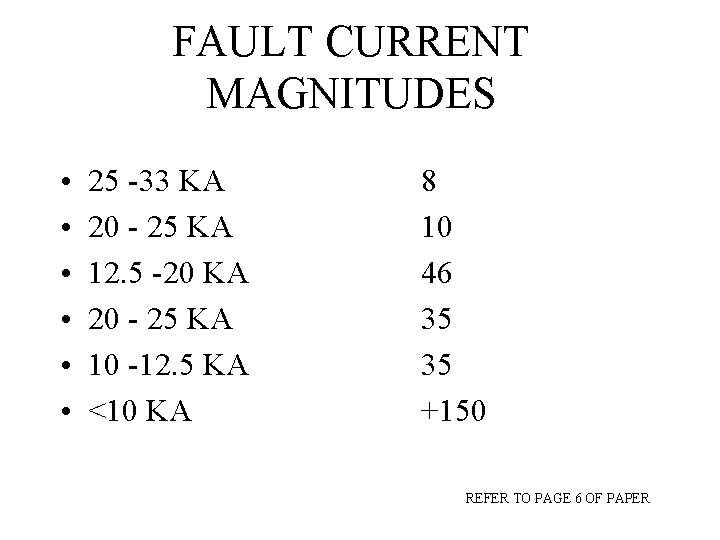
FAULT CURRENT MAGNITUDES • • • 25 -33 KA 20 - 25 KA 12. 5 -20 KA 20 - 25 KA 10 -12. 5 KA <10 KA 8 10 46 35 35 +150 REFER TO PAGE 6 OF PAPER
RED DELICIOUS C 400 ZONE 1
Z = V/A DISTANCE ~Z
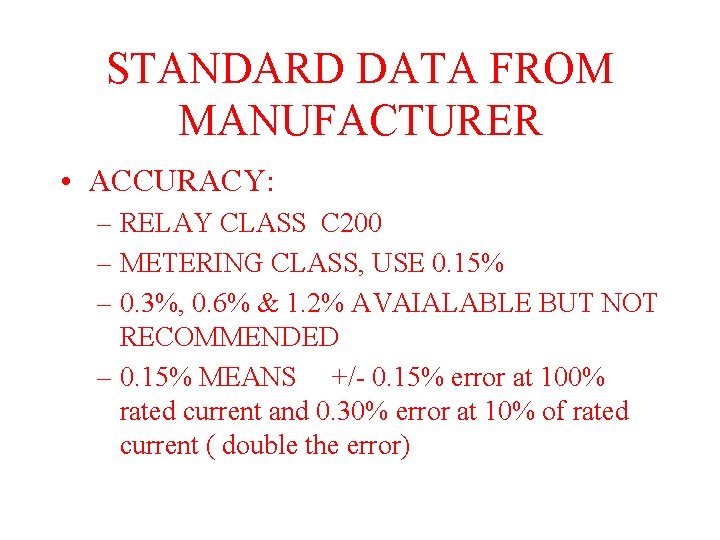
STANDARD DATA FROM MANUFACTURER • ACCURACY: – RELAY CLASS C 200 – METERING CLASS, USE 0. 15% – 0. 3%, 0. 6% & 1. 2% AVAIALABLE BUT NOT RECOMMENDED – 0. 15% MEANS +/- 0. 15% error at 100% rated current and 0. 30% error at 10% of rated current ( double the error)
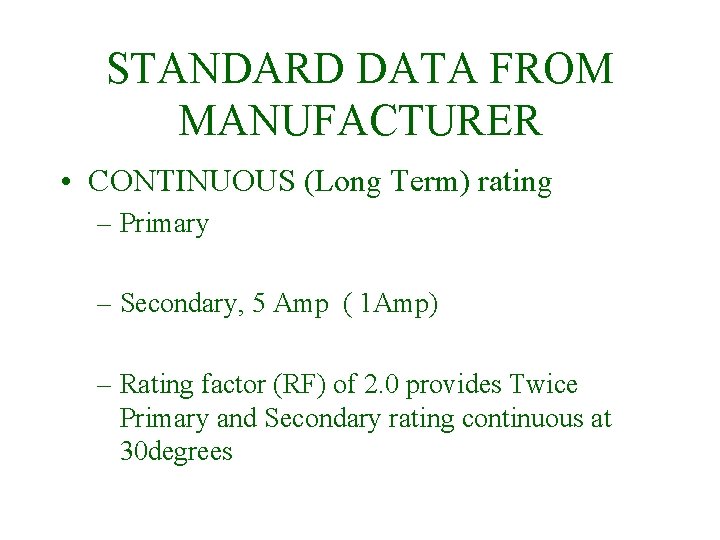
STANDARD DATA FROM MANUFACTURER • CONTINUOUS (Long Term) rating – Primary – Secondary, 5 Amp ( 1 Amp) – Rating factor (RF) of 2. 0 provides Twice Primary and Secondary rating continuous at 30 degrees
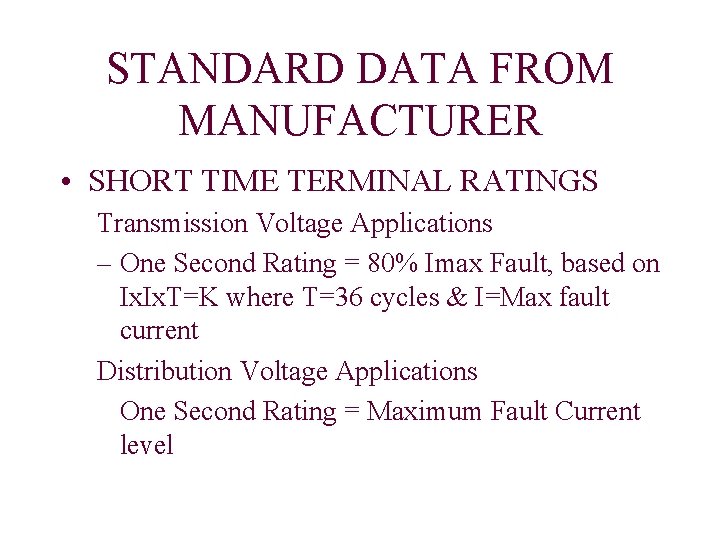
STANDARD DATA FROM MANUFACTURER • SHORT TIME TERMINAL RATINGS Transmission Voltage Applications – One Second Rating = 80% Imax Fault, based on Ix. T=K where T=36 cycles & I=Max fault current Distribution Voltage Applications One Second Rating = Maximum Fault Current level
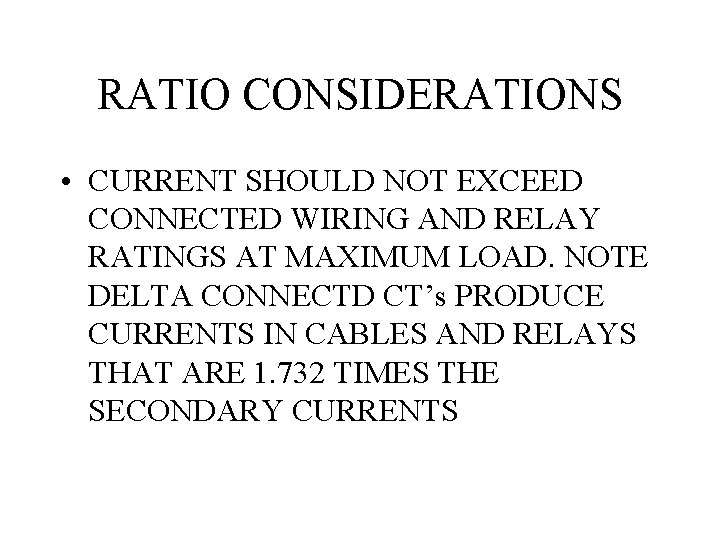
RATIO CONSIDERATIONS • CURRENT SHOULD NOT EXCEED CONNECTED WIRING AND RELAY RATINGS AT MAXIMUM LOAD. NOTE DELTA CONNECTD CT’s PRODUCE CURRENTS IN CABLES AND RELAYS THAT ARE 1. 732 TIMES THE SECONDARY CURRENTS
RATIO CONSIDERATIONS • SELECT RATIO TO BE GREATER THAN THE MAXIMUM DESIGN CURRENT RATINGS OF THE ASSOCIATED BREAKERS AND TRANSFORMERS.
RATIO CONSIDERATIONS • RATIOS SHOULD NOT BE SO HIGH AS TO REDUCE RELAY SENSITIVITY, TAKING INTO ACCOUNT AVAILABLE RANGES.
RATIO CONSIDERATIONS • THE MAXIMUM SECONDARY CURRENT SHOULD NOT EXCEED 20 TIMES RATED CURRENT. (100 A FOR 5 A RATED SECONDARY)
RATIO CONSIDERATIONS • HIGHEST CT RATIO PERMISSIBLE SHOULD BE USED TO MINIMIZE WIRING BURDEN AND TO OBTAIN THE HIGHEST CT CAPABILITY AND PERFORMANCE.
RATIO CONSIDERATIONS • FULL WINGING OF MULTI-RATIO CT’s SHOULD BE SELECTED WHENEVER POSSIBLE TO AVOID LOWERING OF THE EFFECTIVE ACCURACY CLASS.
TESTING • Core Demagnetizing – The core should be demagnetized as the final test before the equipment is put in service. Using the Saturation test circuit, apply enough voltage to the secondary of the CT to saturate the core and produce a cecondary currrent of 35 amps. Slowly reduce the voltage to zero before turning off the variac.
TESTING • Saturation – The saturation point is reached when there is a rise in the test current but not the voltage.
TESTING • Flashing • This test checks the polarity of the CT • Ratio • Insulation test