
Introduction to Cryptography Based on William Stallings Cryptography
Introduction to Cryptography Based on: William Stallings, Cryptography and Network Securityy
Chapter 4 Basic Concepts in Number Theory and Finite Fields
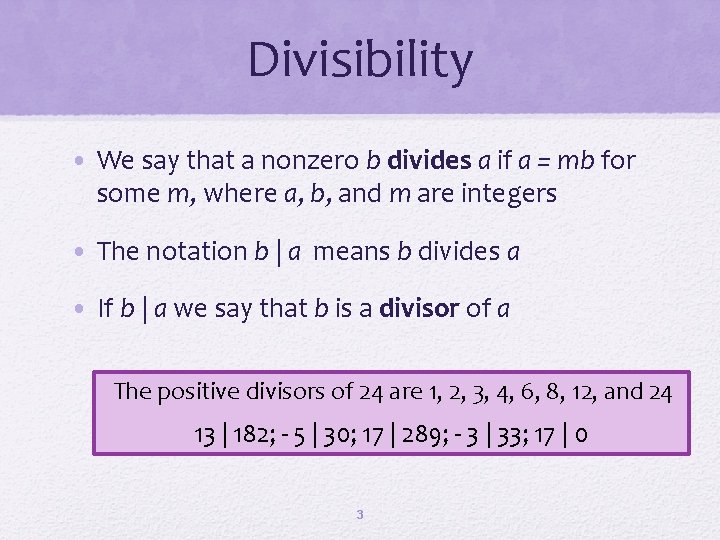
Divisibility • We say that a nonzero b divides a if a = mb for some m, where a, b, and m are integers • The notation b | a means b divides a • If b | a we say that b is a divisor of a The positive divisors of 24 are 1, 2, 3, 4, 6, 8, 12, and 24 13 | 182; - 5 | 30; 17 | 289; - 3 | 33; 17 | 0 3
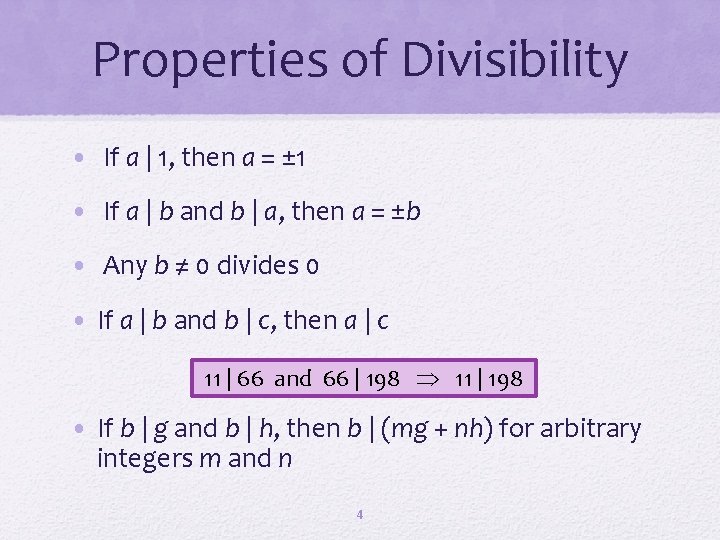
Properties of Divisibility • If a | 1, then a = ± 1 • If a | b and b | a, then a = ±b • Any b ≠ 0 divides 0 • If a | b and b | c, then a | c 11 | 66 and 66 | 198 11 | 198 • If b | g and b | h, then b | (mg + nh) for arbitrary integers m and n 4
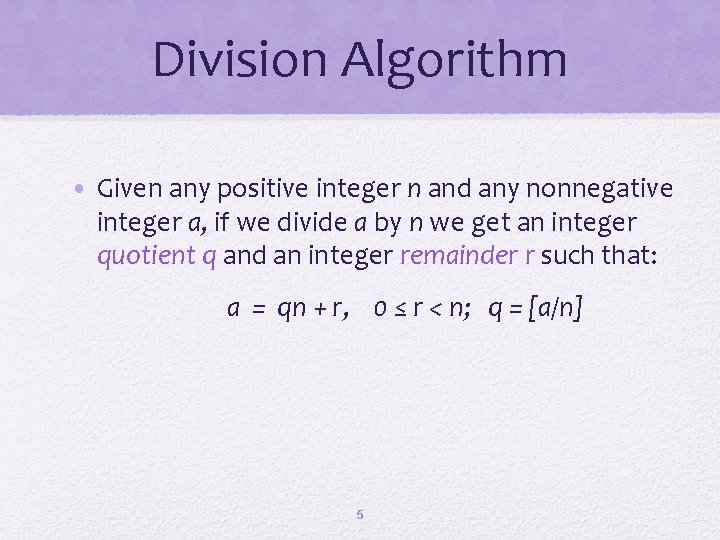
Division Algorithm • Given any positive integer n and any nonnegative integer a, if we divide a by n we get an integer quotient q and an integer remainder r such that: a = qn + r, 0 ≤ r < n; q = [a/n] 5
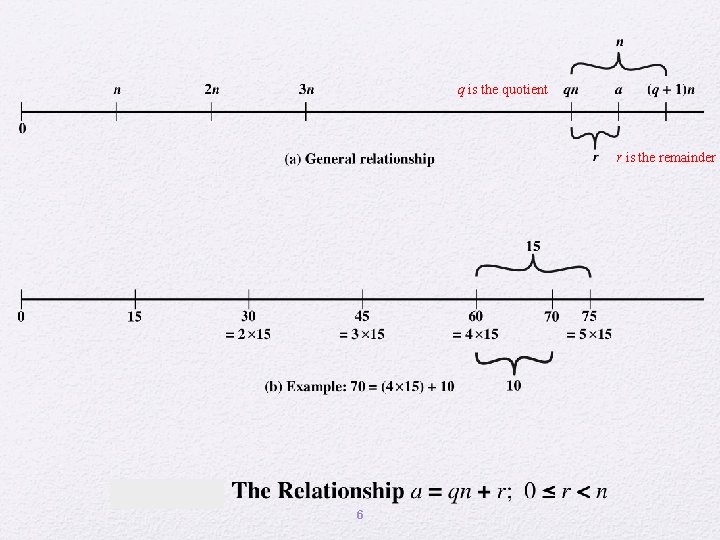
q is the quotient r is the remainder 6
• Procedure to determine the greatest common divisor of two positive integers Euclidean Algorithm • Two integers are relatively prime if their only common positive integer factor is 1 7
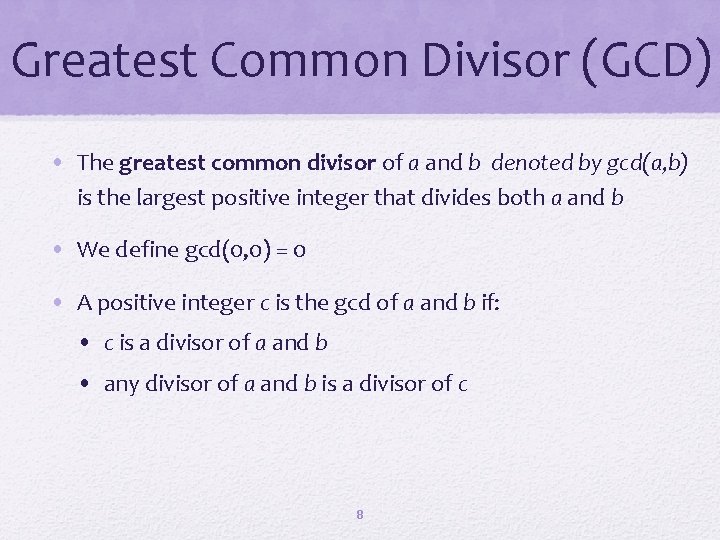
Greatest Common Divisor (GCD) • The greatest common divisor of a and b denoted by gcd(a, b) is the largest positive integer that divides both a and b • We define gcd(0, 0) = 0 • A positive integer c is the gcd of a and b if: • c is a divisor of a and b • any divisor of a and b is a divisor of c 8

GCD • Because the gcd positive, gcd(a, b) = gcd(a, -b) = gcd(-a, -b) gcd(60, 24) = gcd(60, - 24) = 12 • Also, gcd(a, 0) = | a | • Integers a and b are relatively prime if gcd(a, b) = 1 8 and 15 are relatively prime because: • the positive divisors of 8 are 1, 2, 4, and 8, and • the positive divisors of 15 are 1, 3, 5, and 15. 9

Euclidean Algorithm Example Find the greatest common divisor of a = 1160718174 and b = 316258250 10
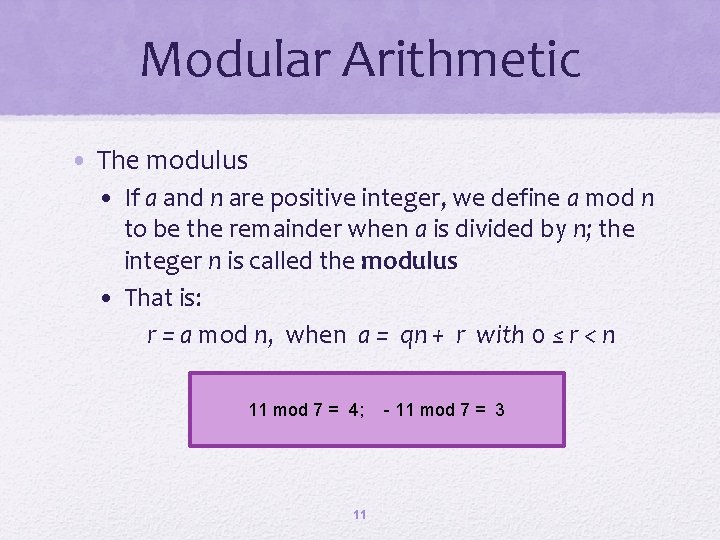
Modular Arithmetic • The modulus • If a and n are positive integer, we define a mod n to be the remainder when a is divided by n; the integer n is called the modulus • That is: r = a mod n, when a = qn + r with 0 ≤ r < n 11 mod 7 = 4; 11 - 11 mod 7 = 3

Modular Arithmetic • Congruence modulo n • Integers a and b are congruent modulo n if (a mod n) = (b mod n) • This is written as a b (mod n) 73 4 (mod 23); 21 -9 (mod 10) • N. B. a b (mod n) if n |(a – b) 12
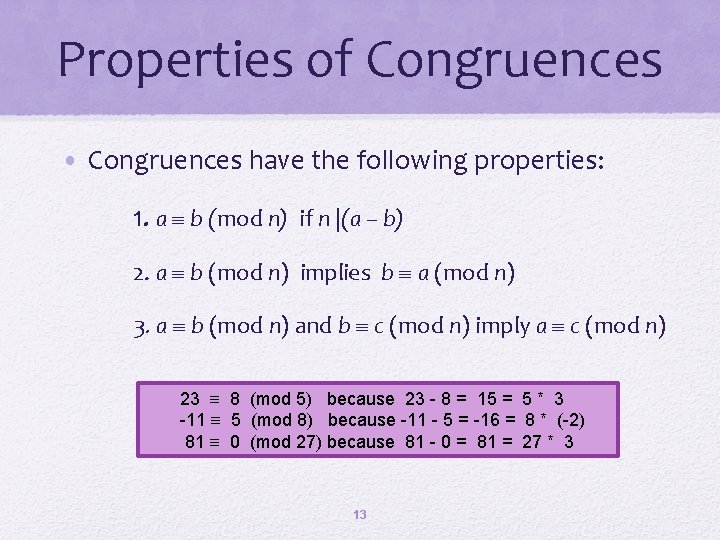
Properties of Congruences • Congruences have the following properties: 1. a b (mod n) if n |(a – b) 2. a b (mod n) implies b a (mod n) 3. a b (mod n) and b c (mod n) imply a c (mod n) 23 8 (mod 5) because 23 - 8 = 15 = 5 * 3 -11 5 (mod 8) because -11 - 5 = -16 = 8 * (-2) 81 0 (mod 27) because 81 - 0 = 81 = 27 * 3 13

14
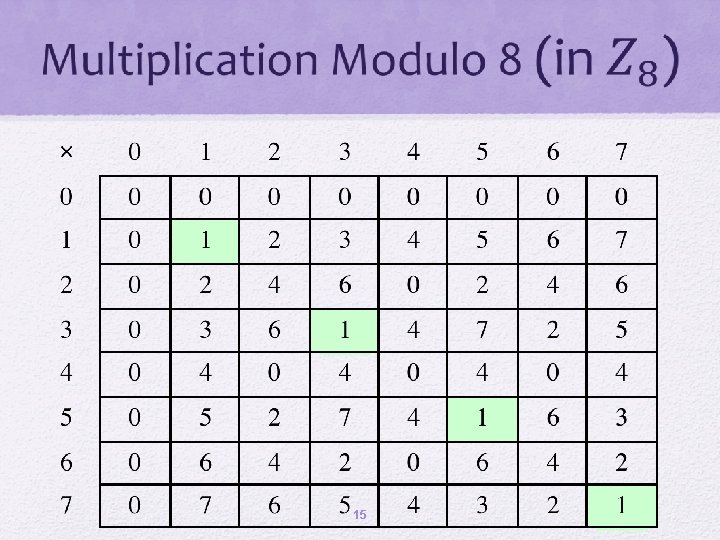
15
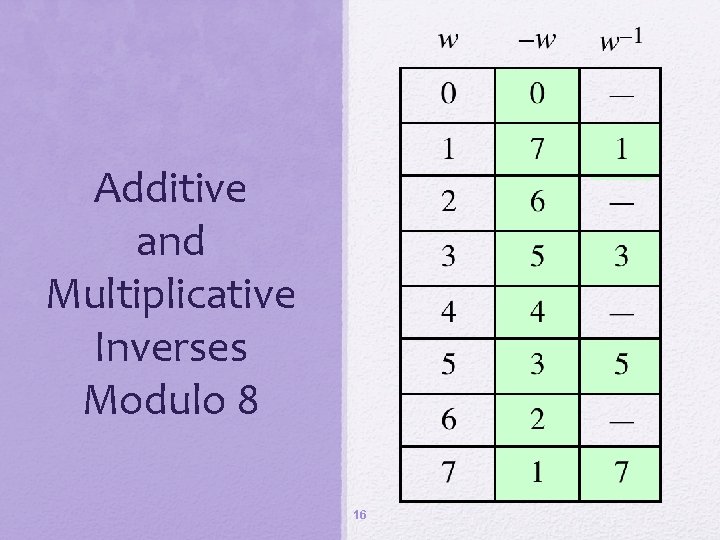
Additive and Multiplicative Inverses Modulo 8 16
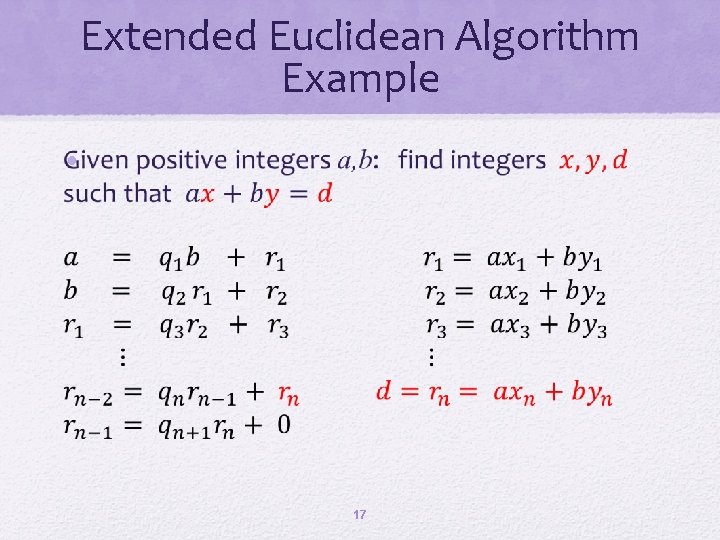
Extended Euclidean Algorithm Example • 17
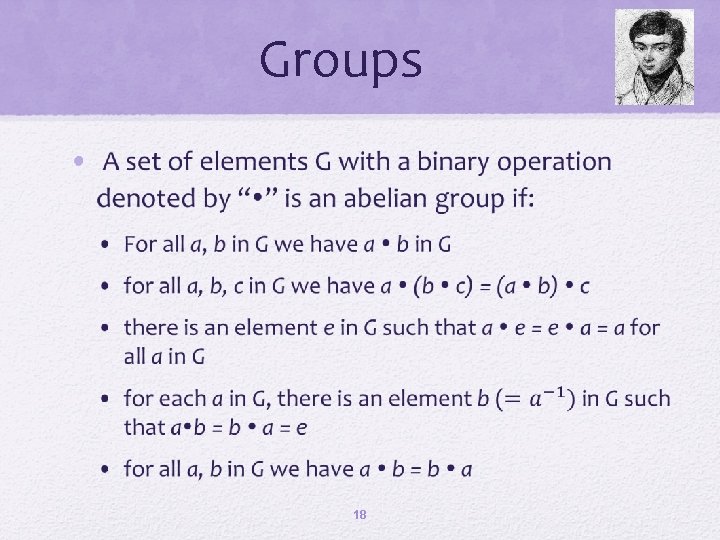
Groups • 18
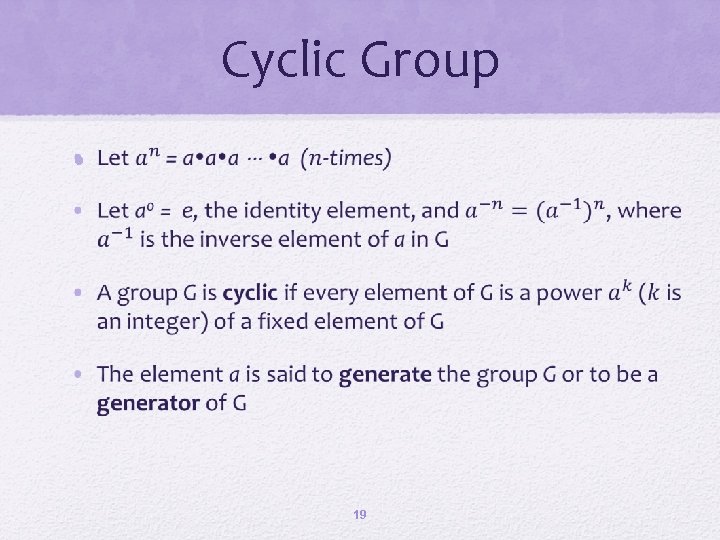
Cyclic Group • 19
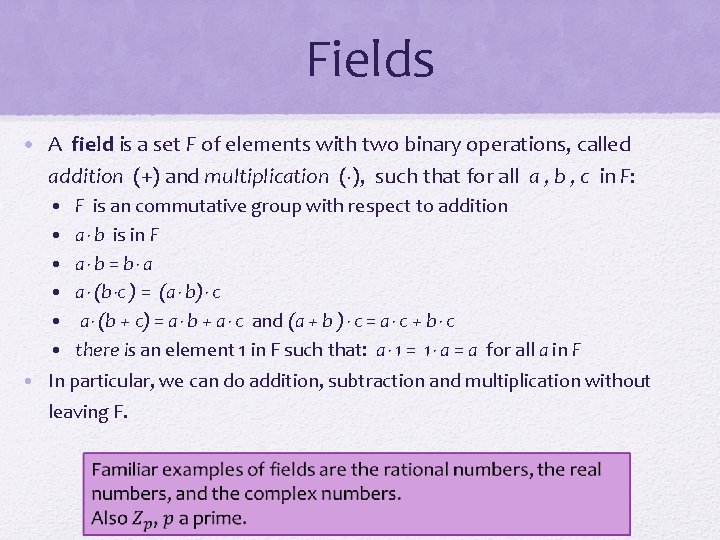
Fields • A field is a set F of elements with two binary operations, called addition (+) and multiplication ( ), such that for all a , b , c in F: • F is an commutative group with respect to addition • a b is in F • a b = b a • a (b c ) = (a b) c • a (b + c) = a b + a c and (a + b ) c = a c + b c • there is an element 1 in F such that: a 1 = 1 a = a for all a in F • In particular, we can do addition, subtraction and multiplication without leaving F. 20
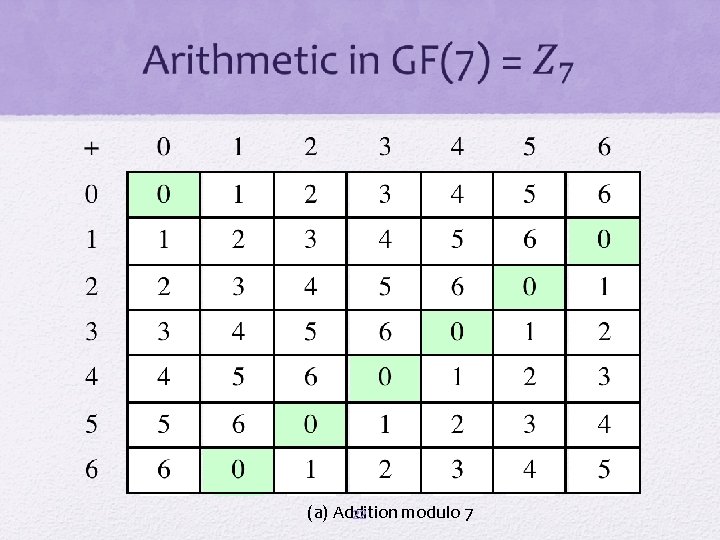
(a) Addition modulo 7 22
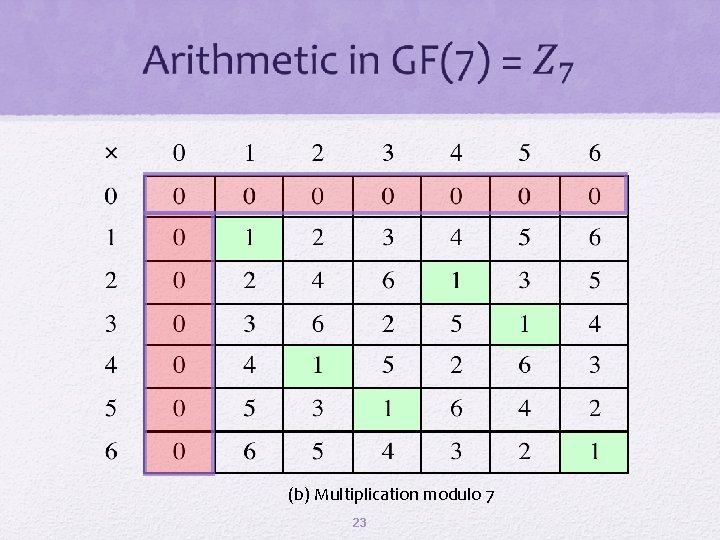
(b) Multiplication modulo 7 23
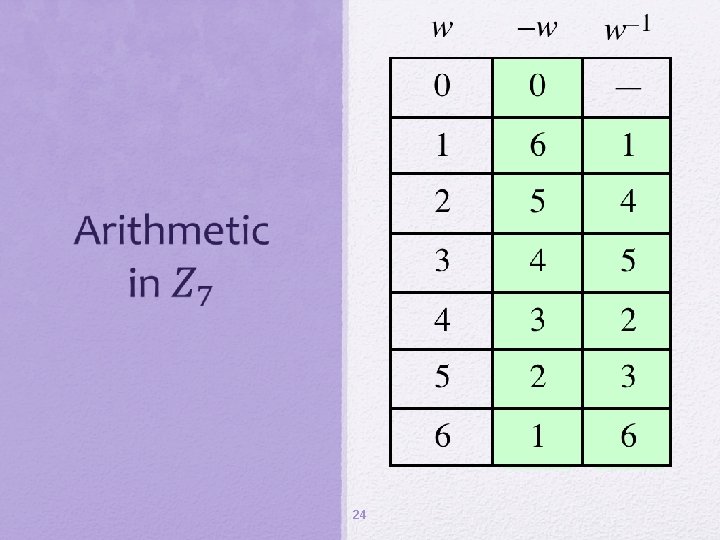
24
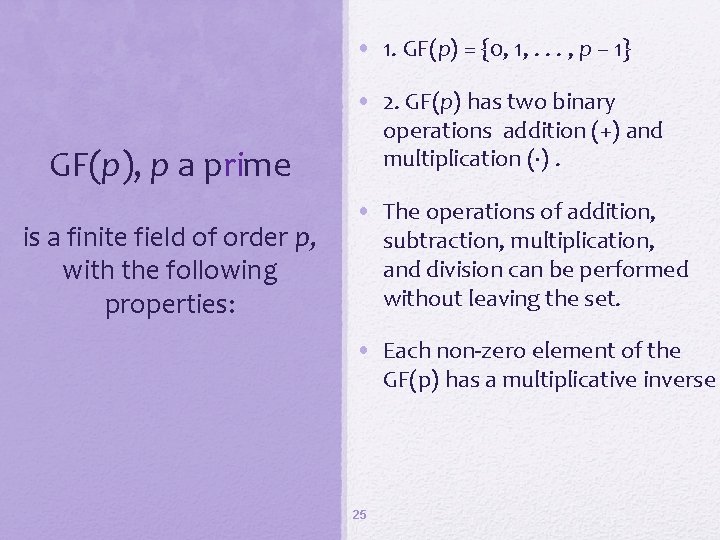
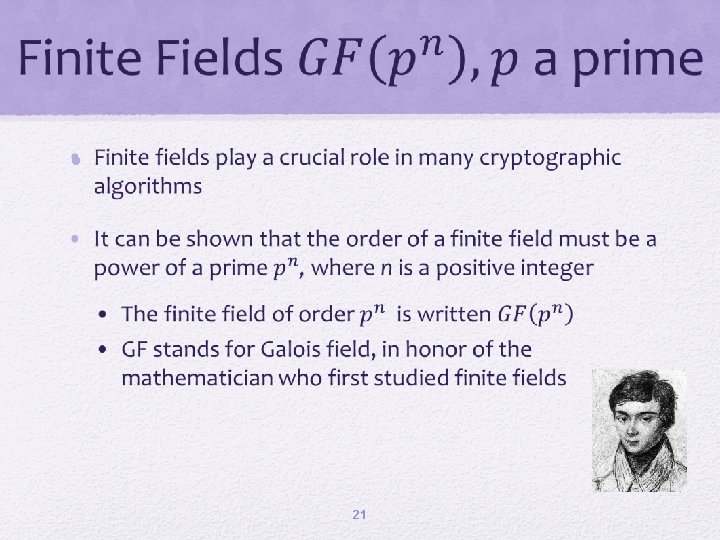
• 1. GF(p) = {0, 1, . . . , p – 1} GF(p), p a prime is a finite field of order p, with the following properties: • 2. GF(p) has two binary operations addition (+) and multiplication ( ). • The operations of addition, subtraction, multiplication, and division can be performed without leaving the set. • Each non-zero element of the GF(p) has a multiplicative inverse 25
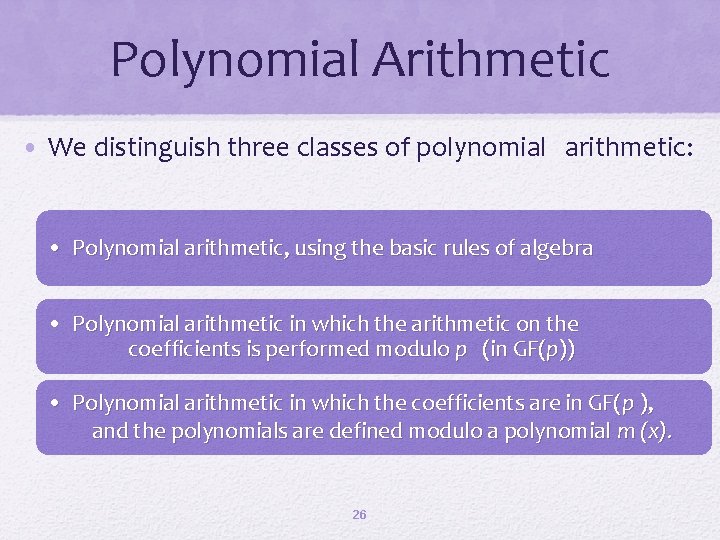
Polynomial Arithmetic • We distinguish three classes of polynomial arithmetic: • Polynomial arithmetic, using the basic rules of algebra • Polynomial arithmetic in which the arithmetic on the coefficients is performed modulo p (in GF(p)) • Polynomial arithmetic in which the coefficients are in GF( p ), and the polynomials are defined modulo a polynomial m (x). 26

Ordinary Polynomial Arithmetic
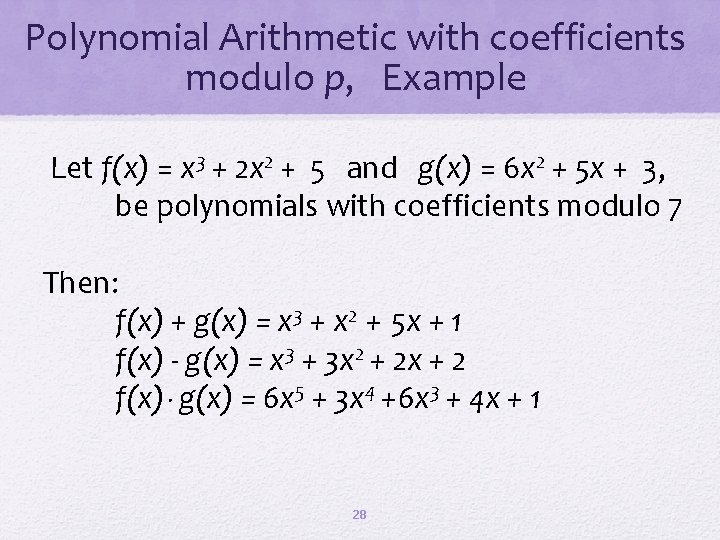
Polynomial Arithmetic with coefficients modulo p, Example Let f(x) = x 3 + 2 x 2 + 5 and g(x) = 6 x 2 + 5 x + 3, be polynomials with coefficients modulo 7 Then: f(x) + g(x) = x 3 + x 2 + 5 x + 1 f(x) - g(x) = x 3 + 3 x 2 + 2 x + 2 f(x) g(x) = 6 x 5 + 3 x 4 +6 x 3 + 4 x + 1 28
• When polynomial arithmetic is performed on polynomials over a field, modulo an “irreducible” or prime polynomial then division is possible • If we attempt to perform polynomial division over a coefficient set that is not a field, we find that division is not always defined 29
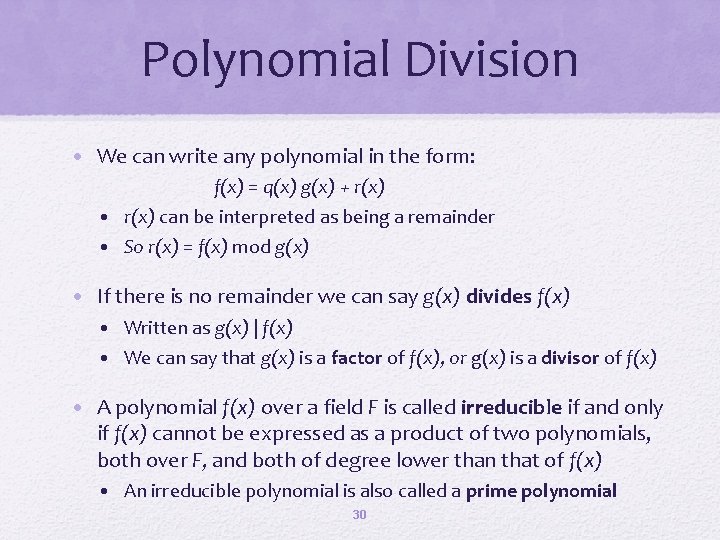
Polynomial Division • We can write any polynomial in the form: f(x) = q(x) g(x) + r(x) • r(x) can be interpreted as being a remainder • So r(x) = f(x) mod g(x) • If there is no remainder we can say g(x) divides f(x) • Written as g(x) | f(x) • We can say that g(x) is a factor of f(x), or g(x) is a divisor of f(x) • A polynomial f(x) over a field F is called irreducible if and only if f(x) cannot be expressed as a product of two polynomials, both over F, and both of degree lower than that of f(x) • An irreducible polynomial is also called a prime polynomial 30
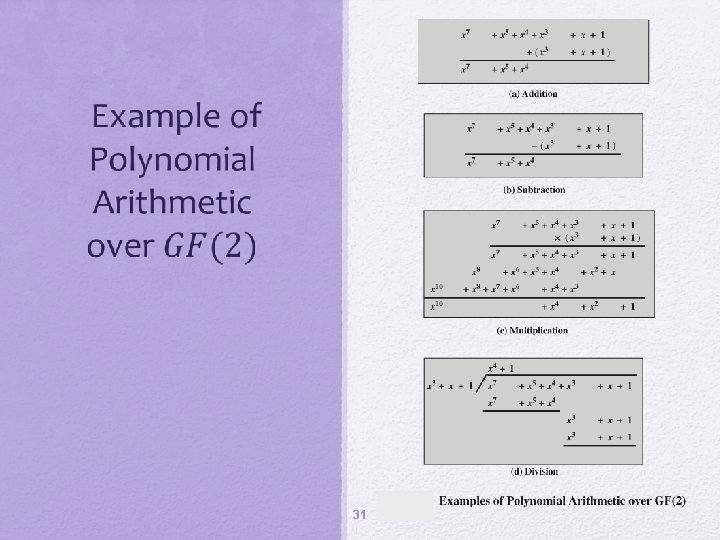
31
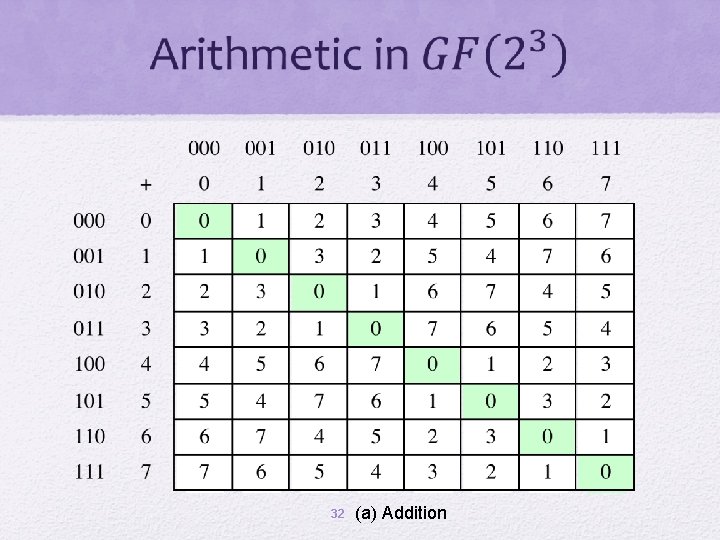
32 (a) Addition
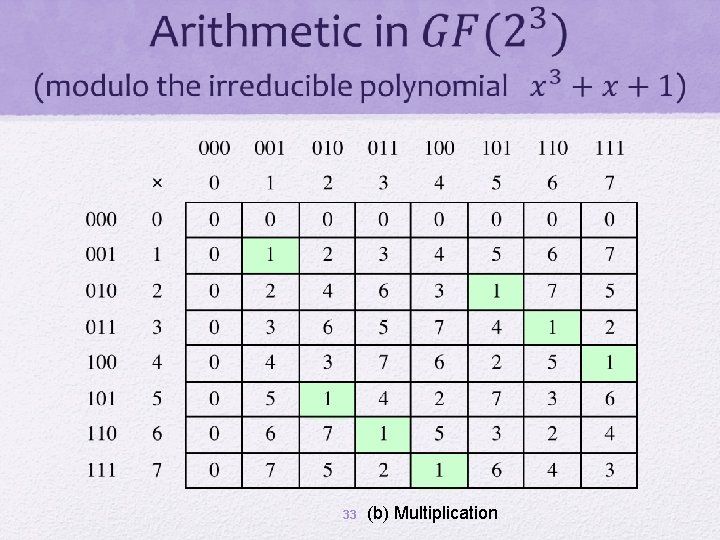
33 (b) Multiplication
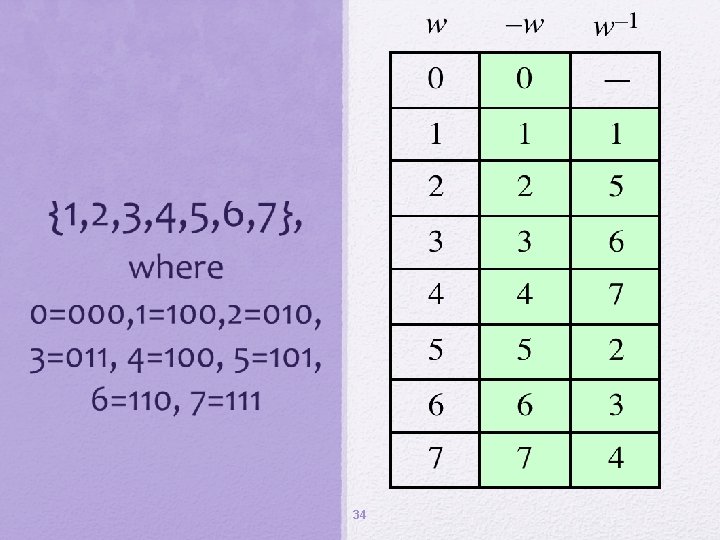
34
Summary • Divisibility and the division algorithm • • The Euclidean algorithm • Modular arithmetic • Groups, rings, and fields 35
- Slides: 35