
Introduction to Cryogenics Neutron Life Cycle Talk 3


- Slides: 33
Introduction to Cryogenics Neutron Life. Cycle Talk 3 Harish Agrawal SE Team Lead – HFIR ORNL is managed by UT-Battelle for the US Department of Energy June 30 th 2016
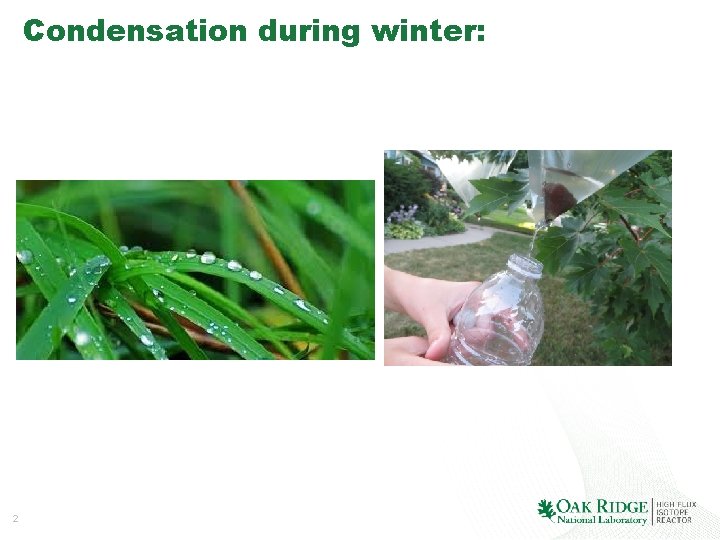
Condensation during winter: 2
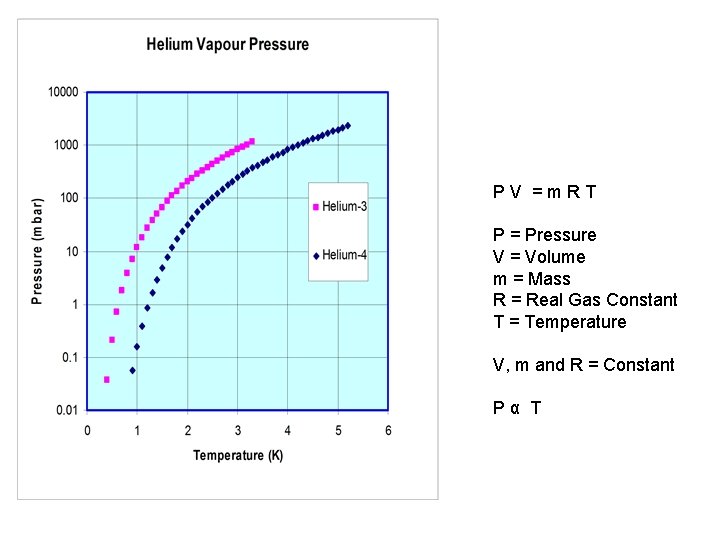
Ideal Gas Equation: P V = m R T P = Pressure V = Volume m = Mass R = Real Gas Constant T = Temperature V, m and R = Constant P α T
Contents of this talk: • Introduction • Cryogen free closed cycle refrigerator (CCR) • Variable temperature insert (VTI) • Helium-3 system (3 He) • ‘Wet’ dilution refrigerator (DR) • ‘Dry’ dilution refrigerator (DR) • Some typical failure modes
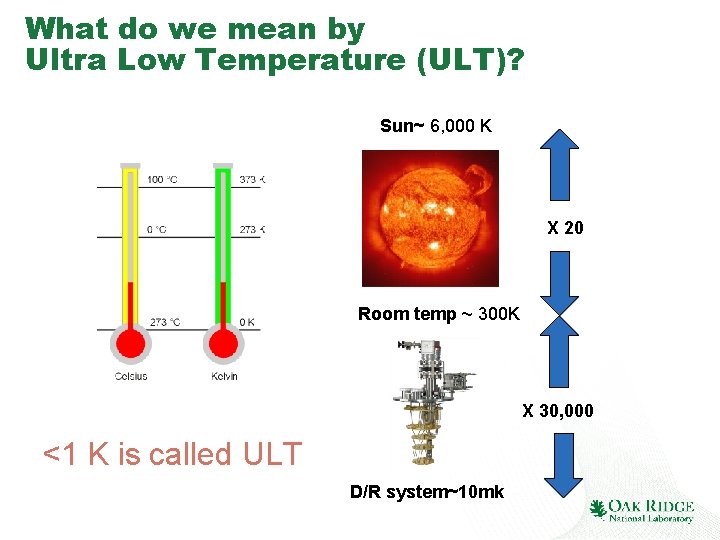
What do we mean by Ultra Low Temperature (ULT)? Sun~ 6, 000 K X 20 Room temp ~ 300 K X 30, 000 <1 K is called ULT D/R system~10 mk
‘How do we get there? ’
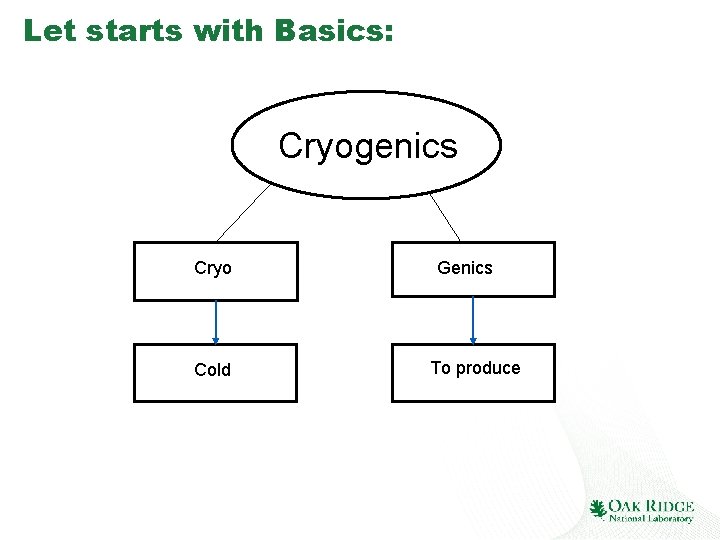
Let starts with Basics: Cryogenics Cryo Cold Genics To produce
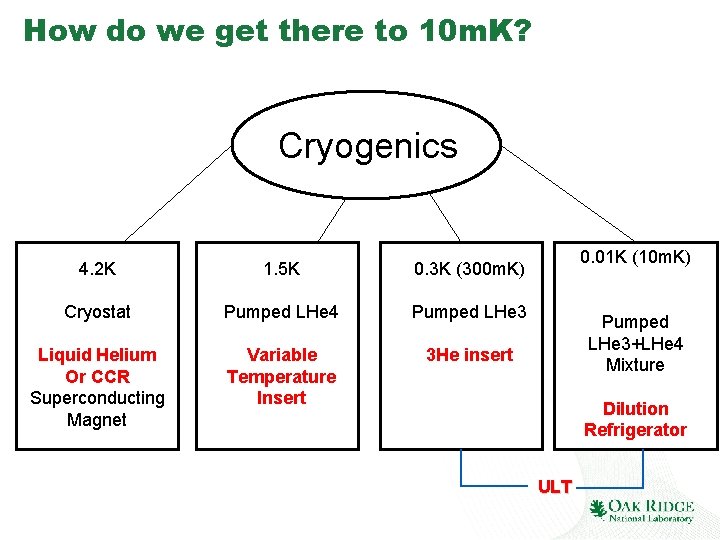
How do we get there to 10 m. K? Cryogenics 4. 2 K 1. 5 K 0. 3 K (300 m. K) Cryostat Pumped LHe 4 Pumped LHe 3 Liquid Helium Or CCR Superconducting Magnet Variable Temperature Insert 3 He insert 0. 01 K (10 m. K) Pumped LHe 3+LHe 4 Mixture Dilution Refrigerator ULT
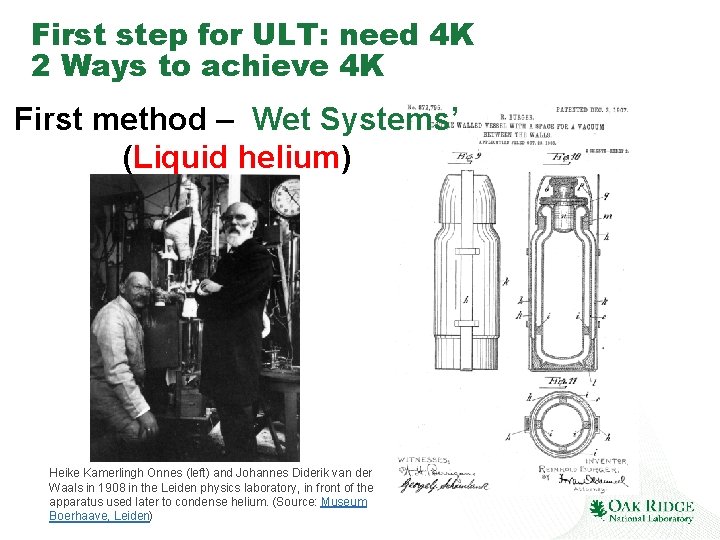
First step for ULT: need 4 K 2 Ways to achieve 4 K First method – Wet Systems’ (Liquid helium) Heike Kamerlingh Onnes (left) and Johannes Diderik van der Waals in 1908 in the Leiden physics laboratory, in front of the apparatus used later to condense helium. (Source: Museum Boerhaave, Leiden)
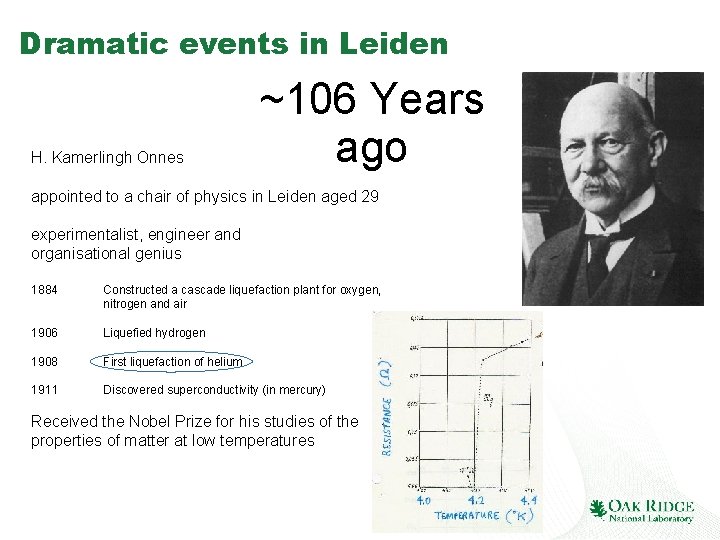
Dramatic events in Leiden H. Kamerlingh Onnes ~106 Years ago appointed to a chair of physics in Leiden aged 29 experimentalist, engineer and organisational genius 1884 Constructed a cascade liquefaction plant for oxygen, nitrogen and air 1906 Liquefied hydrogen 1908 First liquefaction of helium 1911 Discovered superconductivity (in mercury) Received the Nobel Prize for his studies of the properties of matter at low temperatures
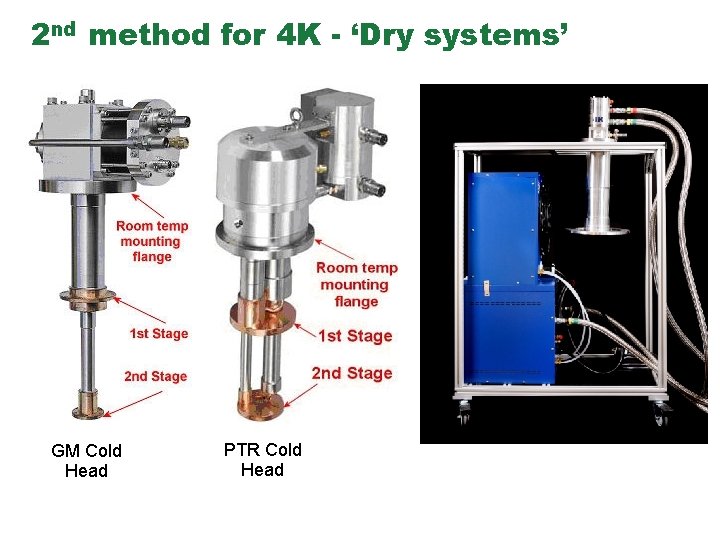
2 nd method for 4 K - ‘Dry systems’ GM Cold Head PTR Cold Head
Second Step for ULT: • Requires 1. 5 K environment: Color doesn’t matter as long as it achieves low temperature And we don’t have to refill the cryostat twice a day
P V = m R T P = Pressure V = Volume m = Mass R = Real Gas Constant T = Temperature V, m and R = Constant P α T
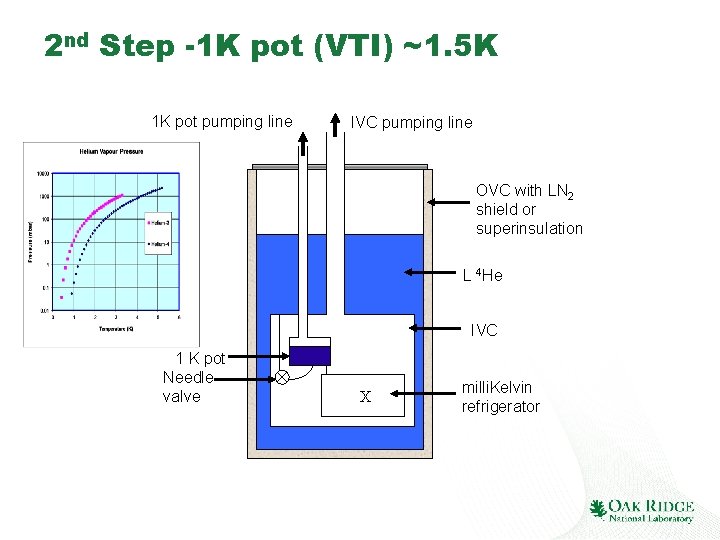
2 nd Step -1 K pot (VTI) ~1. 5 K 1 K pot pumping line IVC pumping line OVC with LN 2 shield or superinsulation L 4 He IVC 1 K pot Needle valve X milli. Kelvin refrigerator
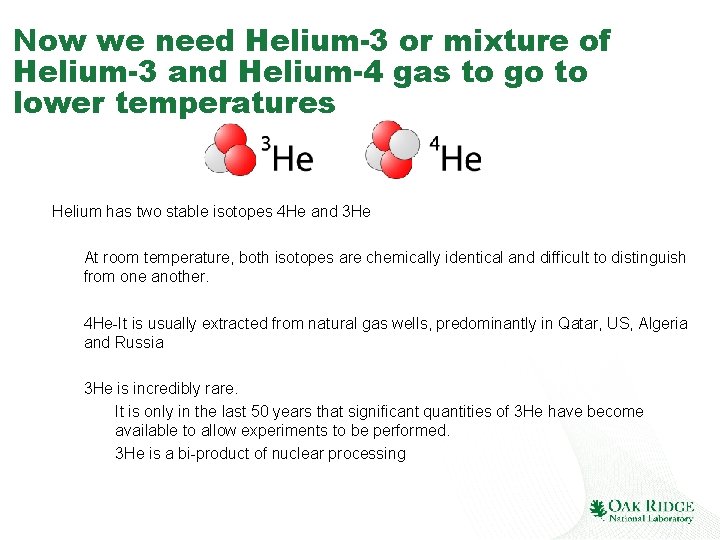
Now we need Helium-3 or mixture of Helium-3 and Helium-4 gas to go to lower temperatures • Helium has two stable isotopes 4 He and 3 He • At room temperature, both isotopes are chemically identical and difficult to distinguish from one another. • 4 He-It is usually extracted from natural gas wells, predominantly in Qatar, US, Algeria and Russia • 3 He is incredibly rare. • It is only in the last 50 years that significant quantities of 3 He have become available to allow experiments to be performed. • 3 He is a bi-product of nuclear processing
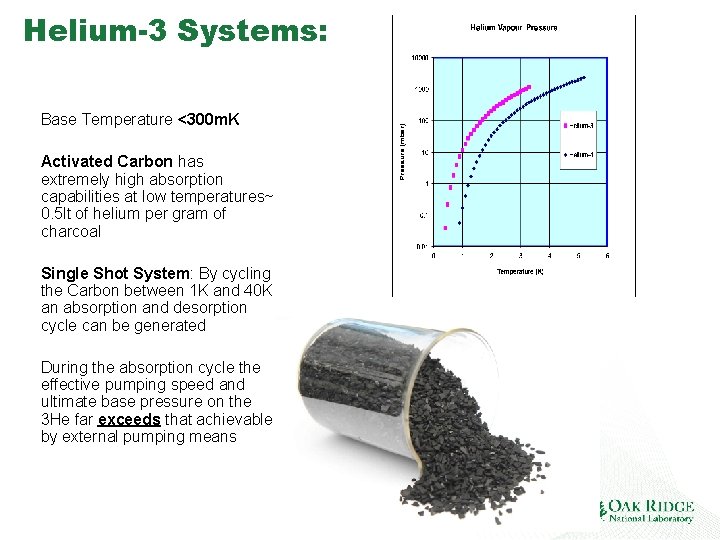
Helium-3 Systems: § Base Temperature <300 m. K § Activated Carbon has extremely high absorption capabilities at low temperatures~ 0. 5 lt of helium per gram of charcoal • Single Shot System: By cycling the Carbon between 1 K and 40 K an absorption and desorption cycle can be generated • During the absorption cycle the effective pumping speed and ultimate base pressure on the 3 He far exceeds that achievable by external pumping means
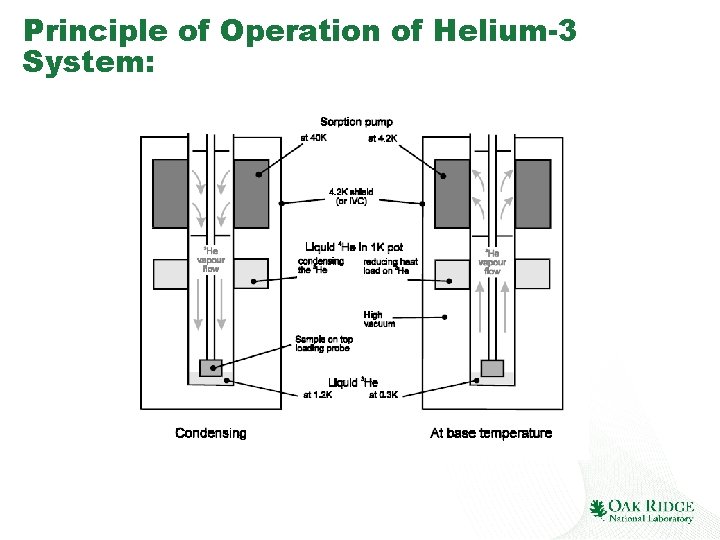
Principle of Operation of Helium-3 System:
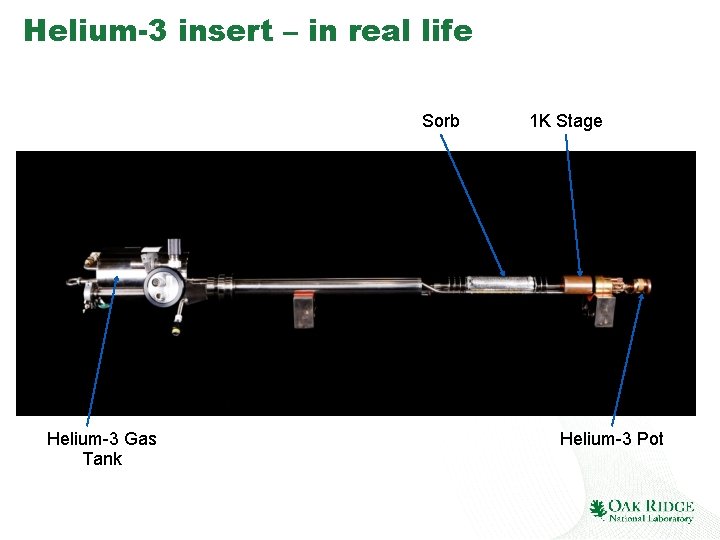
Helium-3 insert – in real life Sorb Helium-3 Gas Tank 1 K Stage Helium-3 Pot
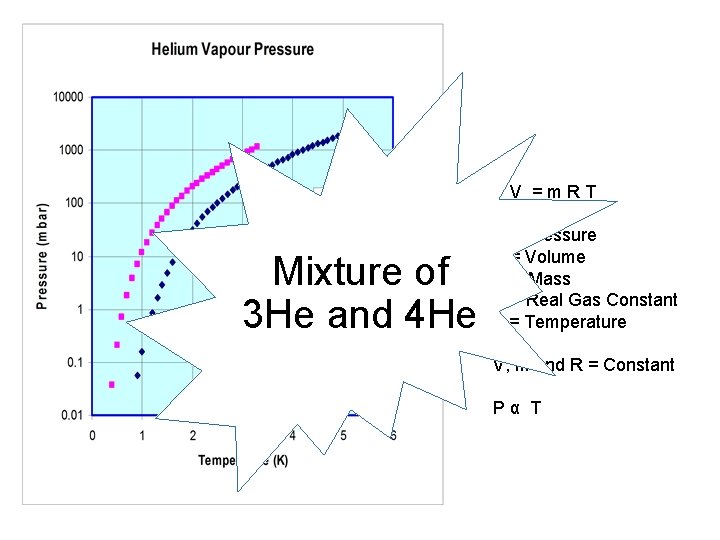
P V = m R T Mixture of 3 He and 4 He P = Pressure V = Volume m = Mass R = Real Gas Constant T = Temperature V, m and R = Constant P α T
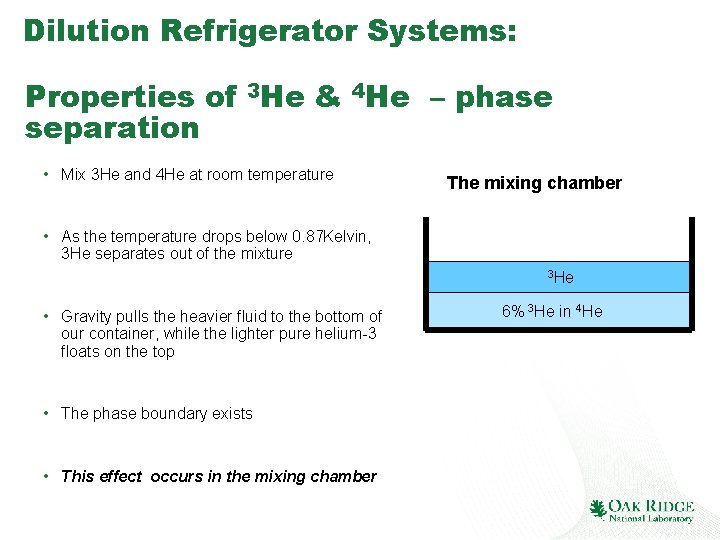
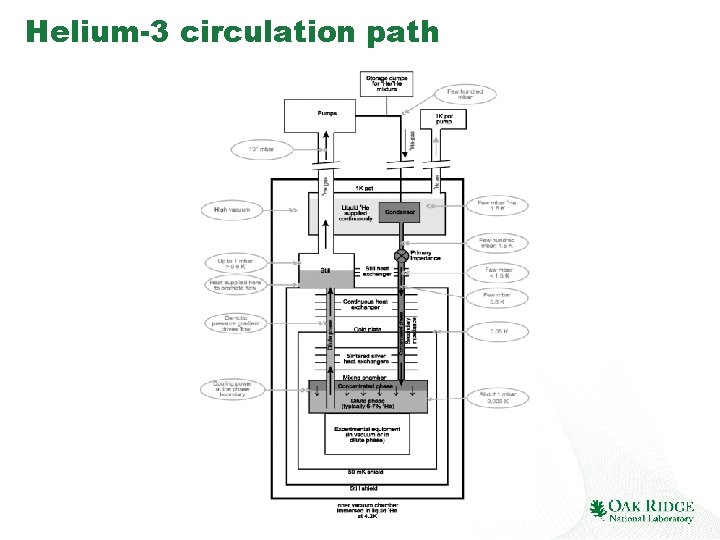
Dilution Refrigerator Systems: Properties of 3 He & 4 He – phase separation • Mix 3 He and 4 He at room temperature The mixing chamber • As the temperature drops below 0. 87 Kelvin, 3 He separates out of the mixture 3 He • Gravity pulls the heavier fluid to the bottom of our container, while the lighter pure helium-3 floats on the top • The phase boundary exists • This effect occurs in the mixing chamber 6% 3 He in 4 He
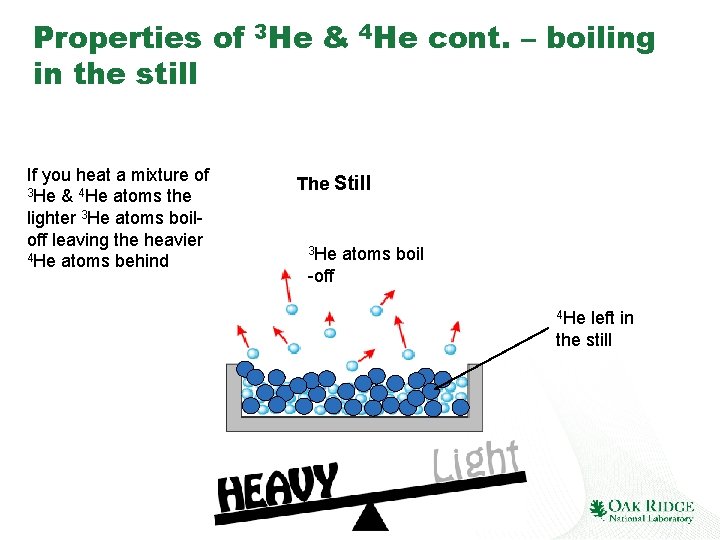
Properties of 3 He & 4 He cont. – boiling in the still If you heat a mixture of 3 He & 4 He atoms the lighter 3 He atoms boiloff leaving the heavier 4 He atoms behind The Still 3 He atoms boil -off 4 He left in the still
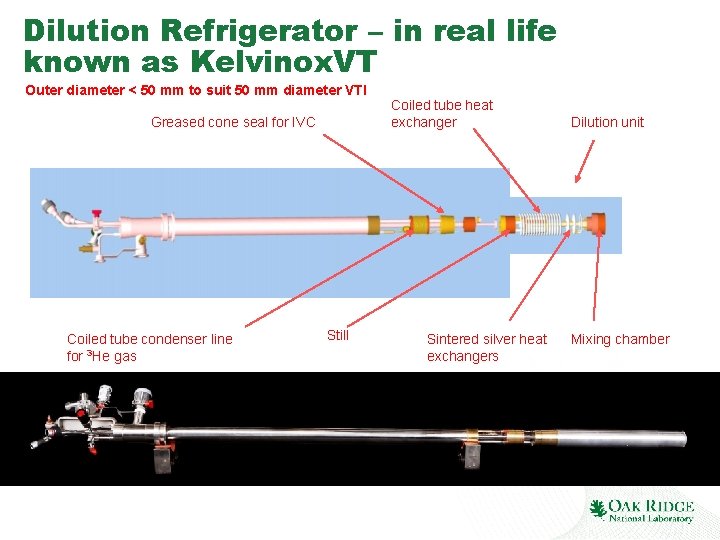
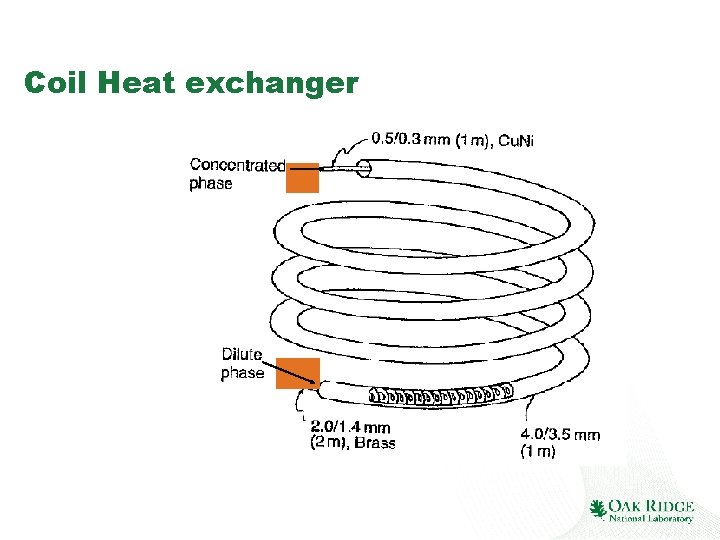
Dilution Refrigerator – in real life known as Kelvinox. VT Outer diameter < 50 mm to suit 50 mm diameter VTI Greased cone seal for IVC Coiled tube condenser line for 3 He gas Still Coiled tube heat exchanger Sintered silver heat exchangers Dilution unit Mixing chamber
Helium-3 circulation path
Coil Heat exchanger
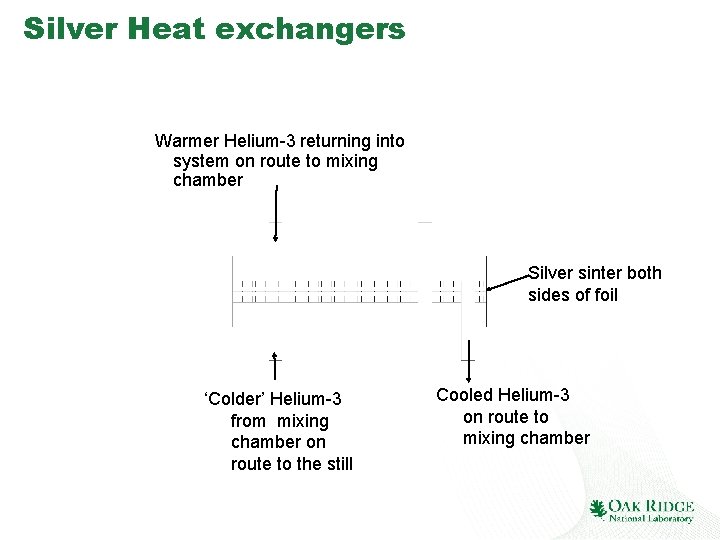
Silver Heat exchangers Warmer Helium-3 returning into system on route to mixing chamber Silver sinter both sides of foil ‘Colder’ Helium-3 from mixing chamber on route to the still Cooled Helium-3 on route to mixing chamber
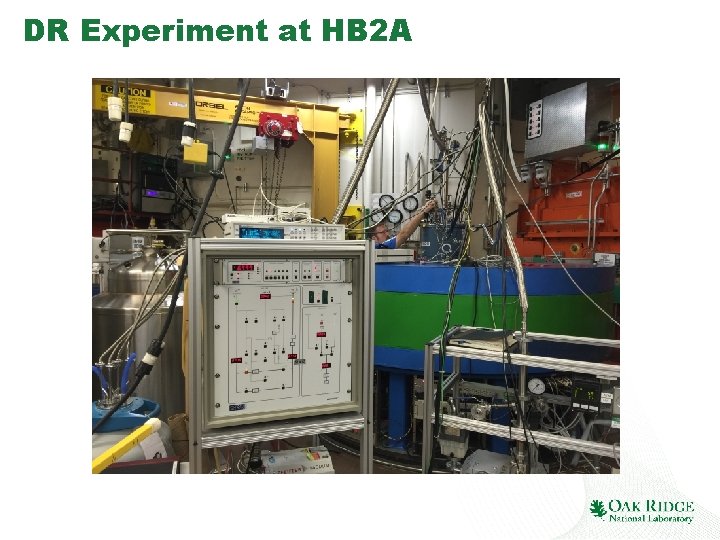
DR Experiment at HB 2 A
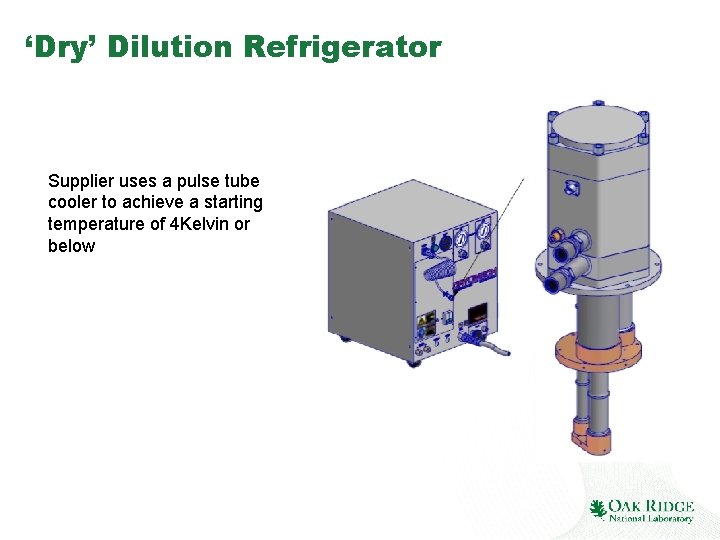
‘Dry’ Dilution Refrigerator Supplier uses a pulse tube cooler to achieve a starting temperature of 4 Kelvin or below
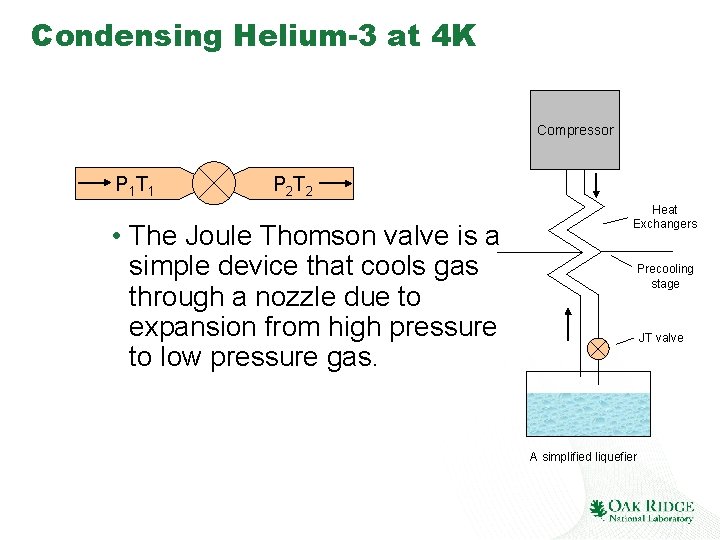
Condensing Helium-3 at 4 K Compressor P 1 T 1 P 2 T 2 • The Joule Thomson valve is a simple device that cools gas through a nozzle due to expansion from high pressure to low pressure gas. Heat Exchangers Precooling stage JT valve A simplified liquefier
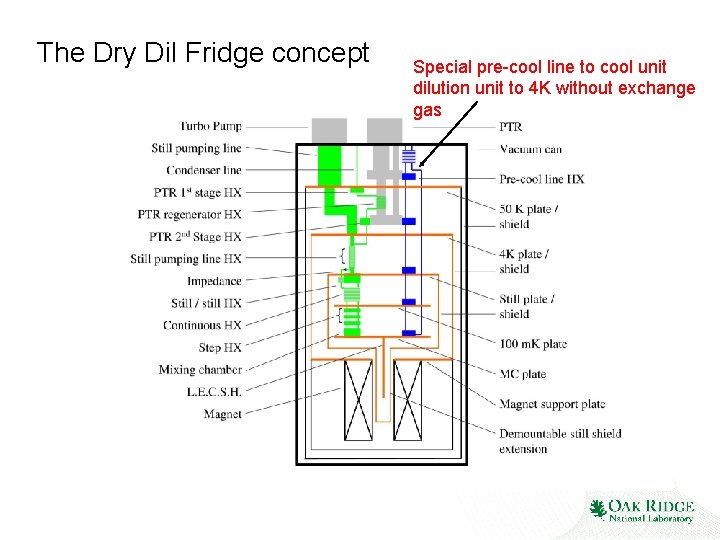
The Dry Dil Fridge concept Special pre-cool line to cool unit dilution unit to 4 K without exchange gas
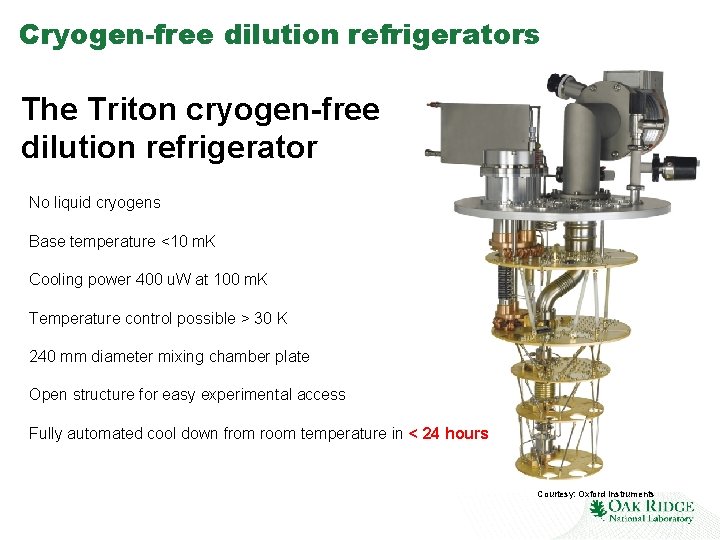
Cryogen-free dilution refrigerators The Triton cryogen-free dilution refrigerator No liquid cryogens Base temperature <10 m. K Cooling power 400 u. W at 100 m. K Temperature control possible > 30 K 240 mm diameter mixing chamber plate Open structure for easy experimental access Fully automated cool down from room temperature in < 24 hours Courtesy: Oxford Instruments
What can possibly go wrong? 1. IVC Leaks through cone seal Helium is superfluid, ‘tiny’ holes on atomic scale will pass helium & destroy cryostat vacuum 2. Heat Load from radiation or touch Holes in shields pass 46 m. W/cm 2, so holes as small as ~1 mm 2 can impact performance – cover all the radiation holes with Al tape 3. Blockages Contamination in tubes or air leaks can cause blockages in cold traps 4. Bolted connections/thermal contact There are lots of bolted connections on ULT systems PTR, shields, mixing chamber , all need securing.
Useful Books • G. K. White and P. J. Meeson: – Experimental Techniques in Low Temperature Physics – (Oxford University Press 2002) • F. Pobell: – Matter and Methods at Low Temperatures – (Springer, 1996) • R. C. Richardson and E. N. Smith: – Experimental Techniques in Condensed Matter Physics at Low Temperatures – (Addison-Wesley, 1988) • D. S. Betts: – Refrigeration and Thermometry Below 1 K – (Sussex University Press, 1976) • O. V. Lounasmaa: – Experimental Principles and Methods Below 1 K – (Academic Press, 1974)
Questions?