
Introduction to Counterplans Counterplans Defined n An alternate
- Slides: 11
Introduction to Counterplans
Counterplans Defined n An alternate policy proposal offered by the negative which is designed to solve part or all of the harms provided in the 1 AC.
The Basics n. A CP should compete with the 1 AC. n Be in the 1 NC. n Have a solvency advocate. n Major thesis: The CP alone is the best policy option.
Why Run a Counterplan? Case impact is too big. n New cases. n Status quo is indefensible. n Opportunity cost theory (implied “should not”; reject the plan for better policy). n PIC (Plan plus/minus) Strategy. n Strategy against performance affirmatives. n
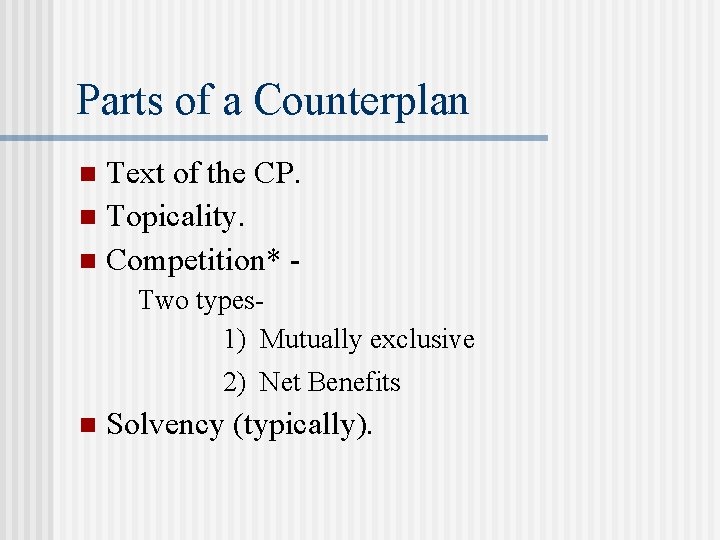
Parts of a Counterplan Text of the CP. n Topicality. n Competition* n Two types 1) Mutually exclusive 2) Net Benefits n Solvency (typically).
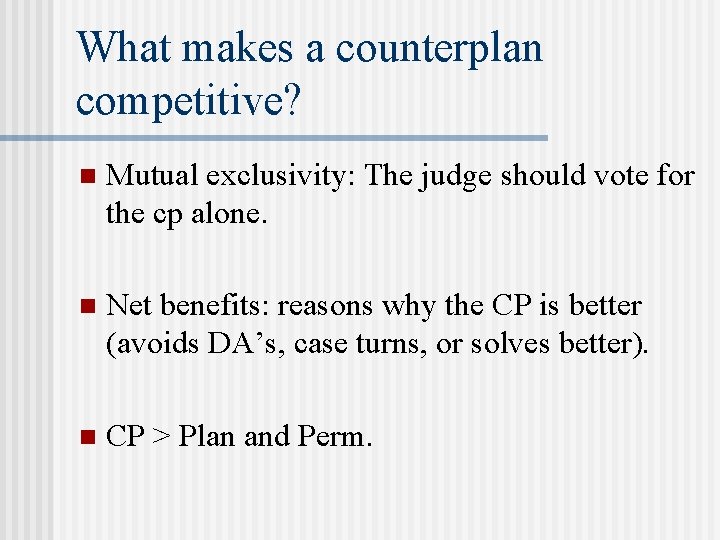
What makes a counterplan competitive? n Mutual exclusivity: The judge should vote for the cp alone. n Net benefits: reasons why the CP is better (avoids DA’s, case turns, or solves better). n CP > Plan and Perm.
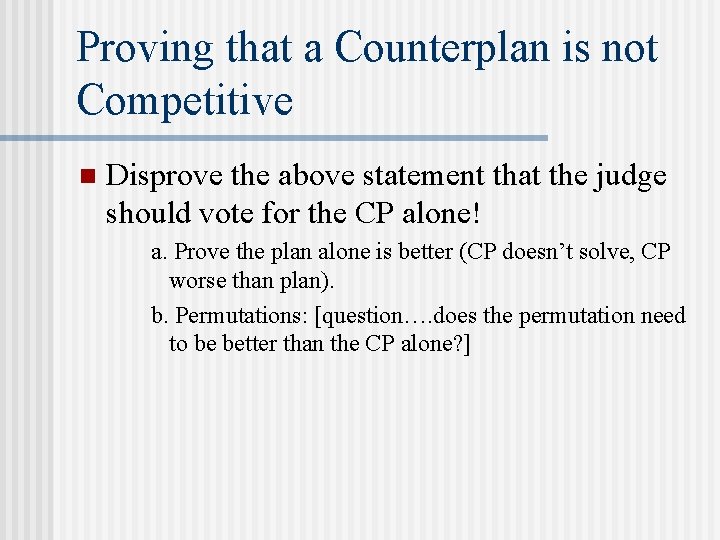
Proving that a Counterplan is not Competitive n Disprove the above statement that the judge should vote for the CP alone! a. Prove the plan alone is better (CP doesn’t solve, CP worse than plan). b. Permutations: [question…. does the permutation need to be better than the CP alone? ]
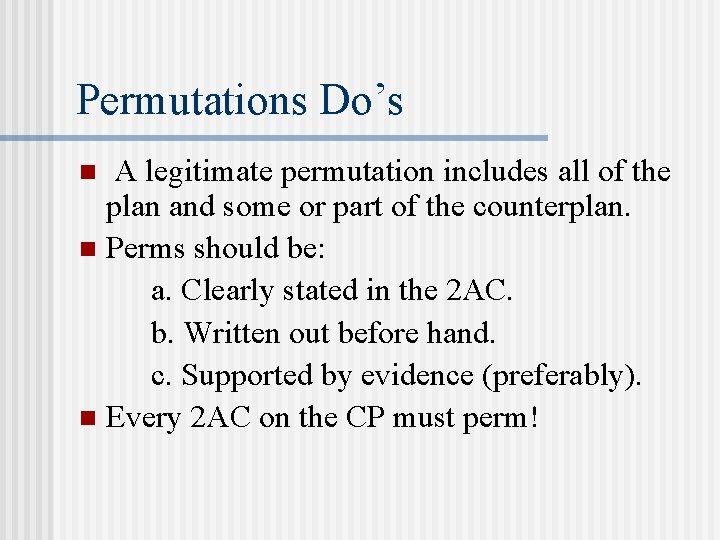
Permutations Do’s A legitimate permutation includes all of the plan and some or part of the counterplan. n Perms should be: a. Clearly stated in the 2 AC. b. Written out before hand. c. Supported by evidence (preferably). n Every 2 AC on the CP must perm! n
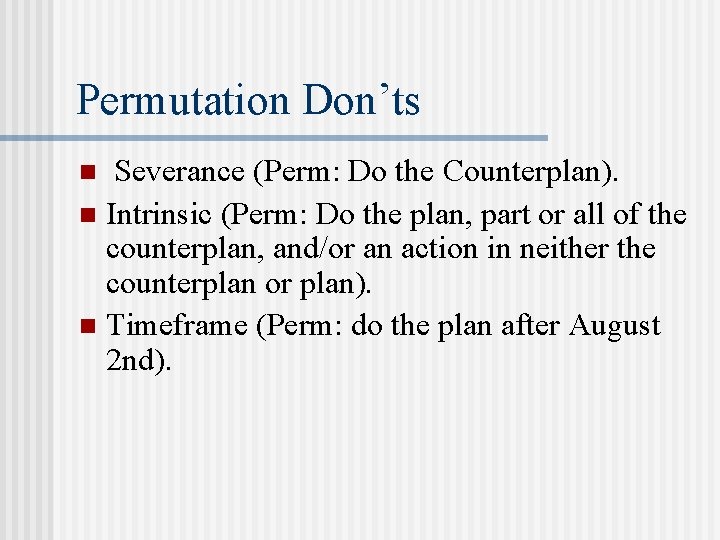
Permutation Don’ts Severance (Perm: Do the Counterplan). n Intrinsic (Perm: Do the plan, part or all of the counterplan, and/or an action in neither the counterplan or plan). n Timeframe (Perm: do the plan after August 2 nd). n
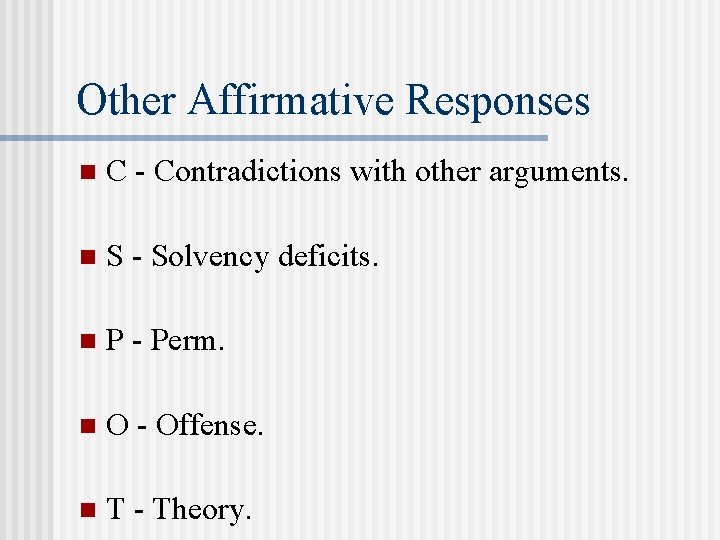
Other Affirmative Responses n C - Contradictions with other arguments. n S - Solvency deficits. n P - Perm. n O - Offense. n T - Theory.
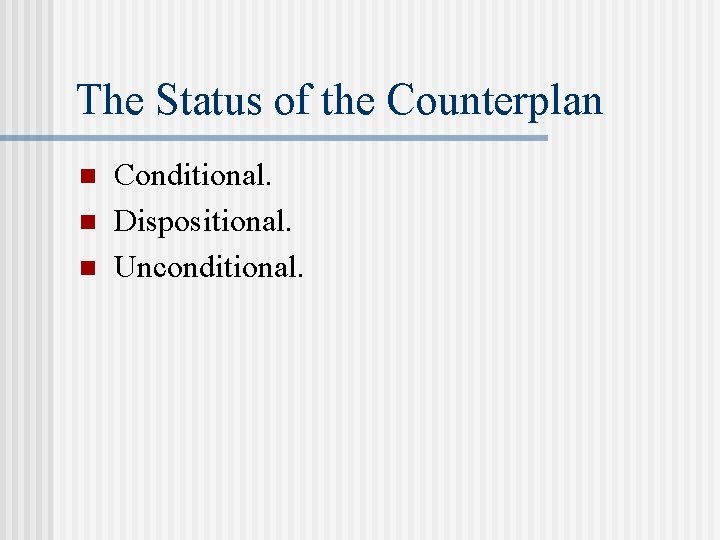
The Status of the Counterplan n Conditional. Dispositional. Unconditional.