
Introduction to Cosmology Lecture 1 the Universe we
- Slides: 8
Introduction to Cosmology Lecture 1: the Universe we observe Observational basis of standard cosmology q. Expansion, Isotropy, Homogeneity q. CMB, Nucleosynthesis q. The matter content of the Universe
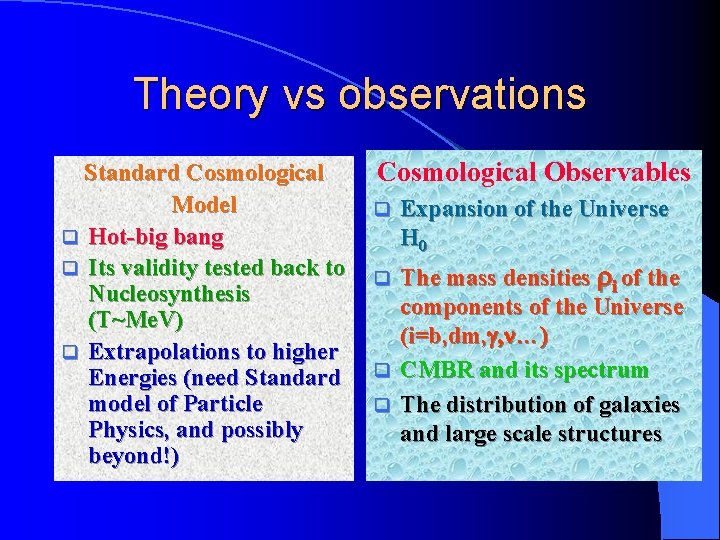
Theory vs observations Standard Cosmological Model q Hot-big bang q Its validity tested back to Nucleosynthesis (T~Me. V) q Extrapolations to higher Energies (need Standard model of Particle Physics, and possibly beyond!) Cosmological Observables q Expansion of the Universe H 0 The mass densities ri of the components of the Universe (i=b, dm, g, n…) q CMBR and its spectrum q The distribution of galaxies and large scale structures q
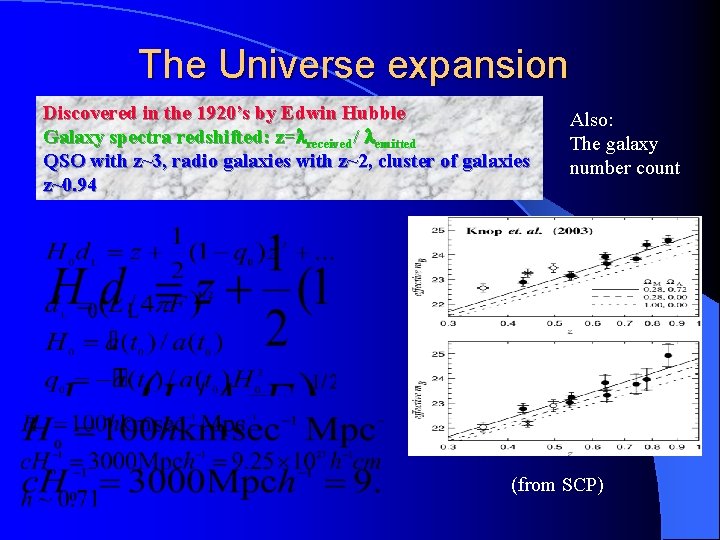
The Universe expansion Discovered in the 1920’s by Edwin Hubble Galaxy spectra redshifted: z=lreceived/ lemitted QSO with z~3, radio galaxies with z~2, cluster of galaxies z~0. 94 Also: The galaxy number count (from SCP)
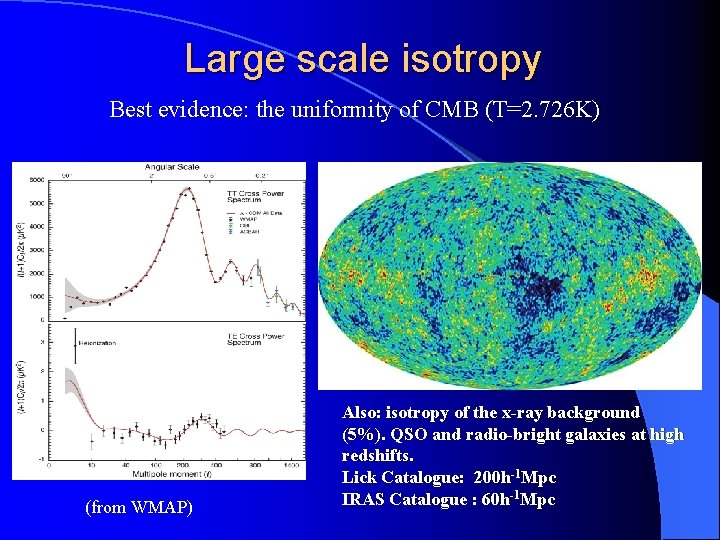
Large scale isotropy Best evidence: the uniformity of CMB (T=2. 726 K) (from WMAP) Also: isotropy of the x-ray background (5%). QSO and radio-bright galaxies at high redshifts. Lick Catalogue: 200 h-1 Mpc IRAS Catalogue : 60 h-1 Mpc
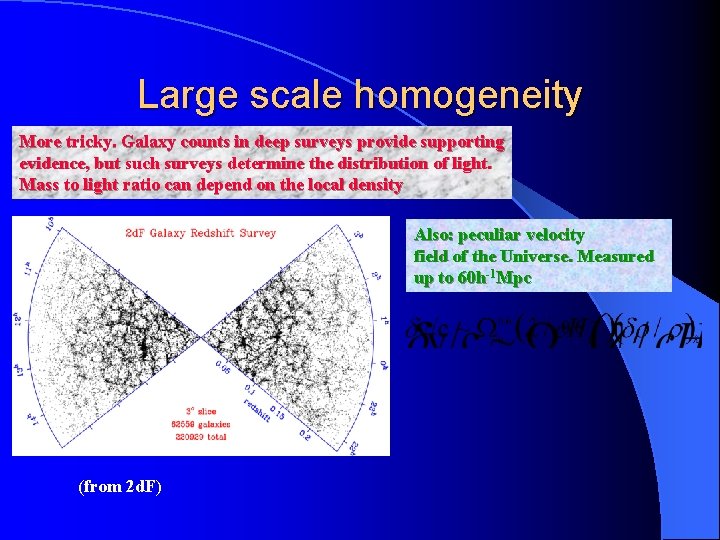
Large scale homogeneity More tricky. Galaxy counts in deep surveys provide supporting evidence, but such surveys determine the distribution of light. Mass to light ratio can depend on the local density Also: peculiar velocity field of the Universe. Measured up to 60 h-1 Mpc (from 2 d. F)
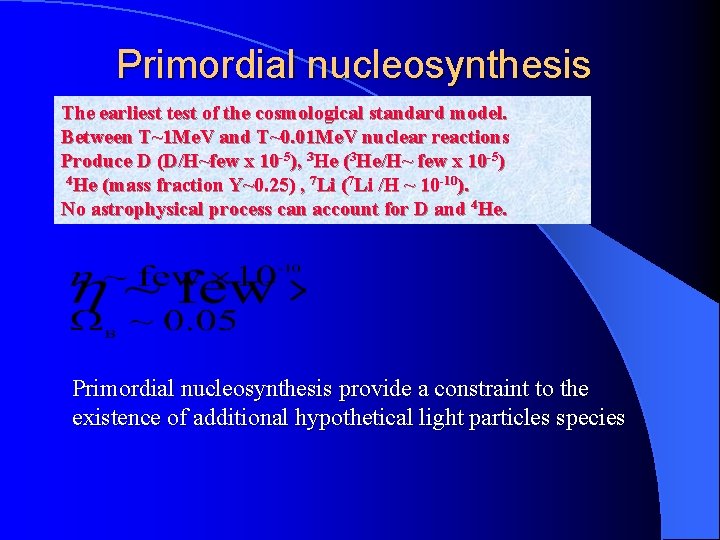
Primordial nucleosynthesis The earliest test of the cosmological standard model. Between T~1 Me. V and T~0. 01 Me. V nuclear reactions Produce D (D/H~few x 10 -5), 3 He (3 He/H~ few x 10 -5) 4 He (mass fraction Y~0. 25) , 7 Li (7 Li /H ~ 10 -10). No astrophysical process can account for D and 4 He. Primordial nucleosynthesis provide a constraint to the existence of additional hypothetical light particles species
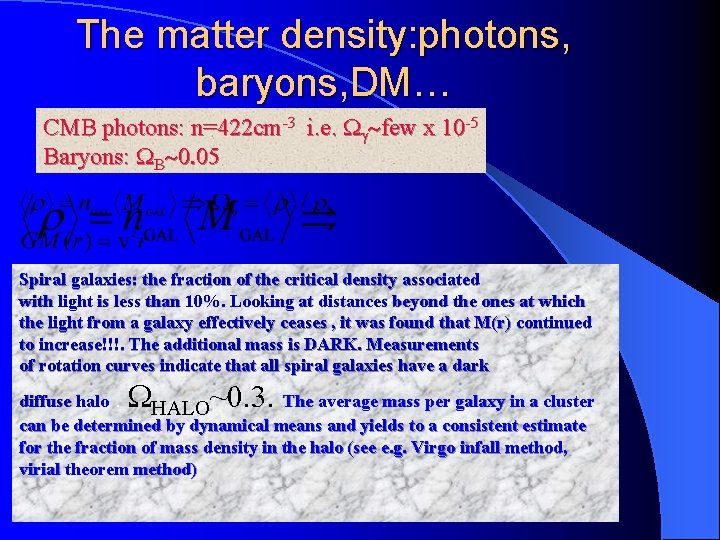
The matter density: photons, baryons, DM… CMB photons: n=422 cm-3 i. e. Wg~few x 10 -5 Baryons: WB~0. 05 Spiral galaxies: the fraction of the critical density associated with light is less than 10%. Looking at distances beyond the ones at which the light from a galaxy effectively ceases , it was found that M(r) continued to increase!!!. The additional mass is DARK. Measurements of rotation curves indicate that all spiral galaxies have a dark W ~0. 3. diffuse halo. The average mass per galaxy in a cluster HALO can be determined by dynamical means and yields to a consistent estimate for the fraction of mass density in the halo (see e. g. Virgo infall method, virial theorem method)
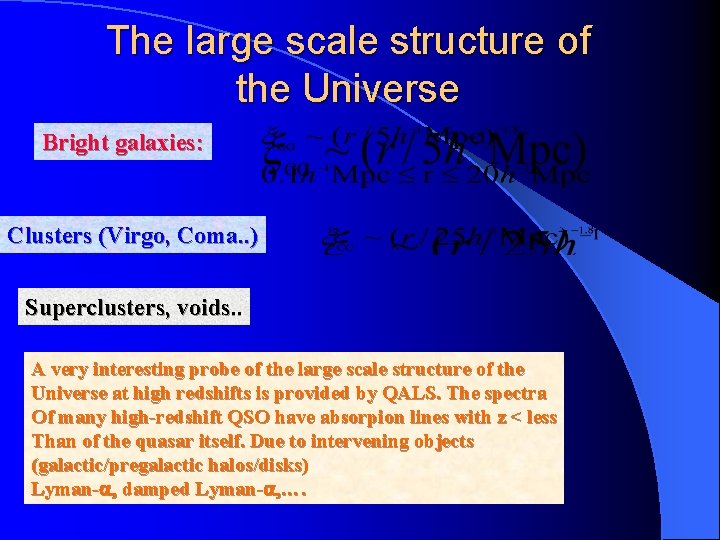
The large scale structure of the Universe Bright galaxies: Clusters (Virgo, Coma. . ) Superclusters, voids. . A very interesting probe of the large scale structure of the Universe at high redshifts is provided by QALS. The spectra Of many high-redshift QSO have absorpion lines with z < less Than of the quasar itself. Due to intervening objects (galactic/pregalactic halos/disks) Lyman-a, damped Lyman-a, ….