
Introduction to Constructive Controversy The Art of Arguing

- Slides: 46
Introduction to Constructive Controversy: The Art of Arguing to Enhance Learning Karl A. Smith STEM Education Center / Technological Leadership Institute/ Civil Engineering – University of Minnesota & Engineering Education – Purdue University ksmith@umn. edu - http: //www. ce. umn. edu/~smith Lilly Teaching Seminar Michigan State University April 11, 2013
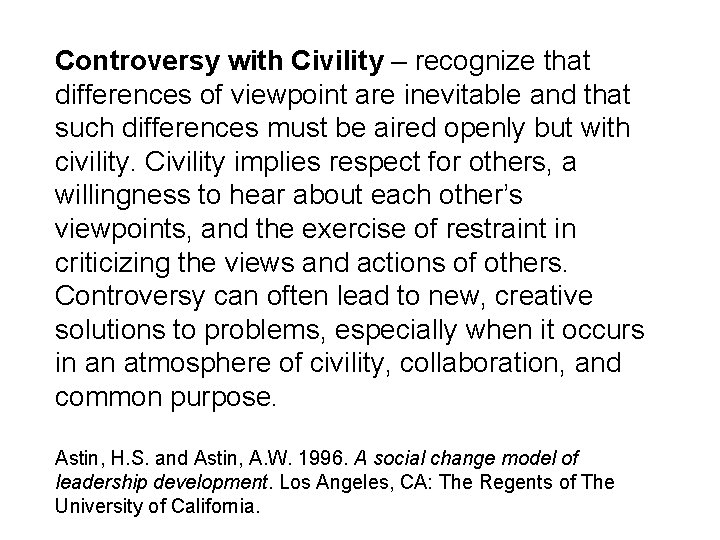
Controversy with Civility – recognize that differences of viewpoint are inevitable and that such differences must be aired openly but with civility. Civility implies respect for others, a willingness to hear about each other’s viewpoints, and the exercise of restraint in criticizing the views and actions of others. Controversy can often lead to new, creative solutions to problems, especially when it occurs in an atmosphere of civility, collaboration, and common purpose. Astin, H. S. and Astin, A. W. 1996. A social change model of leadership development. Los Angeles, CA: The Regents of The University of California.
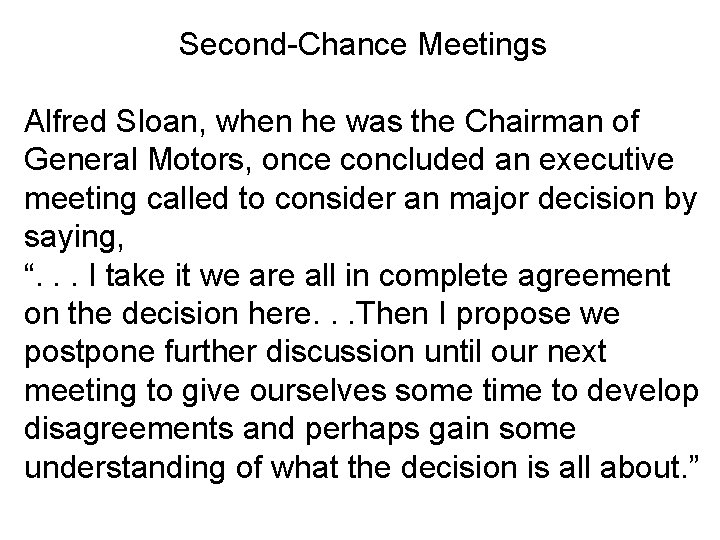
Second-Chance Meetings Alfred Sloan, when he was the Chairman of General Motors, once concluded an executive meeting called to consider an major decision by saying, “. . . I take it we are all in complete agreement on the decision here. . . Then I propose we postpone further discussion until our next meeting to give ourselves some time to develop disagreements and perhaps gain some understanding of what the decision is all about. ”
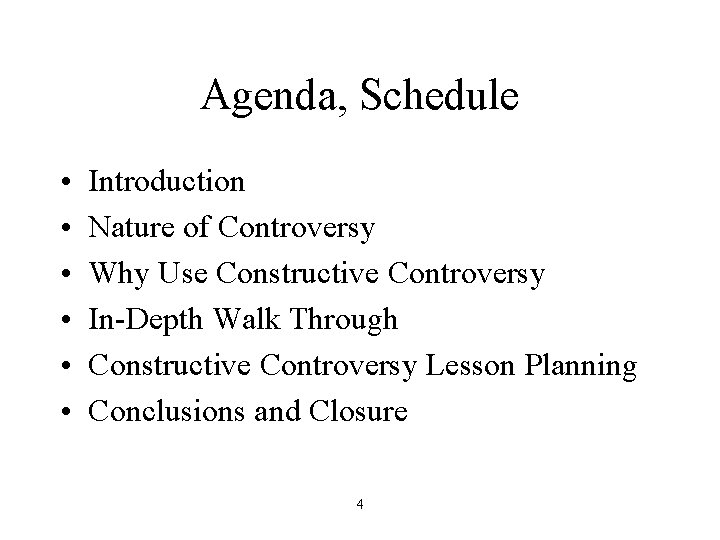
Agenda, Schedule • • • Introduction Nature of Controversy Why Use Constructive Controversy In-Depth Walk Through Constructive Controversy Lesson Planning Conclusions and Closure 4
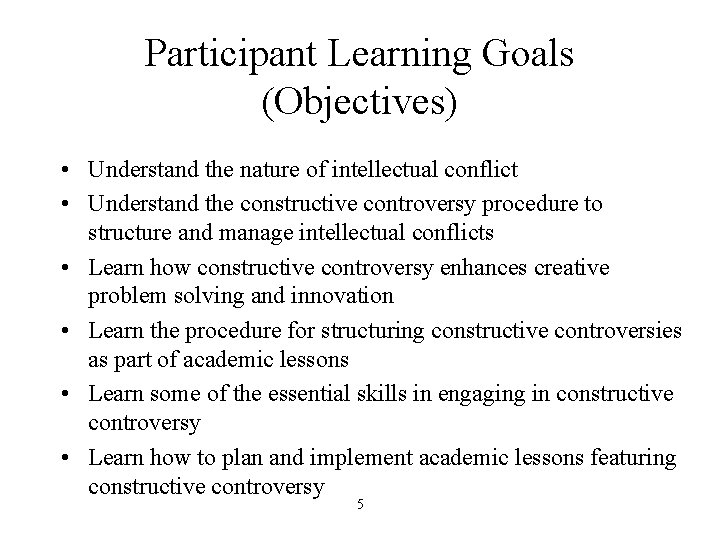
Participant Learning Goals (Objectives) • Understand the nature of intellectual conflict • Understand the constructive controversy procedure to structure and manage intellectual conflicts • Learn how constructive controversy enhances creative problem solving and innovation • Learn the procedure for structuring constructive controversies as part of academic lessons • Learn some of the essential skills in engaging in constructive controversy • Learn how to plan and implement academic lessons featuring constructive controversy 5
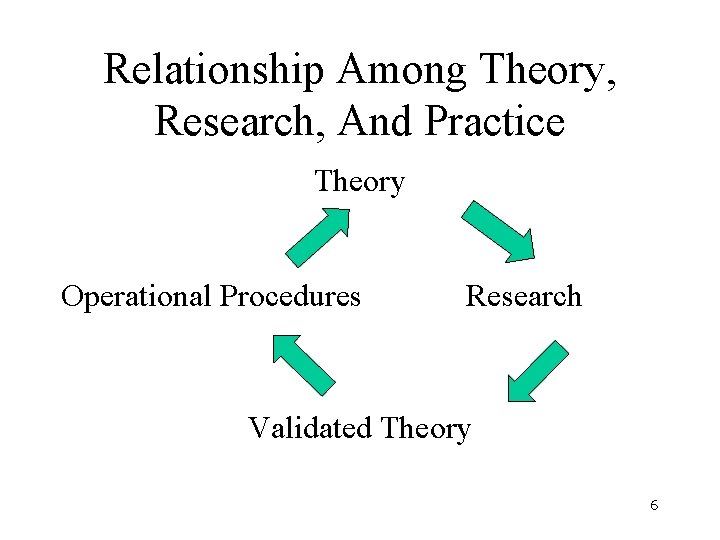
Relationship Among Theory, Research, And Practice Theory Operational Procedures Research Validated Theory 6
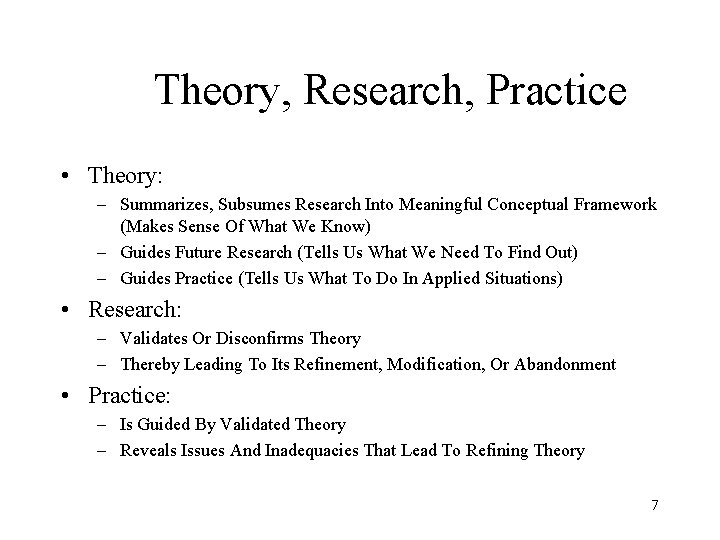
Theory, Research, Practice • Theory: – Summarizes, Subsumes Research Into Meaningful Conceptual Framework (Makes Sense Of What We Know) – Guides Future Research (Tells Us What We Need To Find Out) – Guides Practice (Tells Us What To Do In Applied Situations) • Research: – Validates Or Disconfirms Theory – Thereby Leading To Its Refinement, Modification, Or Abandonment • Practice: – Is Guided By Validated Theory – Reveals Issues And Inadequacies That Lead To Refining Theory 7
What Is Constructive Controversy? • • Definition Survey Walk-Through of Procedure Discussion 8
Controversy • When One Person’s Ideas, Information, Conclusions, Theories, Or Opinions Are Incompatible With Those Of Another - • And The Two Seek To Reach An Agreement. 9
Controversy Survey • An Argument A Day Makes Members’ Involvement Stay. _____ True _____ False • Controversy Is The Team Leader’s Best Friend. _____ True _____ False • A Decision Without Controversy Is Like A Day Without Sunshine. Things Are Gloomy, Depressing, And Drag Along Slowly. _____ True _____ False • All Intellect Growth (And Higher Level Reasoning) Depends On The Collision Of Adverse Opinions. _____ True _____ False • It Is Controversy That Adds To Decision Making The Spark Of Curiosity, The Flame Of Interest, The Heat Of Involvement, And The Power Of Creativity. _____ True _____ False 10
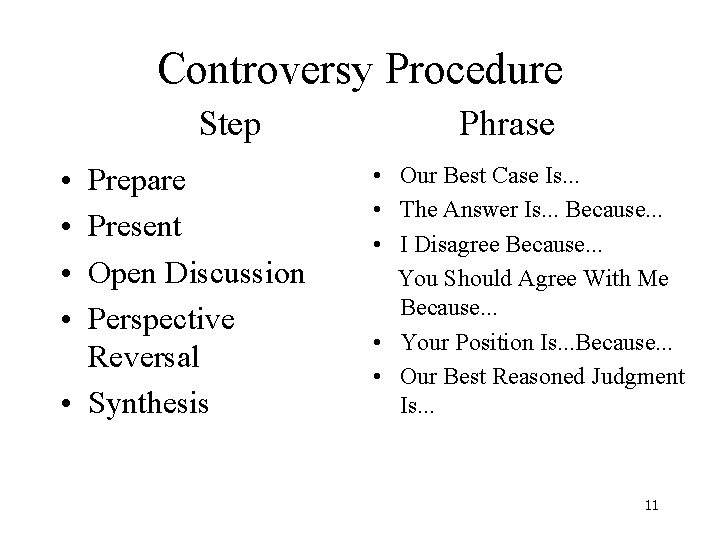
Controversy Procedure Step • • Prepare Present Open Discussion Perspective Reversal • Synthesis Phrase • Our Best Case Is. . . • The Answer Is. . . Because. . . • I Disagree Because. . . You Should Agree With Me Because. . . • Your Position Is. . . Because. . . • Our Best Reasoned Judgment Is. . . 11
Was Peter Pan Right Or Wrong? • Peter Pan Believed That Staying Young In Never-Never Land Was The Ideal Way To Live. Was He Right Or Wrong? Is It Better To: – Stay Young And Never Grow Up? – Grow Up And Leave Childhood Behind? • Be Ready To Present The Best Case Possible For One Of These Positions. (c) Johnson & Johnson 12
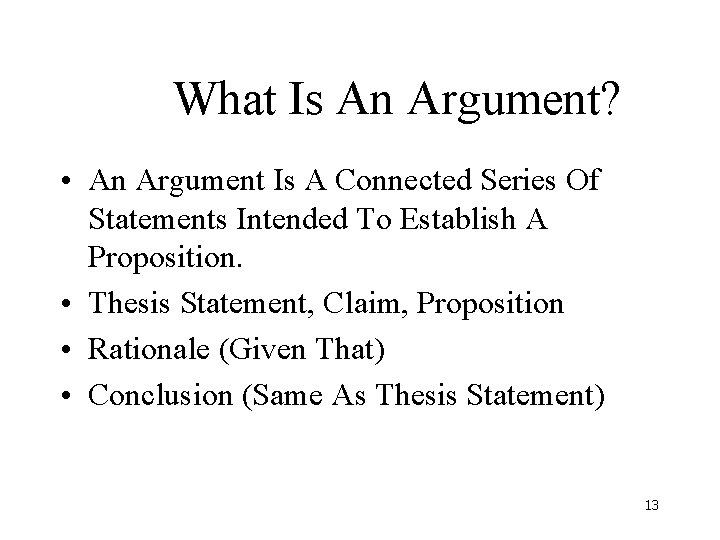
What Is An Argument? • An Argument Is A Connected Series Of Statements Intended To Establish A Proposition. • Thesis Statement, Claim, Proposition • Rationale (Given That) • Conclusion (Same As Thesis Statement) 13
Controversy Rules • • I Am Critical Of Ideas, Not People I Seek The Best Reasoned Judgment, Not Winning I Encourage Everyone To Participate I Listen To Everyone’s Ideas, Even If I Do Not Agree I Restate What Others Say If It Is Not Clear I Try To Understand All Sides Of The Issue I First Bring Out The Different Ideas And Views, Then I Put Them Together • I Change My Mind When Evidence Indicates I Should Do So 14
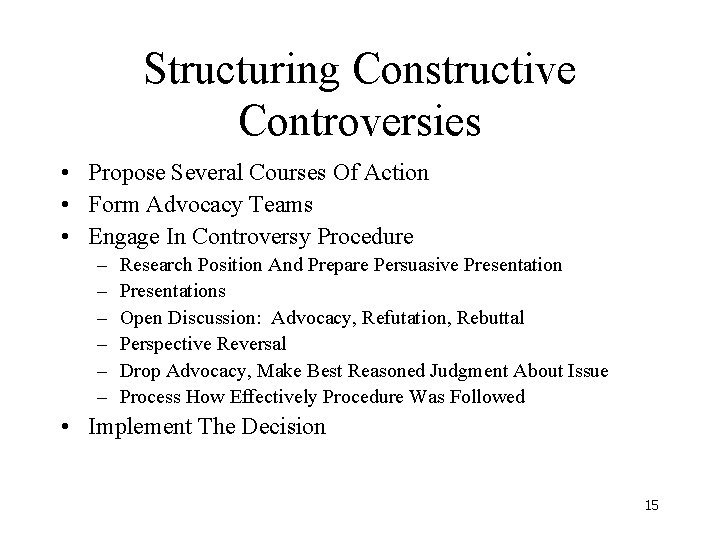
Structuring Constructive Controversies • Propose Several Courses Of Action • Form Advocacy Teams • Engage In Controversy Procedure – – – Research Position And Prepare Persuasive Presentations Open Discussion: Advocacy, Refutation, Rebuttal Perspective Reversal Drop Advocacy, Make Best Reasoned Judgment About Issue Process How Effectively Procedure Was Followed • Implement The Decision 15
Why Use Constructive Controversy • • • Jigsaw Research Promise Outcomes Process Conditions Relationship With Creative Problem Solving And Innovation • Conclusions 16
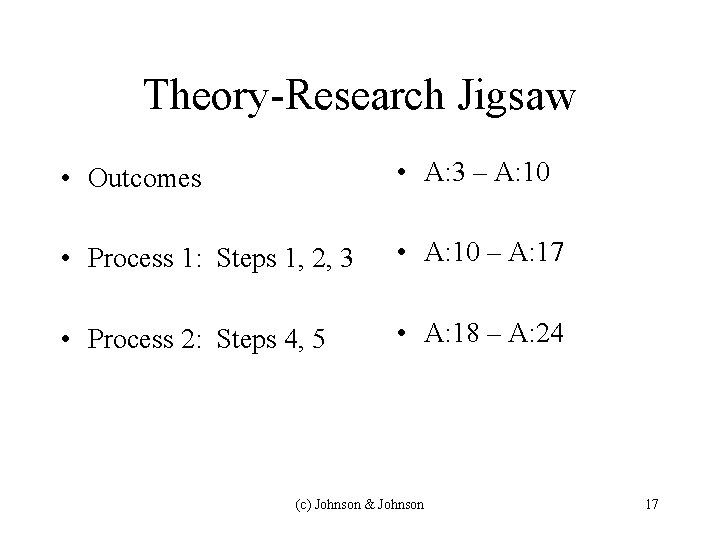
Theory-Research Jigsaw • Outcomes • A: 3 – A: 10 • Process 1: Steps 1, 2, 3 • A: 10 – A: 17 • Process 2: Steps 4, 5 • A: 18 – A: 24 (c) Johnson & Johnson 17
Theory And Research: Constructive Controversy • • Write A Rationale Statement Theory (Process) Research (Outcomes) Conclusions (c) Johnson & Johnson 18
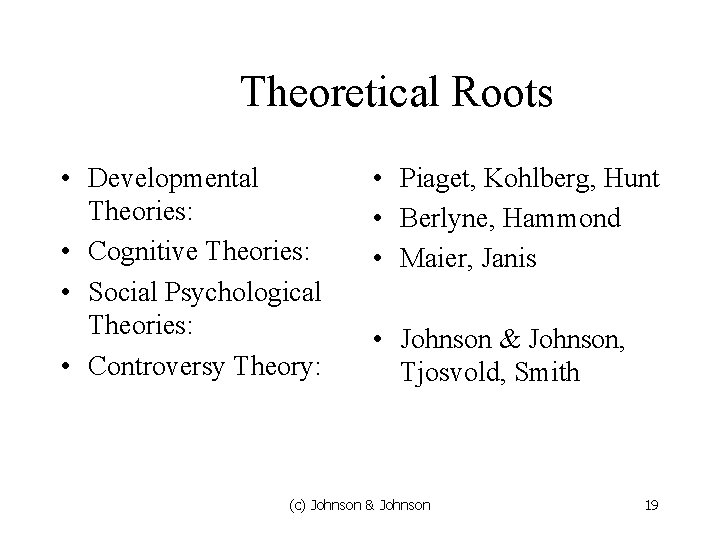
Theoretical Roots • Developmental Theories: • Cognitive Theories: • Social Psychological Theories: • Controversy Theory: • Piaget, Kohlberg, Hunt • Berlyne, Hammond • Maier, Janis • Johnson & Johnson, Tjosvold, Smith (c) Johnson & Johnson 19
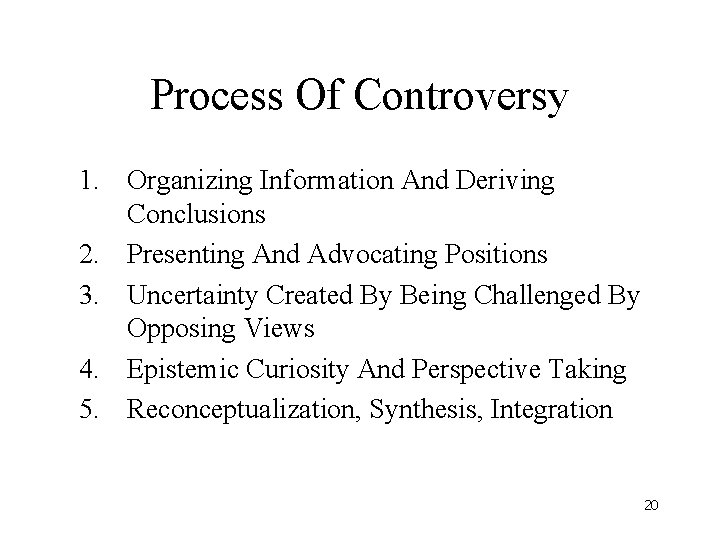
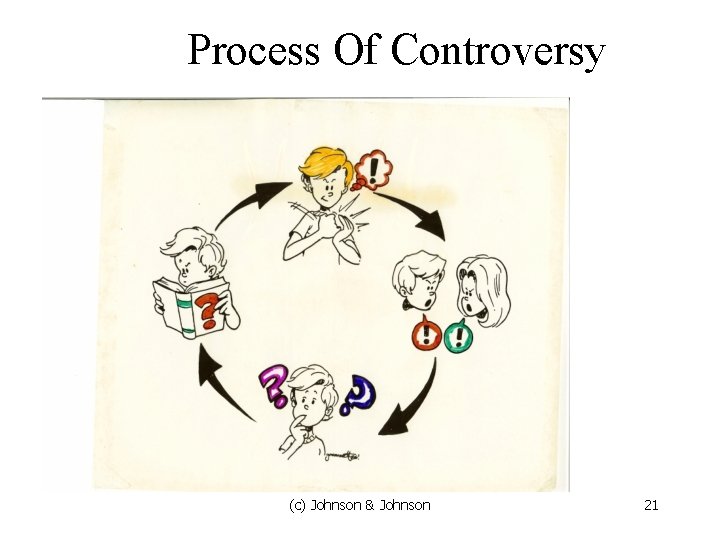
Process Of Controversy 1. Organizing Information And Deriving Conclusions 2. Presenting And Advocating Positions 3. Uncertainty Created By Being Challenged By Opposing Views 4. Epistemic Curiosity And Perspective Taking 5. Reconceptualization, Synthesis, Integration 20
Process Of Controversy (c) Johnson & Johnson 21
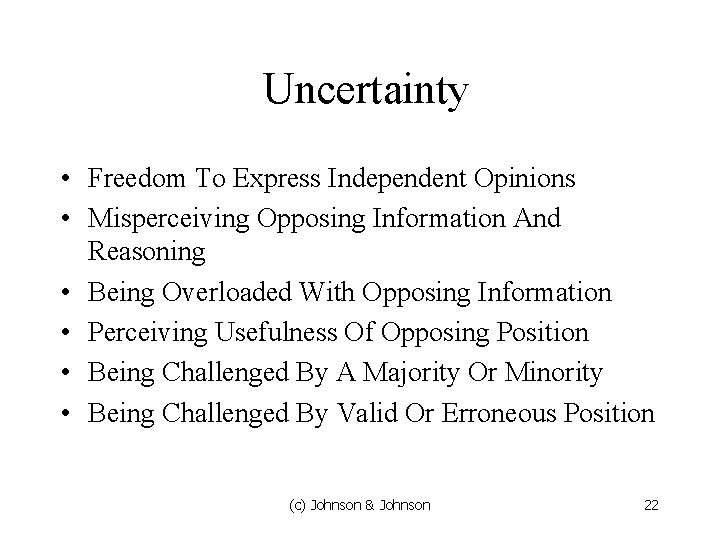
Uncertainty • Freedom To Express Independent Opinions • Misperceiving Opposing Information And Reasoning • Being Overloaded With Opposing Information • Perceiving Usefulness Of Opposing Position • Being Challenged By A Majority Or Minority • Being Challenged By Valid Or Erroneous Position (c) Johnson & Johnson 22
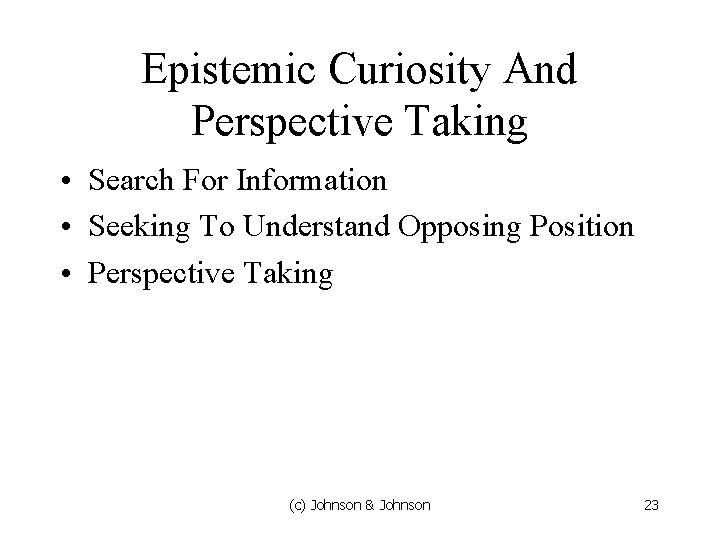
Epistemic Curiosity And Perspective Taking • Search For Information • Seeking To Understand Opposing Position • Perspective Taking (c) Johnson & Johnson 23
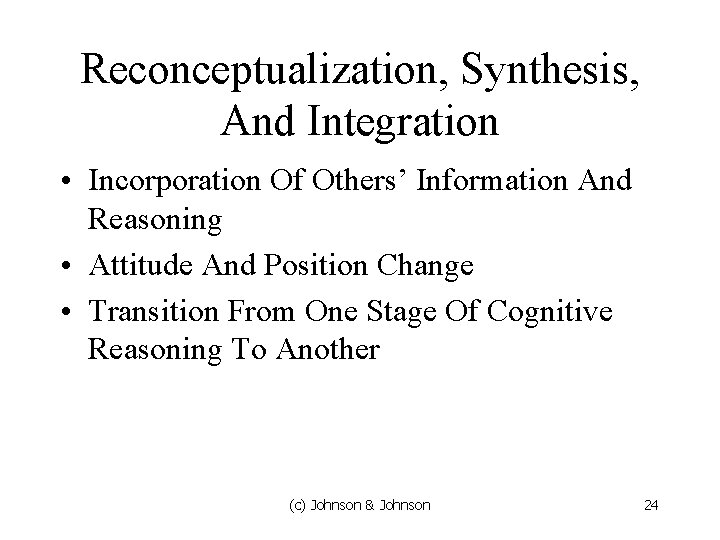
Reconceptualization, Synthesis, And Integration • Incorporation Of Others’ Information And Reasoning • Attitude And Position Change • Transition From One Stage Of Cognitive Reasoning To Another (c) Johnson & Johnson 24
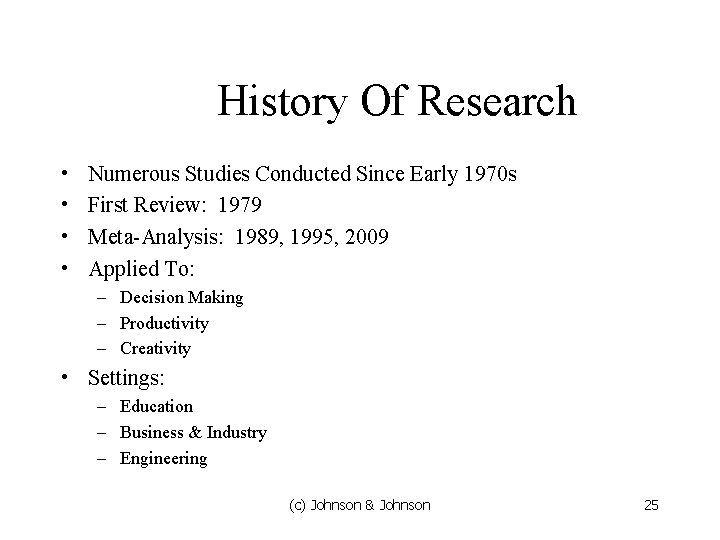
History Of Research • • Numerous Studies Conducted Since Early 1970 s First Review: 1979 Meta-Analysis: 1989, 1995, 2009 Applied To: – Decision Making – Productivity – Creativity • Settings: – Education – Business & Industry – Engineering (c) Johnson & Johnson 25
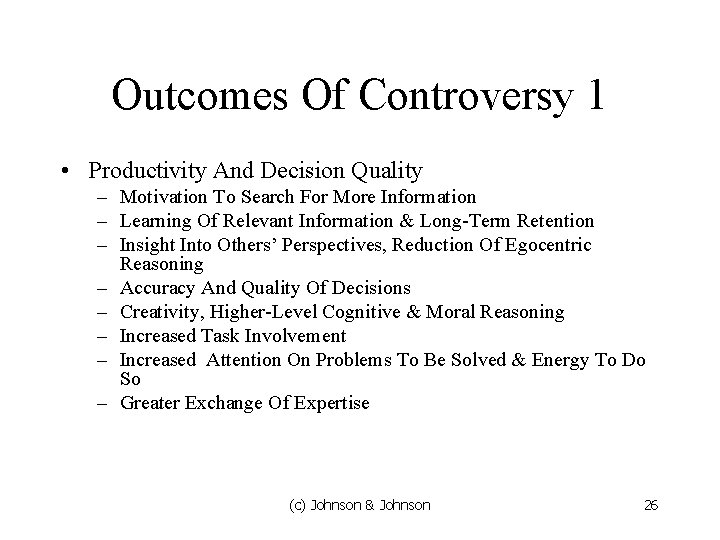
Outcomes Of Controversy 1 • Productivity And Decision Quality – Motivation To Search For More Information – Learning Of Relevant Information & Long-Term Retention – Insight Into Others’ Perspectives, Reduction Of Egocentric Reasoning – Accuracy And Quality Of Decisions – Creativity, Higher-Level Cognitive & Moral Reasoning – Increased Task Involvement – Increased Attention On Problems To Be Solved & Energy To Do So – Greater Exchange Of Expertise (c) Johnson & Johnson 26
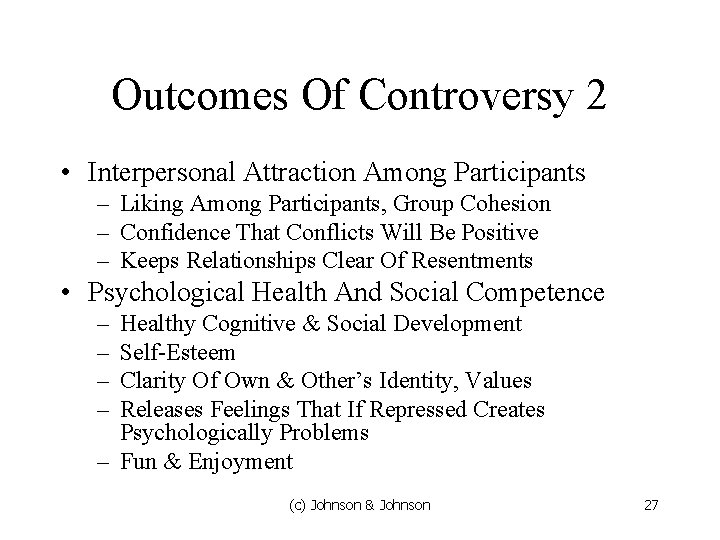
Outcomes Of Controversy 2 • Interpersonal Attraction Among Participants – Liking Among Participants, Group Cohesion – Confidence That Conflicts Will Be Positive – Keeps Relationships Clear Of Resentments • Psychological Health And Social Competence – – Healthy Cognitive & Social Development Self-Esteem Clarity Of Own & Other’s Identity, Values Releases Feelings That If Repressed Creates Psychologically Problems – Fun & Enjoyment (c) Johnson & Johnson 27
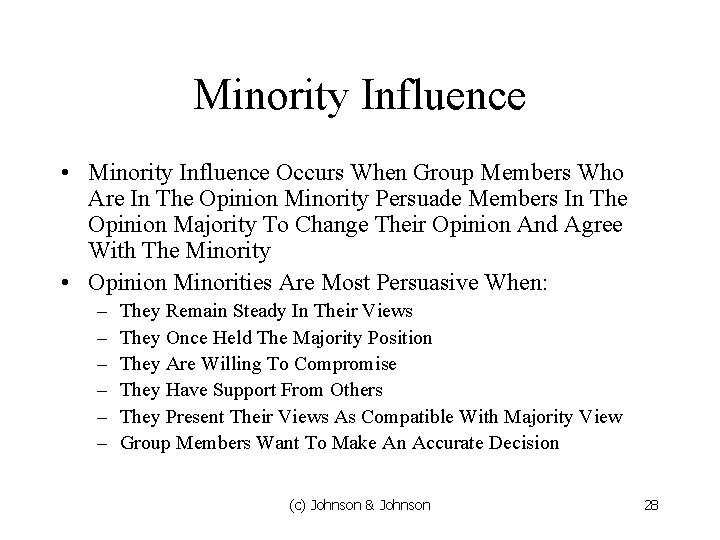
Minority Influence • Minority Influence Occurs When Group Members Who Are In The Opinion Minority Persuade Members In The Opinion Majority To Change Their Opinion And Agree With The Minority • Opinion Minorities Are Most Persuasive When: – – – They Remain Steady In Their Views They Once Held The Majority Position They Are Willing To Compromise They Have Support From Others They Present Their Views As Compatible With Majority View Group Members Want To Make An Accurate Decision (c) Johnson & Johnson 28
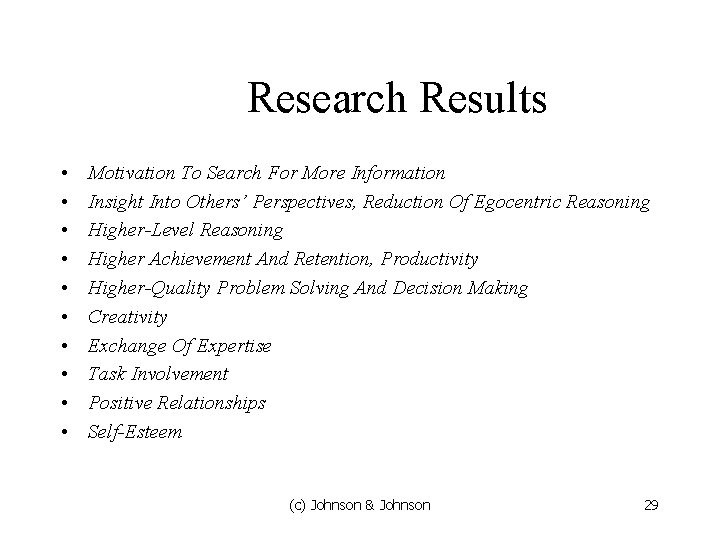
Research Results • • • Motivation To Search For More Information Insight Into Others’ Perspectives, Reduction Of Egocentric Reasoning Higher-Level Reasoning Higher Achievement And Retention, Productivity Higher-Quality Problem Solving And Decision Making Creativity Exchange Of Expertise Task Involvement Positive Relationships Self-Esteem (c) Johnson & Johnson 29
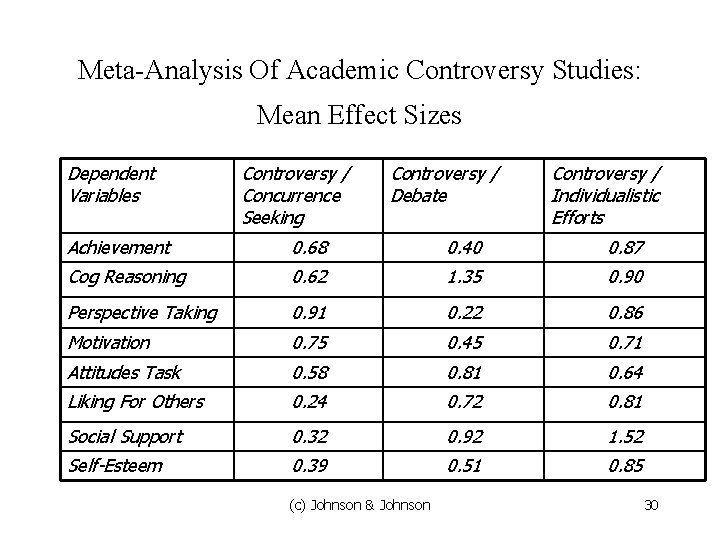
Meta-Analysis Of Academic Controversy Studies: Mean Effect Sizes Dependent Variables Controversy / Concurrence Seeking Controversy / Debate Controversy / Individualistic Efforts Achievement 0. 68 0. 40 0. 87 Cog Reasoning 0. 62 1. 35 0. 90 Perspective Taking 0. 91 0. 22 0. 86 Motivation 0. 75 0. 45 0. 71 Attitudes Task 0. 58 0. 81 0. 64 Liking For Others 0. 24 0. 72 0. 81 Social Support 0. 32 0. 92 1. 52 Self-Esteem 0. 39 0. 51 0. 85 (c) Johnson & Johnson 30
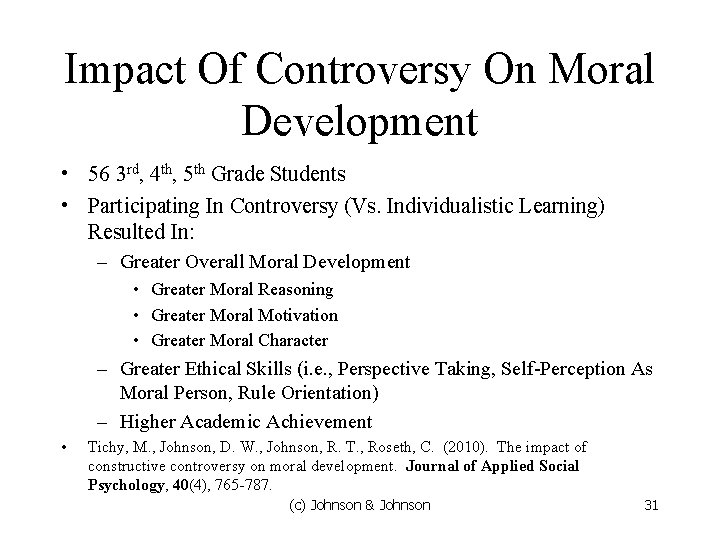
Impact Of Controversy On Moral Development • 56 3 rd, 4 th, 5 th Grade Students • Participating In Controversy (Vs. Individualistic Learning) Resulted In: – Greater Overall Moral Development • Greater Moral Reasoning • Greater Moral Motivation • Greater Moral Character – Greater Ethical Skills (i. e. , Perspective Taking, Self-Perception As Moral Person, Rule Orientation) – Higher Academic Achievement • Tichy, M. , Johnson, D. W. , Johnson, R. T. , Roseth, C. (2010). The impact of constructive controversy on moral development. Journal of Applied Social Psychology, 40(4), 765 -787. (c) Johnson & Johnson 31
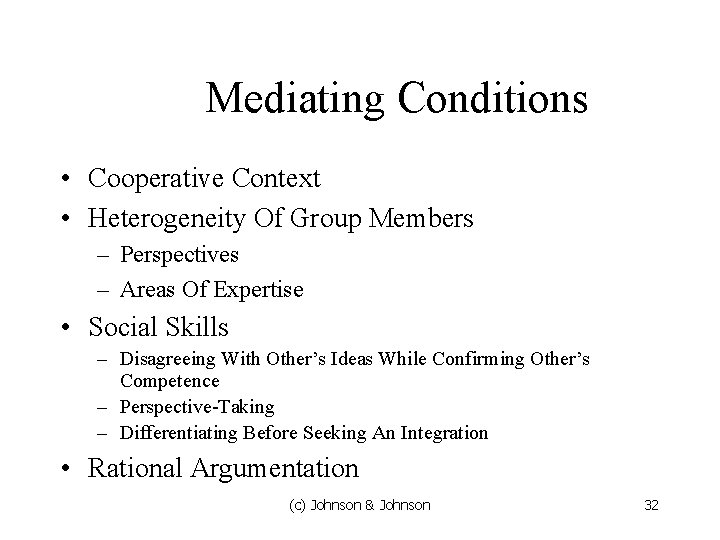
Mediating Conditions • Cooperative Context • Heterogeneity Of Group Members – Perspectives – Areas Of Expertise • Social Skills – Disagreeing With Other’s Ideas While Confirming Other’s Competence – Perspective-Taking – Differentiating Before Seeking An Integration • Rational Argumentation (c) Johnson & Johnson 32
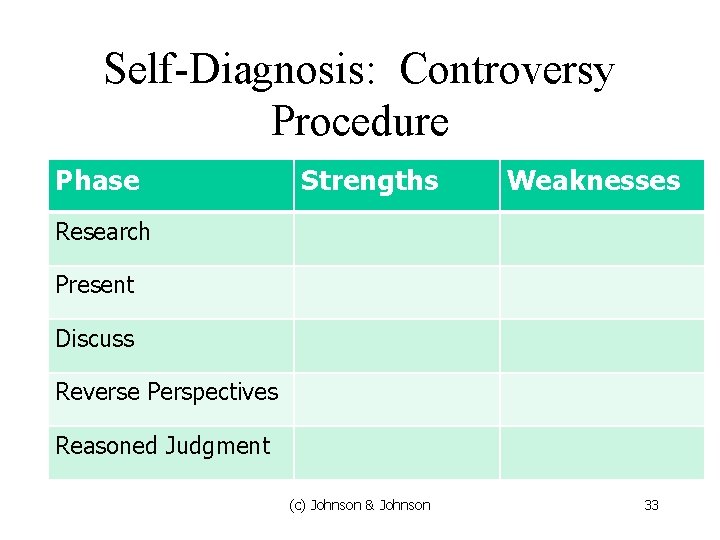
Self-Diagnosis: Controversy Procedure Phase Strengths Weaknesses Research Present Discuss Reverse Perspectives Reasoned Judgment (c) Johnson & Johnson 33
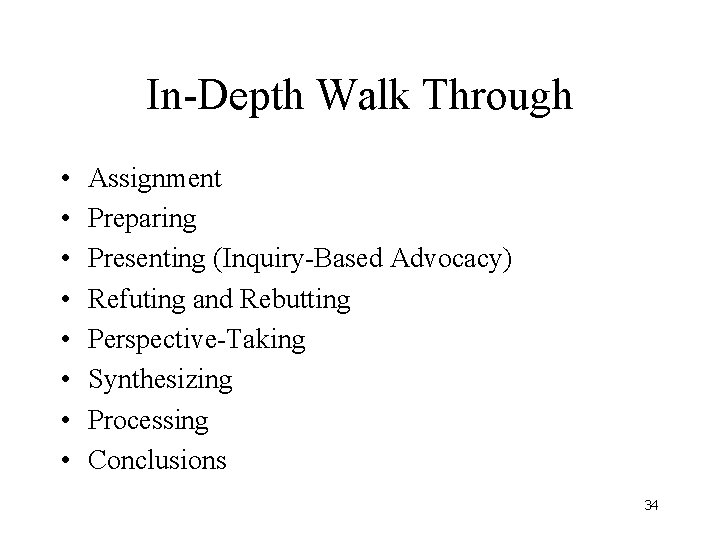
In-Depth Walk Through • • Assignment Preparing Presenting (Inquiry-Based Advocacy) Refuting and Rebutting Perspective-Taking Synthesizing Processing Conclusions 34
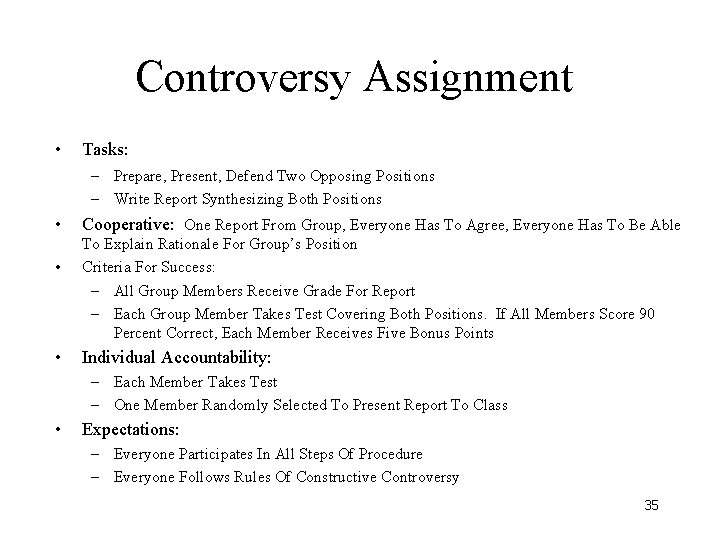
Controversy Assignment • Tasks: – Prepare, Present, Defend Two Opposing Positions – Write Report Synthesizing Both Positions • • • Cooperative: One Report From Group, Everyone Has To Agree, Everyone Has To Be Able To Explain Rationale For Group’s Position Criteria For Success: – All Group Members Receive Grade For Report – Each Group Member Takes Test Covering Both Positions. If All Members Score 90 Percent Correct, Each Member Receives Five Bonus Points Individual Accountability: – Each Member Takes Test – One Member Randomly Selected To Present Report To Class • Expectations: – Everyone Participates In All Steps Of Procedure – Everyone Follows Rules Of Constructive Controversy 35
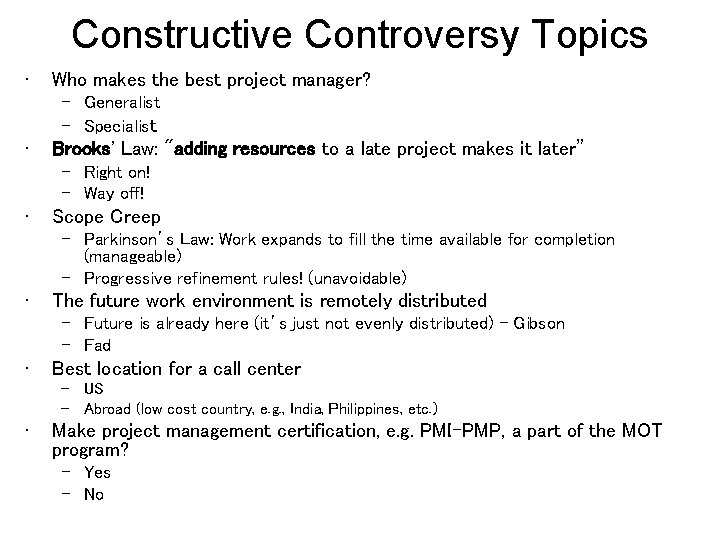
Constructive Controversy Topics • Who makes the best project manager? – Generalist – Specialist • Brooks' Law: "adding resources to a late project makes it later” – Right on! – Way off! • Scope Creep – Parkinson’s Law: Work expands to fill the time available for completion (manageable) – Progressive refinement rules! (unavoidable) • The future work environment is remotely distributed – Future is already here (it’s just not evenly distributed) - Gibson – Fad • Best location for a call center – US – Abroad (low cost country, e. g. , India, Philippines, etc. ) • Make project management certification, e. g. PMI-PMP, a part of the MOT program? – Yes – No
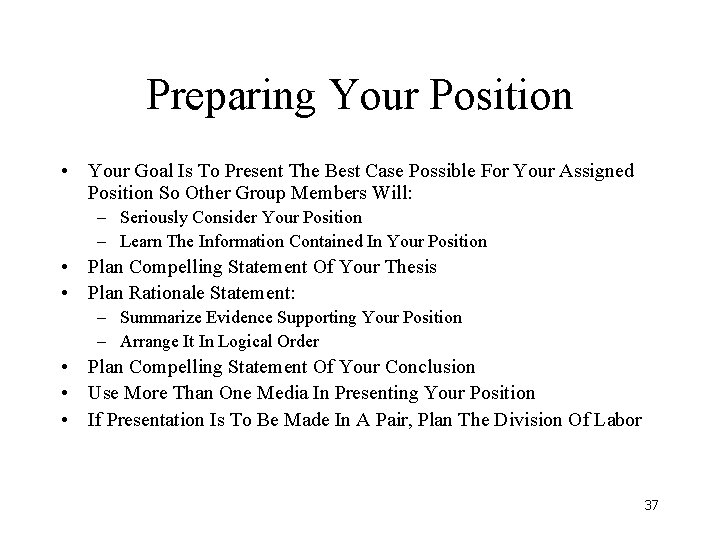
Preparing Your Position • Your Goal Is To Present The Best Case Possible For Your Assigned Position So Other Group Members Will: – Seriously Consider Your Position – Learn The Information Contained In Your Position • Plan Compelling Statement Of Your Thesis • Plan Rationale Statement: – Summarize Evidence Supporting Your Position – Arrange It In Logical Order • Plan Compelling Statement Of Your Conclusion • Use More Than One Media In Presenting Your Position • If Presentation Is To Be Made In A Pair, Plan The Division Of Labor 37
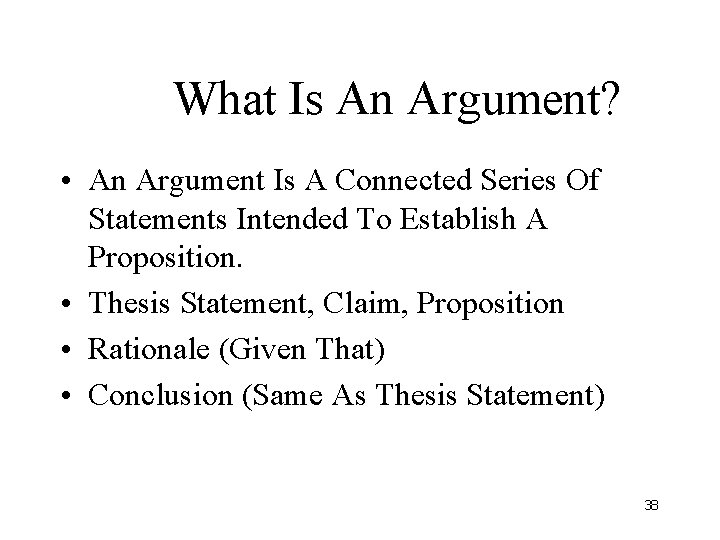
What Is An Argument? • An Argument Is A Connected Series Of Statements Intended To Establish A Proposition. • Thesis Statement, Claim, Proposition • Rationale (Given That) • Conclusion (Same As Thesis Statement) 38
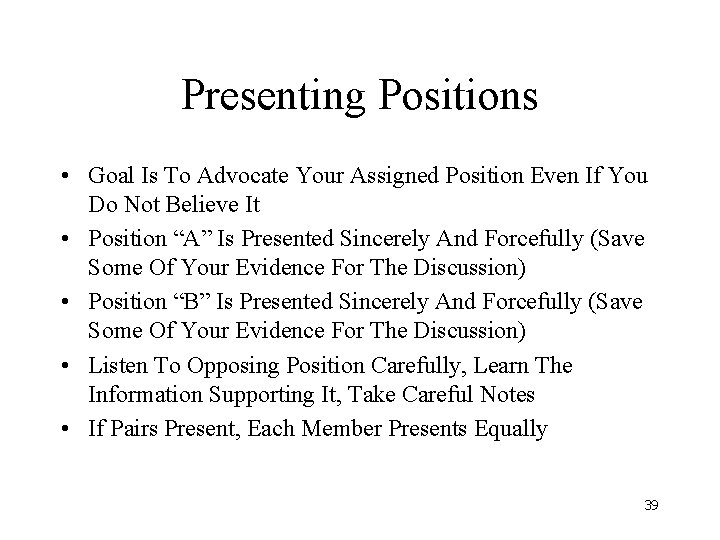
Presenting Positions • Goal Is To Advocate Your Assigned Position Even If You Do Not Believe It • Position “A” Is Presented Sincerely And Forcefully (Save Some Of Your Evidence For The Discussion) • Position “B” Is Presented Sincerely And Forcefully (Save Some Of Your Evidence For The Discussion) • Listen To Opposing Position Carefully, Learn The Information Supporting It, Take Careful Notes • If Pairs Present, Each Member Presents Equally 39
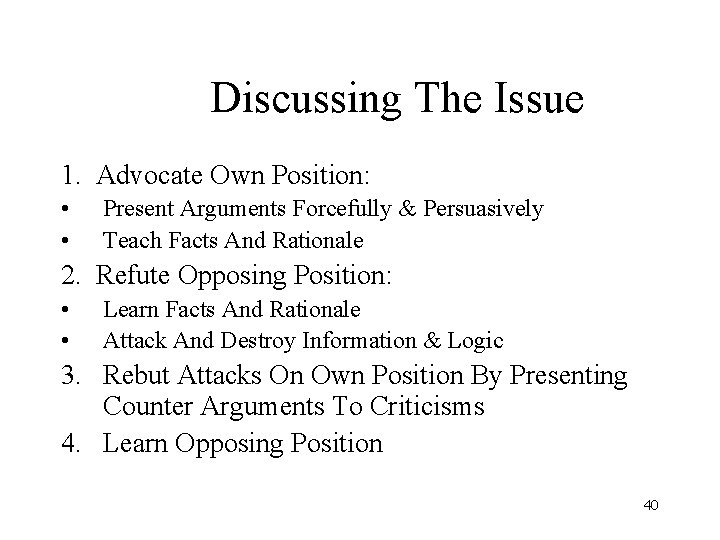
Discussing The Issue 1. Advocate Own Position: • • Present Arguments Forcefully & Persuasively Teach Facts And Rationale 2. Refute Opposing Position: • • Learn Facts And Rationale Attack And Destroy Information & Logic 3. Rebut Attacks On Own Position By Presenting Counter Arguments To Criticisms 4. Learn Opposing Position 40
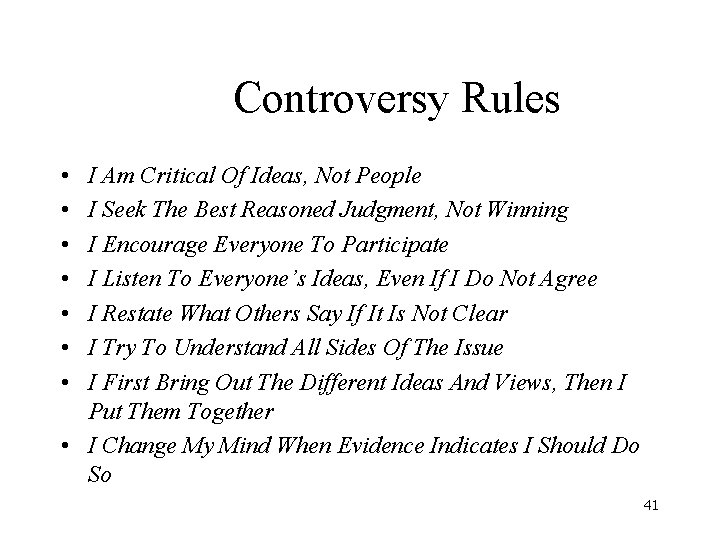
Controversy Rules • • I Am Critical Of Ideas, Not People I Seek The Best Reasoned Judgment, Not Winning I Encourage Everyone To Participate I Listen To Everyone’s Ideas, Even If I Do Not Agree I Restate What Others Say If It Is Not Clear I Try To Understand All Sides Of The Issue I First Bring Out The Different Ideas And Views, Then I Put Them Together • I Change My Mind When Evidence Indicates I Should Do So 41
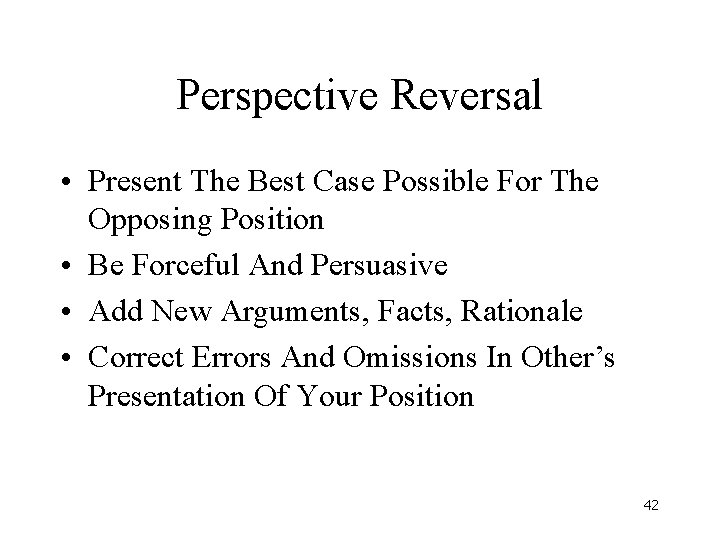
Perspective Reversal • Present The Best Case Possible For The Opposing Position • Be Forceful And Persuasive • Add New Arguments, Facts, Rationale • Correct Errors And Omissions In Other’s Presentation Of Your Position 42
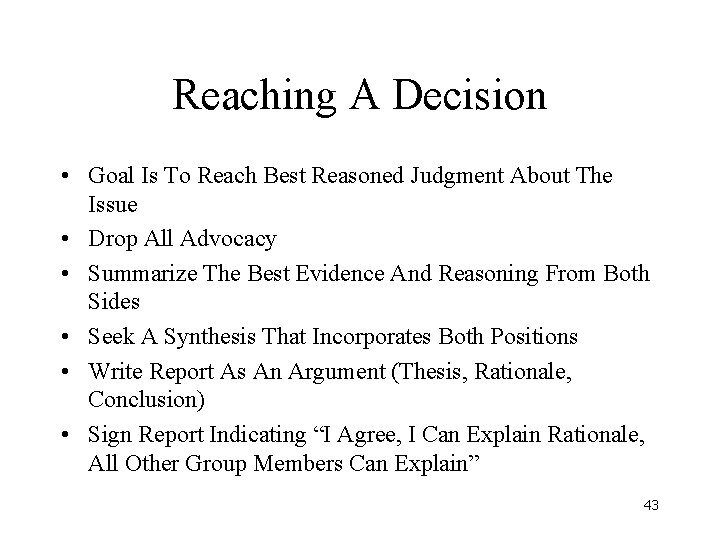
Reaching A Decision • Goal Is To Reach Best Reasoned Judgment About The Issue • Drop All Advocacy • Summarize The Best Evidence And Reasoning From Both Sides • Seek A Synthesis That Incorporates Both Positions • Write Report As An Argument (Thesis, Rationale, Conclusion) • Sign Report Indicating “I Agree, I Can Explain Rationale, All Other Group Members Can Explain” 43
Group Processing • One Thing I Really Liked About Arguing With You Is. . . • One Thing I Really Like About Engaging In A Controversy Is. . 44
Lesson Planning • • Select A Lesson Plan It In Pairs Guided Practice Barriers And Solutions 45
Controversy References Garvin, David A. and Roberto, Michael A. 2001. What you don’t know about making decisions. Harvard Business Review, 79 (8), 108 -116. Johnson, David W. , Johnson, Roger T. 2007. Constructive controversy, 4 th Ed. Edina, MN: Interaction Book Company. Johnson, David W. , Johnson, Roger T. , and Smith, Karl A. 1996. Enriching college instruction with constructive controversy. ASHEERIC Reports on Higher Education. Washington, DC: ERIC. [ASHE-ERIC, One Dupont Circle, Suite 630, Washington, DC 20036 -1183] Johnson, D. W. , Johnson, R. T. , and Smith, K. A. 2000. Constructive controversy: The power of intellectual conflict. Change, 32 (1), 2837. Smith, Karl A. 1984. Structured controversy. Engineering Education, 74(5), 306 -309.