
INTRODUCTION TO CONCEPTUAL DATA MODELING 5242021 DB Intro
INTRODUCTION TO CONCEPTUAL DATA MODELING 5/24/2021 DB: Intro. to Concptual DM 1
Objective n n n 5/24/2021 Introduction + Database Design Process + Requirements + Conceptual Design + Entity-Relationship Model + DB: Intro. to Concptual DM 2
- Introduction n A database application refers to a particular database and the associated programs that implement the database queries and update. n n Designing a Database application involves designing n n 5/24/2021 Example: A bank database application consists of the customer data of the bank in addition to the programs that will implenet all the customer transactions such as deposit and withdrawal. The database And the associated programs. DB: Intro. to Concptual DM 3
- Database Design Process n The first two steps in designing a database are: n n 5/24/2021 Collecting and analyzing requirements Conceptual Design DB: Intro. to Concptual DM 4

-- Database Design Process 5/24/2021 DB: Intro. to Concptual DM 5
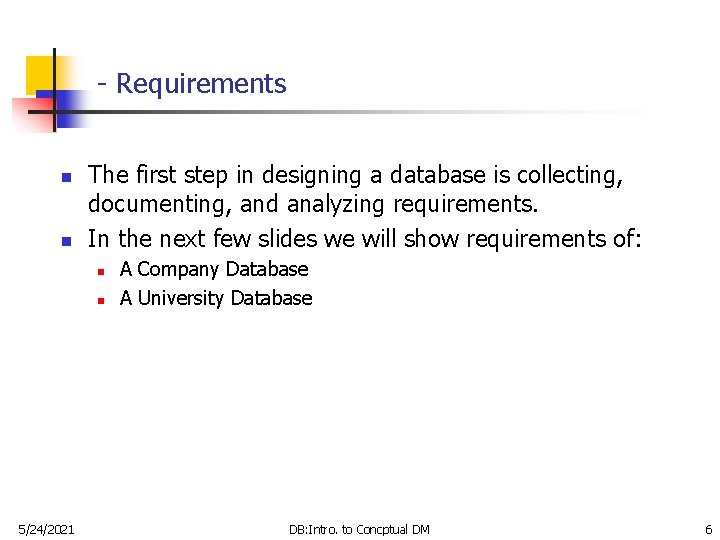
- Requirements n n The first step in designing a database is collecting, documenting, and analyzing requirements. In the next few slides we will show requirements of: n n 5/24/2021 A Company Database A University Database DB: Intro. to Concptual DM 6
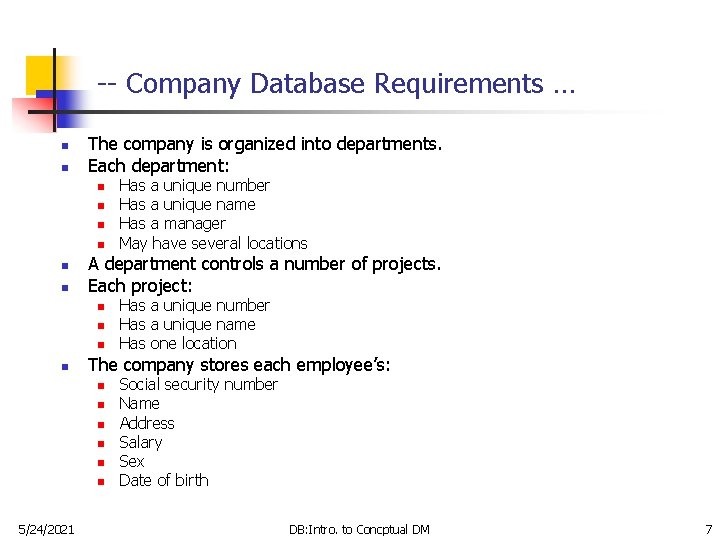
-- Company Database Requirements … n n The company is organized into departments. Each department: n n n A department controls a number of projects. Each project: n n Has a unique number Has a unique name Has one location The company stores each employee’s: n n n 5/24/2021 Has a unique number Has a unique name Has a manager May have several locations Social security number Name Address Salary Sex Date of birth DB: Intro. to Concptual DM 7
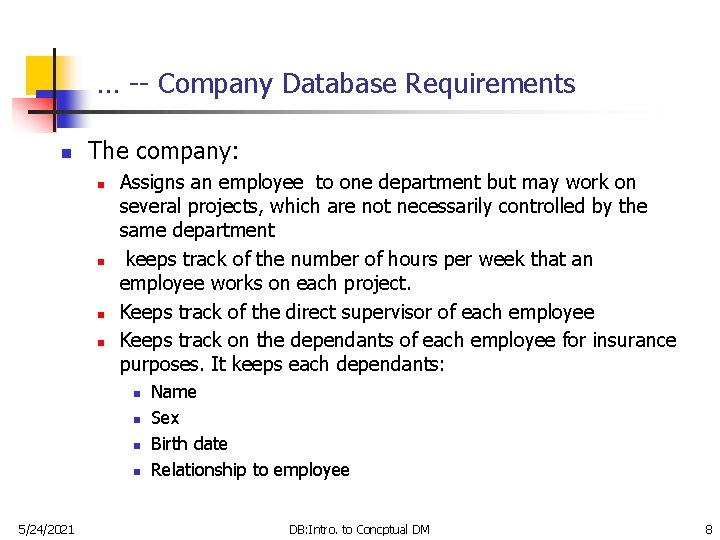
… -- Company Database Requirements n The company: n n Assigns an employee to one department but may work on several projects, which are not necessarily controlled by the same department keeps track of the number of hours per week that an employee works on each project. Keeps track of the direct supervisor of each employee Keeps track on the dependants of each employee for insurance purposes. It keeps each dependants: n n 5/24/2021 Name Sex Birth date Relationship to employee DB: Intro. to Concptual DM 8
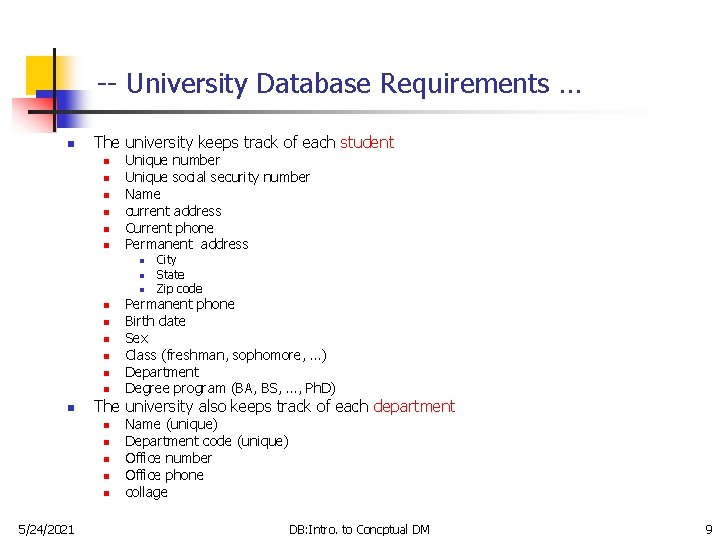
-- University Database Requirements … n The university keeps track of each student n n n Unique number Unique social security number Name current address Current phone Permanent address n n n n n Permanent phone Birth date Sex Class (freshman, sophomore, …) Department Degree program (BA, BS, …, Ph. D) The university also keeps track of each department n n n 5/24/2021 City State Zip code Name (unique) Department code (unique) Office number Office phone collage DB: Intro. to Concptual DM 9
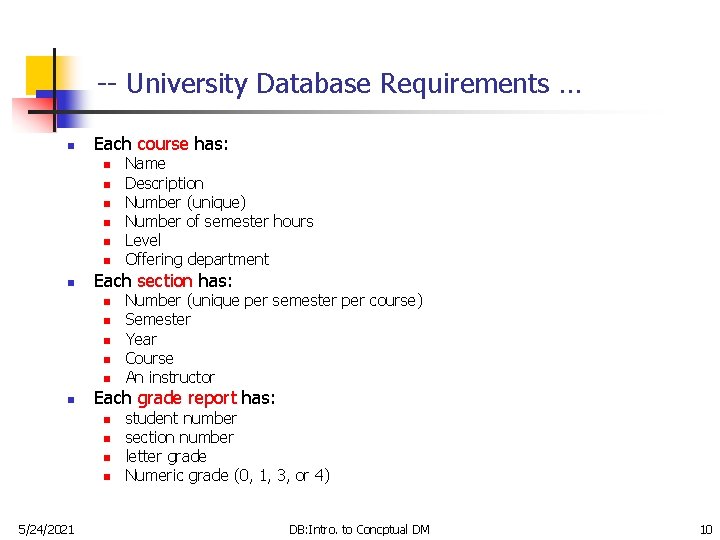
-- University Database Requirements … n Each course has: n n n n Each section has: n n n Number (unique per semester per course) Semester Year Course An instructor Each grade report has: n n 5/24/2021 Name Description Number (unique) Number of semester hours Level Offering department student number section number letter grade Numeric grade (0, 1, 3, or 4) DB: Intro. to Concptual DM 10
- Conceptual Design n n 5/24/2021 Conceptual modeling + Entity-Relationship model + DB: Intro. to Concptual DM 11

-- Conceptual Modeling n n Once the requirements have being collected analyzed, the next step is to create a conceptual schema for the database. A Conceptual schema is a concise description of the data requirements of the user and it contains: n n n 5/24/2021 Detailed description of the entity types Relationships constraints Conceptual schema is created using a high level conceptual data model Here, we will present the Entity-Relationship model, which is a popular high-level conceptual model, and we will use it in designing a database application. DB: Intro. to Concptual DM 12
- Entity Relationship Model n n n 5/24/2021 Definition + Entities + Attributes + DB: Intro. to Concptual DM 13
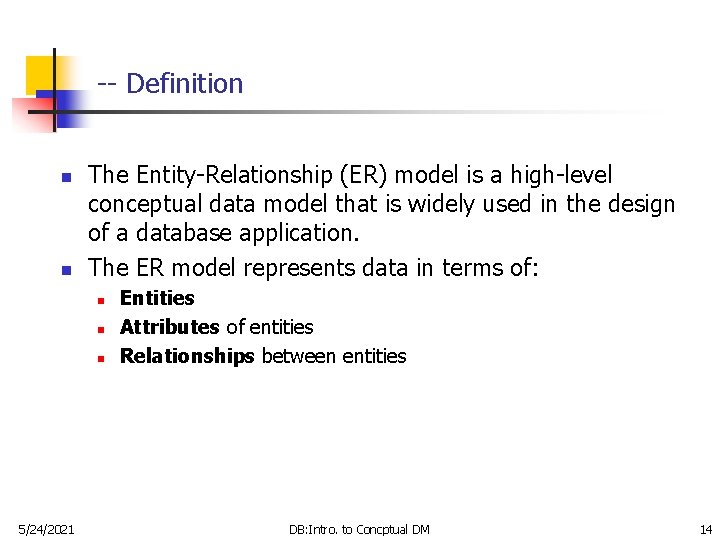
-- Definition n n The Entity-Relationship (ER) model is a high-level conceptual data model that is widely used in the design of a database application. The ER model represents data in terms of: n n n 5/24/2021 Entities Attributes of entities Relationships between entities DB: Intro. to Concptual DM 14
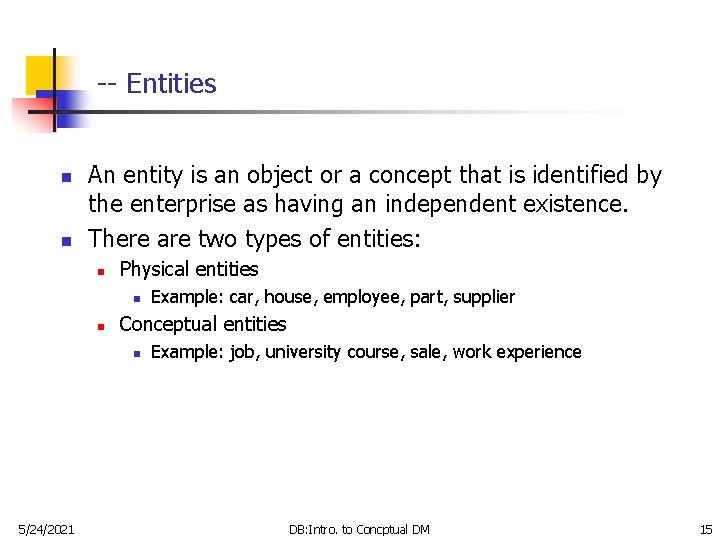
-- Entities n n An entity is an object or a concept that is identified by the enterprise as having an independent existence. There are two types of entities: n Physical entities n n Conceptual entities n 5/24/2021 Example: car, house, employee, part, supplier Example: job, university course, sale, work experience DB: Intro. to Concptual DM 15
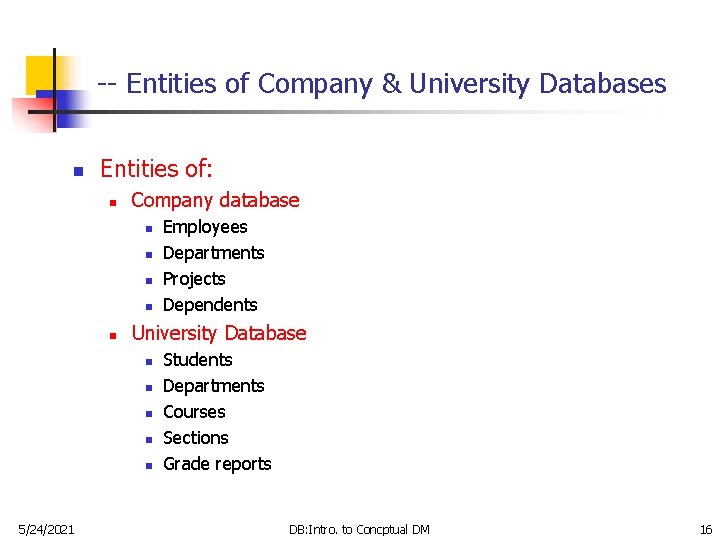
-- Entities of Company & University Databases n Entities of: n Company database n n n University Database n n n 5/24/2021 Employees Departments Projects Dependents Students Departments Courses Sections Grade reports DB: Intro. to Concptual DM 16
-- Attributes n n 5/24/2021 Definition + Types of attributes + DB: Intro. to Concptual DM 17
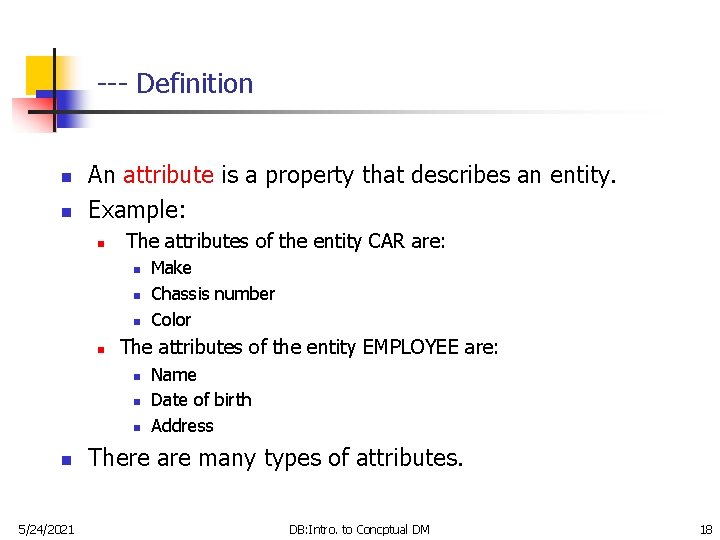
--- Definition n n An attribute is a property that describes an entity. Example: n The attributes of the entity CAR are: n n The attributes of the entity EMPLOYEE are: n n 5/24/2021 Make Chassis number Color Name Date of birth Address There are many types of attributes. DB: Intro. to Concptual DM 18
--- Types of Attributes n n 5/24/2021 Simple Vs Composite Attributes + Single-valued Vs Multi-valued Attributes + Derived Vs Stored Attributes + Complex attributes + DB: Intro. to Concptual DM 19
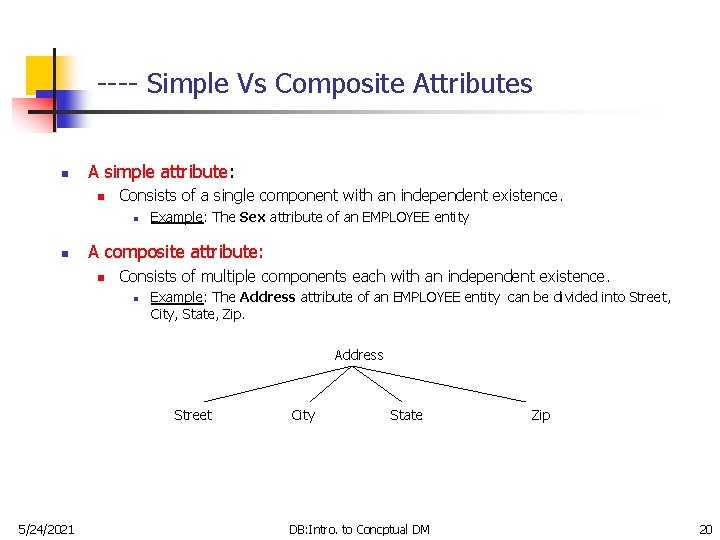
---- Simple Vs Composite Attributes n A simple attribute: n Consists of a single component with an independent existence. n n Example: The Sex attribute of an EMPLOYEE entity A composite attribute: n Consists of multiple components each with an independent existence. n Example: The Address attribute of an EMPLOYEE entity can be divided into Street, City, State, Zip. Address Street 5/24/2021 City State DB: Intro. to Concptual DM Zip 20
---- Single-valued Vs Multi-valued Attributes n Single-valued attribute: n Holds a single value for a single entity. n n Multi-valued attribute: n An attribute that holds more than one value for a single entity. n 5/24/2021 Example: the Sex attribute of an EMPLOYEE entity. Example: The Color attribute of a CAR entity. DB: Intro. to Concptual DM 21
---- Derived Vs Stored Attributes n Derived attribute: n Is an attribute that represents a value that is derived from the value of a related attribute or set of attributes not necessarily in the same entity. n n n Stored attribute: n Is an attribute that is not derived but which is directly stored in the entity. n 5/24/2021 Example 1: The value of the Age attribute of the EMPLOYEE entity can be derived from the today’s date and the value of the employee Birth. Date. Example 2: The Numberof. Employees attribute of a DEPARTMENT entity can be derived from the EMPLOYEE table by counting the number of employees who work in that department. Example: The Sex attribute in the EMPLOEE entity. DB: Intro. to Concptual DM 22
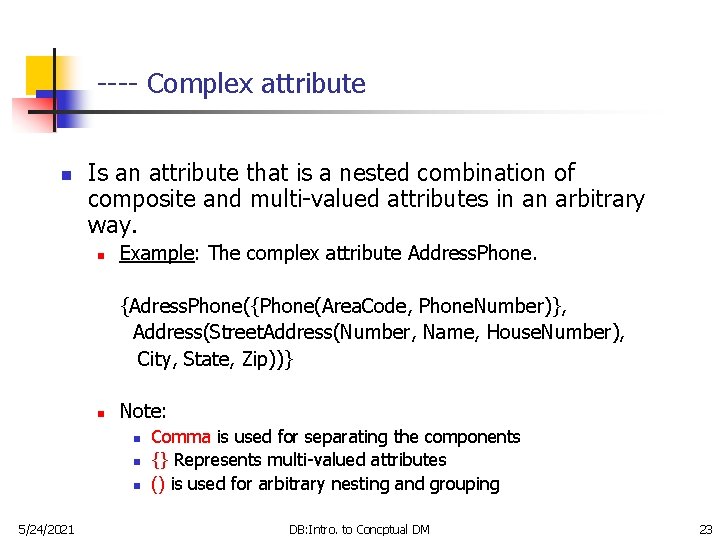
---- Complex attribute n Is an attribute that is a nested combination of composite and multi-valued attributes in an arbitrary way. n Example: The complex attribute Address. Phone. {Adress. Phone({Phone(Area. Code, Phone. Number)}, Address(Street. Address(Number, Name, House. Number), City, State, Zip))} n Note: n n n 5/24/2021 Comma is used for separating the components {} Represents multi-valued attributes () is used for arbitrary nesting and grouping DB: Intro. to Concptual DM 23
- Slides: 23