
Introduction to computer Vision Deep Learning Shai Bagon
Introduction to computer Vision: Deep Learning Shai Bagon
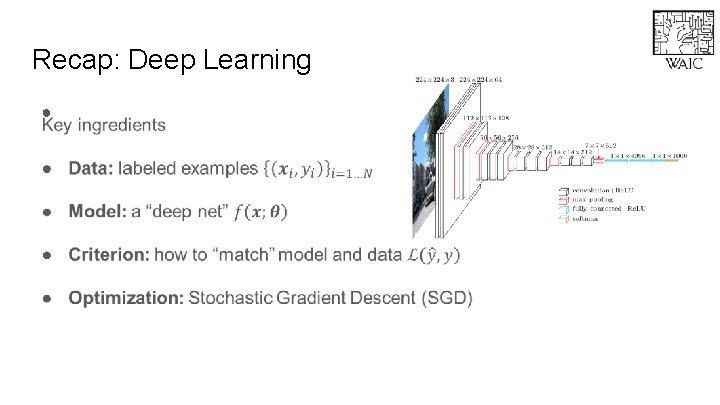
Recap: Deep Learning ●
Additional Tasks ● Object detection ● Semantic segmentation
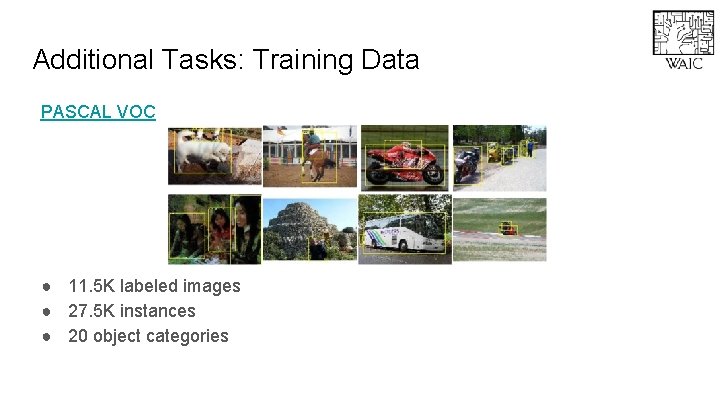
Additional Tasks: Training Data PASCAL VOC ● 11. 5 K labeled images ● 27. 5 K instances ● 20 object categories
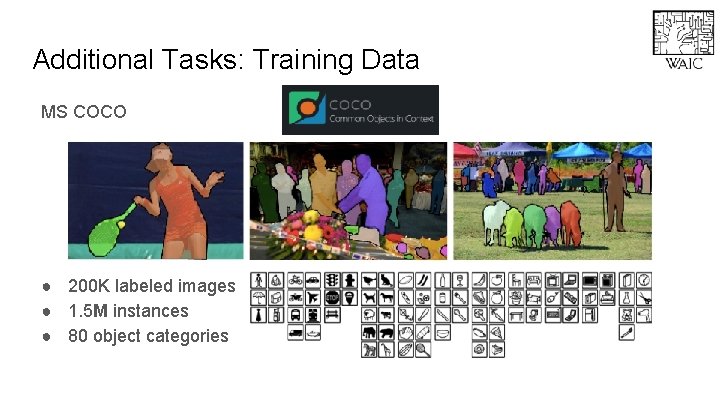
Additional Tasks: Training Data MS COCO ● 200 K labeled images ● 1. 5 M instances ● 80 object categories
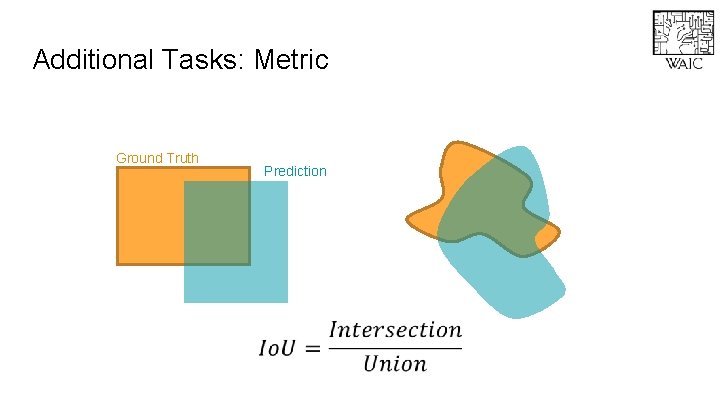
Additional Tasks: Metric Ground Truth Prediction
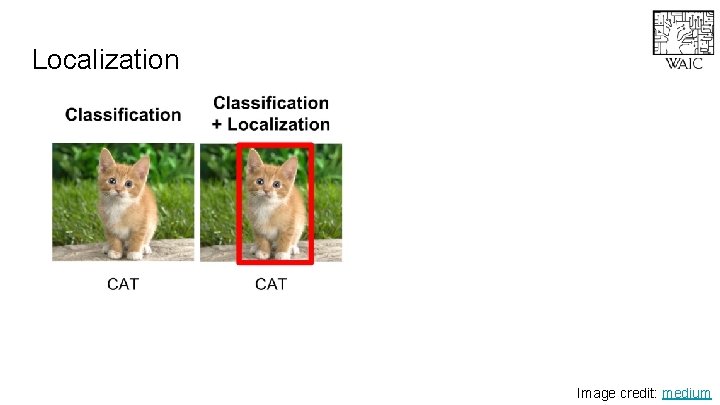
Localization Image credit: medium
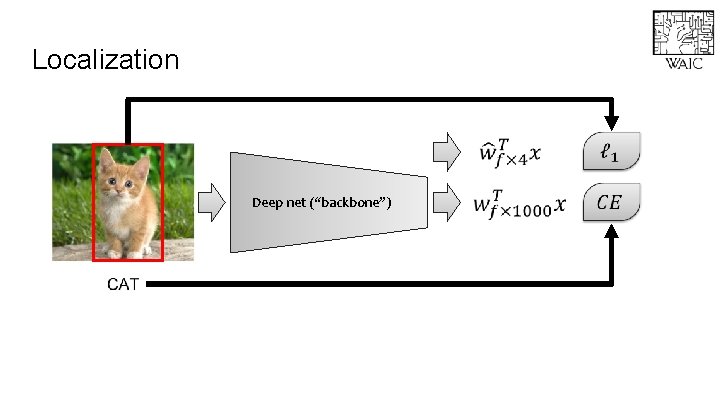
Localization Deep net (“backbone”)
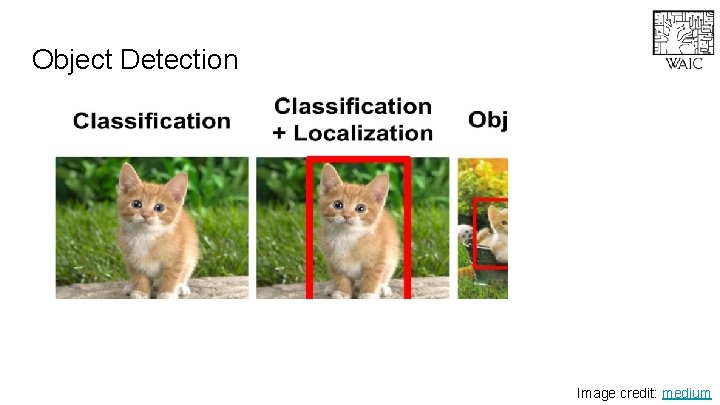
Object Detection Image credit: medium
Object Detection Two Stages (R-CNN) Single Stage (SSD, Yolo) ● Propose “objects” ● ● Classify each candidate Sliding window to classify all candidates
Object Detection Two Stages (R-CNN) Single Stage (SSD, Yolo) ● Propose “objects” ● ● Classify each candidate Sliding window to classify all candidates
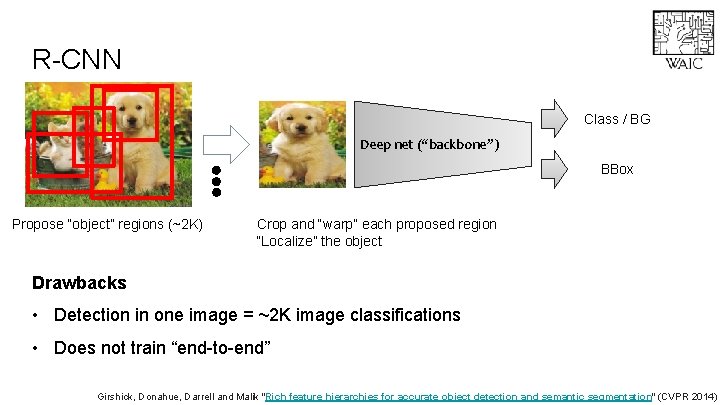
R-CNN Class / BG Deep net (“backbone”) BBox Propose “object” regions (~2 K) Crop and “warp” each proposed region “Localize” the object Drawbacks • Detection in one image = ~2 K image classifications • Does not train “end-to-end” Girshick, Donahue, Darrell and Malik "Rich feature hierarchies for accurate object detection and semantic segmentation" (CVPR 2014)
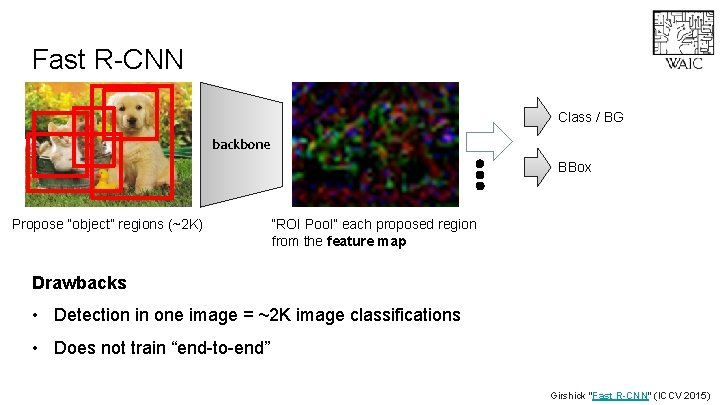
Fast R-CNN Class / BG backbone BBox Propose “object” regions (~2 K) “ROI Pool” each proposed region from the feature map Drawbacks • Detection in one image = ~2 K image classifications • Does not train “end-to-end” Girshick "Fast R-CNN" (ICCV 2015)
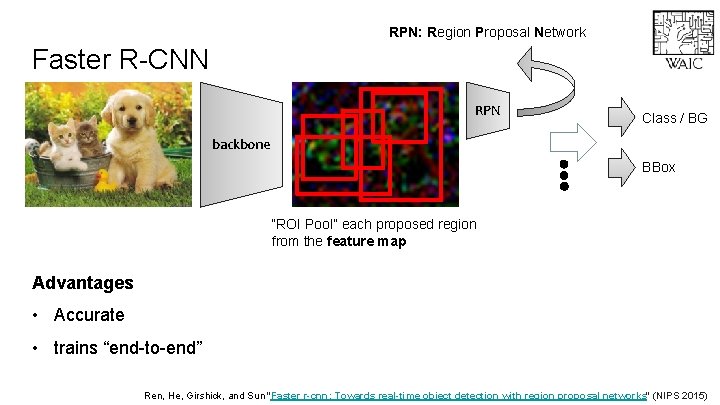
RPN: Region Proposal Network Faster R-CNN RPN Class / BG backbone BBox “ROI Pool” each proposed region from the feature map Advantages • Accurate • trains “end-to-end” Ren, He, Girshick, and Sun "Faster r-cnn: Towards real-time object detection with region proposal networks" (NIPS 2015)
RPN: Region Proposal Network How can a net outputs an arbitrary/varying number of BBoxes?
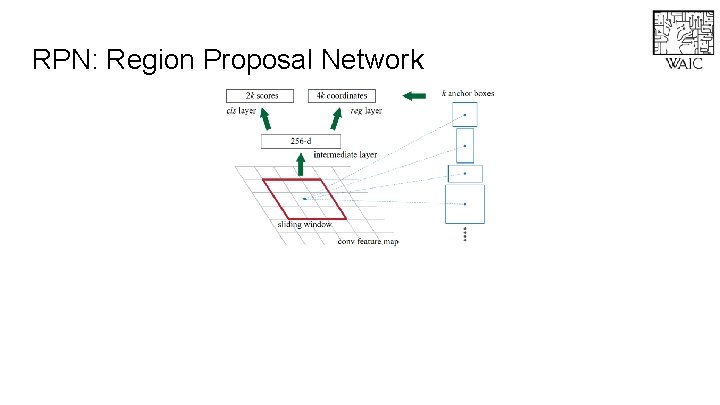
RPN: Region Proposal Network
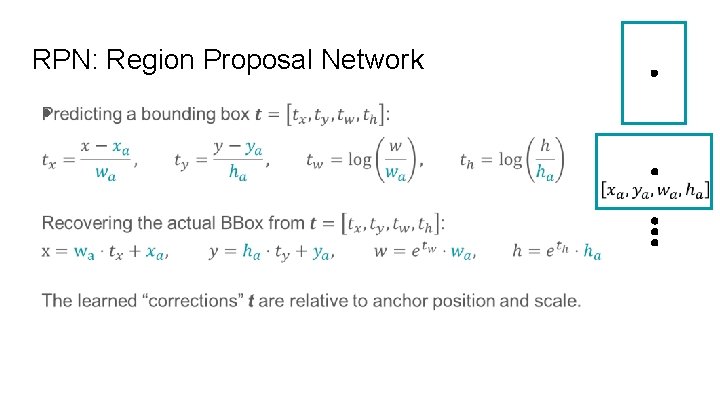
RPN: Region Proposal Network ●
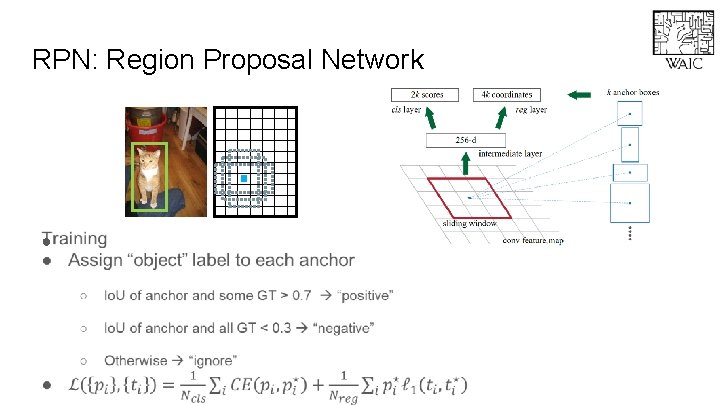
RPN: Region Proposal Network ●
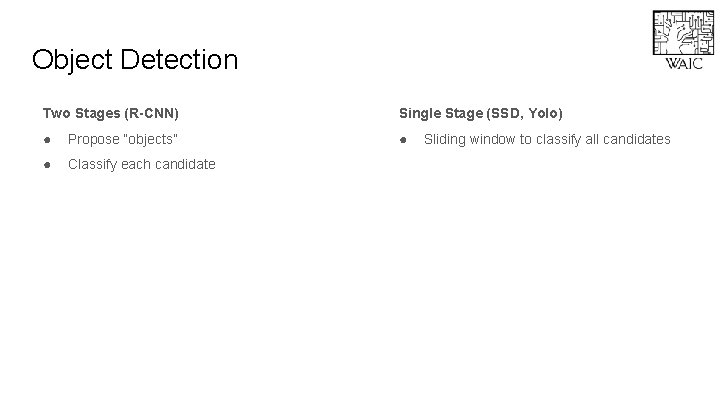
Object Detection Two Stages (R-CNN) Single Stage (SSD, Yolo) ● Propose “objects” ● ● Classify each candidate Sliding window to classify all candidates
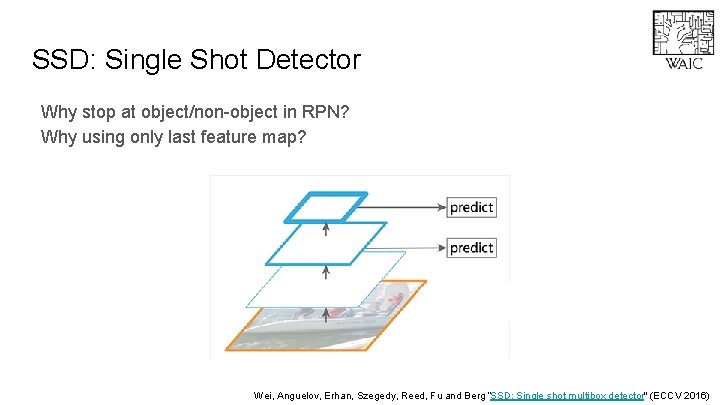
SSD: Single Shot Detector Why stop at object/non-object in RPN? Why using only last feature map? Wei, Anguelov, Erhan, Szegedy, Reed, Fu and Berg “SSD: Single shot multibox detector" (ECCV 2016)
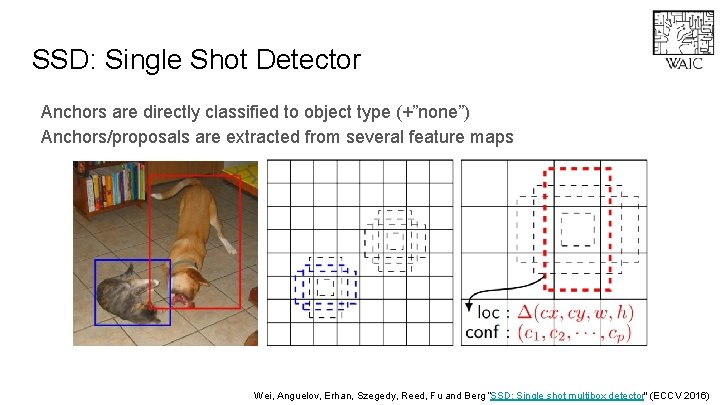
SSD: Single Shot Detector Anchors are directly classified to object type (+”none”) Anchors/proposals are extracted from several feature maps Wei, Anguelov, Erhan, Szegedy, Reed, Fu and Berg “SSD: Single shot multibox detector" (ECCV 2016)
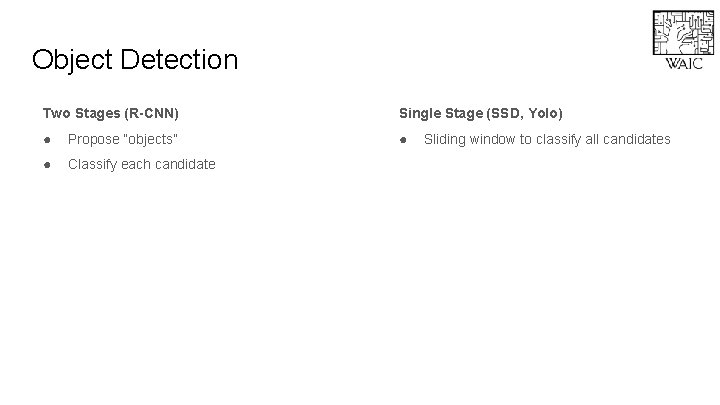
Object Detection Two Stages (R-CNN) Single Stage (SSD, Yolo) ● Propose “objects” ● ● Classify each candidate Sliding window to classify all candidates
source
Object Detection: Pitfalls and Details ● Imbalance ● Receptive field ● Multiscale
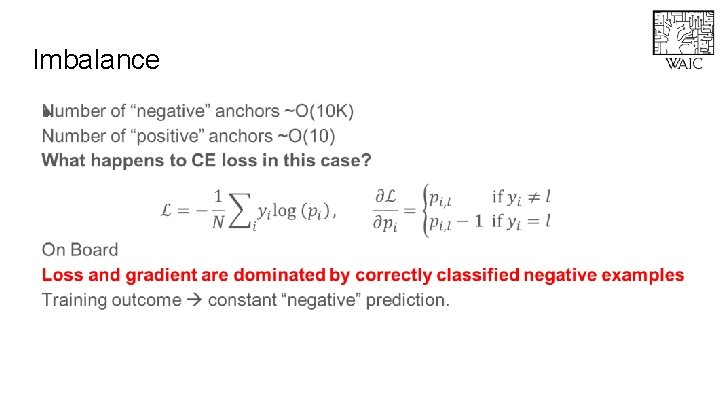
Imbalance ●
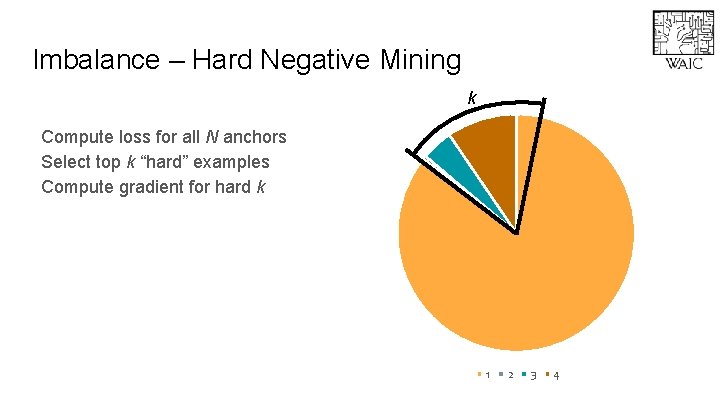
Imbalance – Hard Negative Mining k Compute loss for all N anchors Select top k “hard” examples Compute gradient for hard k 1 2 3 4
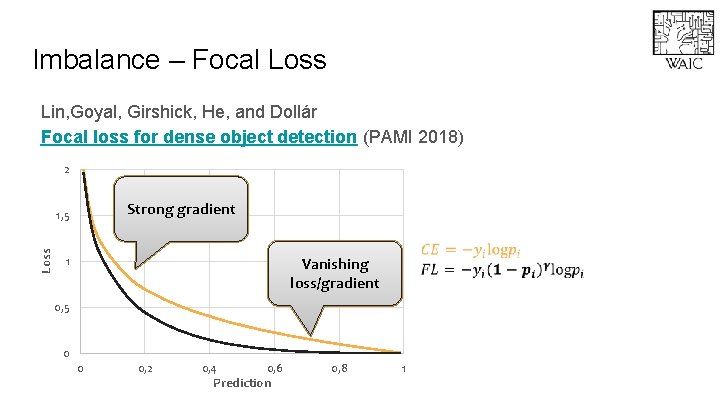
Imbalance – Focal Loss Lin, Goyal, Girshick, He, and Dollár Focal loss for dense object detection (PAMI 2018) 2 Relatively weak Strong gradient Loss 1, 5 1 Non Vanishing vanishing loss/gradient 0, 5 0 0 0, 2 0, 4 0, 6 Prediction 0, 8 1
Object Detection: Pitfalls and Details ● Imbalance ● Receptive field ● Multiscale
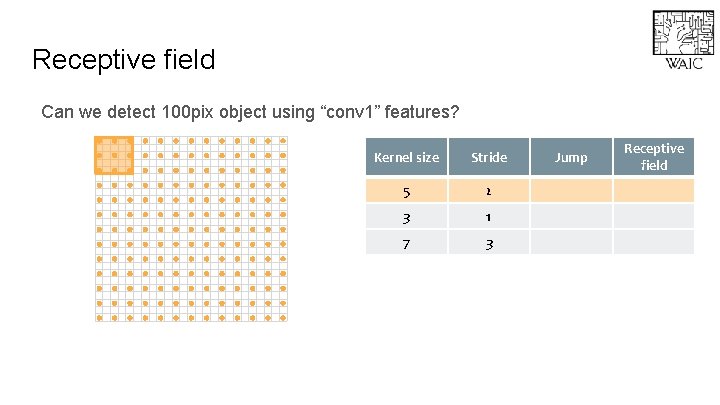
Receptive field Can we detect 100 pix object using “conv 1” features? Kernel size Stride 5 2 3 1 7 3 Jump Receptive field
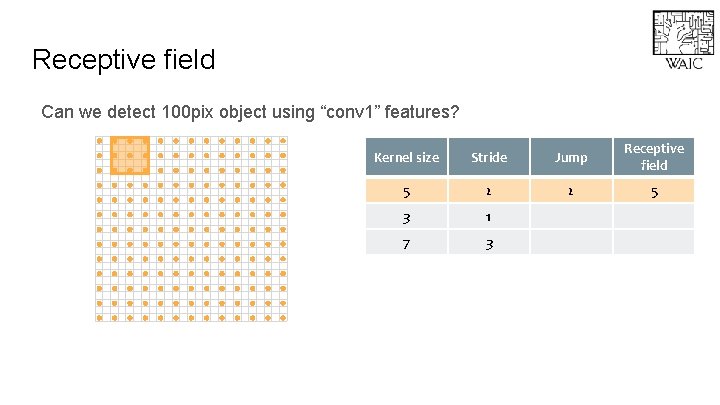
Receptive field Can we detect 100 pix object using “conv 1” features? Kernel size Stride Jump Receptive field 5 2 2 5 3 1 7 3
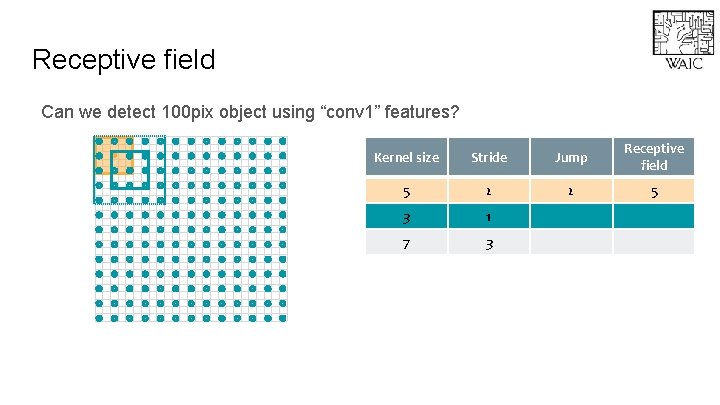
Receptive field Can we detect 100 pix object using “conv 1” features? Kernel size Stride Jump Receptive field 5 2 2 5 3 1 7 3
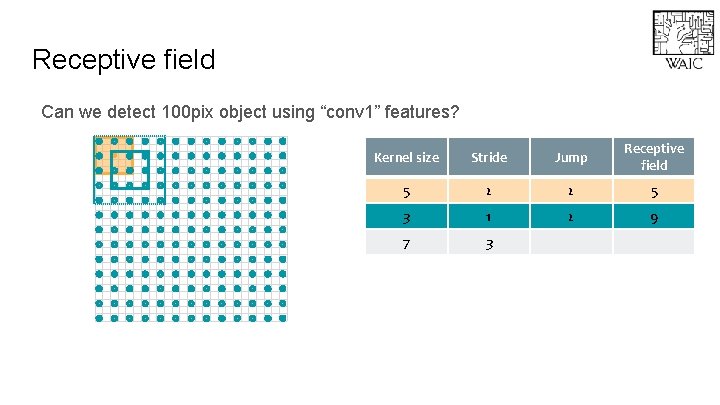
Receptive field Can we detect 100 pix object using “conv 1” features? Kernel size Stride Jump Receptive field 5 2 2 5 3 1 2 9 7 3
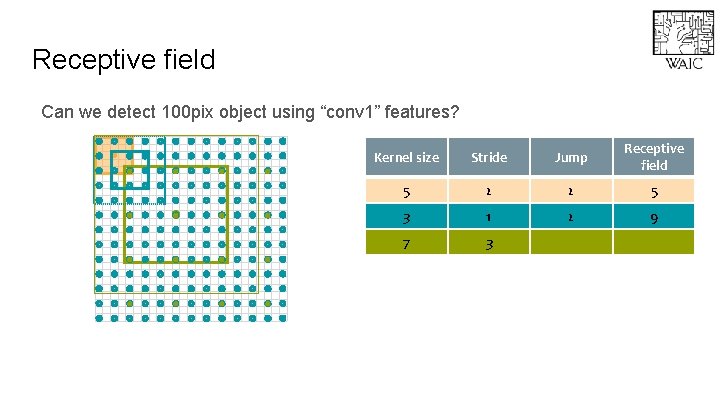
Receptive field Can we detect 100 pix object using “conv 1” features? Kernel size Stride Jump Receptive field 5 2 2 5 3 1 2 9 7 3
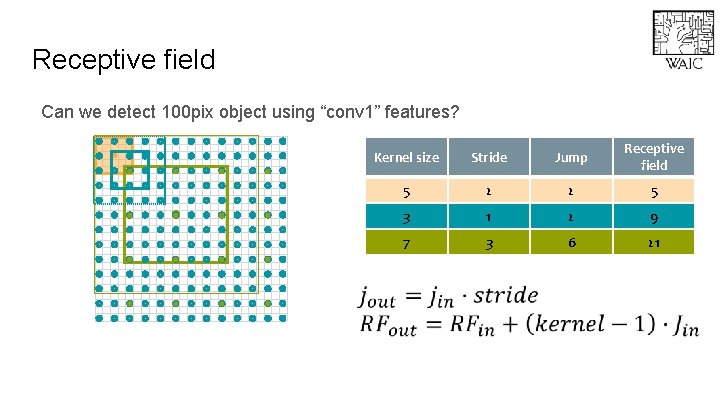
Receptive field Can we detect 100 pix object using “conv 1” features? Kernel size Stride Jump Receptive field 5 2 2 5 3 1 2 9 7 3 6 21
Receptive Field Additional reading ○ Receptive field arithmetic ○ Wenjie, Li, Urtasun and Zemel Understanding the effective receptive field in deep convolutional neural networks (NIPS 2016).
Object Detection: Pitfalls and Details ● Imbalance ● Receptive field ● Multiscale
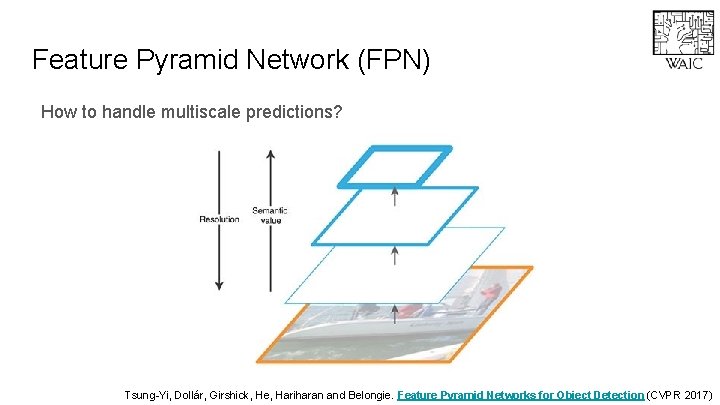
Feature Pyramid Network (FPN) How to handle multiscale predictions? Tsung-Yi, Dollár, Girshick, He, Hariharan and Belongie. Feature Pyramid Networks for Object Detection (CVPR 2017)
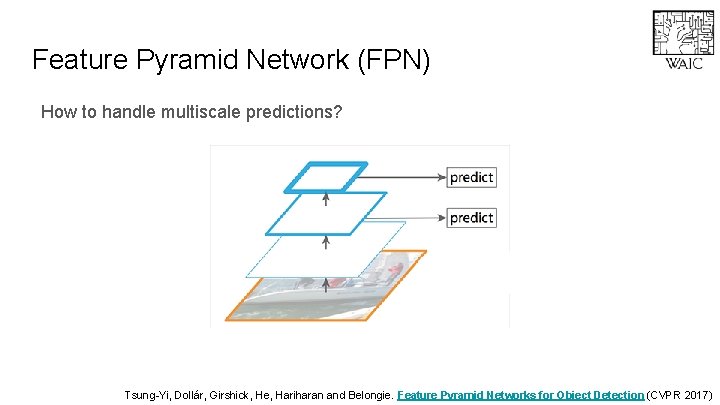
Feature Pyramid Network (FPN) How to handle multiscale predictions? Tsung-Yi, Dollár, Girshick, He, Hariharan and Belongie. Feature Pyramid Networks for Object Detection (CVPR 2017)
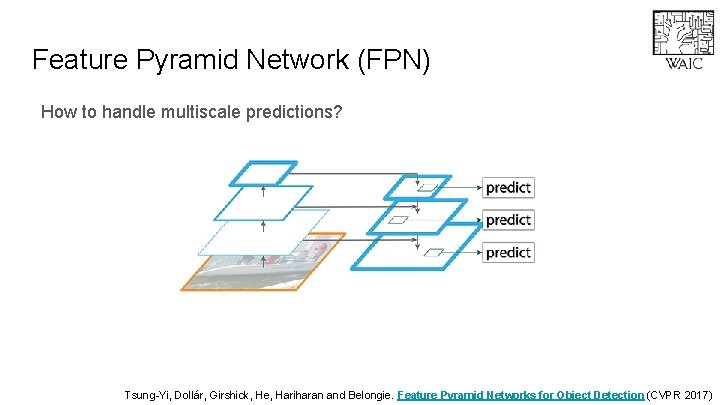
Feature Pyramid Network (FPN) How to handle multiscale predictions? Tsung-Yi, Dollár, Girshick, He, Hariharan and Belongie. Feature Pyramid Networks for Object Detection (CVPR 2017)
Object Detection ● RPN vs “Single Shot” ● Imbalance data ● Receptive field ● Backbone and multiscale
Additional Tasks ● Object detection ● Semantic segmentation
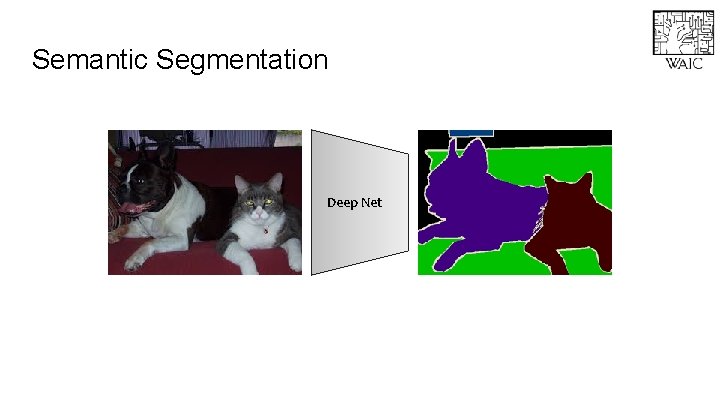
Semantic Segmentation Deep Net
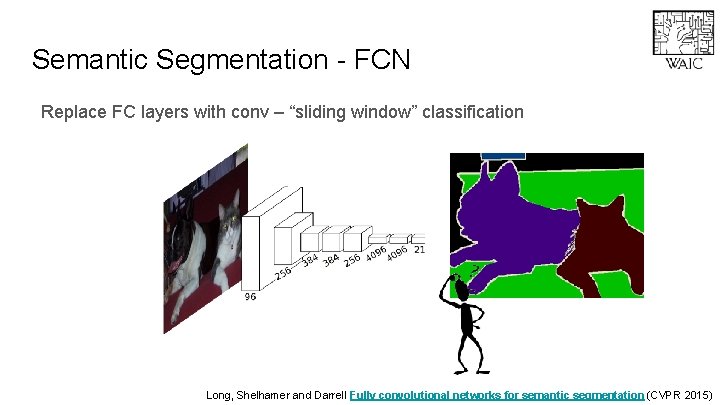
Semantic Segmentation - FCN Replace FC layers with conv – “sliding window” classification Long, Shelhamer and Darrell Fully convolutional networks for semantic segmentation (CVPR 2015)
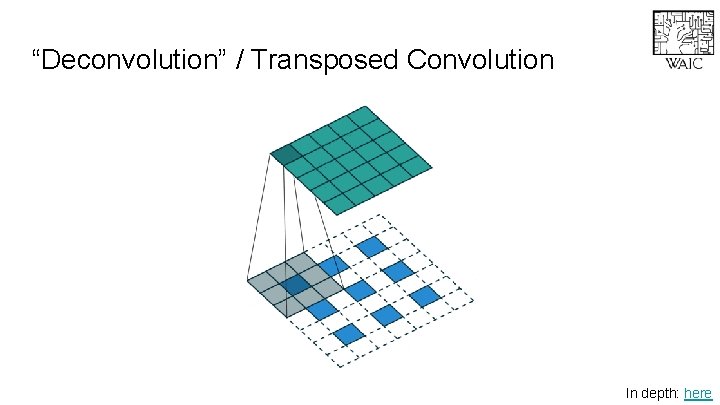
“Deconvolution” / Transposed Convolution In depth: here
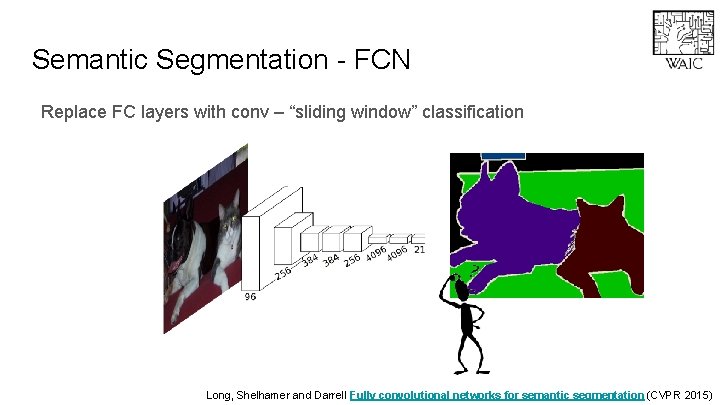
Semantic Segmentation - FCN Replace FC layers with conv – “sliding window” classification Long, Shelhamer and Darrell Fully convolutional networks for semantic segmentation (CVPR 2015)
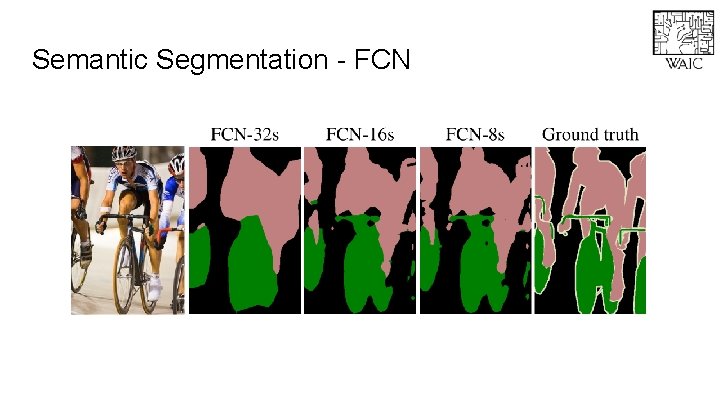
Semantic Segmentation - FCN
“Deconvolution” / Transposed Convolution In depth: here
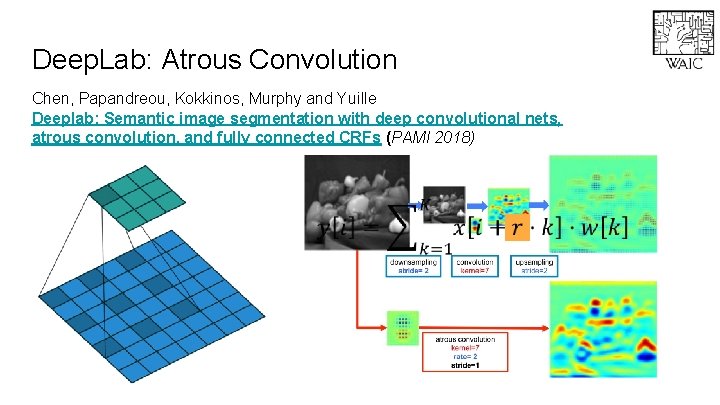
Deep. Lab: Atrous Convolution Chen, Papandreou, Kokkinos, Murphy and Yuille Deeplab: Semantic image segmentation with deep convolutional nets, atrous convolution, and fully connected CRFs (PAMI 2018)
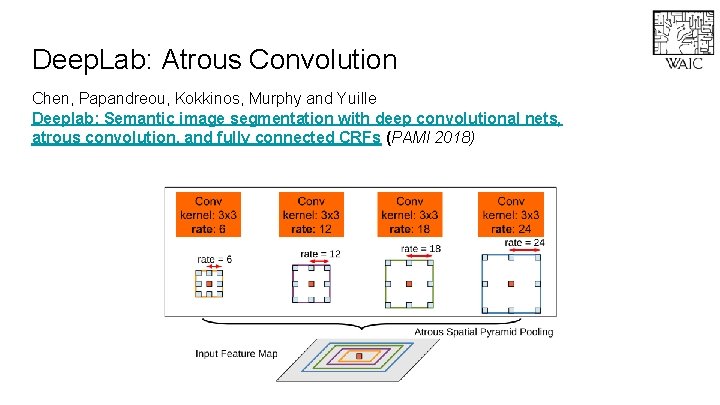
Deep. Lab: Atrous Convolution Chen, Papandreou, Kokkinos, Murphy and Yuille Deeplab: Semantic image segmentation with deep convolutional nets, atrous convolution, and fully connected CRFs (PAMI 2018)
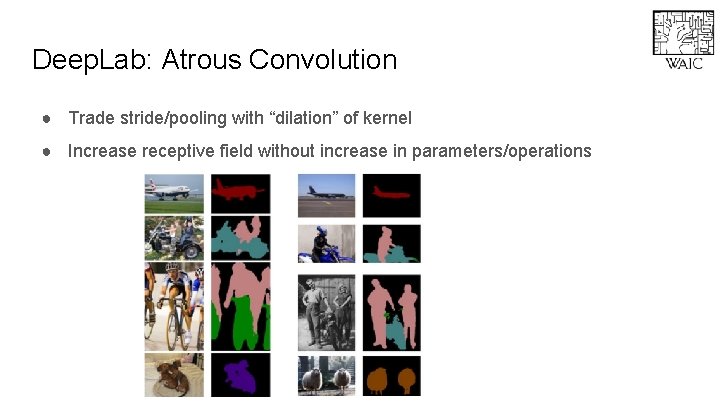
Deep. Lab: Atrous Convolution ● Trade stride/pooling with “dilation” of kernel ● Increase receptive field without increase in parameters/operations
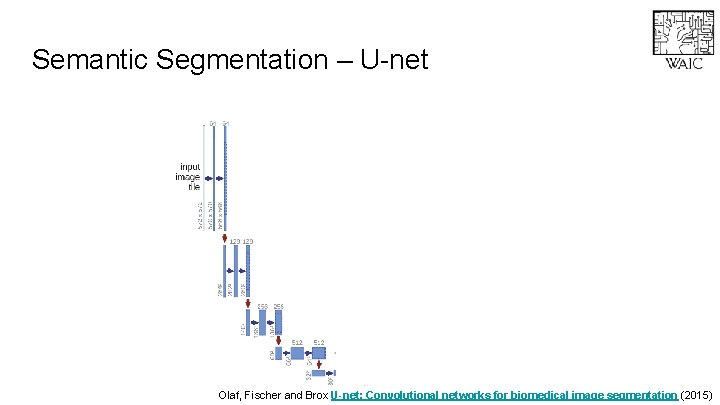
Semantic Segmentation – U-net Olaf, Fischer and Brox U-net: Convolutional networks for biomedical image segmentation (2015)
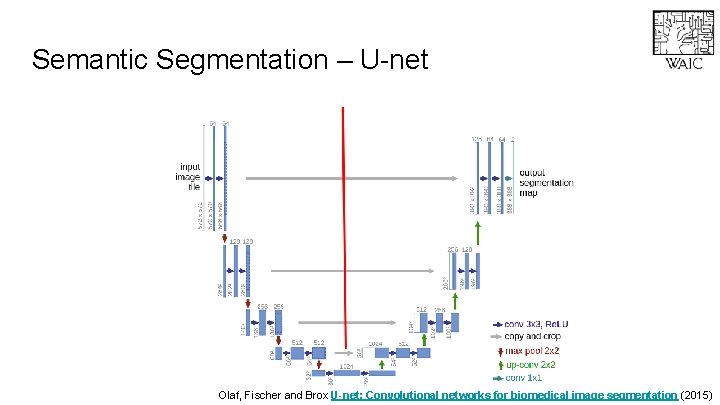
Semantic Segmentation – U-net Olaf, Fischer and Brox U-net: Convolutional networks for biomedical image segmentation (2015)
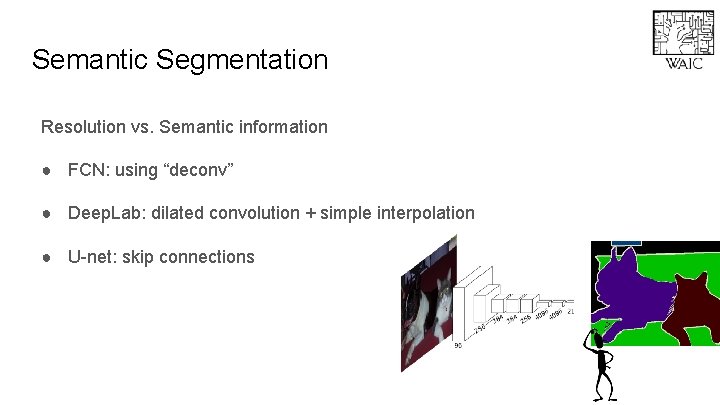
Semantic Segmentation Resolution vs. Semantic information ● FCN: using “deconv” ● Deep. Lab: dilated convolution + simple interpolation ● U-net: skip connections
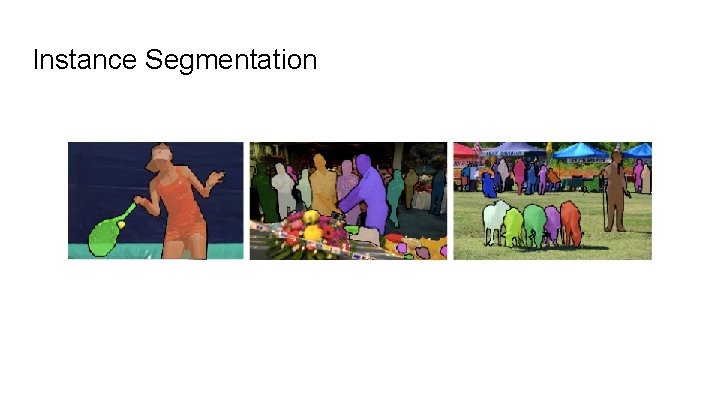
Instance Segmentation
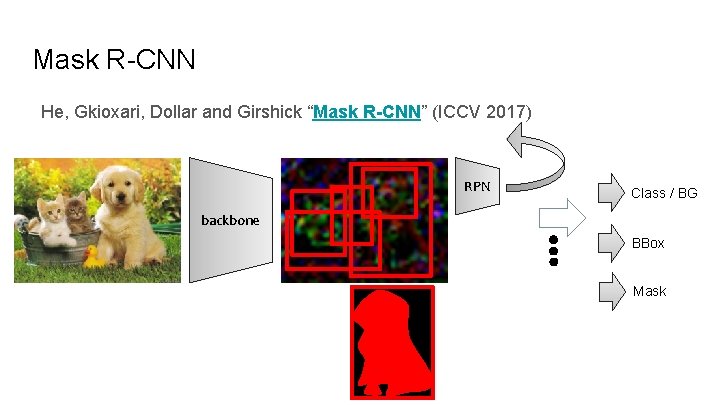
Mask R-CNN He, Gkioxari, Dollar and Girshick “Mask R-CNN” (ICCV 2017) RPN Class / BG backbone BBox Mask
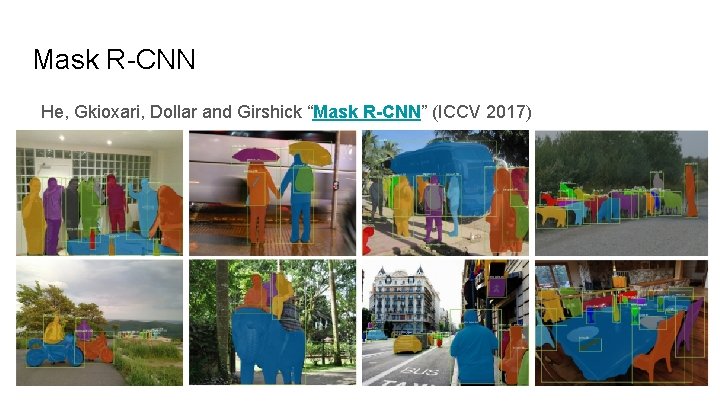
Mask R-CNN He, Gkioxari, Dollar and Girshick “Mask R-CNN” (ICCV 2017)
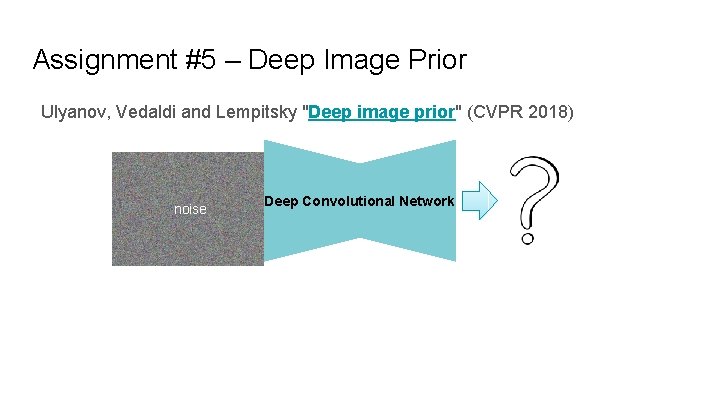
Assignment #5 – Deep Image Prior Ulyanov, Vedaldi and Lempitsky "Deep image prior" (CVPR 2018) noise Deep Convolutional Network
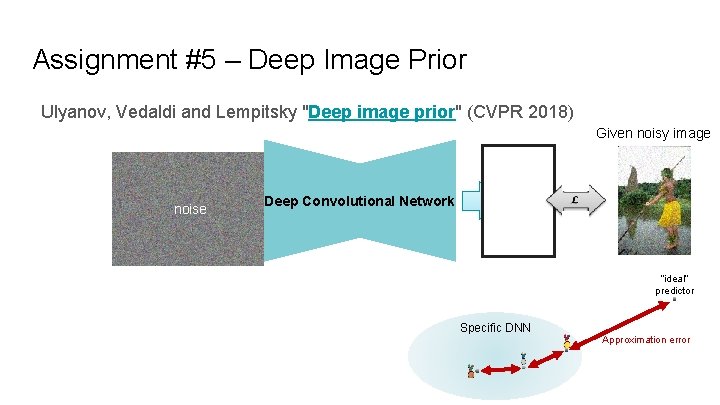
Assignment #5 – Deep Image Prior Ulyanov, Vedaldi and Lempitsky "Deep image prior" (CVPR 2018) Given noisy image noise Deep Convolutional Network “ideal” predictor Specific DNN Approximation error
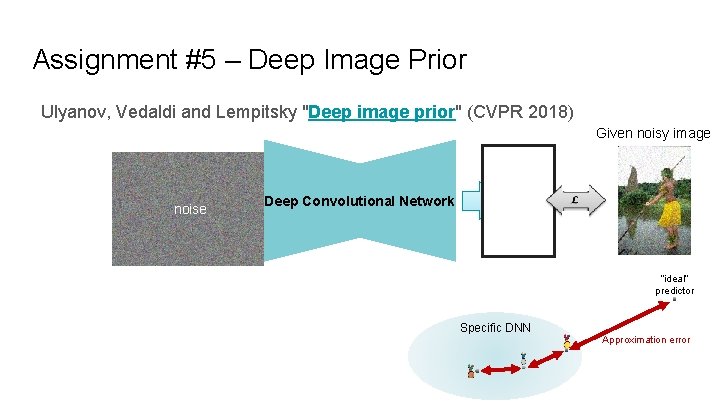
Assignment #5 – Deep Image Prior Ulyanov, Vedaldi and Lempitsky "Deep image prior" (CVPR 2018) Given noisy image noise Deep Convolutional Network “ideal” predictor Specific DNN Approximation error
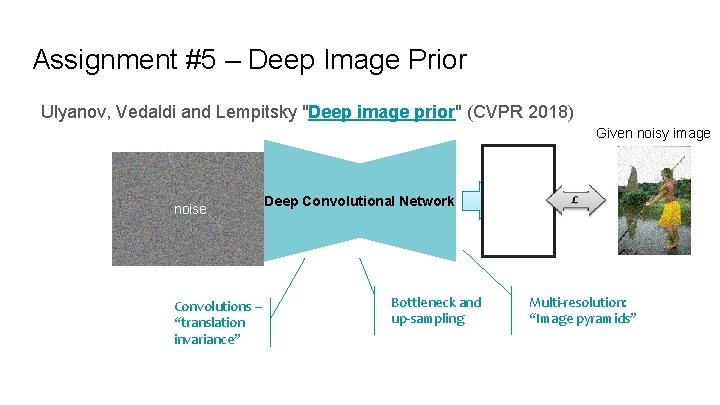
Assignment #5 – Deep Image Prior Ulyanov, Vedaldi and Lempitsky "Deep image prior" (CVPR 2018) Given noisy image noise Convolutions – “translation invariance” Deep Convolutional Network Bottleneck and up-sampling Multi-resolution: “Image pyramids”
Assignment #5 – Deep Image Prior Ulyanov, Vedaldi and Lempitsky "Deep image prior" (CVPR 2018) Goals: ● Easy and fast “hands-on” ● Design you own architecture ● See the effect of optimizers/loss ● Tweak hyper parameters learning rate/number of iterations
Deep Learning for Computer Vision ● Machine learning: “example based” programming ● Deep nets as versatile parametric models ● End-to-end training using SGD ● Overfitting: data augmentation / regularization ● Design considerations, e. g. : receptive field ● Image classification ● Object detection ● Semantic segmentation
If you were to remember only one thing…
- Slides: 63