
Introduction To Computer Science In this section you

- Slides: 45
Introduction To Computer Science In this section you will get an overview of some research areas and higher level courses in Computer Science.
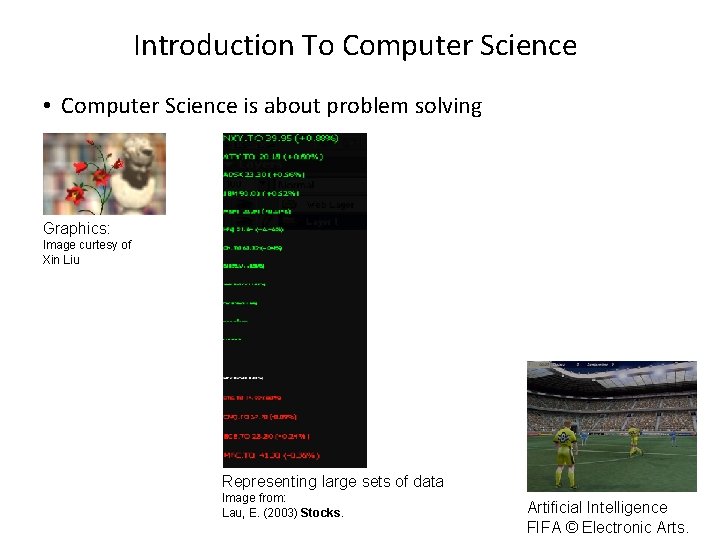
Introduction To Computer Science • Computer Science is about problem solving Graphics: Image curtesy of Xin Liu Representing large sets of data Image from: Lau, E. (2003) Stocks. Artificial Intelligence FIFA © Electronic Arts.
Some Areas Of Study And Research In Computer Science • • • Human-Computer Interaction Computer Graphics Information Visualization Databases Computer theory Computer networking and distributed systems Artificial Intelligence Computer Vision Software Engineering Computer Security Games programming This list provides only a brief introduction to the different areas of Computer Science and is far from comprehensive: For a more updated list of research areas: http: //www. cpsc. ucalgary. ca/Research/ Calendar (courses): – http: //www. ucalgary. ca/pubs/calendar/current/computer-science. html – http: //www. ucalgary. ca/pubs/calendar/current/software-engineering. html James Tam
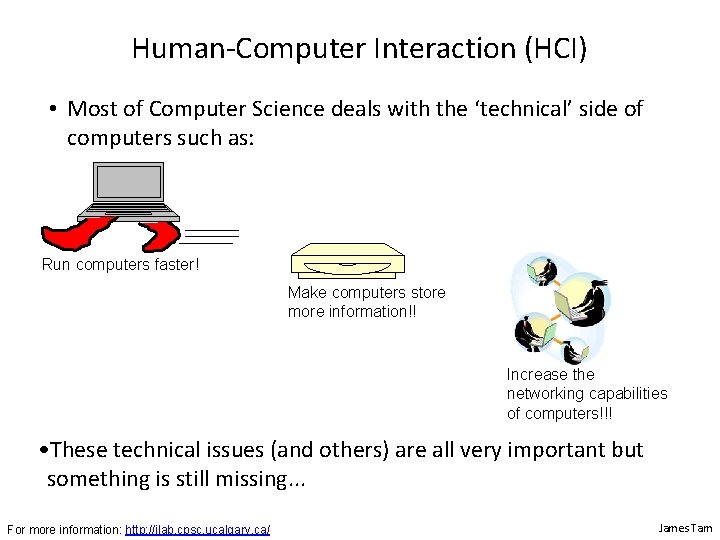
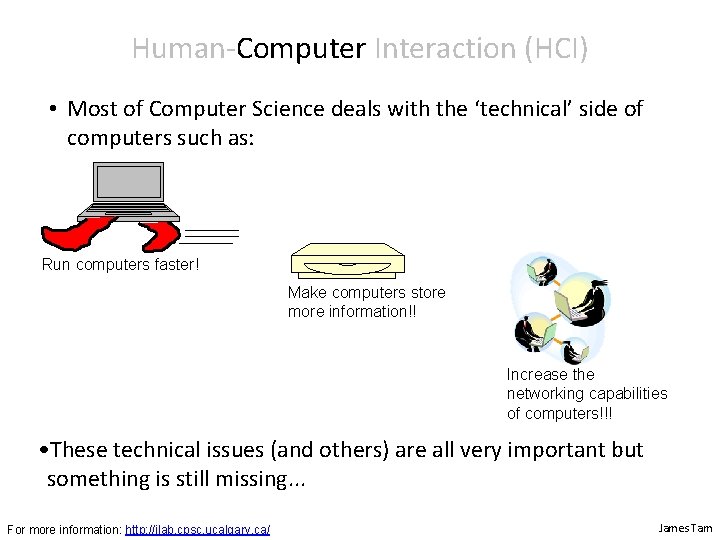
Human-Computer Interaction (HCI) • Most of Computer Science deals with the ‘technical’ side of computers such as: Run computers faster! Make computers store more information!! Increase the networking capabilities of computers!!! • These technical issues (and others) are all very important but something is still missing. . . For more information: http: //ilab. cpsc. ucalgary. ca/ James Tam
Human-Computer Interaction (HCI) • Most of Computer Science deals with the ‘technical’ side of computers such as: Run computers faster! Make computers store more information!! Increase the networking capabilities of computers!!! • These technical issues (and others) are all very important but something is still missing. . . For more information: http: //ilab. cpsc. ucalgary. ca/ James Tam
Human-Computer Interaction • . . . but don’t forget about the other side of the relationship. • No matter how powerful the computer and how well written is the software, if the user can’t figure out how it works then the system is useless. • Software should be written to make it as easy as possible for the user to complete their task. (Don’t make it any harder than it has to be). • This is just common sense and should/is always taken into account when writing software? Common sense? . . . come on! James Tam
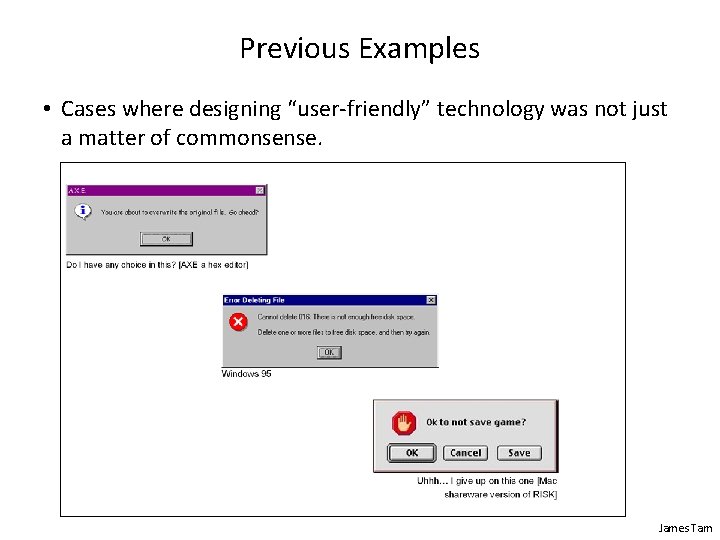
Previous Examples • Cases where designing “user-friendly” technology was not just a matter of commonsense. James Tam
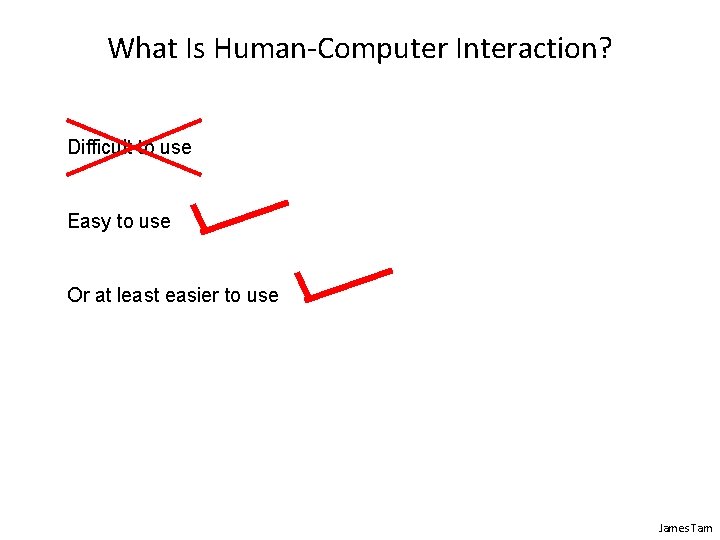
What Is Human-Computer Interaction? Difficult to use Easy to use Or at least easier to use James Tam
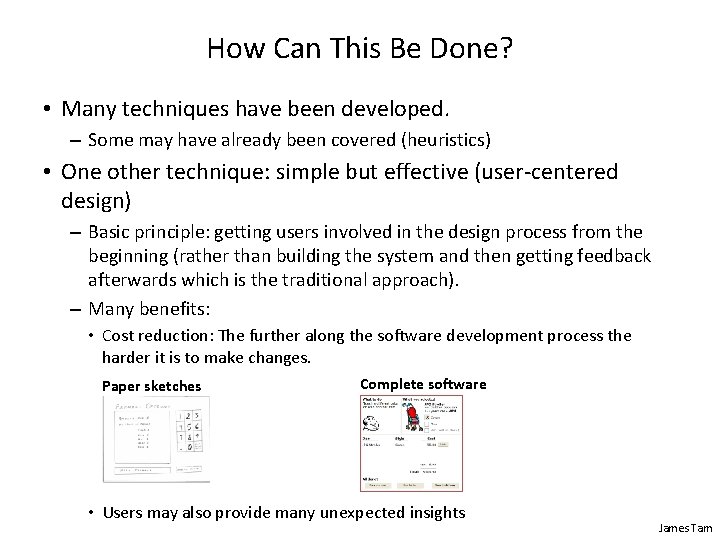
How Can This Be Done? • Many techniques have been developed. – Some may have already been covered (heuristics) • One other technique: simple but effective (user-centered design) – Basic principle: getting users involved in the design process from the beginning (rather than building the system and then getting feedback afterwards which is the traditional approach). – Many benefits: • Cost reduction: The further along the software development process the harder it is to make changes. Paper sketches Complete software • Users may also provide many unexpected insights James Tam
HCI: Higher-Level Courses • CPSC 481: Human-Computer Interaction I • CPSC 581: Human-Computer Interaction II • (Related: Human-Robot Interaction) – CPSC 599. 65—Robot head-based interaction – CPSC 599. 62—Advanced topics in human-computer and human-robot interaction – CPSC 599. 17—Human-robot interaction James Tam
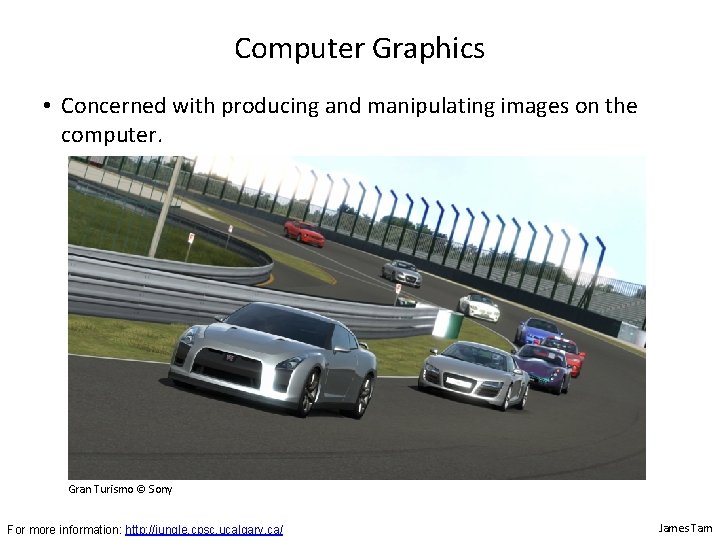
Computer Graphics • Concerned with producing and manipulating images on the computer. Gran Turismo © Sony For more information: http: //jungle. cpsc. ucalgary. ca/ James Tam
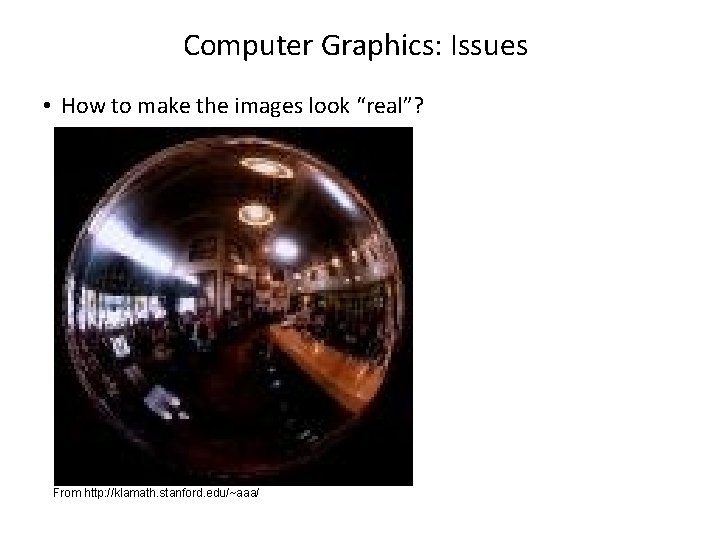
Computer Graphics: Issues • How to make the images look “real”? From http: //klamath. stanford. edu/~aaa/
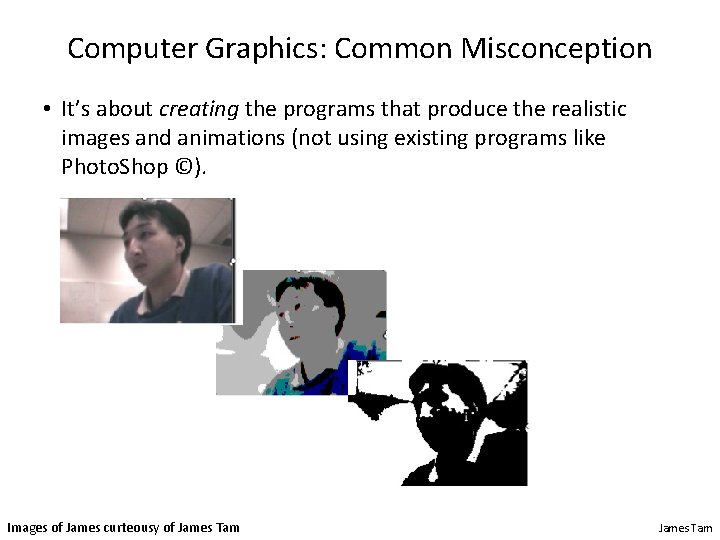
Computer Graphics: Common Misconception • It’s about creating the programs that produce the realistic images and animations (not using existing programs like Photo. Shop ©). Images of James curteousy of James Tam
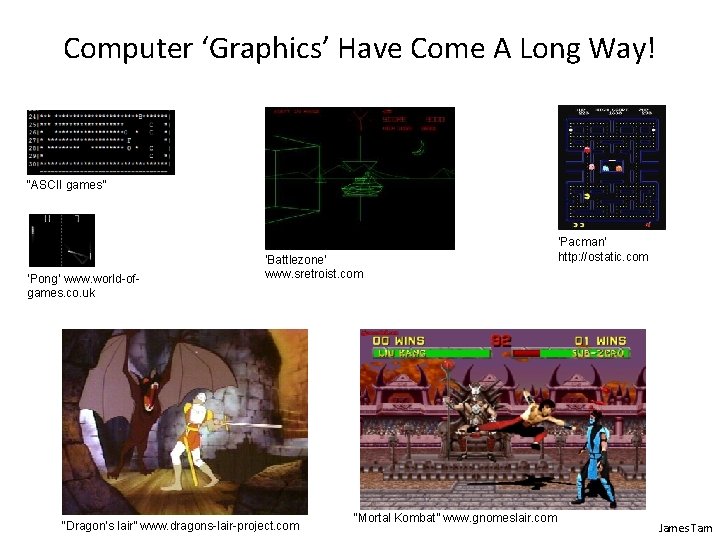
Computer ‘Graphics’ Have Come A Long Way! “ASCII games” ‘Pong’ www. world-ofgames. co. uk ‘Battlezone’ www. sretroist. com “Dragon’s lair” www. dragons-lair-project. com “Mortal Kombat” www. gnomeslair. com ‘Pacman’ http: //ostatic. com James Tam
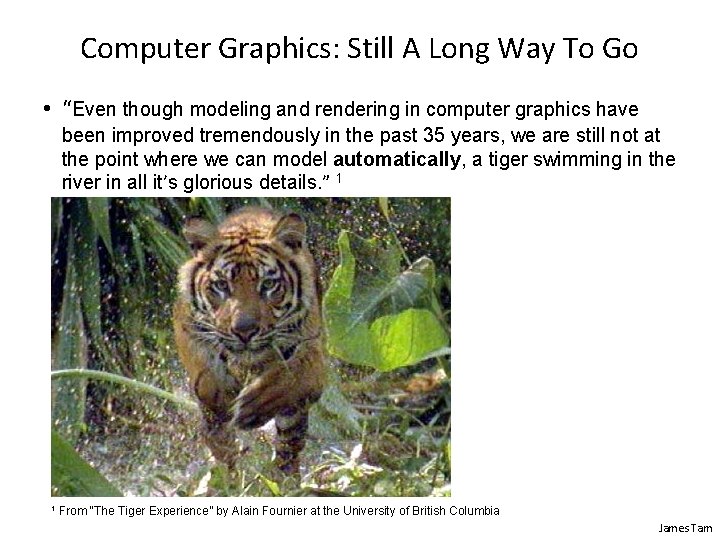
Computer Graphics: Still A Long Way To Go • “Even though modeling and rendering in computer graphics have been improved tremendously in the past 35 years, we are still not at the point where we can model automatically, a tiger swimming in the river in all it’s glorious details. ” 1 1 From “The Tiger Experience” by Alain Fournier at the University of British Columbia James Tam
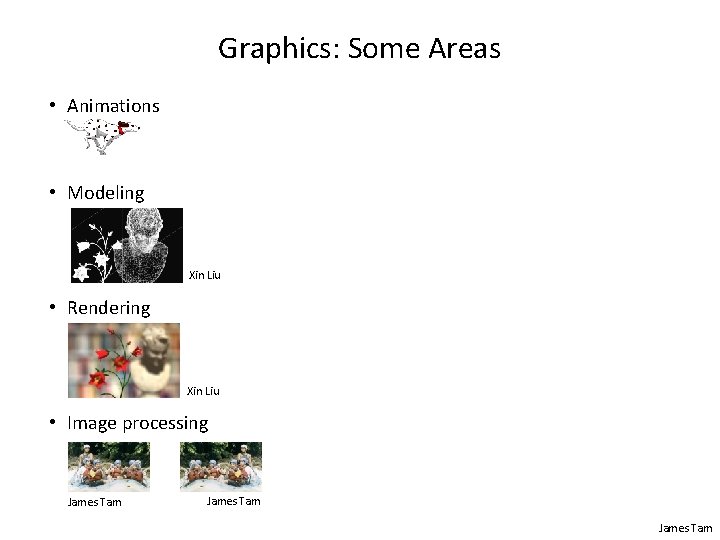
Graphics: Some Areas • Animations • Modeling Xin Liu • Rendering Xin Liu • Image processing James Tam
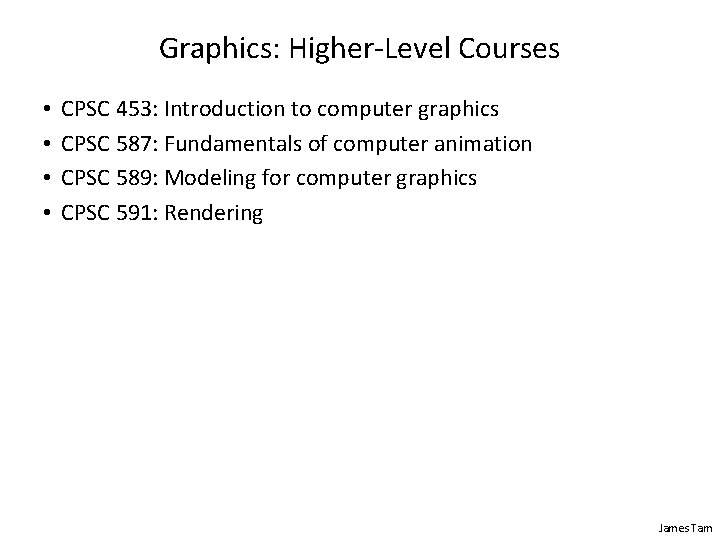
Graphics: Higher-Level Courses • • CPSC 453: Introduction to computer graphics CPSC 587: Fundamentals of computer animation CPSC 589: Modeling for computer graphics CPSC 591: Rendering James Tam
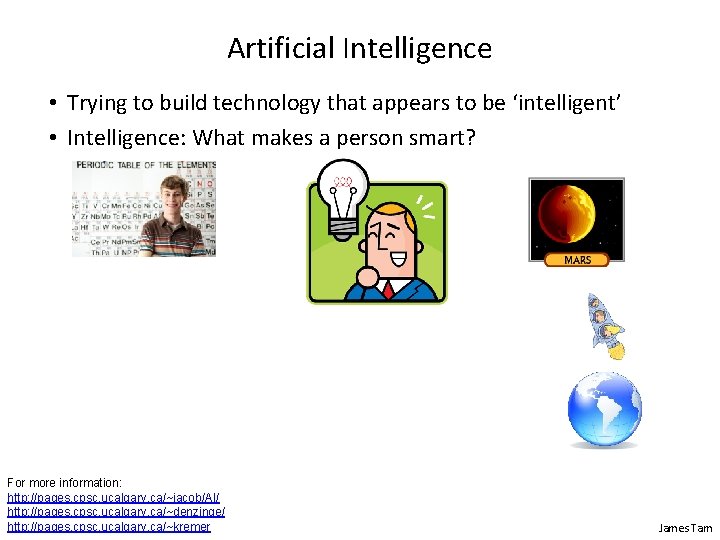
Artificial Intelligence • Trying to build technology that appears to be ‘intelligent’ • Intelligence: What makes a person smart? For more information: http: //pages. cpsc. ucalgary. ca/~jacob/AI/ http: //pages. cpsc. ucalgary. ca/~denzinge/ http: //pages. cpsc. ucalgary. ca/~kremer James Tam
Artificial Intelligence: Areas We Will Discuss • Expert systems • Neural networks James Tam
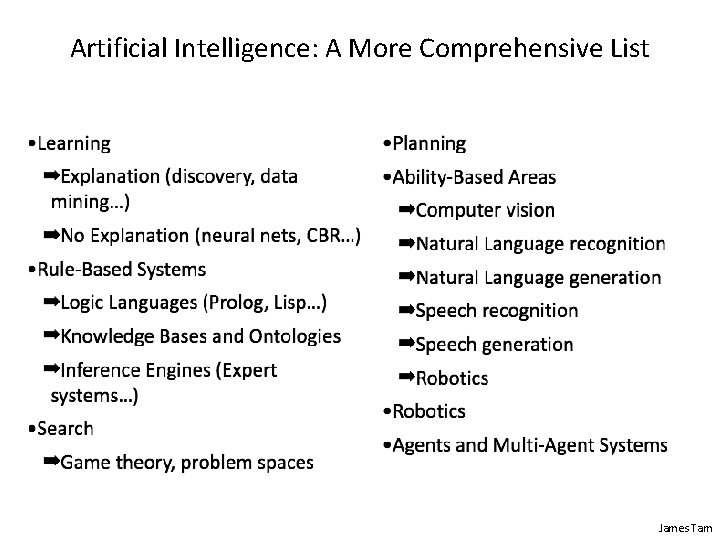
Artificial Intelligence: A More Comprehensive List James Tam
Expert Systems • The focus is on capturing the knowledge of a human expert as a set of rules stored in a database. • The expert system can then answer questions, diagnose problems and guide decision making. • Example applications: medicine, computer repair James Tam
Neural Networks • The focus is on building structures that function the way that neurons (and their connections in the brain) function. • (Simplified overview): – Neurons take electrical pulses as input and send electrical pulses as output. – A required level of input is required before the output is ‘fired’. • This approach has been applied to problems which involve pattern recognition ( e. g. , visual, voice). James Tam
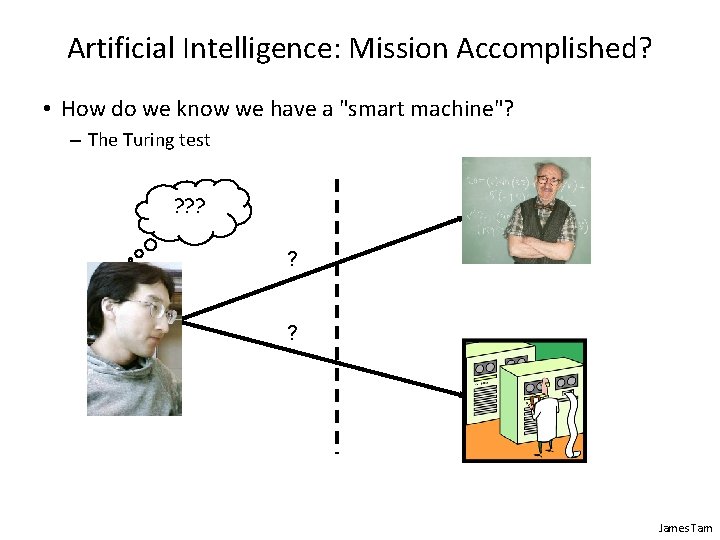
Artificial Intelligence: Mission Accomplished? • How do we know we have a "smart machine"? – The Turing test ? ? ? James Tam
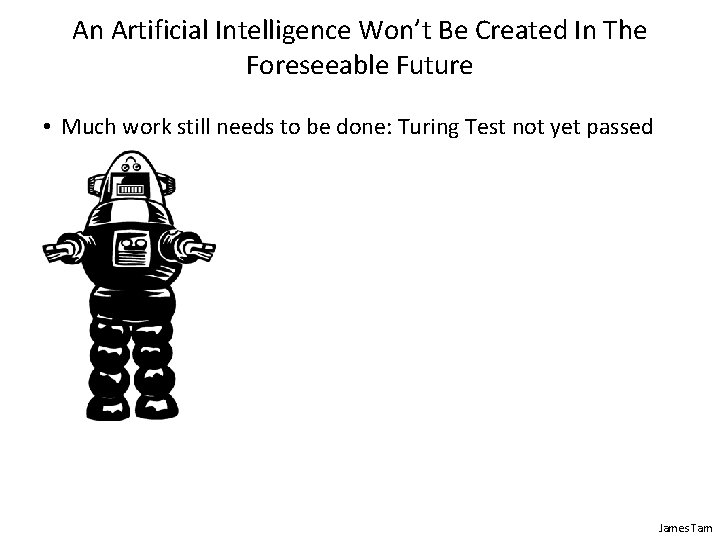
An Artificial Intelligence Won’t Be Created In The Foreseeable Future • Much work still needs to be done: Turing Test not yet passed James Tam
Artificial Intelligence: Higher-Level Courses • • CPSC 433: Artificial Intelligence CPSC 565: Emergent computing CPSC 567: Foundations of multi-agent systems CPSC 568: Agent communications James Tam
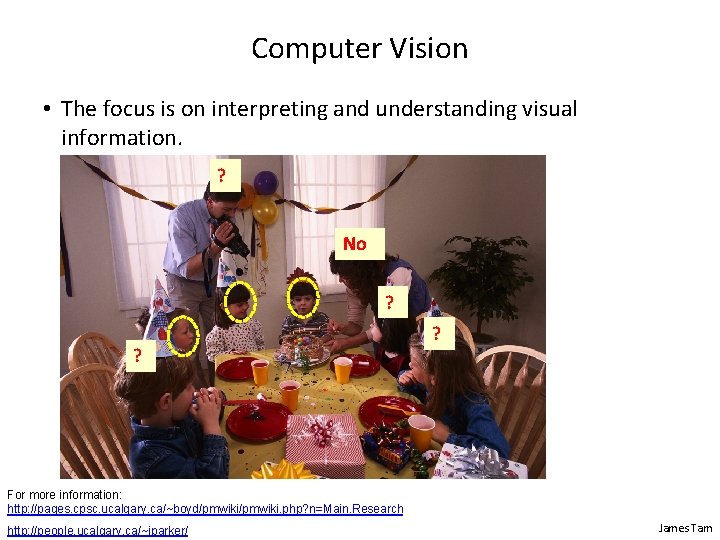
Computer Vision • The focus is on interpreting and understanding visual information. ? No ? ? ? For more information: http: //pages. cpsc. ucalgary. ca/~boyd/pmwiki. php? n=Main. Research http: //people. ucalgary. ca/~jparker/ James Tam
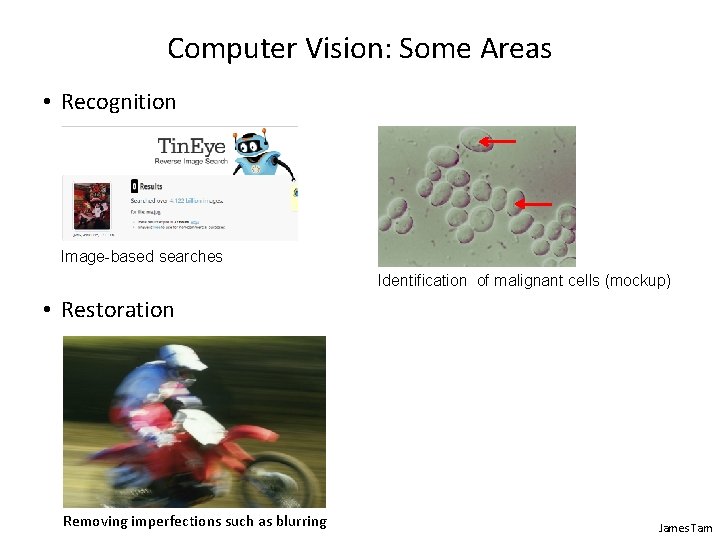
Computer Vision: Some Areas • Recognition Image-based searches Identification of malignant cells (mockup) • Restoration Removing imperfections such as blurring James Tam
Computer Vision: Higher-Level Courses • CPSC 535: Introduction to image analysis and computer vision James Tam
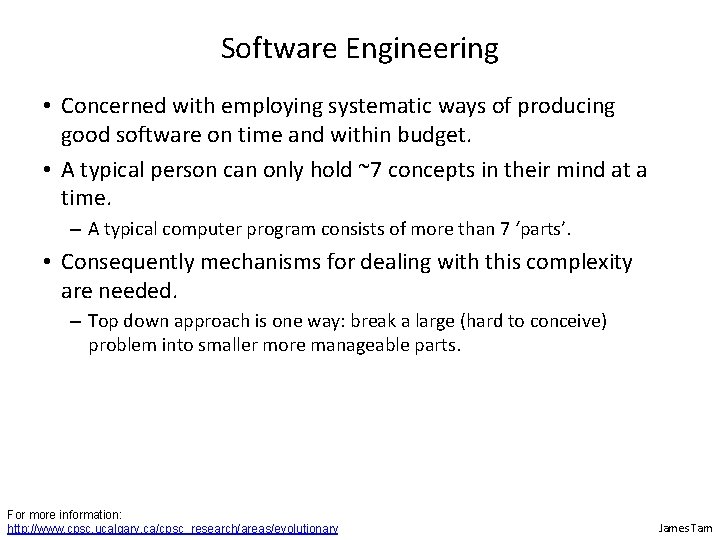
Software Engineering • Concerned with employing systematic ways of producing good software on time and within budget. • A typical person can only hold ~7 concepts in their mind at a time. – A typical computer program consists of more than 7 ‘parts’. • Consequently mechanisms for dealing with this complexity are needed. – Top down approach is one way: break a large (hard to conceive) problem into smaller more manageable parts. For more information: http: //www. cpsc. ucalgary. ca/cpsc_research/areas/evolutionary James Tam
Software Engineering (2): Techniques • Agile development • Design patterns James Tam
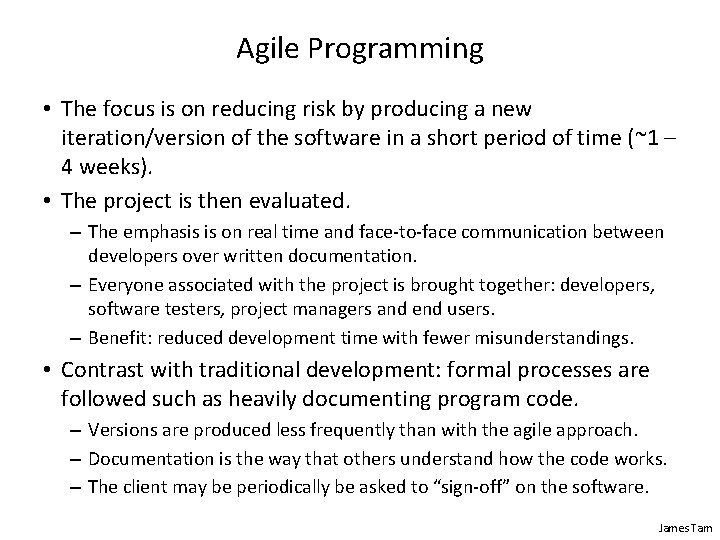
Agile Programming • The focus is on reducing risk by producing a new iteration/version of the software in a short period of time (~1 – 4 weeks). • The project is then evaluated. – The emphasis is on real time and face-to-face communication between developers over written documentation. – Everyone associated with the project is brought together: developers, software testers, project managers and end users. – Benefit: reduced development time with fewer misunderstandings. • Contrast with traditional development: formal processes are followed such as heavily documenting program code. – Versions are produced less frequently than with the agile approach. – Documentation is the way that others understand how the code works. – The client may be periodically be asked to “sign-off” on the software. James Tam
Agile Programming (2) • Traditional approaches work well for extremely large projects that require a high degree of reliability. • Agile programming works well for smaller (although still large) projects where having a shorter development time is crucial. James Tam
Design Patterns • A design pattern: a way of creating software that has been shown to be been sound under a number of different contexts. • Design patterns are a way of documenting successful past approaches – Top down design: although not one of the formally recognized designed patterns it shares some similarities to those approaches. James Tam
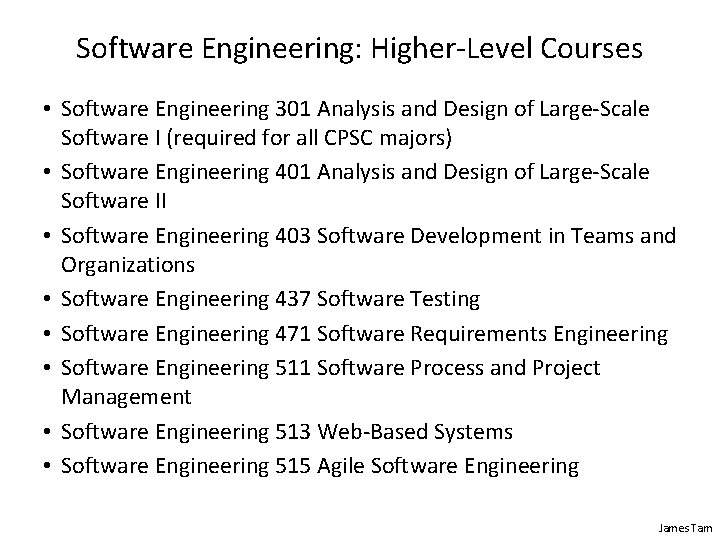
Software Engineering: Higher-Level Courses • Software Engineering 301 Analysis and Design of Large-Scale Software I (required for all CPSC majors) • Software Engineering 401 Analysis and Design of Large-Scale Software II • Software Engineering 403 Software Development in Teams and Organizations • Software Engineering 437 Software Testing • Software Engineering 471 Software Requirements Engineering • Software Engineering 511 Software Process and Project Management • Software Engineering 513 Web-Based Systems • Software Engineering 515 Agile Software Engineering James Tam
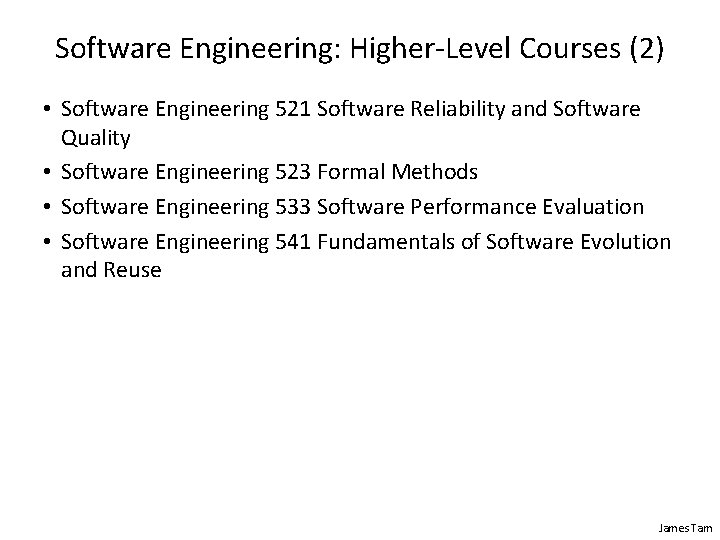
Software Engineering: Higher-Level Courses (2) • Software Engineering 521 Software Reliability and Software Quality • Software Engineering 523 Formal Methods • Software Engineering 533 Software Performance Evaluation • Software Engineering 541 Fundamentals of Software Evolution and Reuse James Tam
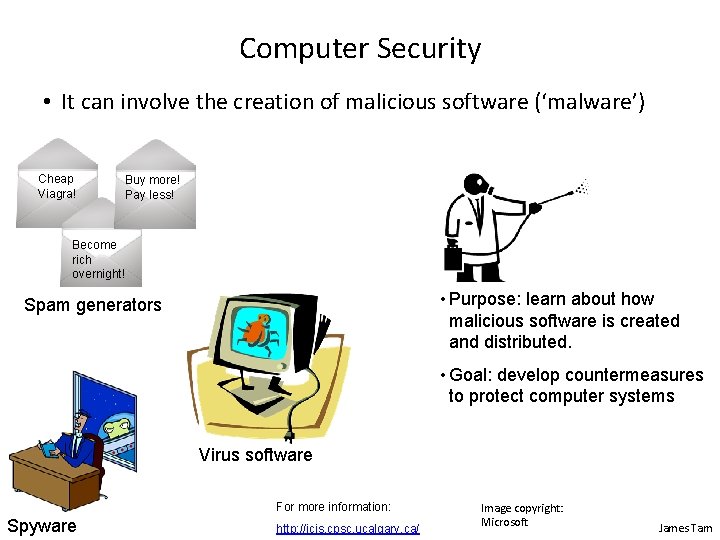
Computer Security • It can involve the creation of malicious software (‘malware’) Cheap Viagra! Buy more! Pay less! Become rich overnight! • Purpose: learn about how malicious software is created and distributed. Spam generators • Goal: develop countermeasures to protect computer systems Virus software For more information: Spyware http: //icis. cpsc. ucalgary. ca/ Image copyright: Microsoft James Tam
Some Approaches To Computer Security • As just demonstrated, understanding ‘how things work’ is one key component to designing more secure systems. – e. g. , Creating viruses and other malware in order to create better defenses against them. • But also the ‘human’ factor must be considered: some security experts think that many security breaches are due to user actions not technical flaws. – But this may require more than just standard ‘security workshops’. James Tam
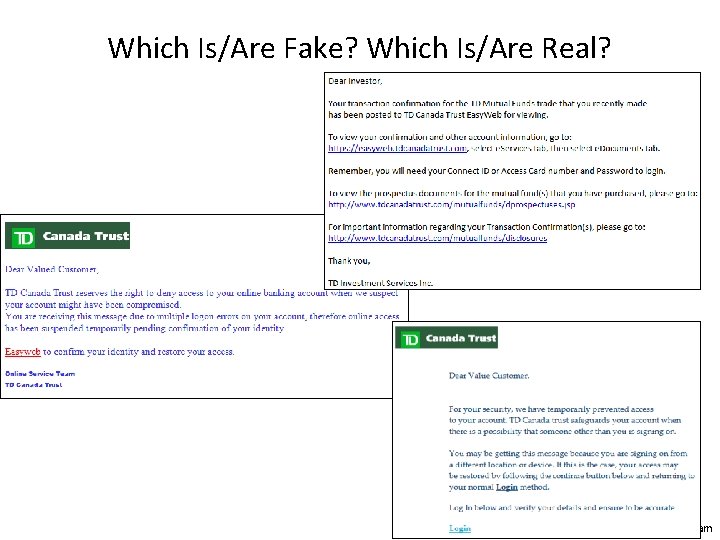
Which Is/Are Fake? Which Is/Are Real? James Tam
Cryptography • As may have already been described earlier in the semester (depends on the particular assignments), cryptography can play an important role in security. – Transmitting and storing sensitive information. – Cryptography involves the development of new and better approaches for encoding sensitive data (to make unauthorized access harder). James Tam
Computer Security: Higher-Level Courses • • • CPSC 329: Explorations in information security and privacy CPSC 418: Introduction to Cryptography CPSC 525: Principles of computer security CPSC 527: Computer viruses and malware CPSC 528: Spam and spyware CPSC 530: Information theoretic security James Tam
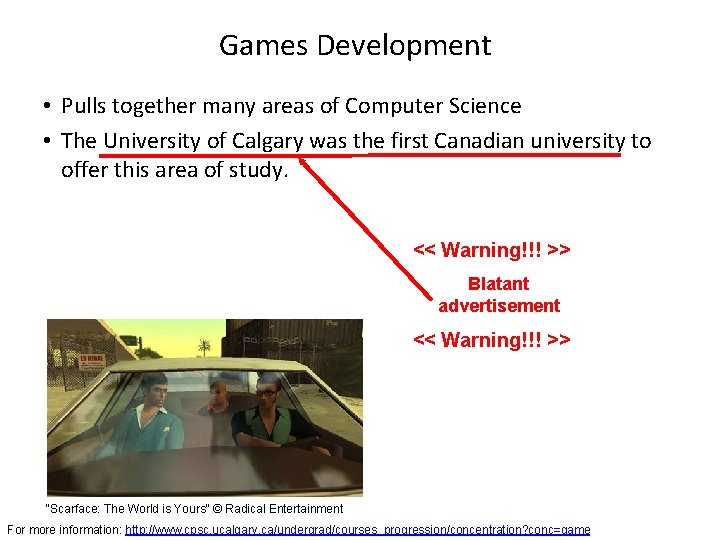
Games Development • Pulls together many areas of Computer Science • The University of Calgary was the first Canadian university to offer this area of study. << Warning!!! >> Blatant advertisement << Warning!!! >> “Scarface: The World is Yours“ © Radical Entertainment For more information: http: //www. cpsc. ucalgary. ca/undergrad/courses_progression/concentration? conc=game
Computer Games: Higher-Level Courses • CPSC 585: Games programming – Actual ‘industry practices’ are taught and applied during the semester • Sound routines, graphics and more – (Lectures have been taught by actual game developers) James Tam
After This Section You Should Know • What are some areas of Computer Science • What does each area entail • Some of the sub-areas, techniques employed or issues associated with each area of computer science James Tam
Copyright Notification • “Unless otherwise indicated, all images in this presentation are used with permission from Microsoft. ” slide 44 James Tam
Sound And Other Special Effects • Unless otherwise indicated they were produced and edited by James Tam : $ James Tam