
Introduction to Computer Graphics with Web GL Ed
Introduction to Computer Graphics with Web. GL Ed Angel Professor Emeritus of Computer Science Founding Director, Arts, Research, Technology and Science Laboratory University of New Mexico Angel and Shreiner: Interactive Computer Graphics 7 E © Addison-Wesley 2015 1
Programming with Web. GL Part 6: Three Dimensions Ed Angel Professor Emeritus of Computer Science University of New Mexico Angel and Shreiner: Interactive Computer Graphics 7 E © Addison-Wesley 2015 2
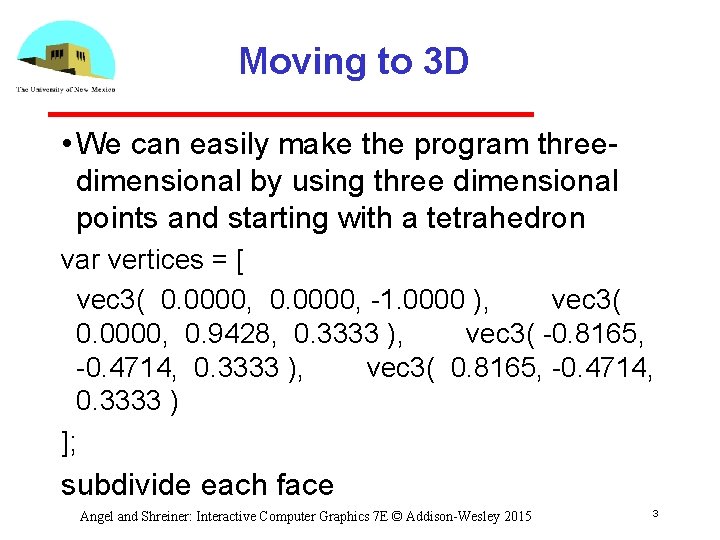
Moving to 3 D • We can easily make the program three dimensional by using three dimensional points and starting with a tetrahedron var vertices = [ vec 3( 0. 0000, 1. 0000 ), vec 3( 0. 0000, 0. 9428, 0. 3333 ), vec 3( 0. 8165, 0. 4714, 0. 3333 ) ]; subdivide each face Angel and Shreiner: Interactive Computer Graphics 7 E © Addison-Wesley 2015 3
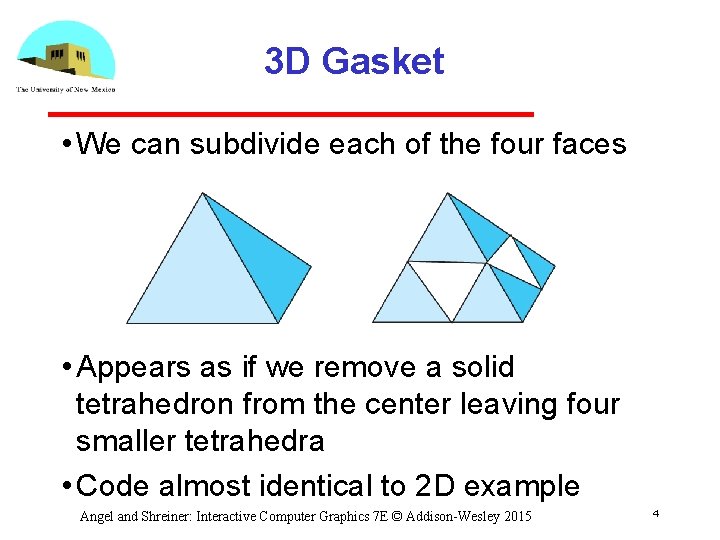
3 D Gasket • We can subdivide each of the four faces • Appears as if we remove a solid tetrahedron from the center leaving four smaller tetrahedra • Code almost identical to 2 D example Angel and Shreiner: Interactive Computer Graphics 7 E © Addison-Wesley 2015 4

Almost Correct • Because the triangles are drawn in the order they are specified in the program, the front triangles are not always rendered in front of triangles behind them get this want this Angel and Shreiner: Interactive Computer Graphics 7 E © Addison-Wesley 2015 5

Hidden-Surface Removal • We want to see only those surfaces in front of other surfaces • Open. GL uses a hidden-surface method called the z buffer algorithm that saves depth information as objects are rendered so that only the front objects appear in the image Angel and Shreiner: Interactive Computer Graphics 7 E © Addison-Wesley 2015 6
Using the z-buffer algorithm • The algorithm uses an extra buffer, the z buffer, to store depth information as geometry travels down the pipeline • Depth buffer is required to be available in Web. GL • It must be Enabled • gl. enable(gl. DEPTH_TEST) Cleared in for each render • gl. clear(gl. COLOR_BUFFER_BIT | gl. DEPTH_BUFFER_BIT) Angel and Shreiner: Interactive Computer Graphics 7 E © Addison-Wesley 2015 7
Surface vs Volume Subdvision • In our example, we divided the surface of each face • We could also divide the volume using the same midpoints • The midpoints define four smaller tetrahedrons, one for each vertex • Keeping only these tetrahedrons removes a volume in the middle • See text for code Angel and Shreiner: Interactive Computer Graphics 7 E © Addison-Wesley 2015 8
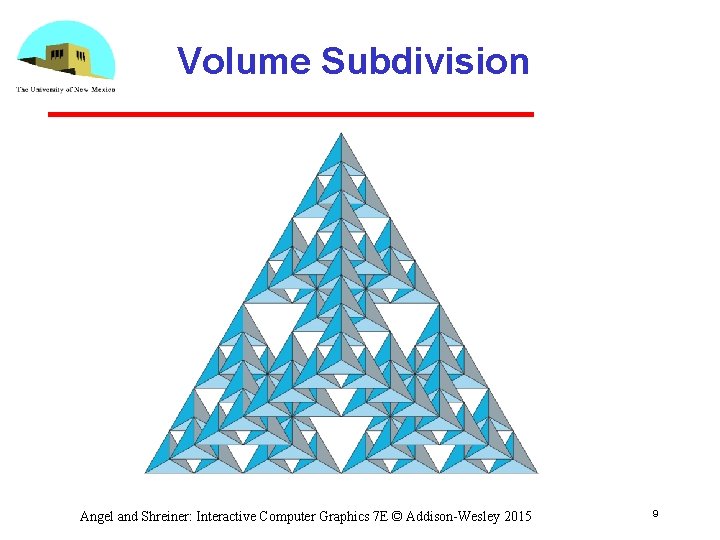
Volume Subdivision Angel and Shreiner: Interactive Computer Graphics 7 E © Addison-Wesley 2015 9
- Slides: 9