
Introduction to Computer Graphics with Web GL Ed
Introduction to Computer Graphics with Web. GL Ed Angel Professor Emeritus of Computer Science Founding Director, Arts, Research, Technology and Science Laboratory University of New Mexico Angel and Shreiner: Interactive Computer Graphics 7 E © Addison Wesley 2015 1
Representation Ed Angel Professor Emeritus of Computer Science, University of New Mexico Angel and Shreiner: Interactive Computer Graphics 7 E © Addison Wesley 2015 2
Objectives • Introduce concepts such as dimension and basis • Introduce coordinate systems for representing vectors spaces and frames for representing affine spaces • Discuss change of frames and bases Angel and Shreiner: Interactive Computer Graphics 7 E © Addison Wesley 2015 3
Linear Independence • A set of vectors v 1, v 2, …, vn is linearly independent if a 1 v 1+a 2 v 2+. . anvn=0 iff a 1=a 2=…=0 • If a set of vectors is linearly independent, we cannot represent one in terms of the others • If a set of vectors is linearly dependent, at least one can be written in terms of the others Angel and Shreiner: Interactive Computer Graphics 7 E © Addison Wesley 2015 4
Dimension • In a vector space, the maximum number of linearly independent vectors is fixed and is called the dimension of the space • In an n dimensional space, any set of n linearly independent vectors form a basis for the space • Given a basis v 1, v 2, …. , vn, any vector v can be written as v=a 1 v 1+ a 2 v 2 +…. +anvn where the {ai} are unique Angel and Shreiner: Interactive Computer Graphics 7 E © Addison Wesley 2015 5
Representation • Until now we have been able to work with geometric entities without using any frame of reference, such as a coordinate system • Need a frame of reference to relate points and objects to our physical world. For example, where is a point? Can’t answer without a reference system World coordinates Camera coordinates Angel and Shreiner: Interactive Computer Graphics 7 E © Addison Wesley 2015 6
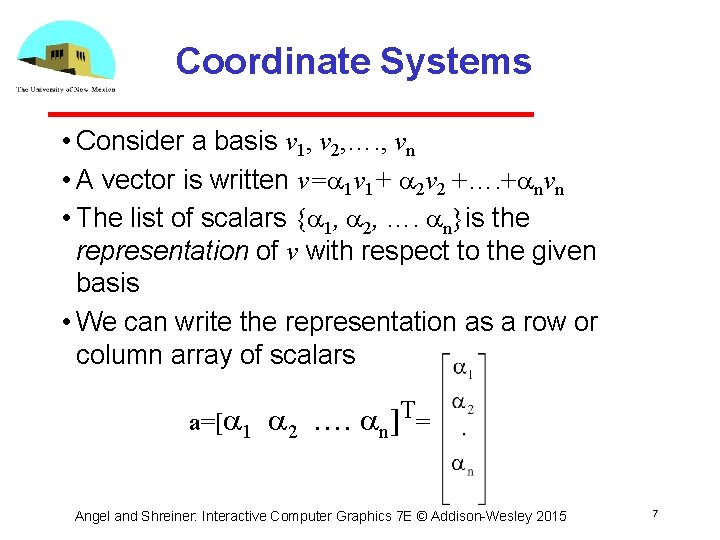
Coordinate Systems • Consider a basis v 1, v 2, …. , vn • A vector is written v=a 1 v 1+ a 2 v 2 +…. +anvn • The list of scalars {a 1, a 2, …. an}is the representation of v with respect to the given basis • We can write the representation as a row or column array of scalars a=[a 1 a 2 …. an]T= Angel and Shreiner: Interactive Computer Graphics 7 E © Addison Wesley 2015 7
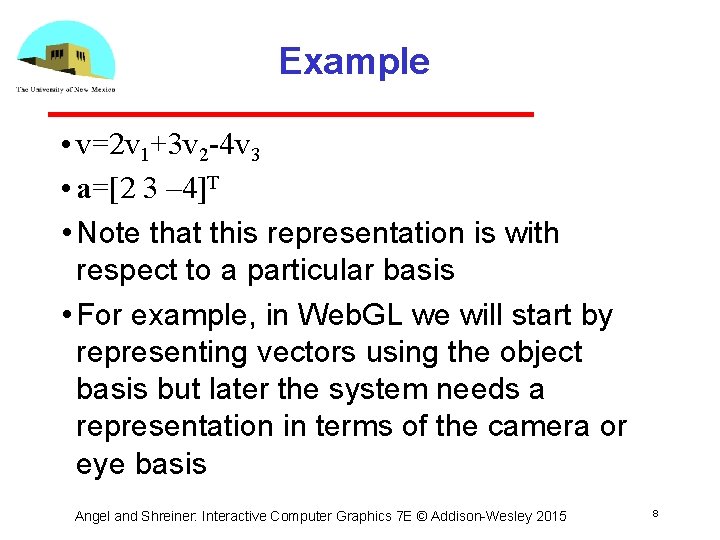
Example • v=2 v 1+3 v 2 -4 v 3 • a=[2 3 – 4]T • Note that this representation is with respect to a particular basis • For example, in Web. GL we will start by representing vectors using the object basis but later the system needs a representation in terms of the camera or eye basis Angel and Shreiner: Interactive Computer Graphics 7 E © Addison Wesley 2015 8
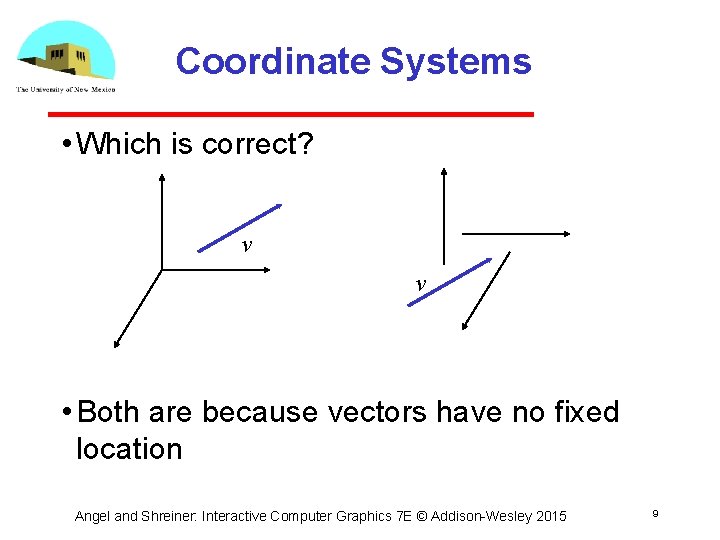
Coordinate Systems • Which is correct? v v • Both are because vectors have no fixed location Angel and Shreiner: Interactive Computer Graphics 7 E © Addison Wesley 2015 9
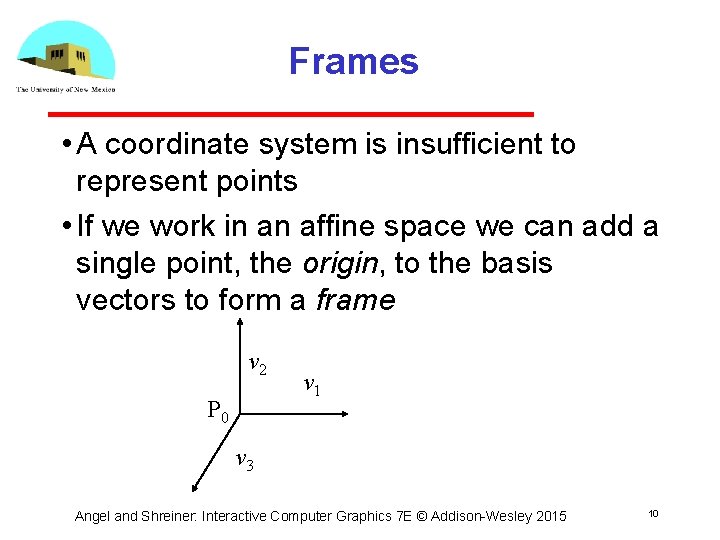
Frames • A coordinate system is insufficient to represent points • If we work in an affine space we can add a single point, the origin, to the basis vectors to form a frame v 2 P 0 v 1 v 3 Angel and Shreiner: Interactive Computer Graphics 7 E © Addison Wesley 2015 10
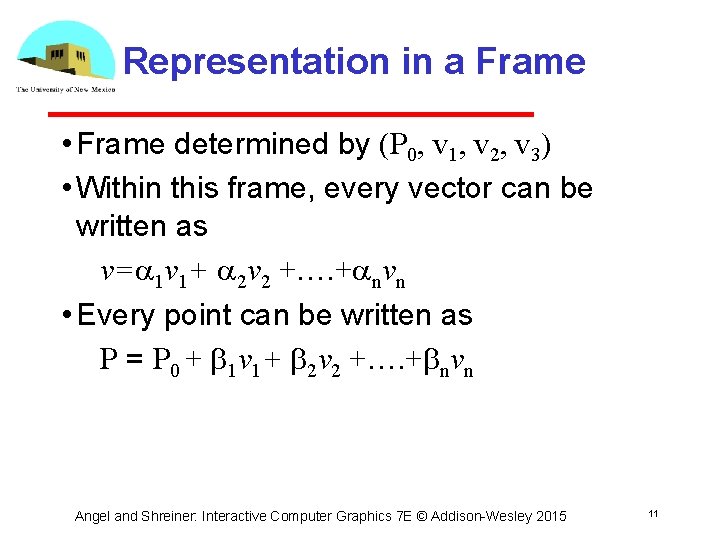
Representation in a Frame • Frame determined by (P 0, v 1, v 2, v 3) • Within this frame, every vector can be written as v=a 1 v 1+ a 2 v 2 +…. +anvn • Every point can be written as P = P 0 + b 1 v 1+ b 2 v 2 +…. +bnvn Angel and Shreiner: Interactive Computer Graphics 7 E © Addison Wesley 2015 11
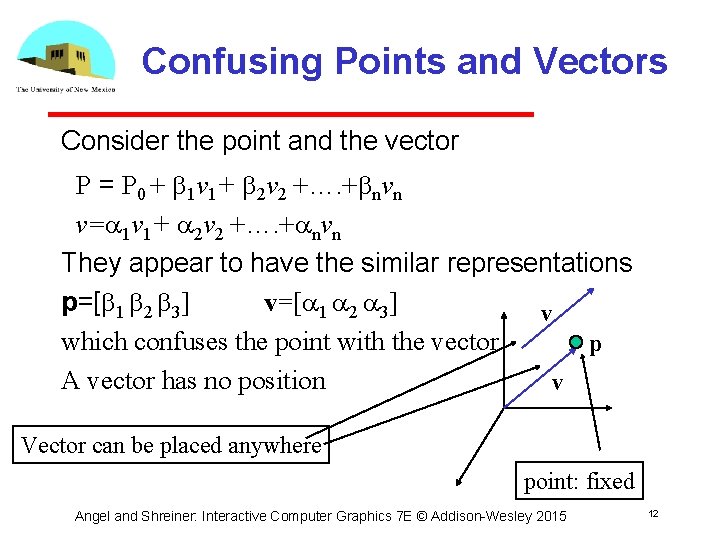
Confusing Points and Vectors Consider the point and the vector P = P 0 + b 1 v 1+ b 2 v 2 +…. +bnvn v=a 1 v 1+ a 2 v 2 +…. +anvn They appear to have the similar representations p=[b 1 b 2 b 3] v=[a 1 a 2 a 3] v which confuses the point with the vector p A vector has no position v Vector can be placed anywhere point: fixed Angel and Shreiner: Interactive Computer Graphics 7 E © Addison Wesley 2015 12
- Slides: 12