
Introduction to Computer Graphics with Web GL Ed

Introduction to Computer Graphics with Web. GL Ed Angel Professor Emeritus of Computer Science Founding Director, Arts, Research, Technology and Science Laboratory University of New Mexico Angel and Shreiner: Interactive Computer Graphics 7 E © Addison Wesley 2015 1
Display Issues Ed Angel Professor Emeritus of Computer Science University of New Mexico Angel and Shreiner: Interactive Computer Graphics 7 E © Addison Wesley 2015 2
Objectives • Consider perceptual issues related to displays • Introduce chromaticity space Color systems Color transformations • Standard Color Systems Angel and Shreiner: Interactive Computer Graphics 7 E © Addison Wesley 2015 3
No Display Can Be Perfect • An analog display device such as a CRT takes digital input (pixels) and outputs a small spot of color • A Digital display such as a LCD display outputs discrete spots • The eye merges (filters) these spots • Sampling theory shows this process cannot be done perfectly Angel and Shreiner: Interactive Computer Graphics 7 E © Addison Wesley 2015 4

Perception Review • Light is the part of the electromagnetic spectrum between ~350 750 nm • A color C(l) is a distribution of energies within this range • The human visual system has three types of cones on the retina, each with its own spectral sensitivity • Consequently, only three values, the tristimulus values, are “seen” by the brain Angel and Shreiner: Interactive Computer Graphics 7 E © Addison Wesley 2015 5

Tristimulus Values • The human visual center has three cones with sensitivity curves S 1(l), S 2(l), and S 3(l) • For a color C(l), the cones output the tristimulus values C(l) optic nerve cones Angel and Shreiner: Interactive Computer Graphics 7 E © Addison Wesley 2015 T 1, T 2, T 3 6

Three Color Theory • Any two colors with the same tristimulus values are perceived to be identical • Thus a display (CRT, LCD, film) must only produce the correct tristimulus values to match a color • Is this possible? Not always Different primaries (different sensitivity curves) in different systems Angel and Shreiner: Interactive Computer Graphics 7 E © Addison Wesley 2015 7
The Problem • The sensitivity curves of the human are not the same as those of physical devices • Human: curves centered in blue, green, and green yellow • CRT: RGB • Print media: CMY or CMYK • Which colors can we match and, if we cannot match, how close can we come? Angel and Shreiner: Interactive Computer Graphics 7 E © Addison Wesley 2015 8
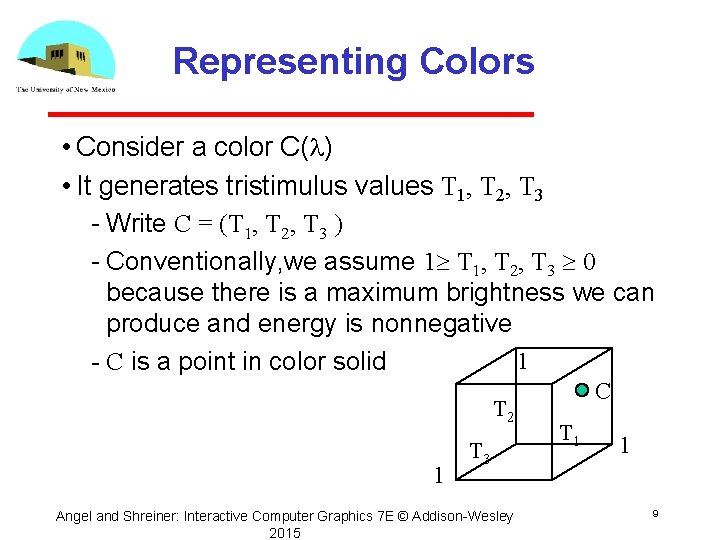
Representing Colors • Consider a color C(l) • It generates tristimulus values T 1, T 2, T 3 Write C = (T 1, T 2, T 3 ) Conventionally, we assume 1 T 1, T 2, T 3 0 because there is a maximum brightness we can produce and energy is nonnegative 1 C is a point in color solid T 2 1 T 3 Angel and Shreiner: Interactive Computer Graphics 7 E © Addison Wesley 2015 C T 1 1 9
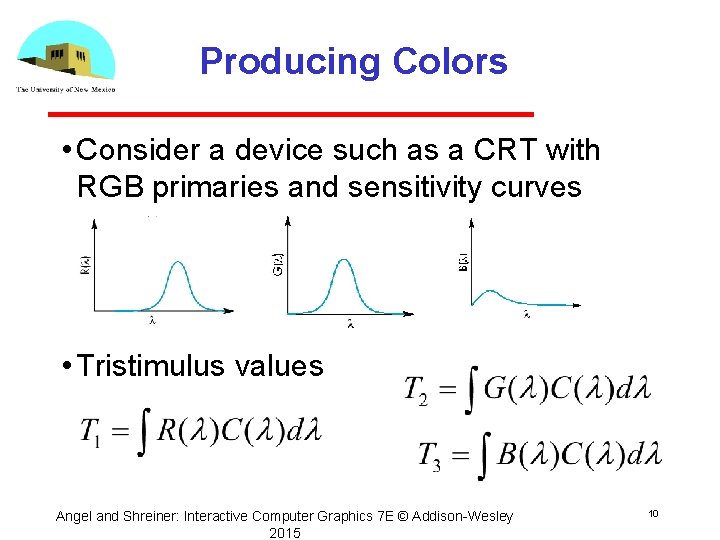
Producing Colors • Consider a device such as a CRT with RGB primaries and sensitivity curves • Tristimulus values Angel and Shreiner: Interactive Computer Graphics 7 E © Addison Wesley 2015 10
Matching • This T 1, T 2, T 3 is dependent on the particular device • If we use another device, we will get different values and these values will not match those of the human cone curves • Need a way of matching and a way of normalizing Angel and Shreiner: Interactive Computer Graphics 7 E © Addison Wesley 2015 11
Color Systems • Various color systems are used Based on real primaries: • NTSC RGB • UVW • CMYK • HLS Theoretical • XYZ • Prefer to separate brightness (luminance) from color (chromatic) information Reduce to two dimensions Angel and Shreiner: Interactive Computer Graphics 7 E © Addison Wesley 2015 12
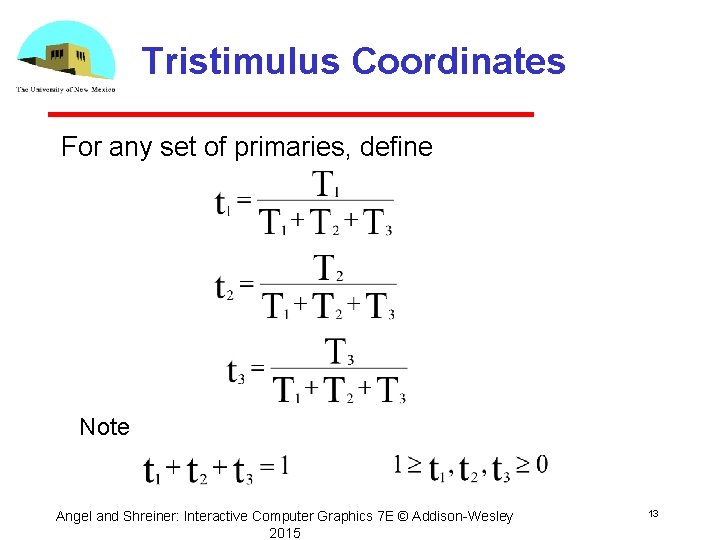
Tristimulus Coordinates For any set of primaries, define Note Angel and Shreiner: Interactive Computer Graphics 7 E © Addison Wesley 2015 13
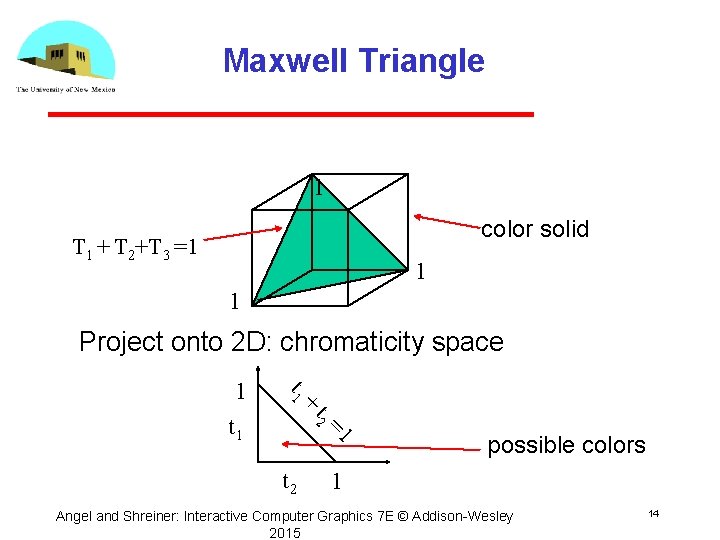
Maxwell Triangle 1 color solid T 1 + T 2+T 3 =1 1 1 Project onto 2 D: chromaticity space + t 1 =1 t 2 possible colors 1 Angel and Shreiner: Interactive Computer Graphics 7 E © Addison Wesley 2015 14
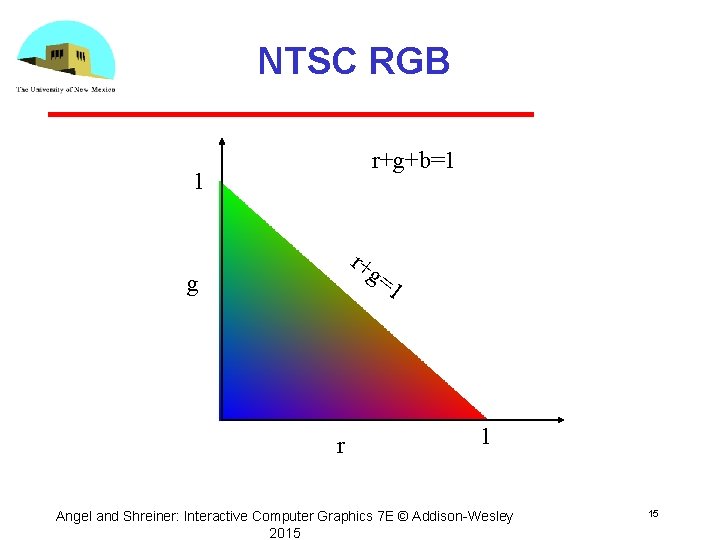
NTSC RGB r+g+b=1 1 r+ g= g r 1 1 Angel and Shreiner: Interactive Computer Graphics 7 E © Addison Wesley 2015 15
Producing Other Colors • However colors producible on one system (its color gamut) is not necessarily producible on any other • Not that if we produce all the pure spectral colors in the 350 750 nm range, we can produce all others by adding spectral colors • With real systems (CRT, film), we cannot produce the pure spectral colors • We can project the color solid of each system into chromaticity space (of some system) to see how close we can get Angel and Shreiner: Interactive Computer Graphics 7 E © Addison Wesley 2015 16
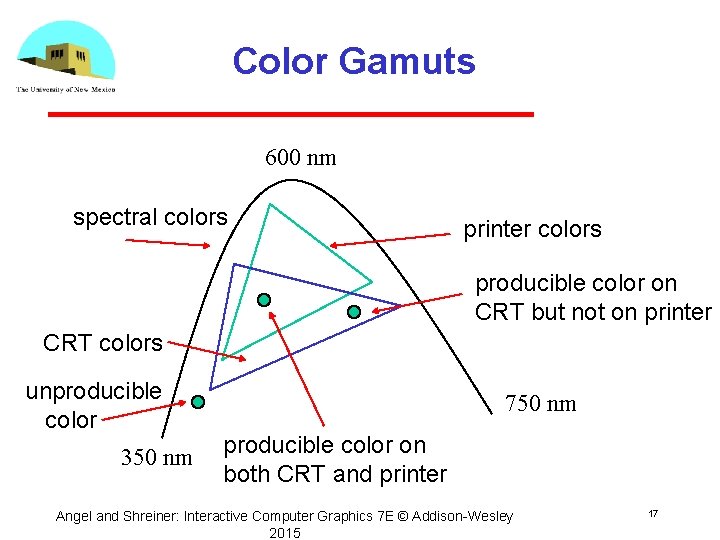
Color Gamuts 600 nm spectral colors printer colors producible color on CRT but not on printer CRT colors unproducible color 350 nm 750 nm producible color on both CRT and printer Angel and Shreiner: Interactive Computer Graphics 7 E © Addison Wesley 2015 17
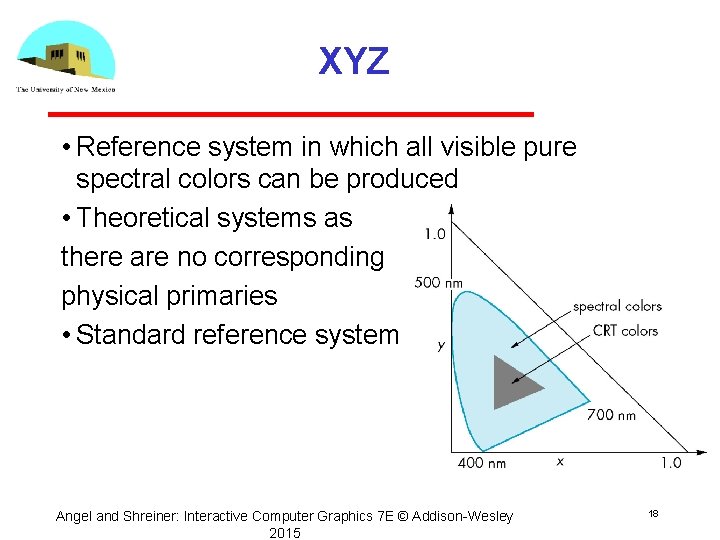
XYZ • Reference system in which all visible pure spectral colors can be produced • Theoretical systems as there are no corresponding physical primaries • Standard reference system Angel and Shreiner: Interactive Computer Graphics 7 E © Addison Wesley 2015 18
Color Systems • Most correspond to real primaries National Television Systems Committee (NTSC) RGB matches phosphors in CRTs • Film both additive (RGB) and subtractive (CMY) for positive and negative film • Print industry CMYK (K = black) K used to produce sharp crisp blacks Example: ink jet printers Angel and Shreiner: Interactive Computer Graphics 7 E © Addison Wesley 2015 19
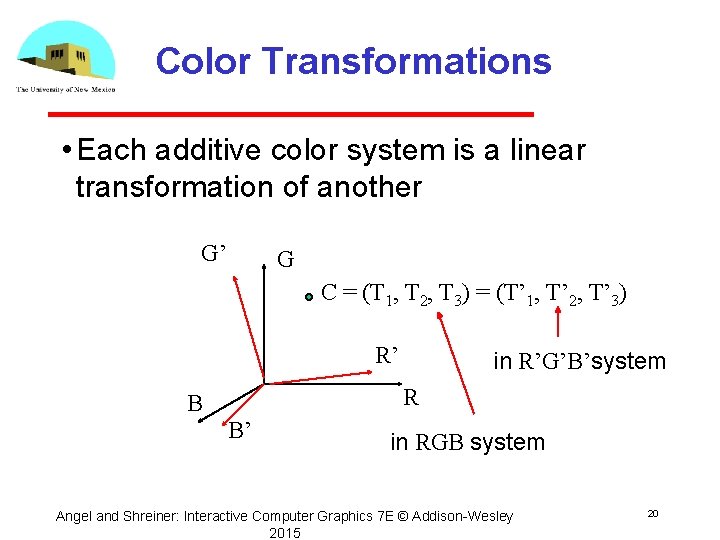
Color Transformations • Each additive color system is a linear transformation of another G’ G C = (T 1, T 2, T 3) = (T’ 1, T’ 2, T’ 3) R’ in R’G’B’system R B B’ in RGB system Angel and Shreiner: Interactive Computer Graphics 7 E © Addison Wesley 2015 20
RGB, CMYK • Assuming 1 is max of a primary C=1–R M=1–G Y=1–B • Convert CMY to CMYK by K = min(C, M, Y) C’ = C – K M’ = M – K Y’ = Y K Angel and Shreiner: Interactive Computer Graphics 7 E © Addison Wesley 2015 21
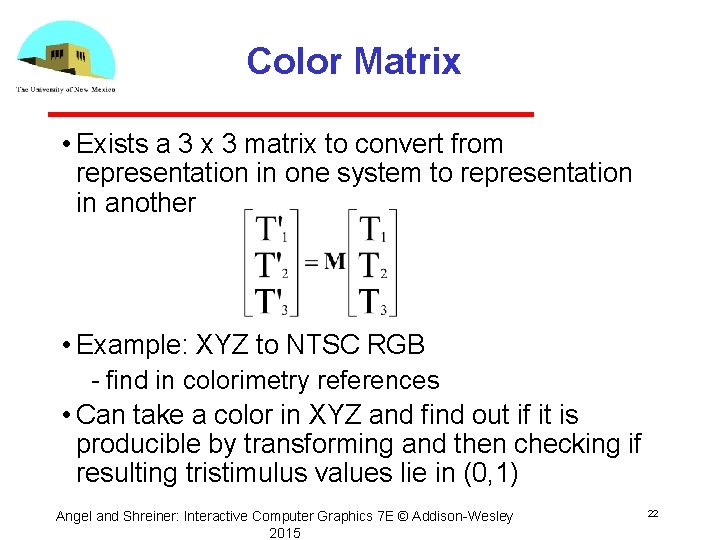
Color Matrix • Exists a 3 x 3 matrix to convert from representation in one system to representation in another • Example: XYZ to NTSC RGB find in colorimetry references • Can take a color in XYZ and find out if it is producible by transforming and then checking if resulting tristimulus values lie in (0, 1) Angel and Shreiner: Interactive Computer Graphics 7 E © Addison Wesley 2015 22
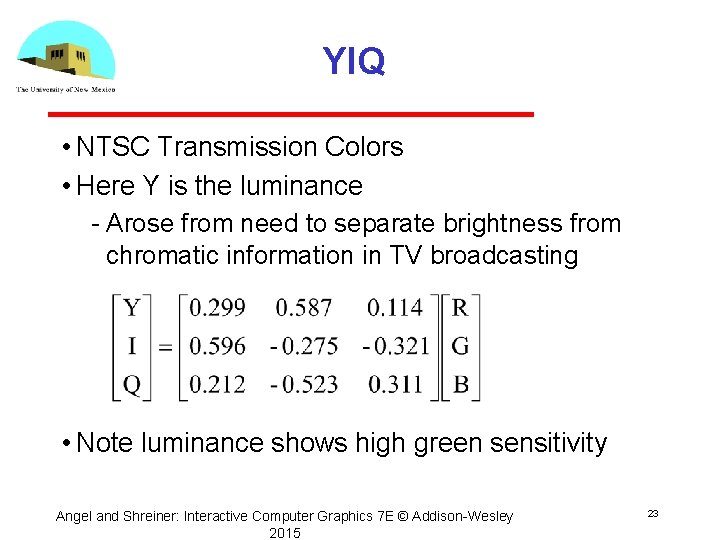
YIQ • NTSC Transmission Colors • Here Y is the luminance Arose from need to separate brightness from chromatic information in TV broadcasting • Note luminance shows high green sensitivity Angel and Shreiner: Interactive Computer Graphics 7 E © Addison Wesley 2015 23
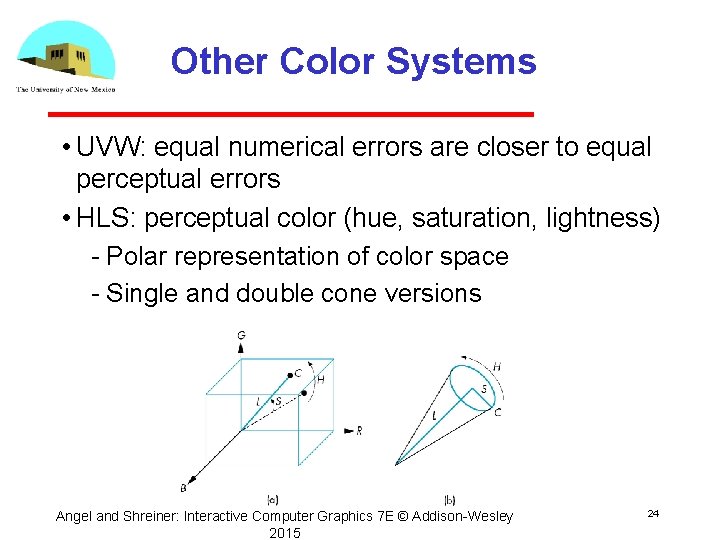
Other Color Systems • UVW: equal numerical errors are closer to equal perceptual errors • HLS: perceptual color (hue, saturation, lightness) Polar representation of color space Single and double cone versions Angel and Shreiner: Interactive Computer Graphics 7 E © Addison Wesley 2015 24
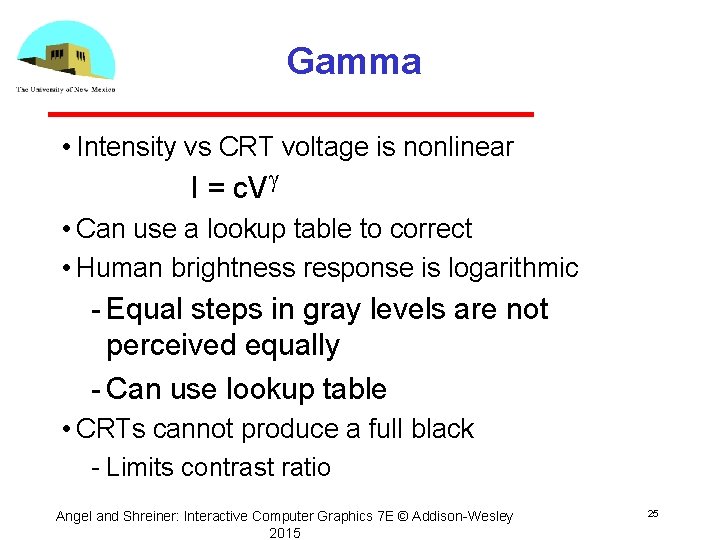
Gamma • Intensity vs CRT voltage is nonlinear I = c. Vg • Can use a lookup table to correct • Human brightness response is logarithmic Equal steps in gray levels are not perceived equally Can use lookup table • CRTs cannot produce a full black Limits contrast ratio Angel and Shreiner: Interactive Computer Graphics 7 E © Addison Wesley 2015 25
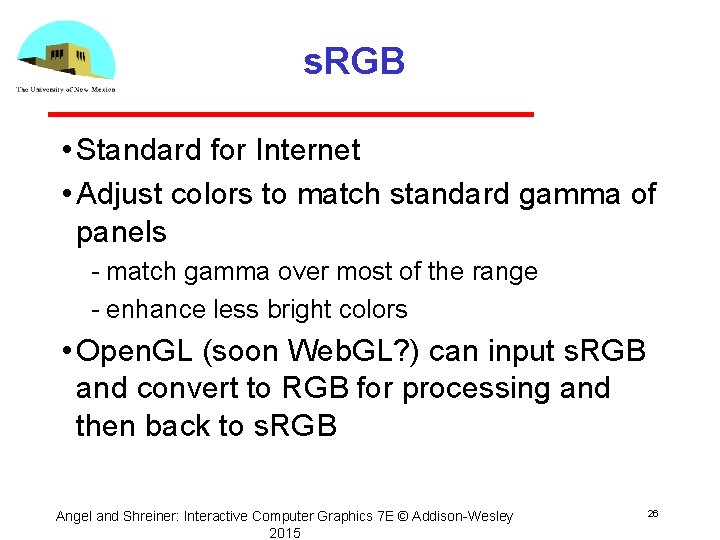
s. RGB • Standard for Internet • Adjust colors to match standard gamma of panels match gamma over most of the range enhance less bright colors • Open. GL (soon Web. GL? ) can input s. RGB and convert to RGB for processing and then back to s. RGB Angel and Shreiner: Interactive Computer Graphics 7 E © Addison Wesley 2015 26
- Slides: 26