
Introduction to Computer Graphics with Web GL Ed
Introduction to Computer Graphics with Web. GL Ed Angel Professor Emeritus of Computer Science Founding Director, Arts, Research, Technology and Science Laboratory University of New Mexico Angel and Shreiner: Interactive Computer Graphics 7 E © Addison Wesley 2015 1
Marching Squares Ed Angel Professor Emeritus of Computer Science University of New Mexico Angel and Shreiner: Interactive Computer Graphics 7 E © Addison Wesley 2015 2
Objectives • Nontrivial two dimensional application • Important method for Contour plots Implicit function visualization • Extends to important method for volume visualization • This lecture is optional but should be interesting to most of you Angel and Shreiner: Interactive Computer Graphics 7 E © Addison Wesley 2015 3
Displaying Implicit Functions • Consider the implicit function g(x, y)=0 • Given an x, we cannot in general find a corresponding y • Given an x and a y, we can test if they are on the curve Angel and Shreiner: Interactive Computer Graphics 7 E © Addison Wesley 2015 4
Height Fields and Contours • In many applications, we have the heights given by a function of the form z=f(x, y) • To find all the points that have a given height t, we have to solve the implicit equation g(x, y)=f(x, y)-t=0 • Such a function determines the isocurves or contours of f for the isovalue t Angel and Shreiner: Interactive Computer Graphics 7 E © Addison Wesley 2015 5
Marching Squares • Displays isocurves or contours for functions f(x, y) = t • Sample f(x, y) on a regular grid yielding samples {fij(x, y)} • These samples can be greater than, less than, or equal to t • Consider four samples fij(x, y), fi+1, j+1(x, y), fi, j+1(x, y) • These samples correspond to the corners of a cell • Color the corners by whether they exceed or are less than the contour value t Angel and Shreiner: Interactive Computer Graphics 7 E © Addison Wesley 2015 6
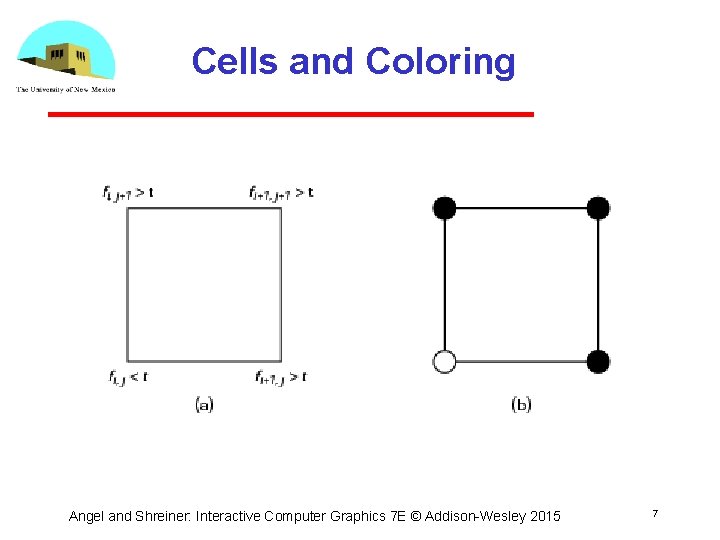
Cells and Coloring Angel and Shreiner: Interactive Computer Graphics 7 E © Addison Wesley 2015 7
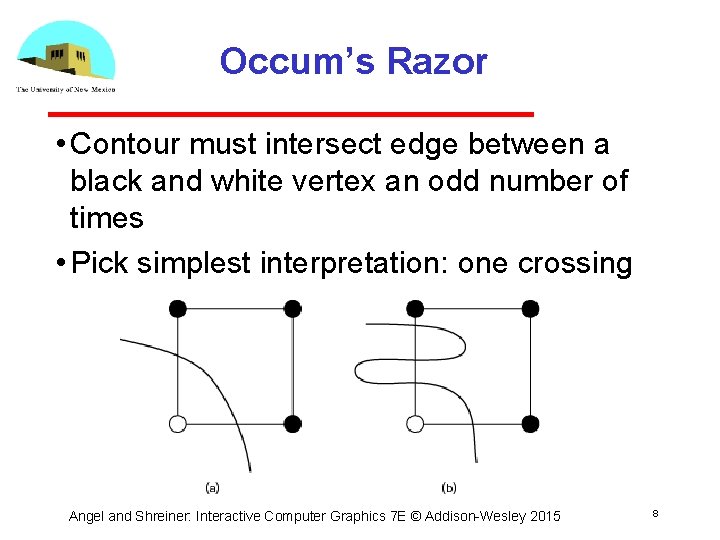
Occum’s Razor • Contour must intersect edge between a black and white vertex an odd number of times • Pick simplest interpretation: one crossing Angel and Shreiner: Interactive Computer Graphics 7 E © Addison Wesley 2015 8
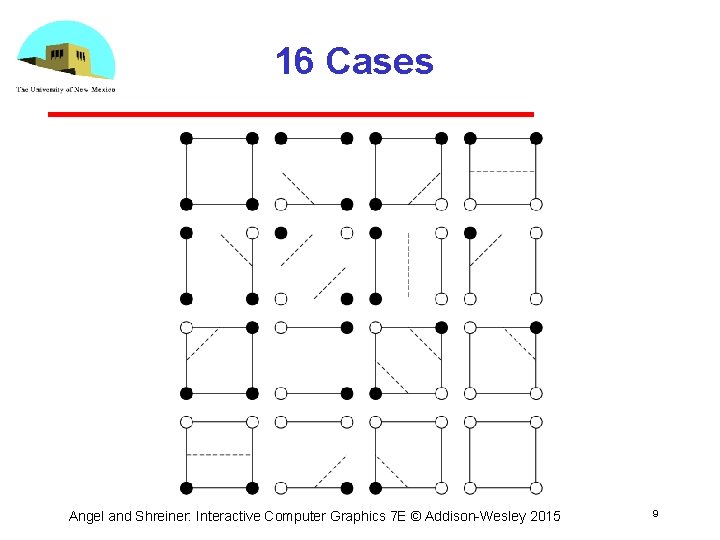
16 Cases Angel and Shreiner: Interactive Computer Graphics 7 E © Addison Wesley 2015 9
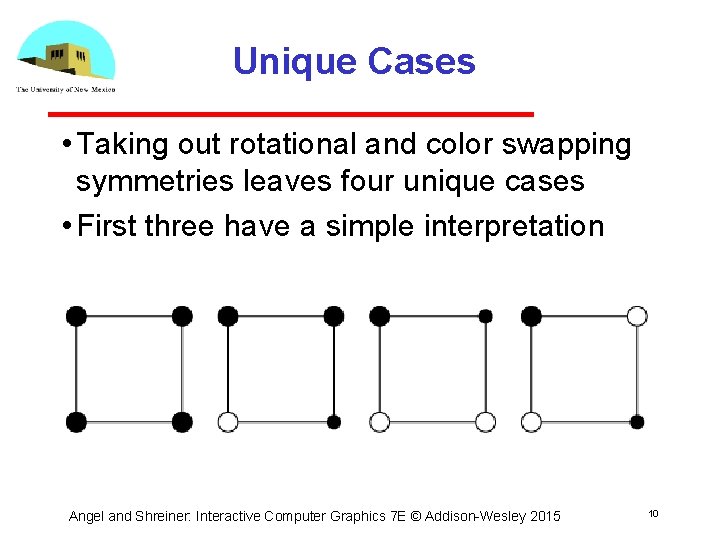
Unique Cases • Taking out rotational and color swapping symmetries leaves four unique cases • First three have a simple interpretation Angel and Shreiner: Interactive Computer Graphics 7 E © Addison Wesley 2015 10
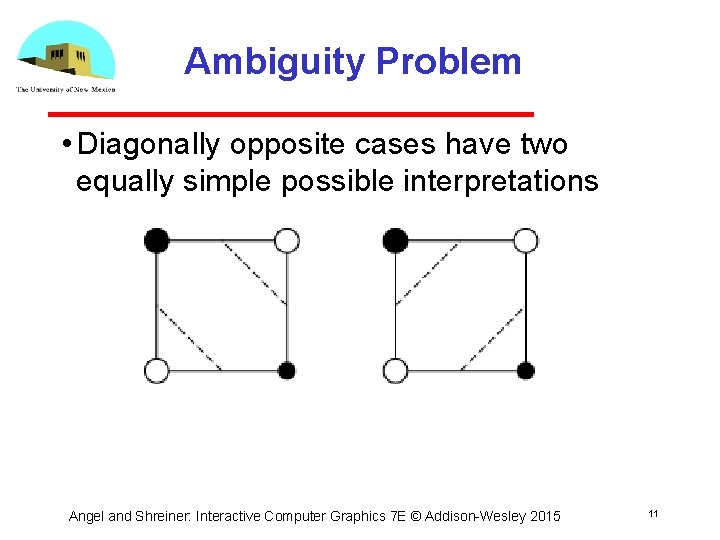
Ambiguity Problem • Diagonally opposite cases have two equally simple possible interpretations Angel and Shreiner: Interactive Computer Graphics 7 E © Addison Wesley 2015 11
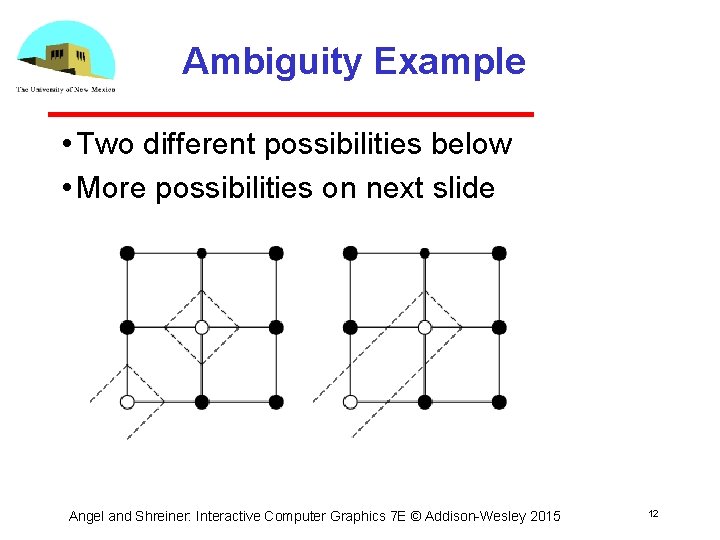
Ambiguity Example • Two different possibilities below • More possibilities on next slide Angel and Shreiner: Interactive Computer Graphics 7 E © Addison Wesley 2015 12
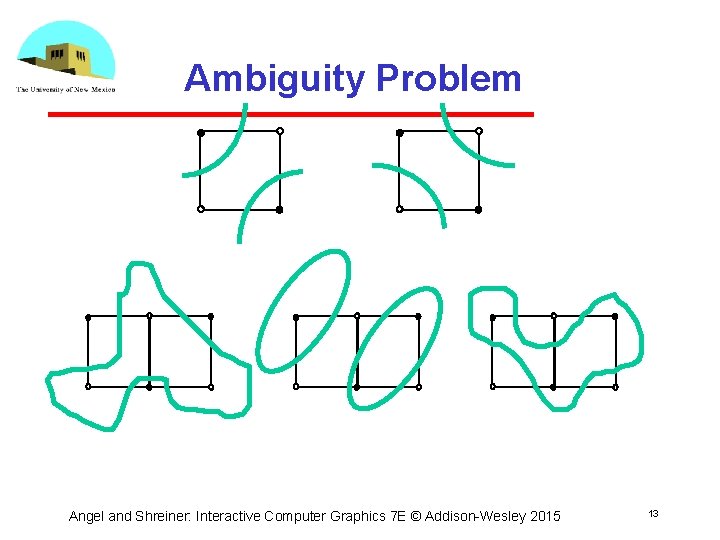
Ambiguity Problem Angel and Shreiner: Interactive Computer Graphics 7 E © Addison Wesley 2015 13
Is Problem Resolvable? • Problem is a sampling problem Not enough samples to know the local detail No solution in a mathematical sense without extra information • More of a problem with volume extension (marching cubes) where selecting “wrong” interpretation can leave a hole in a surface • Multiple methods in literature to give better appearance Supersampling Look at larger area before deciding Angel and Shreiner: Interactive Computer Graphics 7 E © Addison Wesley 2015 14
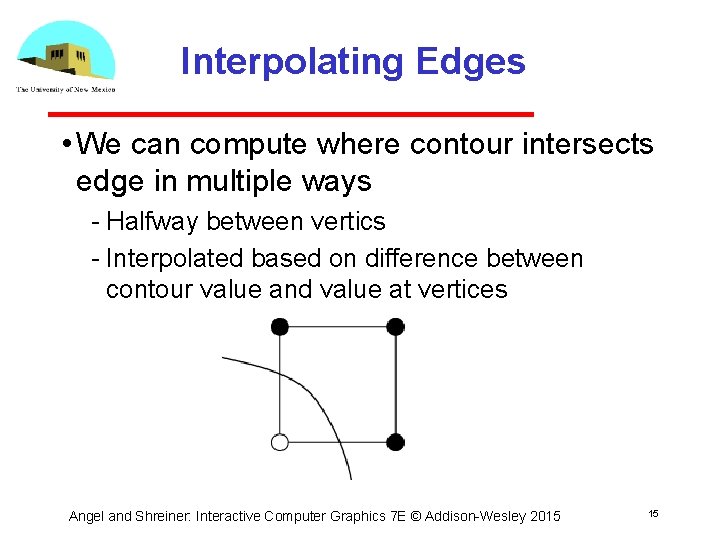
Interpolating Edges • We can compute where contour intersects edge in multiple ways Halfway between vertics Interpolated based on difference between contour value and value at vertices Angel and Shreiner: Interactive Computer Graphics 7 E © Addison Wesley 2015 15
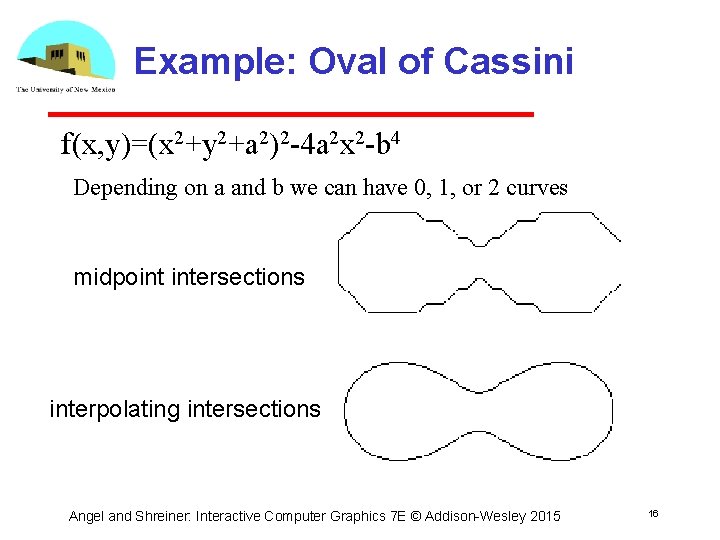
Example: Oval of Cassini f(x, y)=(x 2+y 2+a 2)2 -4 a 2 x 2 -b 4 Depending on a and b we can have 0, 1, or 2 curves midpoint intersections interpolating intersections Angel and Shreiner: Interactive Computer Graphics 7 E © Addison Wesley 2015 16
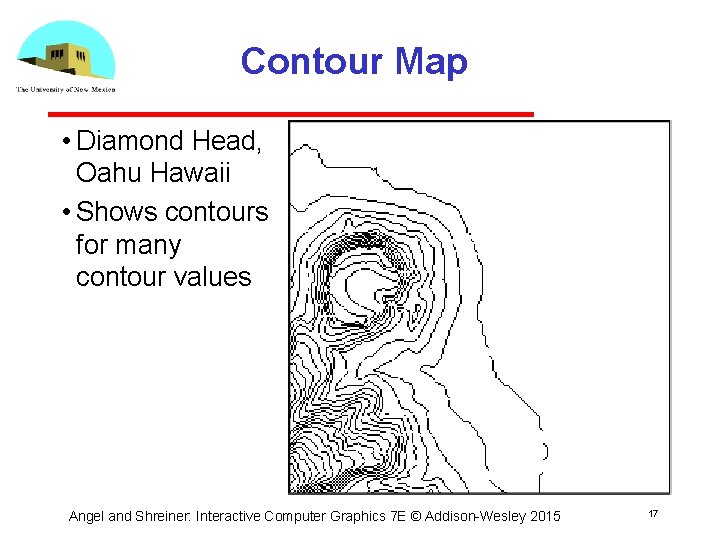
Contour Map • Diamond Head, Oahu Hawaii • Shows contours for many contour values Angel and Shreiner: Interactive Computer Graphics 7 E © Addison Wesley 2015 17
Marching Cubes • Isosurface: solution of g(x, y, z)=c • Use same argument to derive method but with a cubic cell (8 vertices, 256 colorings) • Standard method of volume visualization • Suggested by Lorensen and Kline before marching squares • Note inherent parallelism of both marching cubes and marching squares Angel and Shreiner: Interactive Computer Graphics 7 E © Addison Wesley 2015 18
- Slides: 18