
Introduction to Computer Graphics with Web GL Ed
Introduction to Computer Graphics with Web. GL Ed Angel Professor Emeritus of Computer Science Founding Director, Arts, Research, Technology and Science Laboratory University of New Mexico Angel and Shreiner: Interactive Computer Graphics 7 E © Addison-Wesley 2015 1
Incremental and Quaternion Rotation Ed Angel Professor Emeritus of Computer Science University of New Mexico Angel and Shreiner: Interactive Computer Graphics 7 E © Addison-Wesley 2015 2
Objectives • This is an optional lecture that Illustrates the difference between using direction angles and Euler angles Considers issues with incremental rotation Introduces quaternions as an alternate to rotation matrices Angel and Shreiner: Interactive Computer Graphics 7 E © Addison-Wesley 2015 3
Specifying a Rotation • Pre 3. 1 Open. GL had a function gl. Rotate (theta, dx, dy dz) which incrementally changed the current rotation matrix by a rotation with fixed point of the origin about a vector in the direction (dx, dy, dz) • We implemented rotate in MV. js • Implementations of Rotate often decompose the general rotation into a sequence of rotations about the coordinate axes as in Chapter 4. Angel and Shreiner: Interactive Computer Graphics 7 E © Addison-Wesley 2015 4

Euler from Direction Angles Angel and Shreiner: Interactive Computer Graphics 7 E © Addison-Wesley 2015 5
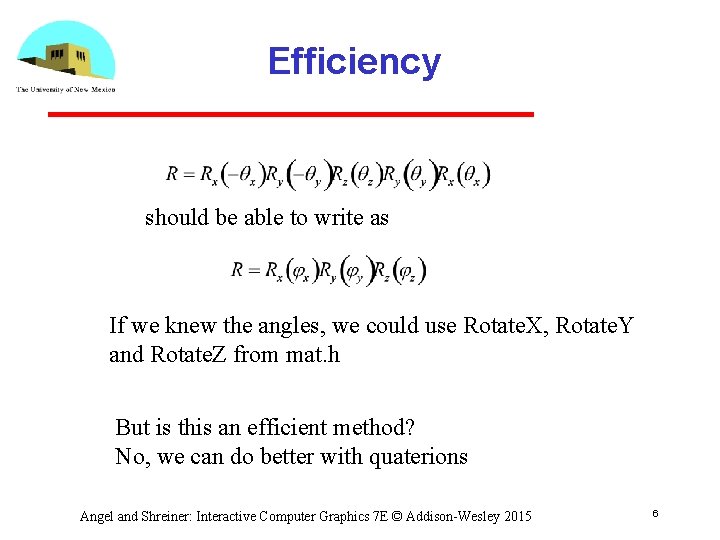
Efficiency should be able to write as If we knew the angles, we could use Rotate. X, Rotate. Y and Rotate. Z from mat. h But is this an efficient method? No, we can do better with quaterions Angel and Shreiner: Interactive Computer Graphics 7 E © Addison-Wesley 2015 6
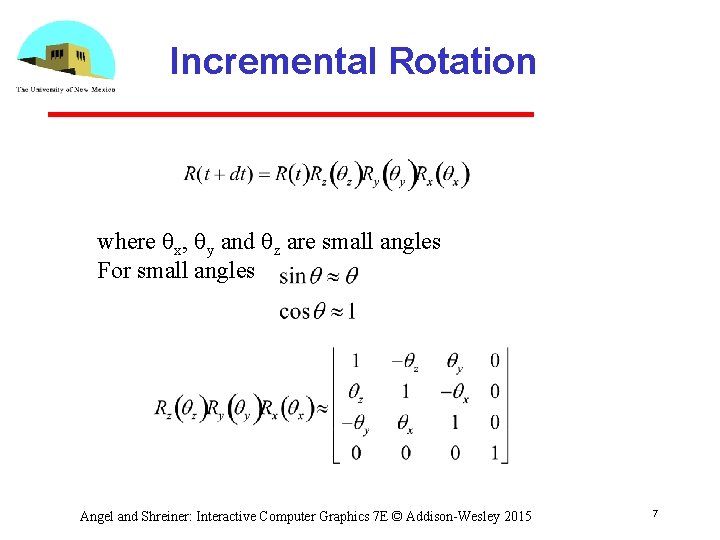
Incremental Rotation where qx, qy and qz are small angles For small angles Angel and Shreiner: Interactive Computer Graphics 7 E © Addison-Wesley 2015 7
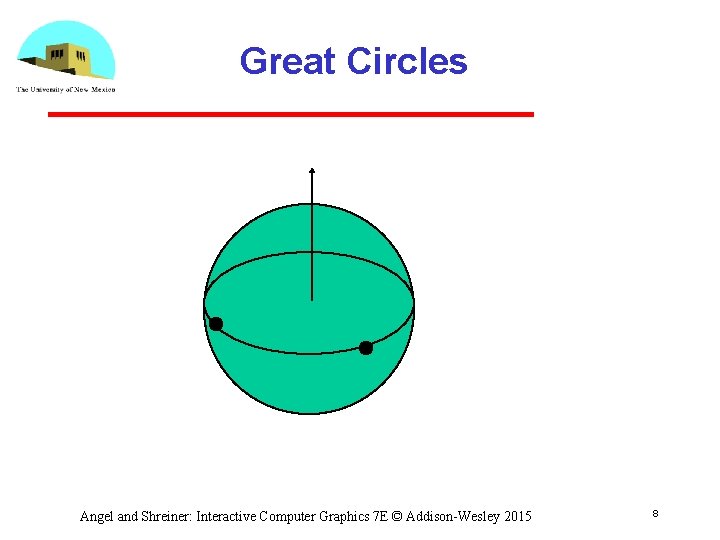
Great Circles Angel and Shreiner: Interactive Computer Graphics 7 E © Addison-Wesley 2015 8
Rotation and Great Circles • Shortest path between two points on a sphere is the great circle passing through the two points • Corresponding to each great circle is vector normal to the circle • Rotation about this vector carries us from the first point to the second Angel and Shreiner: Interactive Computer Graphics 7 E © Addison-Wesley 2015 9
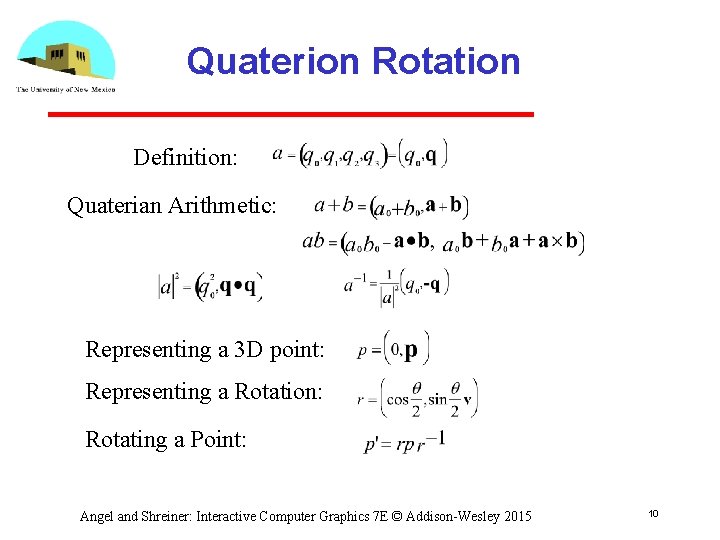
Quaterion Rotation Definition: Quaterian Arithmetic: Representing a 3 D point: Representing a Rotation: Rotating a Point: Angel and Shreiner: Interactive Computer Graphics 7 E © Addison-Wesley 2015 10
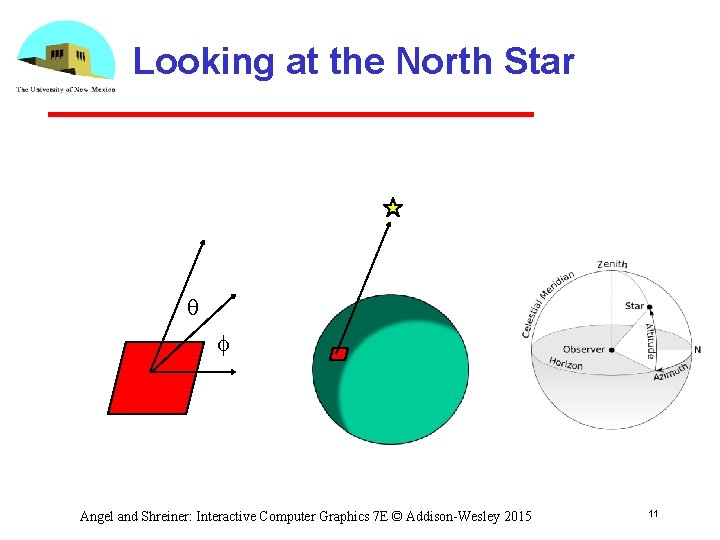
Looking at the North Star q f Angel and Shreiner: Interactive Computer Graphics 7 E © Addison-Wesley 2015 11
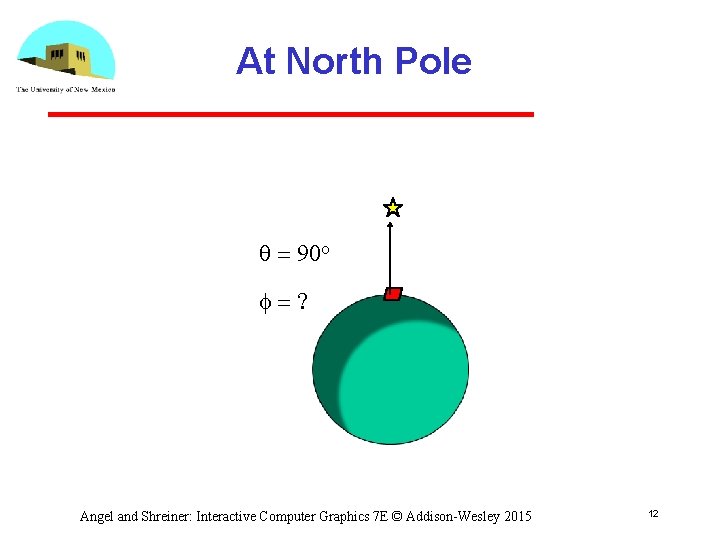
At North Pole q = 90 o f=? Angel and Shreiner: Interactive Computer Graphics 7 E © Addison-Wesley 2015 12
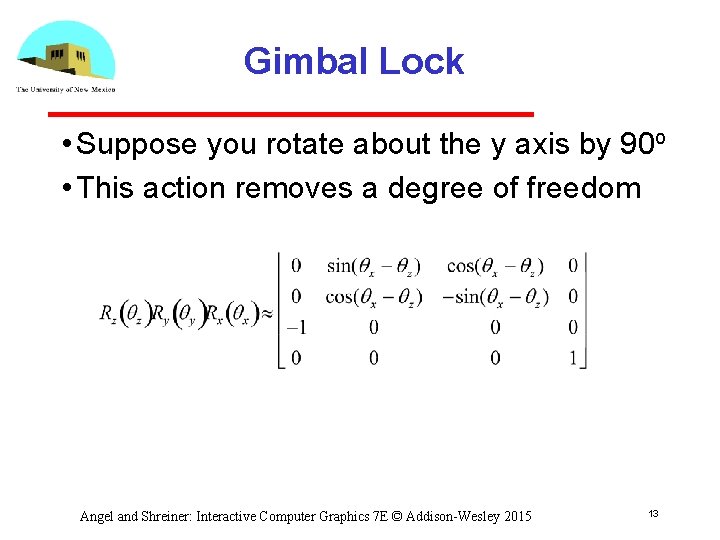
Gimbal Lock • Suppose you rotate about the y axis by 90 o • This action removes a degree of freedom Angel and Shreiner: Interactive Computer Graphics 7 E © Addison-Wesley 2015 13
Quaternions and Computer Graphics • (Re)discovered by both aerospace and animation communities • Used for head mounted display in virtual and augmented reality • Used for smooth camera paths • Caveat: quaternions do not preserve up direction Angel and Shreiner: Interactive Computer Graphics 7 E © Addison-Wesley 2015 14
Working with Quaternians • Quaternion arithmetic works well for representing rotations around the origin • There is no simple way to convert a quaternion to a matrix representation • Usually copy elements back and forth between quaternions and matrices • Can use directly without rotation matrices in the virtual trackball • Quaternion shaders are simple Angel and Shreiner: Interactive Computer Graphics 7 E © Addison-Wesley 2015 15
- Slides: 15