
Introduction to Computer Graphics Mohammad Al Jarrah Nizwa
- Slides: 17
Introduction to Computer Graphics Mohammad Al Jarrah Nizwa University Angel: Interactive Computer Graphics 4 E © Addison Wesley 2005 1
Overview • These lectures are for CPEG 516 Computer Graphics • Ed Angel, Interactive Computer Graphics, A Top down Approach with Open. GL (Fourth Edition), Addison Wesley Angel: Interactive Computer Graphics 4 E © Addison Wesley 2005 2
Objectives • Broad introduction to Computer Graphics Software Hardware Applications • Top down approach • Open. GL Angel: Interactive Computer Graphics 4 E © Addison Wesley 2005 3
Prerequisites • Good programming skills in C (or C++) • Basic Data Structures Linked lists Arrays • Geometry • Simple Linear Algebra Angel: Interactive Computer Graphics 4 E © Addison Wesley 2005 4
Resources • Can run Open. GL on any system Windows Linux Mac • Get GLUT from web if needed Angel: Interactive Computer Graphics 4 E © Addison Wesley 2005 5
References • Other helpful references Open. GL: A Primer, Ed Angel, Addison Wesley, (Second Edition), 2005 • Designed for students who need more programming information The Open. GL Programmer’s Guide (the Redbook) and the Open. GL Reference Manual (The Blue book), Addison Wesley, – The definitive references Angel: Interactive Computer Graphics 4 E © Addison Wesley 2005 6
Web Resources • www. opengl. org • Additional materials available to instructors through their Addison Wesley representatives Angel: Interactive Computer Graphics 4 E © Addison Wesley 2005 7
Outline: Part 1 • Part 1: Introduction • Text: Chapter 1 • Lectures 1 3 What is Computer Graphics? Applications Areas History Image formation Basic Architecture Angel: Interactive Computer Graphics 4 E © Addison Wesley 2005 8
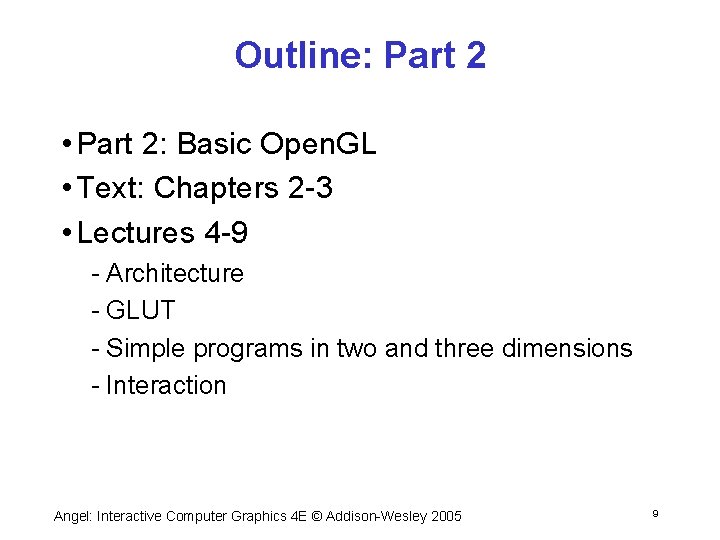
Outline: Part 2 • Part 2: Basic Open. GL • Text: Chapters 2 3 • Lectures 4 9 Architecture GLUT Simple programs in two and three dimensions Interaction Angel: Interactive Computer Graphics 4 E © Addison Wesley 2005 9
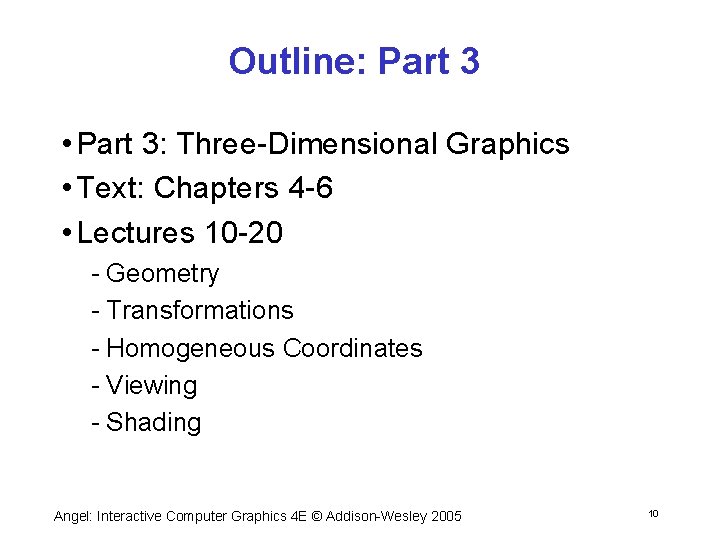
Outline: Part 3 • Part 3: Three Dimensional Graphics • Text: Chapters 4 6 • Lectures 10 20 Geometry Transformations Homogeneous Coordinates Viewing Shading Angel: Interactive Computer Graphics 4 E © Addison Wesley 2005 10
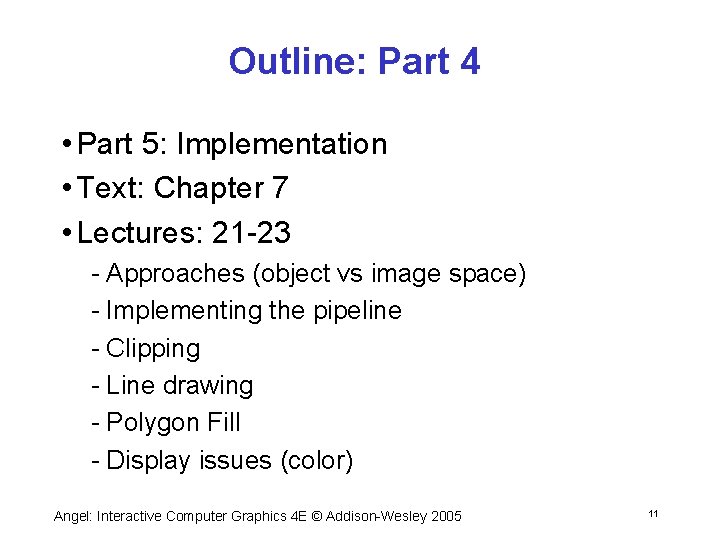
Outline: Part 4 • Part 5: Implementation • Text: Chapter 7 • Lectures: 21 23 Approaches (object vs image space) Implementing the pipeline Clipping Line drawing Polygon Fill Display issues (color) Angel: Interactive Computer Graphics 4 E © Addison Wesley 2005 11
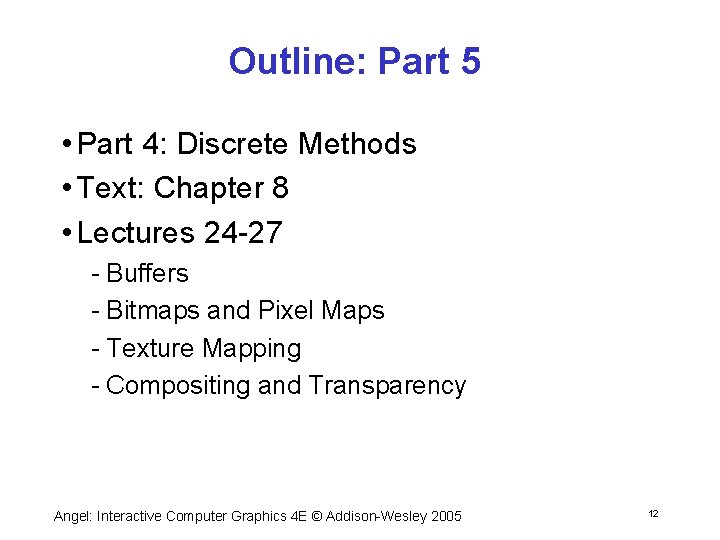
Outline: Part 5 • Part 4: Discrete Methods • Text: Chapter 8 • Lectures 24 27 Buffers Bitmaps and Pixel Maps Texture Mapping Compositing and Transparency Angel: Interactive Computer Graphics 4 E © Addison Wesley 2005 12
Outline: Part 6 • Part 6: Programmable Pipelines • Text: Chapter 9 • Lectures 28 30 Shading Languages GLSL Vertex Shaders Fragment Shaders Angel: Interactive Computer Graphics 4 E © Addison Wesley 2005 13
Outline: Part 7 • Part 7: Hierarchy • Text: Chapter 10 • Lectures: 31 34 • Tree Structured Models Traversal Methods Scene Graphs Angel: Interactive Computer Graphics 4 E © Addison Wesley 2005 14
Outline: Part 8 • Part 8: Curves and Surfaces • Text: Chapter 11 • Lectures: 35 39 Angel: Interactive Computer Graphics 4 E © Addison Wesley 2005 15
Outline: Part 9 • Part 9: Advanced Rendering • Text: Chapter 12 • Lectures: 40 42 Angel: Interactive Computer Graphics 4 E © Addison Wesley 2005 16
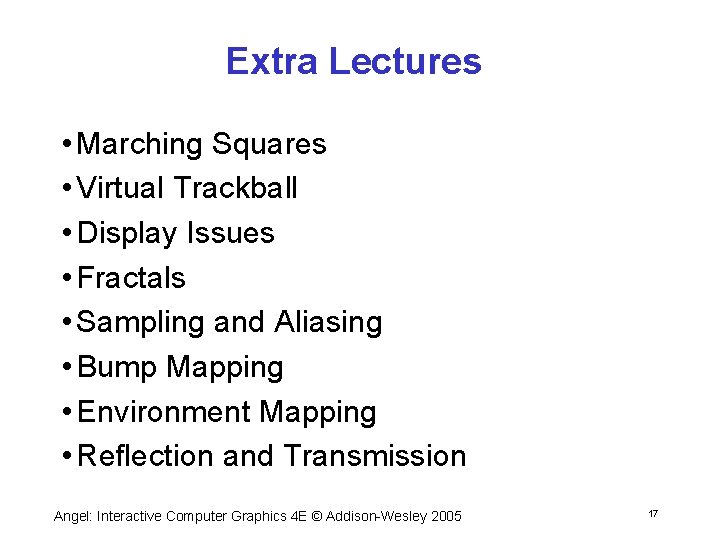
Extra Lectures • Marching Squares • Virtual Trackball • Display Issues • Fractals • Sampling and Aliasing • Bump Mapping • Environment Mapping • Reflection and Transmission Angel: Interactive Computer Graphics 4 E © Addison Wesley 2005 17