
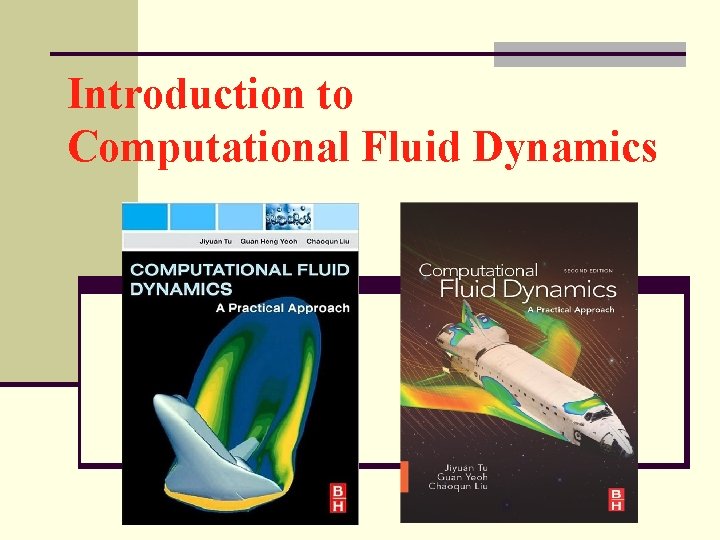
Introduction to Computational Fluid Dynamics What Is CFD


- Slides: 36
Introduction to Computational Fluid Dynamics
What Is CFD? CFD is to use computer codes to solve a wide range of problems in fluid flow and heat transfer. 2
What Is CFD? CFD is a tool to investigate and research a wide range of problems in fluid flow and heat transfer. 3
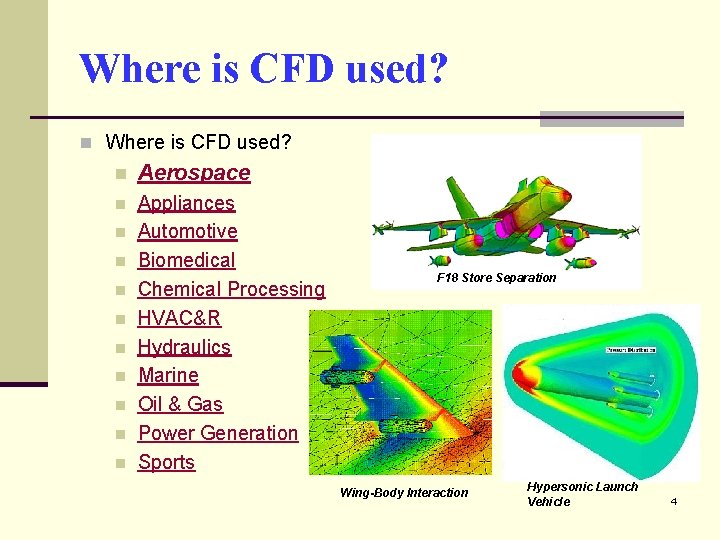
Where is CFD used? n Aerospace n Appliances Automotive Biomedical Chemical Processing HVAC&R Hydraulics Marine Oil & Gas Power Generation Sports n n n n n F 18 Store Separation Wing-Body Interaction Hypersonic Launch Vehicle 4
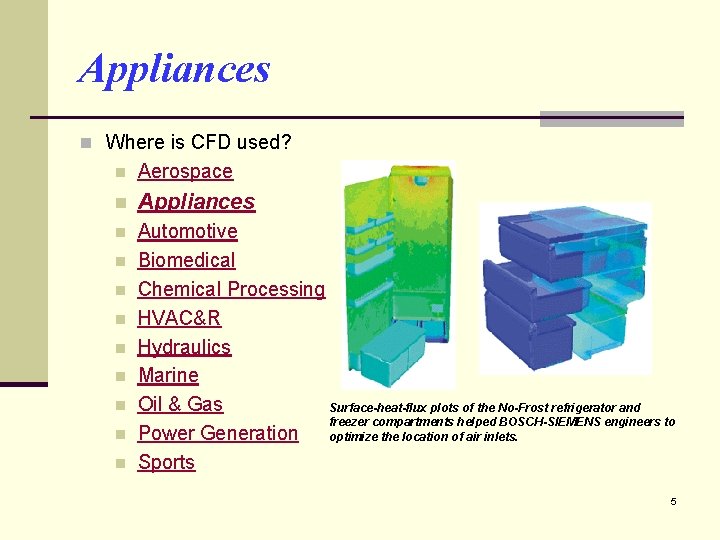
Appliances n Where is CFD used? n Aerospace n Appliances n Automotive Biomedical Chemical Processing HVAC&R Hydraulics Marine Oil & Gas Surface-heat-flux plots of the No-Frost refrigerator and freezer compartments helped BOSCH-SIEMENS engineers to Power Generation optimize the location of air inlets. Sports n n n n 5
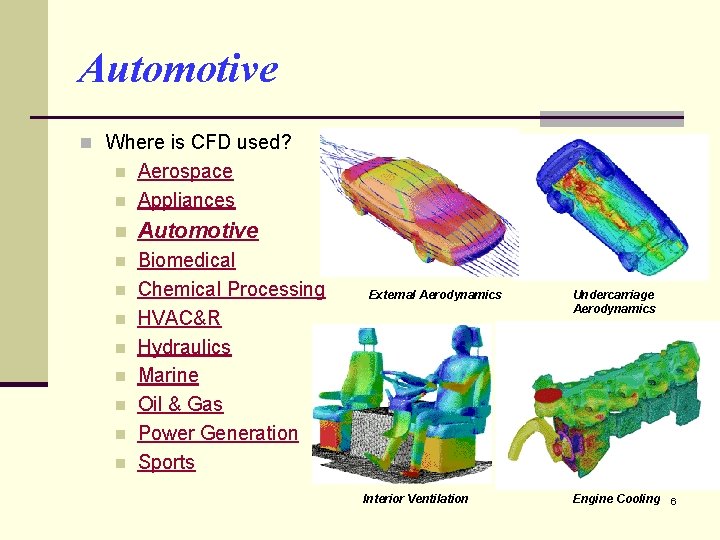
Automotive n Where is CFD used? n Aerospace Appliances n Automotive n Biomedical Chemical Processing HVAC&R Hydraulics Marine Oil & Gas Power Generation Sports n n n n External Aerodynamics Interior Ventilation Undercarriage Aerodynamics Engine Cooling 6
Biomedical n Where is CFD used? n Aerospace Appliances Automotive n Biomedical n Chemical Processing HVAC&R Hydraulics Marine Oil & Gas Power Generation Sports n n n n Medtronic Blood Pump Temperature and natural convection currents in the eye following laser heating. Spinal Catheter 7
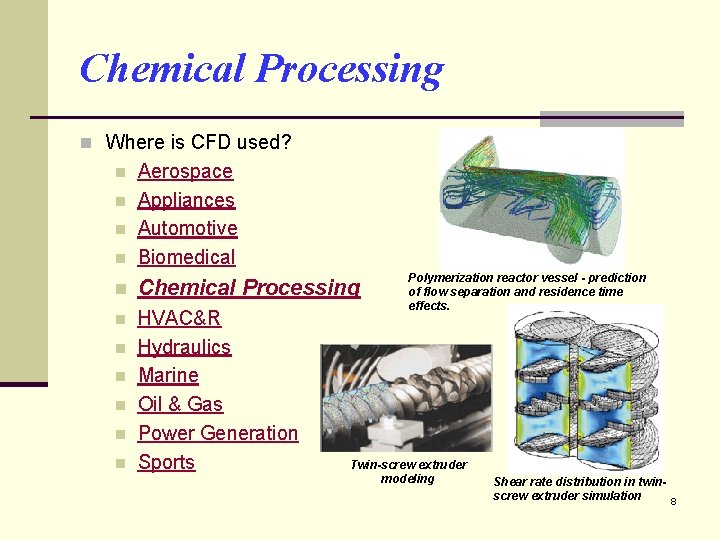
Chemical Processing n Where is CFD used? n Aerospace Appliances Automotive Biomedical n Chemical Processing n HVAC&R Hydraulics Marine Oil & Gas Power Generation Sports n n n n Polymerization reactor vessel - prediction of flow separation and residence time effects. Twin-screw extruder modeling Shear rate distribution in twinscrew extruder simulation 8
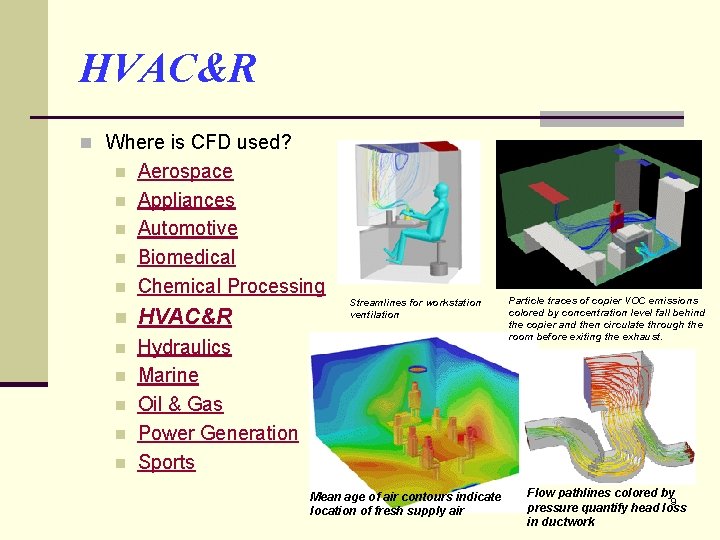
HVAC&R n Where is CFD used? n n n Aerospace Appliances Automotive Biomedical Chemical Processing n HVAC&R n Hydraulics Marine Oil & Gas Power Generation Sports n n Streamlines for workstation ventilation Mean age of air contours indicate location of fresh supply air Particle traces of copier VOC emissions colored by concentration level fall behind the copier and then circulate through the room before exiting the exhaust. Flow pathlines colored by 9 pressure quantify head loss in ductwork
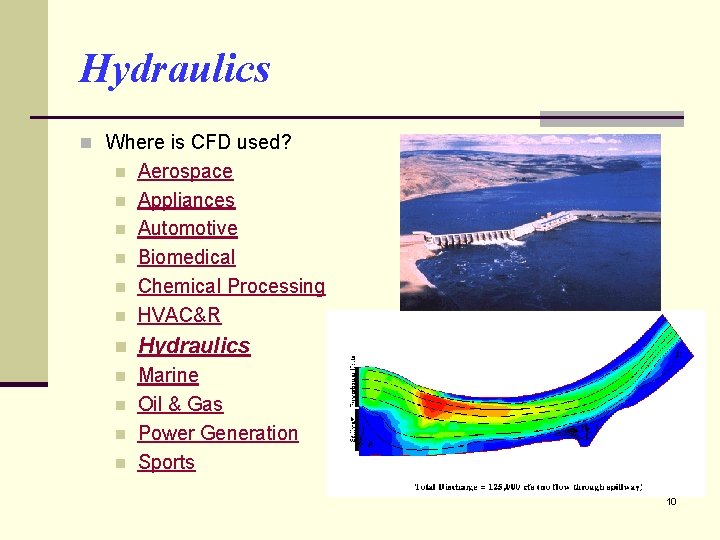
Hydraulics n Where is CFD used? n Aerospace Appliances Automotive Biomedical Chemical Processing HVAC&R n Hydraulics n Marine Oil & Gas Power Generation Sports n n n n 10
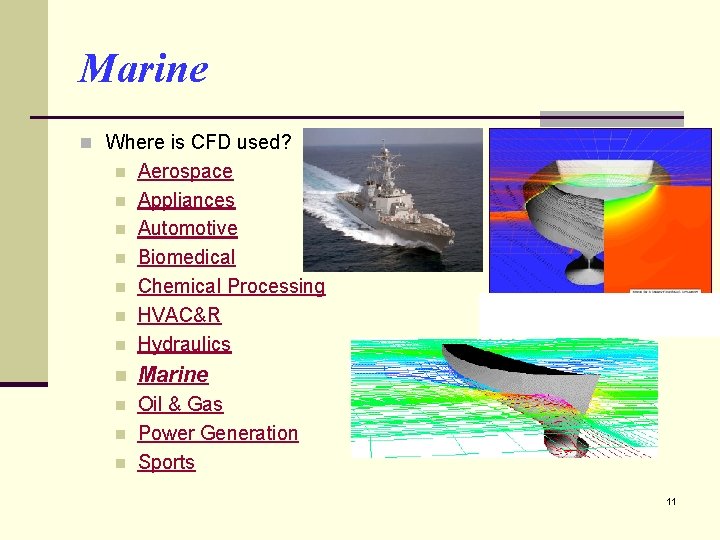
Marine n Where is CFD used? n Aerospace Appliances Automotive Biomedical Chemical Processing HVAC&R Hydraulics n Marine n Oil & Gas Power Generation Sports n n n n 11
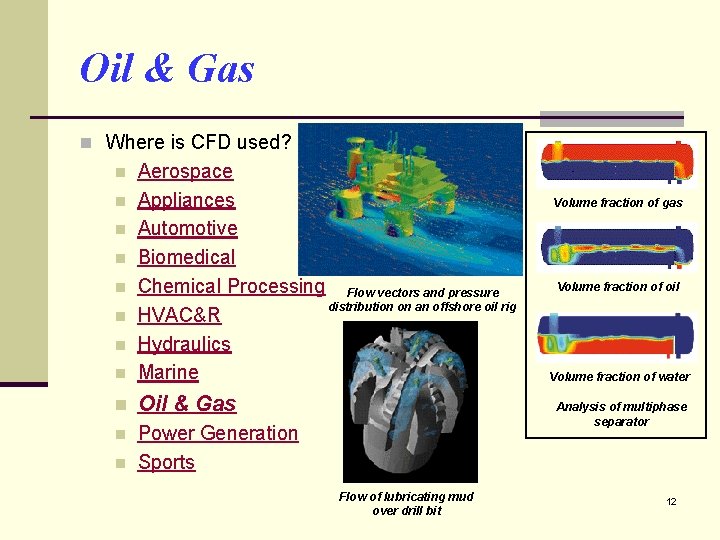
Oil & Gas n Where is CFD used? n Aerospace Appliances Automotive Biomedical Chemical Processing Flow vectors and pressure distribution on an offshore oil rig HVAC&R Hydraulics Marine n Oil & Gas n Power Generation Sports n n n n Volume fraction of gas Volume fraction of oil Volume fraction of water Analysis of multiphase separator Flow of lubricating mud over drill bit 12
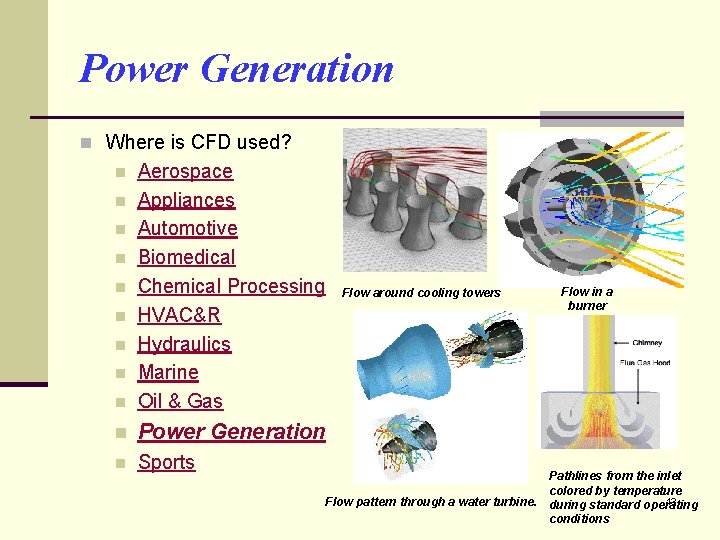
Power Generation n Where is CFD used? n Aerospace Appliances Automotive Biomedical Chemical Processing HVAC&R Hydraulics Marine Oil & Gas n Power Generation n Sports n n n n Flow around cooling towers Flow in a burner Pathlines from the inlet colored by temperature 13 Flow pattern through a water turbine. during standard operating conditions
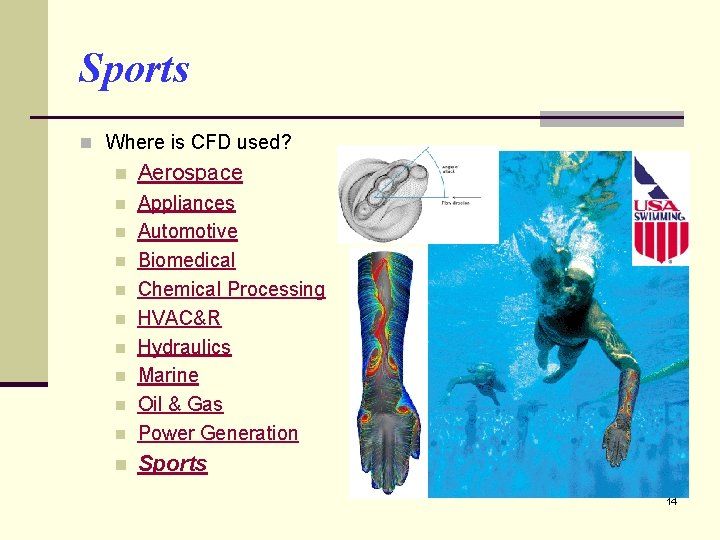
Sports n Where is CFD used? n Aerospace n n Appliances Automotive Biomedical Chemical Processing HVAC&R Hydraulics Marine Oil & Gas Power Generation n Sports n n n n 14
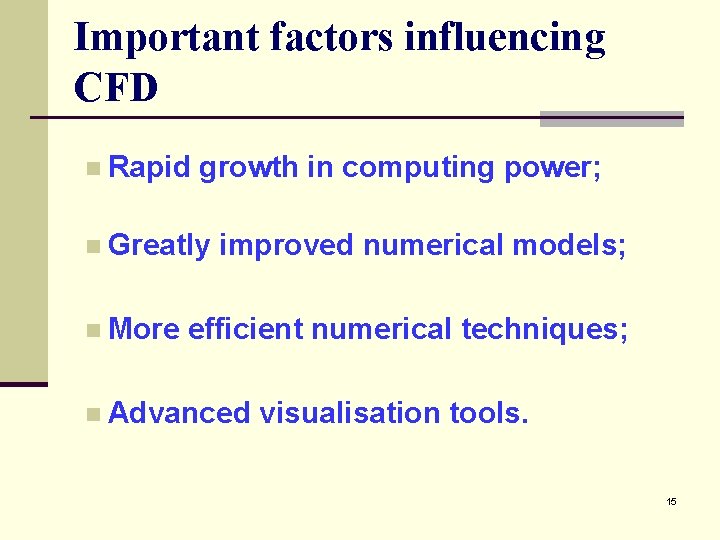
Important factors influencing CFD n Rapid growth in computing power; n Greatly n More improved numerical models; efficient numerical techniques; n Advanced visualisation tools. 15
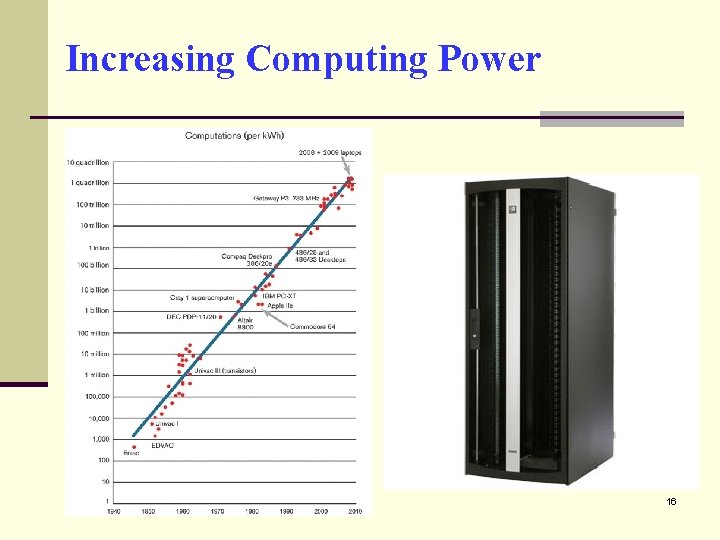
Increasing Computing Power 16
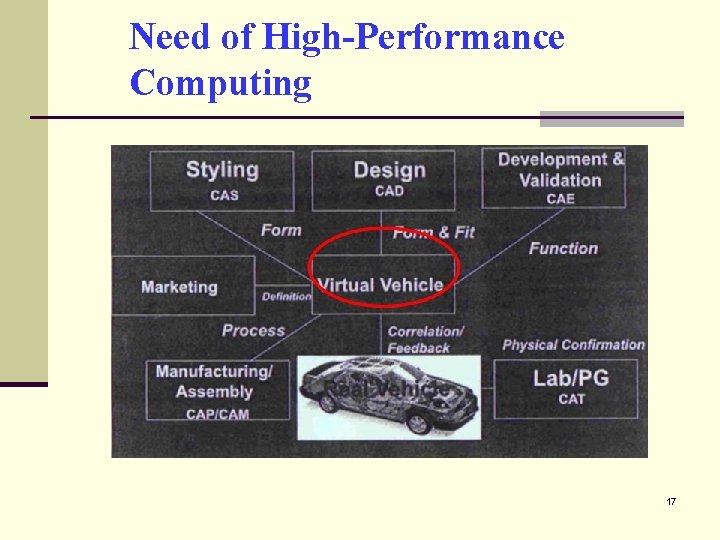
Need of High-Performance Computing 17
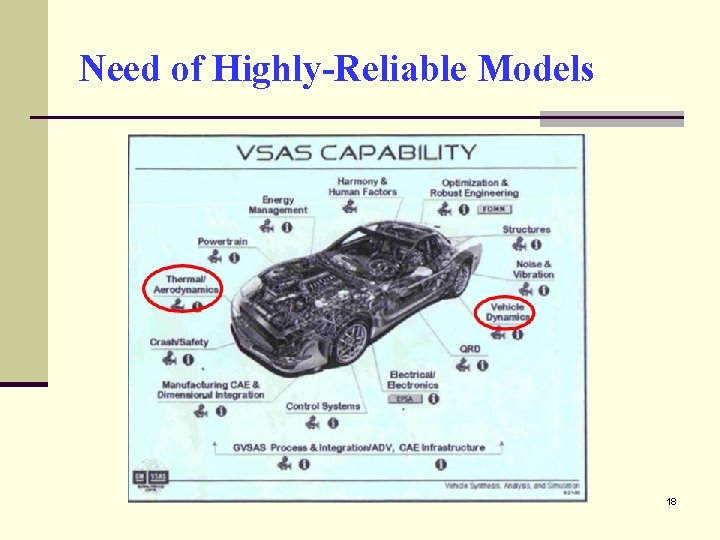
Need of Highly-Reliable Models 18
Advantages of CFD n Low Cost n n Using physical experiments and tests to get essential engineering data for design can be expensive. Computational simulations are relatively inexpensive, and costs are likely to decrease as computers become more powerful. n Speed n n CFD simulations can be executed in a short period of time. Quick turnaround means engineering data can be introduced early in the design process n Ability to Simulate Real Conditions n n Many flow and heat transfer processes can not be (easily) tested - e. g. hypersonic flow at Mach 20, nuclear accident analysis. CFD provides the ability to theoretically simulate any physical condition 19
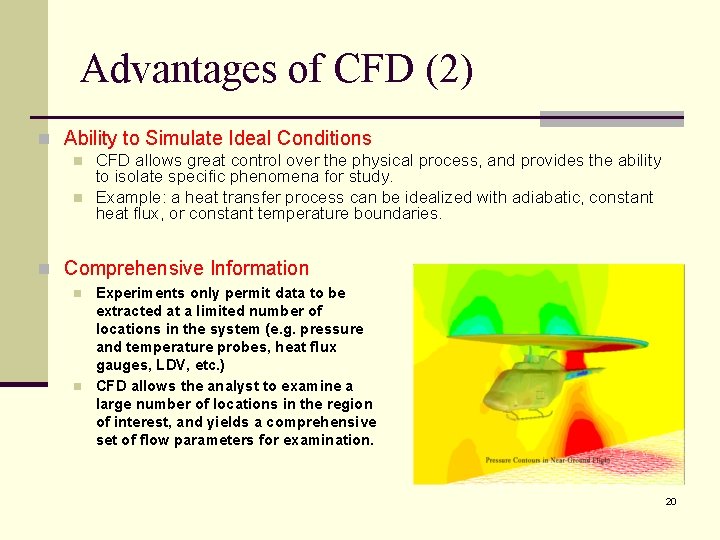
Advantages of CFD (2) n Ability to Simulate Ideal Conditions n n CFD allows great control over the physical process, and provides the ability to isolate specific phenomena for study. Example: a heat transfer process can be idealized with adiabatic, constant heat flux, or constant temperature boundaries. n Comprehensive Information n n Experiments only permit data to be extracted at a limited number of locations in the system (e. g. pressure and temperature probes, heat flux gauges, LDV, etc. ) CFD allows the analyst to examine a large number of locations in the region of interest, and yields a comprehensive set of flow parameters for examination. 20
Limitations of CFD n Physical Models n n CFD solutions rely upon physical models of real world processes (e. g. turbulence, compressibility, chemistry, multiphase flow, etc. ). The solutions that are obtained through CFD can only be as accurate as the physical models on which they are based. n Numerical Errors n Solving equations on a computer invariably introduces numerical errors n n Round-off error - errors due to finite word size available on the computer Truncation error - error due to approximations in the numerical models Round-off errors will always exist (though they should be small in most cases) Truncation errors will go to zero as the grid is refined - so mesh refinement is one way to deal with truncation error. 21
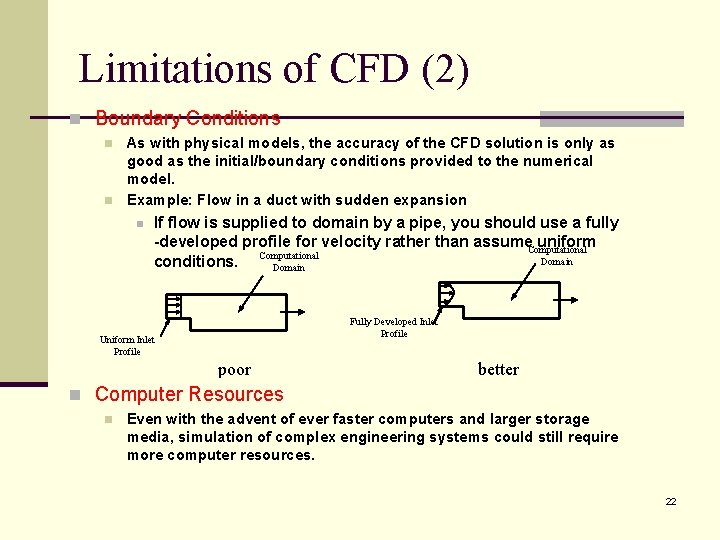
Limitations of CFD (2) n Boundary Conditions n n As with physical models, the accuracy of the CFD solution is only as good as the initial/boundary conditions provided to the numerical model. Example: Flow in a duct with sudden expansion n If flow is supplied to domain by a pipe, you should use a fully -developed profile for velocity rather than assume. Computational uniform Computational Domain conditions. Domain Fully Developed Inlet Profile Uniform Inlet Profile poor better n Computer Resources n Even with the advent of ever faster computers and larger storage media, simulation of complex engineering systems could still require more computer resources. 22
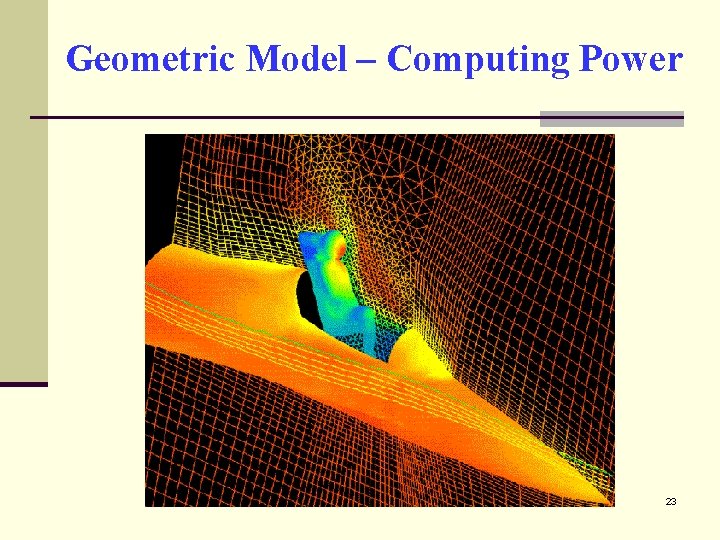
Geometric Model – Computing Power 23
Physics n CFD codes typically designed for resolution of certain flow phenomenon n n n n viscous vs. inviscid (Re) turbulent vs. laminar (Re) incompressible vs. compressible (Ma) single- vs. multi-phase (St) thermal/density effects and energy equation (Nu, Pr, Gr) free-surface flow and surface tension (Fr, We) Chemical reactions and many constituents (C) etc… n Modeling requirements depend upon which physical phenomenon are important 24
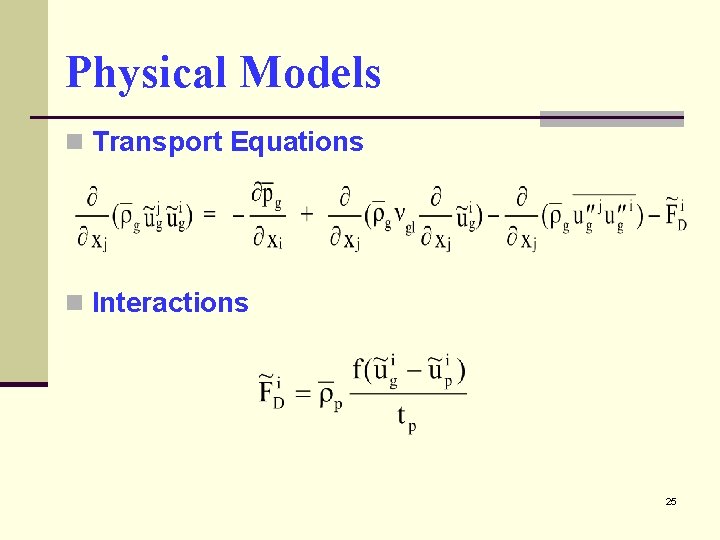
Physical Models n Transport Equations n Interactions 25
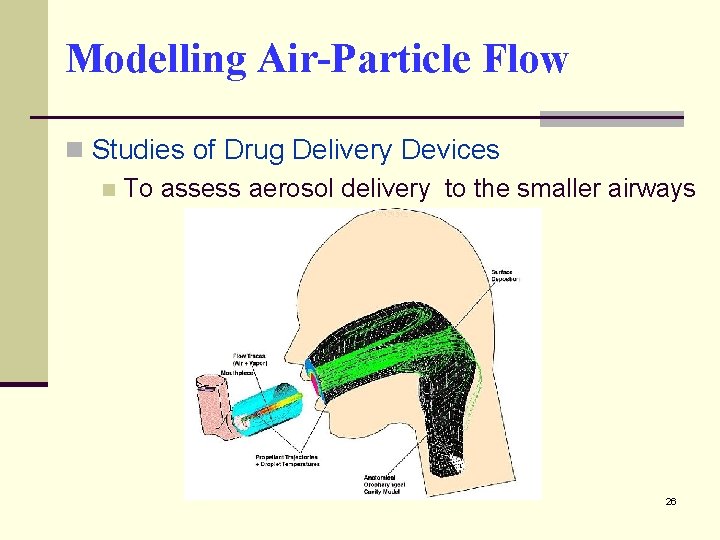
Modelling Air-Particle Flow n Studies of Drug Delivery Devices n To assess aerosol delivery to the smaller airways 26
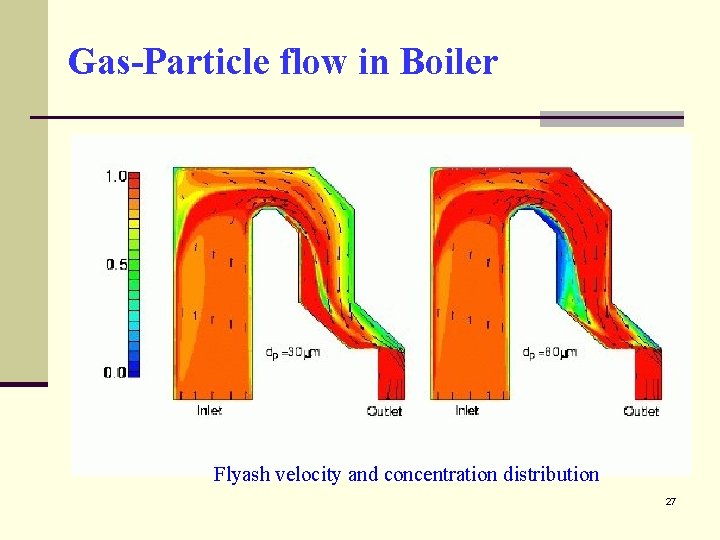
Gas-Particle flow in Boiler Flyash velocity and concentration distribution 27
Numerical Issues n computational solution of the governing equations n method dependent upon the model equations and physics n several components to formulation n discretization and linearization n assembly of system of algebraic equations n solution of equations n unsteady 3 D RANS equations have many issues 28
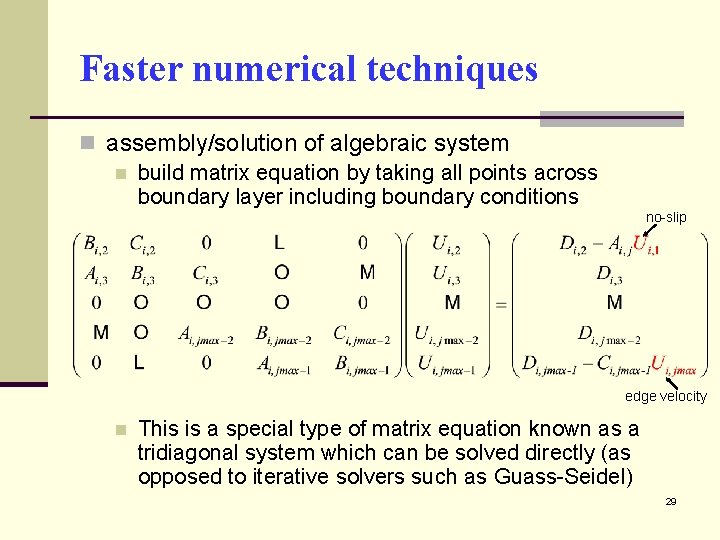
Faster numerical techniques n assembly/solution of algebraic system n build matrix equation by taking all points across boundary layer including boundary conditions no-slip edge velocity n This is a special type of matrix equation known as a tridiagonal system which can be solved directly (as opposed to iterative solvers such as Guass-Seidel) 29
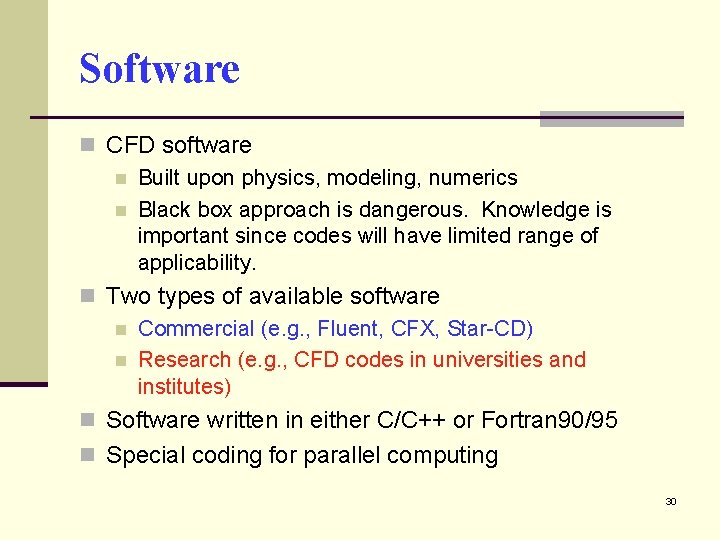
Software n CFD software n Built upon physics, modeling, numerics n Black box approach is dangerous. Knowledge is important since codes will have limited range of applicability. n Two types of available software n Commercial (e. g. , Fluent, CFX, Star-CD) n Research (e. g. , CFD codes in universities and institutes) n Software written in either C/C++ or Fortran 90/95 n Special coding for parallel computing 30
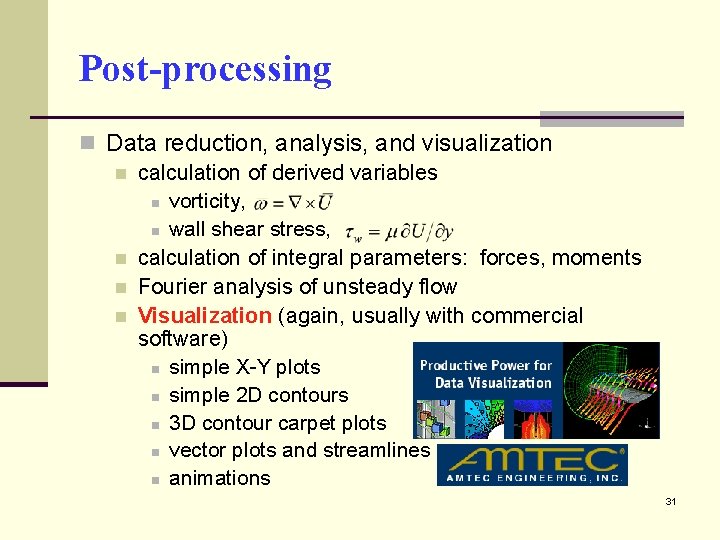
Post-processing n Data reduction, analysis, and visualization n calculation of derived variables n vorticity, n wall shear stress, n calculation of integral parameters: forces, moments n Fourier analysis of unsteady flow n Visualization (again, usually with commercial software) n simple X-Y plots n simple 2 D contours n 3 D contour carpet plots n vector plots and streamlines n animations 31
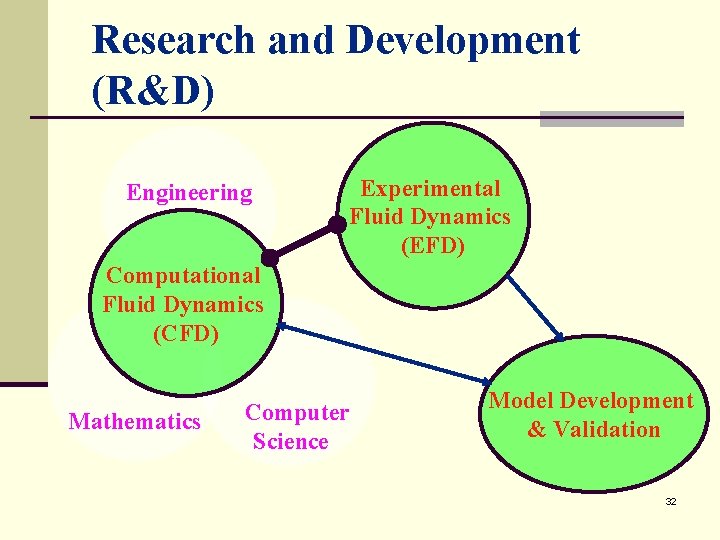
Research and Development (R&D) Engineering Experimental Fluid Dynamics (EFD) Computational Fluid Dynamics (CFD) Mathematics Computer Science Model Development & Validation 32
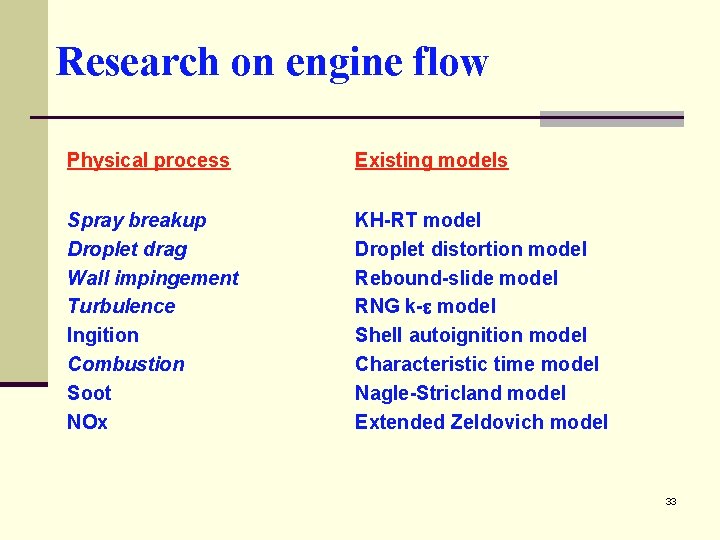
Research on engine flow Physical process Existing models Spray breakup Droplet drag Wall impingement Turbulence Ingition Combustion Soot NOx KH-RT model Droplet distortion model Rebound-slide model RNG k- model Shell autoignition model Characteristic time model Nagle-Stricland model Extended Zeldovich model 33
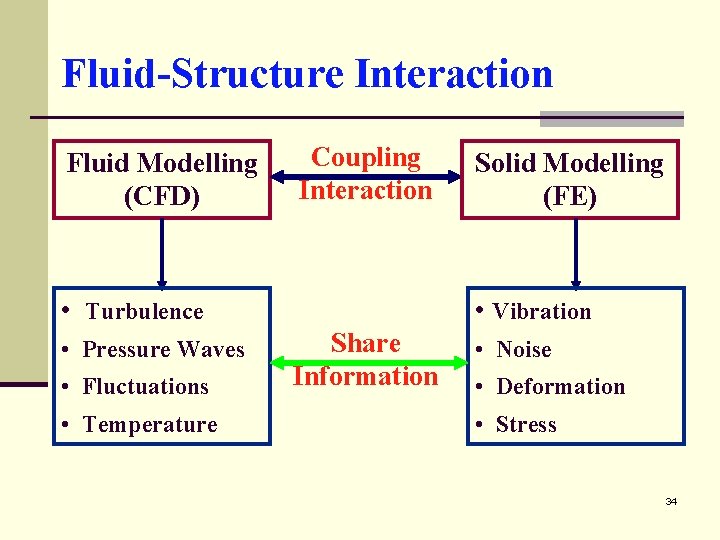
Fluid-Structure Interaction Fluid Modelling (CFD) Coupling Interaction • Turbulence • Pressure Waves • Fluctuations • Temperature Solid Modelling (FE) • Vibration Share Information • Noise • Deformation • Stress 34
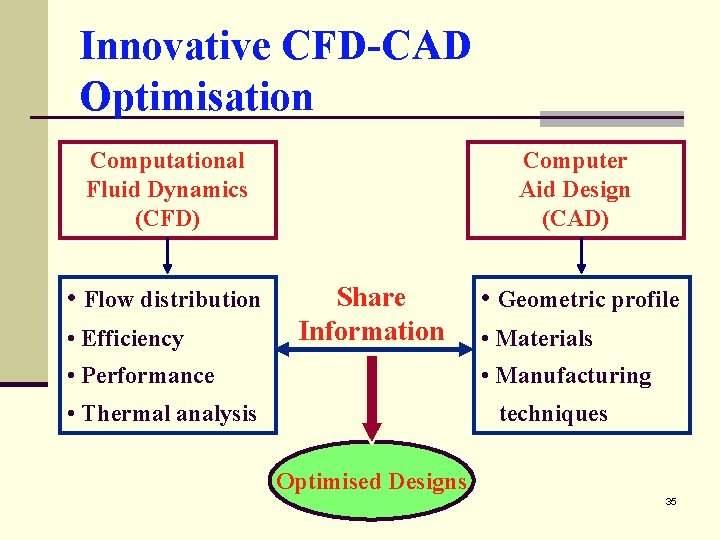
Innovative CFD-CAD Optimisation Computational Fluid Dynamics (CFD) • Flow distribution • Efficiency Computer Aid Design (CAD) Share Information • Performance • Geometric profile • Materials • Manufacturing • Thermal analysis techniques Optimised Designs 35
End of Lecture 1 36