
Introduction to computational chemistry materials science Handson workshop
- Slides: 17
Introduction to computational chemistry & materials science Hands-on workshop Chemistry & Materials with the ADF Modeling Suite KIER, Daejeon, 9 February 2018 Fedor Goumans, goumans@scm. com Making Computational Chemistry Work for You
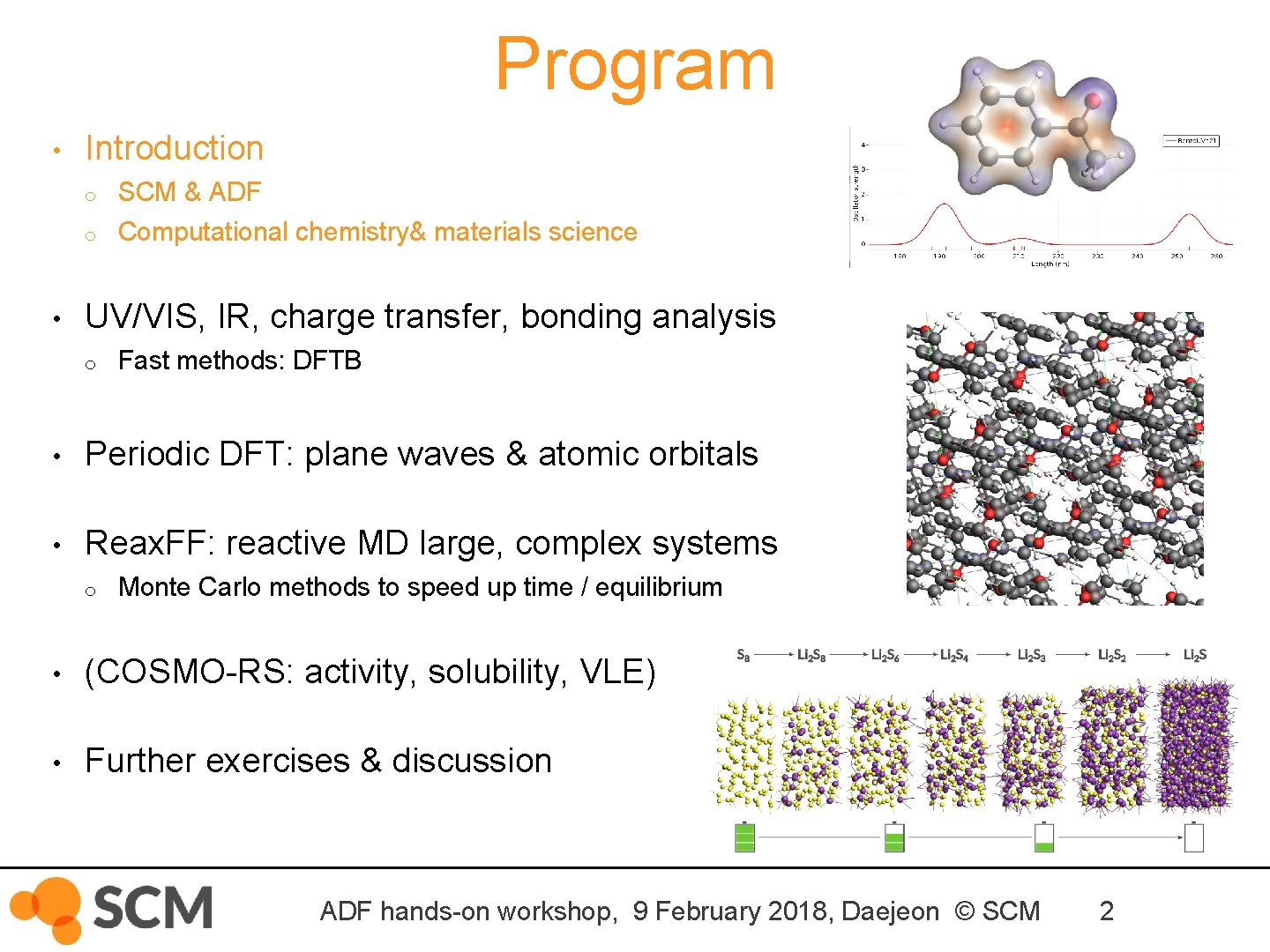
Program • Introduction o o • SCM & ADF Computational chemistry& materials science UV/VIS, IR, charge transfer, bonding analysis o Fast methods: DFTB • Periodic DFT: plane waves & atomic orbitals • Reax. FF: reactive MD large, complex systems o Monte Carlo methods to speed up time / equilibrium • (COSMO-RS: activity, solubility, VLE) • Further exercises & discussion ADF hands-on workshop, 9 February 2018, Daejeon © SCM 2
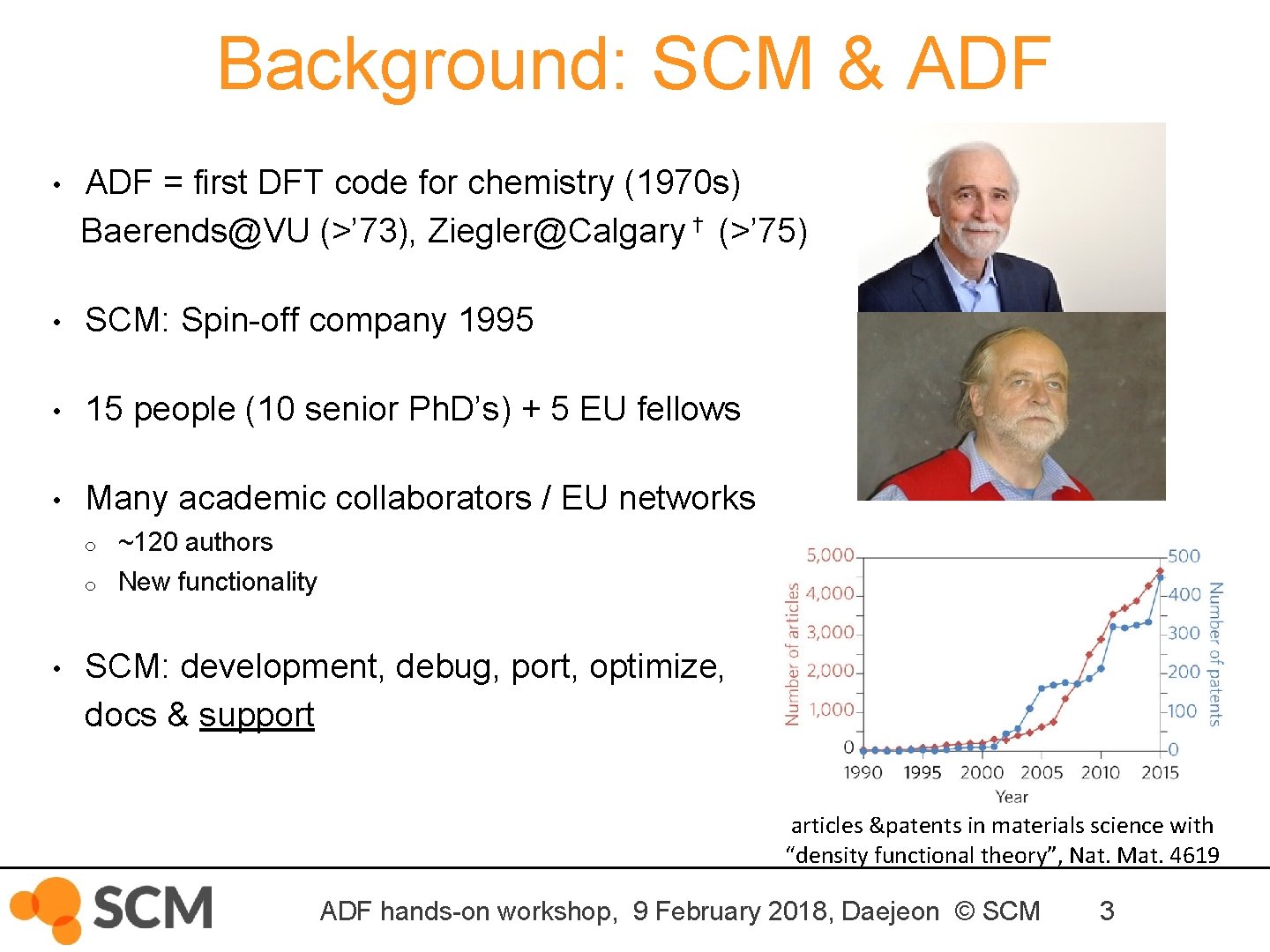
Background: SCM & ADF = first DFT code for chemistry (1970 s) Baerends@VU (>’ 73), Ziegler@Calgary✝ (>’ 75) • • SCM: Spin-off company 1995 • 15 people (10 senior Ph. D’s) + 5 EU fellows • Many academic collaborators / EU networks o o • ~120 authors New functionality SCM: development, debug, port, optimize, docs & support articles &patents in materials science with “density functional theory”, Nat. Mat. 4619 ADF hands-on workshop, 9 February 2018, Daejeon © SCM 3
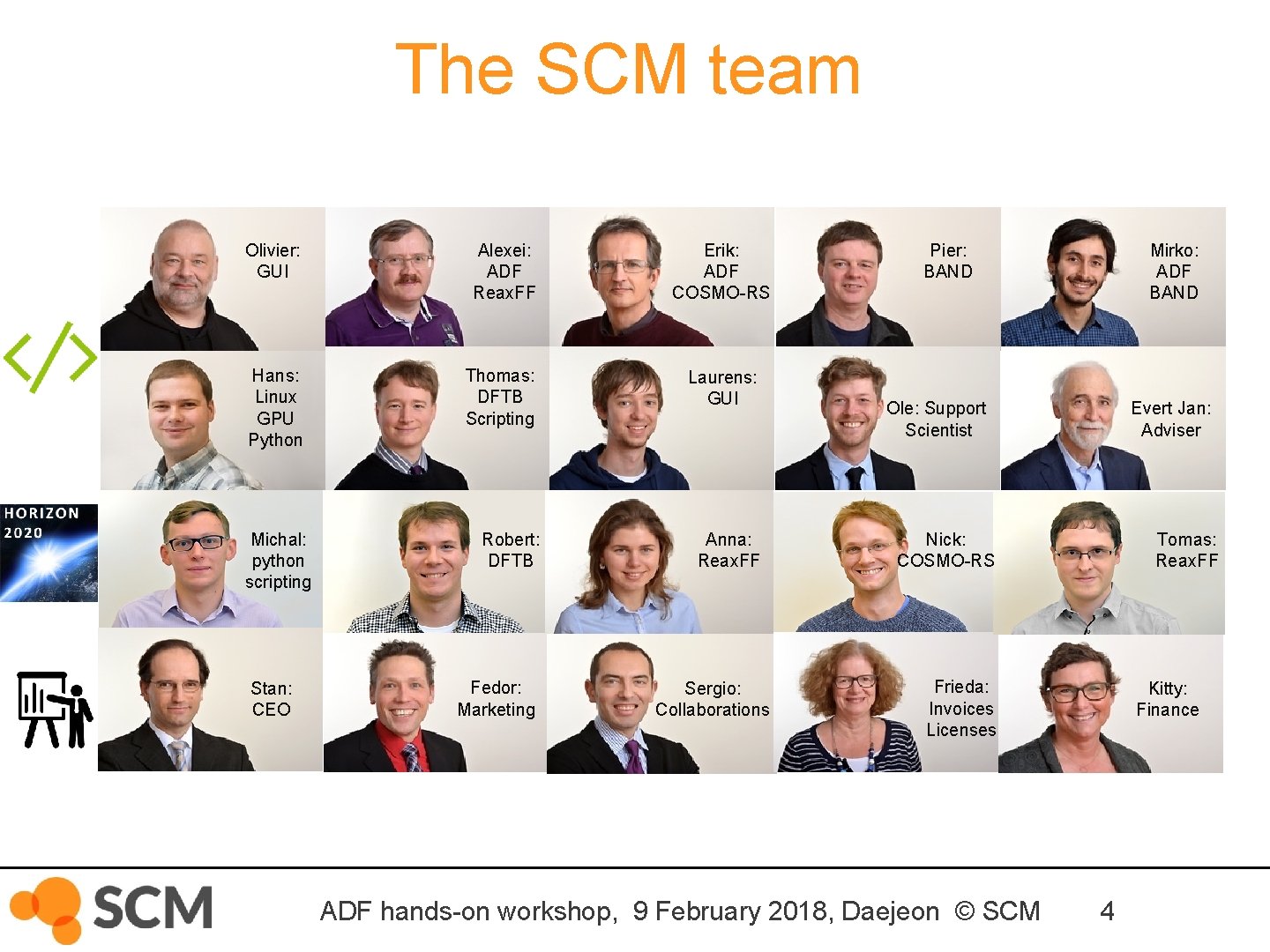
The SCM team Olivier: GUI Alexei: ADF Reax. FF Erik: ADF COSMO-RS Hans: Linux GPU Python Thomas: DFTB Scripting Laurens: GUI Michal: python scripting Stan: CEO Robert: DFTB Fedor: Marketing Anna: Reax. FF Sergio: Collaborations Pier: BAND Ole: Support Scientist Nick: COSMO-RS Frieda: Invoices Licenses ADF hands-on workshop, 9 February 2018, Daejeon © SCM 4 Mirko: ADF BAND Evert Jan: Adviser Tomas: Reax. FF Kitty: Finance
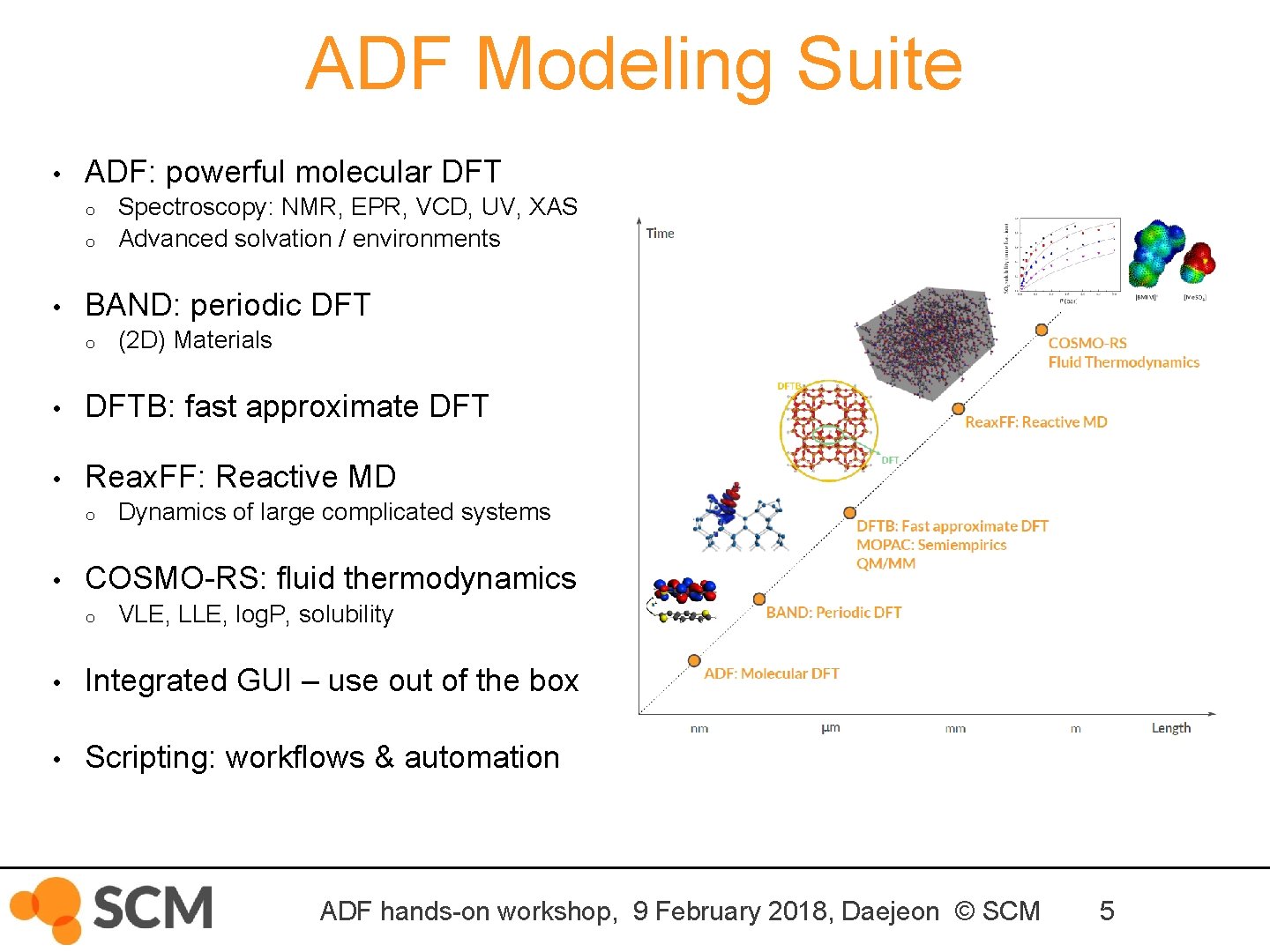
ADF Modeling Suite • ADF: powerful molecular DFT o o • Spectroscopy: NMR, EPR, VCD, UV, XAS Advanced solvation / environments BAND: periodic DFT o (2 D) Materials • DFTB: fast approximate DFT • Reax. FF: Reactive MD o • Dynamics of large complicated systems COSMO-RS: fluid thermodynamics o VLE, LLE, log. P, solubility • Integrated GUI – use out of the box • Scripting: workflows & automation ADF hands-on workshop, 9 February 2018, Daejeon © SCM 5
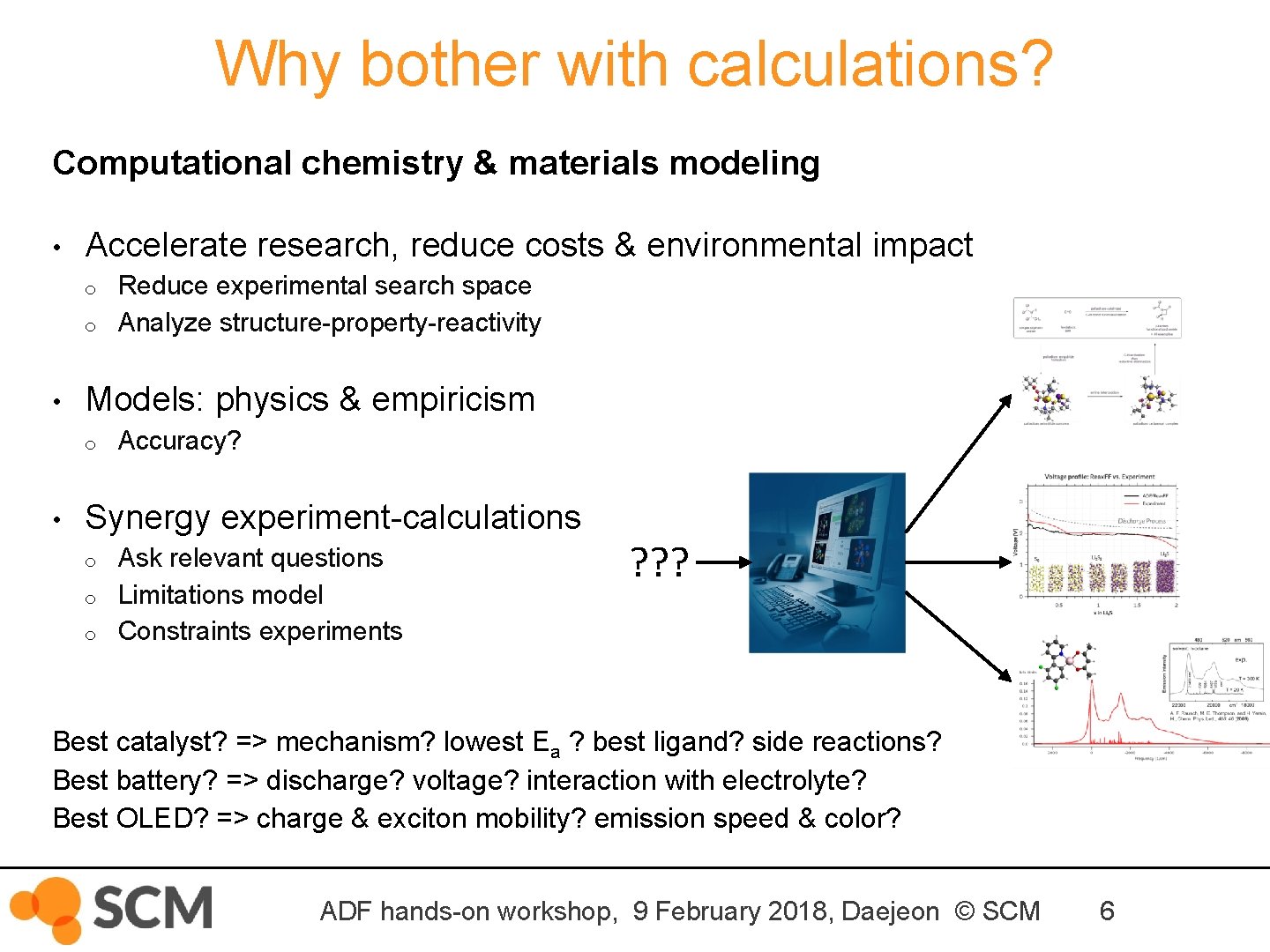
Why bother with calculations? Computational chemistry & materials modeling • Accelerate research, reduce costs & environmental impact o o • Models: physics & empiricism o • Reduce experimental search space Analyze structure-property-reactivity Accuracy? Synergy experiment-calculations o o o Ask relevant questions Limitations model Constraints experiments ? ? ? Best catalyst? => mechanism? lowest Ea ? best ligand? side reactions? Best battery? => discharge? voltage? interaction with electrolyte? Best OLED? => charge & exciton mobility? emission speed & color? ADF hands-on workshop, 9 February 2018, Daejeon © SCM 6
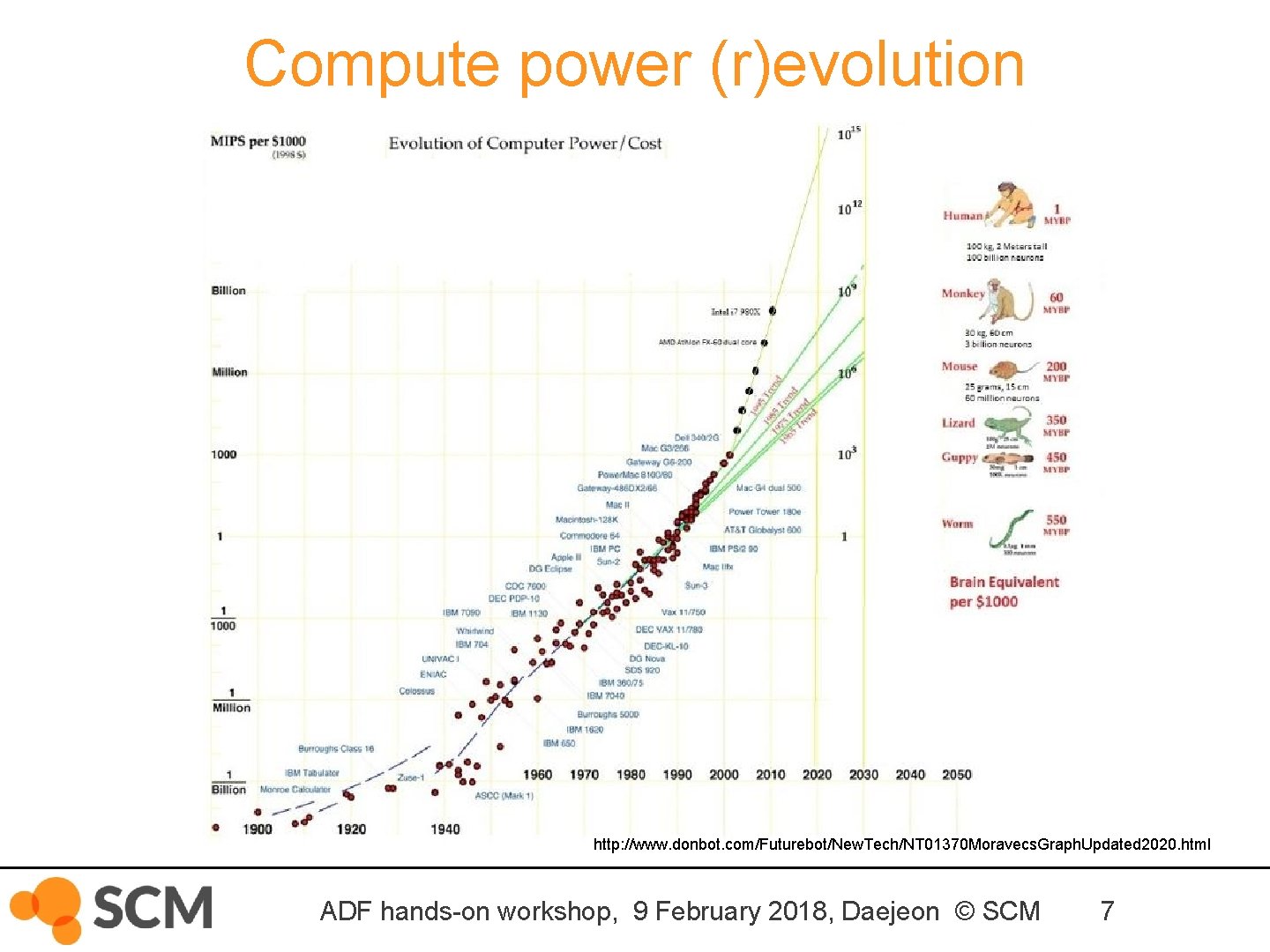
Compute power (r)evolution http: //www. donbot. com/Futurebot/New. Tech/NT 01370 Moravecs. Graph. Updated 2020. html ADF hands-on workshop, 9 February 2018, Daejeon © SCM 7
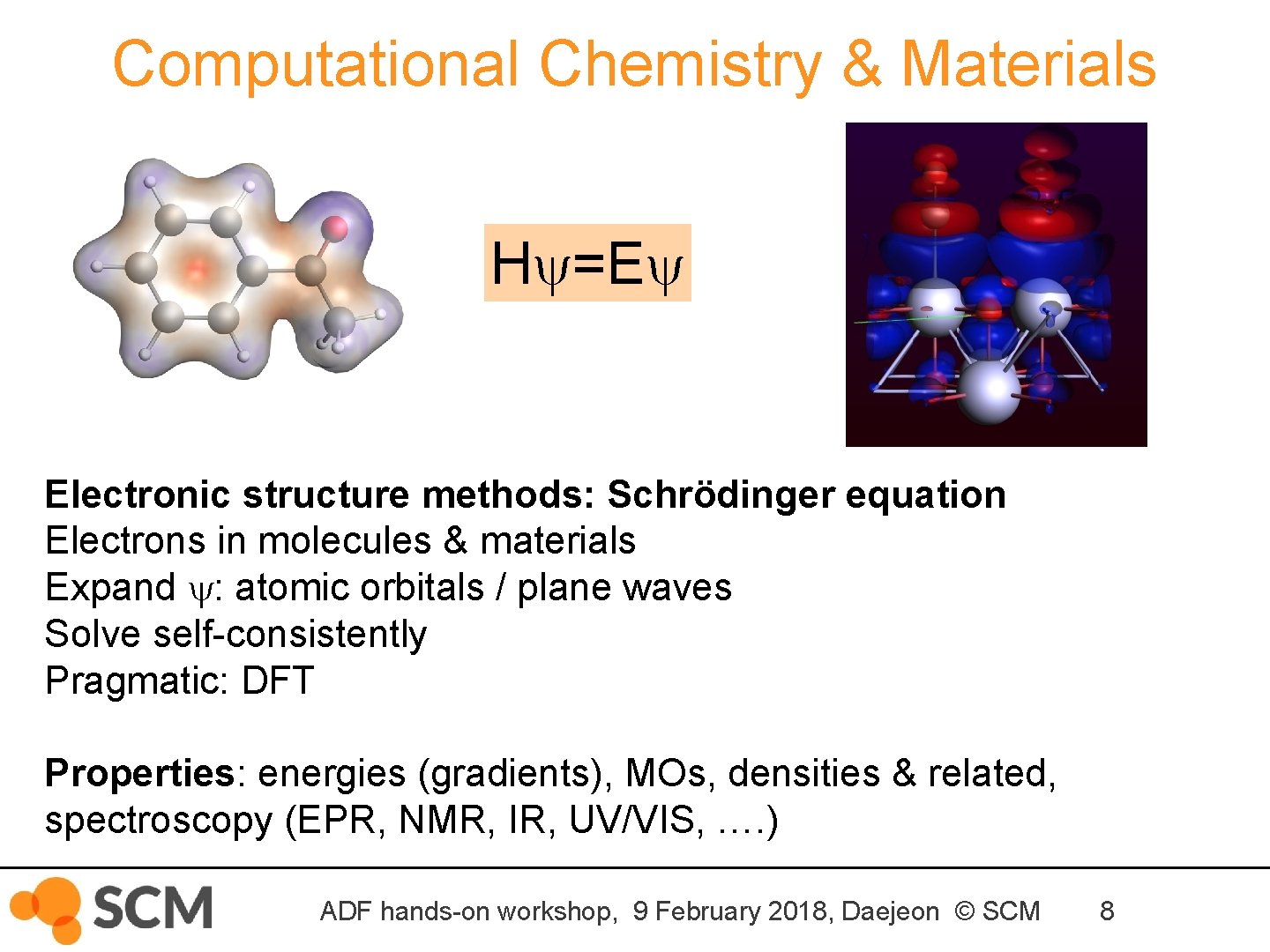
Computational Chemistry & Materials Hy=Ey Electronic structure methods: Schrödinger equation Electrons in molecules & materials Expand y: atomic orbitals / plane waves Solve self-consistently Pragmatic: DFT Properties: energies (gradients), MOs, densities & related, spectroscopy (EPR, NMR, IR, UV/VIS, …. ) ADF hands-on workshop, 9 February 2018, Daejeon © SCM 8
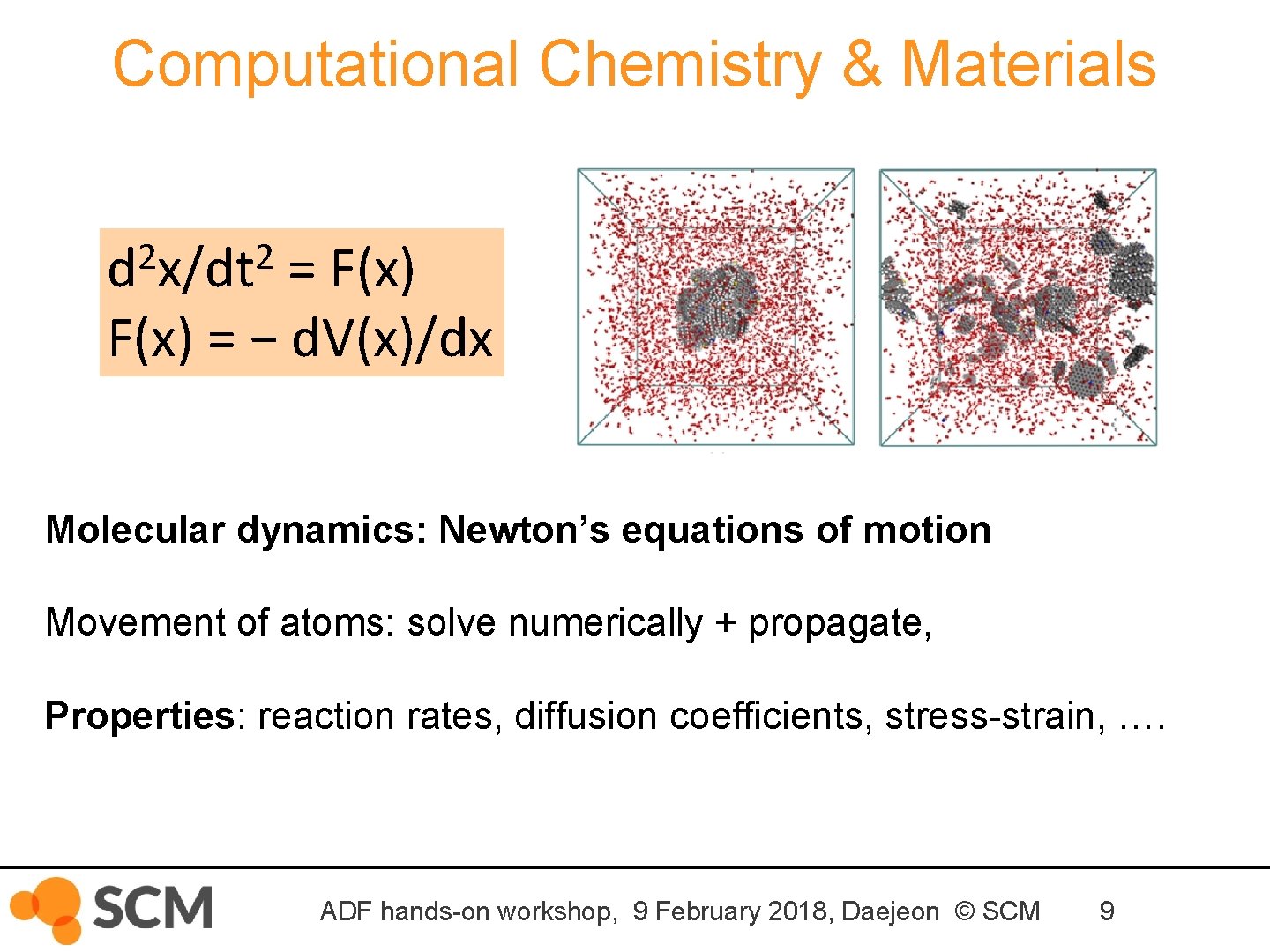
Computational Chemistry & Materials 2 2 d x/dt = F(x) = − d. V(x)/dx Molecular dynamics: Newton’s equations of motion Movement of atoms: solve numerically + propagate, Properties: reaction rates, diffusion coefficients, stress-strain, …. ADF hands-on workshop, 9 February 2018, Daejeon © SCM 9
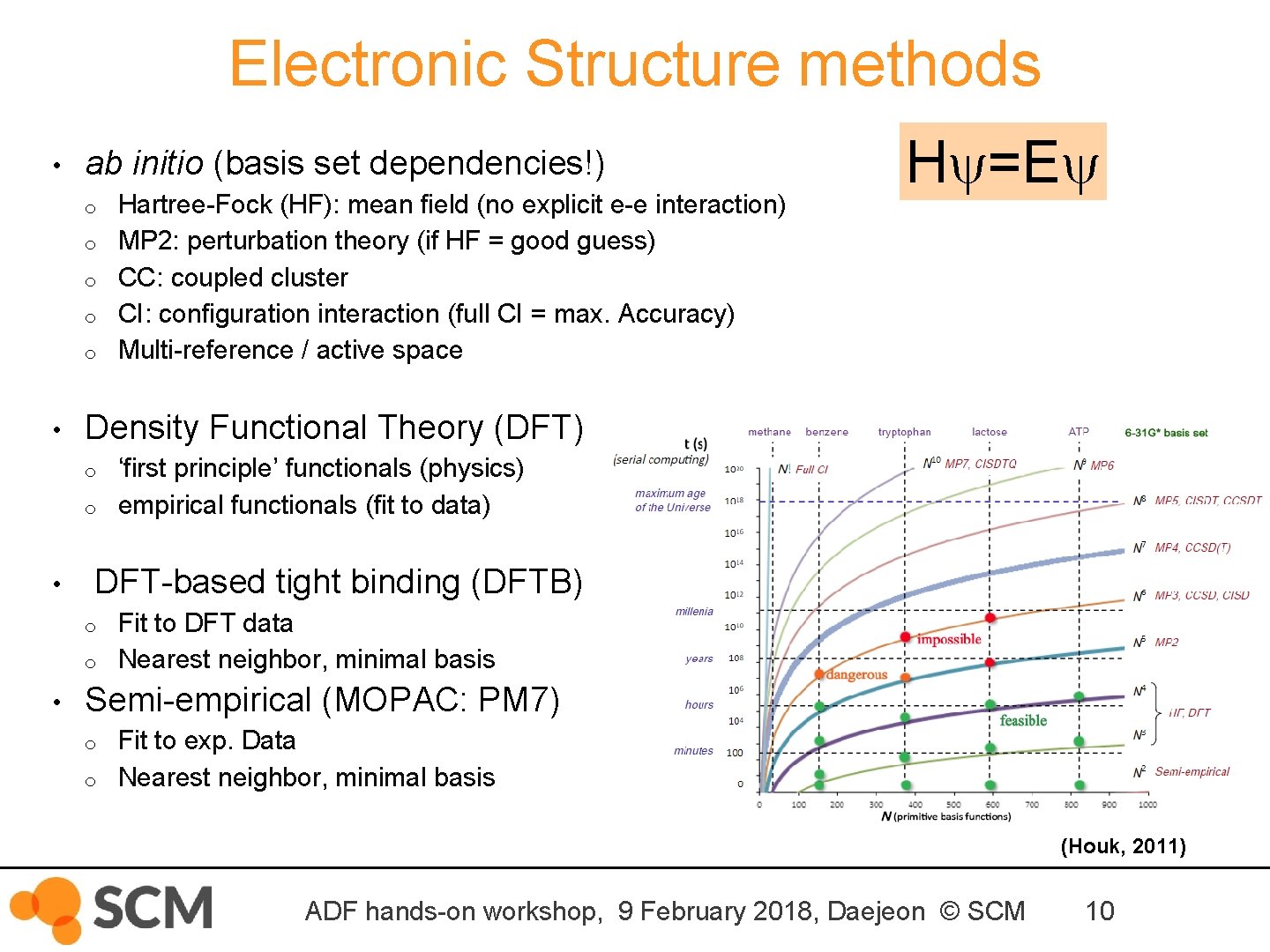
Electronic Structure methods • ab initio (basis set dependencies!) o o o • Density Functional Theory (DFT) o o • ‘first principle’ functionals (physics) empirical functionals (fit to data) DFT-based tight binding (DFTB) o o • Hartree-Fock (HF): mean field (no explicit e-e interaction) MP 2: perturbation theory (if HF = good guess) CC: coupled cluster CI: configuration interaction (full CI = max. Accuracy) Multi-reference / active space Hy=Ey Fit to DFT data Nearest neighbor, minimal basis Semi-empirical (MOPAC: PM 7) o o Fit to exp. Data Nearest neighbor, minimal basis (Houk, 2011) ADF hands-on workshop, 9 February 2018, Daejeon © SCM 10
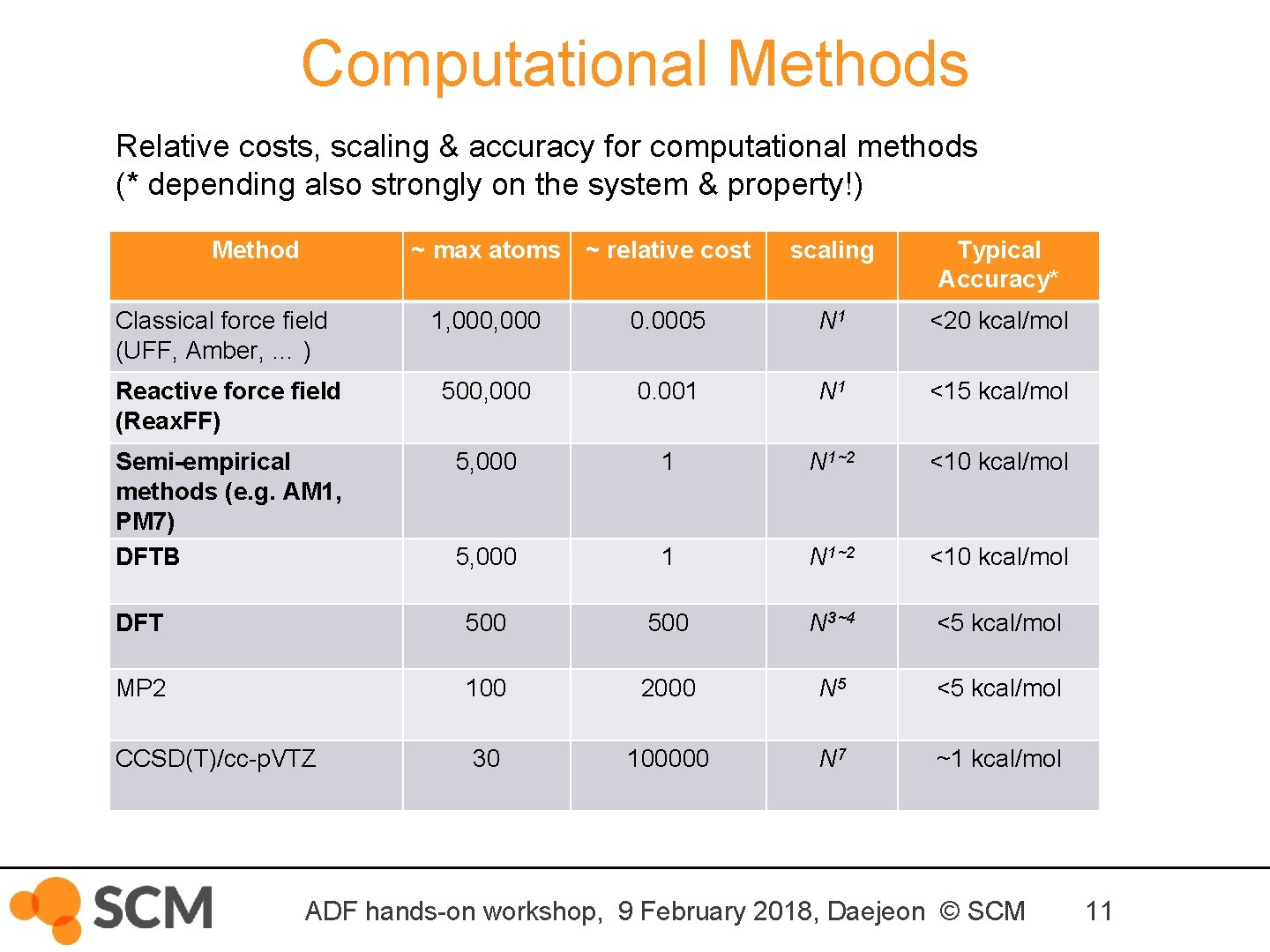
Computational Methods Relative costs, scaling & accuracy for computational methods (* depending also strongly on the system & property!) Method ~ max atoms ~ relative cost scaling Typical Accuracy* Classical force field (UFF, Amber, … ) 1, 000 0. 0005 N 1 <20 kcal/mol Reactive force field (Reax. FF) 500, 000 0. 001 N 1 <15 kcal/mol Semi-empirical methods (e. g. AM 1, PM 7) DFTB 5, 000 1 N 1~2 <10 kcal/mol DFT 500 N 3~4 <5 kcal/mol MP 2 100 2000 N 5 <5 kcal/mol CCSD(T)/cc-p. VTZ 30 100000 N 7 ~1 kcal/mol ADF hands-on workshop, 9 February 2018, Daejeon © SCM 11
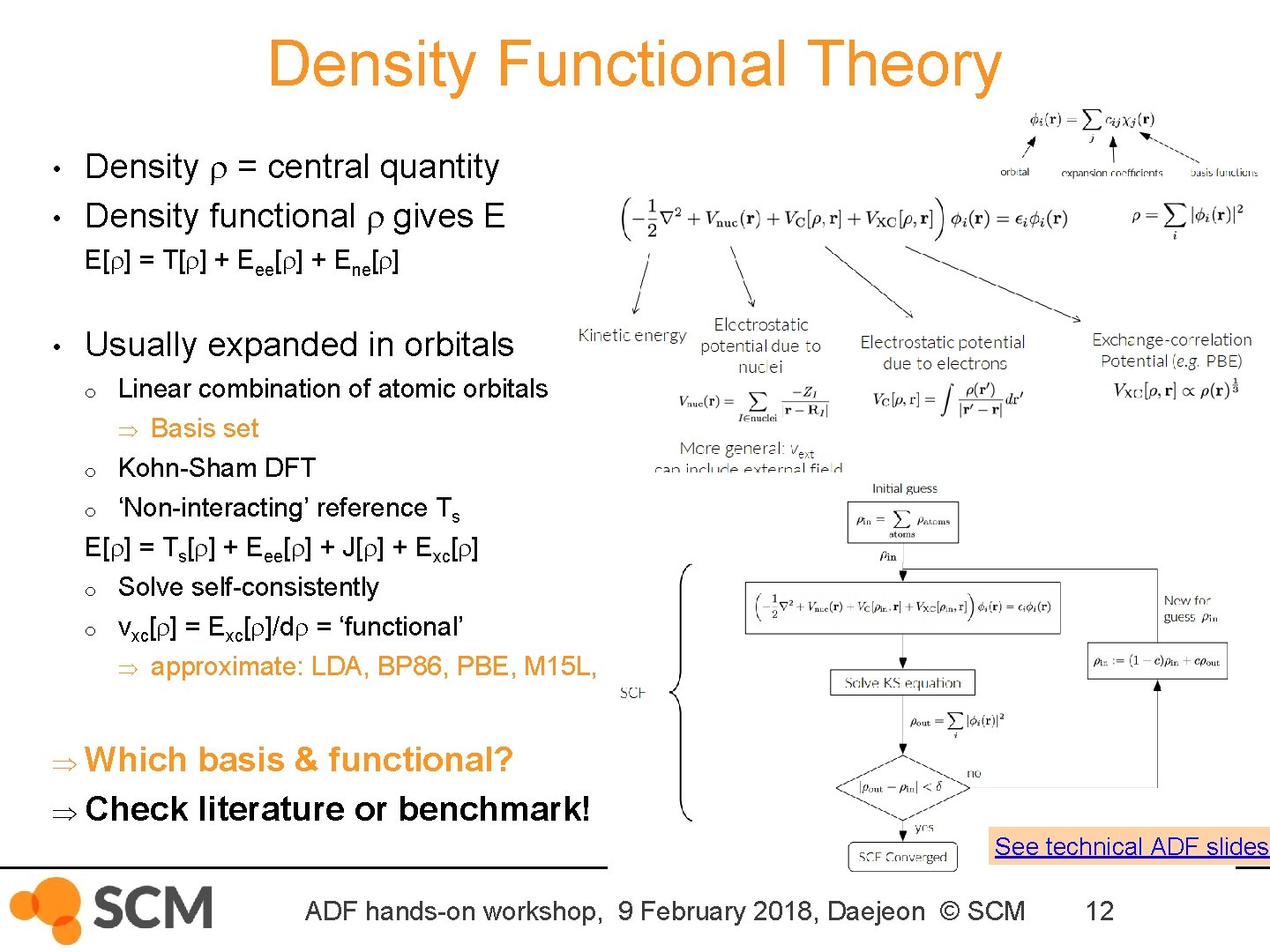
Density Functional Theory • • Density r = central quantity Density functional r gives E E[r] = T[r] + Eee[r] + Ene[r] • Usually expanded in orbitals Linear combination of atomic orbitals Þ Basis set o Kohn-Sham DFT o ‘Non-interacting’ reference Ts E[r] = Ts[r] + Eee[r] + J[r] + Exc[r] o Solve self-consistently o o vxc[r] = Exc[r]/dr = ‘functional’ Þ approximate: LDA, BP 86, PBE, M 15 L, . . . Þ Which basis & functional? Þ Check literature or benchmark! See technical ADF slides ADF hands-on workshop, 9 February 2018, Daejeon © SCM 12
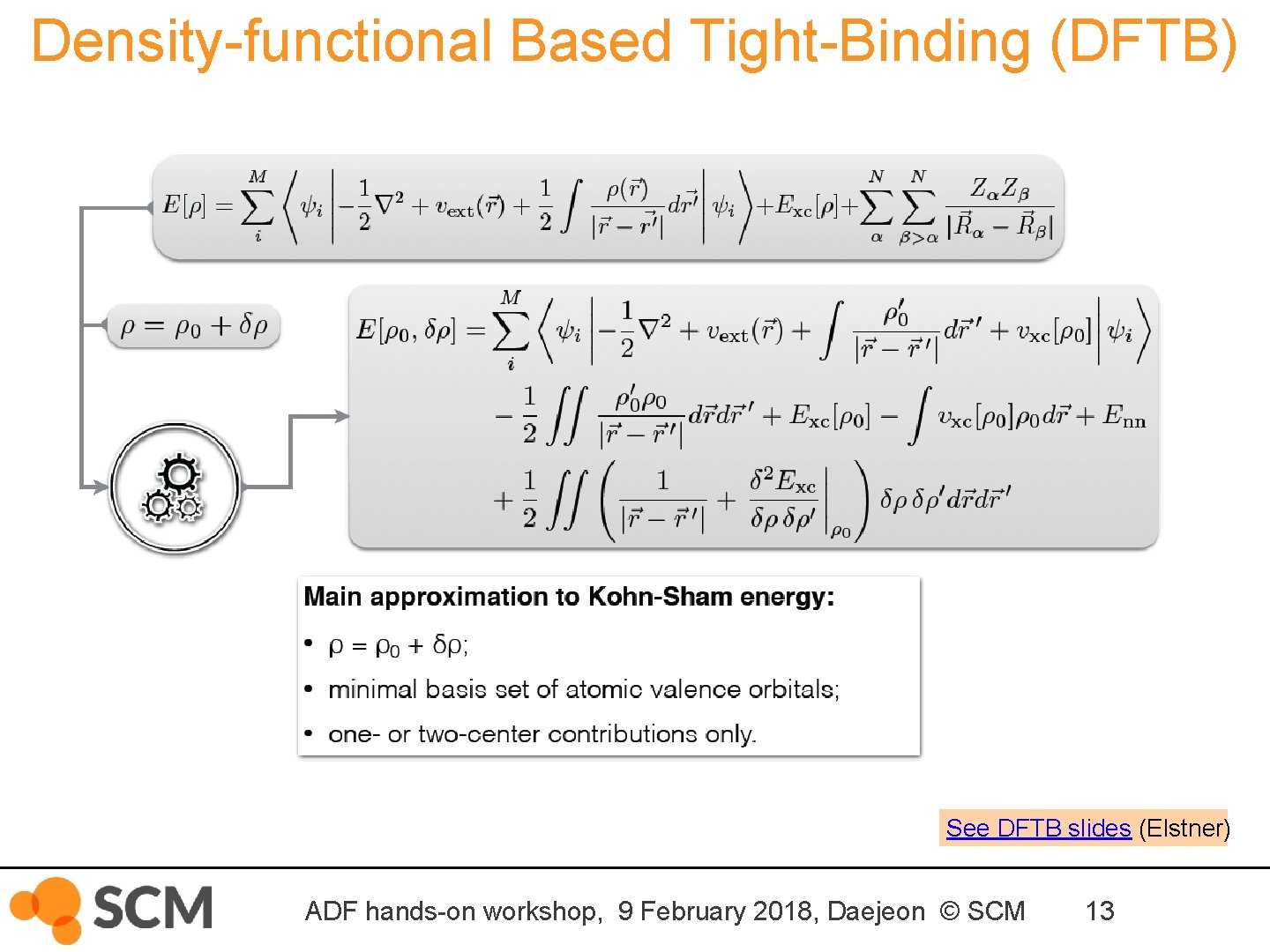
Density-functional Based Tight-Binding (DFTB) See DFTB slides (Elstner) ADF hands-on workshop, 9 February 2018, Daejeon © SCM 13
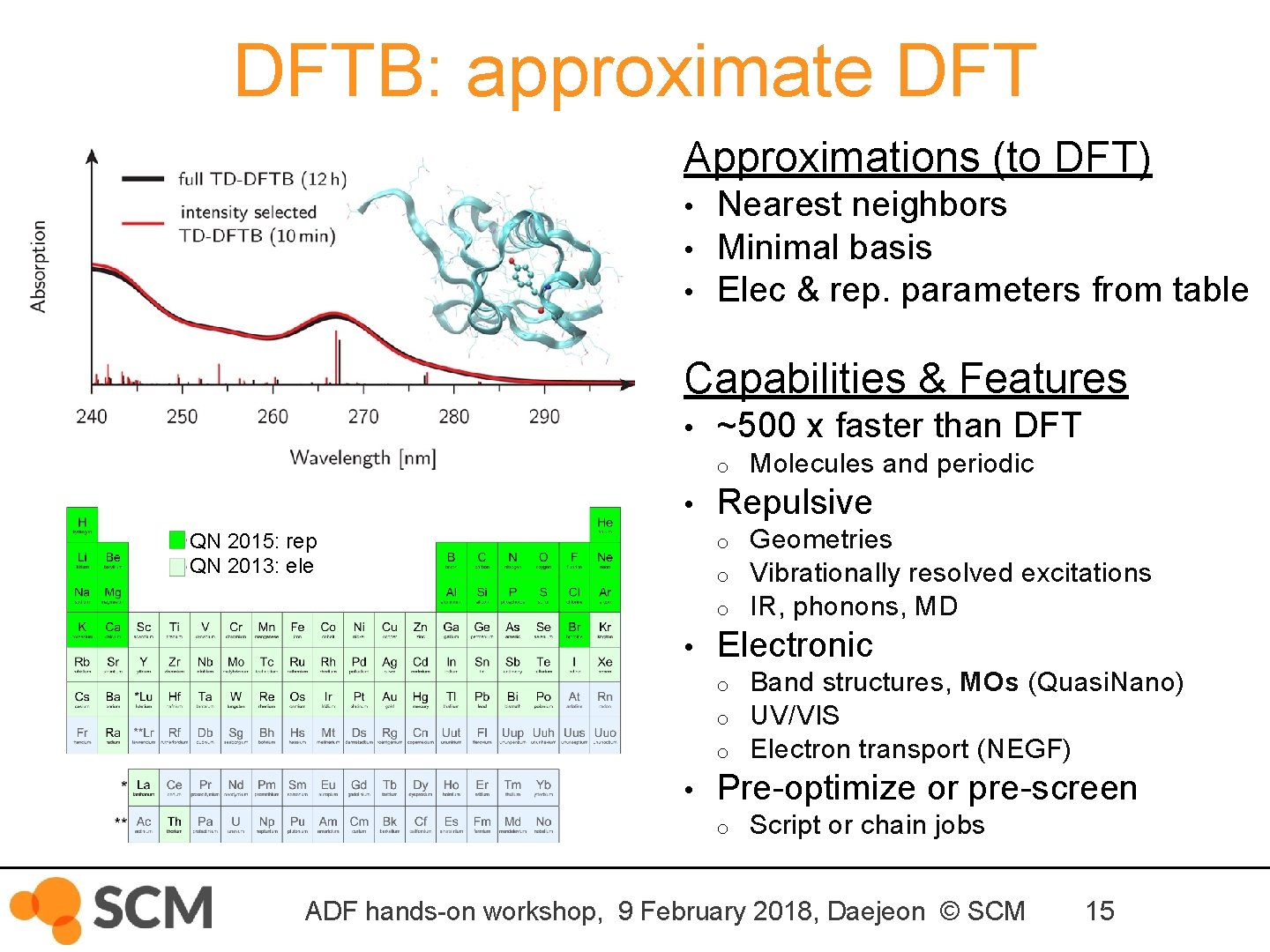
DFTB: approximate DFT Approximations (to DFT) • • • Nearest neighbors Minimal basis Elec & rep. parameters from table Capabilities & Features • ~500 x faster than DFT o • QN 2015: rep QN 2013: ele Repulsive o o o • Geometries Vibrationally resolved excitations IR, phonons, MD Electronic o o o • Molecules and periodic Band structures, MOs (Quasi. Nano) UV/VIS Electron transport (NEGF) Pre-optimize or pre-screen o Script or chain jobs ADF hands-on workshop, 9 February 2018, Daejeon © SCM 15
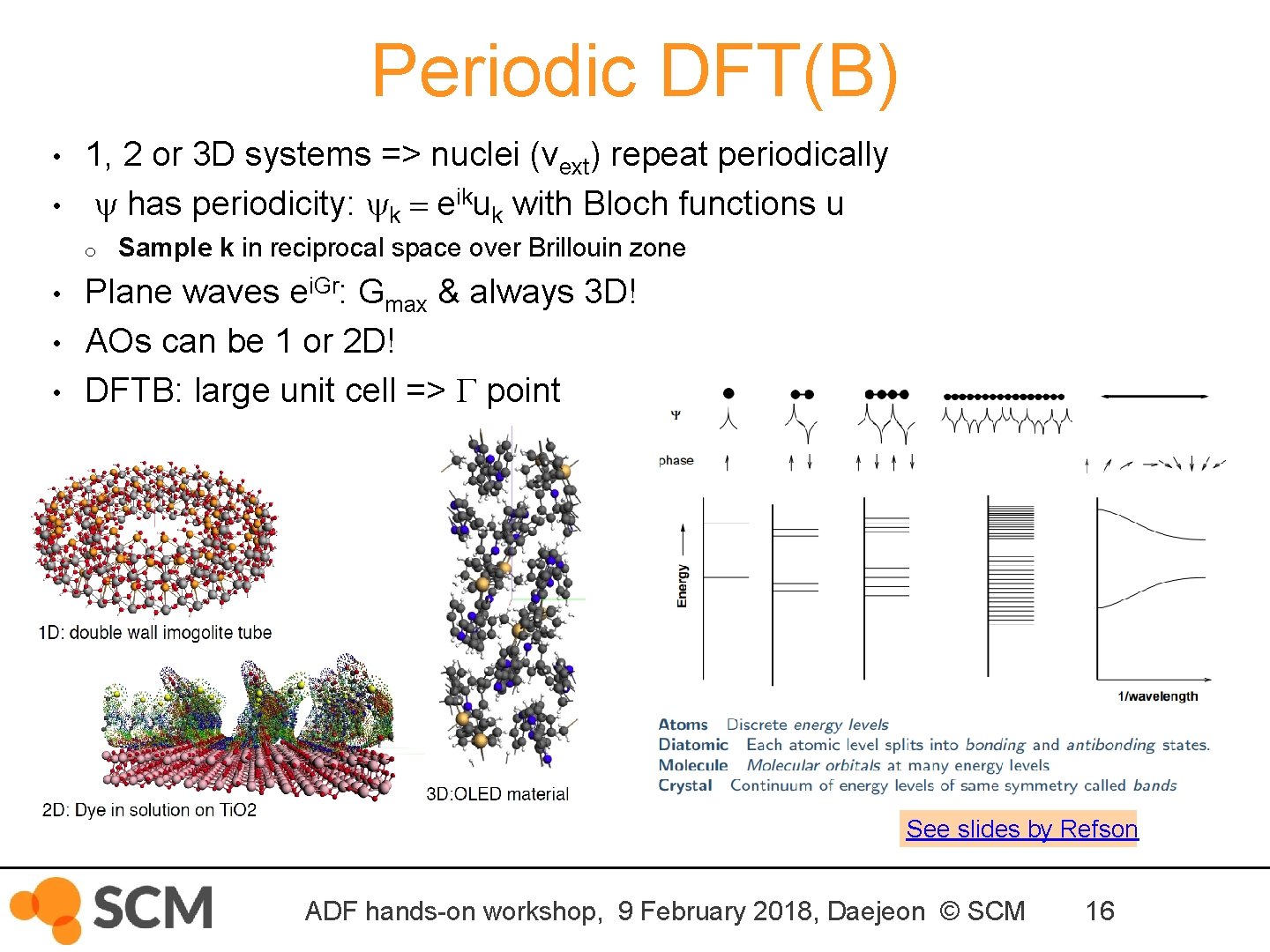
Periodic DFT(B) • • 1, 2 or 3 D systems => nuclei (vext) repeat periodically y has periodicity: yk = eikuk with Bloch functions u o • • • Sample k in reciprocal space over Brillouin zone Plane waves ei. Gr: Gmax & always 3 D! AOs can be 1 or 2 D! DFTB: large unit cell => G point See slides by Refson ADF hands-on workshop, 9 February 2018, Daejeon © SCM 16
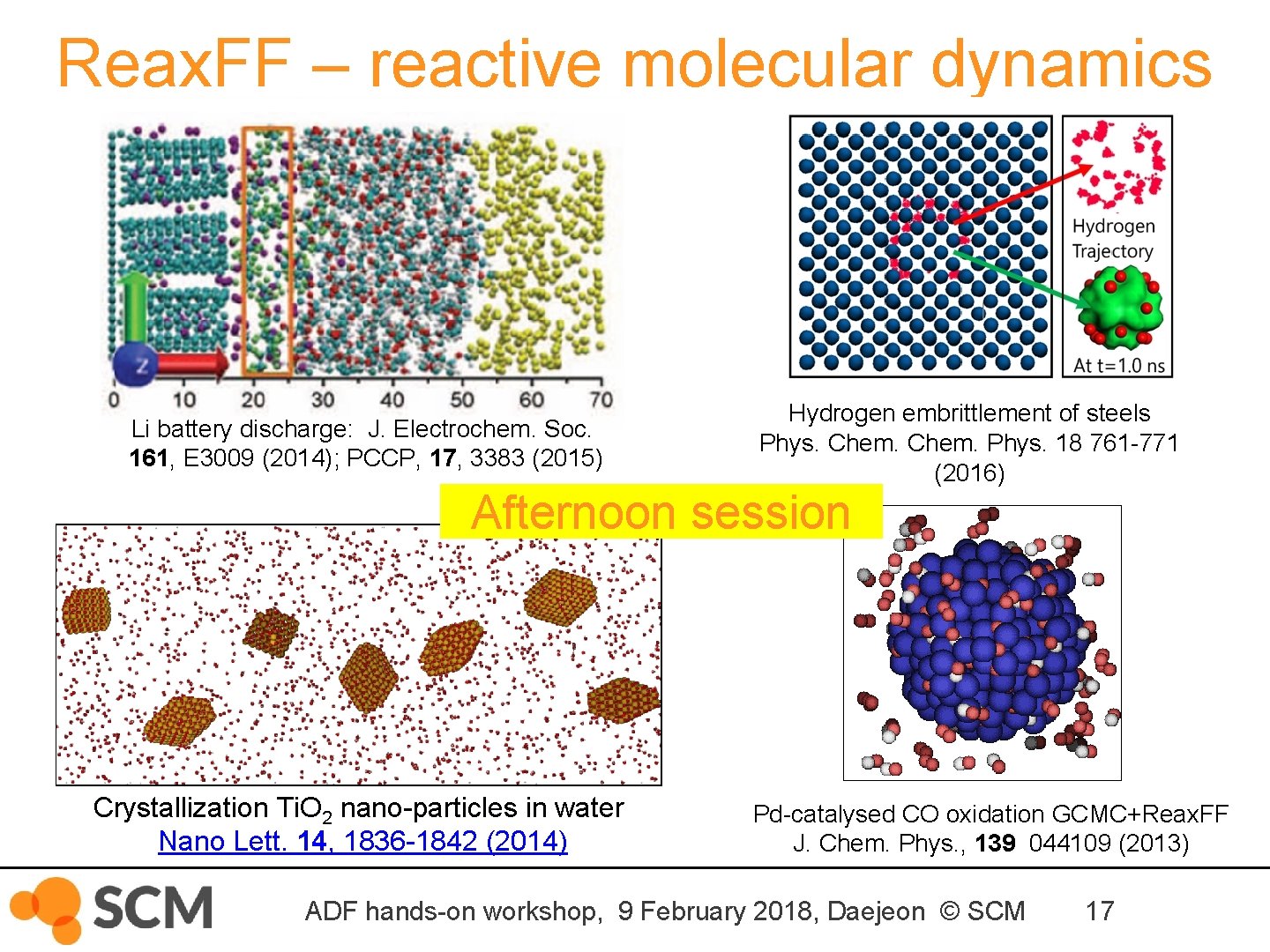
Reax. FF – reactive molecular dynamics Li battery discharge: J. Electrochem. Soc. 161, E 3009 (2014); PCCP, 17, 3383 (2015) Hydrogen embrittlement of steels Phys. Chem. Phys. 18 761 -771 (2016) Afternoon session Crystallization Ti. O 2 nano-particles in water Nano Lett. 14, 1836 -1842 (2014) Pd-catalysed CO oxidation GCMC+Reax. FF J. Chem. Phys. , 139 044109 (2013) ADF hands-on workshop, 9 February 2018, Daejeon © SCM 17
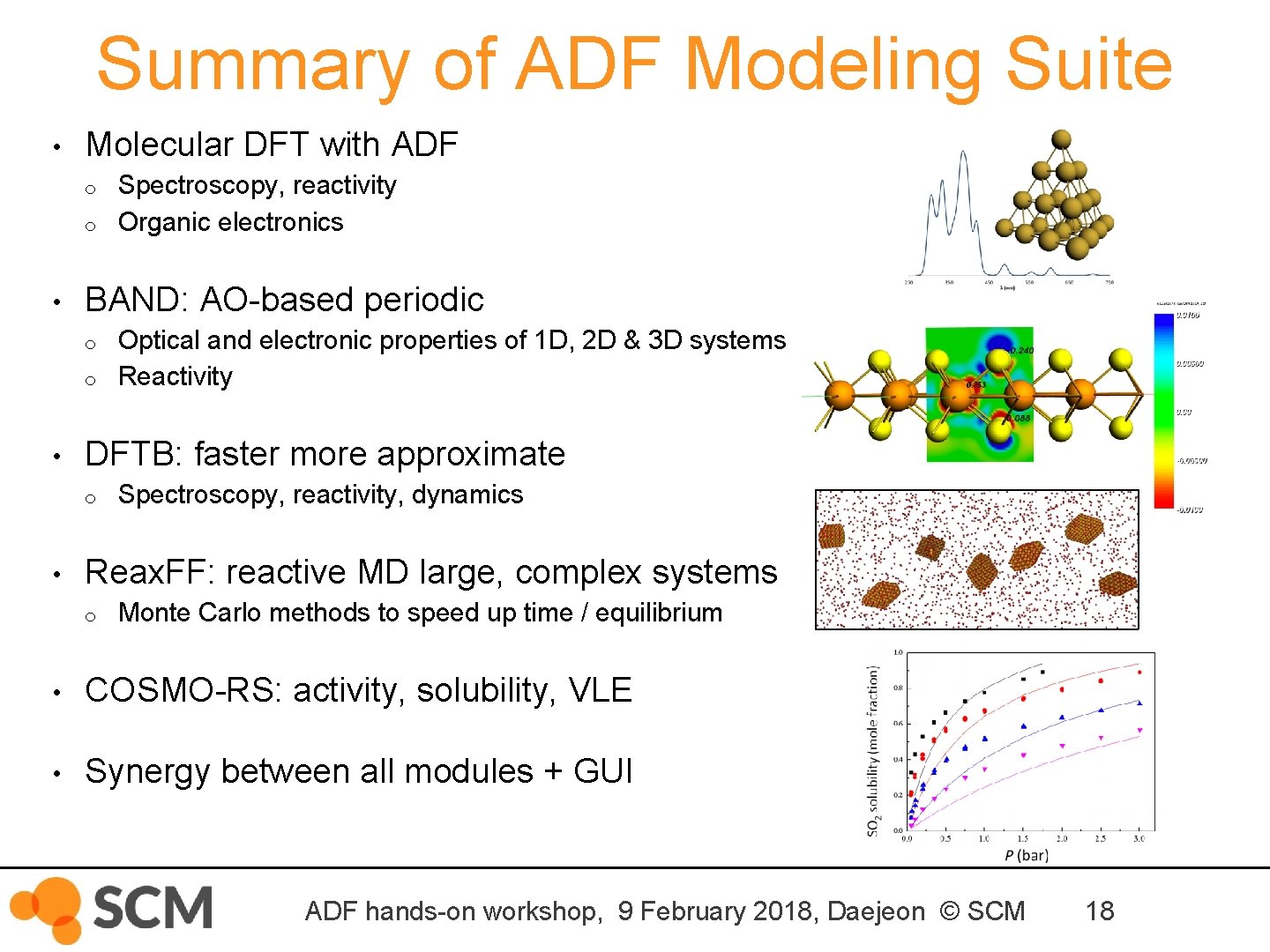
Summary of ADF Modeling Suite • Molecular DFT with ADF o o • BAND: AO-based periodic o o • Optical and electronic properties of 1 D, 2 D & 3 D systems Reactivity DFTB: faster more approximate o • Spectroscopy, reactivity Organic electronics Spectroscopy, reactivity, dynamics Reax. FF: reactive MD large, complex systems o Monte Carlo methods to speed up time / equilibrium • COSMO-RS: activity, solubility, VLE • Synergy between all modules + GUI ADF hands-on workshop, 9 February 2018, Daejeon © SCM 18