
Introduction to Computability Theory Lecture 8 Turing Machines
Introduction to Computability Theory Lecture 8: Turing Machines Prof. Amos Israeli 1
Introduction and Motivation In this lecture we introduce Turing Machines and discuss some of their properties. 2

Turing Machines A Turing Machine is a finite state machine augmented with an infinite tape. The tape head can go in both directions. It can read and write from/to any cell of the semiinfinite tape. Once the TM reaches an accept (reject resp. ) state it accepts (rejects resp. ) immediately. 3
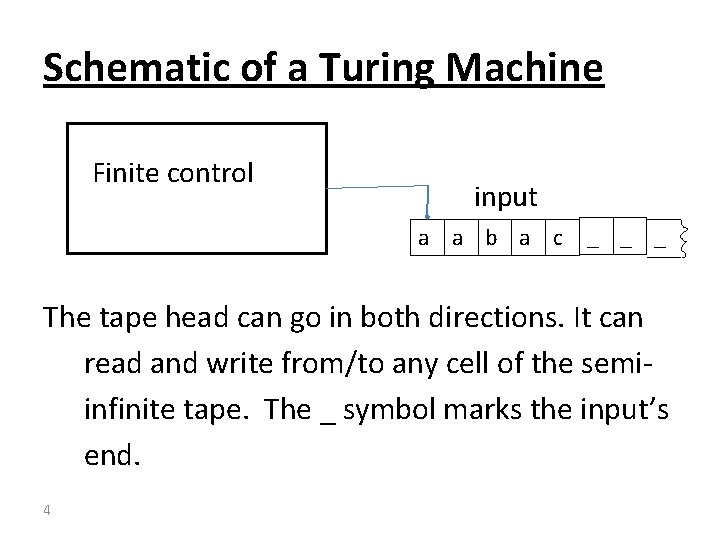
Schematic of a Turing Machine Finite control input a a b a c _ _ _ The tape head can go in both directions. It can read and write from/to any cell of the semiinfinite tape. The _ symbol marks the input’s end. 4
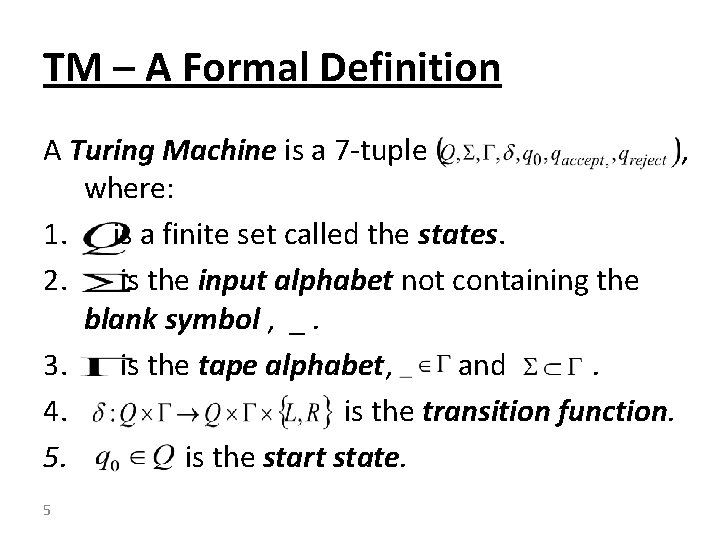
TM – A Formal Definition A Turing Machine is a 7 -tuple , where: 1. is a finite set called the states. 2. is the input alphabet not containing the blank symbol , _. 3. is the tape alphabet, and. 4. is the transition function. 5. is the start state. 5
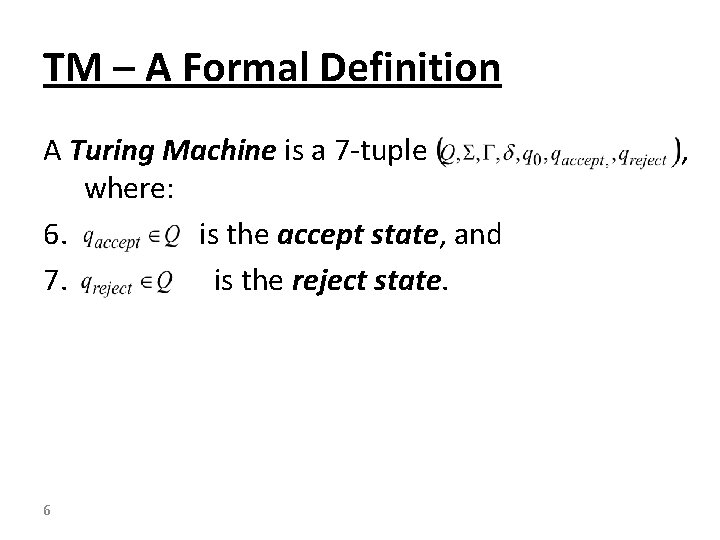
TM – A Formal Definition A Turing Machine is a 7 -tuple where: 6. is the accept state, and 7. is the reject state. 6 ,
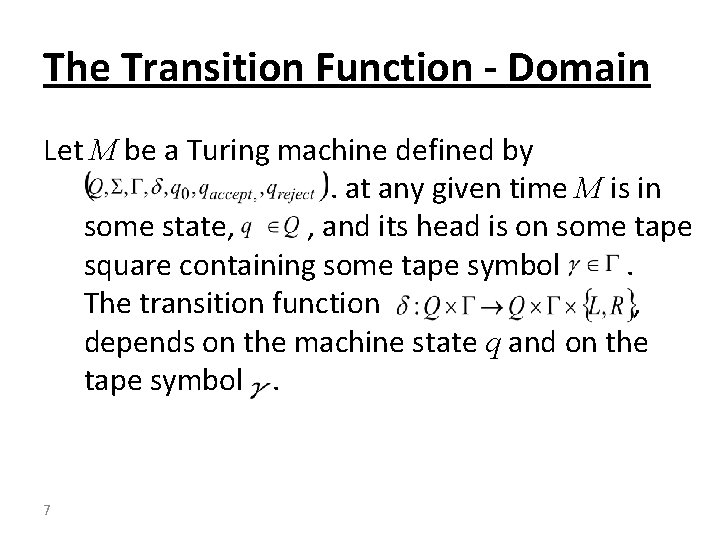
The Transition Function - Domain Let M be a Turing machine defined by. at any given time M is in some state, , and its head is on some tape square containing some tape symbol. The transition function , depends on the machine state q and on the tape symbol. 7
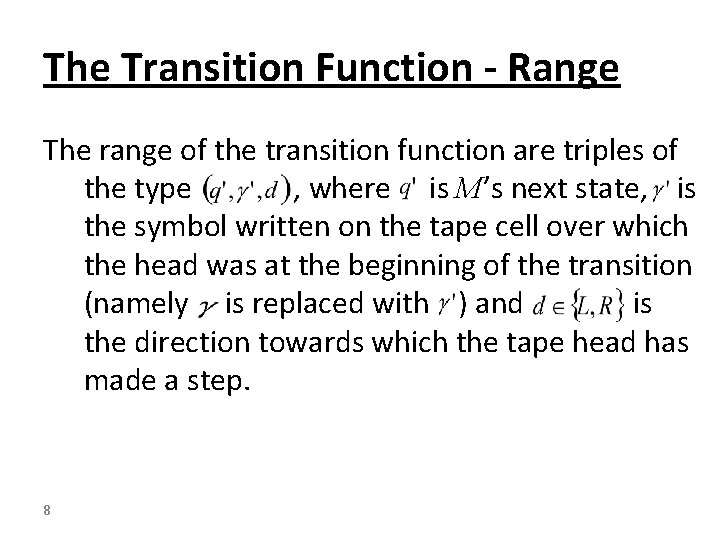
The Transition Function - Range The range of the transition function are triples of the type , where is M’s next state, is the symbol written on the tape cell over which the head was at the beginning of the transition (namely is replaced with ) and is the direction towards which the tape head has made a step. 8

Turing machine – A Computation of M always starts at state , and the input is on the leftmost n cells where n is the input’s length. The tape’s head is over the tape’s cell 0 – the leftmost cell. Computation of M ends either when it reaches - this is an Accepting Computation. Or when it reaches - this is a Rejecting Computation. 9
Configurations A configuration of a Turing machine M is a concise description M’s state and tape contents. It is written as C=uqv. and its meaning is: 1. The state of M is q. 2. The content of M’s tape is uv , where u resides on the leftmost part of the tape. 3. The head of M resides over the leftmost (first) symbol of v. 4. The tape cells past the end of v hold blanks. 10
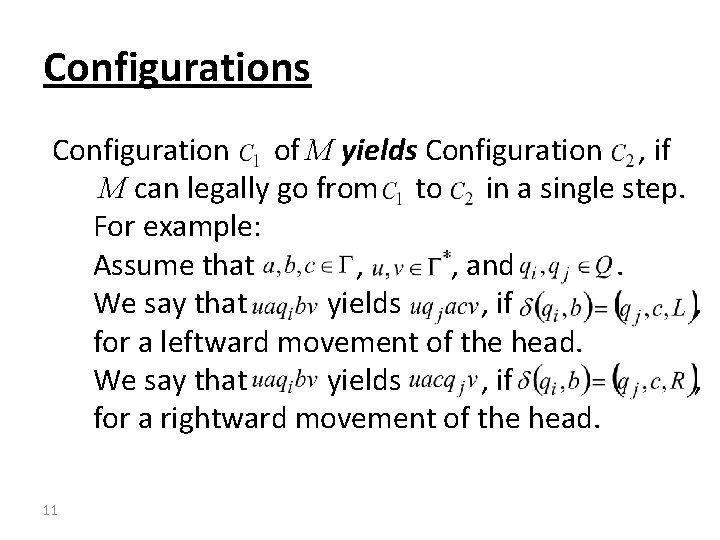
Configurations Configuration of M yields Configuration , if M can legally go from to in a single step. For example: Assume that , , and. We say that yields , if , for a leftward movement of the head. We say that yields , if , for a rightward movement of the head. 11
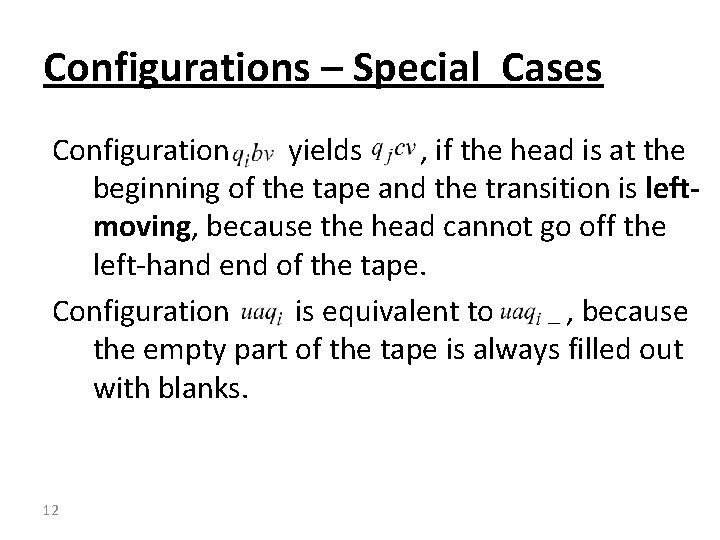
Configurations – Special Cases Configuration yields , if the head is at the beginning of the tape and the transition is leftmoving, because the head cannot go off the left-hand end of the tape. Configuration is equivalent to , because the empty part of the tape is always filled out with blanks. 12
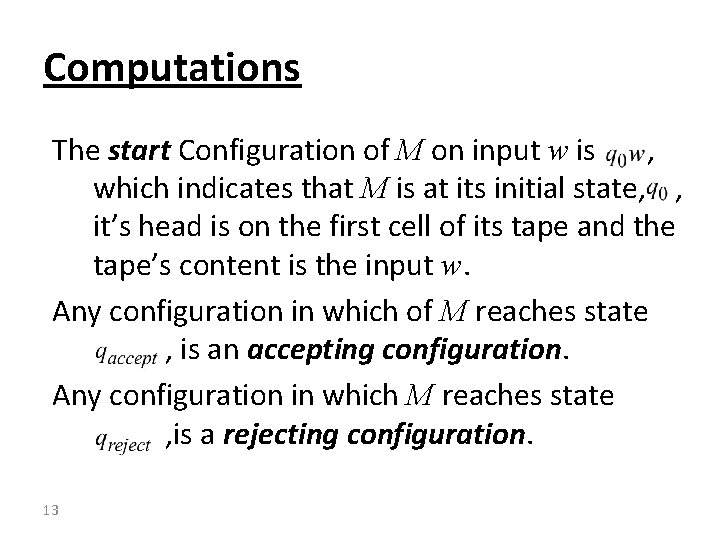
Computations The start Configuration of M on input w is , which indicates that M is at its initial state, , it’s head is on the first cell of its tape and the tape’s content is the input w. Any configuration in which of M reaches state , is an accepting configuration. Any configuration in which M reaches state , is a rejecting configuration. 13
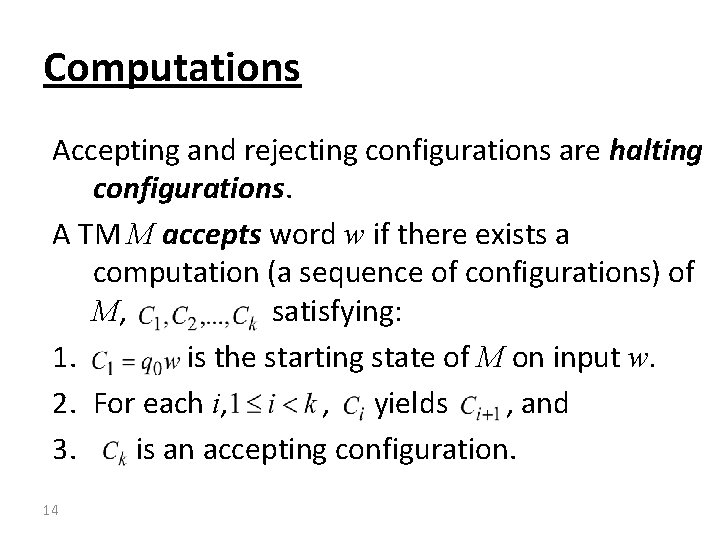
Computations Accepting and rejecting configurations are halting configurations. A TM M accepts word w if there exists a computation (a sequence of configurations) of M, satisfying: 1. is the starting state of M on input w. 2. For each i, , yields , and 3. is an accepting configuration. 14
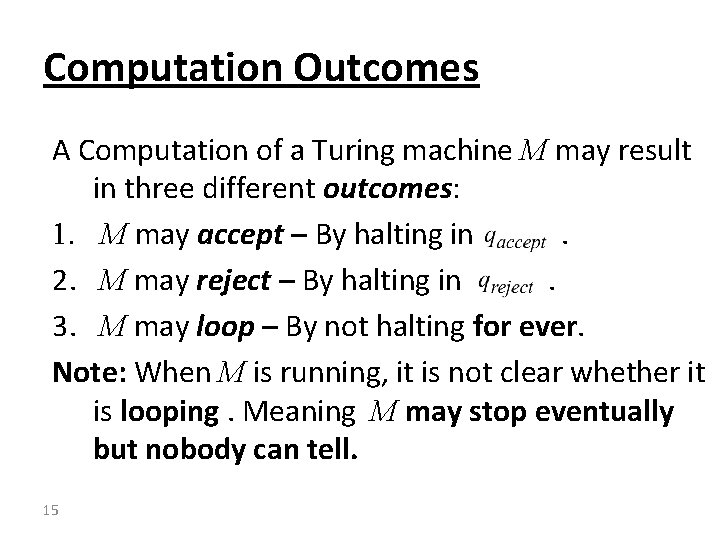
Computation Outcomes A Computation of a Turing machine M may result in three different outcomes: 1. M may accept – By halting in. 2. M may reject – By halting in. 3. M may loop – By not halting for ever. Note: When M is running, it is not clear whether it is looping. Meaning M may stop eventually but nobody can tell. 15
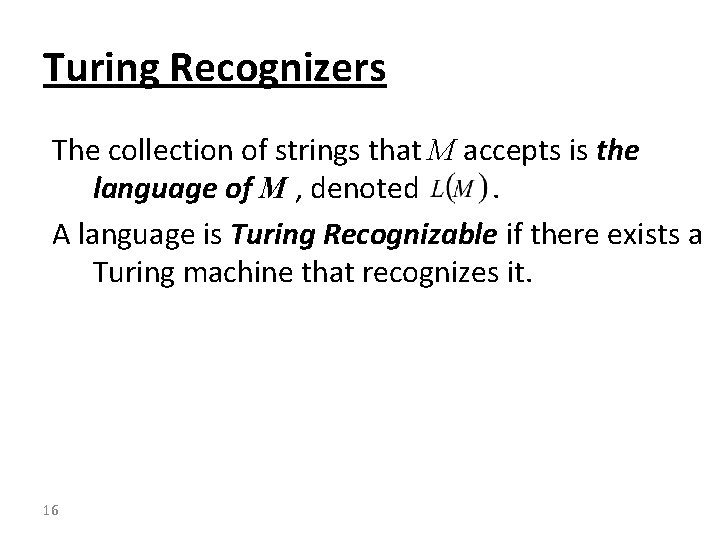
Turing Recognizers The collection of strings that M accepts is the language of M , denoted. A language is Turing Recognizable if there exists a Turing machine that recognizes it. 16
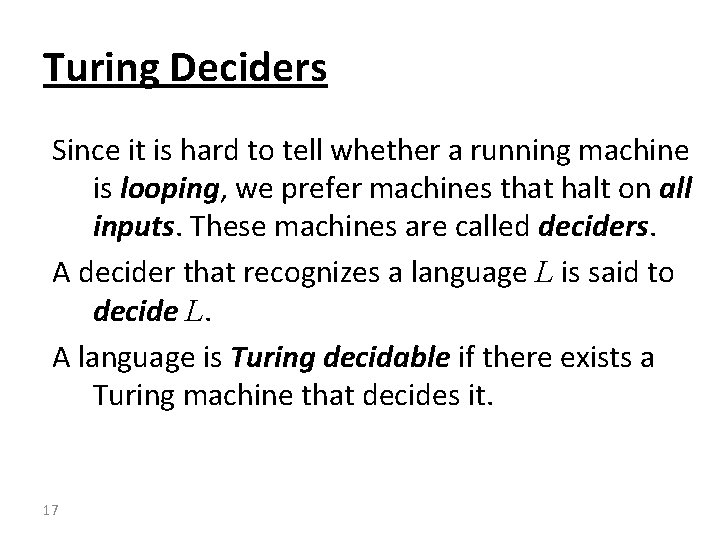
Turing Deciders Since it is hard to tell whether a running machine is looping, we prefer machines that halt on all inputs. These machines are called deciders. A decider that recognizes a language L is said to decide L. A language is Turing decidable if there exists a Turing machine that decides it. 17
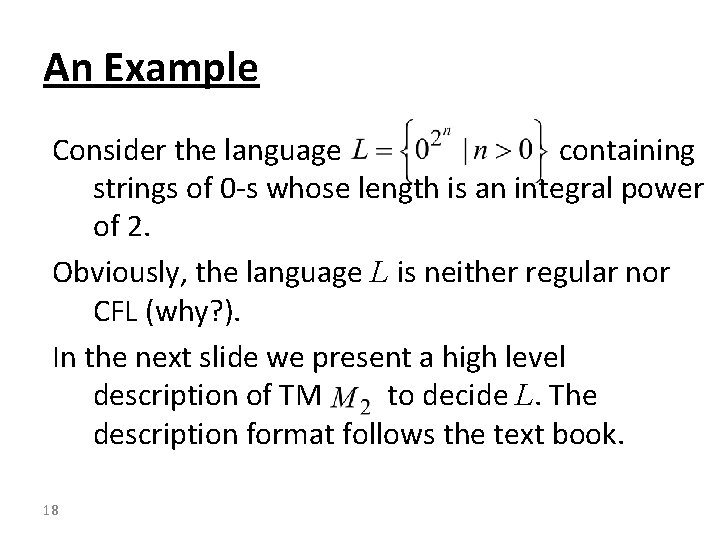
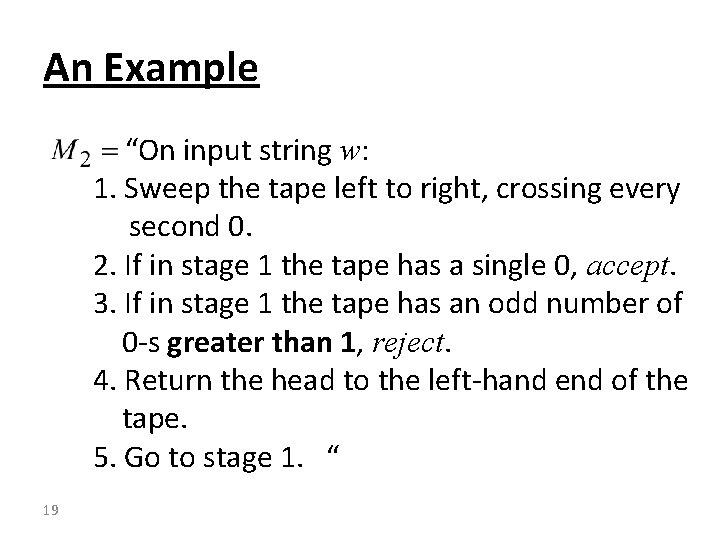
An Example Consider the language containing strings of 0 -s whose length is an integral power of 2. Obviously, the language L is neither regular nor CFL (why? ). In the next slide we present a high level description of TM to decide L. The description format follows the text book. 18
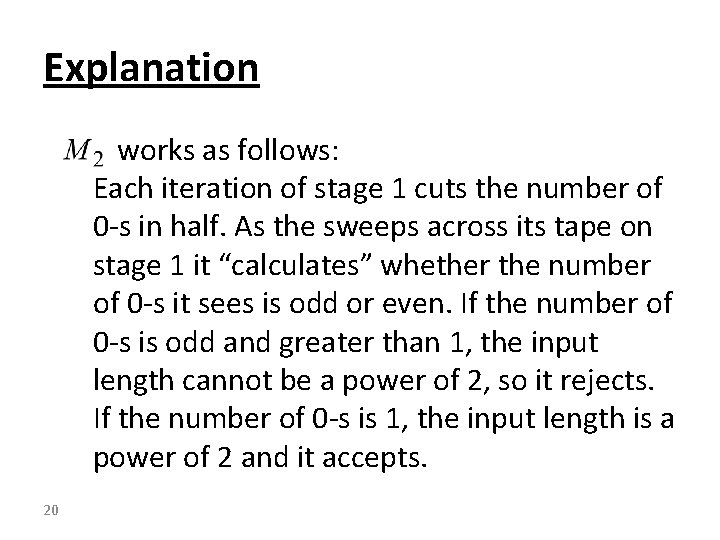
An Example “On input string w: 1. Sweep the tape left to right, crossing every second 0. 2. If in stage 1 the tape has a single 0, accept. 3. If in stage 1 the tape has an odd number of 0 -s greater than 1, reject. 4. Return the head to the left-hand end of the tape. 5. Go to stage 1. “ 19
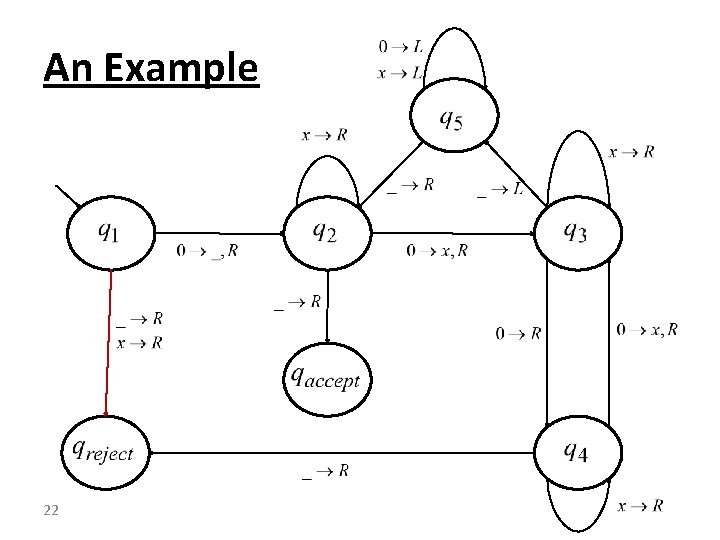
Explanation works as follows: Each iteration of stage 1 cuts the number of 0 -s in half. As the sweeps across its tape on stage 1 it “calculates” whether the number of 0 -s it sees is odd or even. If the number of 0 -s is odd and greater than 1, the input length cannot be a power of 2, so it rejects. If the number of 0 -s is 1, the input length is a power of 2 and it accepts. 20
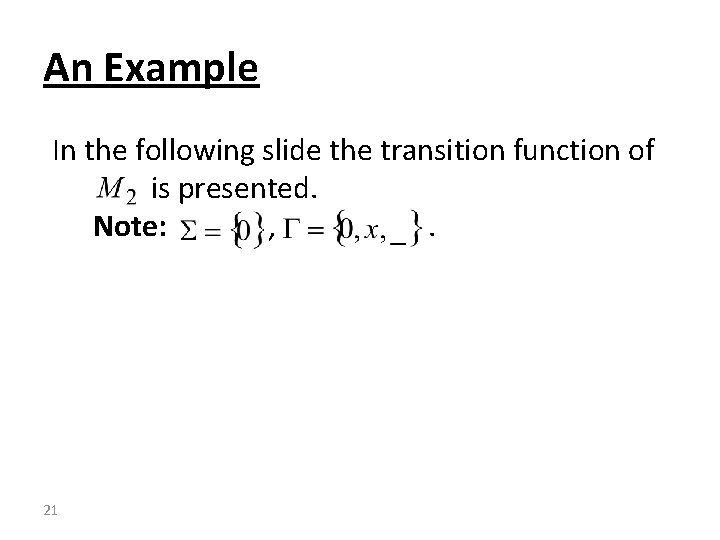
An Example In the following slide the transition function of is presented. Note: , . 21
An Example 22
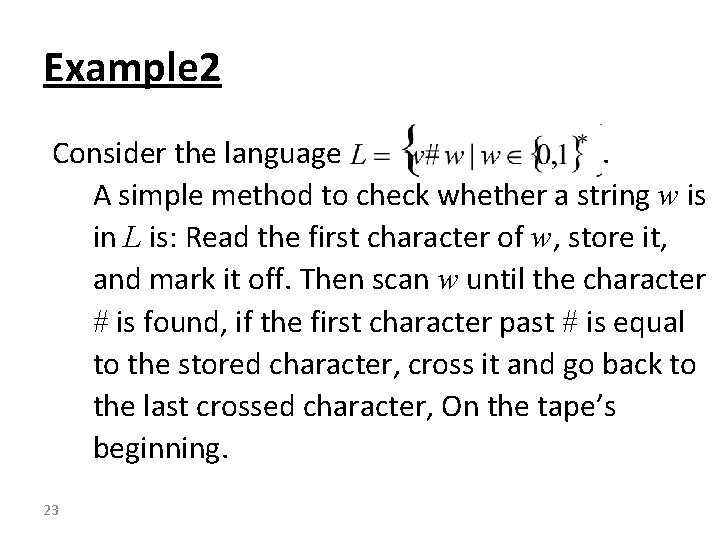
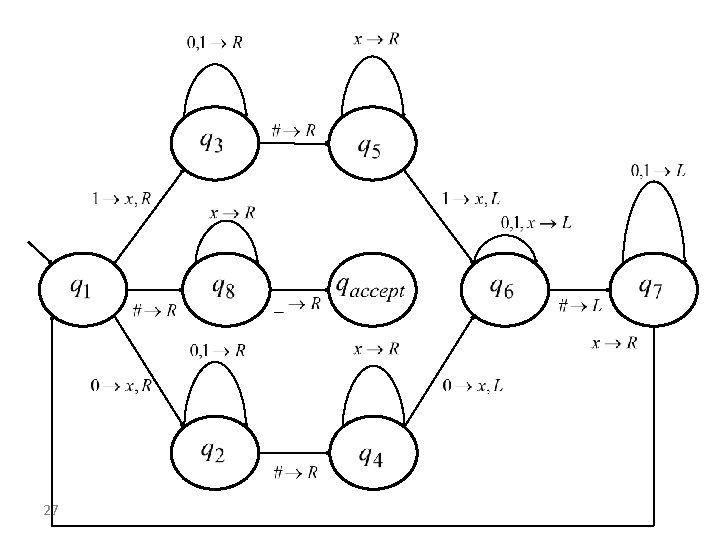
Example 2 Consider the language. A simple method to check whether a string w is in L is: Read the first character of w, store it, and mark it off. Then scan w until the character # is found, if the first character past # is equal to the stored character, cross it and go back to the last crossed character, On the tape’s beginning. 23
Example 2 Repeat this procedure until all the string w is scanned. If an unexpected character is found, reject. Otherwise, accept. In the next slide we present a high level description of TM to decide L. The description format follows the text book. 24
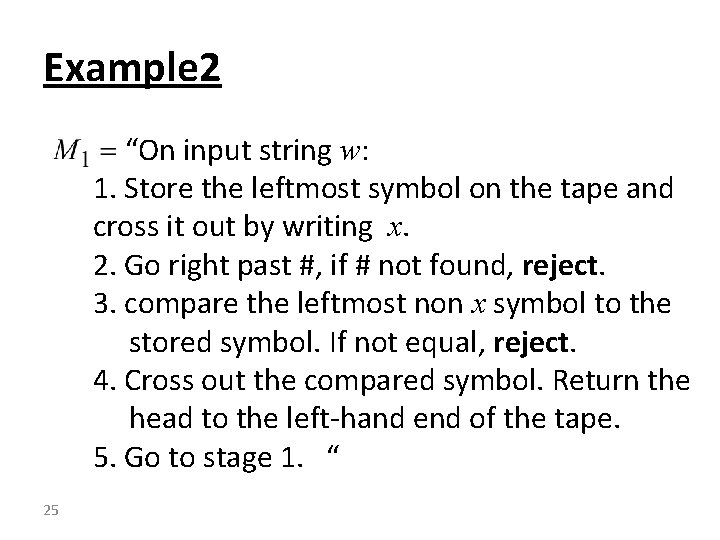
Example 2 “On input string w: 1. Store the leftmost symbol on the tape and cross it out by writing x. 2. Go right past #, if # not found, reject. 3. compare the leftmost non x symbol to the stored symbol. If not equal, reject. 4. Cross out the compared symbol. Return the head to the left-hand end of the tape. 5. Go to stage 1. “ 25
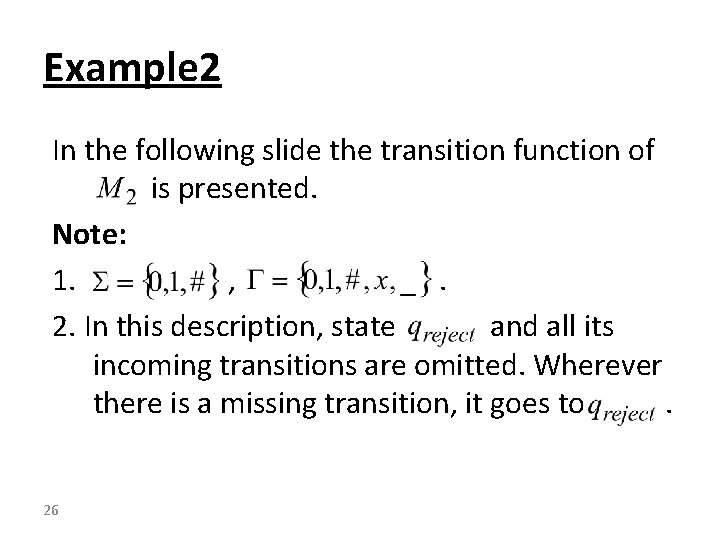
Example 2 In the following slide the transition function of is presented. Note: 1. , . 2. In this description, state and all its incoming transitions are omitted. Wherever there is a missing transition, it goes to. 26
27
Example 2 Note: states and “store” the bit 0, while states and “store” the bit 1. In other words: These two segments are identical, but when the merge each segments uses the value it stored. 28
- Slides: 28