
Introduction to Complexity Science Engineered Complexity Engineered Complexity
- Slides: 13
Introduction to Complexity Science Engineered Complexity
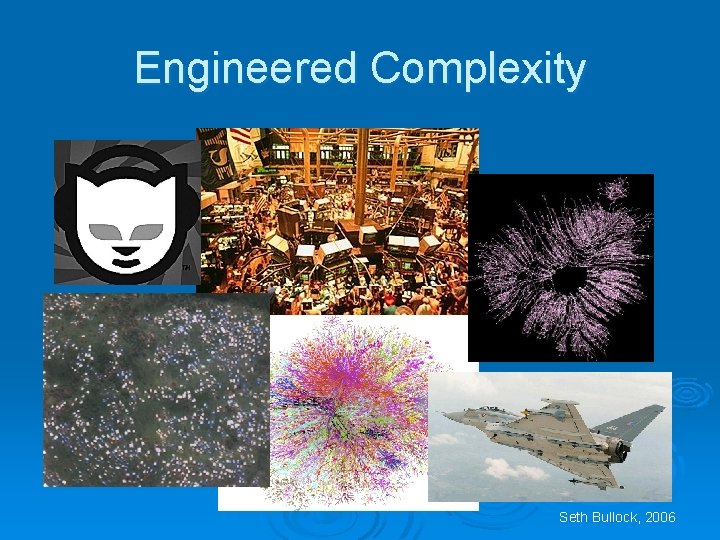
Engineered Complexity Seth Bullock, 2006
Today’s World Today’s world is massively interconnected at an unprecedented scale. Ø Globalisation: l Ø Underpinned by advances in ICT: l Ø Telecoms, internet, satellites, logistics, etc. …further large-scale interconnection: l Ø International tourism, trade, terrorism, etc. Digital NHS, UK Air-Traffic Control Centre, Worldwide University Network, SETI@Home Complexity-related problems are rife. Seth Bullock, 2006
The Net The internet is growing at a fantastic rate. Ø 1 in 6 people are estimated to be online. Ø This figure has doubled since early 2000 Ø The net comprises 180+ million hosts. Measuring growth of a huge, decentralised system such as the web is difficult. Understanding its structure is even harder. How can we map, model & manage the web? Seth Bullock, 2006
Big Science Genome analysis is generating massive amounts of data at an increasing rate. In order to unlock the mysteries of health & disease, we will need to build new tools that allow us to manage the huge amounts of complex data, picture it, and model it. International collaboration amongst scientists will be increasingly important. New & better infrastructures are needed. Seth Bullock, 2006
Data Overload Satellites orbiting the earth and other remote sensors are generating millions of images. Ø biodiversity, global warming, destructive weather patterns, desertification, etc. ATMs, point-of-sale machines, etc. , generate similar amounts of consumer data. How can we efficiently (automatically) analyse this data in order to extract useful information from it? Seth Bullock, 2006
Collaborative Enterprise Firms increasingly collaborate in extended enterprises that are very difficult to manage. a complex and dynamic web of partners, customers, suppliers and markets. Tracking, predicting, and influencing the changing inter-dependencies is hard: Ø products, product parts, part producers, product consumers, product markets, etc. Ø Seth Bullock, 2006
Health Systems The massive digital health record databases being built in hospitals and clinics could: Ø help integrate patient treatment Ø fuel comparative studies Complex issues… Ø infra-structure – security & safety Ø data protection & ownership Ø “relevance” in information retrieval Seth Bullock, 2006
Issues For complex engineered systems, the same issues arise repeatedly: Ø design, control, management Ø massive quantities of data… Ø …but poorly understood Ø robustness, reliability, resilience Ø agility, flexibility, usability Ø dynamic, changing, evolving Seth Bullock, 2006
Complexity: Friend or Foe? For most engineers, complexity/chaos is a property that needs to be extinguished. Ø e. g. , Reynolds number: R=ρdv/η What is the Reynolds number for… Ø London Stock Exchange? Mc. Donalds? If we knew, would we be able to “set it”? Complex systems may also solve problems: Ø swarm intelligence, the edge of chaos… Seth Bullock, 2006
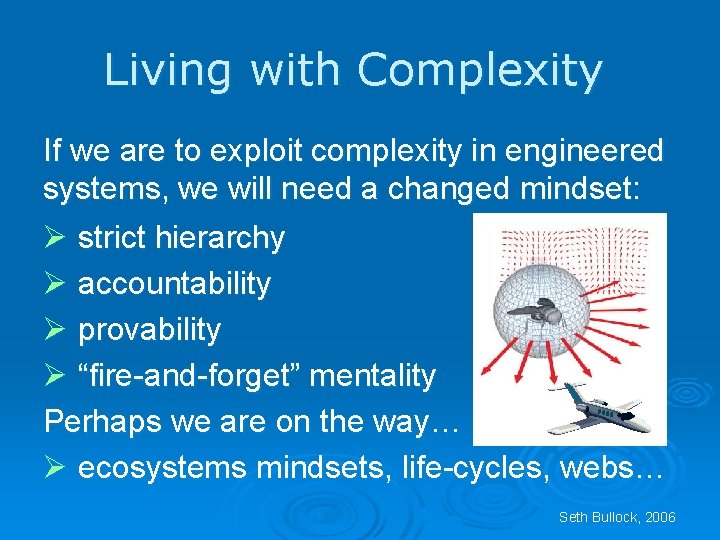
Living with Complexity If we are to exploit complexity in engineered systems, we will need a changed mindset: Ø strict hierarchy Ø accountability Ø provability Ø “fire-and-forget” mentality Perhaps we are on the way… Ø ecosystems mindsets, life-cycles, webs… Seth Bullock, 2006
Grand Challenges? Øin vivo–in silico: the virtual worm… Øscience for global ubiquitous computing Ømemories for life: managing information over a human lifetime Øscalable ubiquitous computing systems Øthe architecture of brain and mind Ødependable systems evolution Øjourneys in non-classical computation Seth Bullock, 2006
More Generally… progressing post-genomic science Ø epidemiological modelling in a complex dynamic world Ø understanding the dynamics of markets, economies, etc. , in a globalised world Ø building effective digital corporate systems Ø facilitating collaboration in large systems Ø managing large-scale design/construction Ø achieving intelligent infrastructure Ø Seth Bullock, 2006