
Introduction to Compiling What is a Compiler Programming
- Slides: 21
Introduction to Compiling
What is a Compiler? § Programming problems are easier to solve in high-level languages – Languages closer to the level of the problem domain, e. g. , • Small. Talk: OO Programming • Java. Script: Web pages § Solutions are usually more efficient (faster, smaller) when written in machine language – Language that reflects to the cycle-by-cycle working of a processor § Compilers are the bridges: – Tools to translate programs written in high-level languages to efficient executable code
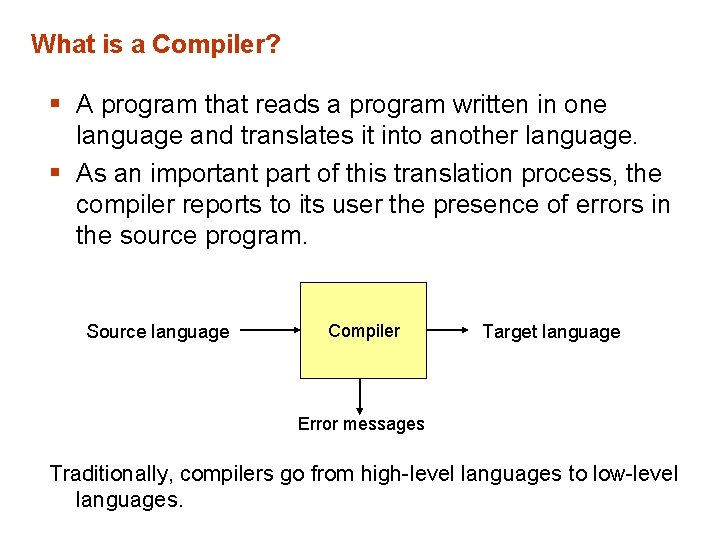
What is a Compiler? § A program that reads a program written in one language and translates it into another language. § As an important part of this translation process, the compiler reports to its user the presence of errors in the source program. Source language Compiler Target language Error messages Traditionally, compilers go from high-level languages to low-level languages.
Compilation Task is Full of Variety? ? § Thousands of source languages – Fortran, Pascal, C, C++, Java, …… § Thousands of target languages – Some other lower level language (assembly language), machine language § Compilation process has similar variety – Single pass, multi-pass, load-and-go, debugging, optimizing…. § Variety is overwhelming…… § Good news is: – Few basic techniques is sufficient to cover all variety – Many efficient tools are available
Requirement § In order to translate statements in a language, one needs to understand both – the structure of the language: the way “sentences" are constructed in the language, and – the meaning of the language: what each “sentence" stands for. § Terminology: Structure ≡ Syntax Meaning ≡ Semantics
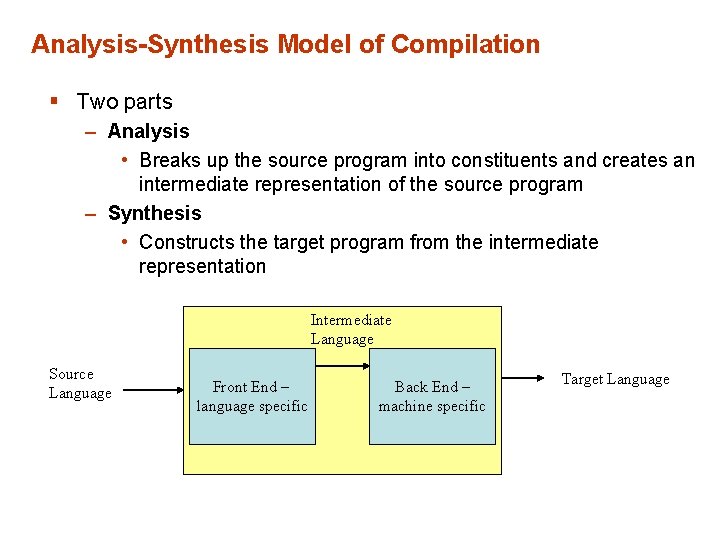
Analysis-Synthesis Model of Compilation § Two parts – Analysis • Breaks up the source program into constituents and creates an intermediate representation of the source program – Synthesis • Constructs the target program from the intermediate representation Intermediate Language Source Language Front End – language specific Back End – machine specific Target Language
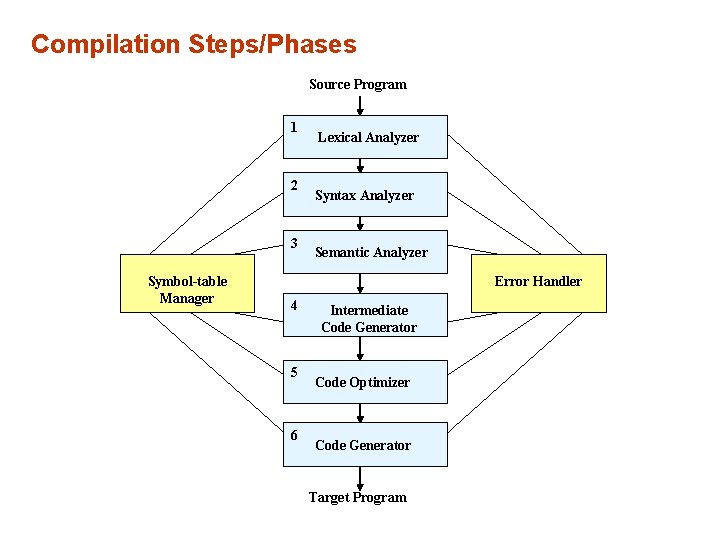
Compilation Steps/Phases Source Program 1 2 3 Symbol-table Manager Lexical Analyzer Syntax Analyzer Semantic Analyzer Error Handler 4 5 6 Intermediate Code Generator Code Optimizer Code Generator Target Program
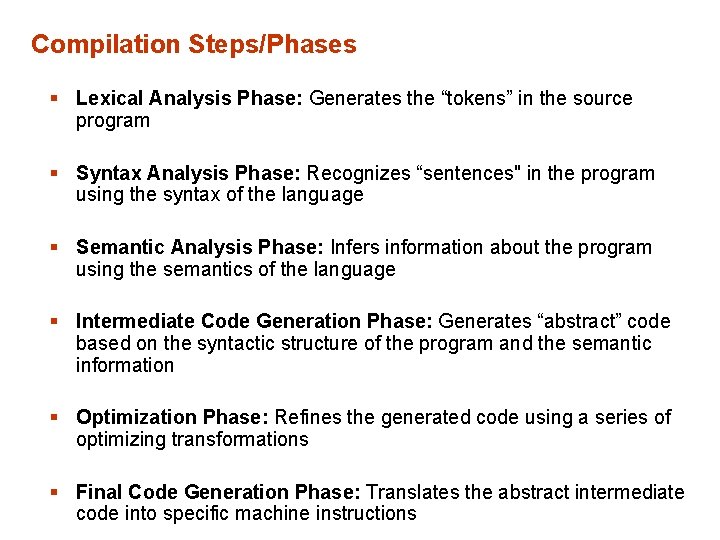
Compilation Steps/Phases § Lexical Analysis Phase: Generates the “tokens” in the source program § Syntax Analysis Phase: Recognizes “sentences" in the program using the syntax of the language § Semantic Analysis Phase: Infers information about the program using the semantics of the language § Intermediate Code Generation Phase: Generates “abstract” code based on the syntactic structure of the program and the semantic information § Optimization Phase: Refines the generated code using a series of optimizing transformations § Final Code Generation Phase: Translates the abstract intermediate code into specific machine instructions
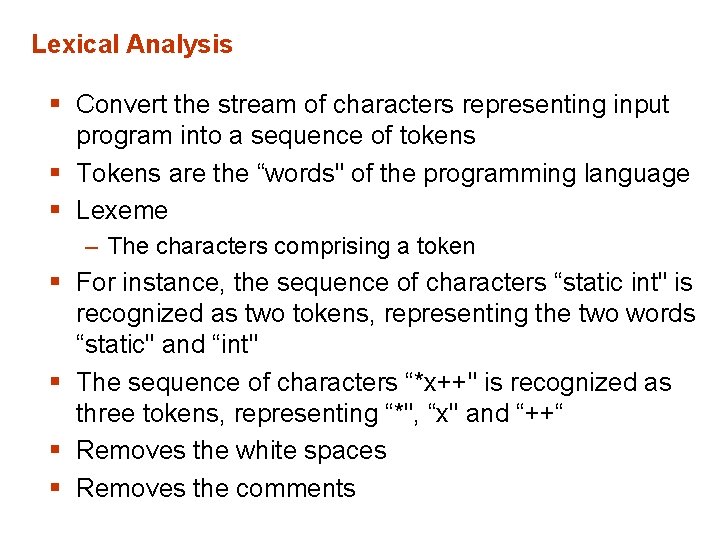
Lexical Analysis § Convert the stream of characters representing input program into a sequence of tokens § Tokens are the “words" of the programming language § Lexeme – The characters comprising a token § For instance, the sequence of characters “static int" is recognized as two tokens, representing the two words “static" and “int" § The sequence of characters “*x++" is recognized as three tokens, representing “*", “x" and “++“ § Removes the white spaces § Removes the comments
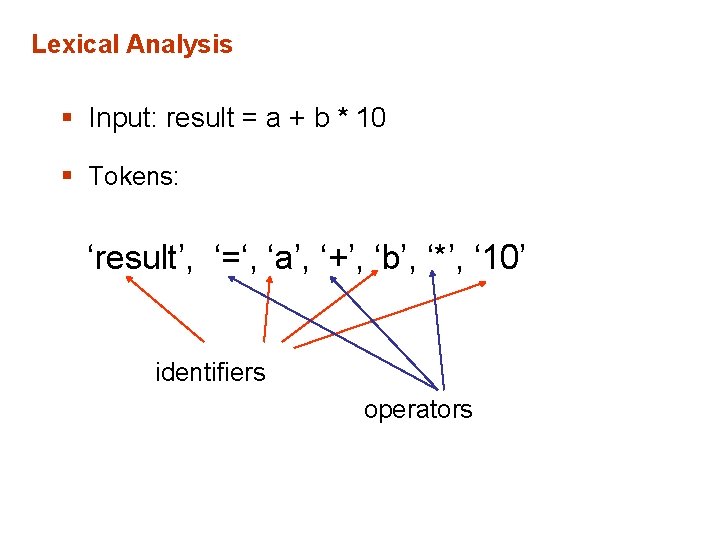
Lexical Analysis § Input: result = a + b * 10 § Tokens: ‘result’, ‘=‘, ‘a’, ‘+’, ‘b’, ‘*’, ‘ 10’ identifiers operators
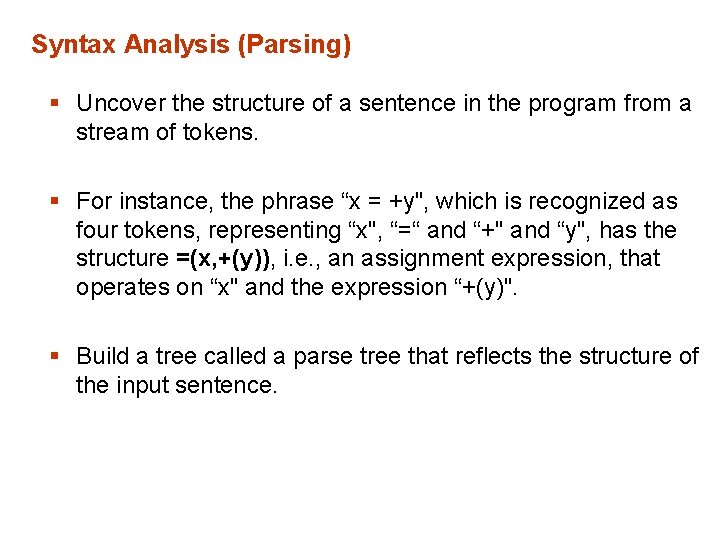
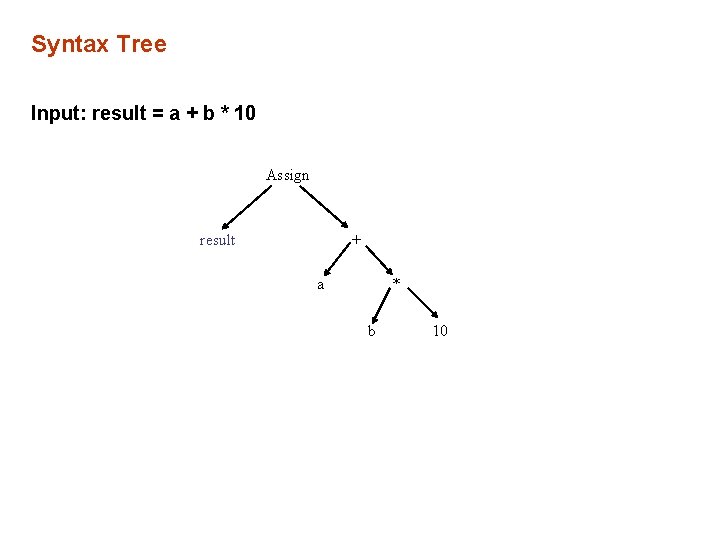
Syntax Analysis (Parsing) § Uncover the structure of a sentence in the program from a stream of tokens. § For instance, the phrase “x = +y", which is recognized as four tokens, representing “x", “=“ and “+" and “y", has the structure =(x, +(y)), i. e. , an assignment expression, that operates on “x" and the expression “+(y)". § Build a tree called a parse tree that reflects the structure of the input sentence.
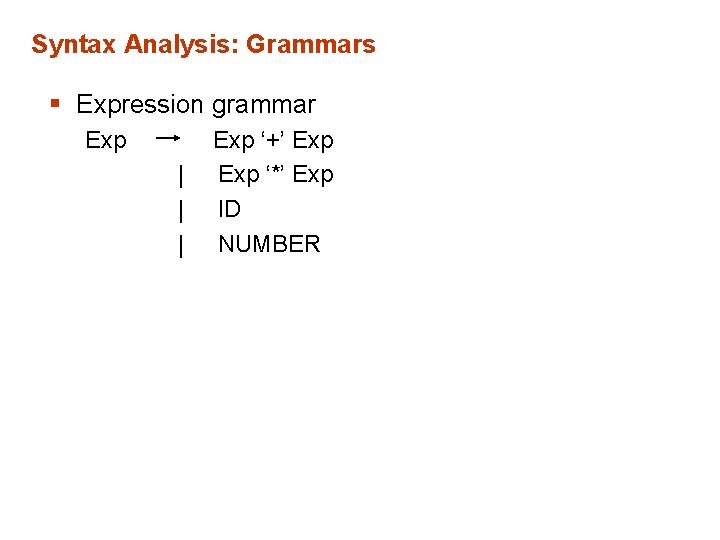
Syntax Analysis: Grammars § Expression grammar Exp | | | Exp ‘+’ Exp ‘*’ Exp ID NUMBER
Syntax Tree Input: result = a + b * 10 Assign result + a * b 10
Semantic Analysis § Check the source program for semantic errors § It uses the hierarchical structure determined by the syntax-analysis phase to identify the operators and operands of expressions and statements § Performs type checking – Operator operand compatibility
Intermediate Code Generation § Translate each hierarchical structure decorated as tree into intermediate code § A program translated for an abstract machine § Properties of intermediate codes – Should be easy to produce – Should be easy to translate into the target program § Intermediate code hides many machine-level details, but has instruction-level mapping to many assembly languages § Main motivation: portability § One commonly used form is “Three-address Code”
Code Optimization § Apply a series of transformations to improve the time and space efficiency of the generated code. § Peephole optimizations: generate new instructions by combining/expanding on a small number of consecutive instructions. § Global optimizations: reorder, remove or add instructions to change the structure of generated code § Consumes a significant fraction of the compilation time § Optimization capability varies widely § Simple optimization techniques can be vary valuable
Code Generation § Map instructions in the intermediate code to specific machine instructions. § Memory management, register allocation, instruction selection, instruction scheduling, … § Generates sufficient information to enable symbolic debugging.
Symbol Table § Records the identifiers used in the source program – Collect information about various attributes of each identifier • Variables: type, scope, storage allocation • Procedure: number and types of arguments, method of argument passing § It’s a data structure containing a record for each identifier – Different fields are collected and used at different phases of compilation § When an identifier in the source program is detected by the lexical analyzer, the identifier is entered into the symbol table
Syntax Analyzer vs Lexical Analyzer § Which constructs of a program should be recognized by the lexical analyzer, and which ones by the syntax analyzer? – Both of them do similar things; But the lexical analyzer deals with simple non-recursive constructs of the language. – The syntax analyzer deals with recursive constructs of the language. – The lexical analyzer simplifies the job of the syntax analyzer. – The lexical analyzer recognizes the smallest meaningful units (tokens) in a source program. – The syntax analyzer works on the smallest meaningful units (tokens) in a source program to recognize meaningful structures in our programming language.
Cousins of the Compiler § Preprocessor – Macro preprocessing • Define and use shorthand for longer constructs – File inclusion • Include header files – “Rational” Preprocessors • Augment older languages with modern flow-of-control or data-structures – Language Extension • Add capabilities to a language • Equel: query language embedded in C
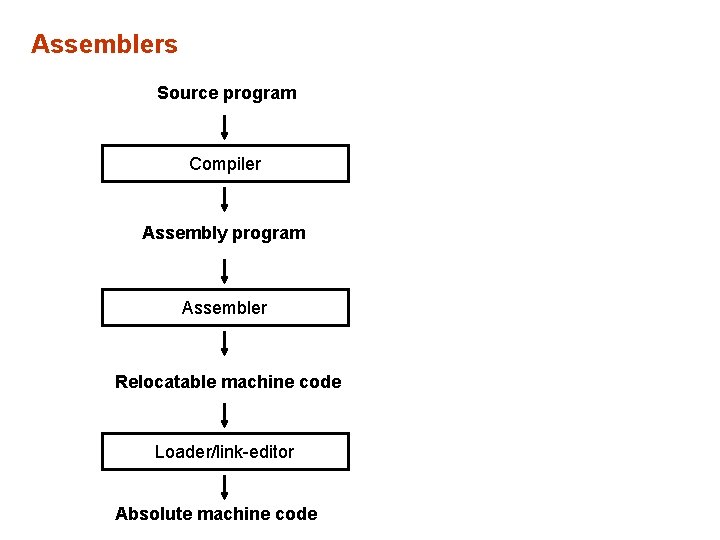
Assemblers Source program Compiler Assembly program Assembler Relocatable machine code Loader/link-editor Absolute machine code