
Introduction to Compiler Construction Robert van Engelen http
Introduction to Compiler Construction Robert van Engelen http: //www. cs. fsu. edu/~engelen/courses/COP 5621 Compiler Construction, Spring 2017 Copyright Robert van Engelen, Florida State University, 2007 -2017
2 Syllabus • Prerequisites: COP 4020 or equivalent • Textbook: “Compilers: Principles, Techniques, and Tools” by Aho, Sethi, and Ullman, 2 nd edition • Other material: “The Java. TM Virtual Machine Specification” SE 8 and class handouts • Grade breakdown: – Exams (three midterm, one final) (60%) – Four project assignments (40%) – Homework for extra credit (at most 4%)
Syllabus, Assignments, and Schedule http: //www. cs. fsu. edu/~engelen/courses/COP 5621 3
4 Objectives • Be able to build a compiler for a (simplified) (programming) language • Know how to use compiler construction tools, such as generators of scanners and parsers • Be familiar with assembly code and virtual machines, such as the JVM, and bytecode • Be able to define LL(1), LR(1), and LALR(1) grammars • Be familiar with compiler analysis and optimization techniques • … learn how to work on a larger software project!
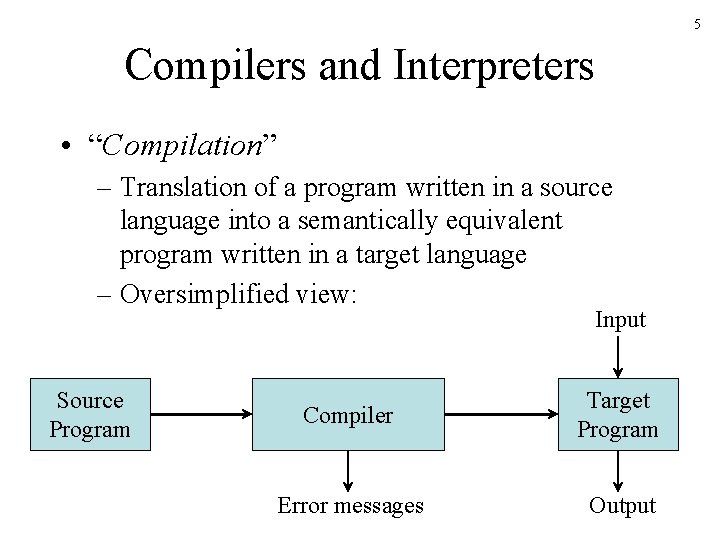
5 Compilers and Interpreters • “Compilation” – Translation of a program written in a source language into a semantically equivalent program written in a target language – Oversimplified view: Input Source Program Compiler Target Program Error messages Output
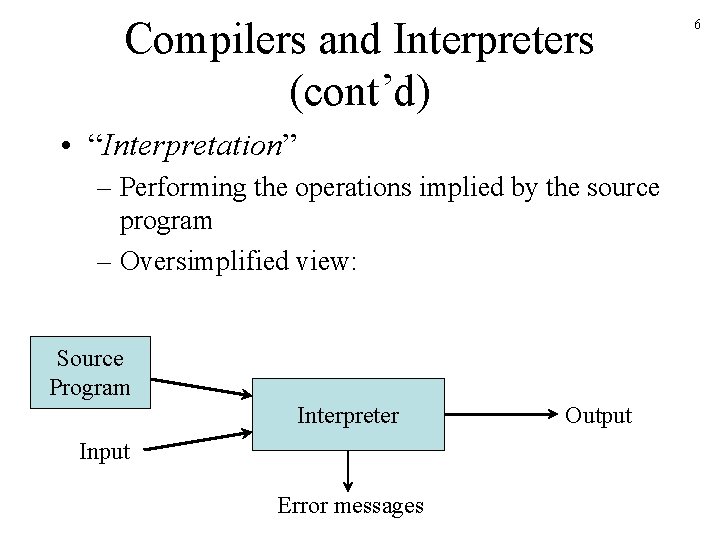
Compilers and Interpreters (cont’d) • “Interpretation” – Performing the operations implied by the source program – Oversimplified view: Source Program Interpreter Input Error messages Output 6
The Analysis-Synthesis Model of Compilation • There are two parts to compilation: – Analysis determines the operations implied by the source program which are recorded in a tree structure – Synthesis takes the tree structure and translates the operations therein into the target program 7
Other Tools that Use the Analysis -Synthesis Model • • Editors (syntax highlighting) Pretty printers (e. g. Doxygen) Static checkers (e. g. Lint and Splint) Interpreters Text formatters (e. g. Te. X and La. Te. X) Silicon compilers (e. g. VHDL) Query interpreters/compilers (Databases) 8
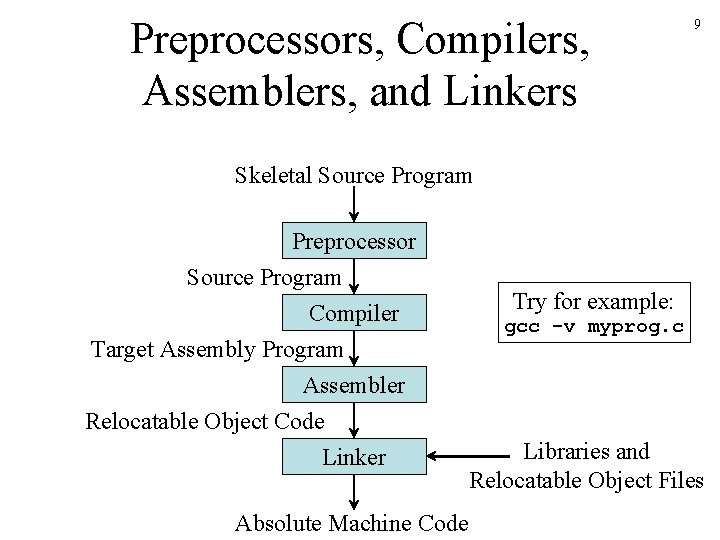
Preprocessors, Compilers, Assemblers, and Linkers 9 Skeletal Source Program Preprocessor Source Program Compiler Target Assembly Program Assembler Relocatable Object Code Linker Absolute Machine Code Try for example: gcc -v myprog. c Libraries and Relocatable Object Files
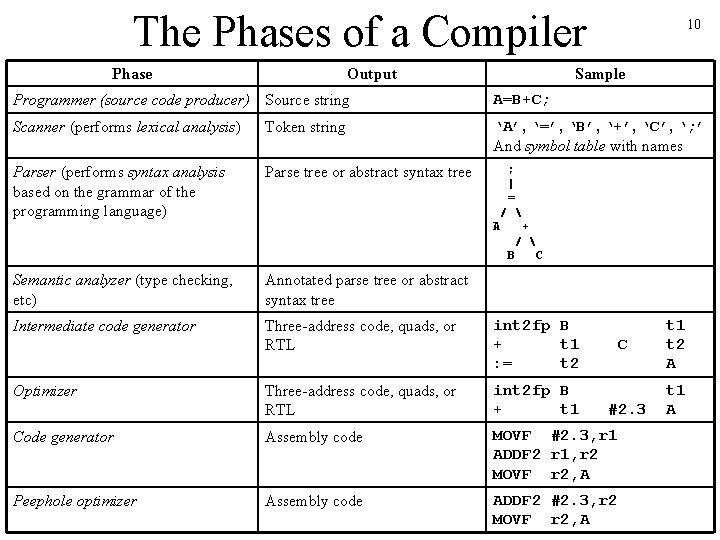
The Phases of a Compiler Phase Output 10 Sample Programmer (source code producer) Source string A=B+C; Scanner (performs lexical analysis) Token string ‘A’, ‘=’, ‘B’, ‘+’, ‘C’, ‘; ’ And symbol table with names Parser (performs syntax analysis based on the grammar of the programming language) Parse tree or abstract syntax tree Semantic analyzer (type checking, etc) Annotated parse tree or abstract syntax tree Intermediate code generator Three-address code, quads, or RTL int 2 fp B + t 1 : = t 2 Three-address code, quads, or RTL int 2 fp B + t 1 Code generator Assembly code MOVF #2. 3, r 1 ADDF 2 r 1, r 2 MOVF r 2, A Peephole optimizer Assembly code ADDF 2 #2. 3, r 2 MOVF r 2, A Optimizer ; | = / A + / B C C #2. 3 t 1 t 2 A t 1 A
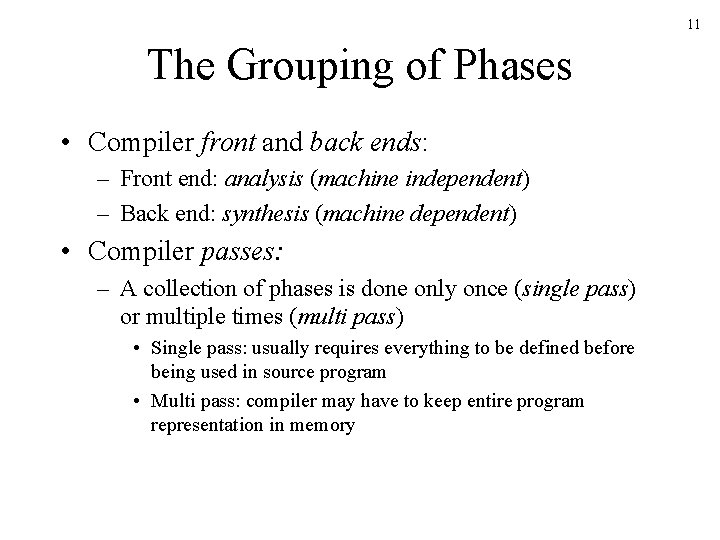
11 The Grouping of Phases • Compiler front and back ends: – Front end: analysis (machine independent) – Back end: synthesis (machine dependent) • Compiler passes: – A collection of phases is done only once (single pass) or multiple times (multi pass) • Single pass: usually requires everything to be defined before being used in source program • Multi pass: compiler may have to keep entire program representation in memory
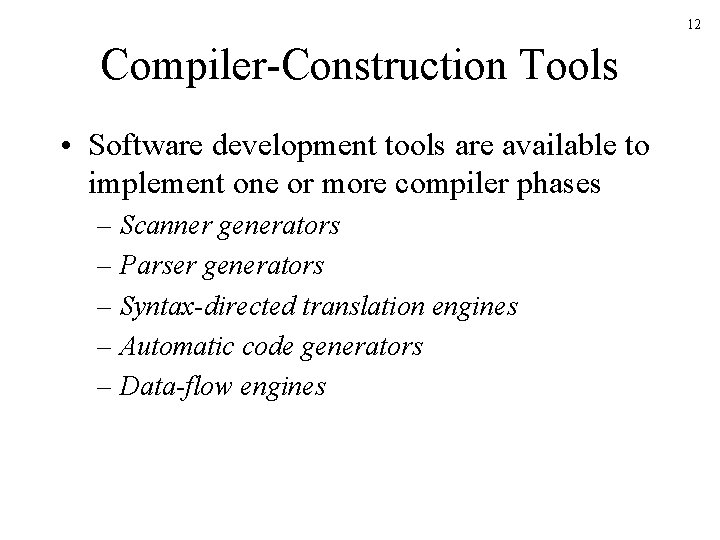
12 Compiler-Construction Tools • Software development tools are available to implement one or more compiler phases – Scanner generators – Parser generators – Syntax-directed translation engines – Automatic code generators – Data-flow engines
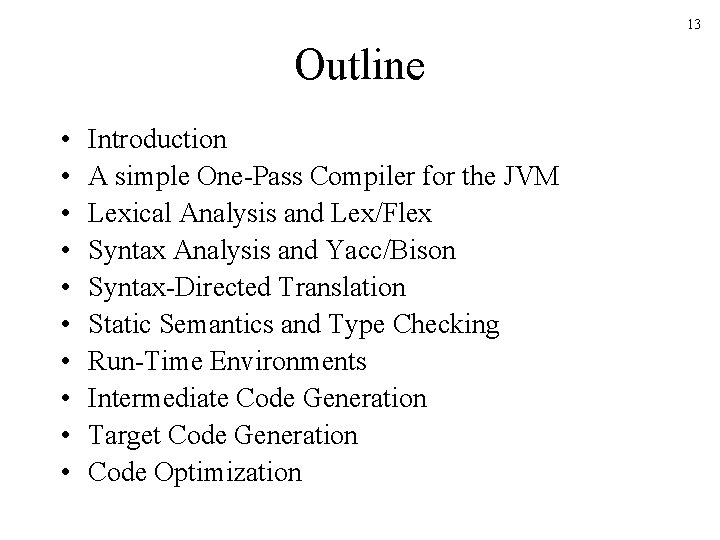
13 Outline • • • Introduction A simple One-Pass Compiler for the JVM Lexical Analysis and Lex/Flex Syntax Analysis and Yacc/Bison Syntax-Directed Translation Static Semantics and Type Checking Run-Time Environments Intermediate Code Generation Target Code Generation Code Optimization
- Slides: 13