
Introduction to Communication ENGL 5 Business Communication What
Introduction to Communication ENGL 5 Business Communication

What is “communication”? � “Communication is sharing information or providing entertainment by speaking, writing, or other methods. ” (World Book Encyclopedia) � “Communication listens. . . “ happens only when someone (Philippine Communication: An Introduction by Crispin Maslog)

What is “communication”? Communication is a process of exchanging information, ideas, thoughts, feelings & emotions through speech, signals, writing, or behavior. (www. notedesk. com)

SMCR Model of Communication Sender Message Channel Receiver
More about “communication” � Communication, like breathing, is so much part of human life that we take it for granted. � People assume that they are automatically communicating when they speak or write.
Etymology of “communication” � “Communication” came from the old English word “comun” which came from the Latin “communis, ” which means “common. ” � To communicate is to “commune, ” to create something in common between the communicator &the audience.
Something to think about “As soon as the audience grasps the message sent by the communicator, a ‘commonness’ between them. ”
Types of Communication Based on communication channel � Verbal � Non-verbal Based on purpose and style � Formal � Informal
Based on communication channel Verbal communication Non-verbal communication � Message is transmitted using words � Types of verbal communication: ◦ Oral communication ◦ Written communication is transmitted in ways other than words � Elements of non-verbal communication: ◦ Appearance ◦ Body language ◦ Sounds
Verbal Communication Oral communication Written communication � Influenced by pitch, volume, speed and clarity of speaking by the vocabulary & grammar used, writing style, precision and clarity of the language used
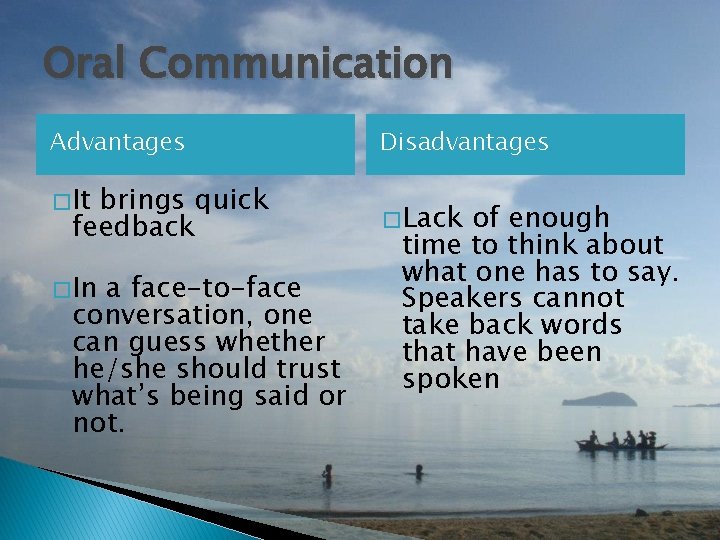
Oral Communication Advantages � It brings quick feedback � In a face-to-face conversation, one can guess whether he/she should trust what’s being said or not. Disadvantages � Lack of enough time to think about what one has to say. Speakers cannot take back words that have been spoken
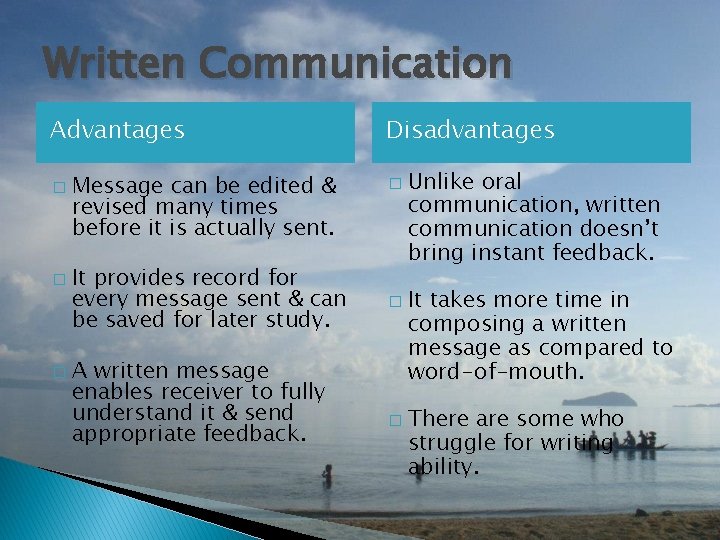
Written Communication Advantages � � � Message can be edited & revised many times before it is actually sent. It provides record for every message sent & can be saved for later study. A written message enables receiver to fully understand it & send appropriate feedback. Disadvantages � � � Unlike oral communication, written communication doesn’t bring instant feedback. It takes more time in composing a written message as compared to word-of-mouth. There are some who struggle for writing ability.
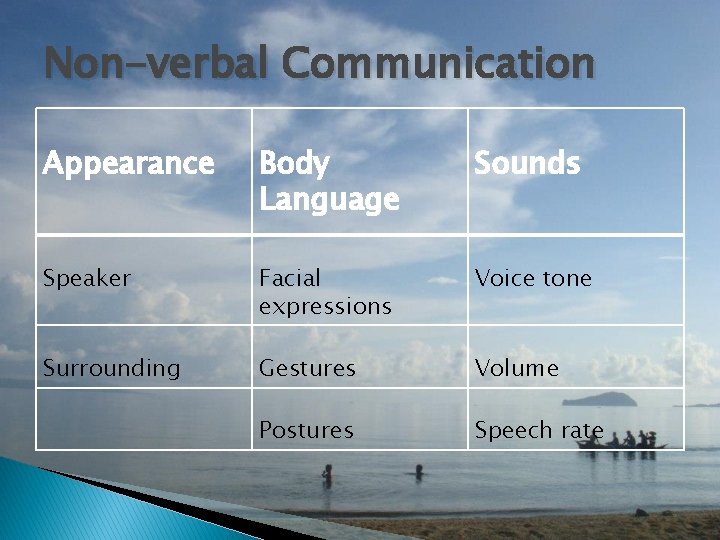
Non-verbal Communication Appearance Body Language Sounds Speaker Facial expressions Voice tone Surrounding Gestures Volume Postures Speech rate
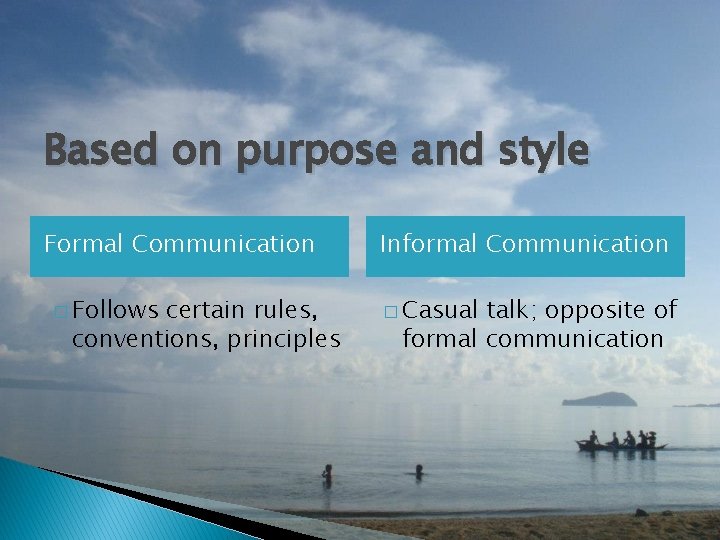
Based on purpose and style Formal Communication � Follows certain rules, conventions, principles Informal Communication � Casual talk; opposite of formal communication
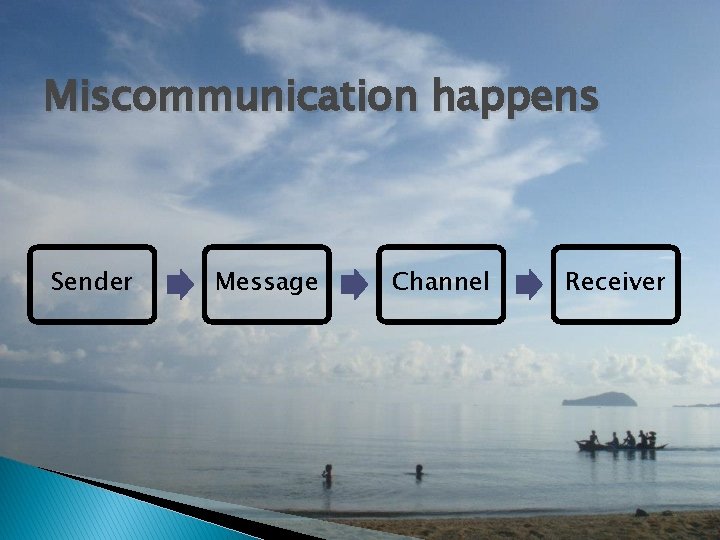
Miscommunication happens Sender Message Channel Receiver
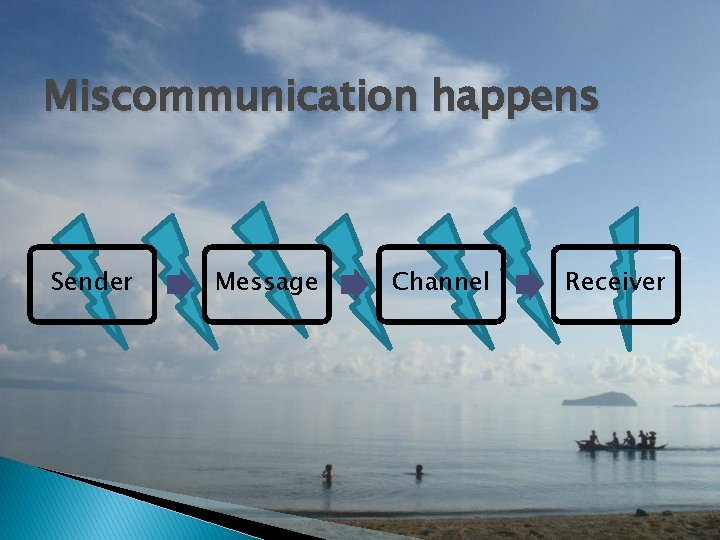
Miscommunication happens Sender Message Channel Receiver
Why miscommunication happens Let us find out why through a group activity called “message relay”
Why miscommunication happens � Noise – interference in the communication process ◦ Physical noise ◦ Psychological noise � Channel overload � Information overload
We interpret messages in light of our personal experiences, our cultures & subcultures, & even the point in history at which we live. (Business Communication: Building Critical Skills, by Locker/ Kaczmarek)
Culture � Culture is a term used by social scientists for a people’s way of life. � It consists of all the ideas, objects, & ways of doing things created by the group � It includes arts, beliefs, customs, inventions, language, technology, traditions. (World Book Encyclopedia)
Categories of culture High-context � Most of the information is inferred from the context of a message, little is “spelled out. ” Ex. Japanese, Arabic, Latin American cultures Low-context � Context is less important; most information is explicitly spelled out. Ex. German, Scandinavian, and the dominant US cultures
Differences in values, beliefs, practices � Example: The concept of “competition” � Example: The concept of “individualism” ◦ For most North Americans, it leads to better performance ◦ For the Japanese, it leads to disharmony ◦ Students in US expected to complete assignments alone ◦ In Japan, groups routinely work together/ collective
� EXAMPLE: The belief in bad luck � EXAMPLE: The meaning of color white ◦ In Philippines, “ 13” is an unlucky number ◦ In other East Asian countries, it’s “ 4” ◦ In some denominations within Christian religion, white is the color of purity ◦ In some denominations within Islam, it is the color of death
Differences in non-verbal communication � Eye contact ◦ For North Americans it is sign of honesty ◦ Puerto Rican children are taught not to meet the eyes of adults ◦ Japanese are taught to look at the neck ◦ In Korea, pro-longed eye contact is rude; low-ranking person must look down first. ◦ In Arab countries, women & men are forbidden to have eye contact
� Thumbs-up sign ◦ In US, it means “good work” or “go ahead” ◦ In Greece, it is a vulgar insult � Personal space ◦ Most N. Americans, N. Europeans & Asians want a bigger personal space than do Latin Americans, French, Italians, Arabs. ◦ In US, men want more personal space than women.
� Spatial Arrangements ◦ In US, an individual office w/ a door that closes connotes more status than a desk in common area ◦ Japanese firms see private offices as “inappropriate & inefficient. ◦ US homes have more furniture, while Japanese homes are minimalist � Time ◦ In US, being “on time” is sign of dependability ◦ In other cultures, internal “body clocks”
Differences in verbal communications � Understatement ◦ The British has reputation for understatement (ex. She “plays a little tennis” – to describe someone who is excellent at playing tennis) � Exaggeration ◦ The Americans are known for overstatement (ex. “impossible” is used to describe something difficult to achieve. )
� Compliments ◦ “You must really be tired. ” In Japan, it is a compliment. The correct response is, “Thank you, but I’m okay. ” ◦ An American who is complimented for a good presentation will say “Thank you. ” A Japanese, in contrast will apologize, saying “No, it wasn’t good enough. ” � Silence ◦ Silence does not always mean “yes. ” ◦ (Business Communication: Building Critical Skills)
Miscommunication around us Let us analyze examples of miscommunication via another group activity called “role-playing”
- Slides: 30