
Introduction to Cognitive Behaviour Therapy Valrie KHODARA PsychologuePsychologist
Introduction to Cognitive Behaviour Therapy Valérie KHODARA Psychologue/Psychologist, Psychothérapeute TCC/Psychotherapist CBT vkhodara@gmail. com
Epictetus 55 - 135 AD • “Men are disturbed, not by things, but by the principles and notions which they form concerning things” • Roman (Greek-born) slave & Stoic philosopher les. TCC Valérie Khodara Nimes University- 2
• “Cognitive Therapy is a system of psychotherapy that attempts to reduce … • excessive emotional reactions and • self-defeating behaviour, • by modifying the faulty or erroneous thinking and maladaptive beliefs that underlie these reactions” • Beck et al 1976, 1979, 1993 les. TCC Valérie Khodara Nimes University- 3
The approach is: • Collaborative (builds trust) • Active • Based on open-ended questioning • Highly structured and focused les. TCC Valérie Khodara Nimes University- 4
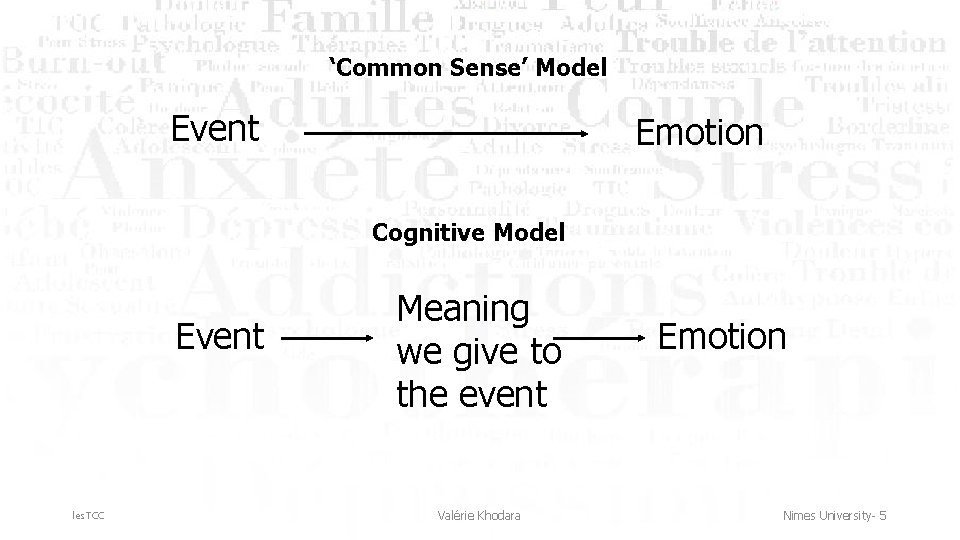
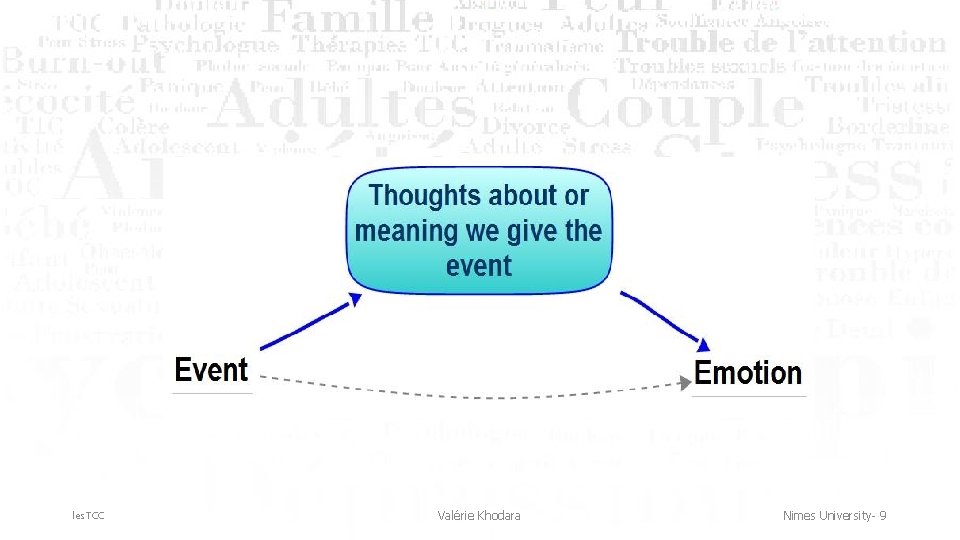
‘Common Sense’ Model Event Emotion Cognitive Model Event les. TCC Meaning we give to the event Valérie Khodara Emotion Nimes University- 5
Example : You’re walking down the High Street, and someone you know walks by without acknowledging you… les. TCC Valérie Khodara Nimes University- 6
• What could you think in this situation? and what could you feel? les. TCC Valérie Khodara Nimes University- 7
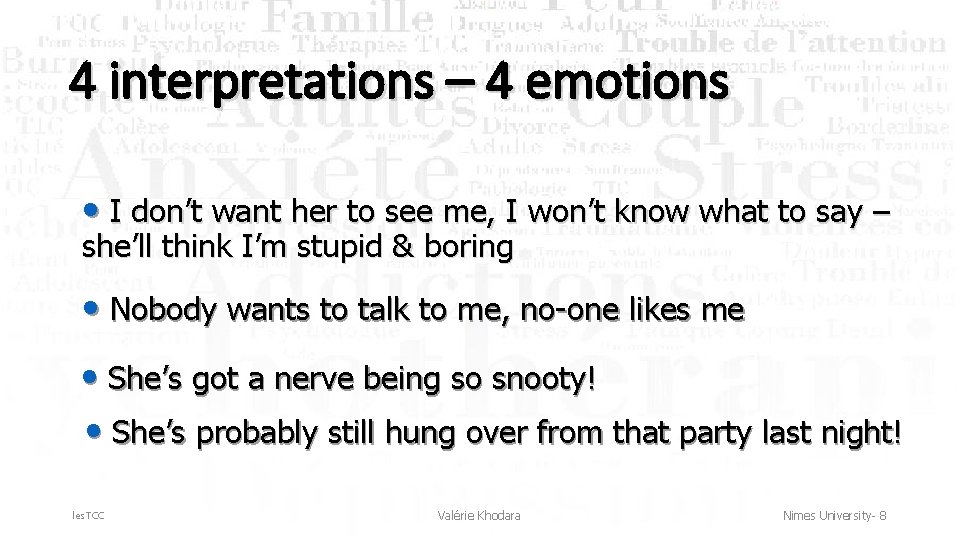
4 interpretations – 4 emotions • I don’t want her to see me, I won’t know what to say – she’ll think I’m stupid & boring • Nobody wants to talk to me, no-one likes me • She’s got a nerve being so snooty! • She’s probably still hung over from that party last night! les. TCC Valérie Khodara Nimes University- 8
les. TCC Valérie Khodara Nimes University- 9
• Cognitive principle – it is interpretations of events, not events themselves, which are crucial. • Behavioural principle – what we do has a powerful influence on our thoughts and emotions • Avoidant strategies • Exposure (phobia) • Testing a belief les. TCC Valérie Khodara Nimes University- 10
• The continuum principle – mental health problems are best conceptualised as exaggerations of normal processes • normal anxiety ---------pathological anxiety • wishing to succeed --------need to be perfect • having a drink with friends ------ getting drunk, alone les. TCC Valérie Khodara Nimes University- 11
• ‘Here and now’ principle It is usually more fruitful to focus on current processes rather than on the past • What studies show… • The dog and the feather…. les. TCC Valérie Khodara Nimes University- 12
How do we become anxious? • The Napalkov’s experiment (1963) • dogs. • Inconditional Stimulus = a gun shot behind the hear of the dog • Inconditional Response = increase of the blood pressure Rapid habituation of the dog’s response to the gun shot les. TCC Valérie Khodara 15
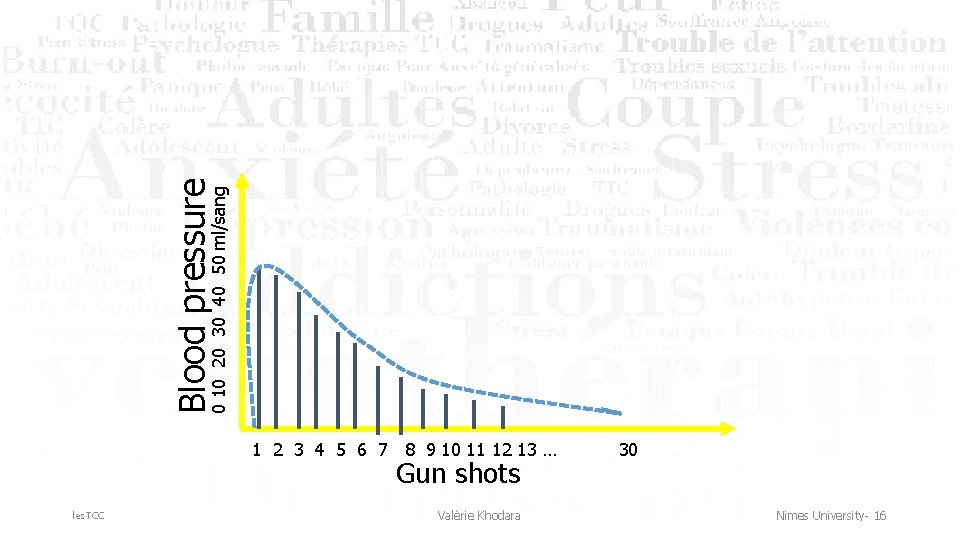
0 10 20 30 40 50 ml/sang Blood pressure 1 2 3 4 5 6 7 8 9 10 11 12 13 … 30 Gun shots les. TCC Valérie Khodara Nimes University- 16
Next step of the experiment • Neutral Stimulus = a feather • Unconditioned Stimulus: a shot gun • We will see how a feather (NS) can become a Conditioned Stimulus • we touch the dog’s ear with a feather and a shot gun is fired immediately after (0, 5 sec. ) • Only one association. No more shot guns after. les. TCC Valérie Khodara 17
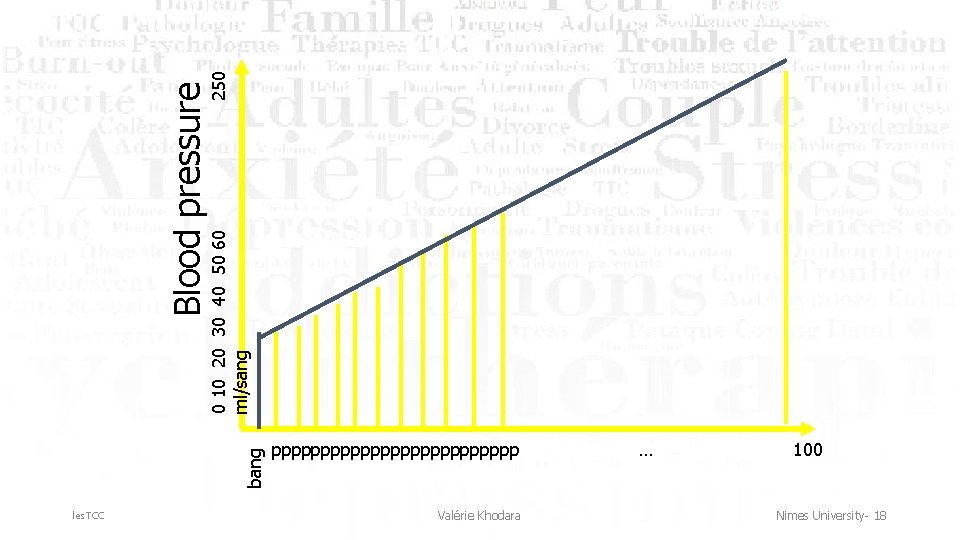
0 10 20 30 40 50 60 250 ml/sang bang Blood pressure les. TCC ppppppppppppp … 100 Valérie Khodara Nimes University- 18
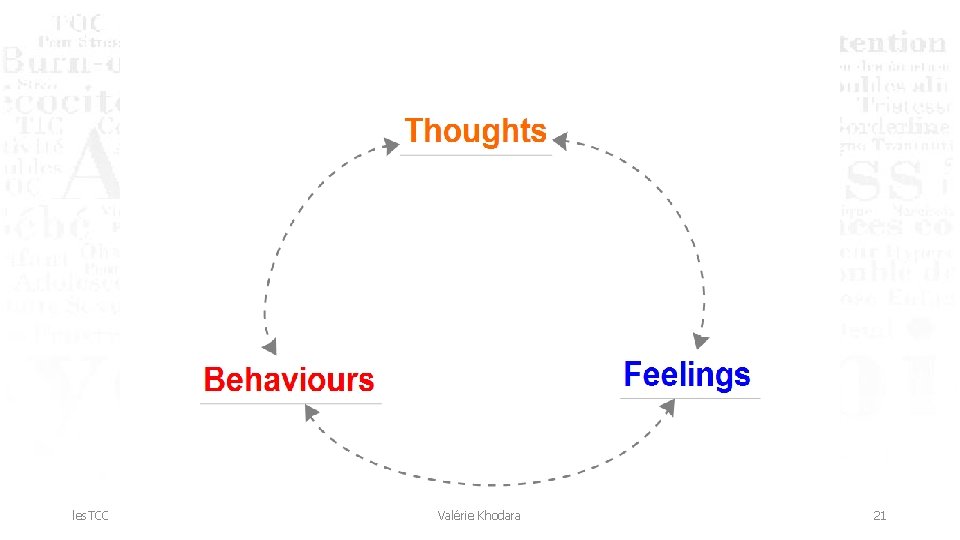
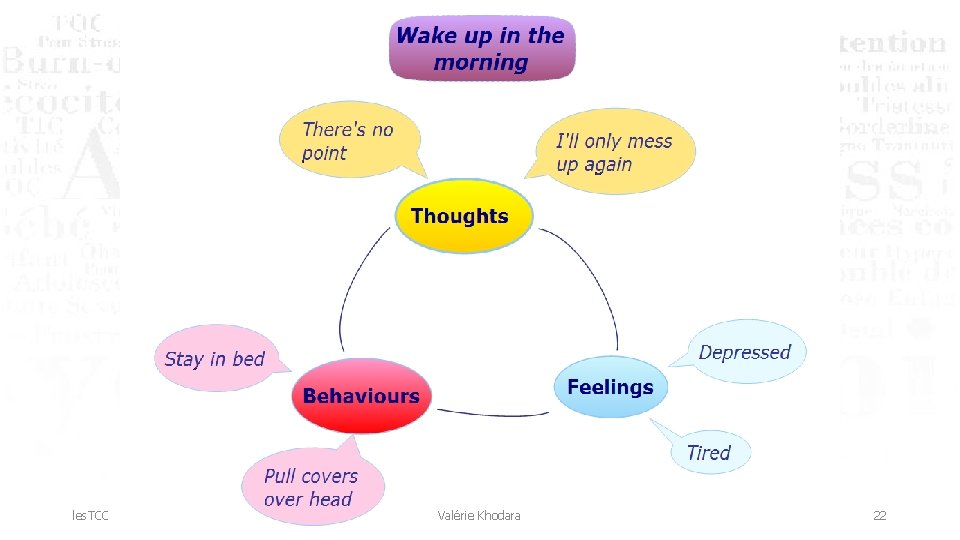
• Interacting systems principle • CBT sees problems as an interaction between • thoughts, • emotions, • behaviour and • physiology and the environment in which the person operates les. TCC Valérie Khodara Nimes University- 20
les. TCC Valérie Khodara 21
les. TCC Valérie Khodara 22
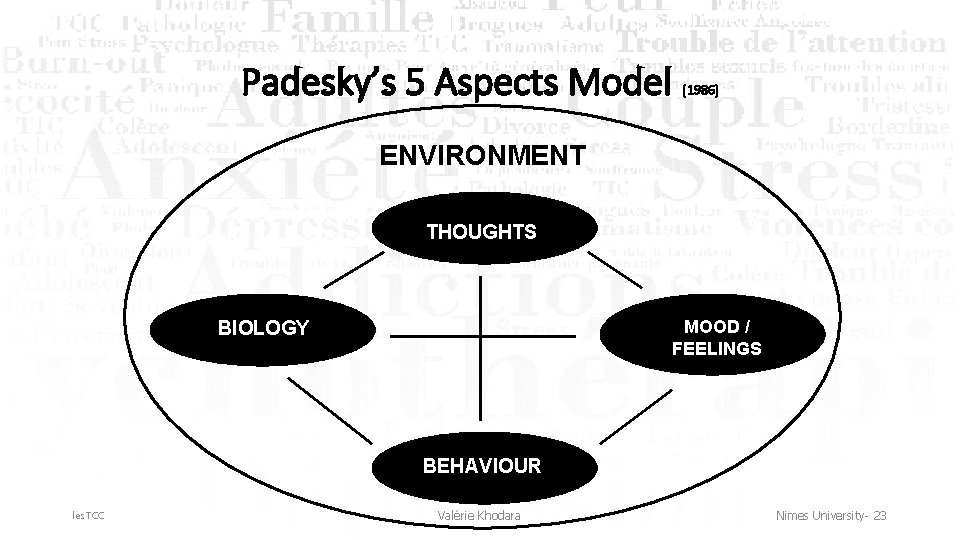
Padesky’s 5 Aspects Model (1986) ENVIRONMENT THOUGHTS MOOD / FEELINGS BIOLOGY BEHAVIOUR les. TCC Valérie Khodara Nimes University- 23
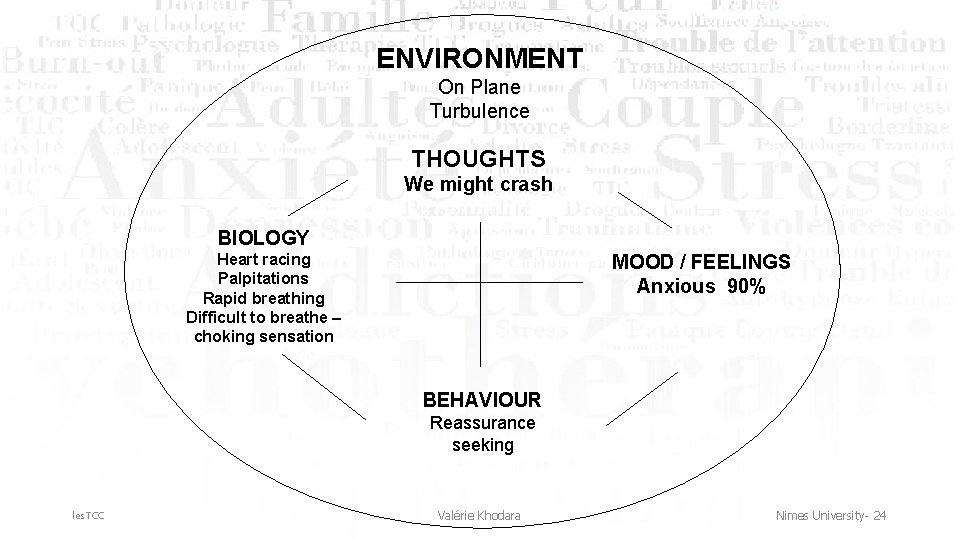
ENVIRONMENT On Plane Turbulence THOUGHTS We might crash BIOLOGY Heart racing Palpitations Rapid breathing Difficult to breathe – choking sensation MOOD / FEELINGS Anxious 90% BEHAVIOUR Reassurance seeking les. TCC Valérie Khodara Nimes University- 24
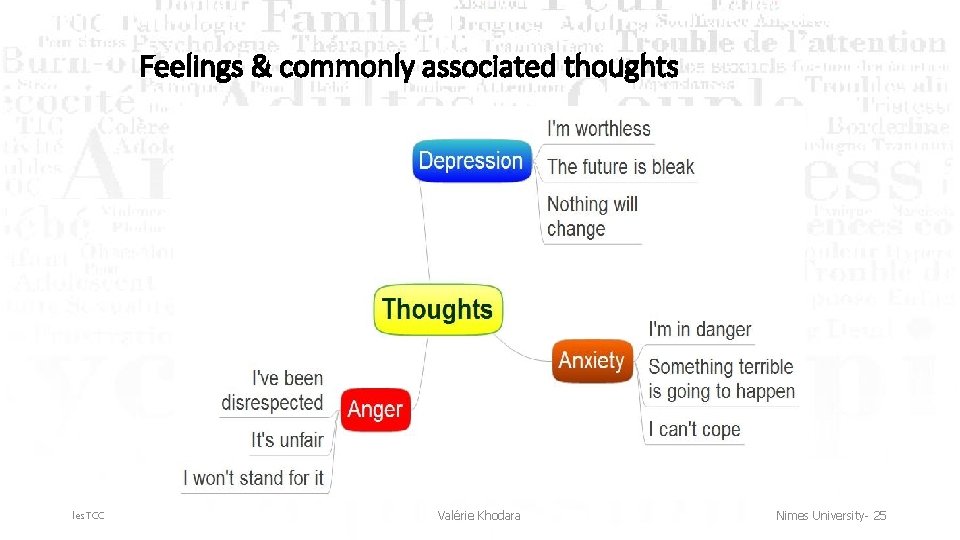
Feelings & commonly associated thoughts les. TCC Valérie Khodara Nimes University- 25
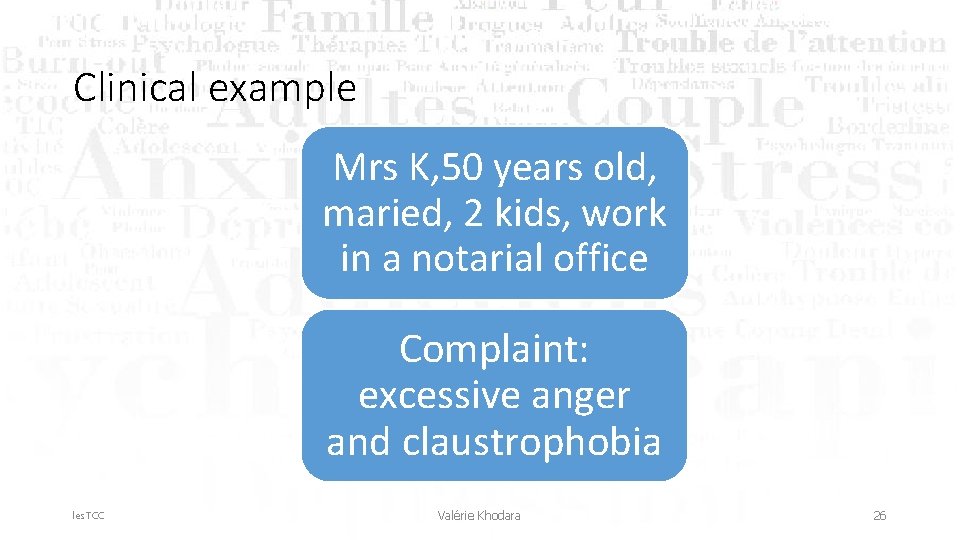
Clinical example Mrs K, 50 years old, maried, 2 kids, work in a notarial office Complaint: excessive anger and claustrophobia les. TCC Valérie Khodara 26
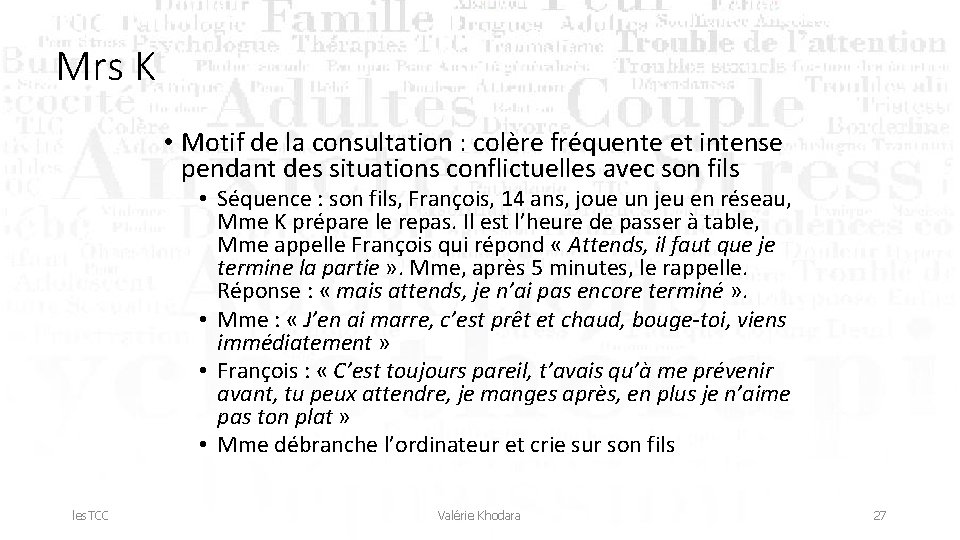
Mrs K • Motif de la consultation : colère fréquente et intense pendant des situations conflictuelles avec son fils • Séquence : son fils, François, 14 ans, joue un jeu en réseau, Mme K prépare le repas. Il est l’heure de passer à table, Mme appelle François qui répond « Attends, il faut que je termine la partie » . Mme, après 5 minutes, le rappelle. Réponse : « mais attends, je n’ai pas encore terminé » . • Mme : « J’en ai marre, c’est prêt et chaud, bouge-toi, viens immédiatement » • François : « C’est toujours pareil, t’avais qu’à me prévenir avant, tu peux attendre, je manges après, en plus je n’aime pas ton plat » • Mme débranche l’ordinateur et crie sur son fils les. TCC Valérie Khodara 27
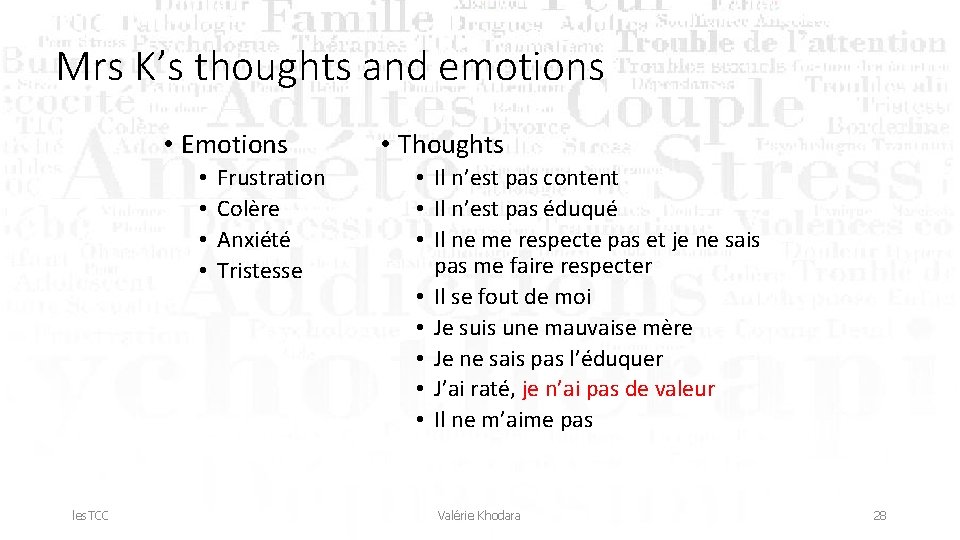
Mrs K’s thoughts and emotions • Emotions • • les. TCC Frustration Colère Anxiété Tristesse • Thoughts • Il n’est pas content • Il n’est pas éduqué • Il ne me respecte pas et je ne sais pas me faire respecter • Il se fout de moi • Je suis une mauvaise mère • Je ne sais pas l’éduquer • J’ai raté, je n’ai pas de valeur • Il ne m’aime pas Valérie Khodara 28
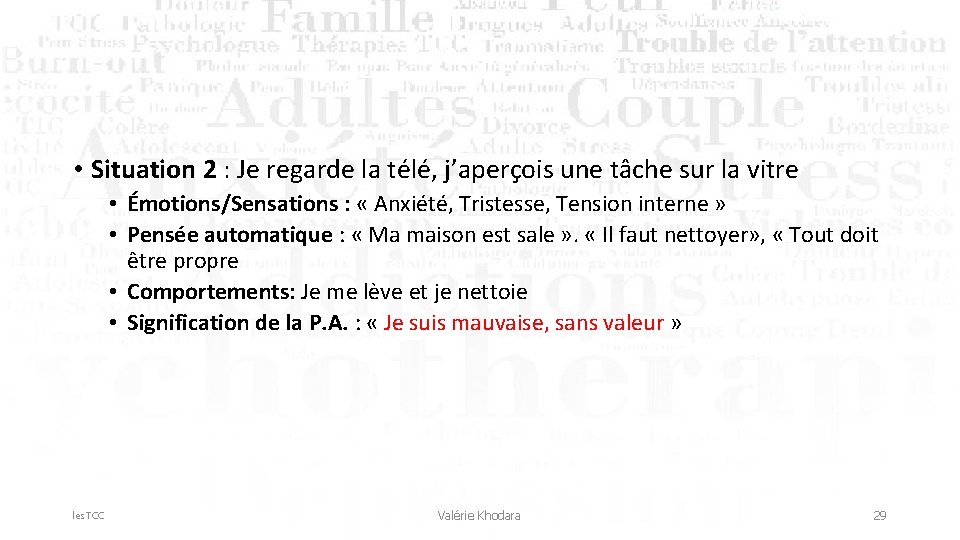
• Situation 2 : Je regarde la télé, j’aperçois une tâche sur la vitre • Émotions/Sensations : « Anxiété, Tristesse, Tension interne » • Pensée automatique : « Ma maison est sale » . « Il faut nettoyer» , « Tout doit être propre • Comportements: Je me lève et je nettoie • Signification de la P. A. : « Je suis mauvaise, sans valeur » les. TCC Valérie Khodara 29
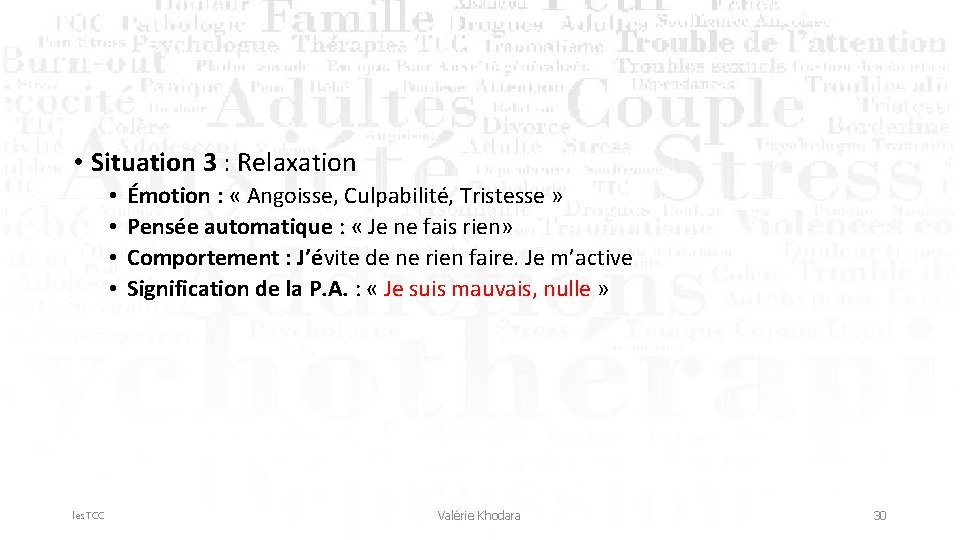
• Situation 3 : Relaxation • • les. TCC Émotion : « Angoisse, Culpabilité, Tristesse » Pensée automatique : « Je ne fais rien» Comportement : J’évite de ne rien faire. Je m’active Signification de la P. A. : « Je suis mauvais, nulle » Valérie Khodara 30
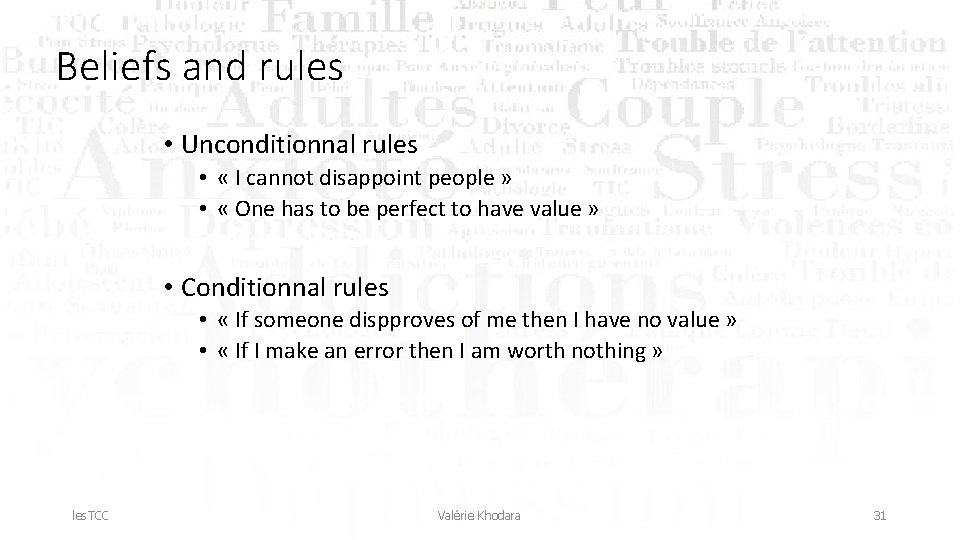
Beliefs and rules • Unconditionnal rules • « I cannot disappoint people » • « One has to be perfect to have value » • Conditionnal rules • « If someone dispproves of me then I have no value » • « If I make an error then I am worth nothing » les. TCC Valérie Khodara 31
Where do come from these rules and beliefs? les. TCC Valérie Khodara 32
Personal history analysis • Eléments diachroniques • Père exigeant, mère effacée • Mme K était punie si les résultats scolaires n’étaient pas excellents: son père exigeait qu’elle soit la première de la classe • Punitions physique • Privations (enfermée dans le placard), privée de loisirs les. TCC Valérie Khodara 33
Groups • Think of a recent situation or event which resulted in a negative mood shift • Anxiety • Sadness • Anger • Groups: therapist / client / observer • Identify: • thoughts / feelings / behaviours les. TCC Valérie Khodara Nimes University- 34
• Identify a recent significant shift in mood (emotion) • What was the situation? • How did you feel? (emotion/physiology) • What was going through your mind at the time? (thoughts) • What did you do? (behaviours) • What were the consequences? les. TCC Valérie Khodara Nimes University- 35
• Examples from the pathological field… les. TCC Valérie Khodara Nimes University- 36
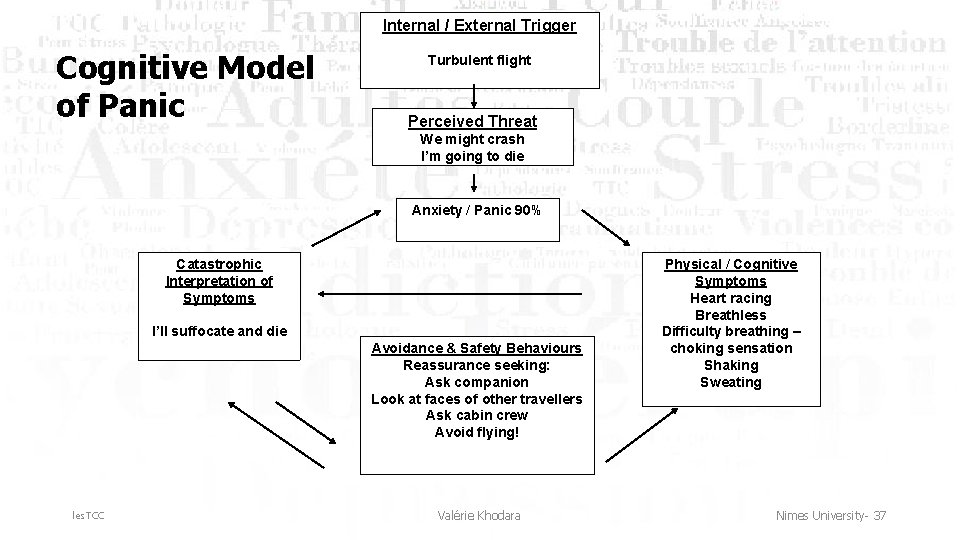
Internal / External Trigger Cognitive Model of Panic Turbulent flight Perceived Threat We might crash I’m going to die Anxiety / Panic 90% Catastrophic Interpretation of Symptoms I’ll suffocate and die Avoidance & Safety Behaviours Reassurance seeking: Ask companion Look at faces of other travellers Ask cabin crew Avoid flying! les. TCC Valérie Khodara Physical / Cognitive Symptoms Heart racing Breathless Difficulty breathing – choking sensation Shaking Sweating Nimes University- 37
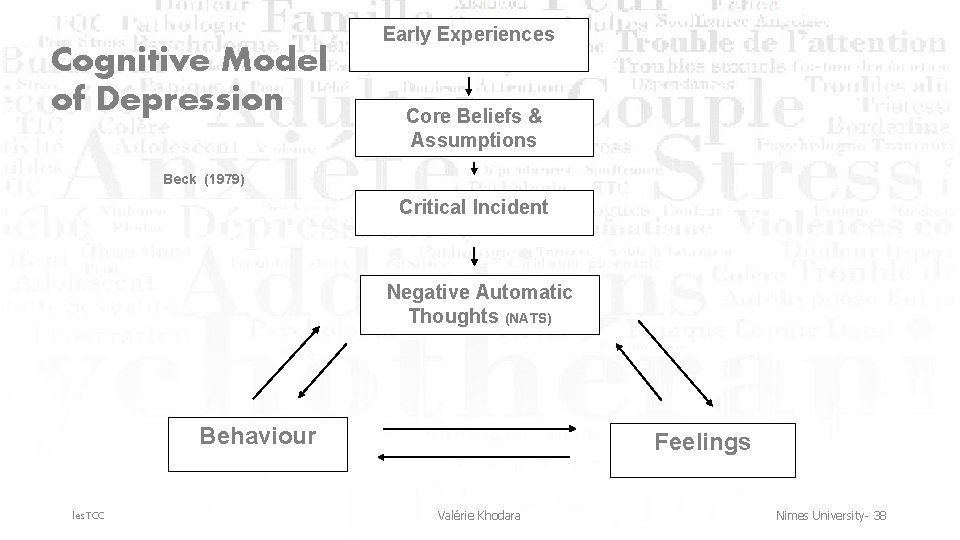
Cognitive Model of Depression les. TCC Early Experiences Core Beliefs & Assumptions Beck (1979) Critical Incident Negative Automatic Thoughts (NATS) Behaviour Feelings Valérie Khodara Nimes University- 38
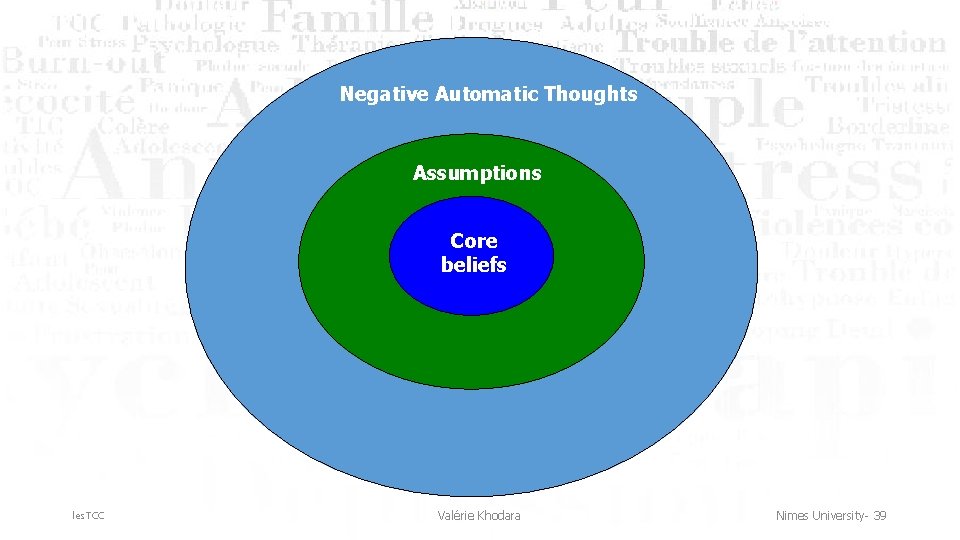
Negative Automatic Thoughts Assumptions Core beliefs les. TCC Valérie Khodara Nimes University- 39
Negative Automatic Thoughts • Stream of thoughts that we can notice if we try to pay attention to them (automatic) • Negatively tinged appraisals or interpretations – meanings we take from what happens around us or within us • Specific thoughts about specific events or situations • Brief, frequent, habitual – often not heard • Plausible and taken as obviously true, especially when emotions are strong les. TCC Valérie Khodara Nimes University- 40
Identifying NATs • Shifts in Affect • Distinguish between thoughts and emotion and behaviour • Check for images les. TCC Valérie Khodara Nimes University- 41
Cognitive Model of Depression The Negative cognitive Triad A biased view of : • Oneself • I am bad, useless, unlovable, worthless, a failure • The world in general • Nothing good happens, life is just a series of trials • The future • It will always be like this, nothing I can do will make any difference, what’s the point of anything? les. TCC Valérie Khodara Nimes University- 42
Negative filters • Remembering events • Interpreting current events / situations • Overgeneralising from small negative event to broad negative conclusion les. TCC Valérie Khodara Nimes University- 43
Goals of therapy • Help the client counteract negative cognitive biases, and develop more balanced view of herself, the world, and the future • Restore activity levels – especially those that give sense of pleasure or achievement • Increase active engagement and problem solving les. TCC Valérie Khodara Nimes University- 44
Course of treatment Practically, we will: • Identify specific problem list (& prioritise) • Eg. Poor sleep, relationship difficulties etc • Introduce cognitive model – how it might apply to client • Goals • Reduce symptoms through behavioural, cognitive strategies and emotional technics • Identify and challenge NATs • Relapse prevention les. TCC Valérie Khodara Nimes University- 45
Phases of a typical course of therapy • Assessment, Formulation • Treatment: start with symptom focused intervention • Review: every six sessions, repeat measures • Discharge: repeat measures, relapse prevention • Follow up / booster sessions: les. TCC • 1, 3, 6, 12 month ? Valérie Khodara Nimes University- 46
Typical CBT treatment session • Set collaborative agenda • Review time since last session • Feedback on last session • Review homework • Focus on major topics for the session • Set homework • Potential problems with completing homework • Feedback on session les. TCC Valérie Khodara Nimes University- 47
Therapy Skills • Engagement • Warmth and empathy • Collaboration • Guided discovery – Socratic questioning • Feedback and summarising • Agenda setting – structure and focus • Open and closed questioning les. TCC Valérie Khodara Nimes University- 48
Aims of Assessment • Initiate & develop therapeutic relationship • Establish suitability for CBT • Gather specific information recurrent difficulties • Elicit maintaining factors • Initial formulation • Socialise to CBT model • Establish joint understanding of the presenting problem les. TCC Valérie Khodara Nimes University- 49
Suitability for short term CBT • Ability to identify & describe negative thoughts • Awareness & differentiation of emotion • Compatibility with CBT rationale • Acceptance of personal responsibility for change • Alliance potential • Chronicity of problem • Optimism/pessimism regarding therapy les. TCC Valérie Khodara Nimes University- 50
Homework • Identify a recent significant shift in mood • What was the situation? • How did you feel? • What was going through your mind at the time? • What did you do? • What were the consequences? les. TCC Valérie Khodara Nimes University- 51
Why Measures? The concept of measures is central to the CBT approach: • Assessment – to provide information • Baseline – subsequent measures will show extent of change • Effectiveness – helps to (objectively) demonstrate effectiveness of therapy, and allow modification of treatment • Feedback • Knowledge - data collection & suggests areas for les. TCC Valérie Khodara Nimes University- 52
What measures? • Standardised – developed for particular populations and problems • Eg. Beck Depression Inventory • Beck Anxiety Inventory • Agoraphobic Cognitions Questionnaire • Individualised – allow for more specific information for assessment and formulation. – Eg. Problem definition, Targets of therapy, Diaries, % Belief Ratings, Ratings of specific emotions les. TCC Valérie Khodara Nimes University- 53
Cognitive Interventions • Restructuring thoughts and beliefs • Guided discovery • Thought diaries • Challenging NATs (looking at evidence) • Addressing thinking errors • Responsibility Pie • Cost/Benefit Analysis • Downward Arrow technique les. TCC Valérie Khodara Nimes University- 54
Cognitive Interventions • Education Eg. Written information on thinking errors, disorder specific info • Continuous use of formulation • Imagery techniques • Role play & role reversal • Action Plan • Education in Body systems (symptoms) les. TCC Valérie Khodara Nimes University- 55
Behavioural Interventions • Very powerful method of bringing about change • Key component of CBT intervention • Borrowed and adapted from Behaviour Therapy • Incorporate different methodological approaches les. TCC Valérie Khodara Nimes University- 56
Examples • Hyperventilation to simulate panic • Activity monitoring and scheduling • Metaphors – South American tribe: • Consider experiment for client with OCD who believes something terrible will happen to his family if he doesn’t neutralise his thoughts by doing rituals for up to an hour les. TCC Valérie Khodara Nimes University- 57
Problem solving • Identify problem to be worked on • Think of as many solutions as possible • Consider each solution – pros & cons • Pick solution that appears best • Small steps • Action & review les. TCC Valérie Khodara Nimes University- 58
Emotionnal Interventions • Relaxation • Mindfulness • Exposure to emotions • Music les. TCC Valérie Khodara Nimes University- 59
Relapse Prevention • What have I learned? • What was most useful? • What can I continue to do? • When will I be at risk of this happening again? • What are the signs? • What could I do to avoid losing control? • What could I do if I did lose control? les. TCC Valérie Khodara Nimes University- 60
Coping with Relapse • How can I make sense of this lapse? • What have I learnt from it? • With hindsight, what would I do differently? les. TCC Valérie Khodara Nimes University- 61
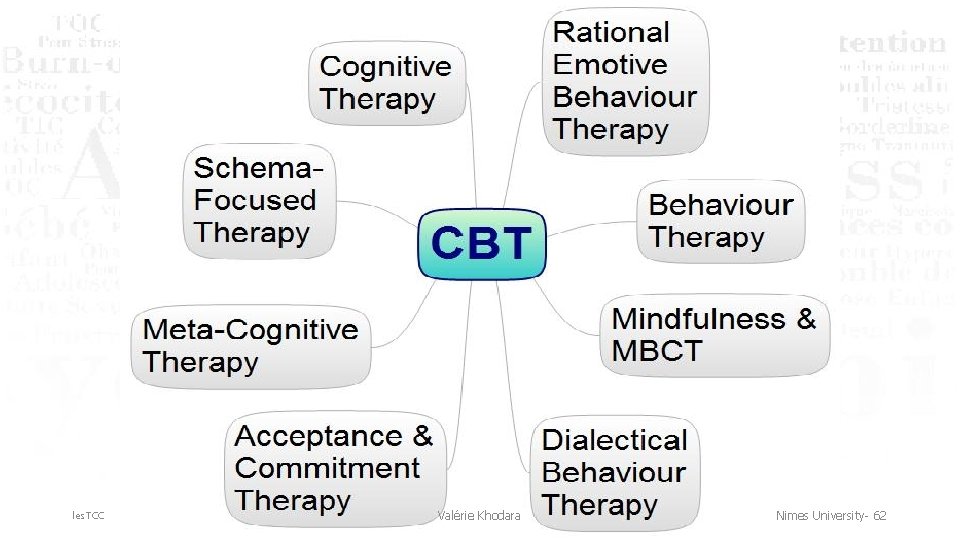
les. TCC Valérie Khodara Nimes University- 62
Conclusion • This presentation just gave you an introduction to the rationale of CBT Thank you for your attention les. TCC Valérie Khodara Nimes University- 63
- Slides: 60