
INTRODUCTION TO CODING MORBIDITY AND MORTALITY BY USING
INTRODUCTION TO CODING MORBIDITY AND MORTALITY BY USING I. C. D VERSION 10

Presentation outline üIntroduction to ICD 10 üEvolution of ICD üMobile Apps üICD 10 code structure and format üBenefits of transition to ICD 10 üCompare and contrast ICD 9&10 üRules, guidelines and standards for coding ü New concepts in ICD 10 Prepared by Dr. Shahzmah Facilitated by NHIF-Tanzania
Acknowledgements • NHIF Tanzania • Bugando Medical Centre • NHIF Facilitator • Dr. Gwamaka Edward - NHIF Prepared by Dr. Shahzmah Facilitated by NHIF-Tanzania
INTRODUCTION TO ICD Ø ICD = International Statistical Classification of Diseases Ø ICD 10 = 10 th review Ø Is a system of coding of diseases, symptoms, signs, laboratory findings, complaints, social circumstances & external causes of injuries or illness Prepared by Dr. Shahzmah Facilitated by NHIF-Tanzania
ICD EVOLUTION • Versions of ICD as endorsed by W. H. O q ICD-6 – 1949 q ICD-7 – 1955 q ICD-8 – 1965 q ICD-9 – 1975 q ICD-10 – 1990 ratified by W. H. O q ICD-11 – Not yet released. Prepared by Dr. Shahzmah Facilitated by NHIF-Tanzania
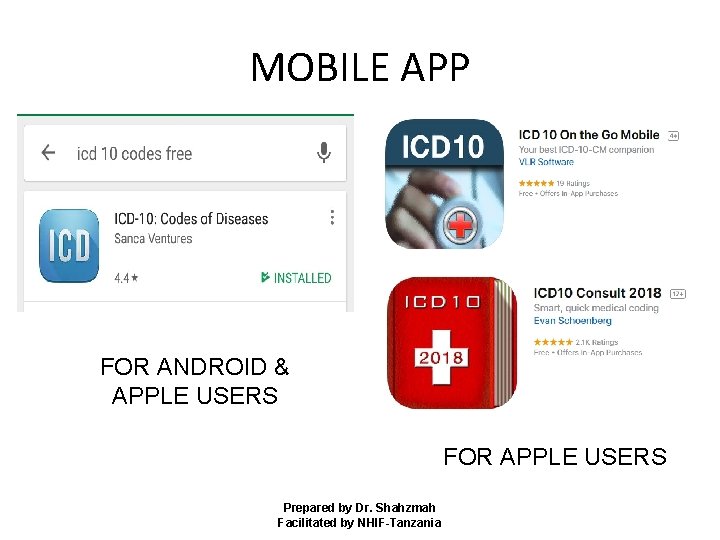
MOBILE APP FOR ANDROID & APPLE USERS FOR APPLE USERS Prepared by Dr. Shahzmah Facilitated by NHIF-Tanzania
WHY ICD? Ø Disease classification according to set criteria Ø Enables data storage and information retrieval Ø Enables compilation of National and International mortality and morbidity statistics Ø Used in reimbursement systems Prepared by Dr. Shahzmah Facilitated by NHIF-Tanzania
TRANSITION FROM ICD 9 TO ICD 10 v. NHIF is migrating in order to keep up with the changes occurring worldwide and so is BMC. v. Benefits of using ICD 10: v. Measures quality, efficacy & safety of care v. Conducting research, trials and studies v. Maintaining uniformity in disease coding v. Preventing and detecting healthcare frauds v. Designing payments system and processing claims for reimbursement. Prepared by Dr. Shahzmah Facilitated by NHIF-Tanzania
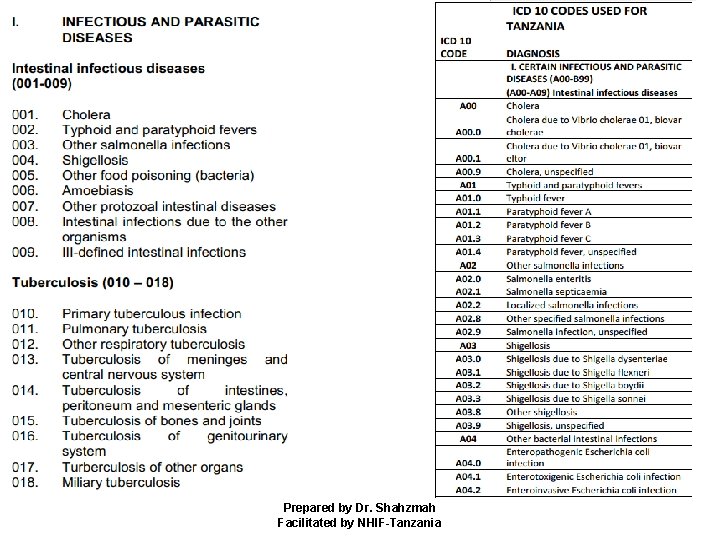
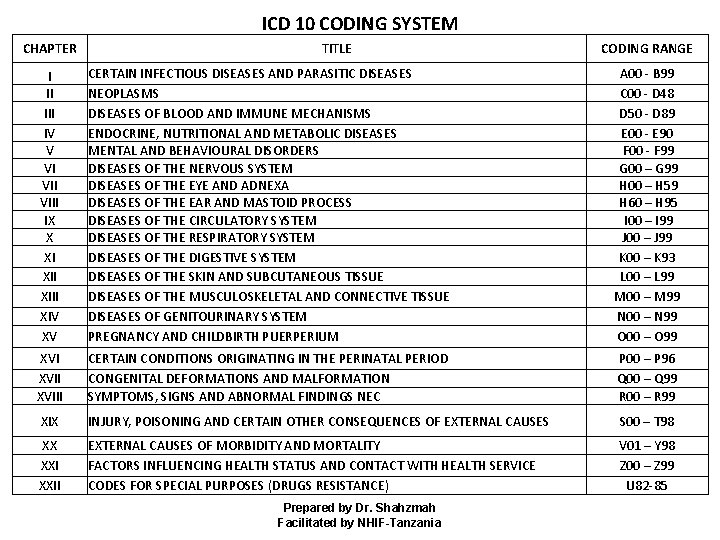
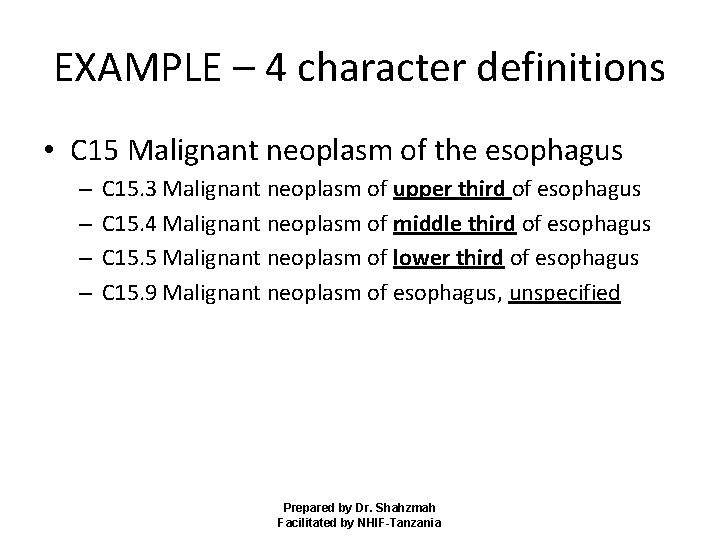
FORMAT & STRUCTURE - ICD • Chapters • Three character blocks • Fourth character further define Site, Etiology, Manifestation and State of the disease or condition • ICD-10 -Tz has 3 to 4 Characters – alphanumeric Prepared by Dr. Shahzmah Facilitated by NHIF-Tanzania
Prepared by Dr. Shahzmah Facilitated by NHIF-Tanzania
ICD-9 -NHIF Comparison to ICD-10 -NHIF Prepared by Dr. Shahzmah Facilitated by NHIF-Tanzania
ICD 10 CODING SYSTEM CHAPTER TITLE CODING RANGE I II III IV V VI VIII IX X XI XIII XIV XV CERTAIN INFECTIOUS DISEASES AND PARASITIC DISEASES NEOPLASMS DISEASES OF BLOOD AND IMMUNE MECHANISMS ENDOCRINE, NUTRITIONAL AND METABOLIC DISEASES MENTAL AND BEHAVIOURAL DISORDERS DISEASES OF THE NERVOUS SYSTEM DISEASES OF THE EYE AND ADNEXA DISEASES OF THE EAR AND MASTOID PROCESS DISEASES OF THE CIRCULATORY SYSTEM DISEASES OF THE RESPIRATORY SYSTEM DISEASES OF THE DIGESTIVE SYSTEM DISEASES OF THE SKIN AND SUBCUTANEOUS TISSUE DISEASES OF THE MUSCULOSKELETAL AND CONNECTIVE TISSUE DISEASES OF GENITOURINARY SYSTEM PREGNANCY AND CHILDBIRTH PUERPERIUM A 00 - B 99 C 00 - D 48 D 50 - D 89 E 00 - E 90 F 00 - F 99 G 00 – G 99 H 00 – H 59 H 60 – H 95 I 00 – I 99 J 00 – J 99 K 00 – K 93 L 00 – L 99 M 00 – M 99 N 00 – N 99 O 00 – O 99 XVIII CERTAIN CONDITIONS ORIGINATING IN THE PERINATAL PERIOD CONGENITAL DEFORMATIONS AND MALFORMATION SYMPTOMS, SIGNS AND ABNORMAL FINDINGS NEC P 00 – P 96 Q 00 – Q 99 R 00 – R 99 XIX INJURY, POISONING AND CERTAIN OTHER CONSEQUENCES OF EXTERNAL CAUSES S 00 – T 98 XX XXII EXTERNAL CAUSES OF MORBIDITY AND MORTALITY FACTORS INFLUENCING HEALTH STATUS AND CONTACT WITH HEALTH SERVICE CODES FOR SPECIAL PURPOSES (DRUGS RESISTANCE) V 01 – Y 98 Z 00 – Z 99 U 82 -85 Prepared by Dr. Shahzmah Facilitated by NHIF-Tanzania

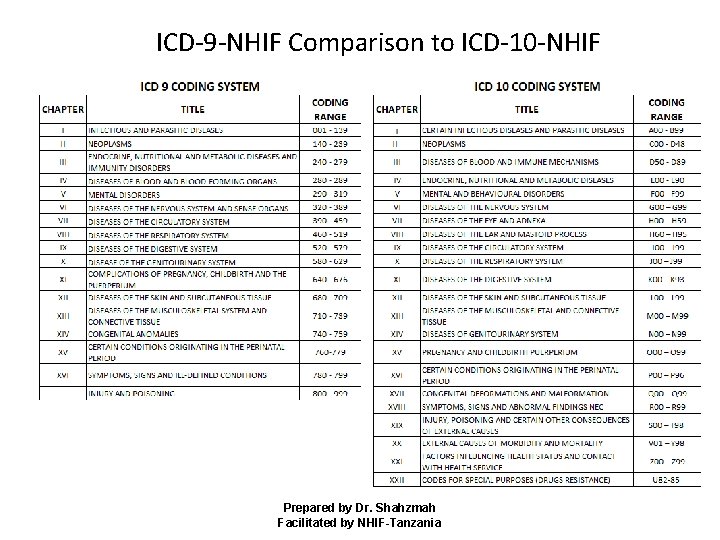
IN COMPARISON ICD 9 AND 10 CODE STRUCTURE ICD 9 ICD 10 Diagnosis structure 3 characters only taken in Tz (but full codes up to 5 th) Diagnosis structure 4 characters adopted in Tz (but full codes up to 7 th character) All codes are numeric e. g 084 / 250 / 999 All codes have both alphabetical and numeric characters e. g B 50. 8 digit 1 is alpha, 2 -4 are numeric Number of codes 999 -for Tanzania (Approximately 12, 000 for full codes book) Number 14, 400 for Tanzania ( About 71, 000 codes book) No location specificity can be provided Allows for higher specificity such as location e. g disease of ovary R/L or unspecified First character is numeric 1 stcharacter is alpha, 2 nd one is numeric then 3 rd to 7 thcharacter can be alpha numeric Printed in two volumes Printed in three volumes Does not allow laterality Allows laterality Prepared by Dr. Shahzmah Facilitated by NHIF-Tanzania
EXAMPLE – 4 character definitions • C 15 Malignant neoplasm of the esophagus – – C 15. 3 Malignant neoplasm of upper third of esophagus C 15. 4 Malignant neoplasm of middle third of esophagus C 15. 5 Malignant neoplasm of lower third of esophagus C 15. 9 Malignant neoplasm of esophagus, unspecified Prepared by Dr. Shahzmah Facilitated by NHIF-Tanzania

1. LOCATING A CODE IN ICD-10 • Look for diagnosis (Lead term/key words) in the record e. g. Asthma, uremia (noun for diseases, injuries) and Cancerous, bilious, carious tooth (adj. ) • Refer tabular list (chapters / alphabetical index). • Read and be guided by blocks or categories or subcategories. • Verify the suitability of the code selected • Assign the code. For example B 54 is code for unspecified Malaria. Prepared by Dr. Shahzmah Facilitated by NHIF-Tanzania
2. LEVEL OF DETAIL IN CODING • Diagnosis codes are to be used and reported at their higher number of characters available. • ICD-10 diagnosis codes are composed of codes with 3 or 4 characters as per ICD 10 codes used in Tanzania. • Codes with three characters are included in ICD-10 as the heading of a category of codes that may be further subdivided by the use of fourth character which provide greater detail Prepared by Dr. Shahzmah Facilitated by NHIF-Tanzania
3. CODE OR CODES FROM A 00. 0 THROUGH T 88. 9, Z 00 Z 99. 8 • The appropriate code or codes from A 00. 0 through T 88. 9, Z 00 -Z 99. 8 must be used to identify diagnoses, symptoms, conditions, problems, complaints or other reason(s) for the encounter/visit. Prepared by Dr. Shahzmah Facilitated by NHIF-Tanzania
4. SIGNS AND SYMPTOMS • In cases where a particular diagnosis is not established, it is ok to use signs and symptoms (Chapter XVIII, R 00 -R 99) • Each healthcare encounter should be coded to the level of certainty known for that encounter. Prepared by Dr. Shahzmah Facilitated by NHIF-Tanzania
5. ENCOUNTERS FOR CIRCUMSTANCES OTHER THAN A DISEASE OR INJURY • ICD-10 provides codes to deal with encounters for circumstances other than a disease or injury. • The Factors Influencing Health Status and Contact with Health Services codes (Z 00 -Z 99) are provided to deal with occasions when circumstances other than a disease or injury are recorded as diagnosis or problems. Prepared by Dr. Shahzmah Facilitated by NHIF-Tanzania

Coding Rules Most rules are the same in ICD 9 as well as in ICD 10: v Same – Abbreviations NOS eg J 22 v Same acronym- NEC eg J 16 v Same – other and unspecified codes & disease classified elsewhere v Same – most of coding principles & rules Prepared by Dr. Shahzmah Facilitated by NHIF-Tanzania

MULTIPLE CODING v Code all documented conditions that coexist: at the time of the encounter/visit, and require or affect patient care treatment or management or work up. v Do not code conditions that were previously treated and no longer exist. However, history codes (categories Z 80 -Z 87) may be coded. v When coding from chapter XIX, use an external cause code (chapter XX) in addition to codes from chapter XIX (pdx: T 01 sdx: V 01) Prepared by Dr. Shahzmah Facilitated by NHIF-Tanzania
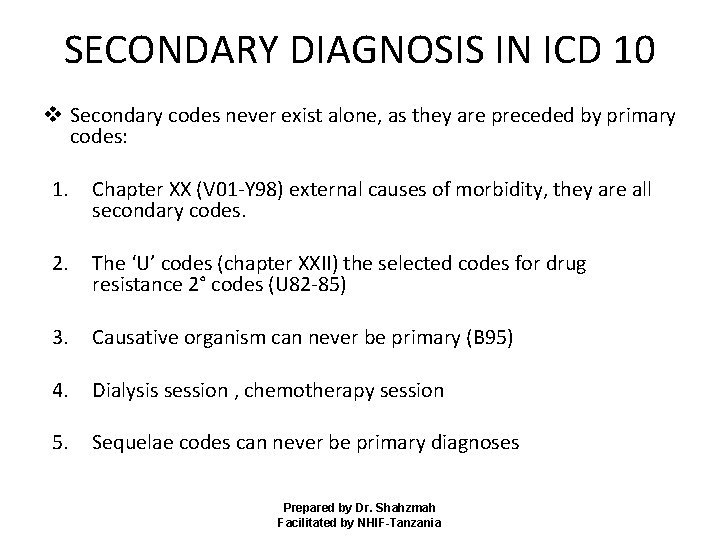
SECONDARY DIAGNOSIS IN ICD 10 v Secondary codes never exist alone, as they are preceded by primary codes: 1. Chapter XX (V 01 -Y 98) external causes of morbidity, they are all secondary codes. 2. The ‘U’ codes (chapter XXII) the selected codes for drug resistance 2° codes (U 82 -85) 3. Causative organism can never be primary (B 95) 4. Dialysis session , chemotherapy session 5. Sequelae codes can never be primary diagnoses Prepared by Dr. Shahzmah Facilitated by NHIF-Tanzania
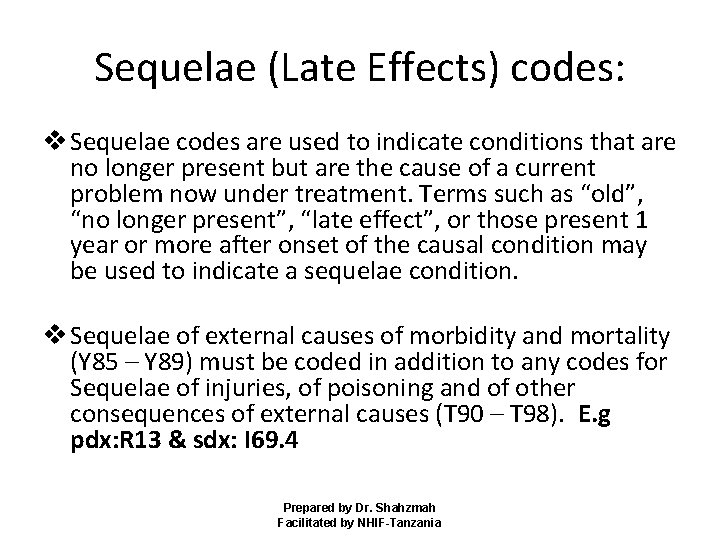
Sequelae (Late Effects) codes: v Sequelae codes are used to indicate conditions that are no longer present but are the cause of a current problem now under treatment. Terms such as “old”, “no longer present”, “late effect”, or those present 1 year or more after onset of the causal condition may be used to indicate a sequelae condition. v Sequelae of external causes of morbidity and mortality (Y 85 – Y 89) must be coded in addition to any codes for Sequelae of injuries, of poisoning and of other consequences of external causes (T 90 – T 98). E. g pdx: R 13 & sdx: I 69. 4 Prepared by Dr. Shahzmah Facilitated by NHIF-Tanzania
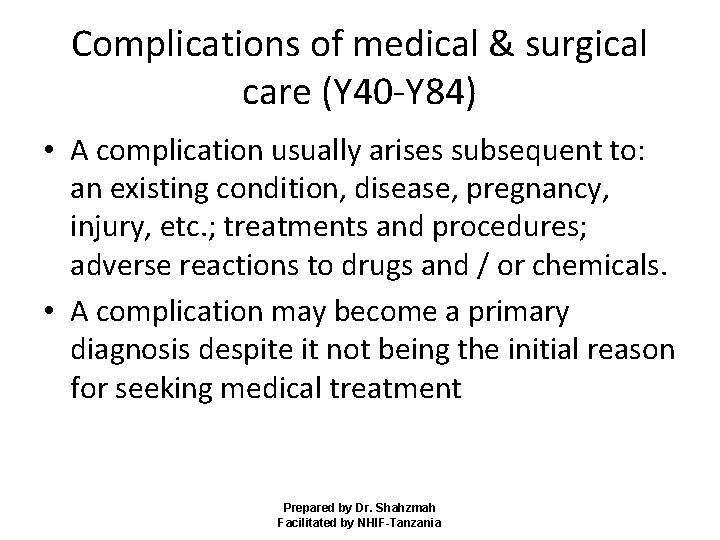
Complications of medical & surgical care (Y 40 -Y 84) • A complication usually arises subsequent to: an existing condition, disease, pregnancy, injury, etc. ; treatments and procedures; adverse reactions to drugs and / or chemicals. • A complication may become a primary diagnosis despite it not being the initial reason for seeking medical treatment Prepared by Dr. Shahzmah Facilitated by NHIF-Tanzania
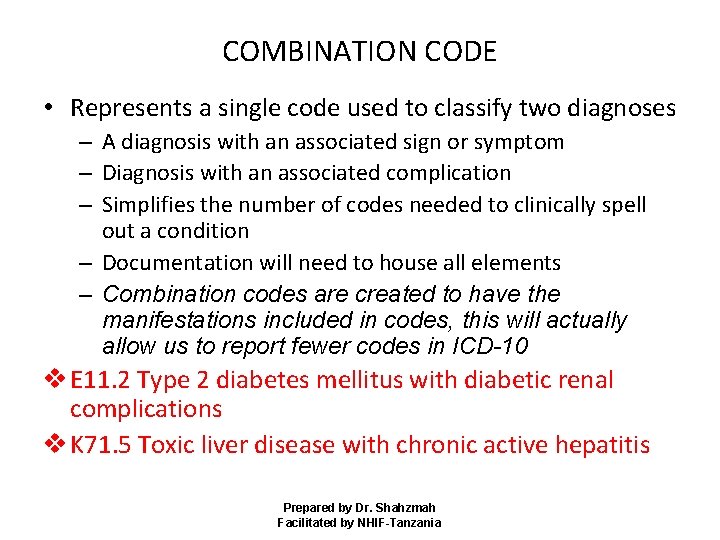
COMBINATION CODE • Represents a single code used to classify two diagnoses – A diagnosis with an associated sign or symptom – Diagnosis with an associated complication – Simplifies the number of codes needed to clinically spell out a condition – Documentation will need to house all elements – Combination codes are created to have the manifestations included in codes, this will actually allow us to report fewer codes in ICD-10 v E 11. 2 Type 2 diabetes mellitus with diabetic renal complications v K 71. 5 Toxic liver disease with chronic active hepatitis Prepared by Dr. Shahzmah Facilitated by NHIF-Tanzania
CONVENTIONS USED IN ICD 10 • • • NOS- Not Otherwise Specified – J 22 ‘’Unspecified ‘’ codes NEC – Not Elsewhere Classified - J 16 ‘’Other ‘’ codes Clinicians may be ICD-10 compliant, but if they abuse the “other” or “unspecified” codes, payment will not occur if a more specific alternative exists. ” • It is felt that “bad coding habits” should not be encouraged and that correct, appropriate coding should be stressed upfront. Prepared by Dr. Shahzmah Facilitated by NHIF-Tanzania
Special ‘’U’’ Codes • There are codes from (U 80 – U 89) indicate resistance to antimicrobial, antiviral, antifungal and antineoplastic drugs. • These codes (categories) should never be used in primary coding as they are secondary • The codes are provided for use as supplementary or additional codes when it is desired to identify the resistance, non-responsiveness and refractive properties of a condition to antimicrobials and antineoplastic drugs. Prepared by Dr. Shahzmah Facilitated by NHIF-Tanzania
ROUTINE ANC v. Routine outpatient prenatal visits: v Routine outpatient prenatal visit see codes Z 34, 35, Z 36 Prepared by Dr. Shahzmah Facilitated by NHIF-Tanzania
EXAMPLES Case 1: A patient is found to have two distinct malignant tumors in his right lung– one in his right lower lobe and one in his right upper lobe. ICD-10 codes: – C 34. 3 Malignant neoplasm of lower lobe, bronchus or lung – C 34. 1 Malignant neoplasm of upper lobe, bronchus or lung Prepared by Dr. Shahzmah Facilitated by NHIF-Tanzania
CHAPTER XV - OBSTETRICS Case 2: A pregnant patient presents to the office for a visit. She is 19 weeks, 3 days, and is diagnosed with a bladder infection caused by E. coli. The doctor told the patient to drink more water and prescribes cephalexin. She is to return in 10 days for a recheck. ICD-10 codes: – O 23. 1 Infections of bladder in pregnancy – B 96. 2 Escherichia coli (E. coli) as the cause of diseases classified elsewhere Prepared by Dr. Shahzmah Facilitated by NHIF-Tanzania
FRACTURES – chapter XIX v CASE 3: A 14 year-old boy is at a movie theater and running in a parking lot when he was hit by a car. He was diagnosed with a non-displaced fracture of the medial condyle of the lower end of the left femur. The leg was placed in a long leg splint and no further intervention was required v ICD-10 code: – S 72. 4 fracture of lower end of femur v Note: Additional V, W, X, Y codes are reported to indicate the circumstances surrounding the injury. There would be external cause codes to complete the coding scenarios v (NB: CHAPTER XX, COMPOSE 34 -36% OF ALL ICD 10 CODES) Prepared by Dr. Shahzmah Facilitated by NHIF-Tanzania
Factors influencing health status and contact with health services (Z 00 - Z 99). v This chapter Categories Z 00 -Z 99 are provided for occasions when circumstances other than a disease, injury or external cause classifiable to categories A 00 - Y 89 are recorded as "diagnoses" or "problems". Prepared by Dr. Shahzmah Facilitated by NHIF-Tanzania
special purposes codes - XXII Codes for special purpose: they are for WHO (U 00 -U 85) use v This chapter contains the following blocks: v U 00 -U 49 are to be used by WHO for the provisional assignment of new diseases of uncertain etiology e. g xeno strains EBOLA v U 82 -U 85 Resistance to antimicrobial and antineoplastic drugs v “ U” codes are unused with exception of U 82 – U 85 as per Tanzania ICD 10 Codes. Prepared by Dr. Shahzmah Facilitated by NHIF-Tanzania
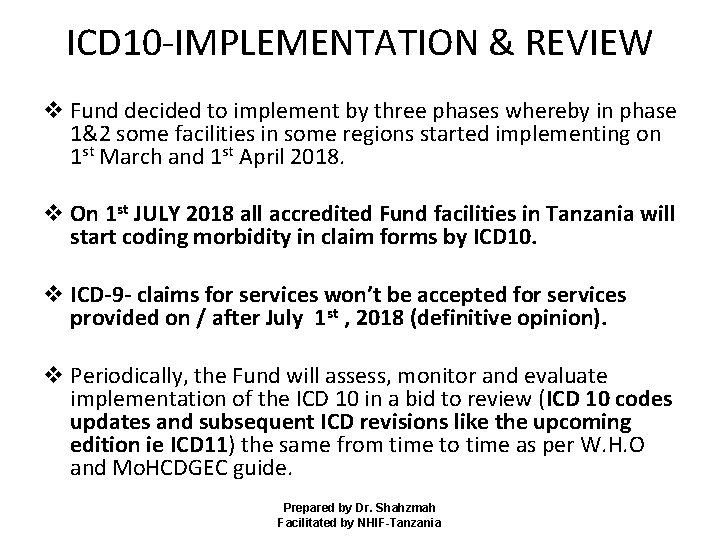
ICD 10 -IMPLEMENTATION & REVIEW v Fund decided to implement by three phases whereby in phase 1&2 some facilities in some regions started implementing on 1 st March and 1 st April 2018. v On 1 st JULY 2018 all accredited Fund facilities in Tanzania will start coding morbidity in claim forms by ICD 10. v ICD-9 - claims for services won’t be accepted for services provided on / after July 1 st , 2018 (definitive opinion). v Periodically, the Fund will assess, monitor and evaluate implementation of the ICD 10 in a bid to review (ICD 10 codes updates and subsequent ICD revisions like the upcoming edition ie ICD 11) the same from time to time as per W. H. O and Mo. HCDGEC guide. Prepared by Dr. Shahzmah Facilitated by NHIF-Tanzania
- Slides: 34