
Introduction to Coal Developed by 2008 2009 TESSE
Introduction to Coal Developed by: 2008 -2009 TESSE Graduate Student Fellows Penn State University
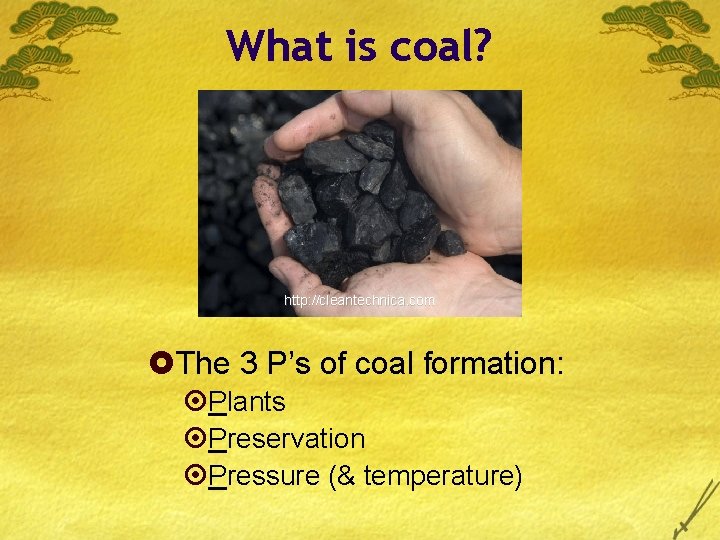
What is coal? http: //cleantechnica. com £The 3 P’s of coal formation: ¤Plants ¤Preservation ¤Pressure (& temperature)
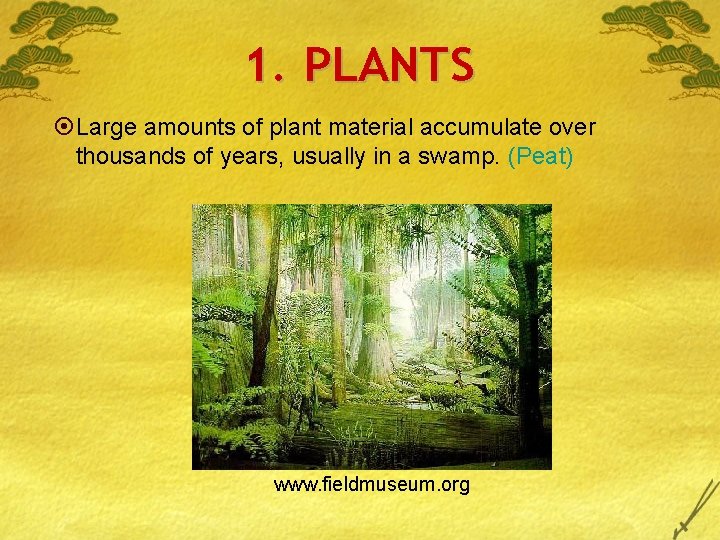
1. PLANTS ¤Large amounts of plant material accumulate over thousands of years, usually in a swamp. (Peat) www. fieldmuseum. org
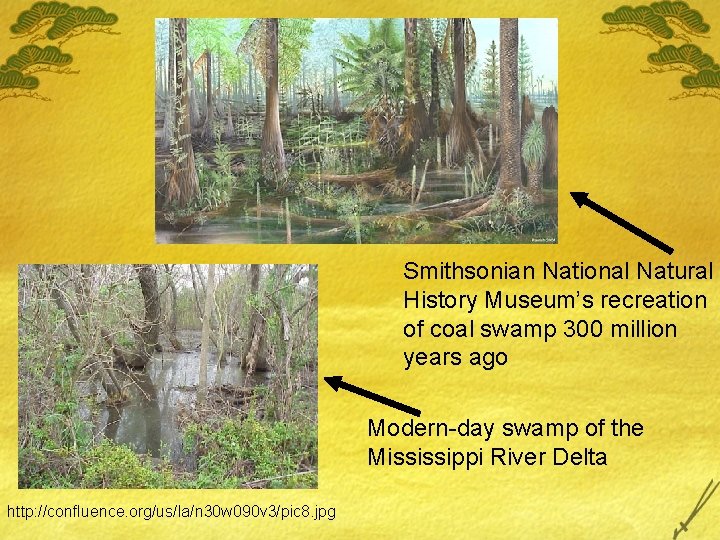
Smithsonian National Natural History Museum’s recreation of coal swamp 300 million years ago Modern-day swamp of the Mississippi River Delta http: //confluence. org/us/la/n 30 w 090 v 3/pic 8. jpg
2. PRESERVATION ¤Dead plant material is very fragile and decays easily in the presence of oxygen. ¤Swamp waters are ideal for preservation ¥stagnant and low in oxygen ¥Organisms that might eat the plants can not live in those conditions ¤Rivers overflow into swamps ¥Bury plant material in sand mud ¤Sea level rises and floods the swamps ¥Covers plant material with marine mud
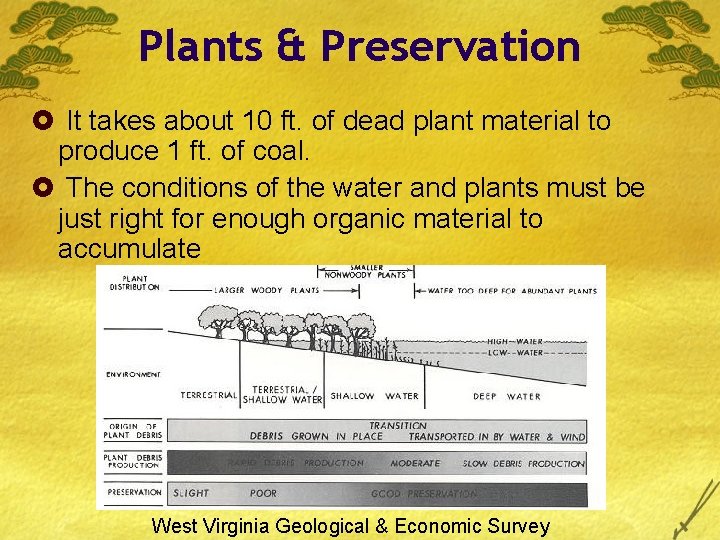
Plants & Preservation £ It takes about 10 ft. of dead plant material to produce 1 ft. of coal. £ The conditions of the water and plants must be just right for enough organic material to accumulate West Virginia Geological & Economic Survey
3. PRESSURE & temperature Coalification: peatfrom becomes £ Dead plant material is How compressed above by coal thick, heavy layers of sediment, slowly turning the deposits to solid rock £ As it is buried deeper below the earth’s surface, pressure and temperature increase, removing moisture and gases, and changing the proportions of the 3 main elements: CARBON, OXYGEN, and HYDROGEN £ Changes are gradual and occur over millions of years
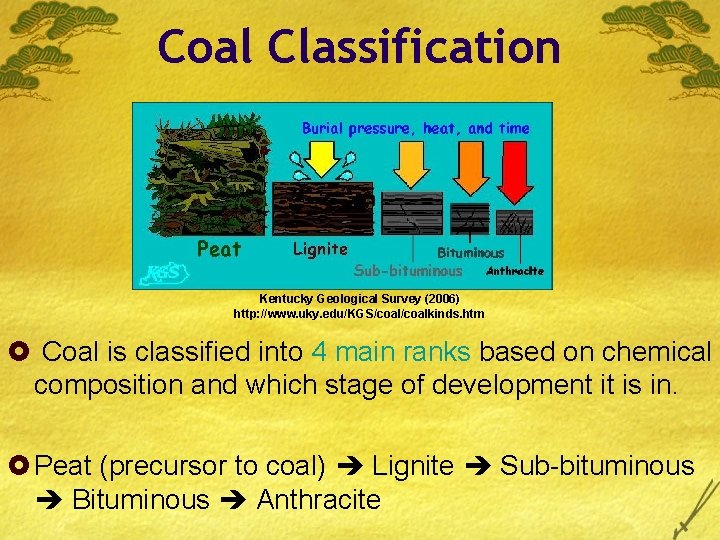
Coal Classification Kentucky Geological Survey (2006) http: //www. uky. edu/KGS/coalkinds. htm £ Coal is classified into 4 main ranks based on chemical composition and which stage of development it is in. £ Peat (precursor to coal) Lignite Sub-bituminous Bituminous Anthracite
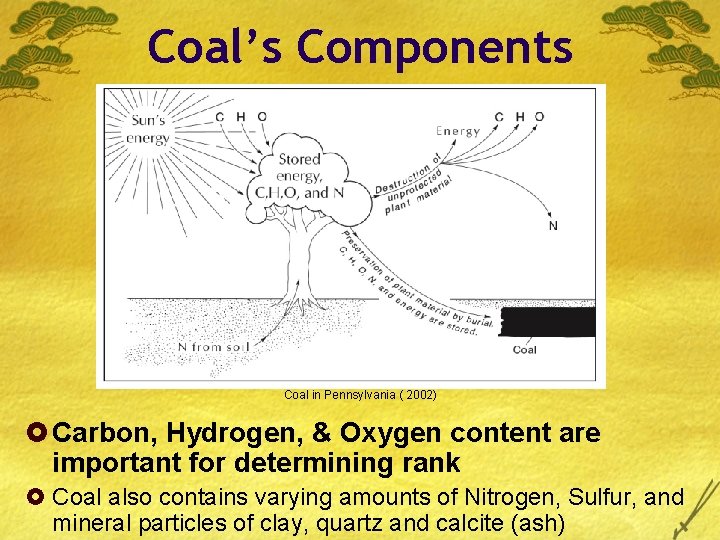
Coal’s Components Coal in Pennsylvania ( 2002) £ Carbon, Hydrogen, & Oxygen content are important for determining rank £ Coal also contains varying amounts of Nitrogen, Sulfur, and mineral particles of clay, quartz and calcite (ash)
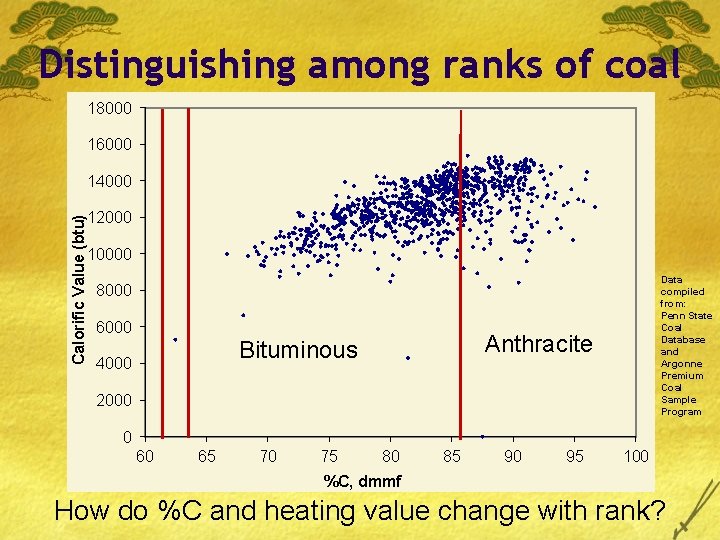
Distinguishing among ranks of coal 18000 16000 Calorific Value (btu) 14000 12000 10000 Data compiled from: Penn State Coal Database and Argonne Premium Coal Sample Program 8000 6000 Anthracite Bituminous 4000 2000 0 60 65 70 75 80 85 90 95 100 %C, dmmf How do %C and heating value change with rank?
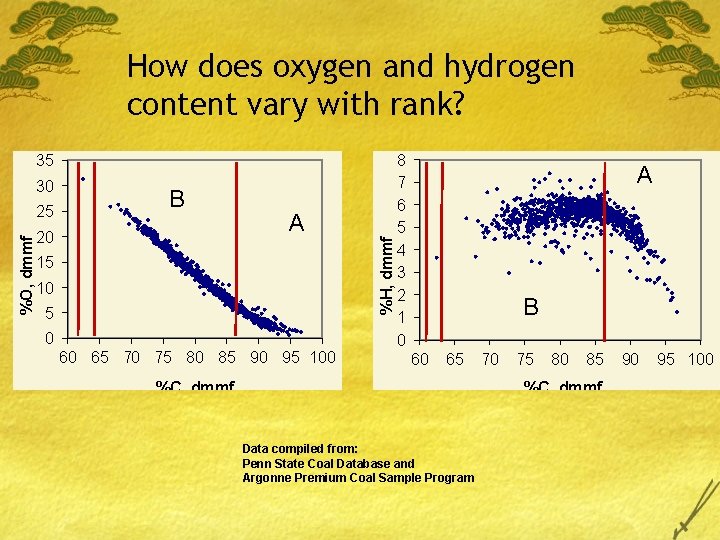
How does oxygen and hydrogen content vary with rank? 35 30 B 20 A %H, dmmf %O, dmmf 25 15 10 5 0 60 65 70 75 80 85 90 95 100 8 7 6 5 4 3 2 1 0 A B 60 65 %C, dmmf 70 75 80 85 %C, dmmf Data compiled from: Penn State Coal Database and Argonne Premium Coal Sample Program 90 95 100
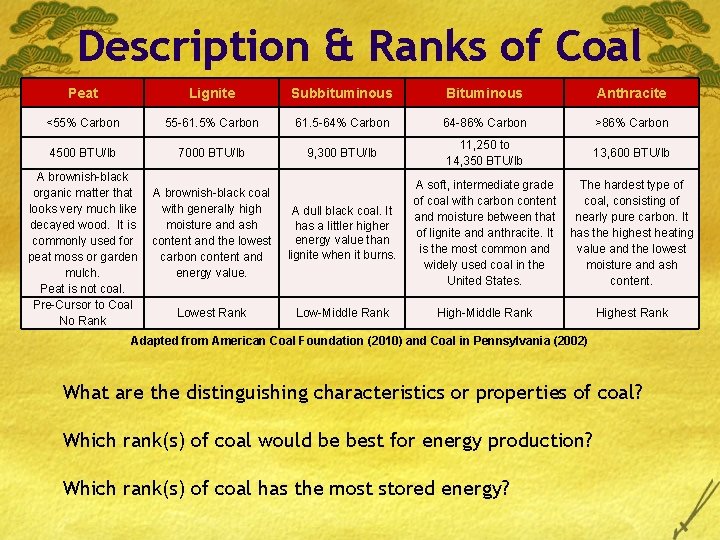
Description & Ranks of Coal Peat Lignite Subbituminous Bituminous Anthracite <55% Carbon 55 -61. 5% Carbon 61. 5 -64% Carbon 64 -86% Carbon >86% Carbon 4500 BTU/lb 7000 BTU/lb 9, 300 BTU/lb 11, 250 to 14, 350 BTU/lb 13, 600 BTU/lb A brownish-black coal with generally high moisture and ash content and the lowest carbon content and energy value. A dull black coal. It has a littler higher energy value than lignite when it burns. A soft, intermediate grade of coal with carbon content and moisture between that of lignite and anthracite. It is the most common and widely used coal in the United States. The hardest type of coal, consisting of nearly pure carbon. It has the highest heating value and the lowest moisture and ash content. Lowest Rank Low-Middle Rank Highest Rank A brownish-black organic matter that looks very much like decayed wood. It is commonly used for peat moss or garden mulch. Peat is not coal. Pre-Cursor to Coal No Rank Adapted from American Coal Foundation (2010) and Coal in Pennsylvania (2002) What are the distinguishing characteristics or properties of coal? Which rank(s) of coal would be best for energy production? Which rank(s) of coal has the most stored energy?
What tests could we perform to identify the different ranks of coal in hand sample?
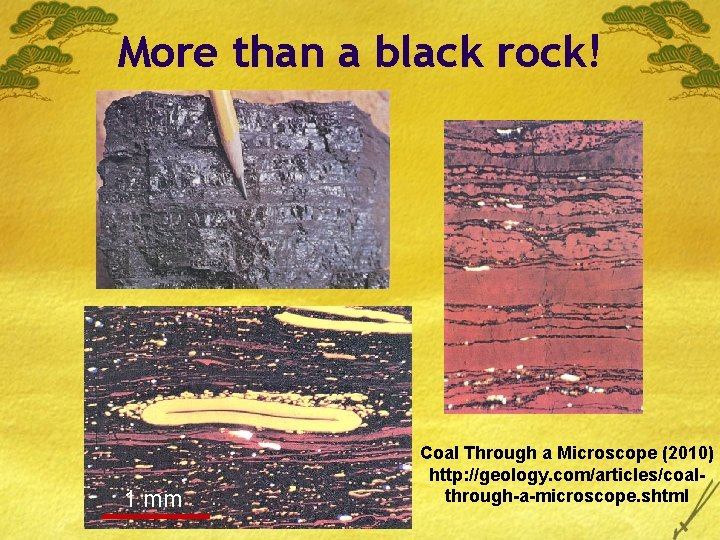
More than a black rock! 1 mm Coal Through a Microscope (2010) http: //geology. com/articles/coalthrough-a-microscope. shtml
Now, you will identify and compare different types of coal. £ You will examine four unidentified types of coal( #1 – 4) ¤Document your visual observations about each sample ¤Document your observations about the burning behavior of each sample ¤Identify each sample based on your observations £ Consult the Descriptions and Ranks of Coal and Peat sheet
- Slides: 15