
Introduction to Cloud Computing Introduction to Cloud Computing
- Slides: 30
Introduction to Cloud Computing
Introduction to Cloud Computing What is a cloud computing? A model for enable ubiquitous, convenient, on-demand network access to a shared pool of configurable computing resources (e. g. , network servers, storage, applications and services) that can be rapidly provisioned and released with minimal management effort or service provider interaction.
Origin and Influences Envisioned as computing utilities for all (similar to water or electricity utilities) Business drivers: Capacity planning - the process of determining and fulfilling future demands of an organization’s IT resources, products, and services. Lead strategy Lag strategy Match strategy Cost reduction – infrastructure-related operating overhead includes Technical personnel, upgrades/patches cost, security and access control measures, administrative/account staffs on-going ownership of technology. Organizational agility - ability to adapt and evolve to successfully face change caused by both internal and external factors.
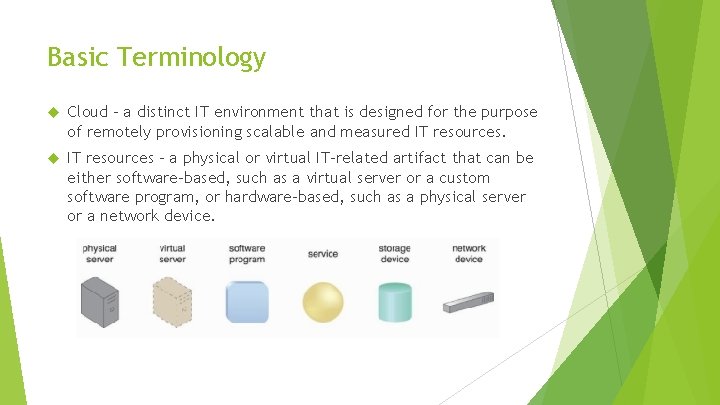
Basic Terminology Cloud - a distinct IT environment that is designed for the purpose of remotely provisioning scalable and measured IT resources - a physical or virtual IT-related artifact that can be either software-based, such as a virtual server or a custom software program, or hardware-based, such as a physical server or a network device.
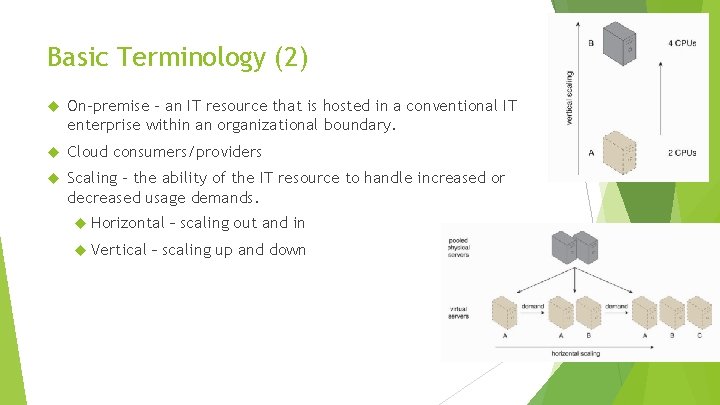
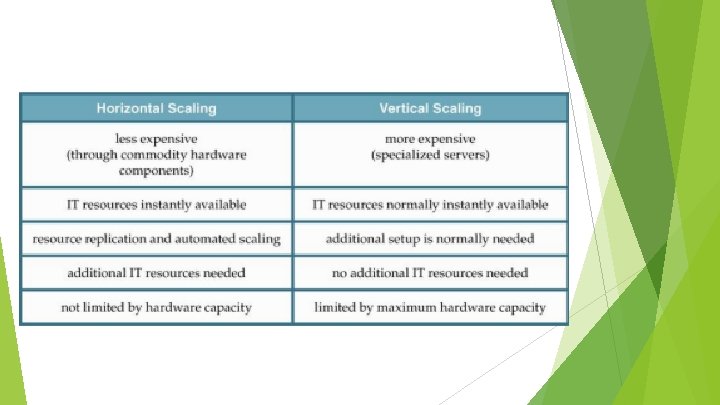
Basic Terminology (2) On-premise - an IT resource that is hosted in a conventional IT enterprise within an organizational boundary. Cloud consumers/providers Scaling - the ability of the IT resource to handle increased or decreased usage demands. Horizontal Vertical – scaling out and in – scaling up and down
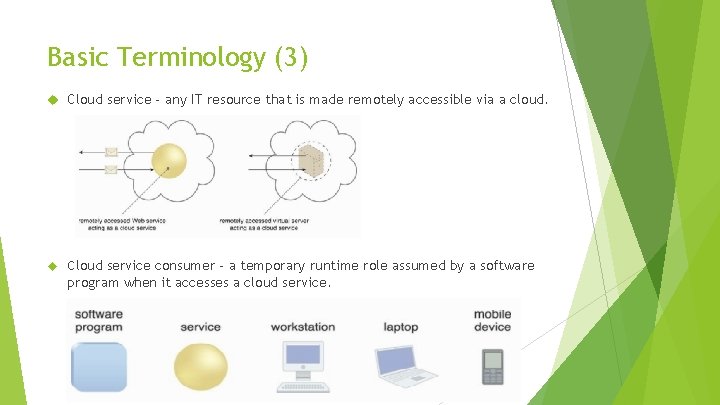
Basic Terminology (3) Cloud service - any IT resource that is made remotely accessible via a cloud. Cloud service consumer - a temporary runtime role assumed by a software program when it accesses a cloud service.
Benefits Reduced investments and proportional costs On demand access to pay-as-you-go The perception of having unlimited computing resources Ability to add/remove IT resources Abstract of IT infrastructure Increased scalability Increased availability and reliability
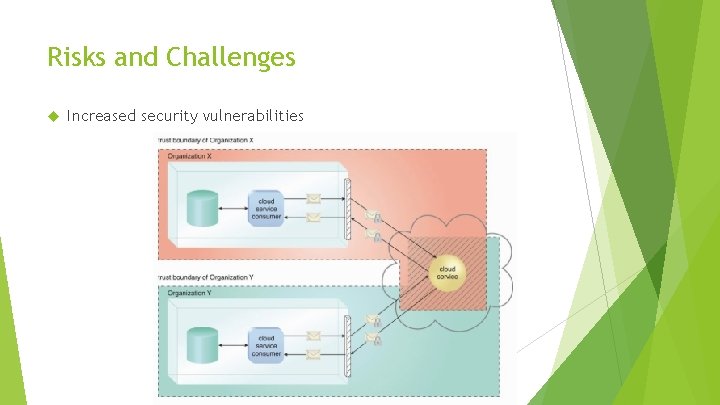
Risks and Challenges Increased security vulnerabilities
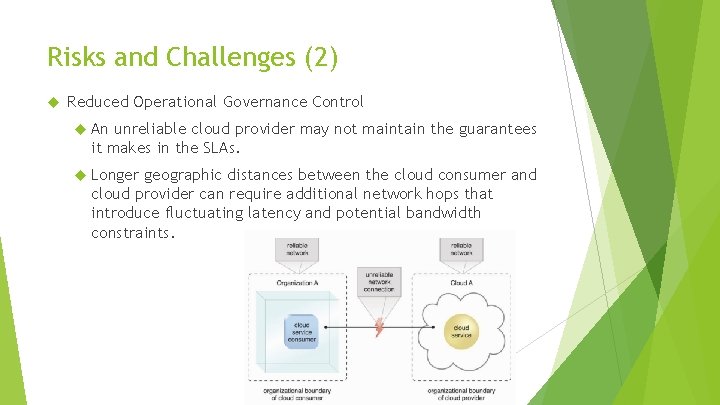
Risks and Challenges (2) Reduced Operational Governance Control An unreliable cloud provider may not maintain the guarantees it makes in the SLAs. Longer geographic distances between the cloud consumer and cloud provider can require additional network hops that introduce fluctuating latency and potential bandwidth constraints.
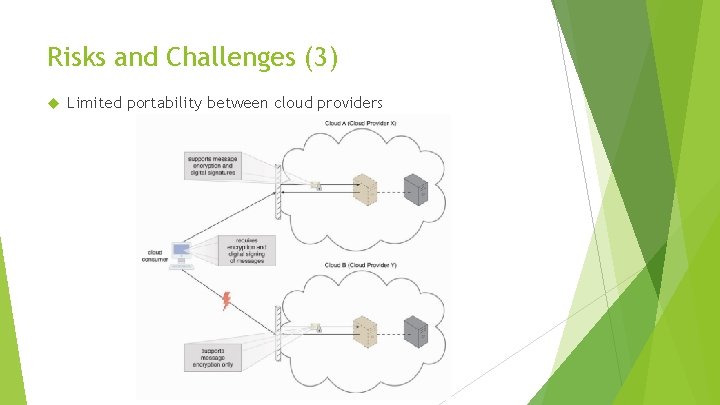
Risks and Challenges (3) Limited portability between cloud providers
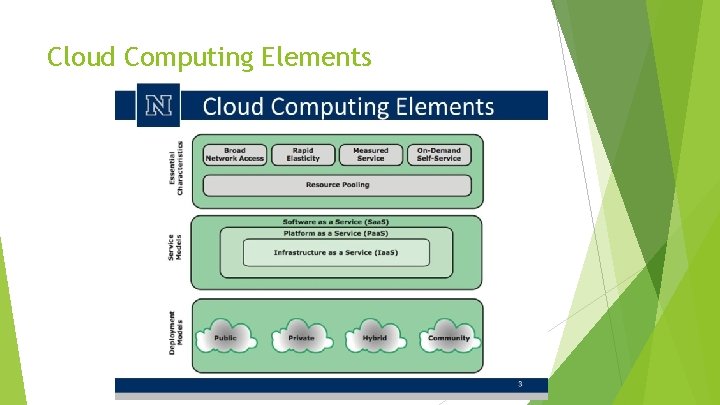
Cloud Computing Elements Five essential characteristics Broad network access, rapid elasticity, measured service, ondemand resource pooling. Three service models Software as a service (Saa. S), Platform as a service (Paas), Infrastructure as a service (Iaas). Four deployment models Public, private, community and hybrid
Cloud Computing Elements
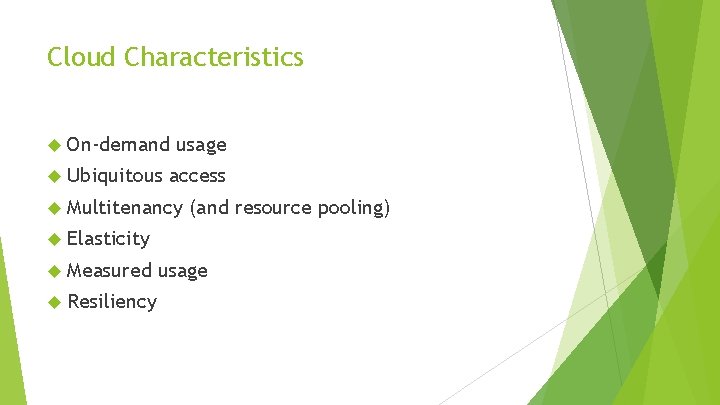
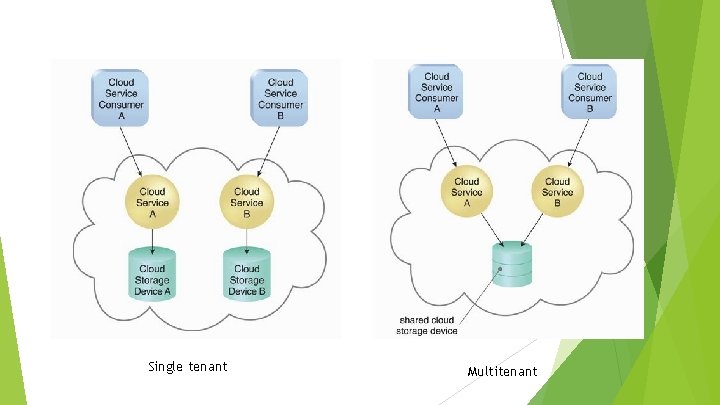
Cloud Characteristics On-demand Ubiquitous usage access Multitenancy (and resource pooling) Elasticity Measured Resiliency usage
Single tenant Multitenant
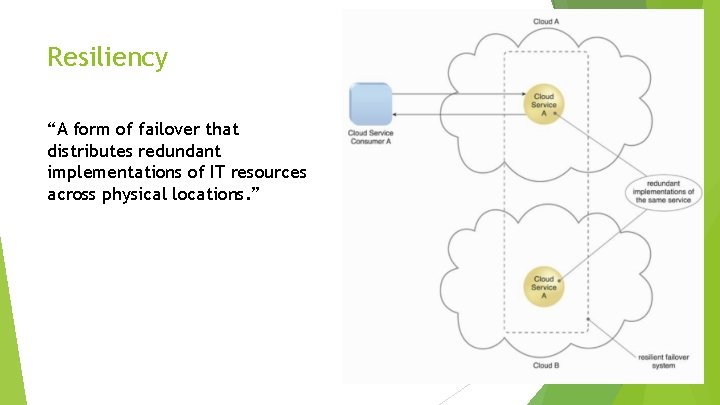
Resiliency “A form of failover that distributes redundant implementations of IT resources across physical locations. ”
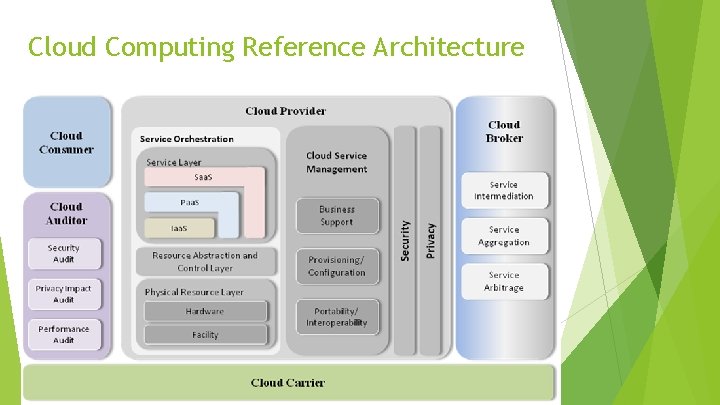
Cloud Computing Reference Architecture
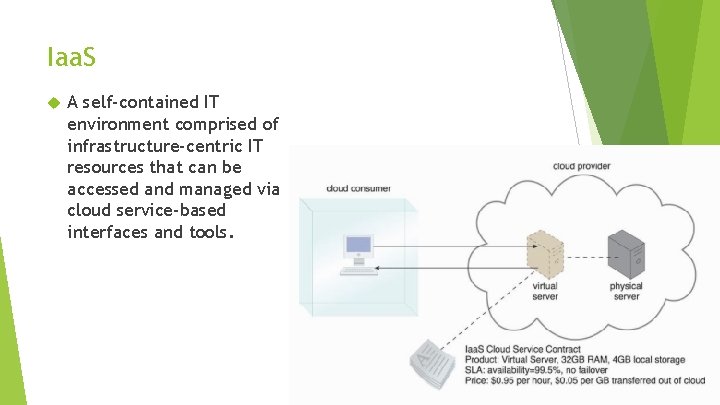
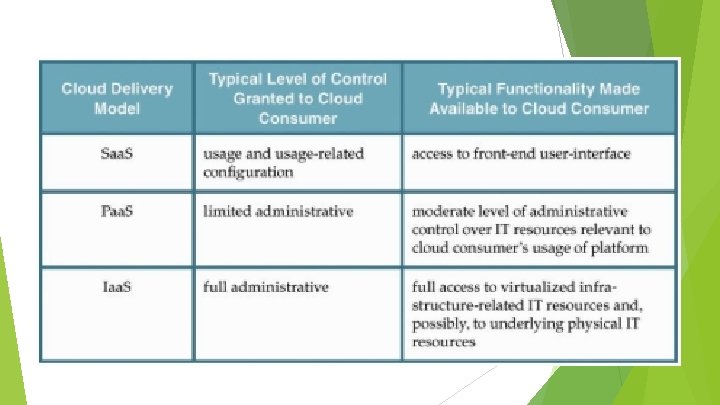
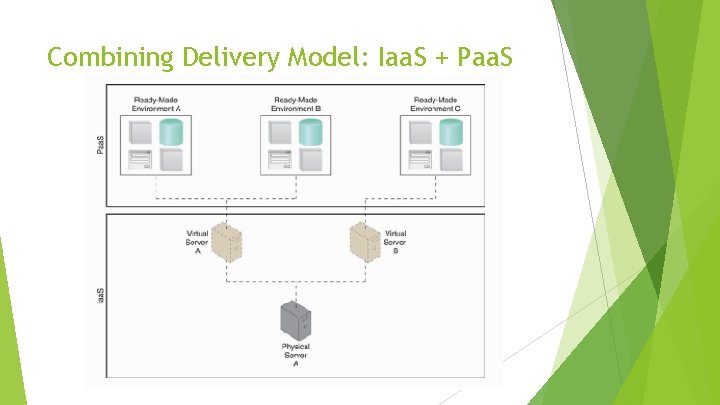
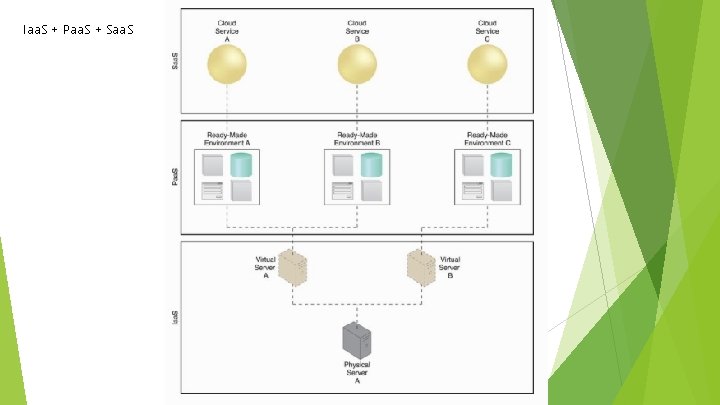
Iaa. S A self-contained IT environment comprised of infrastructure-centric IT resources that can be accessed and managed via cloud service-based interfaces and tools.
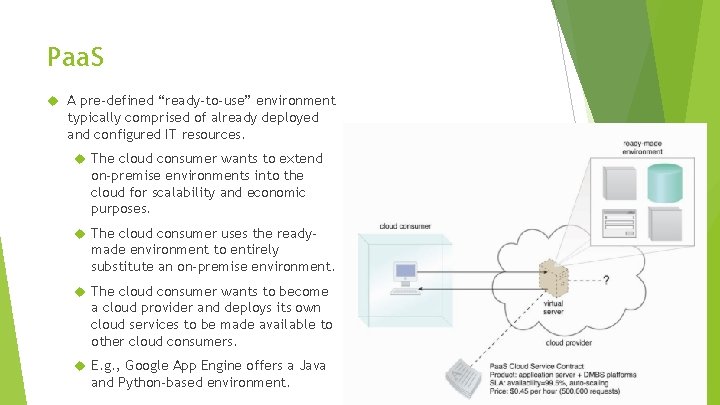
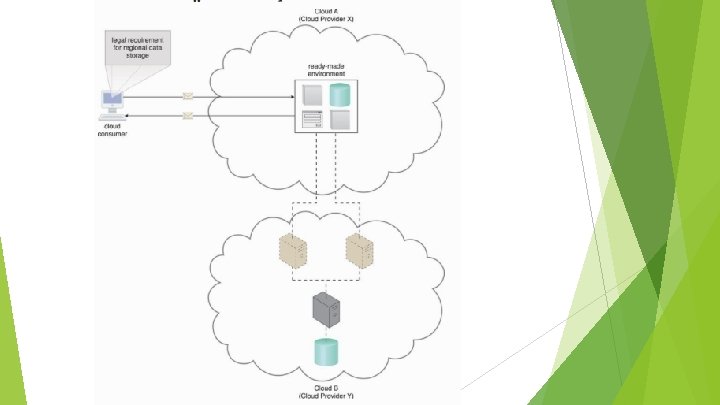
Paa. S A pre-defined “ready-to-use” environment typically comprised of already deployed and configured IT resources. The cloud consumer wants to extend on-premise environments into the cloud for scalability and economic purposes. The cloud consumer uses the ready- made environment to entirely substitute an on-premise environment. The cloud consumer wants to become a cloud provider and deploys its own cloud services to be made available to other cloud consumers. E. g. , Google App Engine offers a Java and Python-based environment.
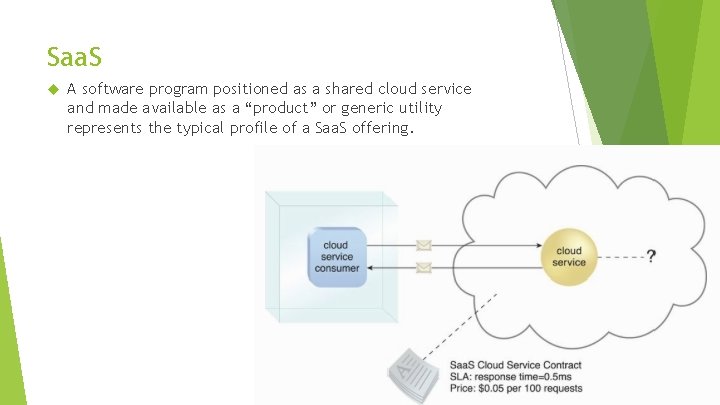
Saa. S A software program positioned as a shared cloud service and made available as a “product” or generic utility represents the typical profile of a Saa. S offering.
Combining Delivery Model: Iaa. S + Paa. S
Iaa. S + Paa. S + Saa. S
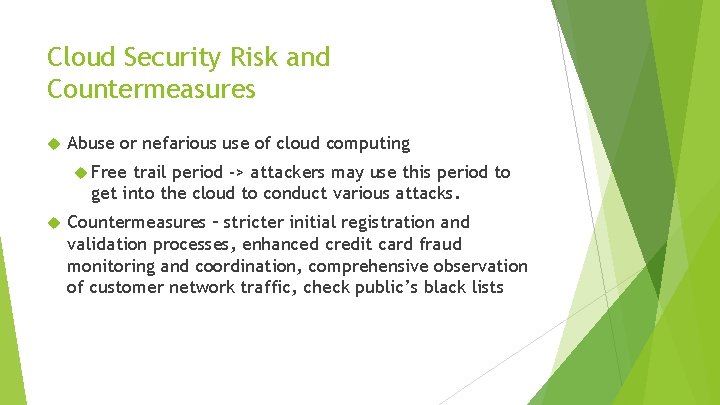
Cloud Security Risk and Countermeasures Abuse or nefarious use of cloud computing Free trail period -> attackers may use this period to get into the cloud to conduct various attacks. Countermeasures – stricter initial registration and validation processes, enhanced credit card fraud monitoring and coordination, comprehensive observation of customer network traffic, check public’s black lists
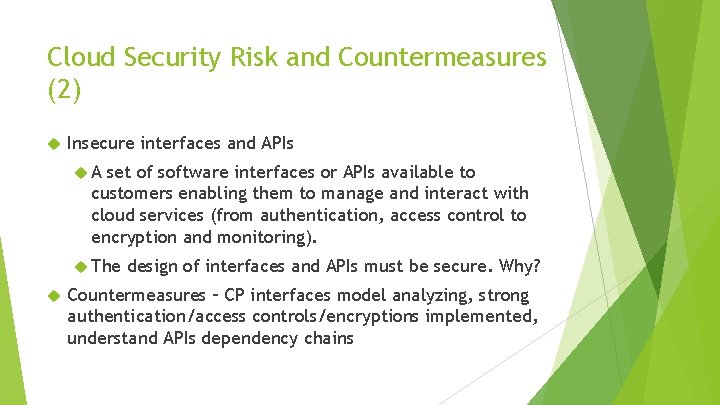
Cloud Security Risk and Countermeasures (2) Insecure interfaces and APIs A set of software interfaces or APIs available to customers enabling them to manage and interact with cloud services (from authentication, access control to encryption and monitoring). The design of interfaces and APIs must be secure. Why? Countermeasures – CP interfaces model analyzing, strong authentication/access controls/encryptions implemented, understand APIs dependency chains
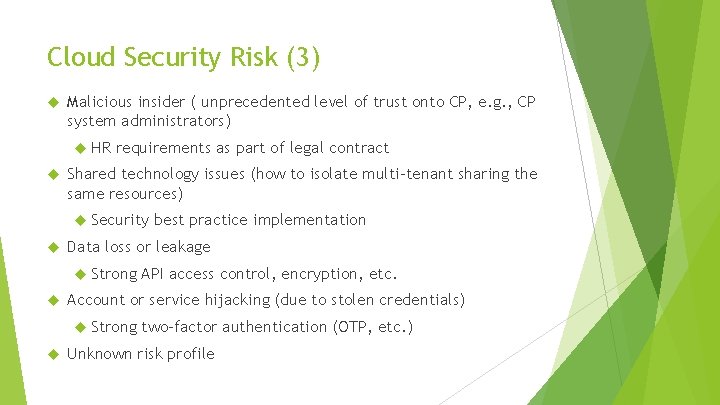
Cloud Security Risk (3) Malicious insider ( unprecedented level of trust onto CP, e. g. , CP system administrators) HR requirements as part of legal contract Shared technology issues (how to isolate multi-tenant sharing the same resources) Security Data loss or leakage Strong API access control, encryption, etc. Account or service hijacking (due to stolen credentials) Strong best practice implementation two-factor authentication (OTP, etc. ) Unknown risk profile
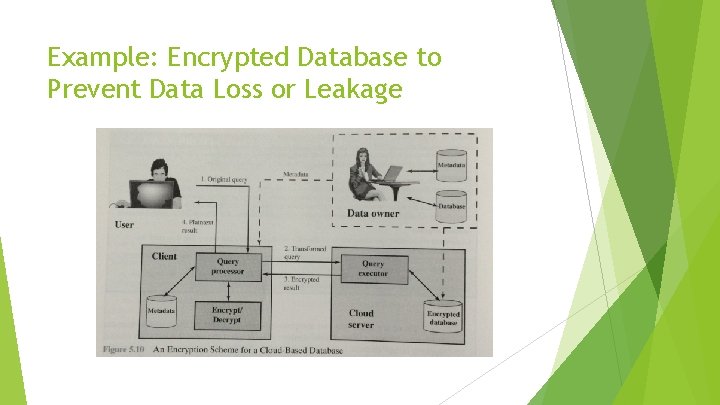
Example: Encrypted Database to Prevent Data Loss or Leakage
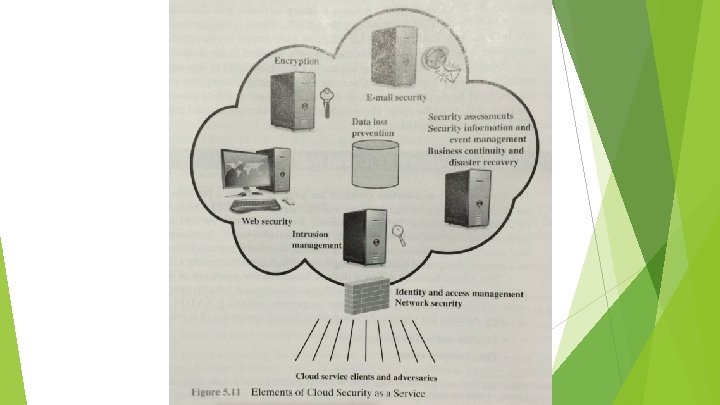
Cloud Security as a Service The Cloud Security Alliance defines security as a service (Secaa. S) the provision security applications and services via the cloud either cloud-based infra and software or from cloud to the customer’s premise system. Secaa. S categories of service Identity and access management, data loss prevention, web security, email security, security assessments, intrusion management, security information and event management, encryption, business continuity and disaster recovery and network security.