
Introduction to CLIPS Overview of CLIPS Facts Rule
![Deffacts • (deffacts <deffacts name> [<optional comment>] <<facts>> ) used to automatically assert a](https://slidetodoc.com/presentation_image_h2/5c264ec7c343b6d5347b8151d7408e56/image-14.jpg "Deffacts • (deffacts <deffacts name> [<optional comment>] <<facts>> ) used to automatically assert a")
![Components of a rule • (defrule <rule name> [<optional comment>] <<<patterns>>> => <<<actions>>>) •](https://slidetodoc.com/presentation_image_h2/5c264ec7c343b6d5347b8151d7408e56/image-16.jpg "Components of a rule • (defrule <rule name> [<optional comment>] <<<patterns>>> => <<<actions>>>) •")
![The agenda and activation • (run [<limit>]) runs a CLIPS program, <limit> is the](https://slidetodoc.com/presentation_image_h2/5c264ec7c343b6d5347b8151d7408e56/image-17.jpg "The agenda and activation • (run [<limit>]) runs a CLIPS program, <limit> is the")
- Slides: 29
Introduction to CLIPS • • • Overview of CLIPS Facts Rule firing Control techniques Example CS 561, Session 25 1
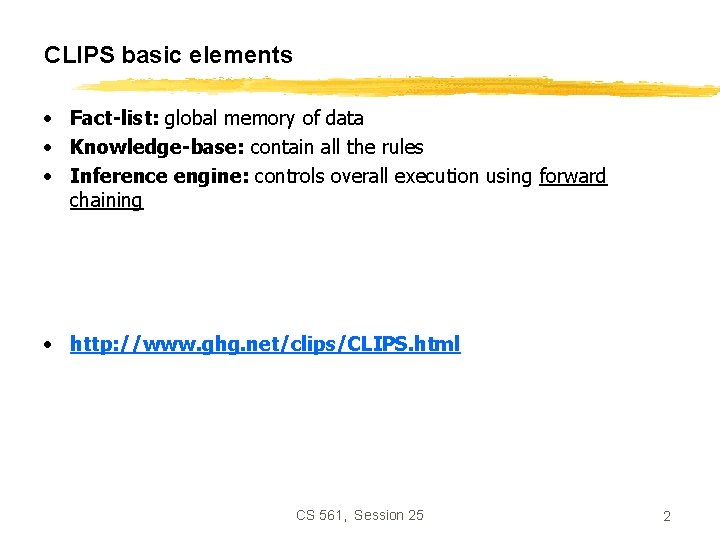
CLIPS basic elements • Fact-list: global memory of data • Knowledge-base: contain all the rules • Inference engine: controls overall execution using forward chaining • http: //www. ghg. net/clips/CLIPS. html CS 561, Session 25 2
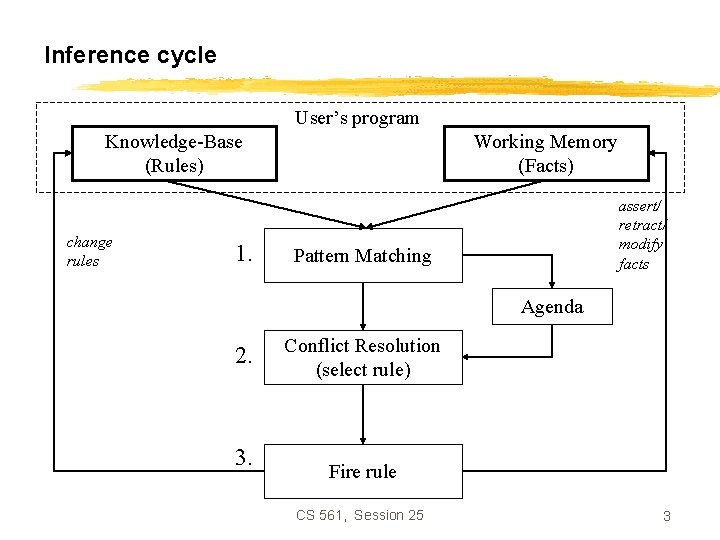
Inference cycle User’s program Knowledge-Base (Rules) change rules 1. Working Memory (Facts) assert/ retract/ modify facts Pattern Matching Agenda 2. 3. Conflict Resolution (select rule) Fire rule CS 561, Session 25 3
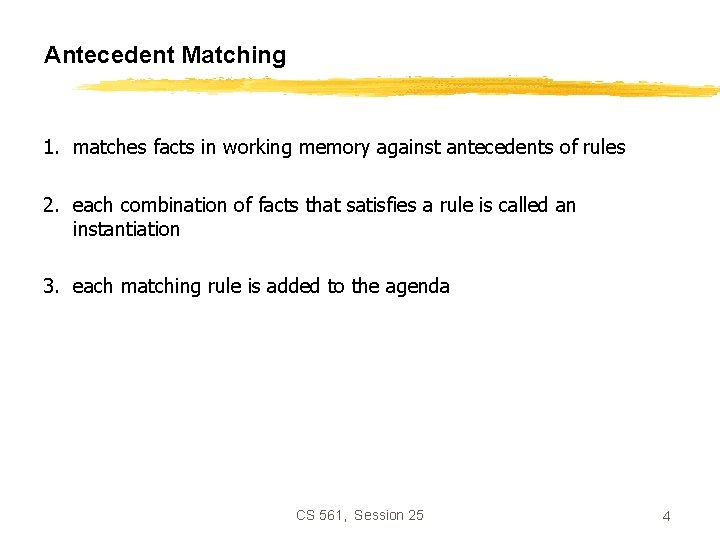
Antecedent Matching 1. matches facts in working memory against antecedents of rules 2. each combination of facts that satisfies a rule is called an instantiation 3. each matching rule is added to the agenda CS 561, Session 25 4
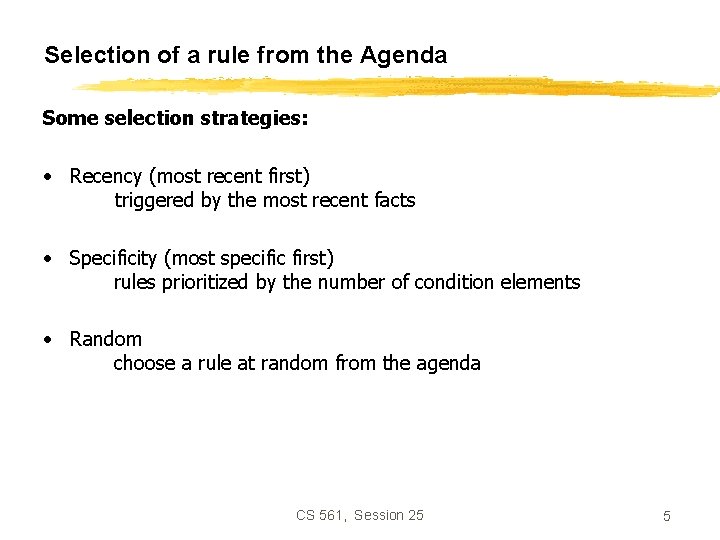
Selection of a rule from the Agenda Some selection strategies: • Recency (most recent first) triggered by the most recent facts • Specificity (most specific first) rules prioritized by the number of condition elements • Random choose a rule at random from the agenda CS 561, Session 25 5
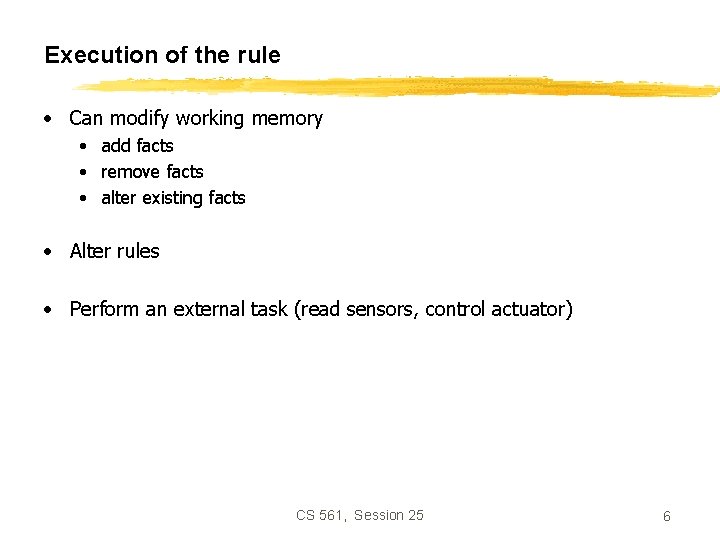
Execution of the rule • Can modify working memory • add facts • remove facts • alter existing facts • Alter rules • Perform an external task (read sensors, control actuator) CS 561, Session 25 6
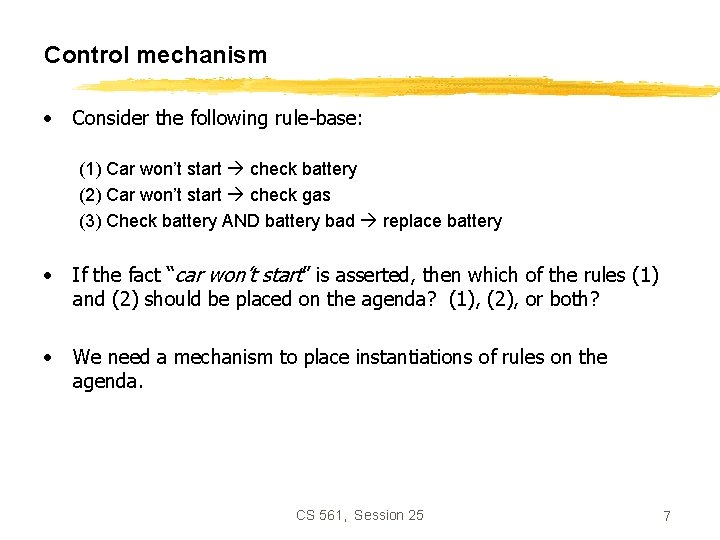
Control mechanism • Consider the following rule-base: (1) Car won’t start check battery (2) Car won’t start check gas (3) Check battery AND battery bad replace battery • If the fact “car won’t start” is asserted, then which of the rules (1) and (2) should be placed on the agenda? (1), (2), or both? • We need a mechanism to place instantiations of rules on the agenda. CS 561, Session 25 7
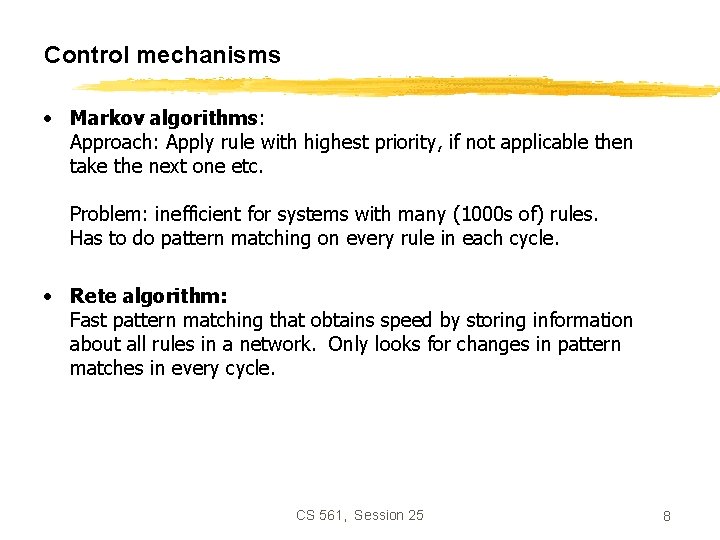
Control mechanisms • Markov algorithms: Approach: Apply rule with highest priority, if not applicable then take the next one etc. Problem: inefficient for systems with many (1000 s of) rules. Has to do pattern matching on every rule in each cycle. • Rete algorithm: Fast pattern matching that obtains speed by storing information about all rules in a network. Only looks for changes in pattern matches in every cycle. CS 561, Session 25 8
Install and run • Access to CLIPS: • On aludra: at ~csci 561 a/clips • In Windows: install http: //www. ghgcorp. com/clips/download/executables/pc • Running Clips • On aludra: > clips • In Windows: run clips. exe CS 561, Session 25 9
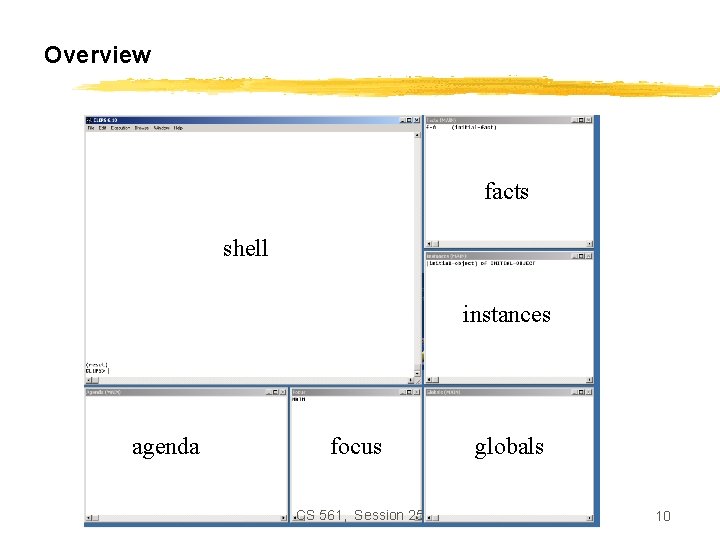
Overview facts shell instances agenda focus CS 561, Session 25 globals 10
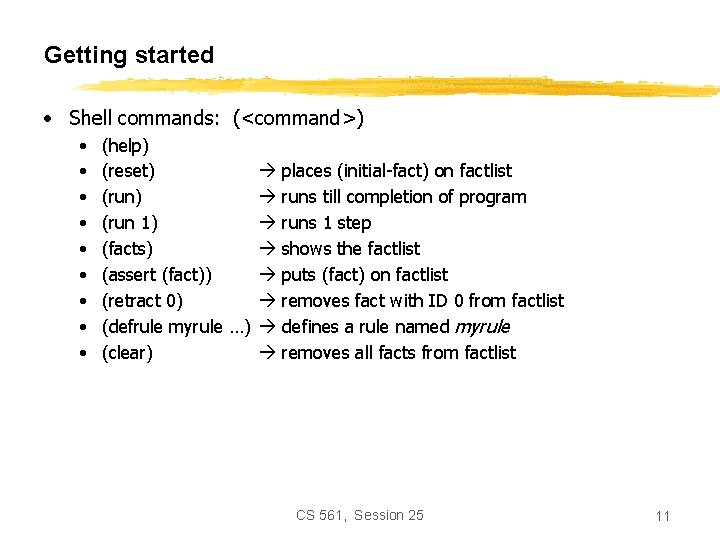
Getting started • Shell commands: (<command>) • • • (help) (reset) (run 1) (facts) (assert (fact)) (retract 0) (defrule myrule …) (clear) places (initial-fact) on factlist runs till completion of program runs 1 step shows the factlist puts (fact) on factlist removes fact with ID 0 from factlist defines a rule named myrule removes all facts from factlist CS 561, Session 25 11
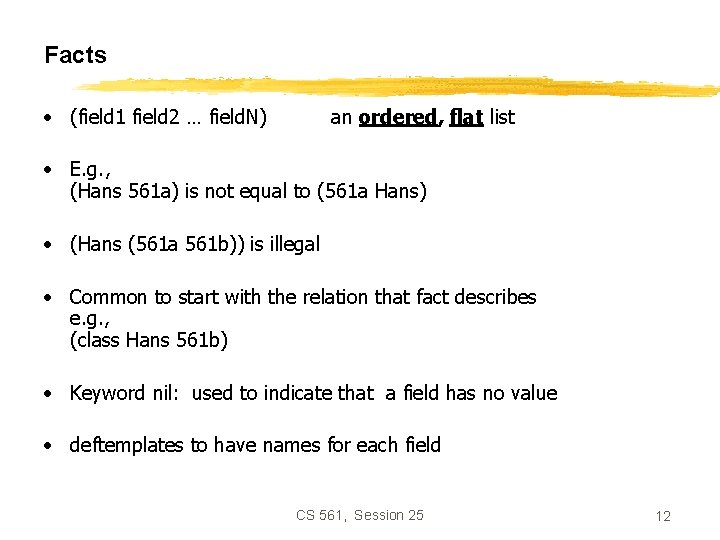
Facts • (field 1 field 2 … field. N) an ordered, flat list • E. g. , (Hans 561 a) is not equal to (561 a Hans) • (Hans (561 a 561 b)) is illegal • Common to start with the relation that fact describes e. g. , (class Hans 561 b) • Keyword nil: used to indicate that a field has no value • deftemplates to have names for each field CS 561, Session 25 12
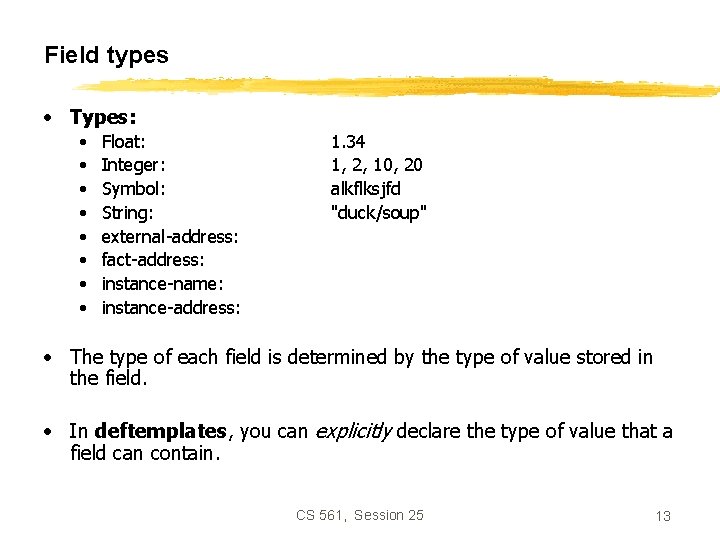
Field types • Types: • • Float: Integer: Symbol: String: external-address: fact-address: instance-name: instance-address: 1. 34 1, 2, 10, 20 alkflksjfd "duck/soup" • The type of each field is determined by the type of value stored in the field. • In deftemplates, you can explicitly declare the type of value that a field can contain. CS 561, Session 25 13
Deffacts • (deffacts <deffacts name> [<optional comment>] <<facts>> ) used to automatically assert a set of facts • (deffacts status “some facts about emergency” (emergency fire) (fire-class A) ) • Are asserted after a (reset) command CS 561, Session 25 14
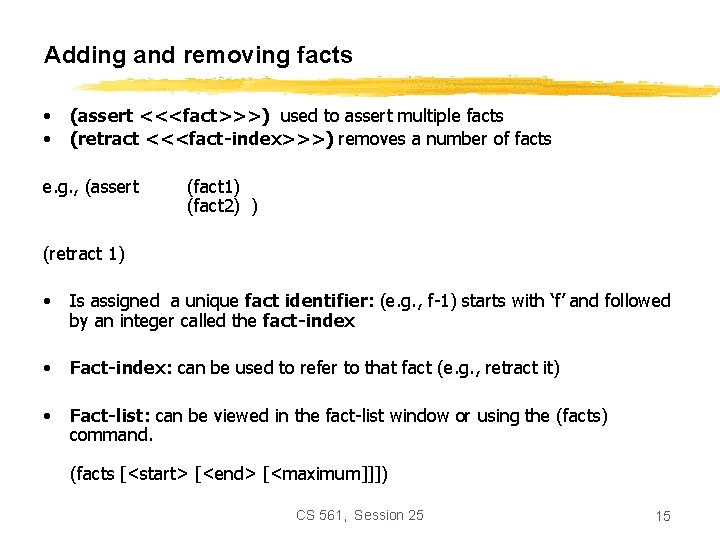
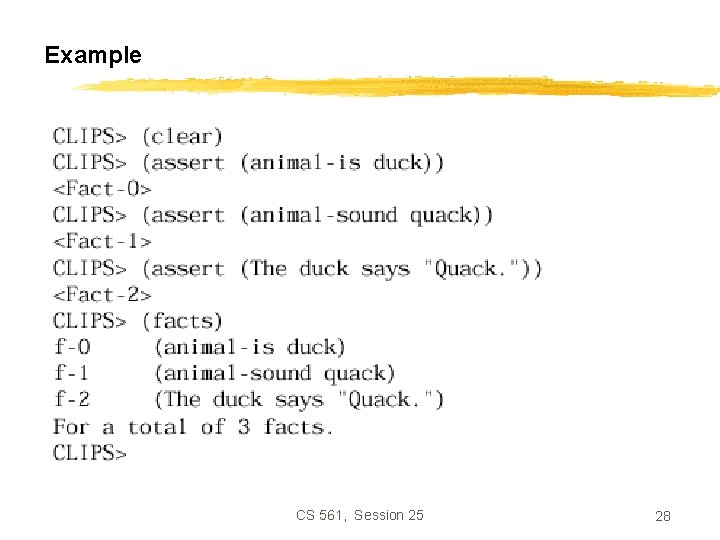
Adding and removing facts • • (assert <<<fact>>>) used to assert multiple facts (retract <<<fact-index>>>) removes a number of facts e. g. , (assert (fact 1) (fact 2) ) (retract 1) • Is assigned a unique fact identifier: (e. g. , f-1) starts with ‘f’ and followed by an integer called the fact-index • Fact-index: can be used to refer to that fact (e. g. , retract it) • Fact-list: can be viewed in the fact-list window or using the (facts) command. (facts [<start> [<end> [<maximum]]]) CS 561, Session 25 15
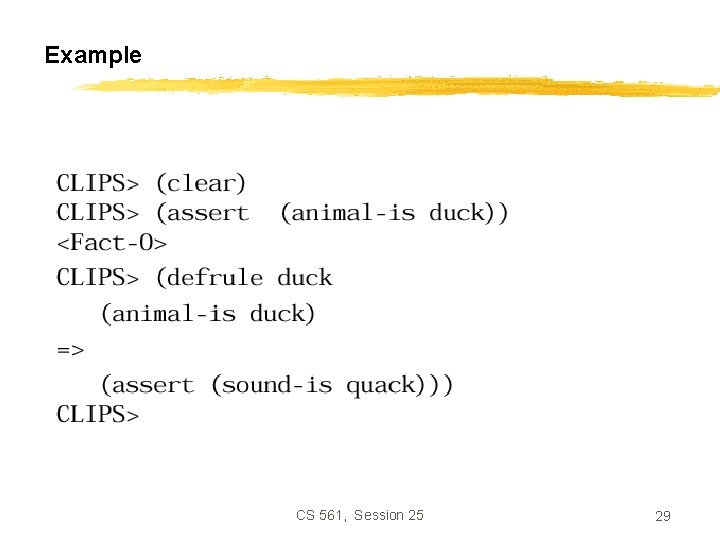
Components of a rule • (defrule <rule name> [<optional comment>] <<<patterns>>> => <<<actions>>>) • (defrule fire-emergency “An example rule” (emergency fire) => (assert (action activate-sprinkler-system))) • Rules can be inserted into the shell or loaded from a file using the (load) command CS 561, Session 25 16
The agenda and activation • (run [<limit>]) runs a CLIPS program, <limit> is the number of rules to fire • Activating a rule: requires that all its patterns on LHS (Left-Hand. Side) are matched. Asserting an existing fact has no effect. • List of activated rules: can be seen in the agenda window or listed using (agenda) 0 fire-emergency f-2 matching facts rule name salience CS 561, Session 25 17
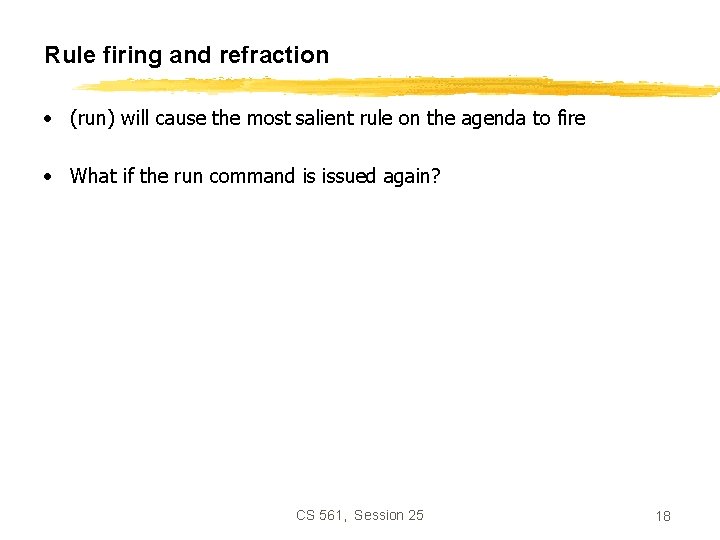
Rule firing and refraction • (run) will cause the most salient rule on the agenda to fire • What if the run command is issued again? CS 561, Session 25 18
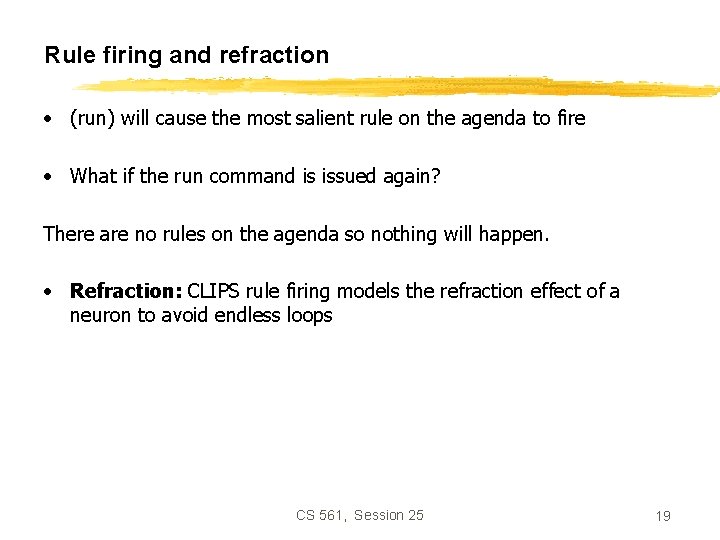
Rule firing and refraction • (run) will cause the most salient rule on the agenda to fire • What if the run command is issued again? There are no rules on the agenda so nothing will happen. • Refraction: CLIPS rule firing models the refraction effect of a neuron to avoid endless loops CS 561, Session 25 19
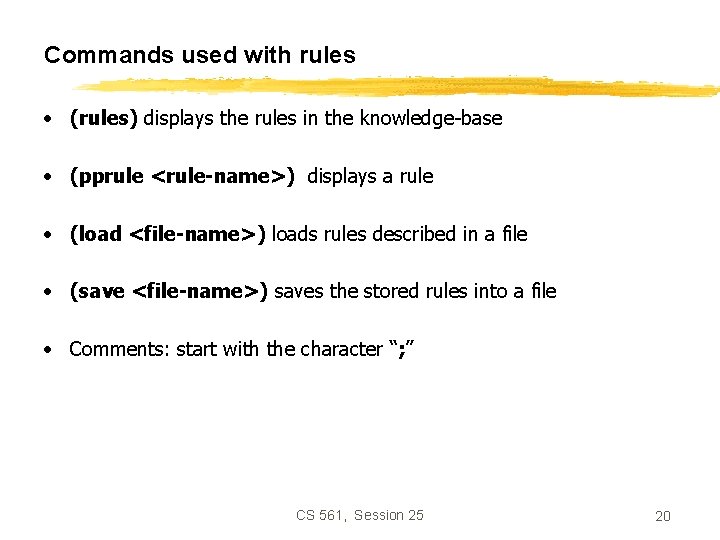
Commands used with rules • (rules) displays the rules in the knowledge-base • (pprule <rule-name>) displays a rule • (load <file-name>) loads rules described in a file • (save <file-name>) saves the stored rules into a file • Comments: start with the character “; ” CS 561, Session 25 20
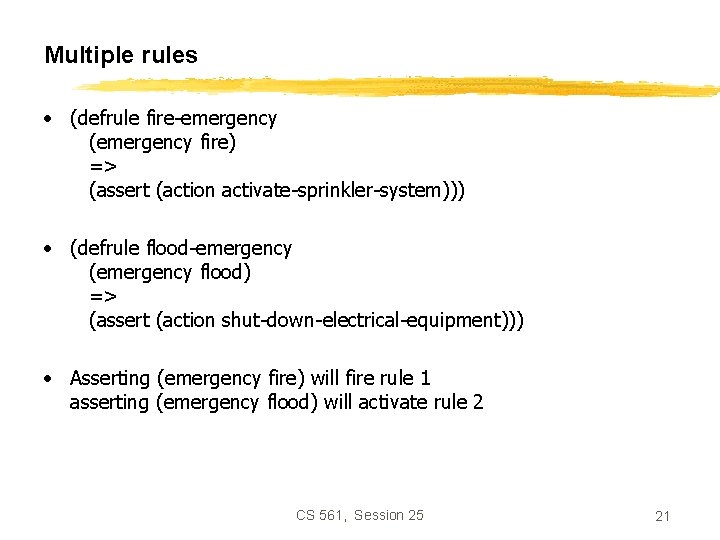
Multiple rules • (defrule fire-emergency (emergency fire) => (assert (action activate-sprinkler-system))) • (defrule flood-emergency (emergency flood) => (assert (action shut-down-electrical-equipment))) • Asserting (emergency fire) will fire rule 1 asserting (emergency flood) will activate rule 2 CS 561, Session 25 21
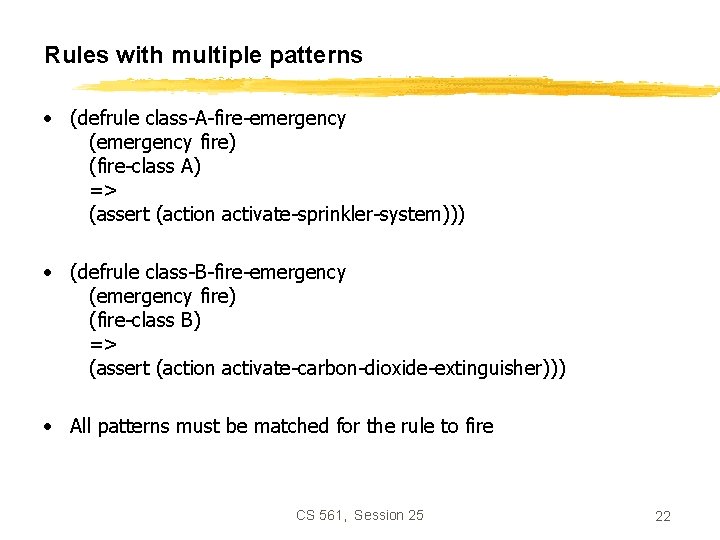
Rules with multiple patterns • (defrule class-A-fire-emergency (emergency fire) (fire-class A) => (assert (action activate-sprinkler-system))) • (defrule class-B-fire-emergency (emergency fire) (fire-class B) => (assert (action activate-carbon-dioxide-extinguisher))) • All patterns must be matched for the rule to fire CS 561, Session 25 22
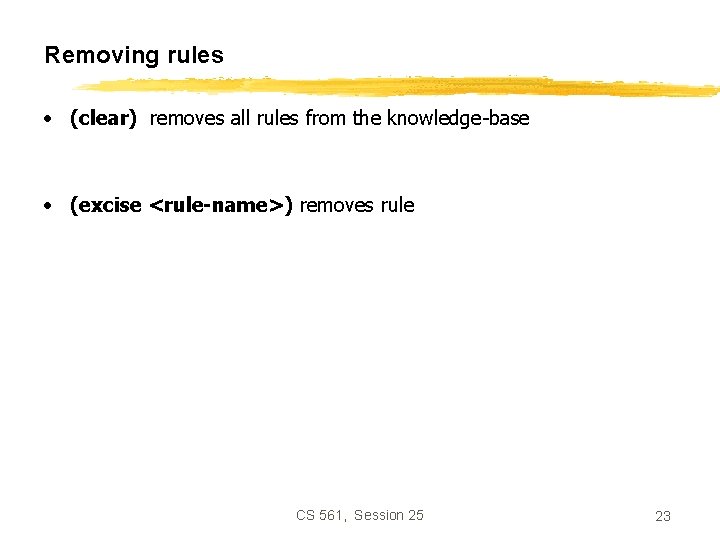
Removing rules • (clear) removes all rules from the knowledge-base • (excise <rule-name>) removes rule CS 561, Session 25 23
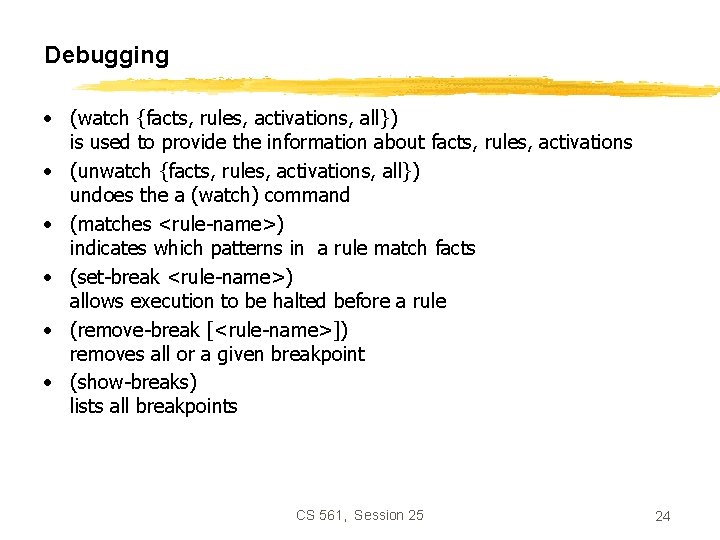
Debugging • (watch {facts, rules, activations, all}) is used to provide the information about facts, rules, activations • (unwatch {facts, rules, activations, all}) undoes the a (watch) command • (matches <rule-name>) indicates which patterns in a rule match facts • (set-break <rule-name>) allows execution to be halted before a rule • (remove-break [<rule-name>]) removes all or a given breakpoint • (show-breaks) lists all breakpoints CS 561, Session 25 24
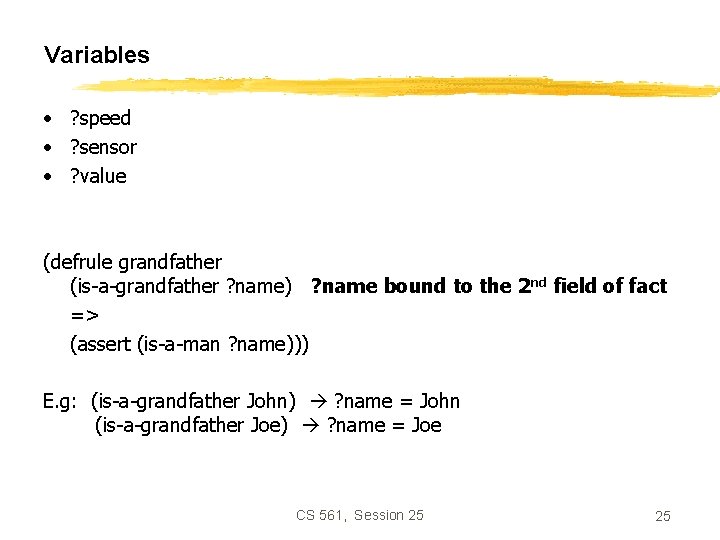
Variables • ? speed • ? sensor • ? value (defrule grandfather (is-a-grandfather ? name) ? name bound to the 2 nd field of fact => (assert (is-a-man ? name))) E. g: (is-a-grandfather John) ? name = John (is-a-grandfather Joe) ? name = Joe CS 561, Session 25 25
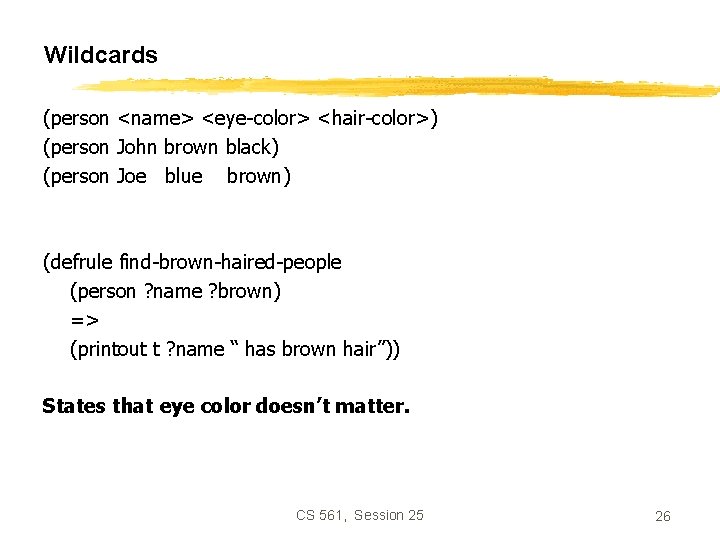
Wildcards (person <name> <eye-color> <hair-color>) (person John brown black) (person Joe blue brown) (defrule find-brown-haired-people (person ? name ? brown) => (printout t ? name “ has brown hair”)) States that eye color doesn’t matter. CS 561, Session 25 26
Control techniques • Using control facts • Using salience • Using control rules CS 561, Session 25 27
Example CS 561, Session 25 28
Example CS 561, Session 25 29