
Introduction to Classical Civilisation A Level OCR H

- Slides: 8
Introduction to Classical Civilisation A Level (OCR H 408)
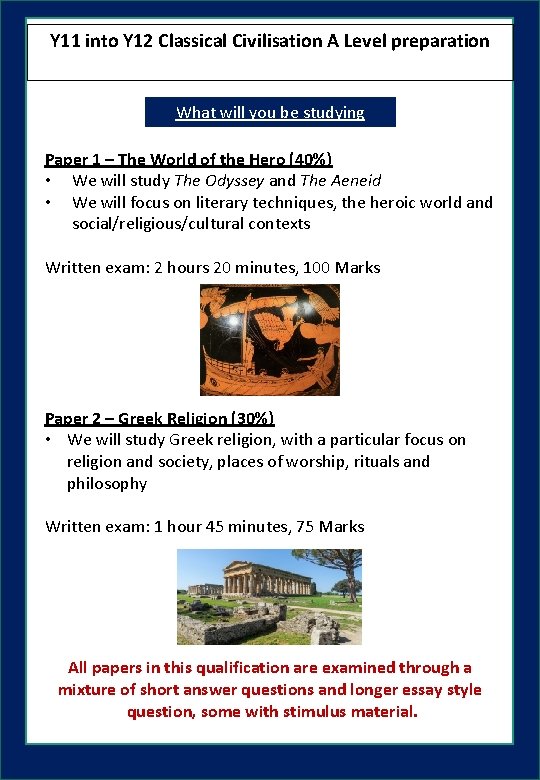
Y 11 into Y 12 Classical Civilisation A Level preparation What will you be studying Paper 1 – The World of the Hero (40%) • We will study The Odyssey and The Aeneid • We will focus on literary techniques, the heroic world and social/religious/cultural contexts Written exam: 2 hours 20 minutes, 100 Marks Paper 2 – Greek Religion (30%) • We will study Greek religion, with a particular focus on religion and society, places of worship, rituals and philosophy Written exam: 1 hour 45 minutes, 75 Marks All papers in this qualification are examined through a mixture of short answer questions and longer essay style question, some with stimulus material.
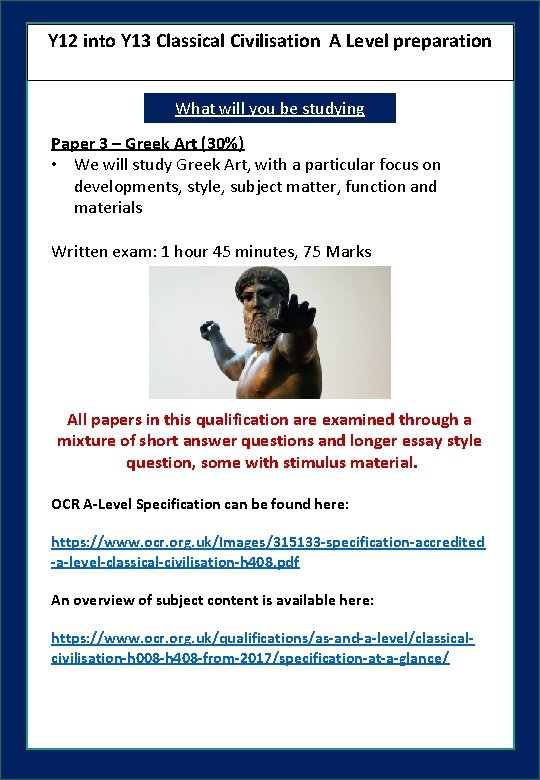
Y 12 into Y 13 Classical Civilisation A Level preparation What will you be studying Paper 3 – Greek Art (30%) • We will study Greek Art, with a particular focus on developments, style, subject matter, function and materials Written exam: 1 hour 45 minutes, 75 Marks All papers in this qualification are examined through a mixture of short answer questions and longer essay style question, some with stimulus material. OCR A-Level Specification can be found here: https: //www. ocr. org. uk/Images/315133 -specification-accredited -a-level-classical-civilisation-h 408. pdf An overview of subject content is available here: https: //www. ocr. org. uk/qualifications/as-and-a-level/classicalcivilisation-h 008 -h 408 -from-2017/specification-at-a-glance/
Transition work Y 11 – Y 12 The ideas raised in these tasks will be used and discussed in the first lessons in Year 12. reference will be made to examples within this work, so make sure you bring it with you at the start of the academic year.
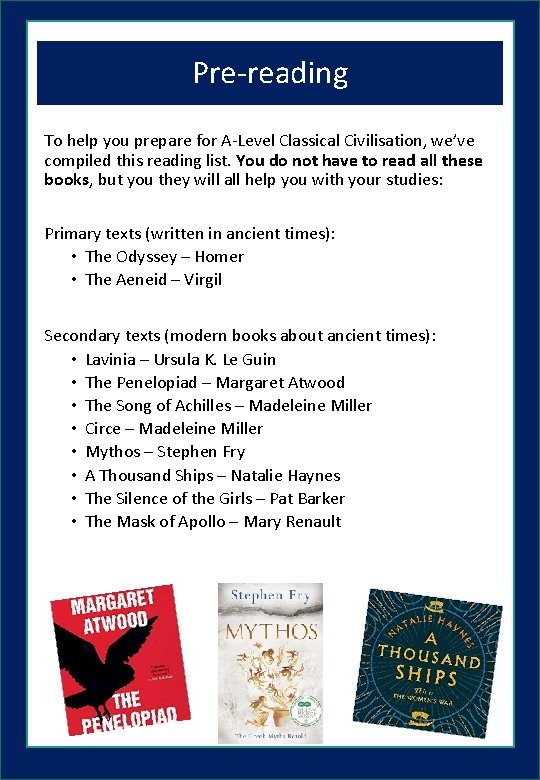
Pre-reading To help you prepare for A-Level Classical Civilisation, we’ve compiled this reading list. You do not have to read all these books, but you they will all help you with your studies: Primary texts (written in ancient times): • The Odyssey – Homer • The Aeneid – Virgil Secondary texts (modern books about ancient times): • Lavinia – Ursula K. Le Guin • The Penelopiad – Margaret Atwood • The Song of Achilles – Madeleine Miller • Circe – Madeleine Miller • Mythos – Stephen Fry • A Thousand Ships – Natalie Haynes • The Silence of the Girls – Pat Barker • The Mask of Apollo – Mary Renault
Task 1 A look at what Classical Civilisation is…. Classical Civilisation is the study of the ancient Mediterranean world and the cultures that existed within it. This qualification focuses largely on Ancient Greece and Rome, but also other ancient cultures such as Ancient Persia and Ancient Egypt. 1. Write down your preconceptions about Classical Civilisation. 2. Do you have any questions about the ancient world? If so, please write them below. 3. What motivates you to study the ancient world? 4. Having read about the modules, which one is the most appealing to you?
Task 2 Presentation on an episode from The Odyssey Using the internet or books, research one of the following, famous episodes in the Odyssey: • The cyclops, Polyphemus • Circe • The Sirens • Scylla and Charybdis • Calypso Then create a poster/presentation about this episode. Your presentation should include: • A description of the characters who features in this episode • The narrative of this episode (e. g. what happens in this part of the story? ) • How does Odysseus eventually escape? This list is not everything you can include but will guide you in the right direction.
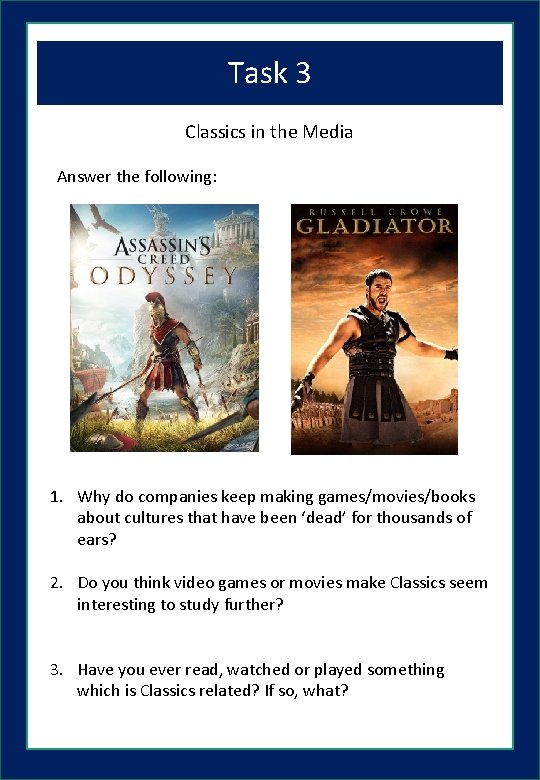
Task 3 Classics in the Media Answer the following: 1. Why do companies keep making games/movies/books about cultures that have been ‘dead’ for thousands of ears? 2. Do you think video games or movies make Classics seem interesting to study further? 3. Have you ever read, watched or played something which is Classics related? If so, what?