
Introduction to Chit Fund The concept of chit

- Slides: 19
Introduction to Chit Fund The concept of chit funds originated more than 1000 years ago. Initially it was in the form of an informal association of traders and households within communities, wherein the members contributed some money in return for an accumulated sum at the end of the tenure. However, in recent times, there has been tremendous alteration in the constitution and functioning of chit funds. Chit funds are the Indian equivalent of the Rotating Savings and Credit Associations (ROSCA) that are famous throughout the world.
Introduction to Chit Fund Chit funds are a means to ’save and borrow’ at the same time. It is considered one of the best financial instruments to cater to the emergency needs Chit funds are also, more importantly, a means of easy and profitable access to finance for the Small and Medium Enterprises (SMEs). In spite of competitive banking age, chit funds are popularly increasing.
Why Chit funds are popular? • • Once a person become member of group, he/she gets “right to loan” which is unlike in rather today’s competitive banking sector. Easy access to loan without irritation of heavy documentation Value for savings and interest for loan according market value. Chit funds are seen as savings for emergency
Demerits of common chit fund • No freedom of entry or exit • Chits are closed ended scheme which results in low demand for loan after certain duration. • No transparency in out-cry bidding system • Most of the chits are run by unauthorized persons. Hence saved amount is vulnerable of fraud. Hence practice of taking loan by highest discount is rampant. • Forced loan during low demand duration
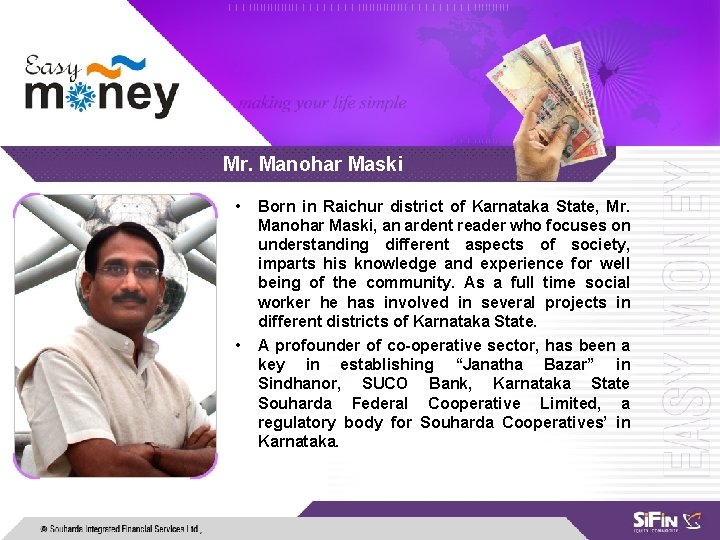
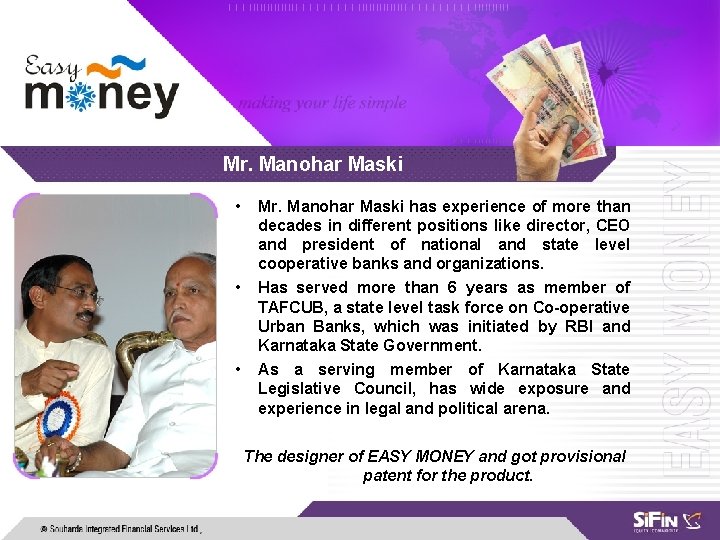
Mr. Manohar Maski • Born in Raichur district of Karnataka State, Mr. Manohar Maski, an ardent reader who focuses on understanding different aspects of society, imparts his knowledge and experience for well being of the community. As a full time social worker he has involved in several projects in different districts of Karnataka State. • A profounder of co-operative sector, has been a key in establishing “Janatha Bazar” in Sindhanor, SUCO Bank, Karnataka State Souharda Federal Cooperative Limited, a regulatory body for Souharda Cooperatives’ in Karnataka.
Mr. Manohar Maski • Mr. Manohar Maski has experience of more than decades in different positions like director, CEO and president of national and state level cooperative banks and organizations. • Has served more than 6 years as member of TAFCUB, a state level task force on Co-operative Urban Banks, which was initiated by RBI and Karnataka State Government. • As a serving member of Karnataka State Legislative Council, has wide exposure and experience in legal and political arena. The designer of EASY MONEY and got provisional patent for the product.
Here comes a unique financial scheme!! EASY MONEY (Provisional patent obtained) Its Chit Fund! Its R. D ! Its O. D! Yes - Banking facilities and Security No - Demerits of chit fund
What is Easy Money ? • Its an Open Ended Scheme. (Customer has freedom of entry and exit at any point of time) • No groups of particular value. Irrespective of members and value of pot its one group and one tender. • • Customer decides for himself (saving and duration) Transparent tender system instead of out-cry system.
How does Easy Money works? • A customer joins the group by deciding his savings and duration. • A member of the group participates in tender for his “Target Money” • A member can vote 3 tenders before the box is open. • A member has flexibility for participating either for full or partial target money. • A member can participate again in the tender for the rest of the money (Just like O. D) • A member get bonus for his savings (Interest is given only for first month) • A member gets more time to decide the discount because of transparent tender system.
Advantage of Easy Money It’s all about freedom and flexibility!! • Freedom of exit and entry • Freedom of deciding for himself the savings and duration • Flexibility of tendering for full or partial money • Freedom of not participating in tender and deem this as savings scheme.
Tender and Loan • To avail loan in tender, a member has to quote minimum 13+ percent. • Out of 13 %, 5 percent goes towards foreman commission or service charge. • Total Collected in money in a given month in Easy money scheme is offered for tendering. • A member who quotes highest “offer money” is awarded with first tender. The second highest quote is offered next. Like this tenders are offered to equivalent of the total “pot” money.
Tender and Loan • Hence in one tender more than 5 or 6 members can avail the loan. • Partial offer money and money left in the “pot” will be transferred to next month tender. • If there is “tie” between members in quoting “offer money” then tender is awarded to that member who’s savings amount is more in ratio to the tender amount.
Bonus Minimum 13 -5 = 8 percent and extra quoted value is issued as bonus for every 100 Rupees. Example: Money for bonus = 1, 60, 000 Total “pot” amount for tender = 50, 00 1, 60, 00 x 100 = 3. 2% 50, 00 • Rs. 3. 20 for every 100 rupee. If a member’s saving is Rs. 1000/- per month then he receives Rs. 32 rupees as bonus. • Hence a member earns pre-decided 8% (135=8) on his savings and earns bonus according to market values. • Bonus is credited to member’s account in that particular month itself.
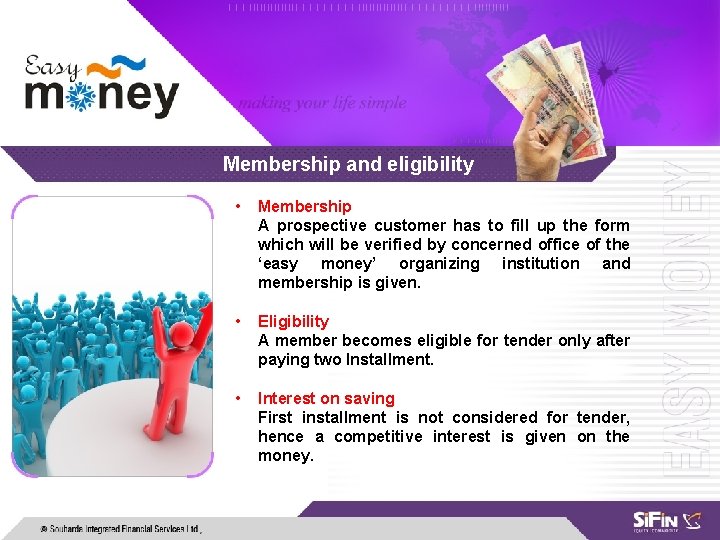
Membership and eligibility • • • Membership A prospective customer has to fill up the form which will be verified by concerned office of the ‘easy money’ organizing institution and membership is given. Eligibility A member becomes eligible for tender only after paying two Installment. Interest on saving First installment is not considered for tender, hence a competitive interest is given on the money.
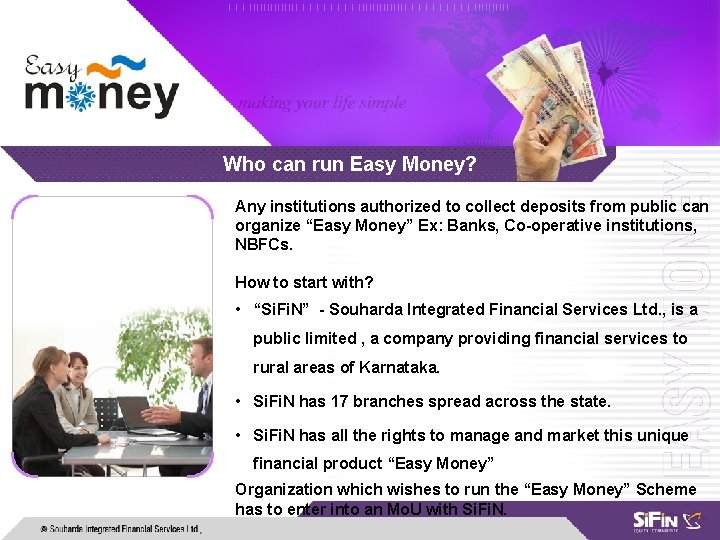
Who can run Easy Money? Any institutions authorized to collect deposits from public can organize “Easy Money” Ex: Banks, Co-operative institutions, NBFCs. How to start with? • “Si. Fi. N” - Souharda Integrated Financial Services Ltd. , is a public limited , a company providing financial services to rural areas of Karnataka. • Si. Fi. N has 17 branches spread across the state. • Si. Fi. N has all the rights to manage and market this unique financial product “Easy Money” Organization which wishes to run the “Easy Money” Scheme has to enter into an Mo. U with Si. Fi. N.
Role of Si. Fi. N Sifi. N • Legitimizes the organization to run the “Easy Money” scheme. • Offers all the guidelines and drafts of the documents. • Conducts the tender and publishes the results. • Follow-up with customers through SMS in name of organizing institution. Si. Fi. N receives 1% as service charge out of 5 percent charged to members Mutually agreed business advance has to be paid to Si. Fi. N without any interest.
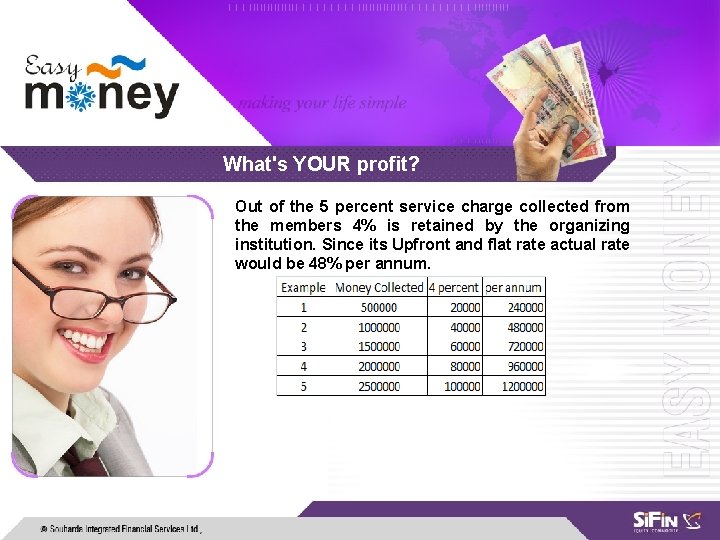
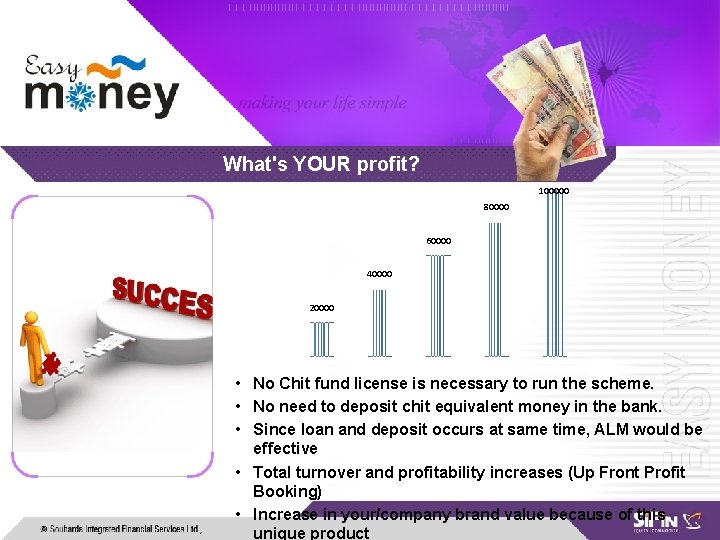
What's YOUR profit? Out of the 5 percent service charge collected from the members 4% is retained by the organizing institution. Since its Upfront and flat rate actual rate would be 48% per annum.
What's YOUR profit? 100000 80000 60000 40000 20000 • No Chit fund license is necessary to run the scheme. • No need to deposit chit equivalent money in the bank. • Since loan and deposit occurs at same time, ALM would be effective • Total turnover and profitability increases (Up Front Profit Booking) • Increase in your/company brand value because of this unique product
Easy Money • More Customers • More Profit • More Brand Value Thank you, Any questions?