
INTRODUCTION TO CHEMISTRY LAB SAFETY CONVERSIONS NUCLEAR WELCOME
INTRODUCTION TO CHEMISTRY LAB SAFETY CONVERSIONS NUCLEAR
WELCOME TO HONORS CHEMISTRY!! Please pick up the three sheets of paper up front Syllabus “Student Information Sheet”-start filling out for me and this will need to be signed by your parents! Please find your table with the same number as what is on your index card (you may sit in any seat at that table) On the lined side of the index card, please write your… Name – (First) (Last) (name like to be called) **This is how I will be taking attendance today!!*** Where you would like to sit (like where you are, front, back, around people, table 5 etc) What is your science background? (Meaning, how do you feel about science? Did you have positive or negative relationships with former science teachers and science classrooms, how do you feel about the subject of science? )
SYLLABUS AND RULES OF THE CLASS Looking over the unit you will find we have quite a bit to cover…. What you will need to be successful: Pens and pencils (mechanical pencils) 3 Ring Binder and notebook paper Dividers (Bell work, worksheets, hw, study guides) CALCULATOR!! Scientific works best!
PROCEDURES IN THE CLASSROOM RISK Turn in papers - Absent/Make up work Extra Help In the mornings After school on Tuesdays-Thursdays and by appointment! Tests–Students who earn a 70 or less on a test are eligible to retake the test within ONE WEEK of return date. The maximum grade a student can earn after a retest is 70. Retakes take a different form than the initial test. If the student is absent on the retest day, their absence must be excused and they must take the test the day they return.
GETTING TO KNOW YOU ACTIVITY With the sheet of paper, go around the room and write down the students name and their answer to the question. Can not have the same person answer more then one question (and you can not ask the teacher ; ) ) You will have 15 minutes to complete the activity!

FLINN SAFETY CONTRACT Take a few minutes to read over the Safety Contract. We will watch a movie and I want you to highlight what rule(s) you saw in the movie https: //www. youtube. com/watch? v=S 6 WARq. Vd. Wr. E Be ready for a Safety Quiz on Wednesday!
CHEMISTRY MISCONCEPTIONS Try to answer each question the best you can. For every false, explain why you think it is false **I encourage you to work in partners/groups on this** In 15 minutes we will go over the answers….
LAB SAFETY
Warm Up for Tuesday, August 29 th 1. Whose responsibility is it to keep the lab clean? 2. Describe at least three different safety rules we discussed in class yesterday. TURN IN YOUR STUDENT INFO SHEET TO THE BIN IF YOU HAVE IT SIGNED!

GLASSWARE SAFETY Handle glassware carefully. Never use broken or chipped glassware. Never heat glassware that is not thoroughly dry. Always clean glassware at the end of each lab.

FIRE SAFETY Always wear safety goggles. Never heat anything unless instructed to do so. Never heat anything in a closed container. Never leave a lit burner or hot plate unattended. Never reach across a flame. Tie back long hair and do not wear loose clothing. Always maintain a neat work area especially when using a flame. Flammable liquids (ex. alcohol) should never be poured/ placed near an open flame. Always use tongs or heat-resistant gloves to handle hot objects. Know the location of the fire blanket/extinguisher. If there is a fire, notify the teacher immediately and wait for instructions.
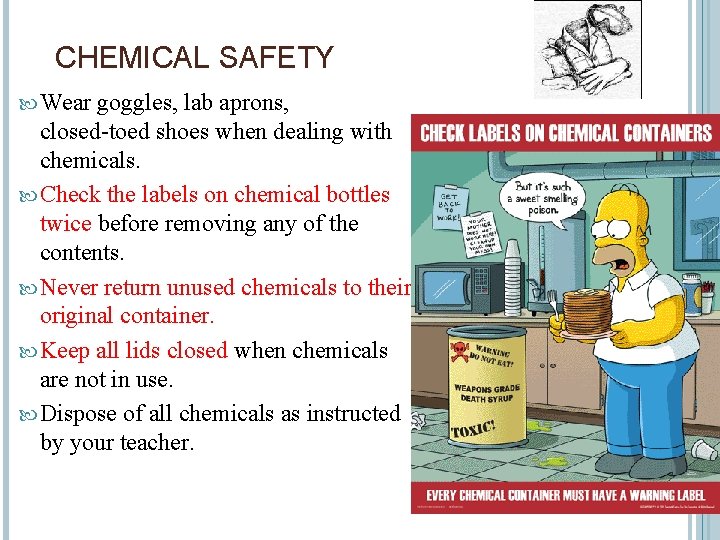
CHEMICAL SAFETY Wear goggles, lab aprons, closed-toed shoes when dealing with chemicals. Check the labels on chemical bottles twice before removing any of the contents. Never return unused chemicals to their original container. Keep all lids closed when chemicals are not in use. Dispose of all chemicals as instructed by your teacher.
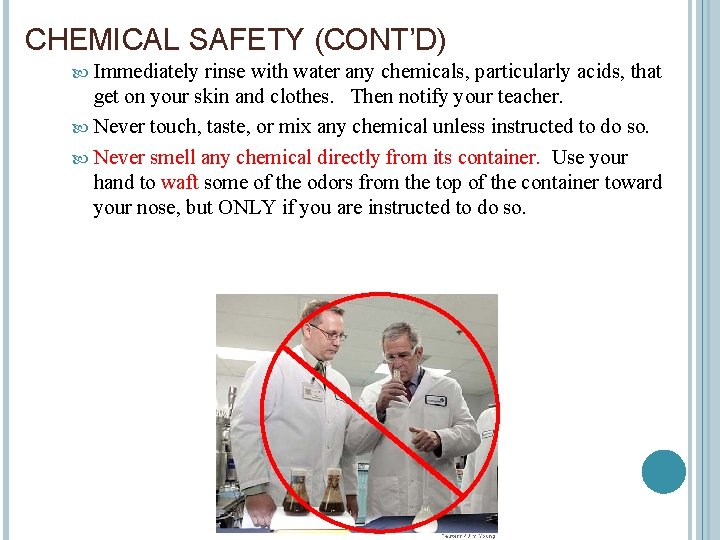
CHEMICAL SAFETY (CONT’D) Immediately rinse with water any chemicals, particularly acids, that get on your skin and clothes. Then notify your teacher. Never touch, taste, or mix any chemical unless instructed to do so. Never smell any chemical directly from its container. Use your hand to waft some of the odors from the top of the container toward your nose, but ONLY if you are instructed to do so.
ACID SAFETY Do not smell, waft, or touch acids. If acid gets on your skin or clothes, immediately rinse with water. To dilute an acid, add acid slowly to water, while stirring. If acid is spilled, it can be neutralized with sodium bicarbonate solution and then soaked up with paper towels.

MSDS Hazard Rating Chart
EYE & FACE SAFETY Wear safety goggles any time you are using chemicals, heat, or glassware. Do not remove your goggles at any time during the lab. When you are heating a test tube or bottle, always point it away from you and others. If a chemical should splash in your eye or on your skin, immediately flush with water from the eyewash station or safety shower for at least 20 minutes.
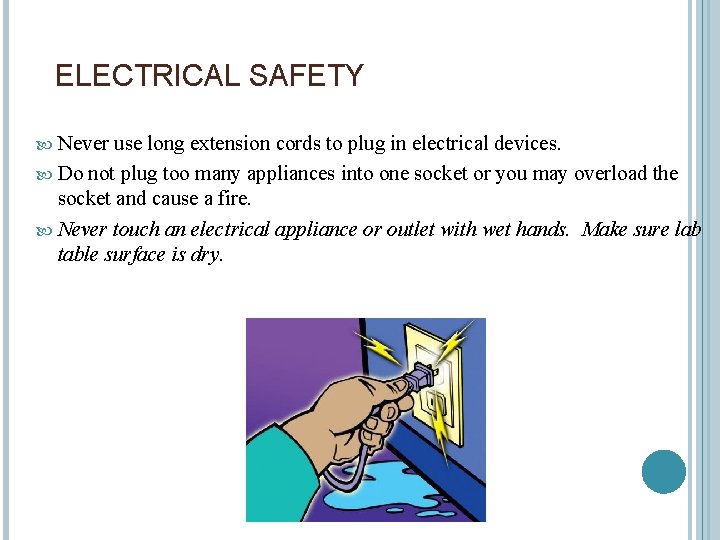
ELECTRICAL SAFETY Never use long extension cords to plug in electrical devices. Do not plug too many appliances into one socket or you may overload the socket and cause a fire. Never touch an electrical appliance or outlet with wet hands. Make sure lab table surface is dry.
GENERAL SAFETY No unnecessary movement Absolutely no horseplay Follow all instructions and do not improvise. If you are uncertain about what to do next, ask your teacher first. Report any accidents/spills to instructor immediately – no matter how trivial. Clean up spills immediately. Use appropriate disposal techniques for chemicals. - Flammable liquids or solid chemicals must be placed in a designated chemical waste container. Clean your lab area thoroughly before leaving. Keeping a clean laboratory is the responsibility of the students leaving the lab.
MILK LAB Lab Procedures: Please stay at your station If you need to gather supplies, only send one person in your group to get the supplies Limit the amount of papers going to the station (1 sheet is all you need per group) **Milk, food coloring, and soap will be used, if you have an allergies please let me know** Disposal: Dump milk and food coloring from petri dish down the sink with water. Please rinse dish and place back in bucket with all other supplies. Used toothpicks can go in trash can BEFORE YOU BEGIN THIS LAB, WRITE YOUR HYPOTHESIS!
Measurement (Ch 3) NUMBERS IN CHEMISTRY
WHEN YOU ARE FINISHED WITH THE QUIZ. . PLEASE write the letter to your answer choice next to the question…makes it easier to grade Place quiz in the bin when you are finished Take out your Unit 1 packet and try to work on scientific notation quietly until everyone is finished.
THE NUMBER COMFORT ZONE We are used to Small Numbers Lunch for $2. 25 or $5. 50 Tickets for $25, $50, or $125 Car for $2, 500, or $23, 000 But $9, 000, 000 deficit is too big to get our mind around. (Nine Trillion Dollars) Science uses very large or very small numbers
TWO WAYS SCIENTISTS GET NUMBERS INTO THE COMFORT ZONE Use units to express amount Kilobuck $ 1000 Milligram 60 milligram Tylenol tablet has 0. 060 grams ingredient. Use Scientific Notation 6. 023 x 1023 atoms per mole
SCIENTIFIC NOTATION Scientific Notation was developed in order to easily represent numbers that are either very large or very small. Scientific Notation is based on powers of the base number 10. Examples: The number 200, 000, 000 grams in scientific notation is written as 2 x 10¹¹ grams The number 0. 000, 006, 645 kilometers in scientific notation is written as 6. 645 x 10 -6 kilometers
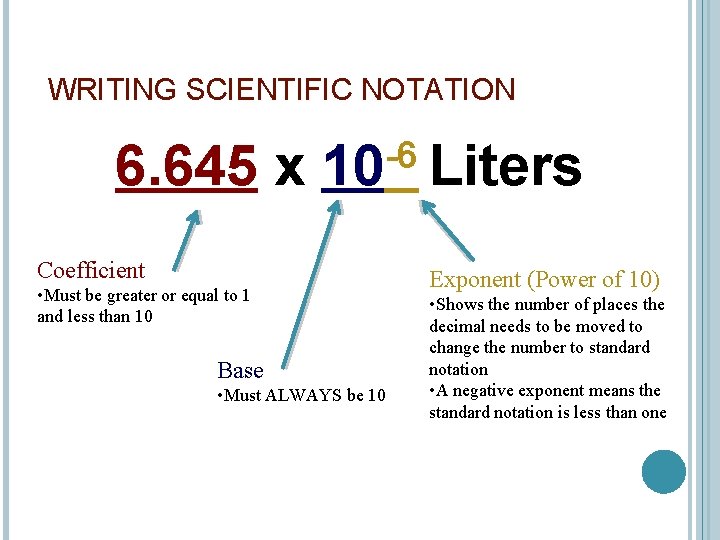
WRITING SCIENTIFIC NOTATION 6. 645 x -6 10 Liters Coefficient • Must be greater or equal to 1 and less than 10 Base • Must ALWAYS be 10 Exponent (Power of 10) • Shows the number of places the decimal needs to be moved to change the number to standard notation • A negative exponent means the standard notation is less than one
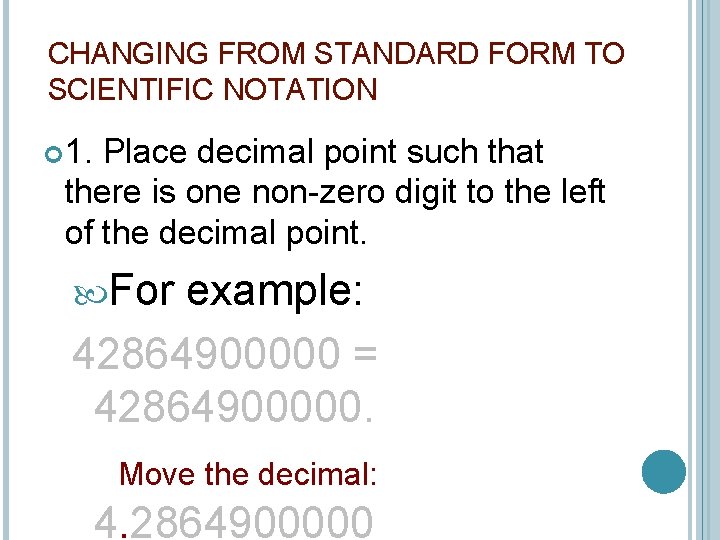
CHANGING FROM STANDARD FORM TO SCIENTIFIC NOTATION 1. Place decimal point such that there is one non-zero digit to the left of the decimal point. For example: 42864900000 = 42864900000. Move the decimal: 4. 2864900000
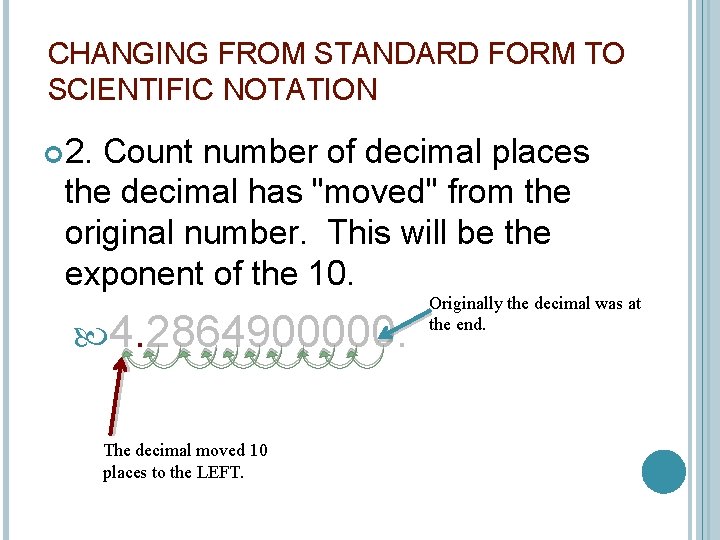
CHANGING FROM STANDARD FORM TO SCIENTIFIC NOTATION 2. Count number of decimal places the decimal has "moved" from the original number. This will be the exponent of the 10. 4. 2864900000. The decimal moved 10 places to the LEFT. Originally the decimal was at the end.
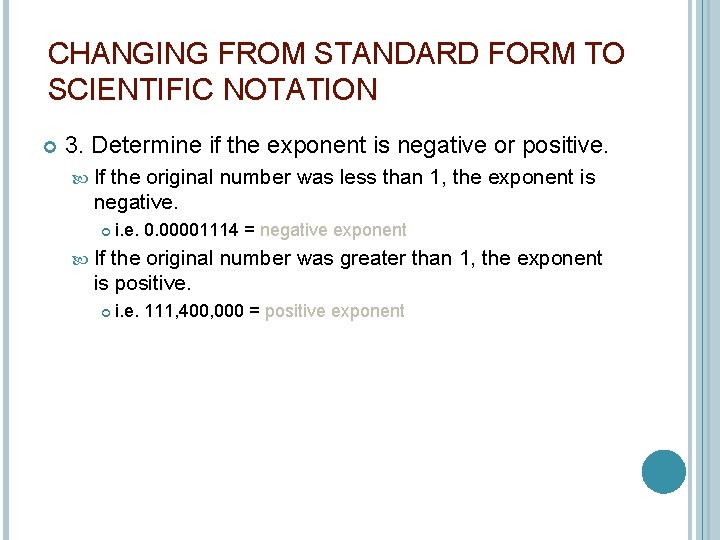
CHANGING FROM STANDARD FORM TO SCIENTIFIC NOTATION 3. Determine if the exponent is negative or positive. If the original number was less than 1, the exponent is negative. i. e. 0. 00001114 = negative exponent If the original number was greater than 1, the exponent is positive. i. e. 111, 400, 000 = positive exponent
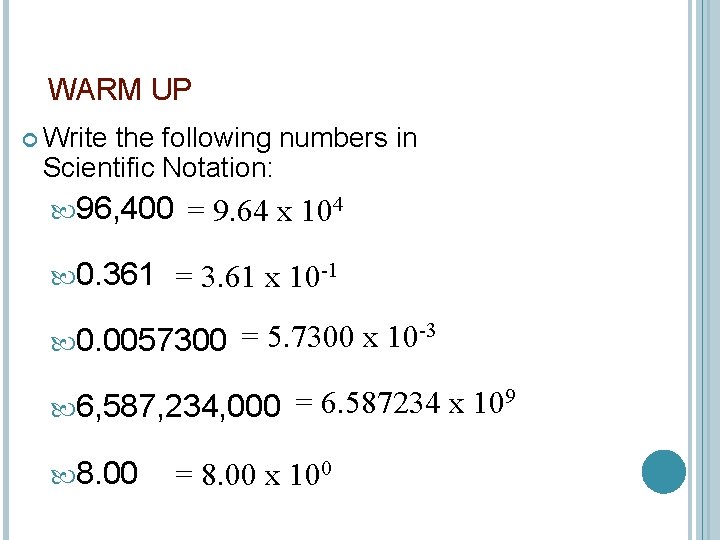
WARM UP Write the following numbers in Scientific Notation: 96, 400 = 9. 64 x 104 0. 361 = 3. 61 x 10 -1 0. 0057300 = 5. 7300 x 10 -3 9 = 6. 587234 x 10 6, 587, 234, 000 8. 00 = 8. 00 x 100
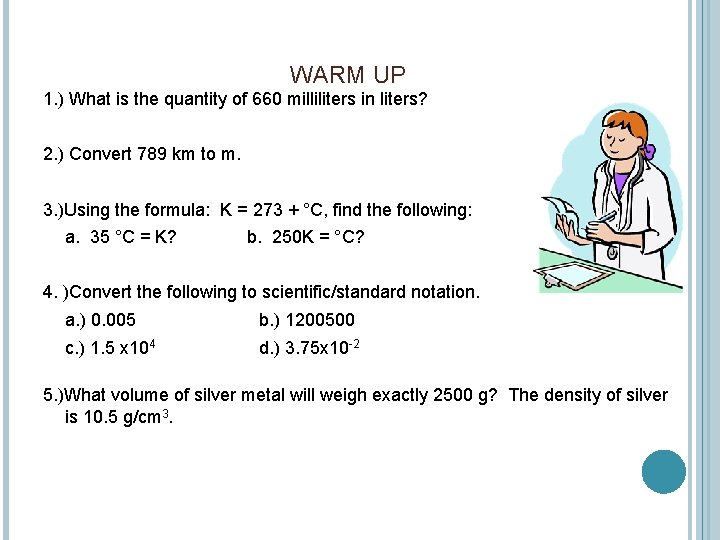
WARM UP 1. ) What is the quantity of 660 milliliters in liters? 2. ) Convert 789 km to m. 3. )Using the formula: K = 273 + °C, find the following: a. 35 °C = K? b. 250 K = °C? 4. )Convert the following to scientific/standard notation. a. ) 0. 005 b. ) 1200500 c. ) 1. 5 x 10⁴ d. ) 3. 75 x 10 -2 5. )What volume of silver metal will weigh exactly 2500 g? The density of silver is 10. 5 g/cm 3.
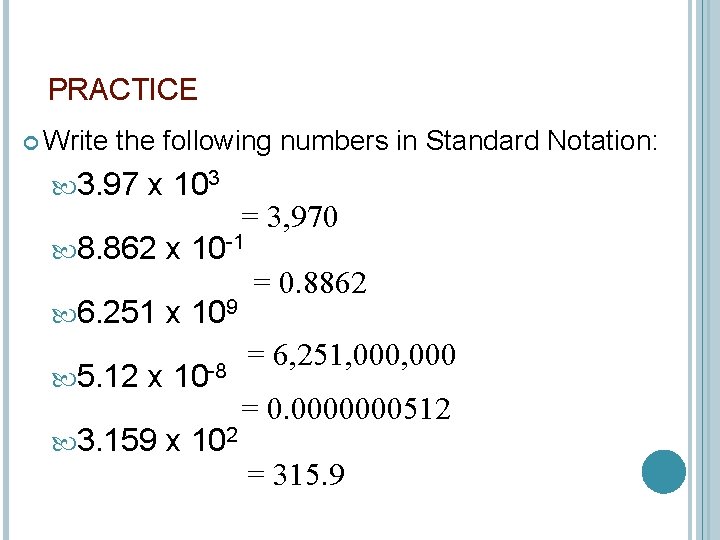
PRACTICE Write the following numbers in Standard Notation: 3. 97 x 103 = 3, 970 8. 862 x 10 -1 6. 251 x 109 5. 12 x 10 -8 3. 159 x 102 = 0. 8862 = 6, 251, 000 = 0. 0000000512 = 315. 9
WHEN YOU ARE FINISHED WITH THE QUIZ… Place quiz in bin… Check to make sure your name is on top Answered all 26 questions Take out your calculator if you have one. You may borrow one by Lab Station 1. Begin working on your Unit 1 HW Packet.
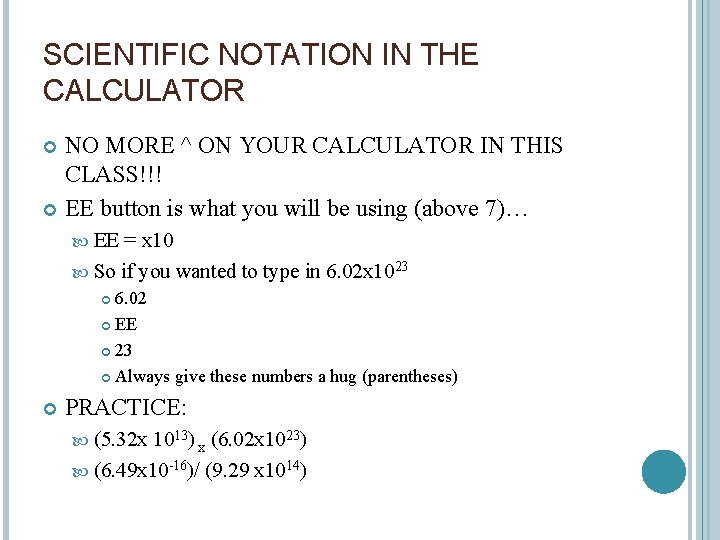
SCIENTIFIC NOTATION IN THE CALCULATOR NO MORE ^ ON YOUR CALCULATOR IN THIS CLASS!!! EE button is what you will be using (above 7)… EE = x 10 So if you wanted to type in 6. 02 x 1023 6. 02 EE 23 Always give these numbers a hug (parentheses) PRACTICE: (5. 32 x 1013) x (6. 02 x 1023) (6. 49 x 10 -16)/ (9. 29 x 1014)
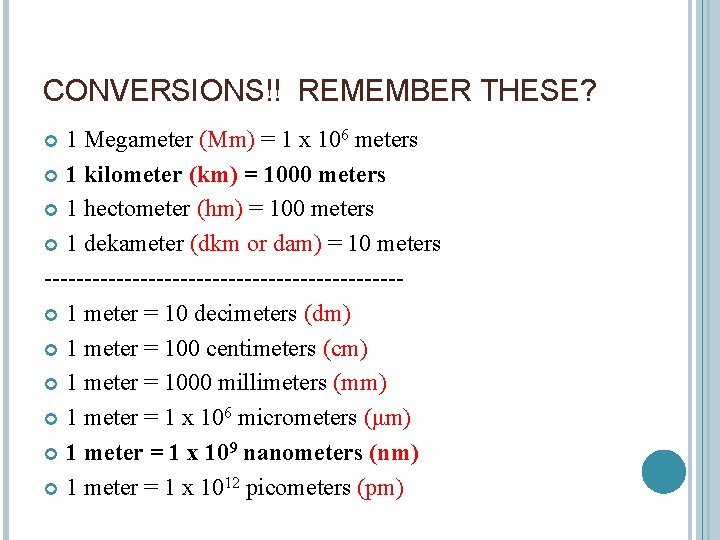
CONVERSIONS!! REMEMBER THESE? 1 Megameter (Mm) = 1 x 10⁶ meters 1 kilometer (km) = 1000 meters 1 hectometer (hm) = 100 meters 1 dekameter (dkm or dam) = 10 meters ---------------------- 1 meter = 10 decimeters (dm) 1 meter = 100 centimeters (cm) 1 meter = 1000 millimeters (mm) 1 meter = 1 x 10⁶ micrometers (μm) 1 meter = 1 x 10⁹ nanometers (nm) 1 meter = 1 x 10¹² picometers (pm)
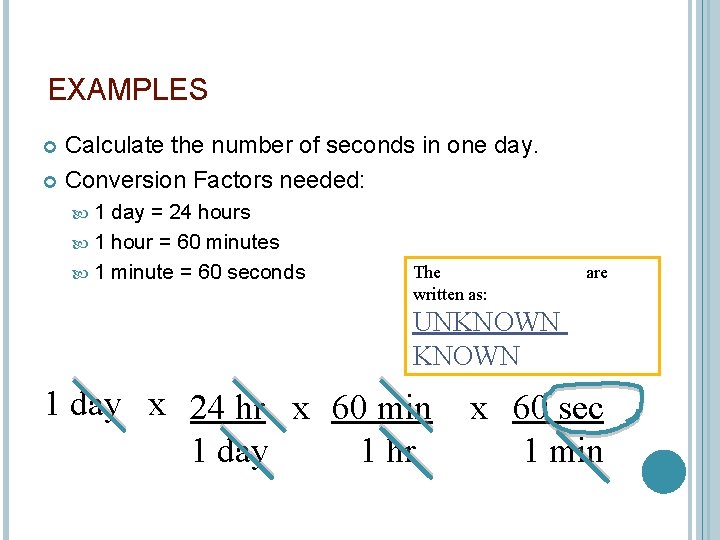
EXAMPLES Calculate the number of seconds in one day. Conversion Factors needed: 1 day = 24 hours 1 hour = 60 minutes 1 minute = 60 seconds The conversion factors are written as: UNKNOWN KNOWN 1 day x 24 hr x 60 min 1 day 1 hr x 60 sec 1 min
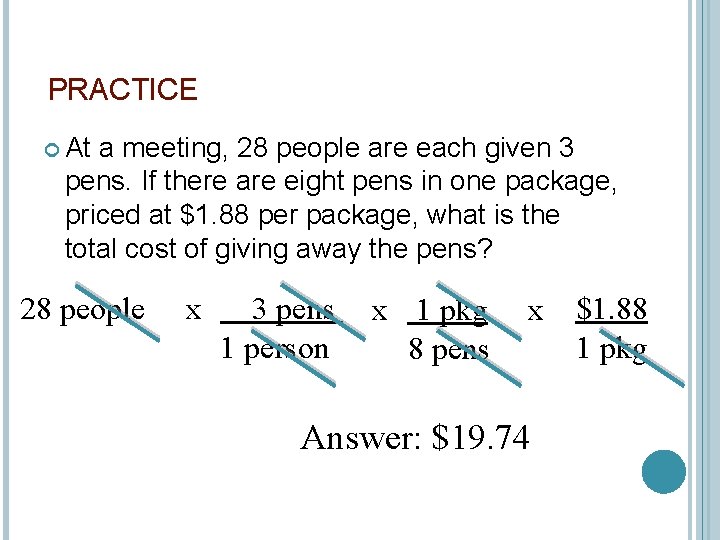
PRACTICE At a meeting, 28 people are each given 3 pens. If there are eight pens in one package, priced at $1. 88 per package, what is the total cost of giving away the pens? 28 people x 3 pens x 1 pkg 1 person 8 pens x $1. 88 1 pkg Answer: $19. 74
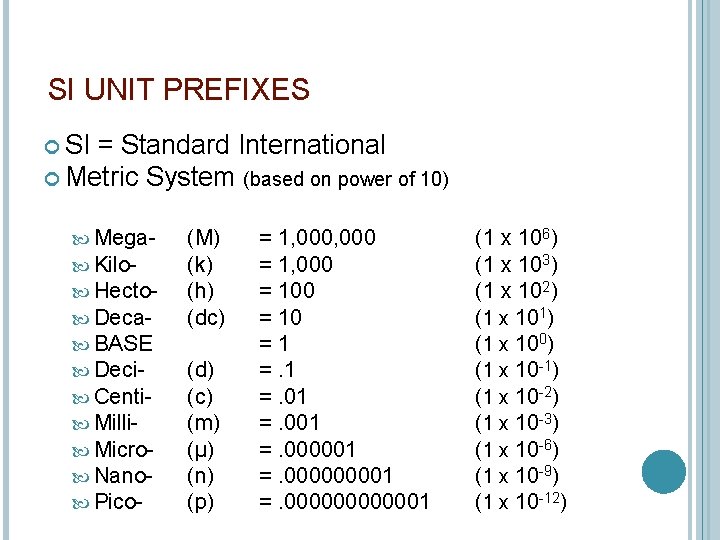
SI UNIT PREFIXES SI = Standard International Metric System (based on power of 10) Mega- Kilo Hecto Deca BASE Deci Centi Milli Micro Nano Pico- (M) (k) (h) (dc) (d) (c) (m) (μ) (n) (p) = 1, 000 = 10 = 1 =. 01 =. 000001 =. 000000000001 (1 x 10⁶) (1 x 10³) (1 x 10²) (1 x 101) (1 x 100) (1 x 10 -1) (1 x 10 -2) (1 x 10 -3) (1 x 10 -6) (1 x 10 -9) (1 x 10 -12)
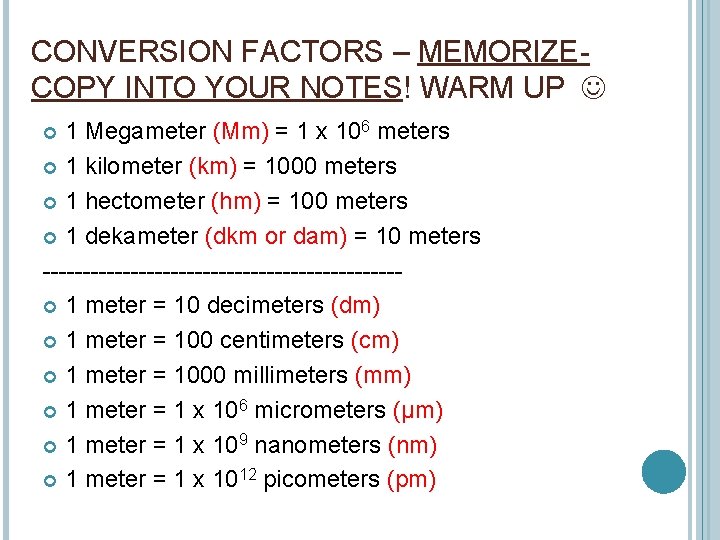
CONVERSION FACTORS – MEMORIZECOPY INTO YOUR NOTES! WARM UP 1 Megameter (Mm) = 1 x 10⁶ meters 1 kilometer (km) = 1000 meters 1 hectometer (hm) = 100 meters 1 dekameter (dkm or dam) = 10 meters ---------------------- 1 meter = 10 decimeters (dm) 1 meter = 100 centimeters (cm) 1 meter = 1000 millimeters (mm) 1 meter = 1 x 10⁶ micrometers (μm) 1 meter = 1 x 10⁹ nanometers (nm) 1 meter = 1 x 10¹² picometers (pm)
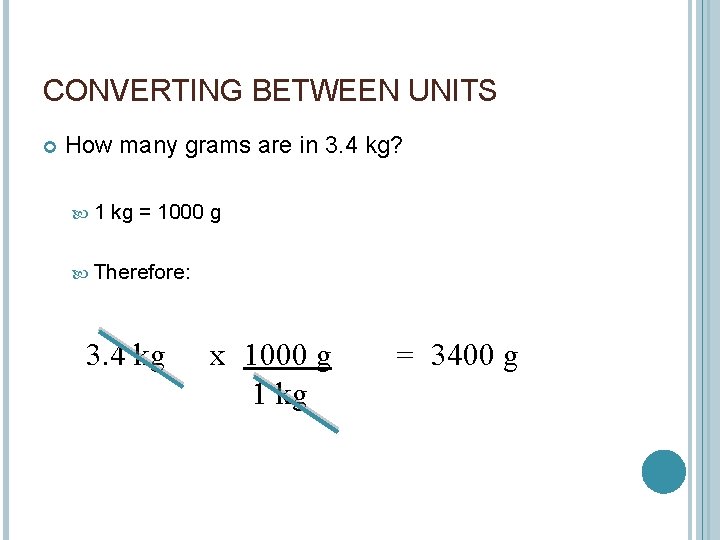
CONVERTING BETWEEN UNITS How many grams are in 3. 4 kg? 1 kg = 1000 g Therefore: 3. 4 kg x 1000 g 1 kg = 3400 g
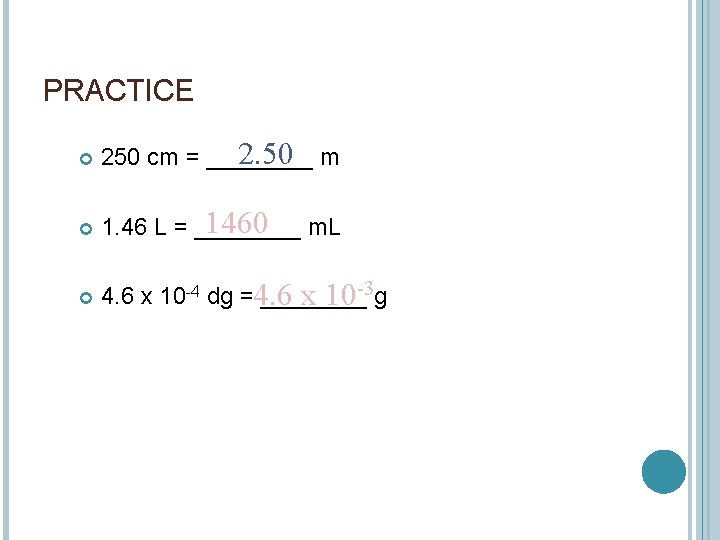
PRACTICE 2. 50 250 cm = ____ m 1460 1. 46 L = ____ m. L 4. 6 x 10 -4 dg = ____ g 4. 6 x 10 -3
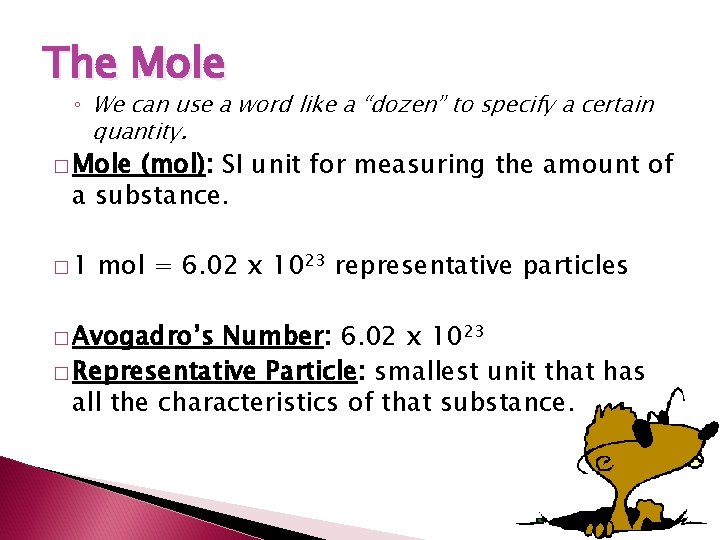
The Mole ◦ We can use a word like a “dozen” to specify a certain quantity. � Mole (mol): SI unit for measuring the amount of a substance. � 1 mol = 6. 02 x 1023 representative particles � Avogadro’s Number: 6. 02 x 1023 � Representative Particle: smallest unit that has all the characteristics of that substance.
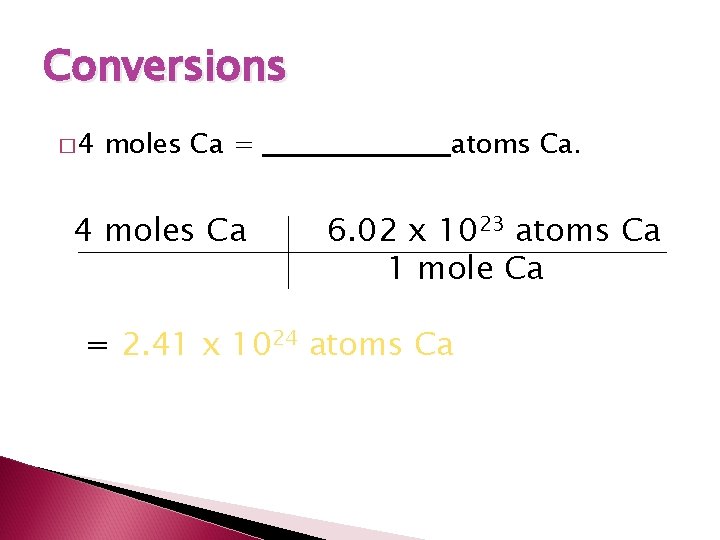
Conversions � 4 moles Ca = 4 moles Ca atoms Ca. 6. 02 x 1023 atoms Ca 1 mole Ca = 2. 41 x 1024 atoms Ca
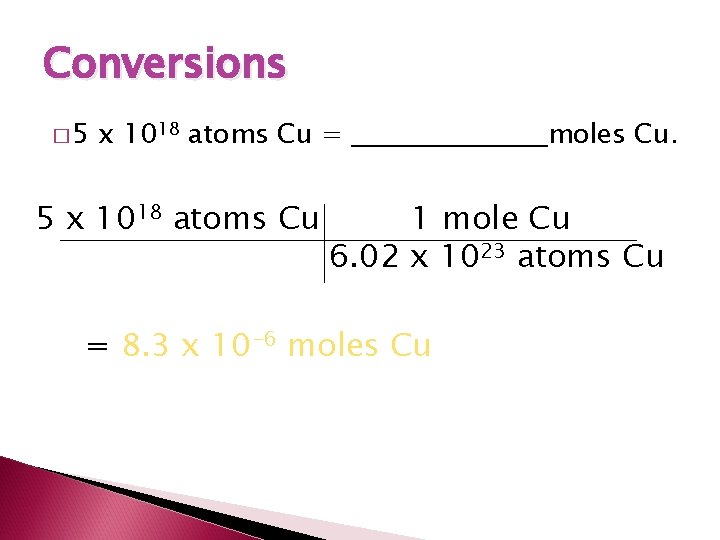
Conversions � 5 x 10¹⁸ atoms Cu = 5 x 10¹⁸ atoms Cu moles Cu. 1 mole Cu 6. 02 x 1023 atoms Cu = 8. 3 x 10 -6 moles Cu
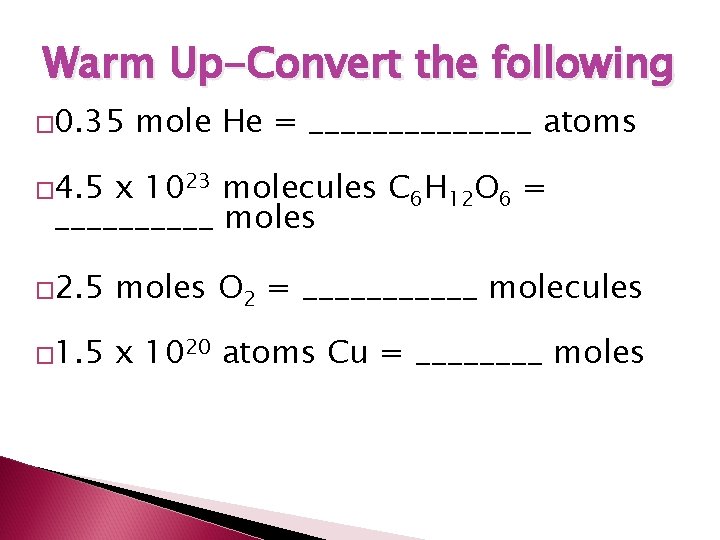
Warm Up-Convert the following � 0. 35 mole He = _______ atoms � 4. 5 x 10²³ molecules C 6 H 12 O 6 = _____ moles � 2. 5 moles O 2 = ______ molecules � 1. 5 x 10²⁰ atoms Cu = ____ moles
THE HISTORY OF THE ATOM How did we learn about the atom?
WARM UP Complete the Scientist worksheet from yesterday! Textbooks are at Station 3 You will get your tests back today and I will explain how I grade tests. I always open up to the class on questions about the test instead of answering individual questions. I’m sure if you are stuck on one question someone else may be as well I will also explain recovery tests
THE ATOMIC THEORY OF MATTER All matter is made up of fundamental particles. What does “fundamental” mean?
S. MORRIS 2006
THE HISTORY OF THE ATOM How did we learn about the atom?
Warm- up-Grab a textbook • Chemistry is the study of matter, brainstorm the different types of matter and list them in your warm-up. • How do you compare Physical and chemical properties
Grab a textbook…. . • Use Ch. 4 to take as much notes as you can about each scientist
THE ATOMIC THEORY OF MATTER All matter is made up of fundamental particles. What does “fundamental” mean?
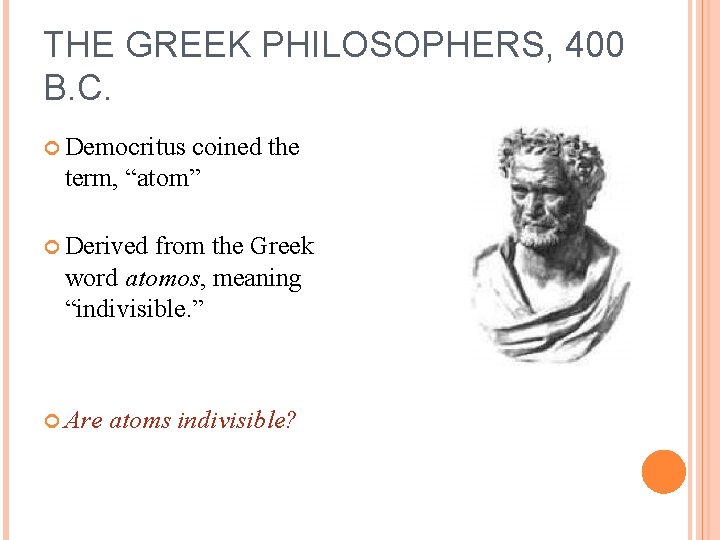
THE GREEK PHILOSOPHERS, 400 B. C. Democritus coined the term, “atom” Derived from the Greek word atomos, meaning “indivisible. ” Are atoms indivisible?
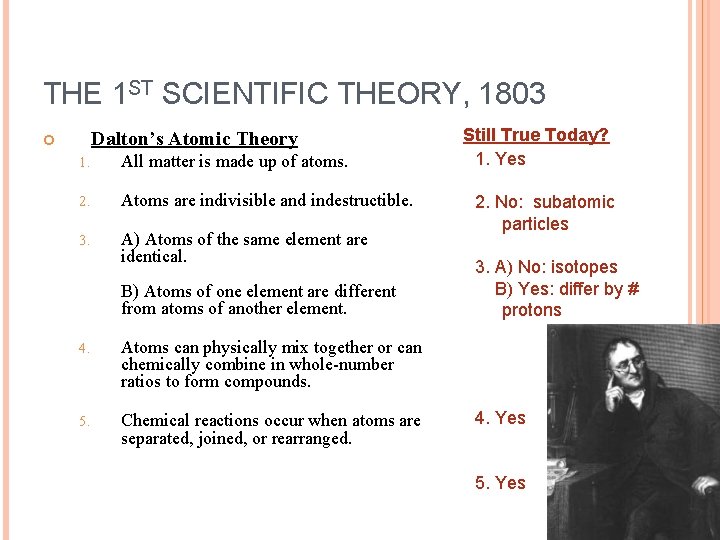
THE 1 ST SCIENTIFIC THEORY, 1803 Dalton’s Atomic Theory 1. All matter is made up of atoms. 2. Atoms are indivisible and indestructible. 3. A) Atoms of the same element are identical. B) Atoms of one element are different from atoms of another element. 4. Atoms can physically mix together or can chemically combine in whole-number ratios to form compounds. 5. Chemical reactions occur when atoms are separated, joined, or rearranged. Still True Today? 1. Yes 2. No: subatomic particles 3. A) No: isotopes B) Yes: differ by # protons 4. Yes 5. Yes
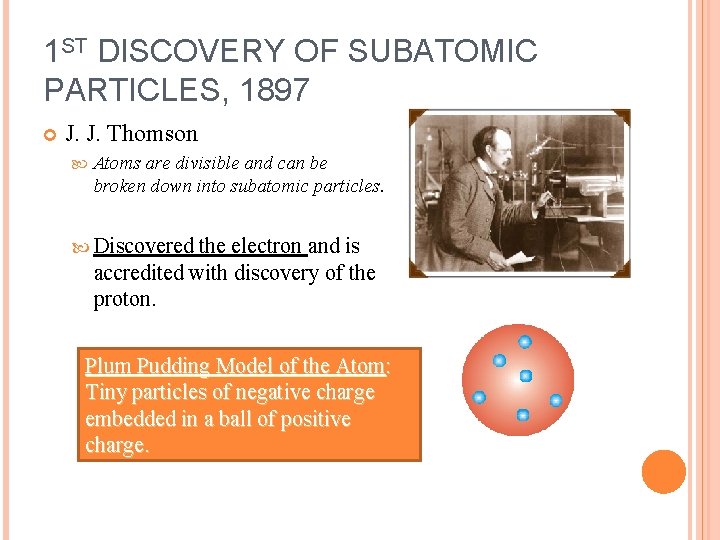
1 ST DISCOVERY OF SUBATOMIC PARTICLES, 1897 J. J. Thomson Atoms are divisible and can be broken down into subatomic particles. Discovered the electron and is accredited with discovery of the proton. Plum Pudding Model of the Atom: Tiny particles of negative charge embedded in a ball of positive charge.
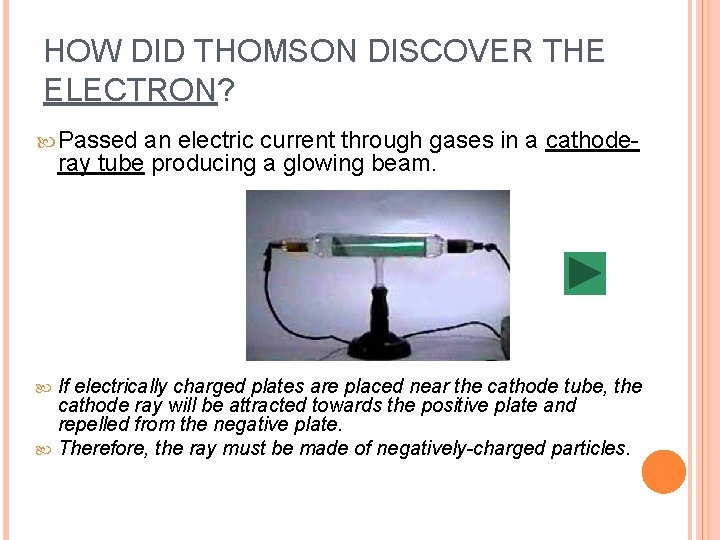
HOW DID THOMSON DISCOVER THE ELECTRON? Passed an electric current through gases in a cathode- ray tube producing a glowing beam. If electrically charged plates are placed near the cathode tube, the cathode ray will be attracted towards the positive plate and repelled from the negative plate. Therefore, the ray must be made of negatively-charged particles.
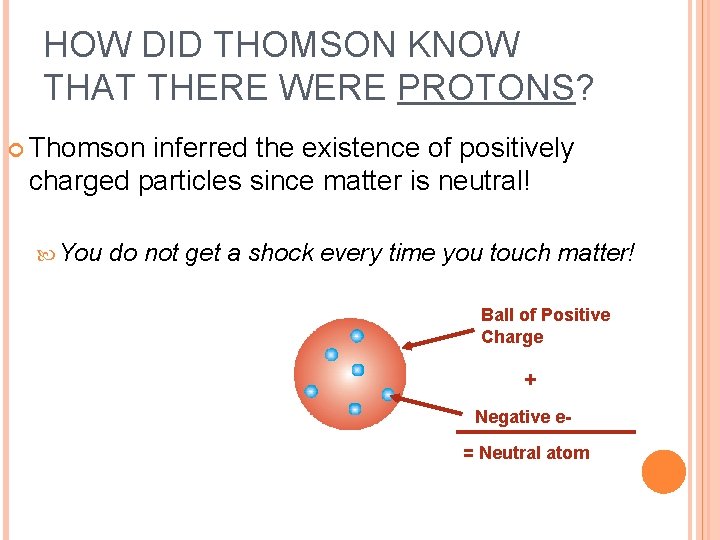
HOW DID THOMSON KNOW THAT THERE WERE PROTONS? Thomson inferred the existence of positively charged particles since matter is neutral! You do not get a shock every time you touch matter! Ball of Positive Charge + Negative e= Neutral atom
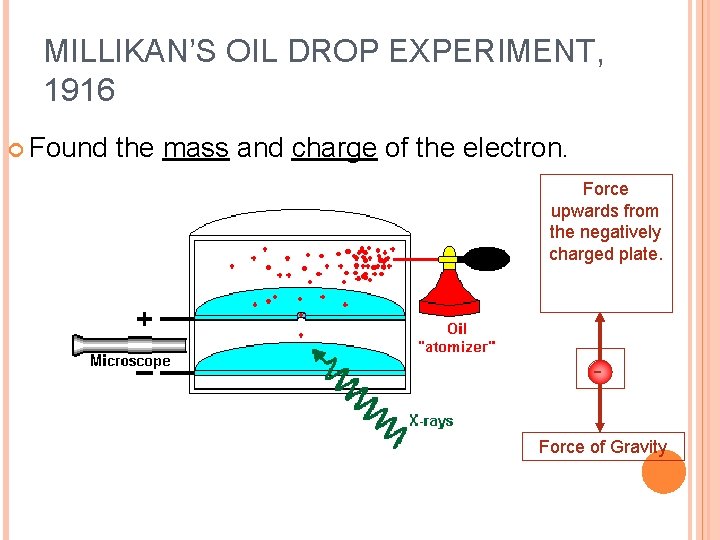
MILLIKAN’S OIL DROP EXPERIMENT, 1916 Found the mass and charge of the electron. Force upwards from the negatively charged plate. - Force of Gravity
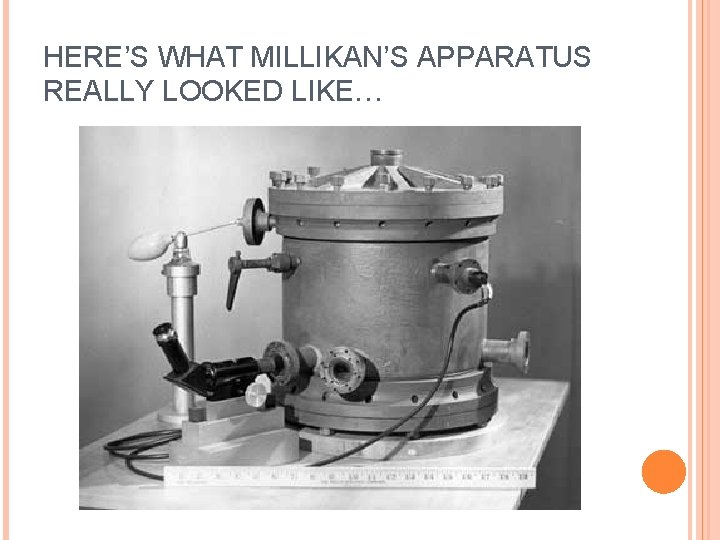
HERE’S WHAT MILLIKAN’S APPARATUS REALLY LOOKED LIKE…
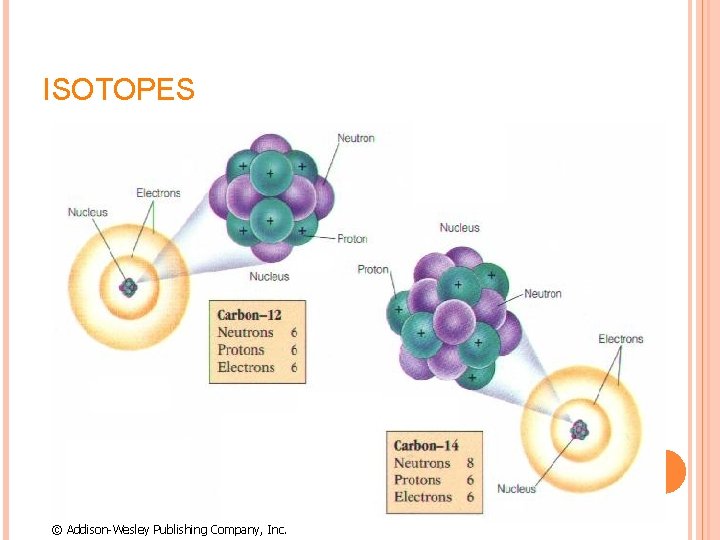
CHADWICK, 1932 Discovered the neutron. Isotopes: Atoms of an element that are chemically alike but differ in mass. Same number of protons and electrons, different number of neutrons! Ex. Carbon-14 and Carbon-12
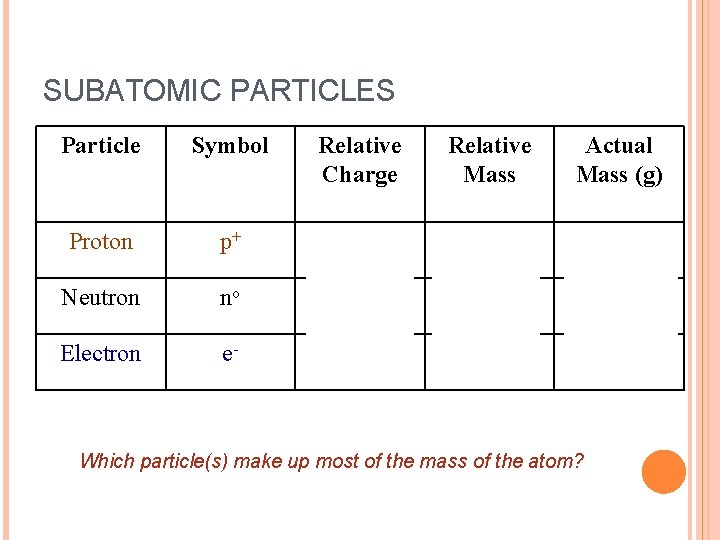
SUBATOMIC PARTICLES Particle Symbol Relative Charge Relative Mass Actual Mass (g) Proton p+ 1+ 1 1. 67 x 10 -24 Neutron no 0 1 1. 67 x 10 -24 Electron e- 1 - 1/1840 9. 11 x 10 -28 Which particle(s) make up most of the mass of the atom?
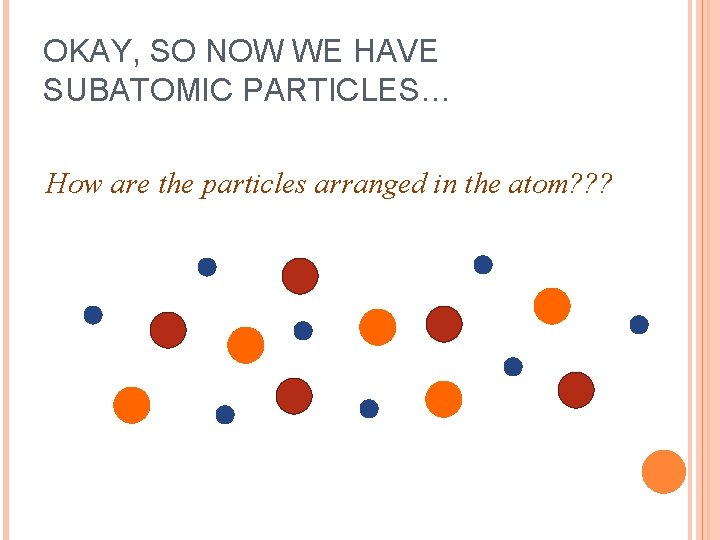
OKAY, SO NOW WE HAVE SUBATOMIC PARTICLES… How are the particles arranged in the atom? ? ?
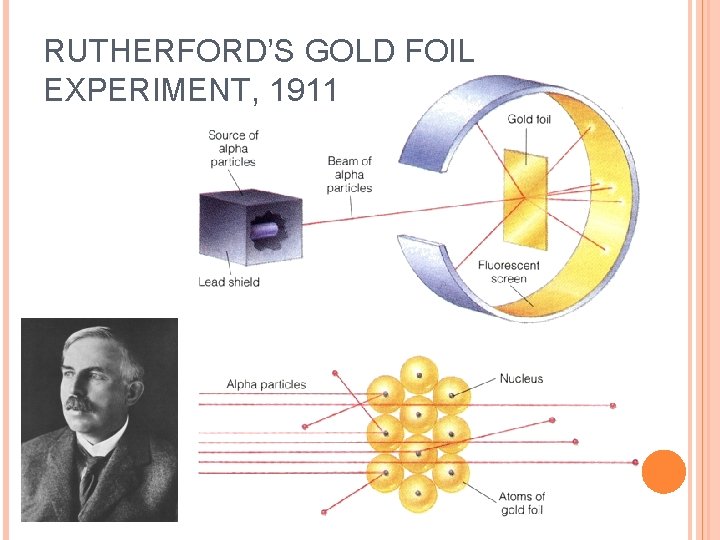
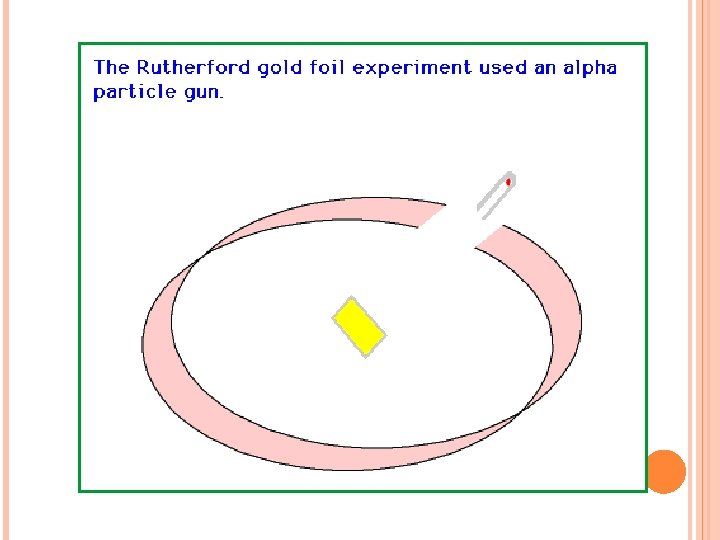
RUTHERFORD’S GOLD FOIL EXPERIMENT, 1911
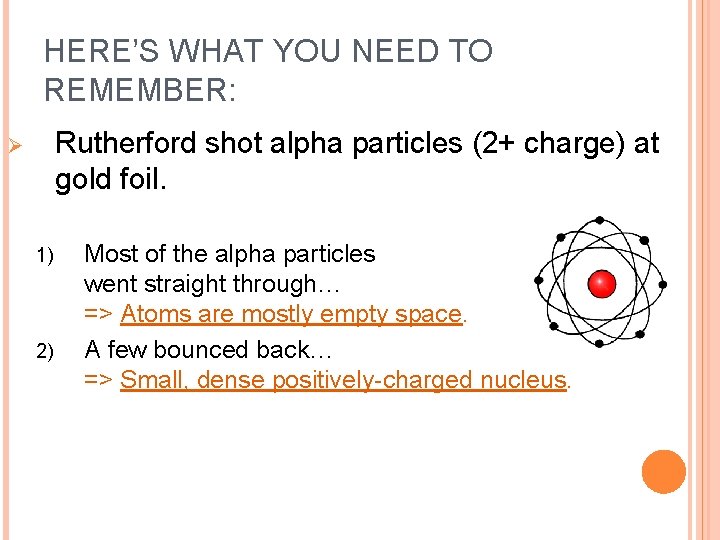
HERE’S WHAT YOU NEED TO REMEMBER: Rutherford shot alpha particles (2+ charge) at gold foil. Ø 1) 2) Most of the alpha particles went straight through… => Atoms are mostly empty space. A few bounced back… => Small, dense positively-charged nucleus.
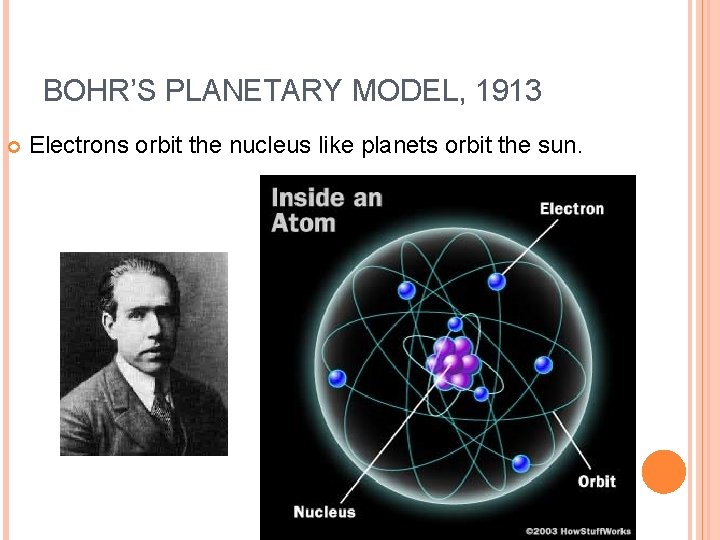
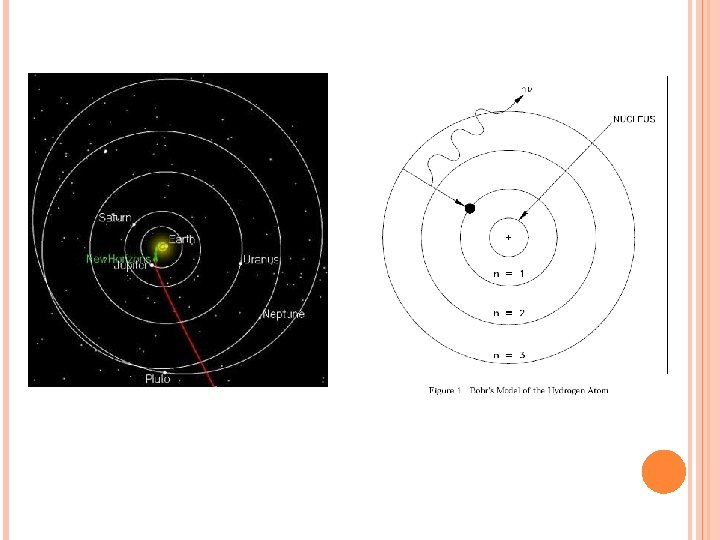
BOHR’S PLANETARY MODEL, 1913 Electrons orbit the nucleus like planets orbit the sun.
BOHR: ELECTRONS IN ORBITS • Ø Bohr studied how atoms emit or absorb light. Negative electrons circle a positive nucleus. • Electrons overcome the attraction of the nucleus because they are in motion. Ø Given more energy, electrons will move to an orbit farther away from the nucleus. Ø Electrons can occupy only certain orbits called energy levels. Ø Energy Levels: regions of space in which e- can move about the nucleus of an atom.
WARM UP Give a brief summary on the history of our atom; scientists and their discoveries up to today What does the Bohr model explain about our atom? Take out your notes from yesterday and we will continue today
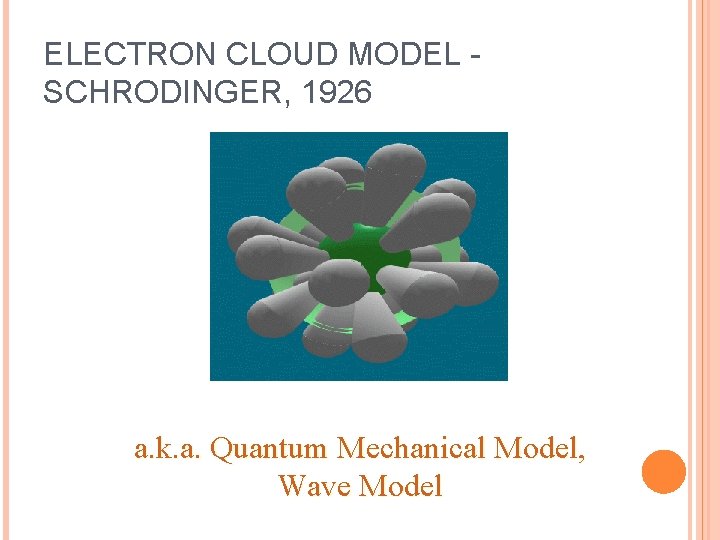
ELECTRON CLOUD MODEL - SCHRODINGER, 1926 a. k. a. Quantum Mechanical Model, Wave Model
WHY IS IT CALLED THE ELECTRON CLOUD MODEL? Electrons do not orbit. Electrons can only have certain energies (energy levels). Cannot pinpoint the exact location of electrons (only probability). Therefore, the probability of finding an electron is represented by an electron cloud. Heisenberg’s Uncertainty Principle: It is impossible to know the velocity and the position of a particle at the same time.
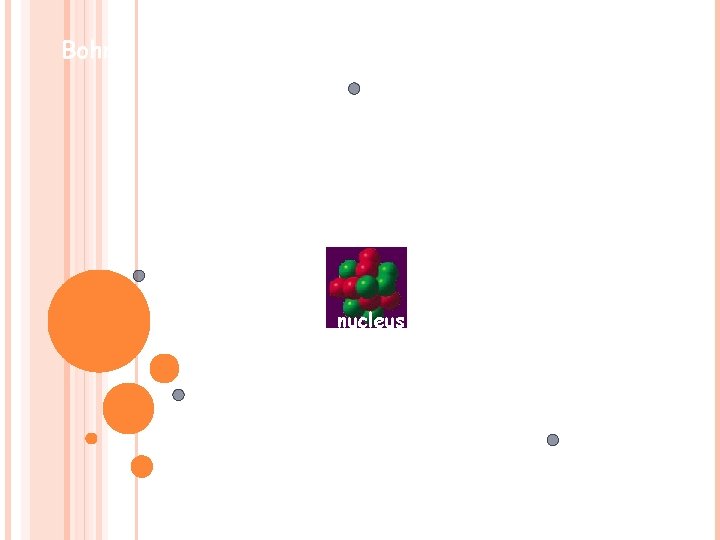
Bohr’s Atom electrons in orbits nucleus
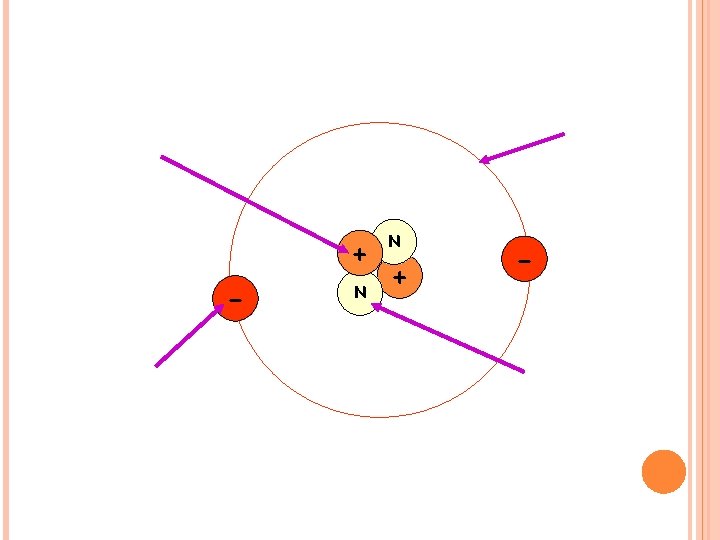
HELIUM ATOM Shell proton + - N N + electron What do these particles consist of? - neutron
OKAY, SO NOW WE HAVE SUBATOMIC PARTICLES… How are the particles arranged in the atom? ? ?
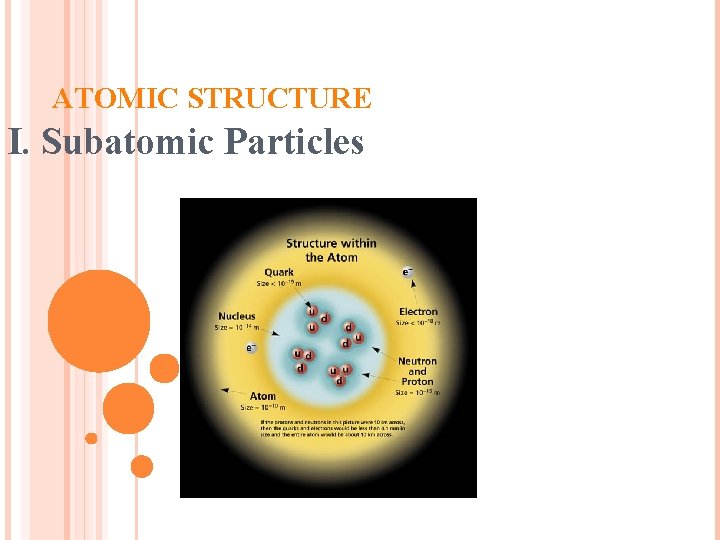
ATOMIC STRUCTURE I. Subatomic Particles
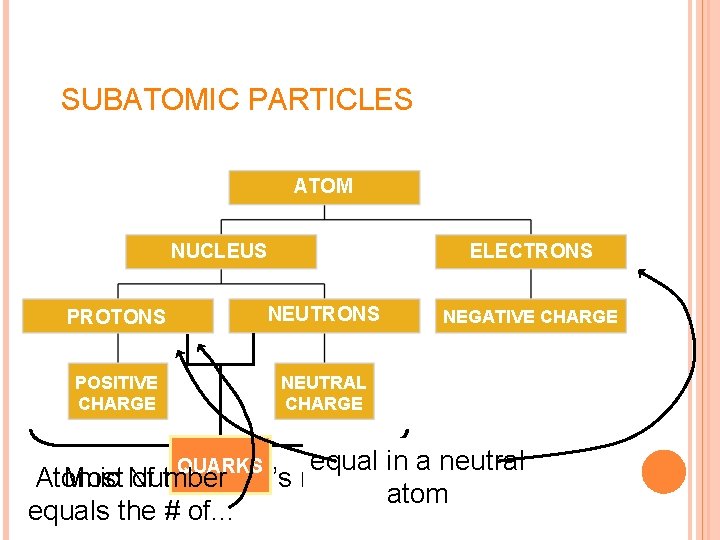
SUBATOMIC PARTICLES ATOM NUCLEUS ELECTRONS PROTONS NEUTRONS POSITIVE CHARGE NEUTRAL CHARGE NEGATIVE CHARGE equal in a neutral Atomic Number Most of the atom’s mass. atom equals the # of. . . QUARKS
Warm-up • Which Statements in Dalton’s original atomic Theory are now considered to be incorrect? Describe how modern atomic theory differs from these statements. • Briefly outline all our scientists and their discoveries
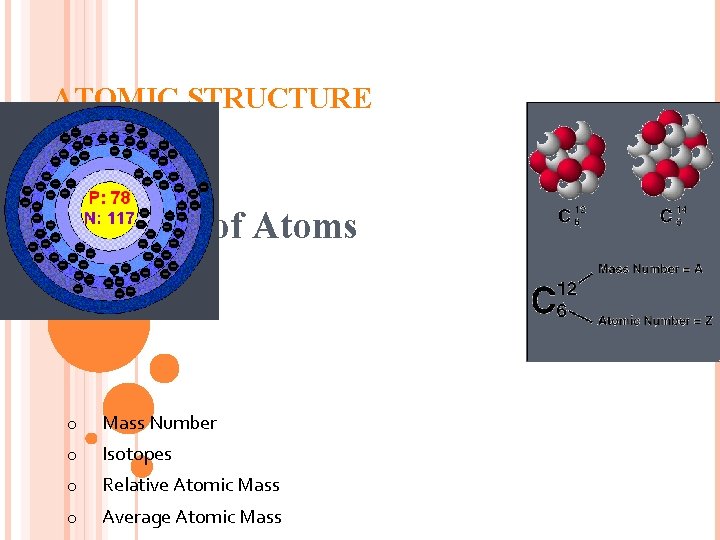
ATOMIC STRUCTURE II. Masses of Atoms o Mass Number o Isotopes o Relative Atomic Mass o Average Atomic Mass
WARM UP 1. Chemistry is the study of matter, brainstorm the different types of matter and list them in your warm-up. 2. How do you compare Physical and chemical properties
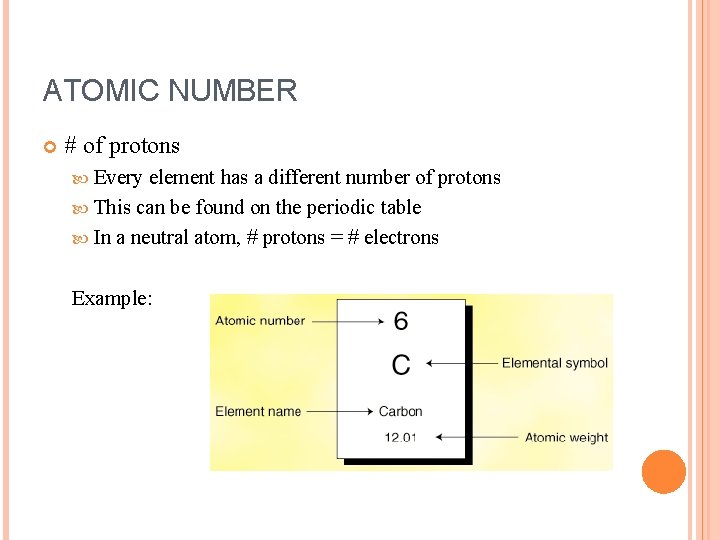
ATOMIC NUMBER # of protons Every element has a different number of protons This can be found on the periodic table In a neutral atom, # protons = # electrons Example:
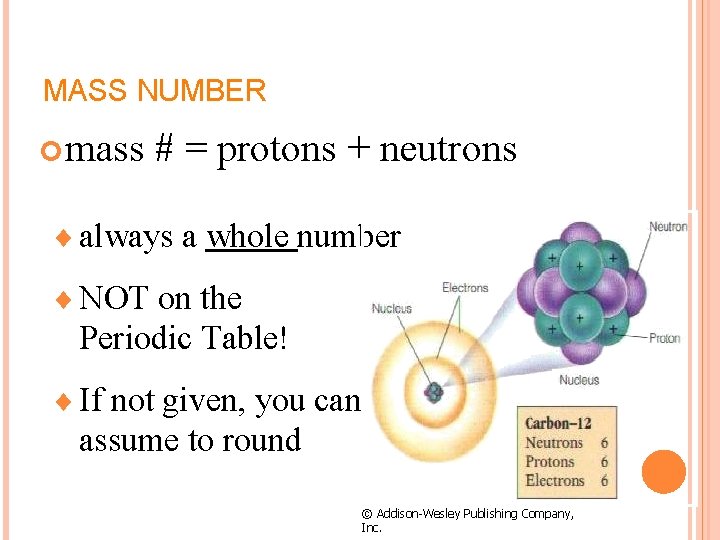
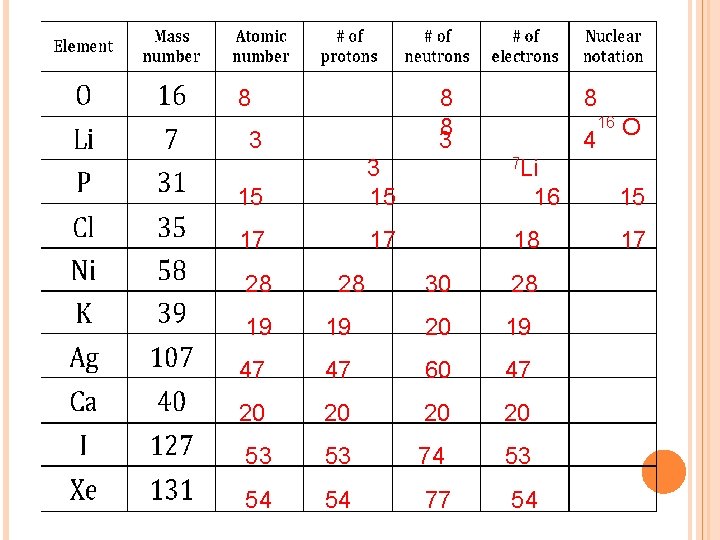
MASS NUMBER mass # = protons + neutrons ¨ always a whole number ¨ NOT on the Periodic Table! ¨ If not given, you can assume to round © Addison-Wesley Publishing Company, Inc.
8 8 8 3 8 16 O 4 3 15 3 15 7 Li 17 17 18 17 16 15 28 30 28 19 20 19 47 60 47 20 20 20 53 74 53 54 77 54
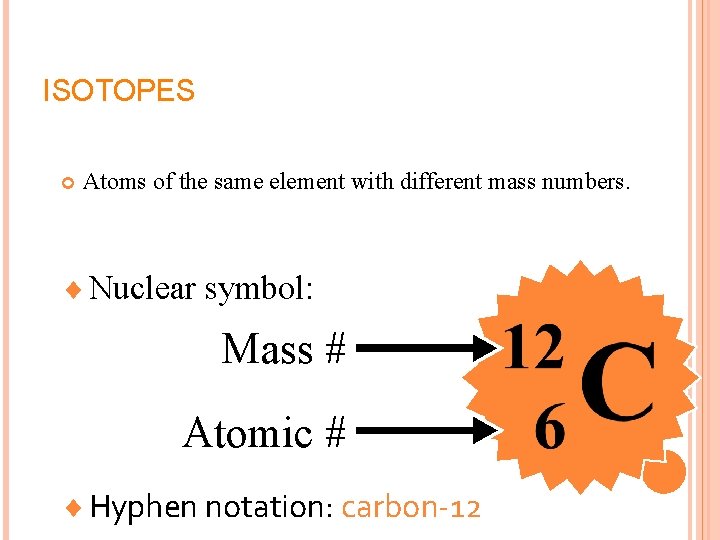
ISOTOPES Atoms of the same element with different mass numbers. ¨ Nuclear symbol: Mass # Atomic # ¨ Hyphen notation: carbon-12
ISOTOPES © Addison-Wesley Publishing Company, Inc.
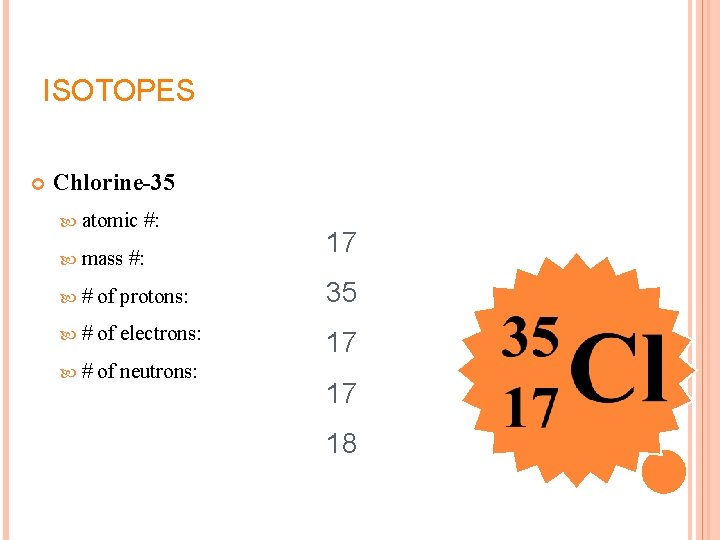
ISOTOPES Chlorine-35 atomic #: mass #: 17 # of protons: 35 # of electrons: 17 # of neutrons: 17 18
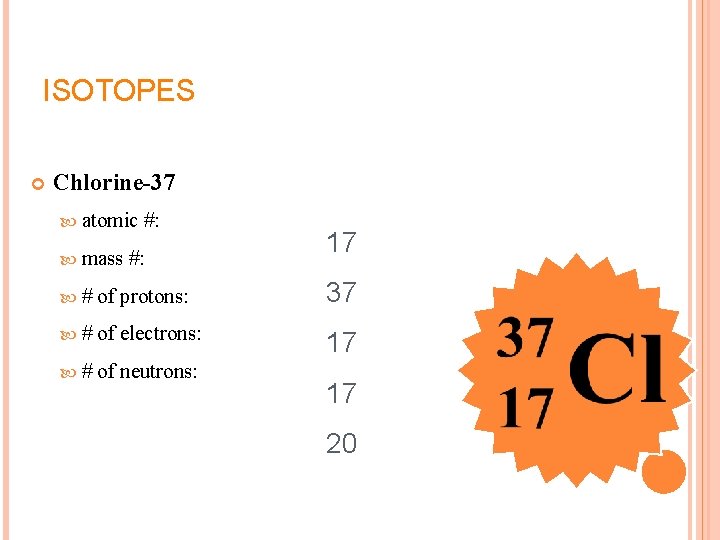
ISOTOPES Chlorine-37 atomic #: mass #: 17 # of protons: 37 # of electrons: 17 # of neutrons: 17 20
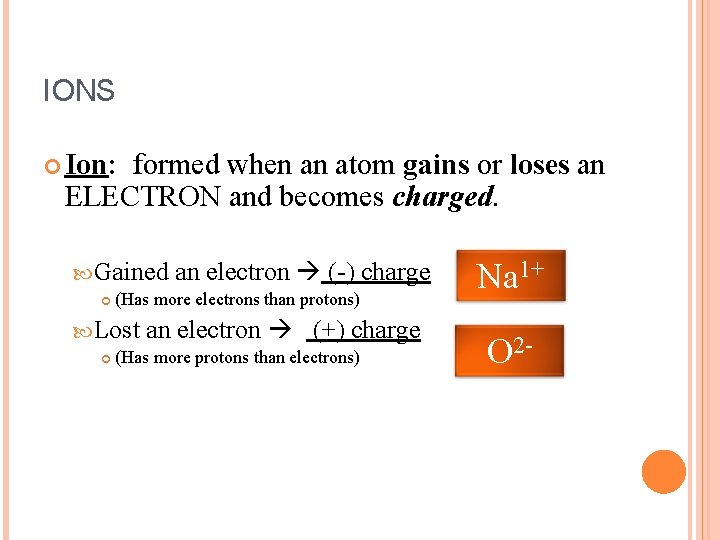
IONS Ion: formed when an atom gains or loses an ELECTRON and becomes charged. Gained an electron (-) charge (Has more electrons than protons) Lost an electron (+) charge (Has more protons than electrons) Na 1+ O 2 -
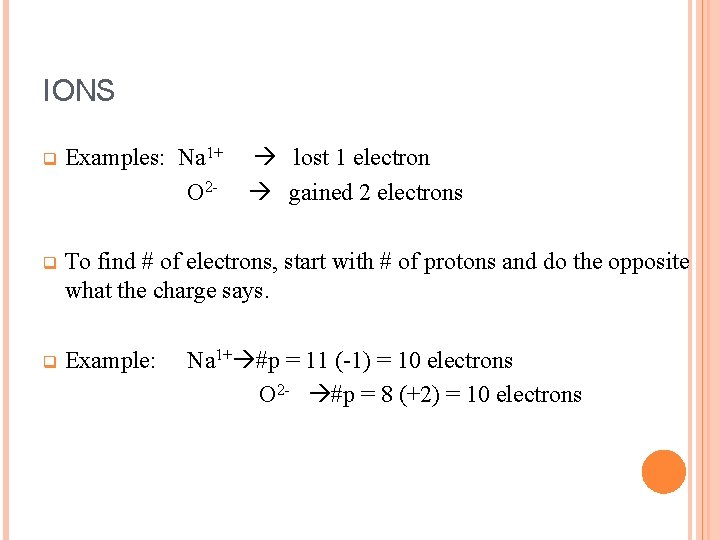
IONS q Examples: Na 1+ lost 1 electron O 2 - gained 2 electrons q To find # of electrons, start with # of protons and do the opposite what the charge says. q Example: Na 1+ #p = 11 (-1) = 10 electrons O 2 - #p = 8 (+2) = 10 electrons
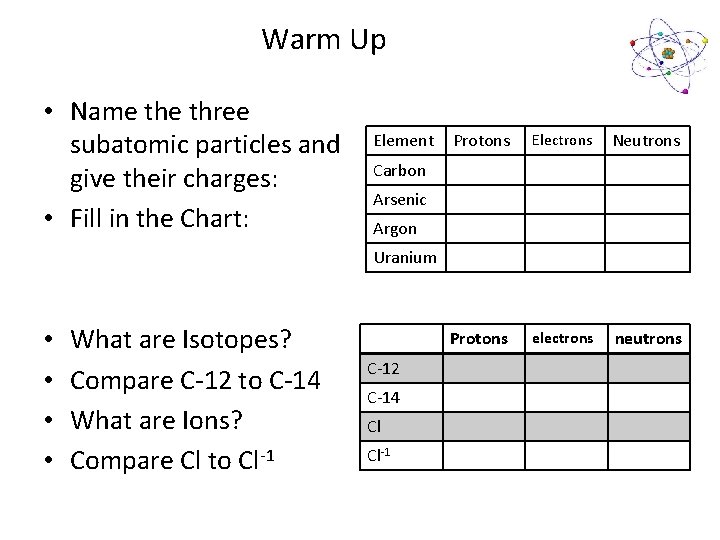
Warm Up • Name three subatomic particles and give their charges: • Fill in the Chart: Element Protons Electrons Neutrons Protons electrons neutrons Carbon Arsenic Argon Uranium • • What are Isotopes? Compare C-12 to C-14 What are Ions? Compare Cl to Cl-1 C-12 C-14 Cl Cl-1
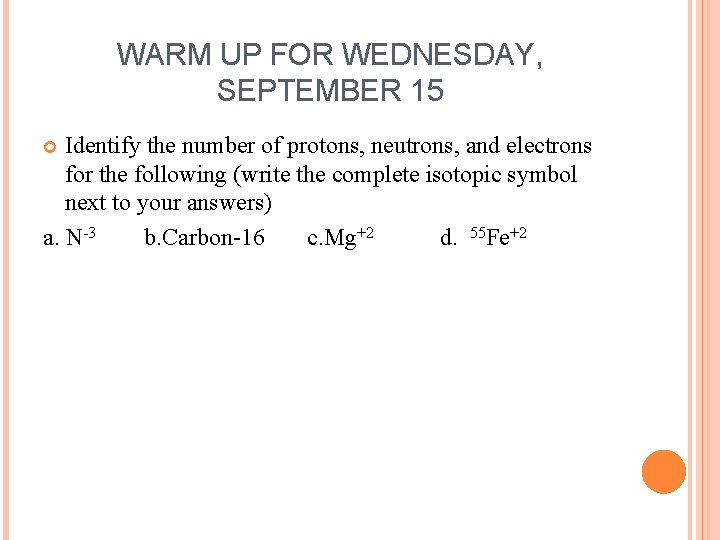
WARM UP FOR WEDNESDAY, SEPTEMBER 15 Identify the number of protons, neutrons, and electrons for the following (write the complete isotopic symbol next to your answers) a. N-3 b. Carbon-16 c. Mg+2 d. 55 Fe+2
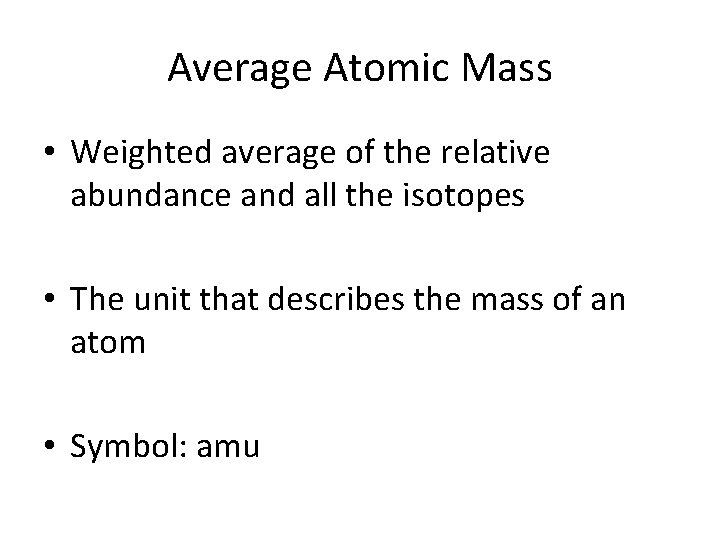
Average Atomic Mass • Weighted average of the relative abundance and all the isotopes • The unit that describes the mass of an atom • Symbol: amu
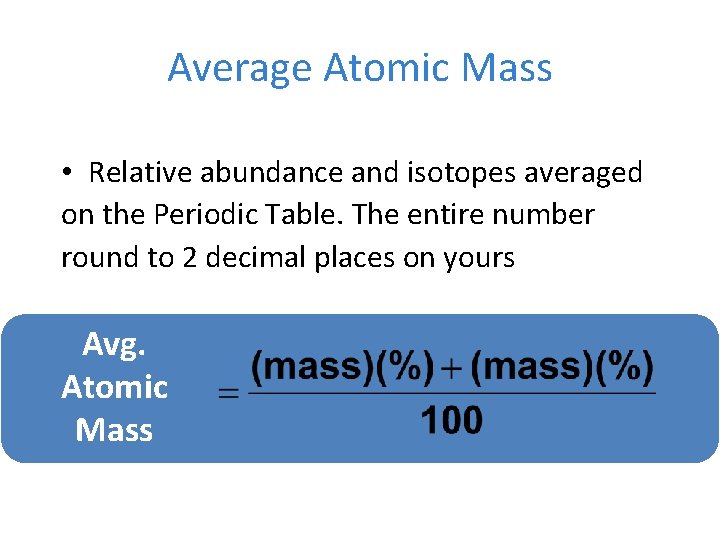
Average Atomic Mass • Relative abundance and isotopes averaged on the Periodic Table. The entire number round to 2 decimal places on yours Avg. Atomic Mass
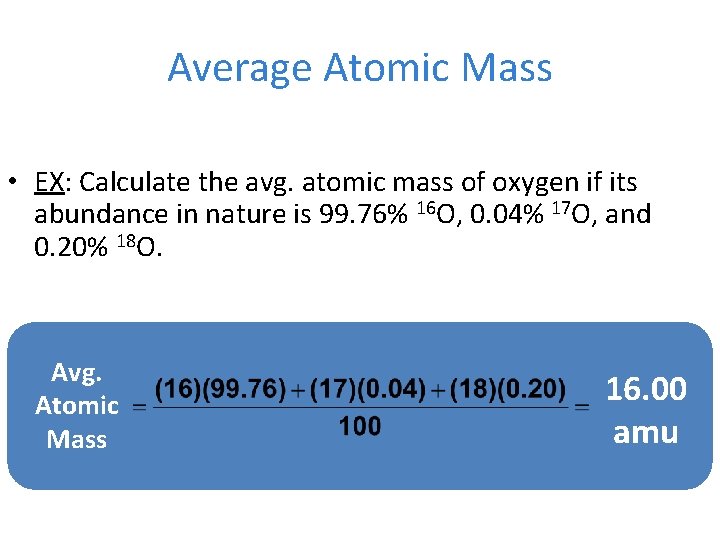
Average Atomic Mass • EX: Calculate the avg. atomic mass of oxygen if its abundance in nature is 99. 76% 16 O, 0. 04% 17 O, and 0. 20% 18 O. Avg. Atomic Mass 16. 00 amu
Example #1 • The mass of a Cu-63 atom is 62. 94 amu, and that of a Cu-65 atom is 64. 93 amu. The percent abundance of Cu-63 is 69. 17% and the percent abundance of Cu-65 is 30. 83%. What is the average atomic mass of Cu?
Example #1 • The mass of a Cu-63 atom is 62. 94 amu, and that of a Cu-65 atom is 64. 93 amu. The percent abundance of Cu-63 is 69. 17% and the percent abundance of Cu-65 is 30. 83%. What is the average atomic mass? • Step 1: Find the contribution of each isotope: Cu-63: (62. 94 amu) x (0. 6917) = 43. 535598 amu Cu-65: (64. 93 amu) x (0. 3083) = 20. 017919 amu • Step 2: Add the relative abundances from each isotope together. 43. 535598 amu + 20. 017919 amu = 63. 553517 amu Round answer to two numbers after the decimal: 63. 55 amu
Example #2 • Calculate the average atomic mass of chromium. It is made up of isotopes with the following percent compositions and atomic masses: 83. 79% with a mass of 51. 94 amu; 9. 50% with a mass of 52. 94 amu; 4. 35% with a mass of 49. 95 amu; 2. 36 % with a mass of 53. 94 amu.
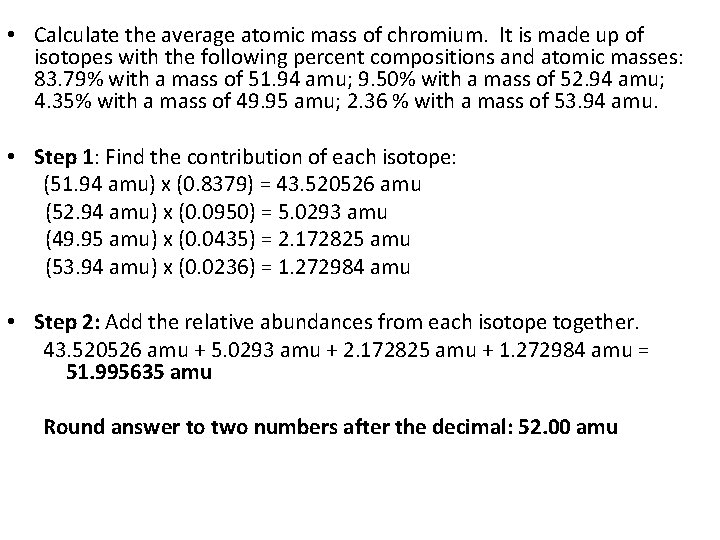
• Calculate the average atomic mass of chromium. It is made up of isotopes with the following percent compositions and atomic masses: 83. 79% with a mass of 51. 94 amu; 9. 50% with a mass of 52. 94 amu; 4. 35% with a mass of 49. 95 amu; 2. 36 % with a mass of 53. 94 amu. • Step 1: Find the contribution of each isotope: (51. 94 amu) x (0. 8379) = 43. 520526 amu (52. 94 amu) x (0. 0950) = 5. 0293 amu (49. 95 amu) x (0. 0435) = 2. 172825 amu (53. 94 amu) x (0. 0236) = 1. 272984 amu • Step 2: Add the relative abundances from each isotope together. 43. 520526 amu + 5. 0293 amu + 2. 172825 amu + 1. 272984 amu = 51. 995635 amu Round answer to two numbers after the decimal: 52. 00 amu
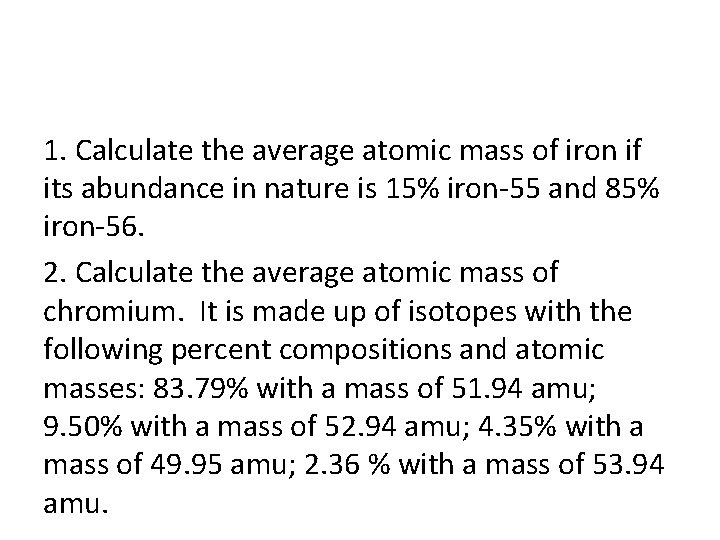
1. Calculate the average atomic mass of iron if its abundance in nature is 15% iron-55 and 85% iron-56. 2. Calculate the average atomic mass of chromium. It is made up of isotopes with the following percent compositions and atomic masses: 83. 79% with a mass of 51. 94 amu; 9. 50% with a mass of 52. 94 amu; 4. 35% with a mass of 49. 95 amu; 2. 36 % with a mass of 53. 94 amu.
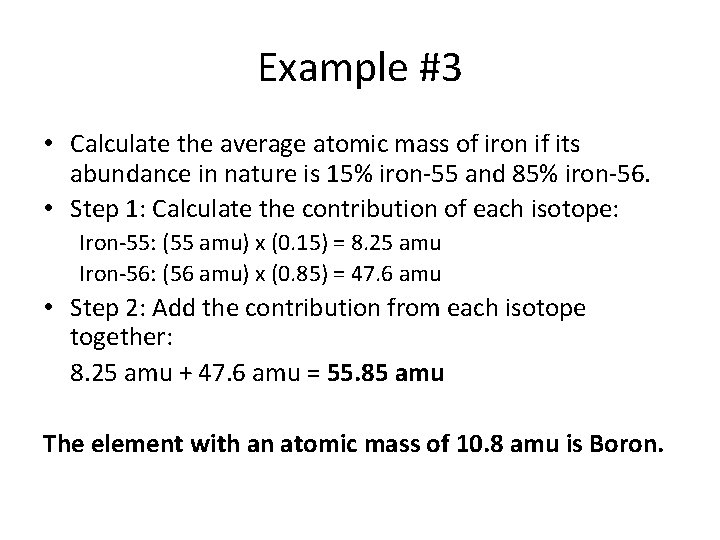
Example #3 • Calculate the average atomic mass of iron if its abundance in nature is 15% iron-55 and 85% iron-56. • Step 1: Calculate the contribution of each isotope: Iron-55: (55 amu) x (0. 15) = 8. 25 amu Iron-56: (56 amu) x (0. 85) = 47. 6 amu • Step 2: Add the contribution from each isotope together: 8. 25 amu + 47. 6 amu = 55. 85 amu The element with an atomic mass of 10. 8 amu is Boron.
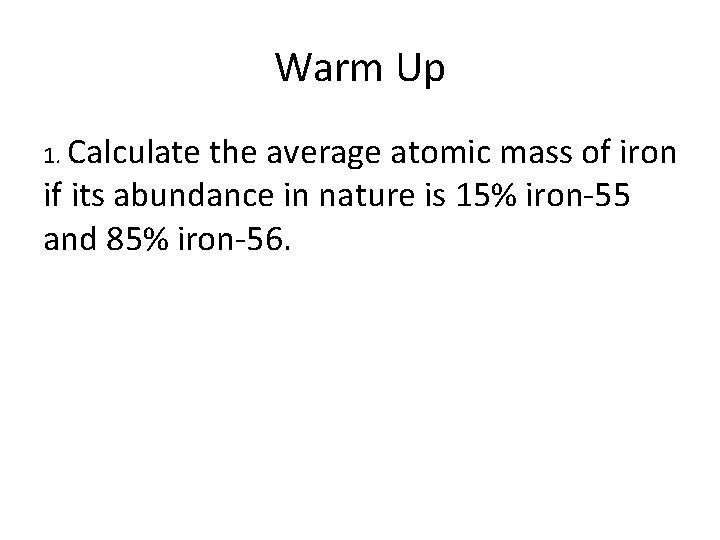
Warm Up 1. Calculate the average atomic mass of iron if its abundance in nature is 15% iron-55 and 85% iron-56.
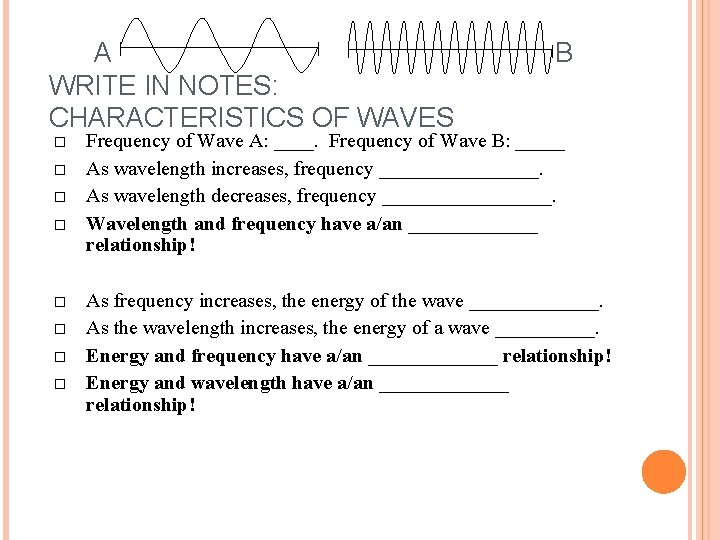
A B WRITE IN NOTES: CHARACTERISTICS OF WAVES Frequency of Wave A: ____. Frequency of Wave B: _____ As wavelength increases, frequency ________. As wavelength decreases, frequency _________. Wavelength and frequency have a/an _______ relationship! As frequency increases, the energy of the wave _______. As the wavelength increases, the energy of a wave _____. Energy and frequency have a/an _______ relationship! Energy and wavelength have a/an _______ relationship!
WARM UP Arrange in order from least energy most energy. Hint: The more energy an electromagnetic wave has, the more dangerous it is for us.
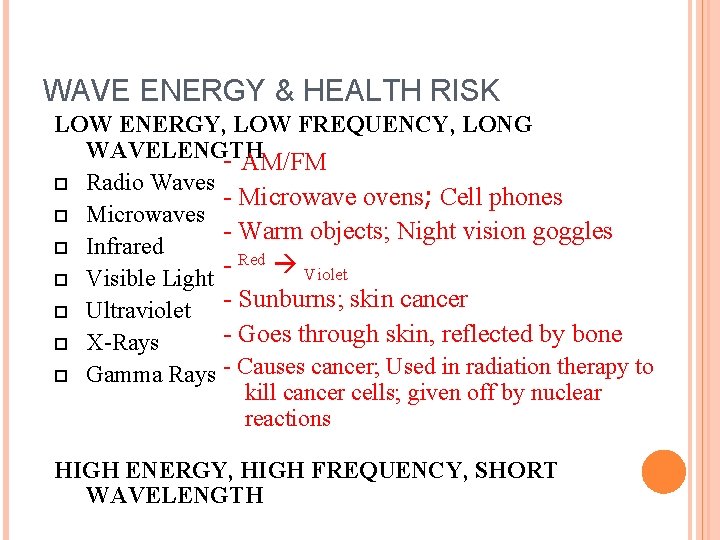
WAVE ENERGY & HEALTH RISK LOW ENERGY, LOW FREQUENCY, LONG WAVELENGTH - AM/FM Radio Waves - Microwave ovens; Cell phones Microwaves - Warm objects; Night vision goggles Infrared Red - Violet Visible Light - Sunburns; skin cancer Ultraviolet - Goes through skin, reflected by bone X-Rays Gamma Rays - Causes cancer; Used in radiation therapy to kill cancer cells; given off by nuclear reactions HIGH ENERGY, HIGH FREQUENCY, SHORT WAVELENGTH
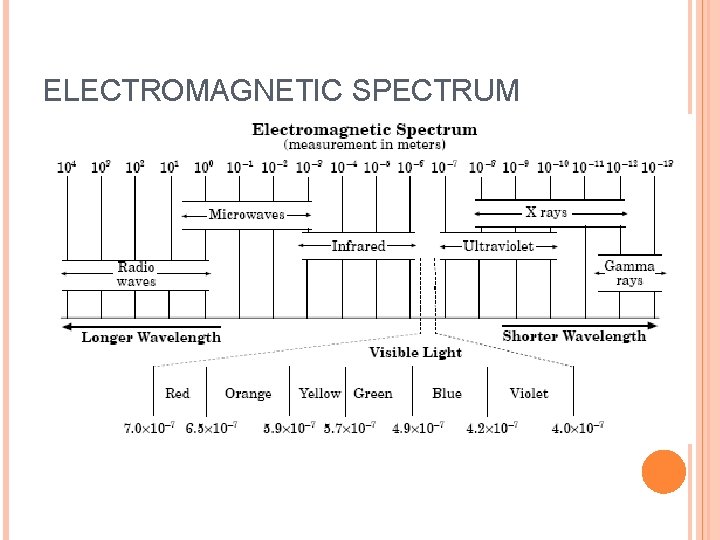
ELECTROMAGNETIC SPECTRUM
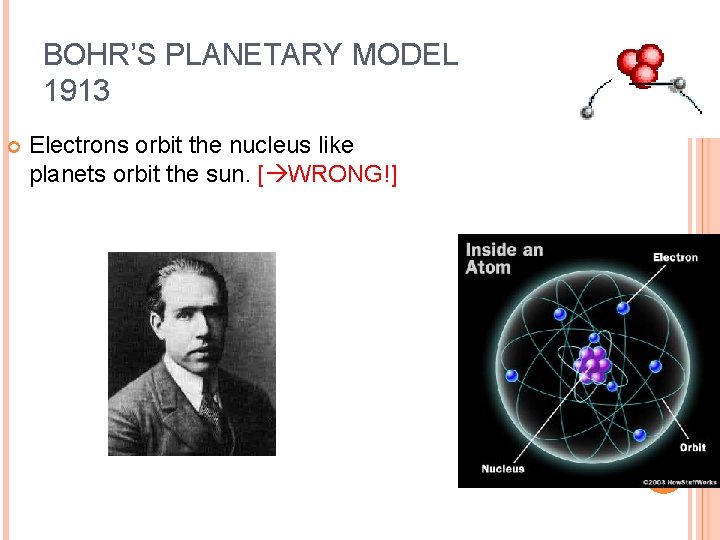
BOHR’S PLANETARY MODEL 1913 Electrons orbit the nucleus like planets orbit the sun. [ WRONG!]
BOHR: ELECTRONS IN ENERGY LEVELS • Bohr studied how atoms emit or absorb light. Here’s what he discovered that still holds true today… Ø Electrons can occupy only certain energy levels. Ø Energy Levels: Regions of space in which e- can move about the nucleus of an atom. Ø Given more energy, e- will move to an energy level farther away from the nucleus. Ø Eventually, electrons will fall back to lower energy levels, releasing electromagnetic radiation (light).
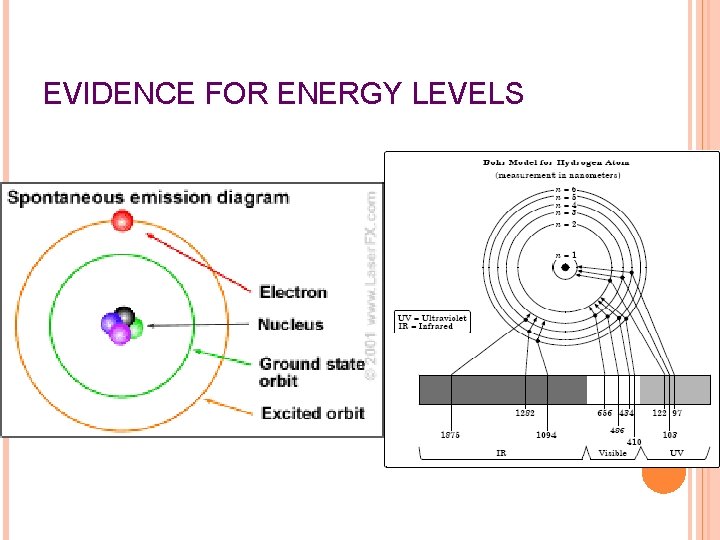
EVIDENCE FOR ENERGY LEVELS
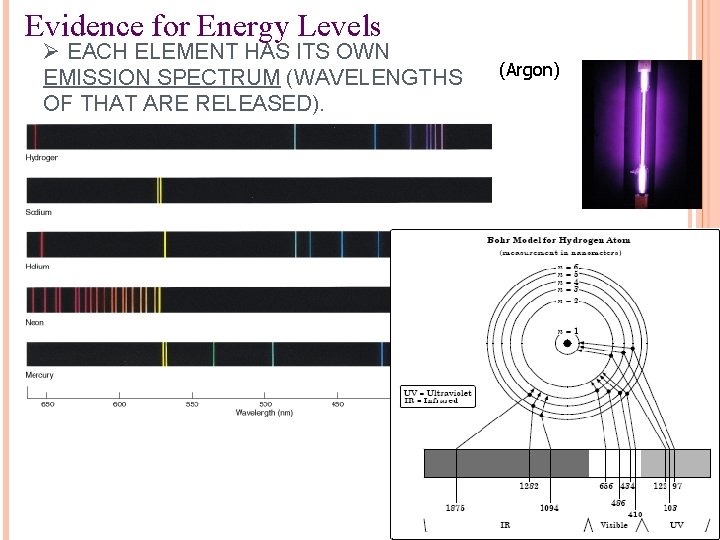
Evidence for Energy Levels Ø EACH ELEMENT HAS ITS OWN EMISSION SPECTRUM (WAVELENGTHS OF THAT ARE RELEASED). (Argon)
WHEN YOU ARE FINISHED, TURN QUIZ INTO BIN AND COPY THE FOLLOWING IN YOUR NOTES: BOHR MODEL – TERMS (IN PACKET) Photon: A particle of electromagnetic radiation with no mass that carries a quantum of energy. Quantum (pl. quanta): “a packet of energy”; the amount of energy absorbed or released when an electron moves between energy levels. Ground State: lowest possible energy of an e-. The principal quantum number (n) = 1. [Energy level = 1] The most energy is released when electrons fall to the n=1 energy level.
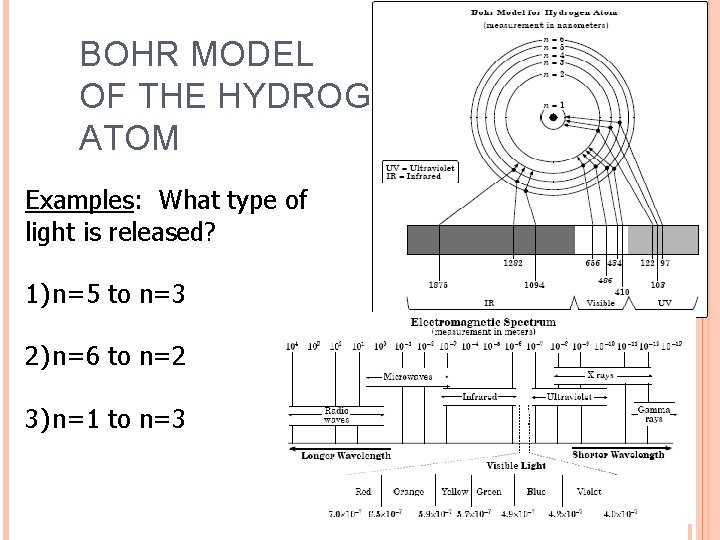
BOHR MODEL OF THE HYDROGEN ATOM Examples: What type of light is released? 1) n=5 to n=3 2) n=6 to n=2 3) n=1 to n=3
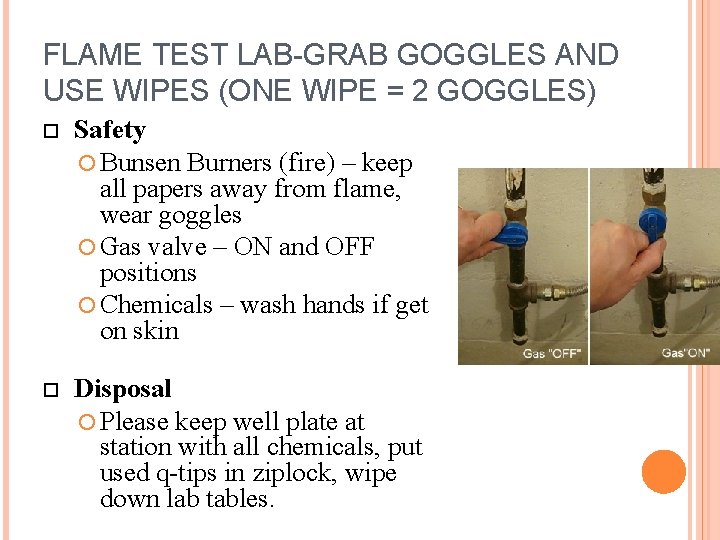
FLAME TEST LAB-GRAB GOGGLES AND USE WIPES (ONE WIPE = 2 GOGGLES) Safety Bunsen Burners (fire) – keep all papers away from flame, wear goggles Gas valve – ON and OFF positions Chemicals – wash hands if get on skin Disposal Please keep well plate at station with all chemicals, put used q-tips in ziplock, wipe down lab tables.
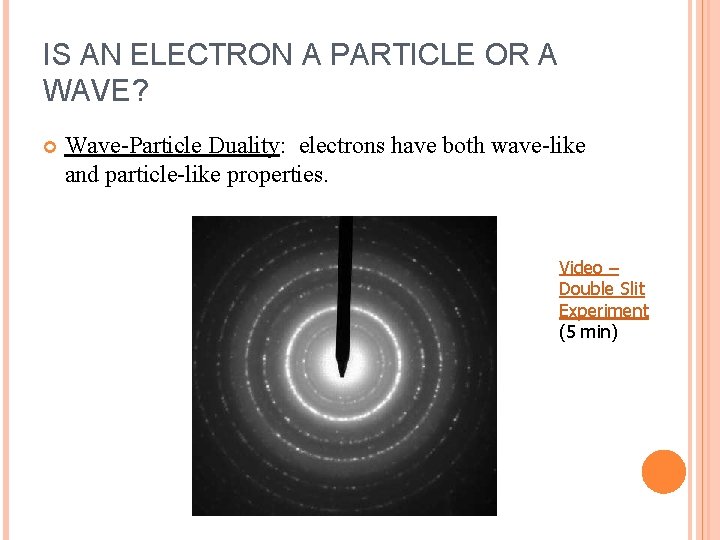
IS AN ELECTRON A PARTICLE OR A WAVE? Wave-Particle Duality: electrons have both wave-like and particle-like properties. Video – Double Slit Experiment (5 min)
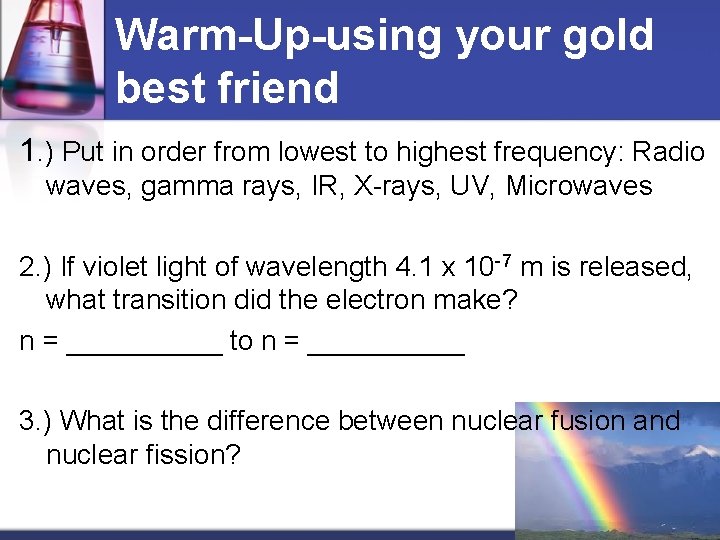
Warm-Up-using your gold best friend 1. ) Put in order from lowest to highest frequency: Radio waves, gamma rays, IR, X-rays, UV, Microwaves 2. ) If violet light of wavelength 4. 1 x 10 -7 m is released, what transition did the electron make? n = _____ to n = _____ 3. ) What is the difference between nuclear fusion and nuclear fission?
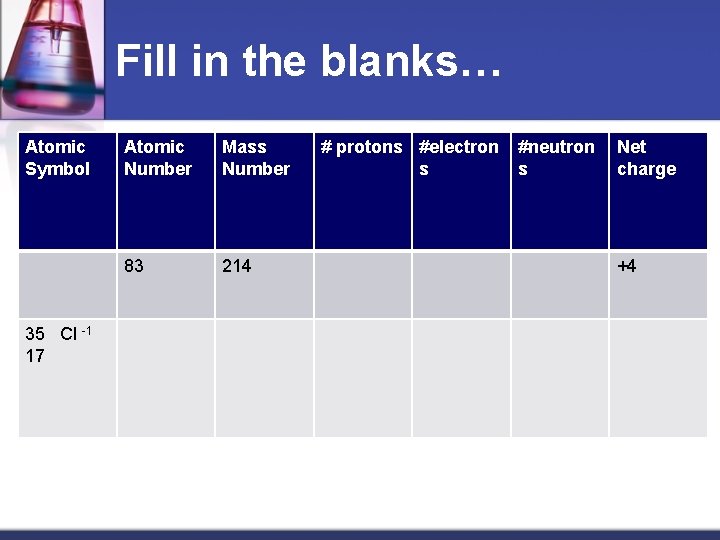
Fill in the blanks… Atomic Symbol 35 Cl -1 17 Atomic Number Mass Number 83 214 # protons #electron s #neutron s Net charge +4
Nuclear Chemistry
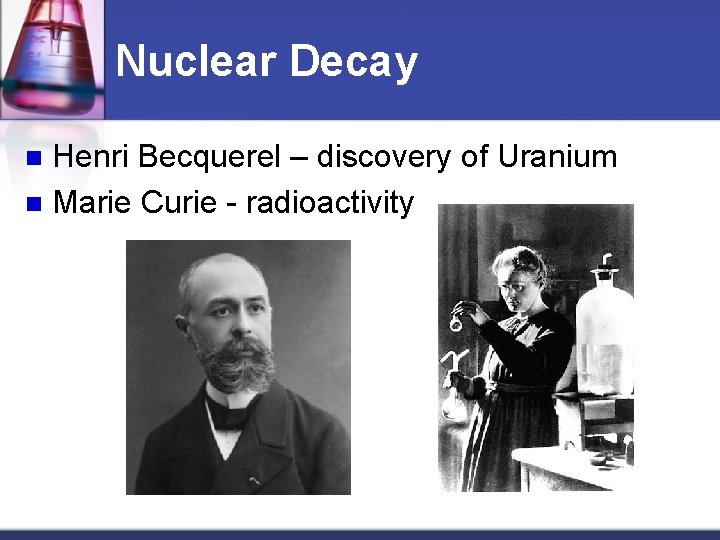
Nuclear Decay Henri Becquerel – discovery of Uranium n Marie Curie - radioactivity n
Nuclear Reaction n Nuclear Reactions: a nucleus loses or gains protons and neutrons. n Why do some nuclei undergo radioactive decay? 1) They are too big (too many protons)! - All elements with atomic numbers of 84 or higher are radioactive! 2) There are too many neutrons compared to protons.
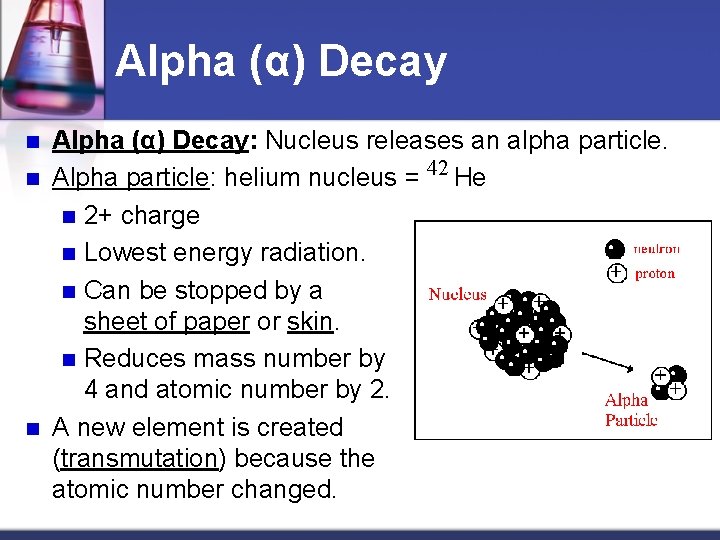
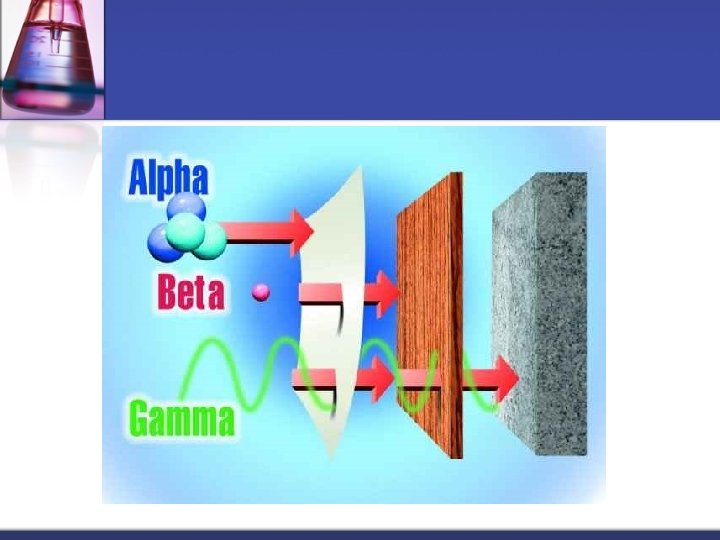
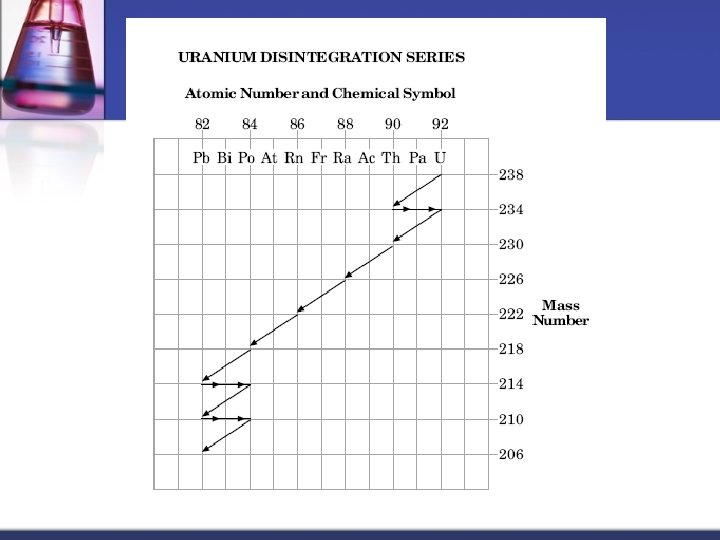
Alpha (α) Decay n n n Alpha (α) Decay: Nucleus releases an alpha particle. Alpha particle: helium nucleus = 42 He n 2+ charge n Lowest energy radiation. n Can be stopped by a sheet of paper or skin. n Reduces mass number by 4 and atomic number by 2. A new element is created (transmutation) because the atomic number changed.
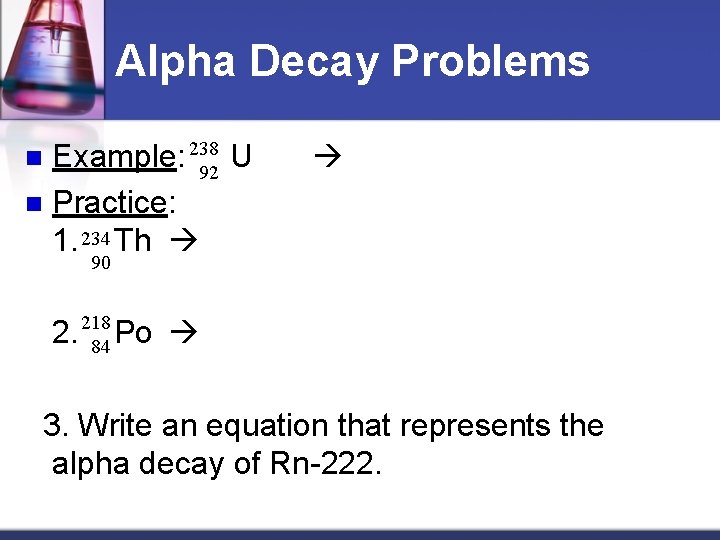
Alpha Decay Problems 238 Example: U 92 n Practice: 234 1. Th n 90 218 2. Po 84 3. Write an equation that represents the alpha decay of Rn-222.
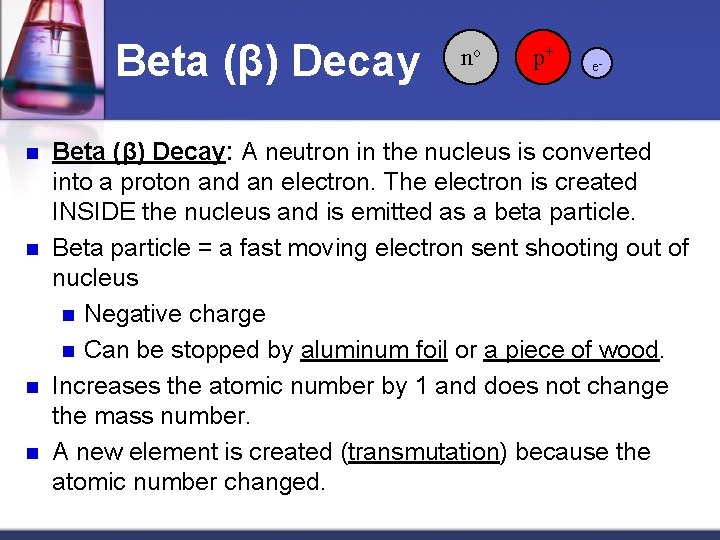
Beta (β) Decay n n no p+ e- Beta (β) Decay: A neutron in the nucleus is converted into a proton and an electron. The electron is created INSIDE the nucleus and is emitted as a beta particle. Beta particle = a fast moving electron sent shooting out of nucleus n Negative charge n Can be stopped by aluminum foil or a piece of wood. Increases the atomic number by 1 and does not change the mass number. A new element is created (transmutation) because the atomic number changed.
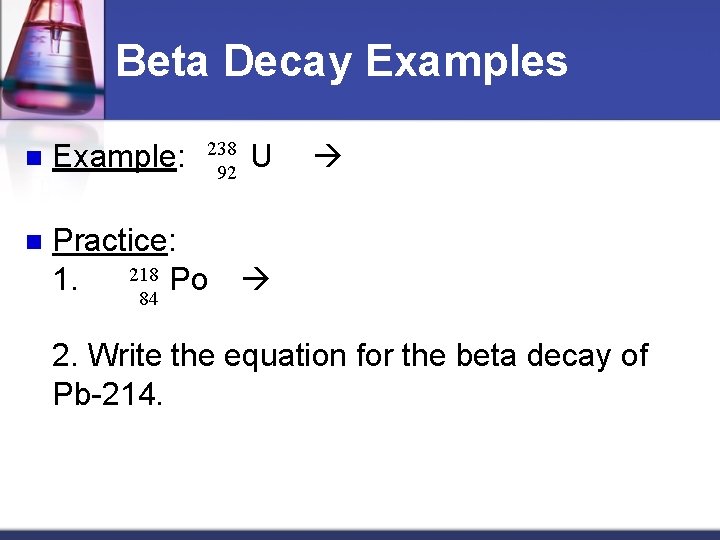
Beta Decay Examples Example: 238 U 92 n Practice: 218 Po 1. 84 n 2. Write the equation for the beta decay of Pb-214.
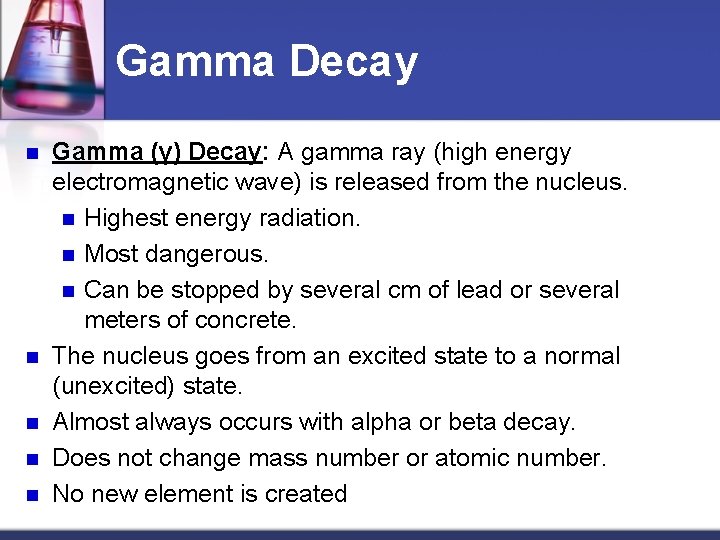
Gamma Decay n n n Gamma (γ) Decay: A gamma ray (high energy electromagnetic wave) is released from the nucleus. n Highest energy radiation. n Most dangerous. n Can be stopped by several cm of lead or several meters of concrete. The nucleus goes from an excited state to a normal (unexcited) state. Almost always occurs with alpha or beta decay. Does not change mass number or atomic number. No new element is created
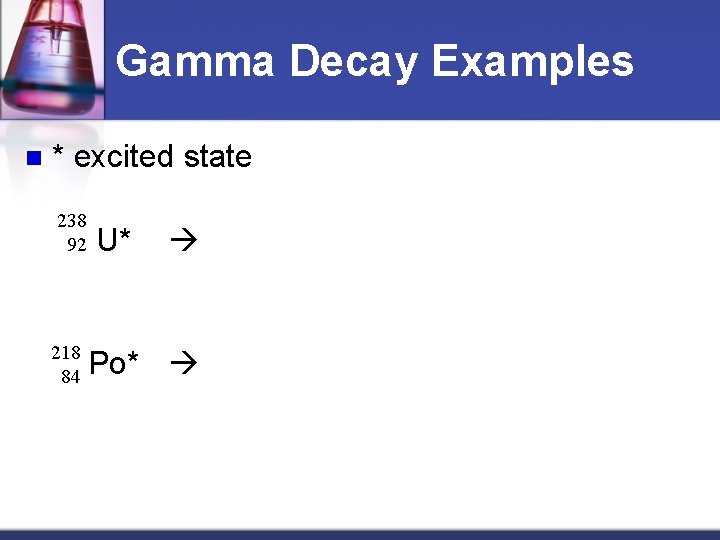
Gamma Decay Examples n * excited state 238 92 U* 218 84 Po*
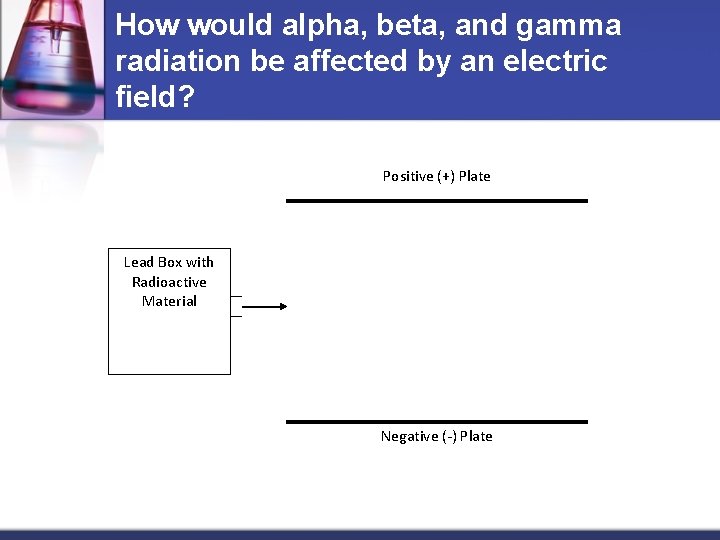
How would alpha, beta, and gamma radiation be affected by an electric field? Positive (+) Plate Lead Box with Radioactive Material Negative (-) Plate
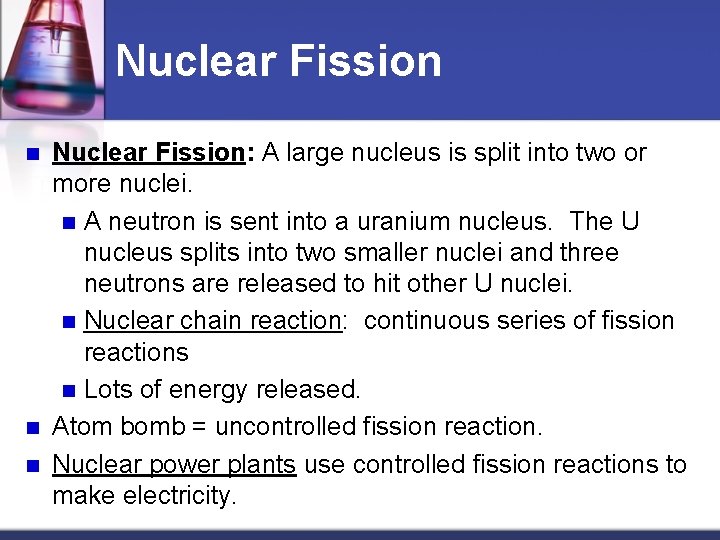
Nuclear Fission n Nuclear Fission: A large nucleus is split into two or more nuclei. n A neutron is sent into a uranium nucleus. The U nucleus splits into two smaller nuclei and three neutrons are released to hit other U nuclei. n Nuclear chain reaction: continuous series of fission reactions n Lots of energy released. Atom bomb = uncontrolled fission reaction. Nuclear power plants use controlled fission reactions to make electricity.
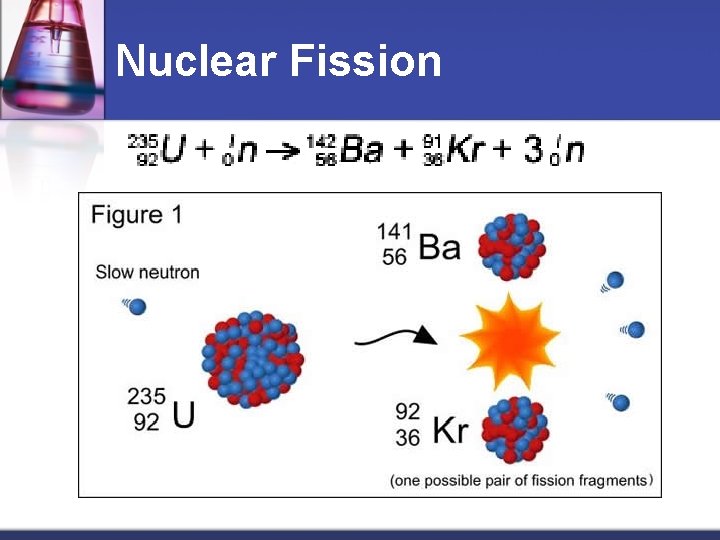
Nuclear Fission
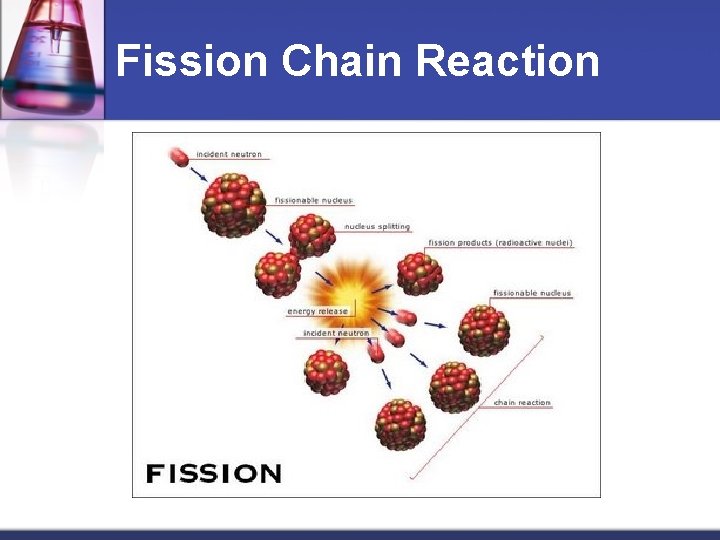
Fission Chain Reaction
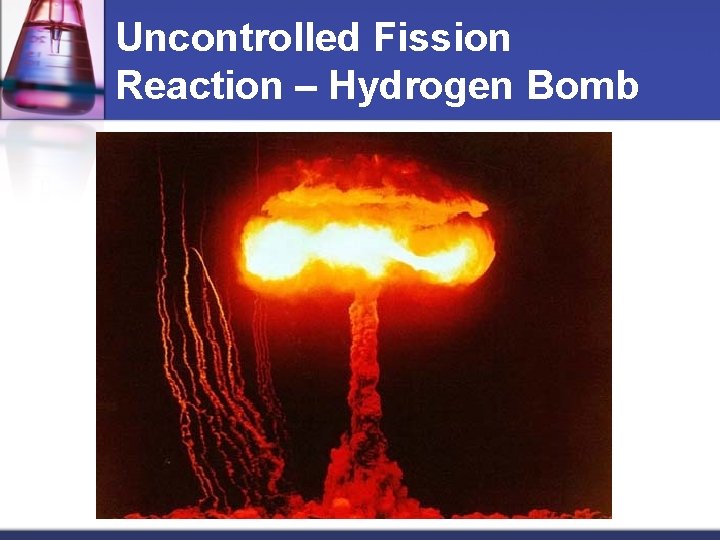
Uncontrolled Fission Reaction – Hydrogen Bomb
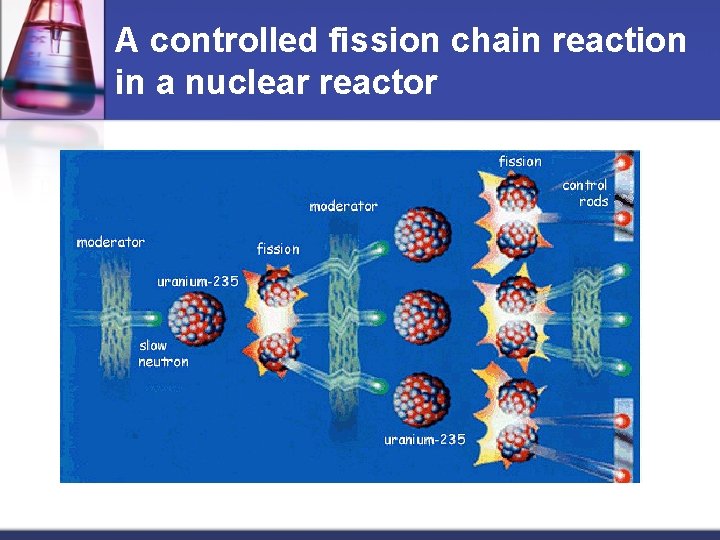
A controlled fission chain reaction in a nuclear reactor
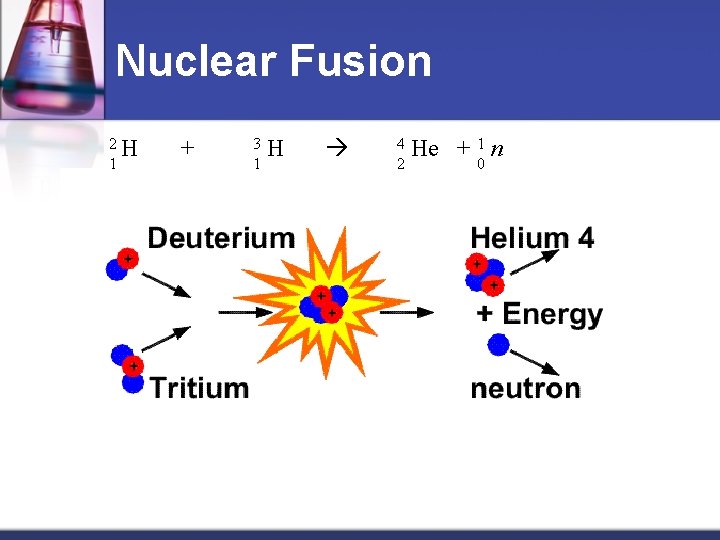
Nuclear Fusion n Nuclear Fusion: Two or more small nuclei combine to form a larger nucleus. Occurs on the sun and other stars (not on Earth!). n Produces enormous amounts of energy n n Why can’t we use this energy as a source of electricity? ? ? To start a fusion reaction, temperature must be 200 million Kelvin (360 million degrees Fahrenheit). n Difficult to initiate and contain this reaction due to high temperature required (Remember Spiderman? …). n
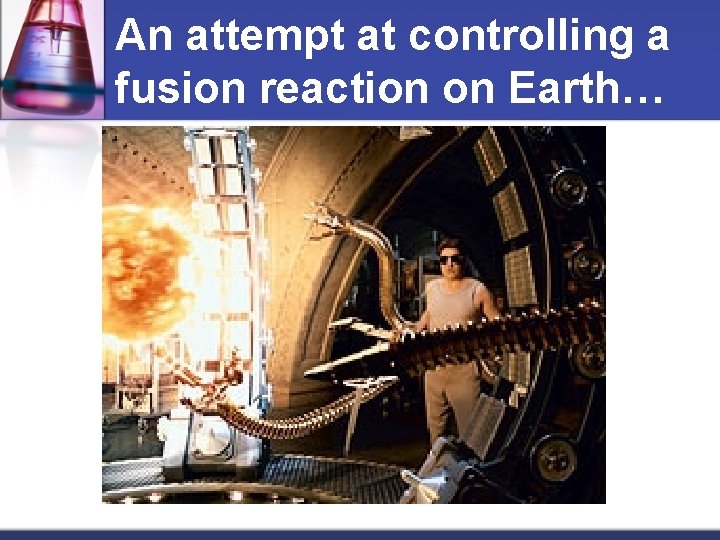
An attempt at controlling a fusion reaction on Earth…
Nuclear Fusion 2 H 3 H 4 He + 1 n + 1 2 0
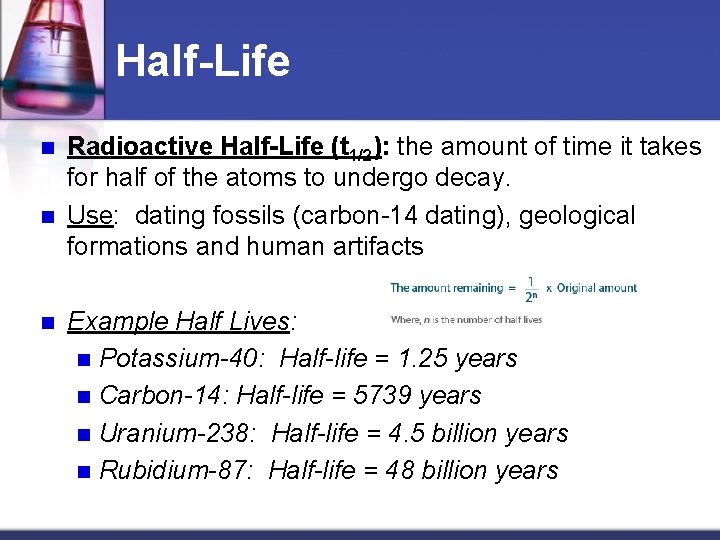
Half-Life n n n Radioactive Half-Life (t 1/2): the amount of time it takes for half of the atoms to undergo decay. Use: dating fossils (carbon-14 dating), geological formations and human artifacts Example Half Lives: n Potassium-40: Half-life = 1. 25 years n Carbon-14: Half-life = 5739 years n Uranium-238: Half-life = 4. 5 billion years n Rubidium-87: Half-life = 48 billion years
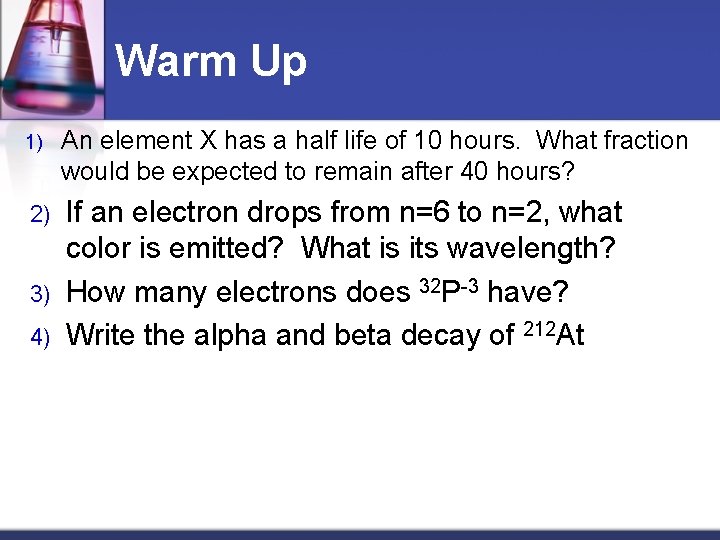
Warm Up 1) An element X has a half life of 10 hours. What fraction would be expected to remain after 40 hours? 2) If an electron drops from n=6 to n=2, what color is emitted? What is its wavelength? How many electrons does 32 P-3 have? Write the alpha and beta decay of 212 At 3) 4)
When you are finished… Staple gradecam to the test and place in bin n Turn in all of the following… n Unit 2 Packet (don’t forget that additional sheet ) n Ch. 4 and 25 vocab n n Grab a textbook and work on Ch. 6 and 7 vocab!
Half-Life Example Problems 2) A radioactive substance with a half-life of 8 years is allowed to decay. If the sample started out with 80 grams and ended with 10 grams, how many years have passed? Start Amount Half Life - End Amount - Total Time - 3) You started with a sample of 70 grams of a radioactive material. After 30 years, you only had 8. 75 grams left. What is the half-life of this substance? Start Amount Half Life - End Amount - Total Time -
Half-Life Example Problems 4) You have 60 grams of Potassium-40 (half-life = 1. 25 years). If this sample has been decaying for 10 years, how much did you start with? Start Amount Half Life - End Amount - Total Time -
Uses of Nuclear Radiation n n Dating Fossils Smoke Detectors n Contain Americium which gives off alpha particles – producing a current. Smoke interrupts the current. Detection of Diseases n Radioactive tracers Radiation Therapy for Cancer
Why is radiation dangerous? n Alpha and Beta particles are charged. n n They can ionize, or change the number of electrons in the atoms in your body. Gamma Rays are energy (not charged). n They can give enough energy to the electrons in atoms to allow them to escape the atom (leaving an ion behind).
How much radiation have you been exposed to? n Have you ever…. n n n n n Traveled in an airplane? Gone through luggage inspection at the airport? Worn a luminous watch? Smoked? Watched TV? Sat in front of a computer screen? Been near a smoke detector? Had an x-ray? Lived within 50 miles of a nuclear power plant? Most organisms are adapted to survive low levels of background radiation.
Nuclear Waste n Fission n The products of fission reactions are often also radioactive. used fuel rods must be stored in shielded containers away from ground water… forever… n Fusion n Produces very fast-moving neutrons. Shielding material in the reactor would have to be replaced periodically.
- Slides: 143