
Introduction to Chemistry Chemistry Because living and nonliving
Introduction to Chemistry
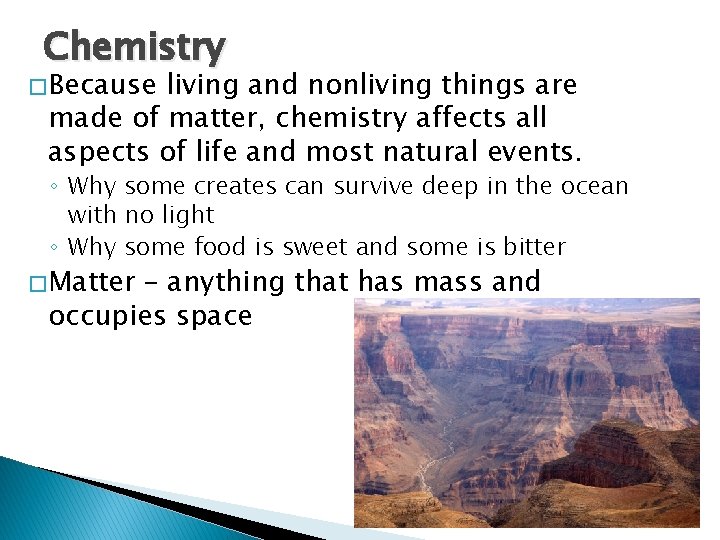
Chemistry � Because living and nonliving things are made of matter, chemistry affects all aspects of life and most natural events. ◦ Why some creates can survive deep in the ocean with no light ◦ Why some food is sweet and some is bitter � Matter – anything that has mass and occupies space
Areas of Study � Organic – study of chemicals that contain carbon � Inorganic – study of chemicals that, in general, don’t contain carbon � Biochemistry – the study of processes that take place in an organism � Analytical Chemistry – area of study that focuses on the composition of matter � Physical Chemistry – area of study dealing with the mechanism, the rate, and the energy transfer that occurs when matter undergoes a change

Pure and Applied Chemist � Pure Chemistry – the pursuit of chemical knowledge for its own sake; no immediate practical use for the knowledge. � Applied Chemistry - research that is directed toward a practical goal or application.
Pure and Applied Chemist � Pure research can lead directly to an application, but an application can exist before research is done to explain how it works. � Nylon was research and produced due to low supply of natural silk � Aspirin – historically used to relieve pain; in 1971, it was discovered that aspirin can block the production of a group of chemicals that cause pain, which are also used in the formation of blood clots � Chemistry Far and Wide: chemists design materials to fit specific needs.
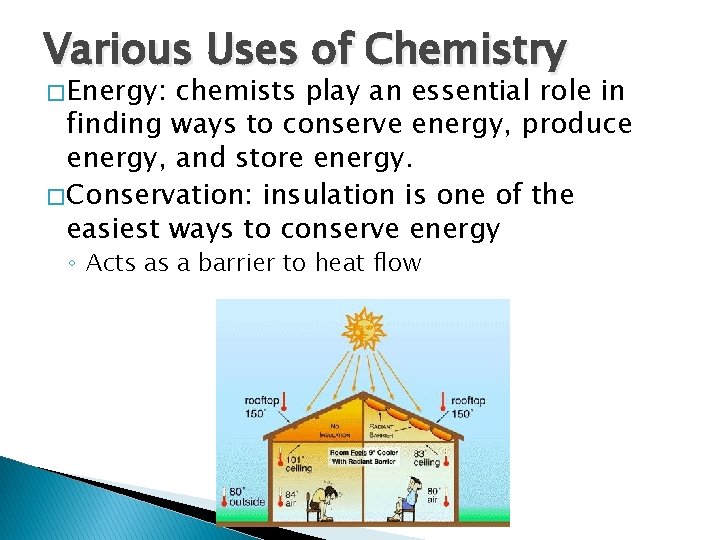
Various Uses of Chemistry � Energy: chemists play an essential role in finding ways to conserve energy, produce energy, and store energy. � Conservation: insulation is one of the easiest ways to conserve energy ◦ Acts as a barrier to heat flow
Various Uses of Chemistry � Production: the burning of coal, petroleum, and natural gas is a major source of energy ◦ Scientists are working with biofuels ◦ Biodiesel from soybeans � Storage: batteries are devices that use chemical to store energy that will be released as electric current when the batteries are used ◦ Rechargeable batteries were first developed for NASA for the Astronauts to collect samples from the moon
Chemistry and the World � Medicine and Biotechnology: chemistry supplies the medicines, materials, and technology doctors use to treat their patients � Medicines – there are over 2000 prescription drugs � Materials – supply materials to repair or replace body parts � Biotechnology – production of insulin by bacteria

Chemistry and the World � Agriculture: develop more productive crops and safer, more effective ways to protect crops � Productivity – soil tests � Crop Protection – used chemical to treat specific problems, in contrast to killing all insects � Environment: chemists help identify pollutants and prevent pollution � Universe: chemists gather data from afar and analyze matter that is brought back to Earth
- Slides: 11