
Introduction to Chemistry Chapter 1 Chemistry n The



- Slides: 31
Introduction to Chemistry Chapter 1
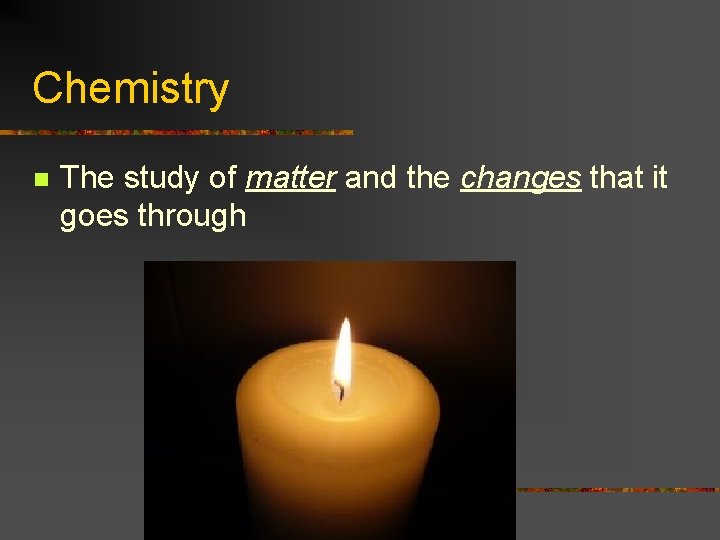
Chemistry n The study of matter and the changes that it goes through
What do chemists study? n We will learn about what chemists study during our presentations.
Can you name several things you use every day that contain chemicals? n n n Shampoo Deodorant Hairspray Soap Toothpaste
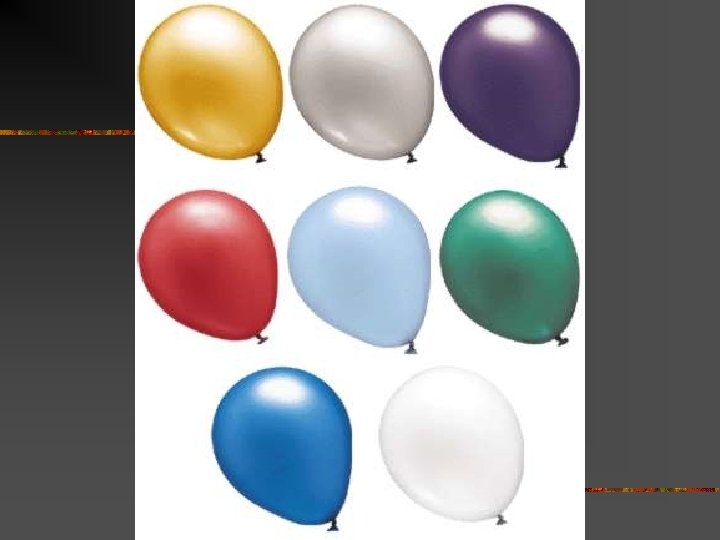
Matter n n Anything that has mass and takes up space Is air matter? n Yes, it takes up space and has mass
What types of things are not matter? n n n Light Heat UV radiation X-rays Ideas Sound
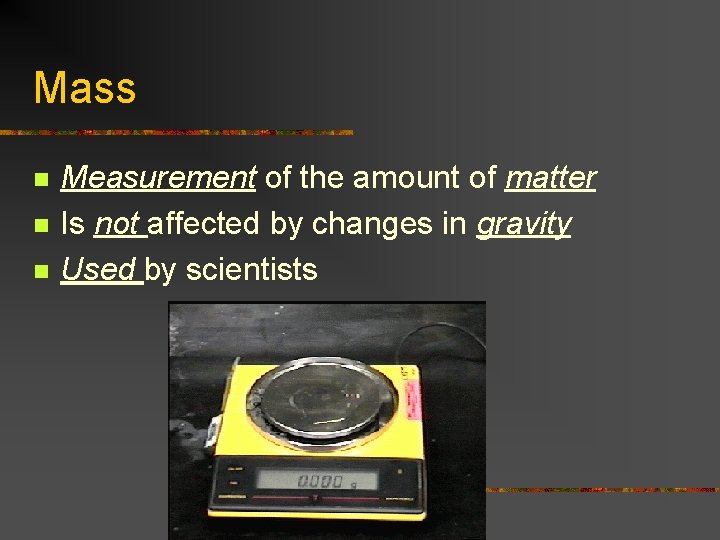
Mass n n n Measurement of the amount of matter Is not affected by changes in gravity Used by scientists
Weight n n n Measurement of the amount of matter Is affected by changes in gravity Not used by scientists
Your weight on other worlds! n How much do you think you would weigh on the moon? n n More, less or the same? What do you think your mass would be on the moon? n More, less or the same?
Why do scientists use mass and not weight? n They need to be able to compare measurements made in different parts of the world where gravity may be different
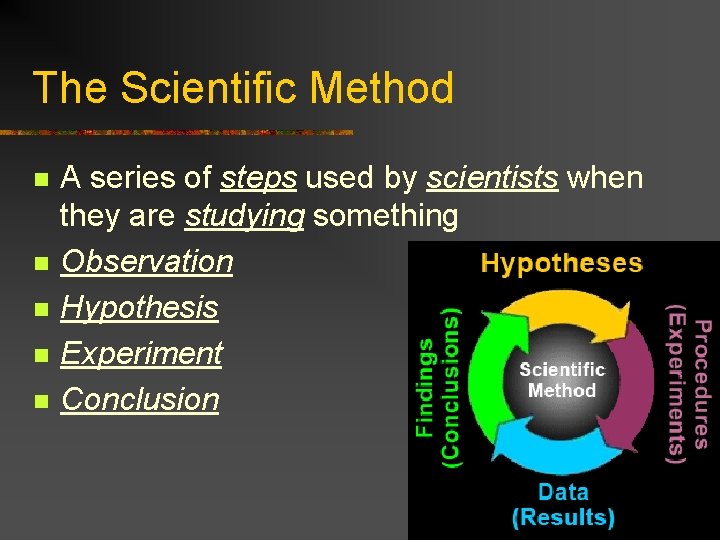
The Scientific Method n n n A series of steps used by scientists when they are studying something Observation Hypothesis Experiment Conclusion
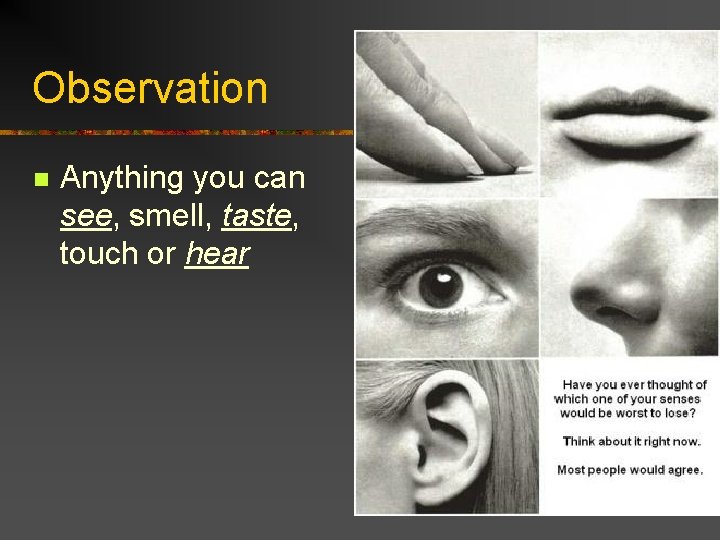
Observation n Anything you can see, smell, taste, touch or hear
Observation n n Two Types Qualitative n n “Quality” Quantitative n “Quantity”
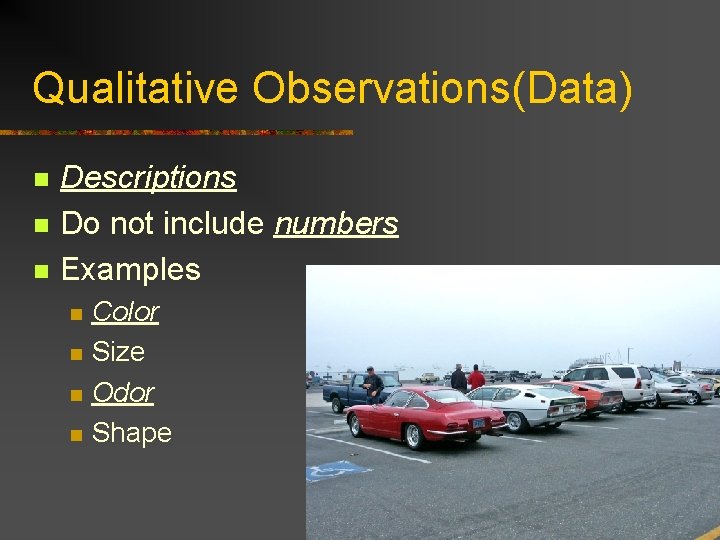
Qualitative Observations(Data) n n n Descriptions Do not include numbers Examples n n Color Size Odor Shape
Quantitative Observations(Data) n n n Measurements Include numbers Examples n n Temperature Volume Quantity Length
Hypothesis n n n An educated guess based on observations Is tested during an experiment In the form of If…. . , then…. Example If you add salt to water, then it will reach its boiling point faster.
Experiment n n n Used to test a hypothesis Data is collected during the experiment Contains two variables n n n Independent Variable Dependent Variable Contains Two Groups n n Control Group Experimental Group
Independent Variable n n n Variable that “I” change “I” = independent Example n n Remember the hypothesis: If you add salt to water, then it will reach its boiling point faster. Adding salt would be the independent variable
Dependent Variable n n n Changes in response to the independent variable “Depends” on the independent variable Example: n n Remember the hypothesis: If you add salt to water, then it will reach its boiling point faster. Time it takes the water to reach its boiling point would be the dependent variable
Control Group n n n “Normal” group Used to compare the results of the experimental group Example n n Remember the hypothesis: If you add salt to water, then it will reach its boiling point faster. The control group would contain no added salt
Experimental Group n n Used to test the effects of the independent variable Example n n Remember the hypothesis: If you add salt to water, then it will reach its boiling point faster. The experimental group would contain added salt
Experimental Constants (Controlled Factors) n n n You can only test one independent variable at a time Everything else in the experiment must remain the same for both the experimental and control groups Examples n n Type of water Type of salt Amount of salt added Temperature of the water
Conclusion n n Statement made based on the data collected during the experiment Examples n n n Adding salt to water decreases the time it takes for the water to reach its boiling point Or Adding salt to water does not change the time it takes for water to reach its boiling point Or Adding salt to water increases the time it takes for water to reach its boiling point
Scientific Theory n n n Explanation for our observations Can be changed based on new experiments Example n Theory of Evolution
Scientific Law n n n Description of observations Does not explain why things are the way they are Example n Law of Gravity
Types of Research n Pure Research n n Done to gain knowledge for the sake of curiosity Applied Research n Done to solve a specific problem