
Introduction to Chemistry Branches of Chemistry Scientific Method
Introduction to Chemistry Branches of Chemistry Scientific Method Experimental Design
Chemistry Joke Q: Why are chemists great at solving problems? A: They have all the solutions!!!
Branches of Chemistry Organic ◦ Associated with CARBON compounds. Inorganic ◦ Associated with NON-CARBON compounds. Analytical ◦ Associated with the COMPOSITION of samples Physical ◦ Associated with the BEHAVIOR/ENERGY of compounds Biochemical ◦ Associated with the chemistry of LIFE
1. 3 The Scientific Method A logical, systematic approach to the solution of a scientific problem. Steps in the scientific method include: 1. Making observations 2. Formulating hypotheses 3. Testing hypothesis through experimentation 4. Developing theories or formulating laws.
1. 3 The Scientific Method 1. Making Observations or Identifying Problem ◦ When you use your senses to obtain information, you make an observation. This allows you to identify a problem that needs to be investigated. 2. Formulating Hypotheses – A hypothesis is a proposed explanation for an observation.
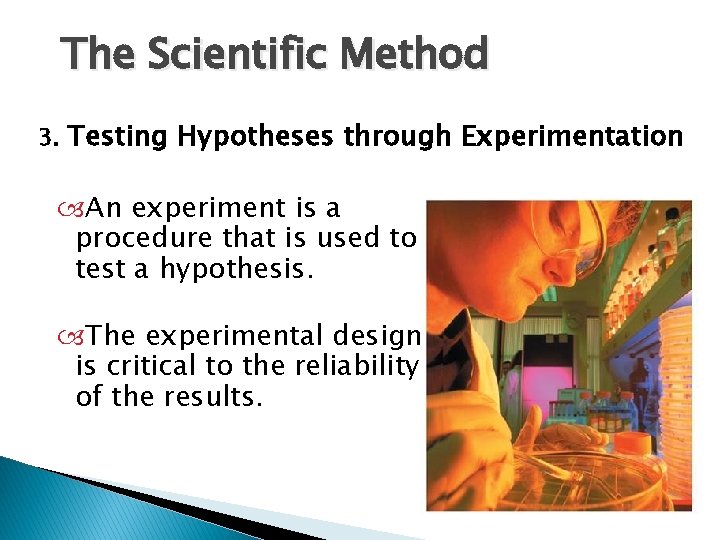
1. 3 The Scientific Method 3. Testing Hypotheses through Experimentation An experiment is a procedure that is used to test a hypothesis. The experimental design is critical to the reliability of the results.
Experimental Design We should have only one manipulated variable (independent variable) and one dependent variable. ◦ We want to test the effect of the manipulated variable on the dependent variable. ◦ For example: The effect of surface area on solubility The effect of temperature on pressure
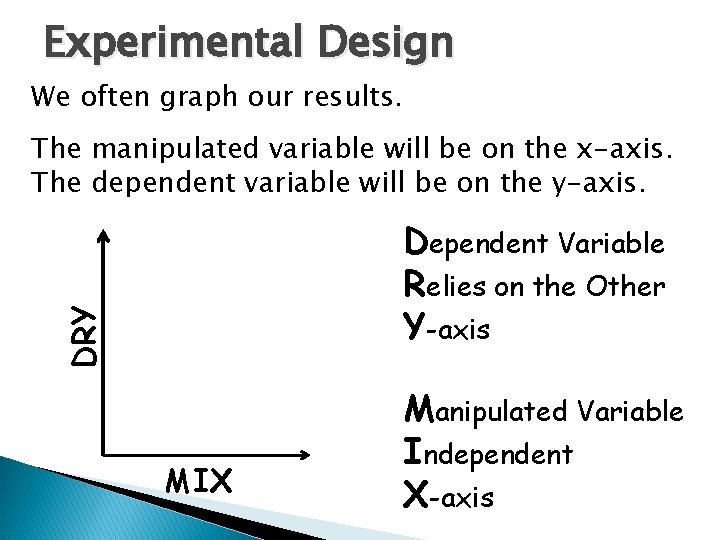
Experimental Design We often graph our results. The manipulated variable will be on the x-axis. The dependent variable will be on the y-axis. DRY Dependent Variable Relies on the Other Y-axis MIX Manipulated Variable Independent X-axis
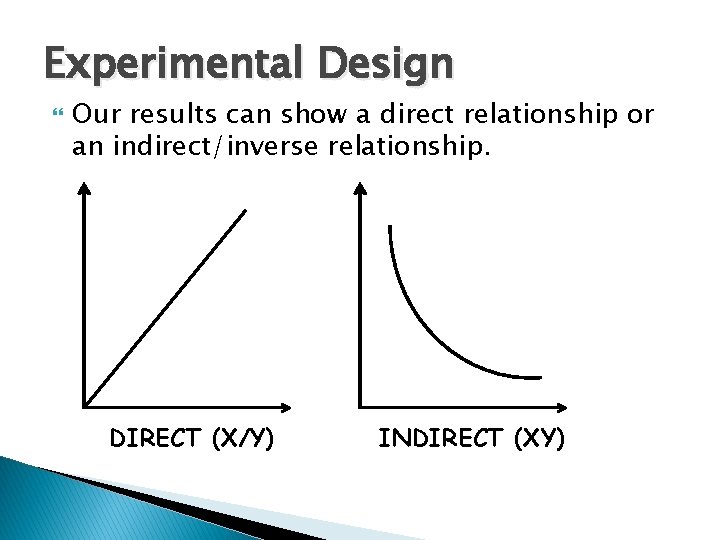
Experimental Design Our results can show a direct relationship or an indirect/inverse relationship. DIRECT (X/Y) INDIRECT (XY)

Experimental Design We should be careful to change only one variable. ◦ For example, use the same equipment for each trial. ◦ Conduct each trial under the same conditions.
Experimental Design We should have a control. ◦ This is a trial in which the manipulated variable is not changed—used for comparison. We should average the results of many trials. ◦ To find the mean, add the results of each trial and divide by the total number of trials. ◦ More trials produce better reliability of results. Results should be reproducible by other scientists. We should report all results, not just the expected ones.
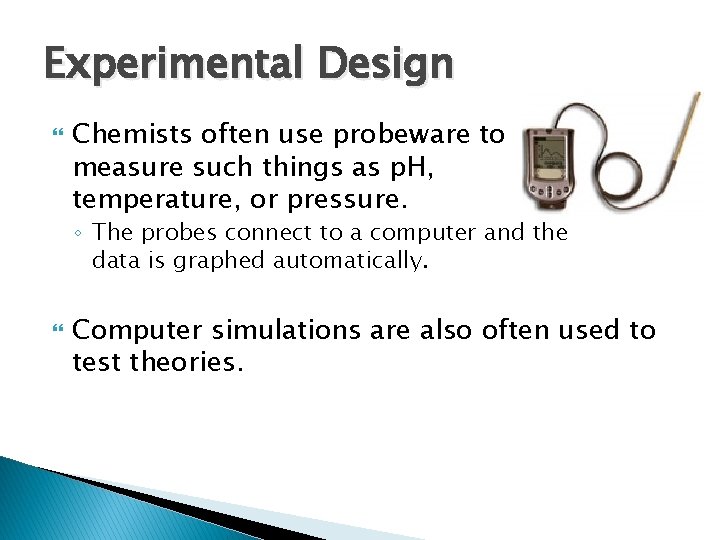
Experimental Design Chemists often use probeware to measure such things as p. H, temperature, or pressure. ◦ The probes connect to a computer and the data is graphed automatically. Computer simulations are also often used to test theories.
1. 3 The Scientific Method 4. Developing Theories Once a hypothesis meets the test of repeated experimentation, it may become a theory. A theory is a loooong explanation for WHY something happens. A theory may need to be changed at some point in the future to explain new observations or experimental results.
1. 3 The Scientific Method 4. Formulating Scientific Laws A scientific law is a short mathematical statement of WHAT happens. A scientific law doesn’t try to explain the relationship it describes. That explanation requires a theory.
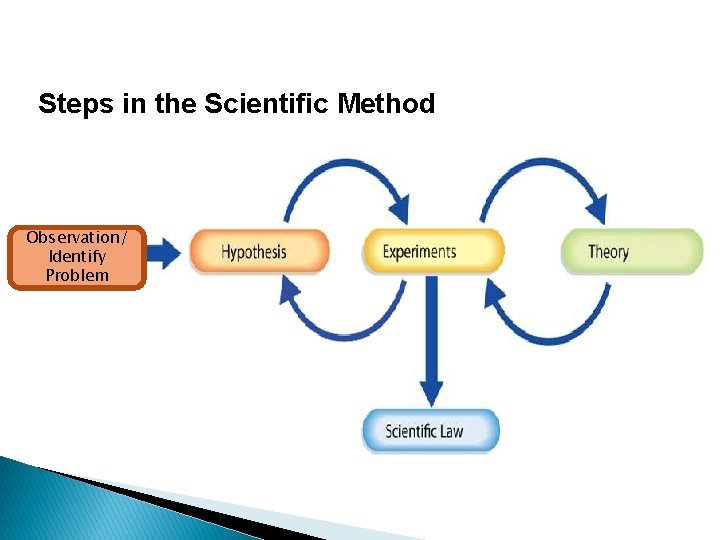
Steps in the Scientific Method Observation/ Identify Problem
Chemistry Joke Q: What substance has the formula HIJKLMNO? A: Water (H to O)!!!
- Slides: 16