
Introduction to Chapter 8 Segmenting and Targeting Markets






- Slides: 20
Introduction to Chapter 8: Segmenting and Targeting Markets Designed & Prepared by Laura Rush B-books, Ltd. Copyright Cengage Learning 2013 All Rights Reserved 1
Learning Outcomes LO 1 Describe the characteristics of markets and market segments LO 2 Explain the importance of market segmentation LO 3 Discuss criteria for successful market segmentation LO 4 Describe the bases commonly used to segment consumer markets Copyright Cengage Learning 2013 All Rights Reserved 2
Learning Outcomes LO 5 Describe the bases for segmenting business markets LO 6 List the steps involved in segmenting markets LO 7 Discuss alternative strategies for selecting target markets LO 8 Explain one-to-one marketing LO 9 Explain how and why firms implement positioning strategies and how product differentiation plays a role Copyright Cengage Learning 2013 All Rights Reserved 3
A Market Is. . . (1) people or organizations with (2) needs or wants, and with (3) the ability and (4) the willingness to buy. A group of people that lacks any one of these characteristics is not a market. LO 1 Copyright Cengage Learning 2013 All Rights Reserved 4
The Importance of Market Segmentation u Markets have a variety of product needs and preferences. u Marketers can better define customer needs. u Decision makers can define objectives and allocate resources more accurately. LO 2 Copyright Cengage Learning 2013 All Rights Reserved 5
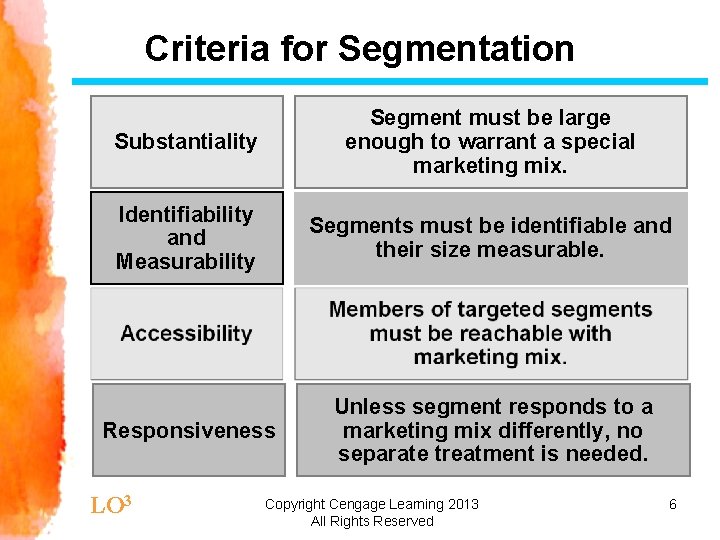
Criteria for Segmentation Substantiality Segment must be large enough to warrant a special marketing mix. Identifiability and Measurability Segments must be identifiable and their size measurable. Responsiveness Unless segment responds to a marketing mix differently, no separate treatment is needed. LO 3 Copyright Cengage Learning 2013 All Rights Reserved 6
Bases for Segmentation Geography Demographics Psychographics Benefits Sought Usage Rate LO 4 Copyright Cengage Learning 2013 All Rights Reserved 7
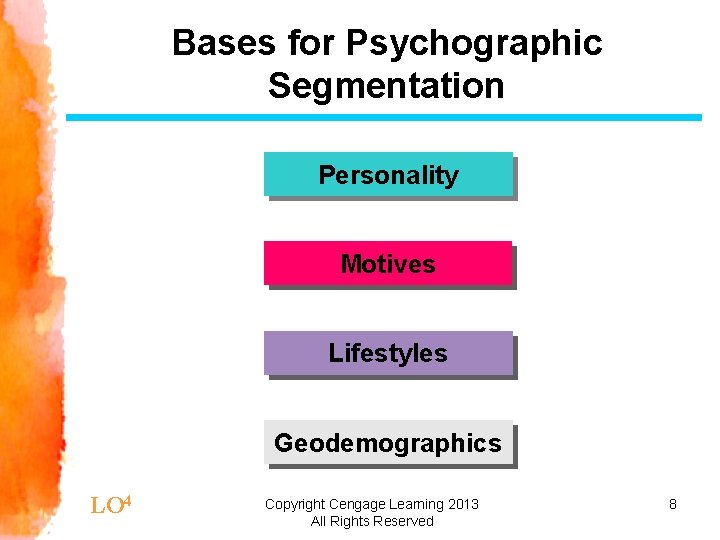
Bases for Psychographic Segmentation Personality Motives Lifestyles Geodemographics LO 4 Copyright Cengage Learning 2013 All Rights Reserved 8
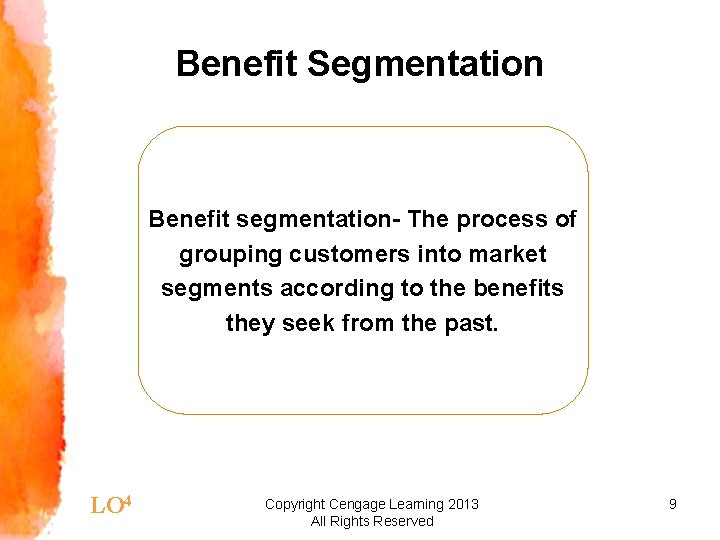
Benefit Segmentation Benefit segmentation- The process of grouping customers into market segments according to the benefits they seek from the past. LO 4 Copyright Cengage Learning 2013 All Rights Reserved 9
Usage-Rate Segmentation- Dividing a market by the amount of product bought or consumed. 80/20 Principle- A principle holding that 20 percent of all customers generate 80 percent of the demand. LO 4 Copyright Cengage Learning 2013 All Rights Reserved 10
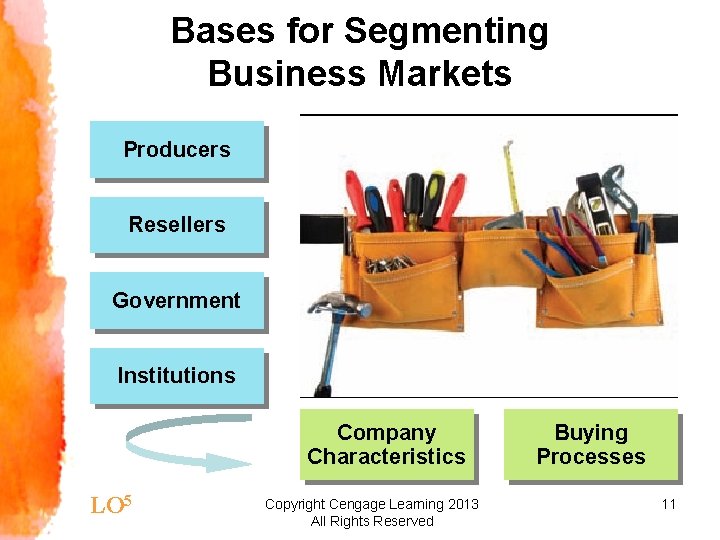
Bases for Segmenting Business Markets Producers Resellers Government Institutions Company Characteristics LO 5 Copyright Cengage Learning 2013 All Rights Reserved Buying Processes 11
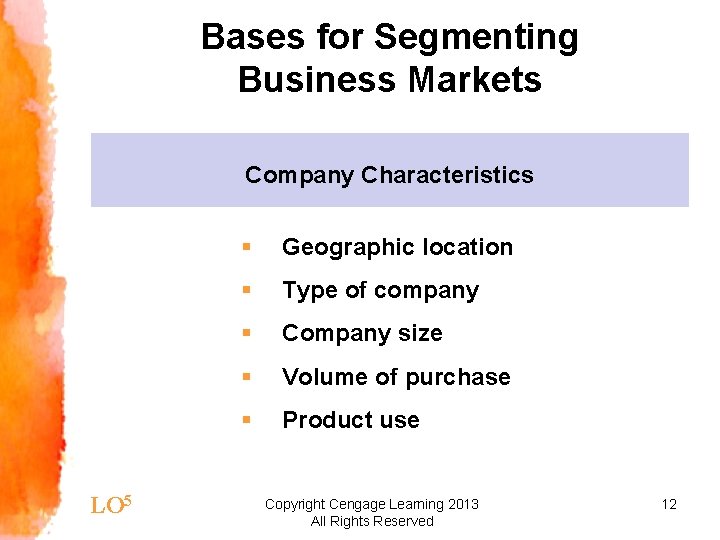
Bases for Segmenting Business Markets Company Characteristics LO 5 § Geographic location § Type of company § Company size § Volume of purchase § Product use Copyright Cengage Learning 2013 All Rights Reserved 12
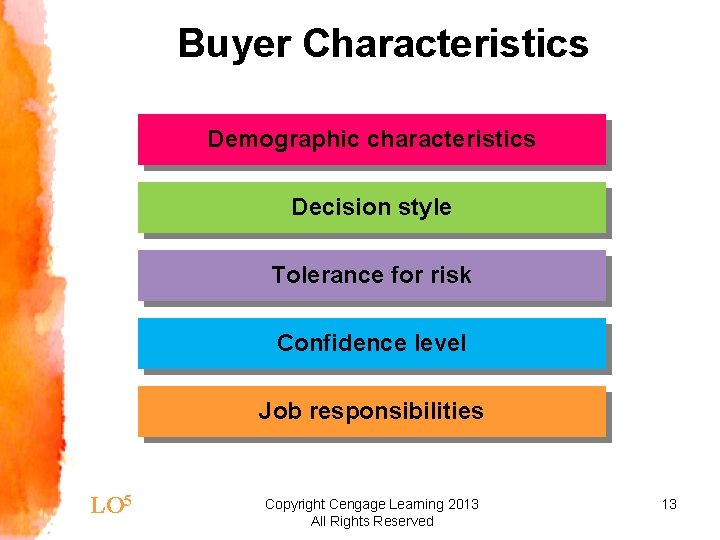
Buyer Characteristics Demographic characteristics Decision style Tolerance for risk Confidence level Job responsibilities LO 5 Copyright Cengage Learning 2013 All Rights Reserved 13
Strategies for Selecting Target Markets Undifferentiated Strategy LO 7 Concentrated Strategy Copyright Cengage Learning 2013 All Rights Reserved Multisegment Strategy 14
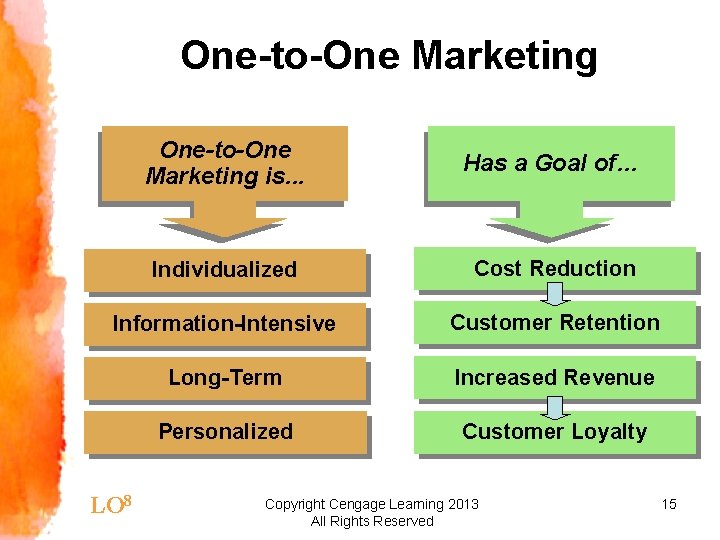
One-to-One Marketing is. . . Has a Goal of… Individualized Cost Reduction Information-Intensive Customer Retention Long-Term Increased Revenue Personalized Customer Loyalty LO 8 Copyright Cengage Learning 2013 All Rights Reserved 15
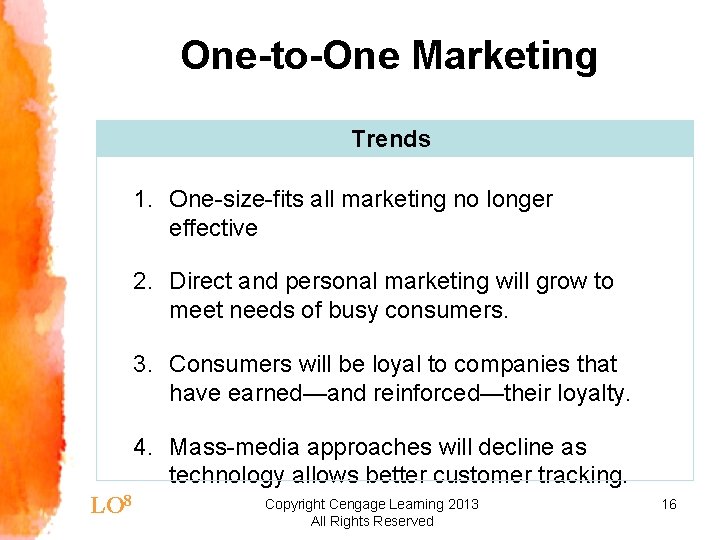
One-to-One Marketing Trends 1. One-size-fits all marketing no longer effective 2. Direct and personal marketing will grow to meet needs of busy consumers. 3. Consumers will be loyal to companies that have earned—and reinforced—their loyalty. 4. Mass-media approaches will decline as technology allows better customer tracking. LO 8 Copyright Cengage Learning 2013 All Rights Reserved 16
Positioning Developing a specific marketing mix to influence potential customers’ overall perception of a brand, product line, or organization in general. LO 9 Copyright Cengage Learning 2013 All Rights Reserved 17
Product Differentiation A positioning strategy that some firms use to distinguish their products from those of their competitors. Distinctions can be real or perceived. LO 9 Copyright Cengage Learning 2013 All Rights Reserved 18
Positioning Bases Attribute Price and Quality Use or Application Product User Product Class Competitor Emotion LO 9 Copyright Cengage Learning 2013 All Rights Reserved 19
Repositioning Changing perceptions of a brand in relation to competing brands. LO 9 Copyright Cengage Learning 2013 All Rights Reserved 20