
Introduction to Cellular Networking and Rethinking Mobile Architectures
Introduction to Cellular Networking and Rethinking Mobile Architectures Jatinder Pal Singh EE 392 I, Lecture-3 April 13 th, 2010
Agenda § Basics & Technology Evolution § Architecture and Functionality (GSM, 3 G and beyond) § Cellular future goals § Emerging trends Ø Alternative wireless access technologies Ø Convergence § Comparison with Internet and sample scenario studies § Economics of operation § From a clean slate
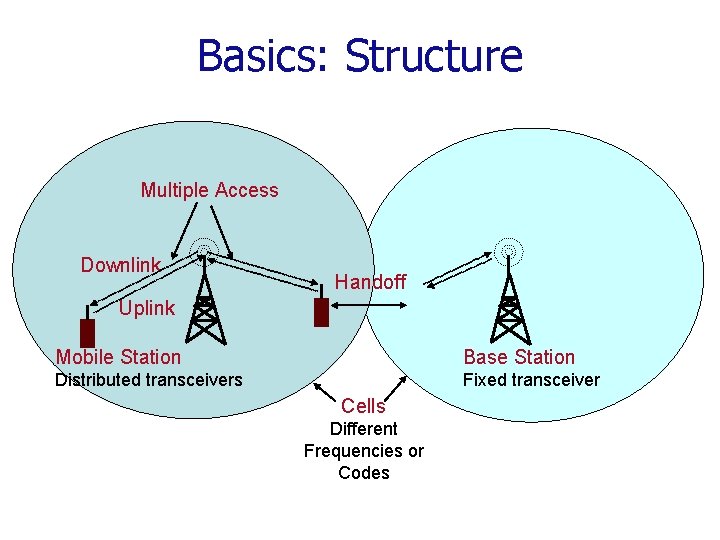
Basics: Structure Multiple Access Downlink Handoff Uplink Mobile Station Base Station Distributed transceivers Fixed transceiver Cells Different Frequencies or Codes
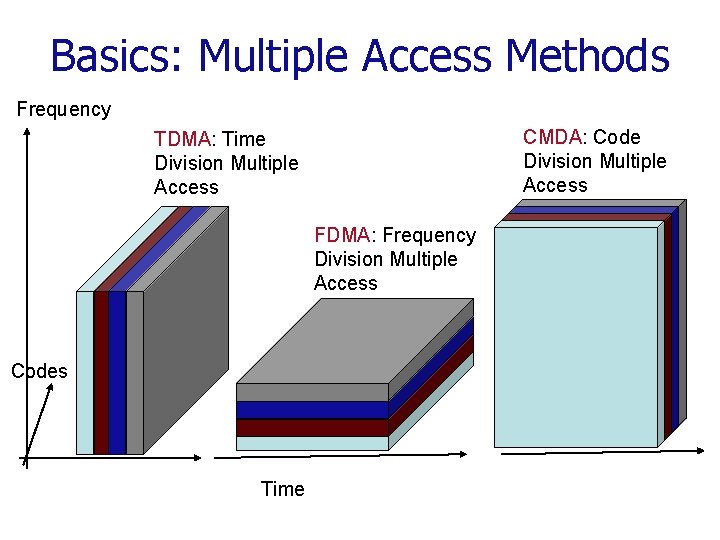
Basics: Multiple Access Methods Frequency CMDA: Code Division Multiple Access TDMA: Time Division Multiple Access FDMA: Frequency Division Multiple Access Codes Time
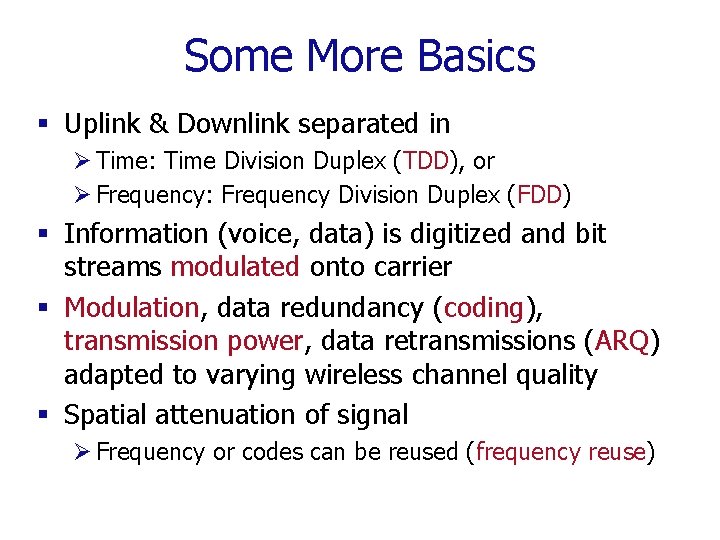
Some More Basics § Uplink & Downlink separated in Ø Time: Time Division Duplex (TDD), or Ø Frequency: Frequency Division Duplex (FDD) § Information (voice, data) is digitized and bit streams modulated onto carrier § Modulation, data redundancy (coding), transmission power, data retransmissions (ARQ) adapted to varying wireless channel quality § Spatial attenuation of signal Ø Frequency or codes can be reused (frequency reuse)

Cellular Technology Evolution § 0 G: Mobile radio telephones (e. g. MTS) § 1 G: Analog § 2 G/3 G/4 G. . - digital: GSM/3 GPP Family cdma. One/CDMA 2000 Family GSM cdma. One/IS-95 2 G GPRS EDGE 3 G 4 G UMTS, WCDMA HSPA LTE CDMA 2000 EV-DO
Agenda § Basics & Technology Evolution § Architecture and Functionality (GSM, 3 G and beyond) § Cellular future goals § Emerging trends Ø Alternative wireless access technologies Ø Convergence § Comparison with Internet and sample scenario studies § Economics of operation § From a clean slate
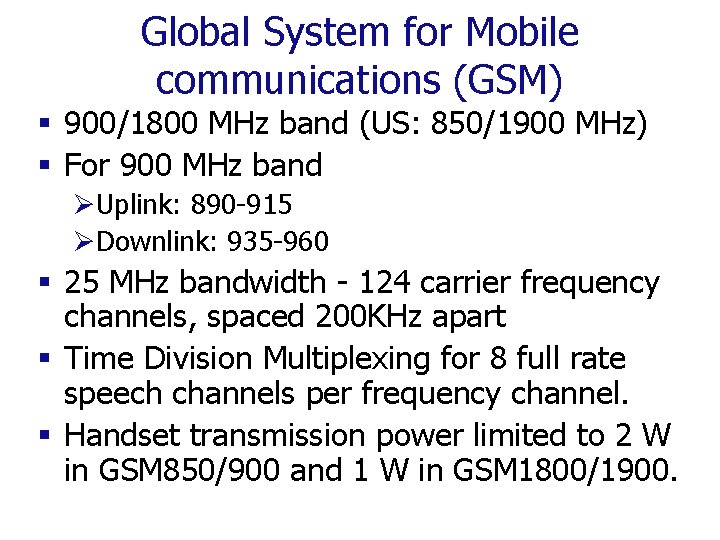
Global System for Mobile communications (GSM) § 900/1800 MHz band (US: 850/1900 MHz) § For 900 MHz band ØUplink: 890 -915 ØDownlink: 935 -960 § 25 MHz bandwidth - 124 carrier frequency channels, spaced 200 KHz apart § Time Division Multiplexing for 8 full rate speech channels per frequency channel. § Handset transmission power limited to 2 W in GSM 850/900 and 1 W in GSM 1800/1900.
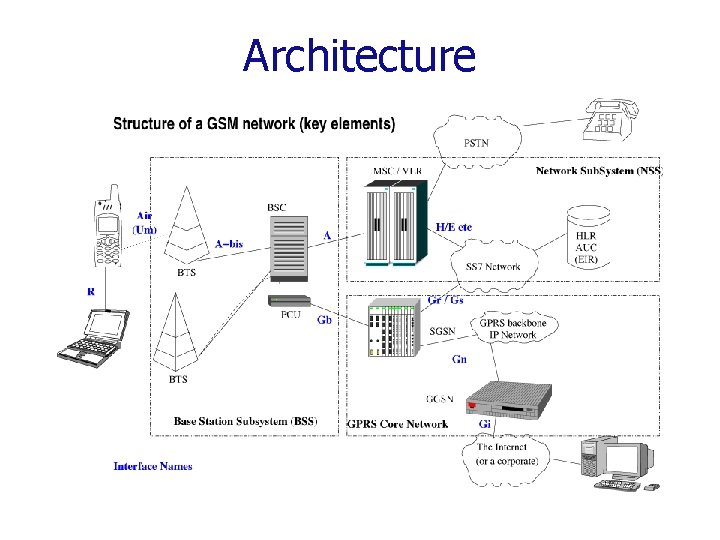
Architecture
The Base Station Subsystem (BSS) § Base Transceiver Station BTS - transceivers serve different frequencies. § Frequency hopping by handsets and transceivers § Sectorization using directional antennas § Base Station Controller (BSC) controls several (tens to hundreds) of BTSs Ø allocation of radio channels Ø handovers between BTSs Ø concentrator of traffic Ø databases with information such as carrier frequencies, frequency hopping lists, power reduction levels, etc. for each cell site
Network Switching Subsystem (NSS) § This GSM core network manages communication amongst mobile devices & with PSTN § Mobile Switching Center (MSC) : routing of calls and GSM services for users, mobility management, handovers, Ø Gateway MSC – interfaces with PSTN, determines the visited MSC at which the subscriber being called is currently located Ø Visited MSC - MSC where a customer is currently located. The Visitor Location Register (VLR) associated with this MSC has subscriber's data. Ø Anchor MSC - MSC from which handover initiated. Ø Target MSC - MSC toward which a handover should take place. § Home Location Register (HLR): database with all mobile phone subscriber details
GPRS core network § Mobility management, session management, and transport for IP services § GPRS Tunneling Protocol, GTP allows end users mobility with continued Internet connectivity by transporting user’s data between users’ current SGSN and GGSN § GPRS support nodes (GSN) ØGGSN - Gateway GPRS Support Node ØSGSN - Serving GPRS Support Node
GSM Support for Data Services: GPRS § User gets pair of uplink and downlink frequencies. § Multiple users share the same frequency channel with time domain multiplexing. § Packets have constant length corresponding to a GSM time slot. § Downlink uses FCFS packet scheduling § Uplink Ø Slotted ALOHA for reservation inquiries during contention phase Ø data transferred using dynamic TDMA with FCFS scheduling. § Upto 64 kbps (more for EDGE) downlink per user.
UMTS and 3 G technologies (WCDMA & HSPA) § Universal Mobile Telecommunications System (UMTS) – commonly uses WCDMA as the underlying interface § Theoretically supports up to 14 Mbps rates with HSDPA § WCDMA Frequency bands Ø 1885 -2025 Mhz (uplink), 2110 -2200 Mhz (downlink) Ø US: 1710 -1755 MHz and 2110 -2155 MHz § W-CDMA has 5 Mhz wide radio channels (CDMA 2000 transmits on one or several pairs of 1. 25 Mhz radio channels). § HSDPA allows networks based on UMTS to have higher data rates on downlink(1. 8. 3. 6, 7. 2, 14. 0 Mbps via AMC, and HARQ, fast packet scheduling.
Agenda § Basics & Technology Evolution § Architecture and Functionality (GSM, 3 G and beyond) § Cellular future goals § Emerging trends Ø Alternative wireless access technologies Ø Convergence § Comparison with Internet and sample scenario studies § Economics of operation § From a clean slate
Next Generation Mobile Networks § Next Generation Mobile Networks (NGMN) Ltd. Consortium with partnership of major mobile operators § Recommendations without specific technology prescriptions § Target to establish performance targets, recommendations and deployment scenarios for future wide-area mobile broadband network packet switched core § The architecture intended to provide a smooth migration of existing 2 G/3 G networks towards an IP network that is cost competitive and has broadband performance.
NGMN: Beyond 3 G § Video telephony and multimedia conferencing, IM, video streaming – among high drivers for NGMN § Essential System recommendations Ø Seamless mobility across all bearers with service continuity through a min of 120 km/h Ø Peak uplink data rates 30 -50 Mbps Ø Peak > 100 Mbps downlink Ø Latency core < 10 ms, RAN <10 ms, <30 ms e 2 e Ø Qo. S based global roaming Ø Broadcast, multicast, and unicast services to subscribers of all environments Ø Real time, conversational and streaming in PS across all required bearers Ø Cost per MB : as close to DSL as possible
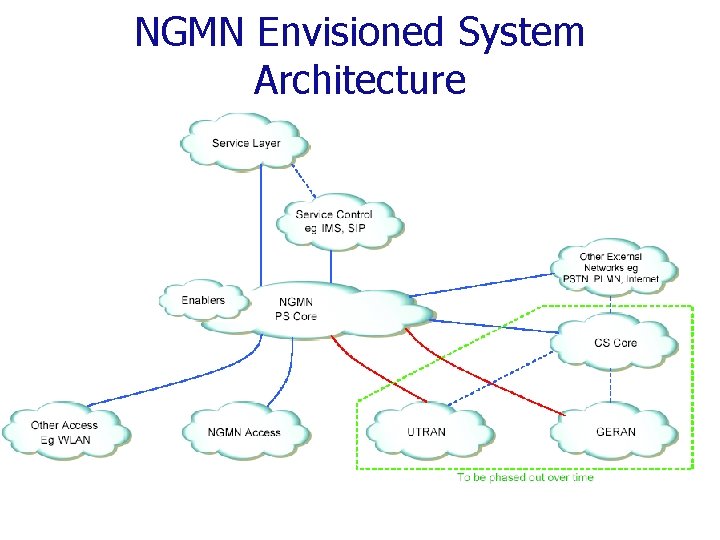
NGMN Envisioned System Architecture
Agenda § Basics & Technology Evolution § Architecture and Functionality (GSM, 3 G and beyond) § Cellular future goals § Emerging trends Ø Alternative wireless access technologies Ø Convergence § Comparison with Internet and sample scenario studies § Economics of operation § From a clean slate
Alternative fixed wireless and MAN standards § Wi. MAX, the Worldwide Interoperability for Microwave Access based on IEEE 802. 16 standard § Last-mile broadband access, backhaul for cellular networks, Internet Services § 802. 16 d Fixed Wi. MAX, 802. 16 e - Mobile Wi. MAX. § Licensed spectrum profiles: 2. 3 GHz, 2. 5 GHz and 3. 5 GHz. US mostly around 2. 5 GHz, assigned primarily to Sprint Nextel, Clearwire.
Convergence § Heterogeneous access technologies § Multi-mode access devices Ø Dual mode phones (Wi. Fi, 2. 5/3 G), UMA § Heterogeneous Services § Cellular Internet access and Internet based voice/video access § Challenges Ø Time variant heterogeneous network characteristics Ø Heterogeneous applications with different utilities Ø System design and networking challenges
Agenda § Basics & Technology Evolution § Architecture and Functionality (GSM, 3 G and beyond) § Cellular future goals § Emerging trends Ø Alternative wireless access technologies Ø Convergence § Comparison with Internet and sample scenario studies § Economics of operation § From a clean slate
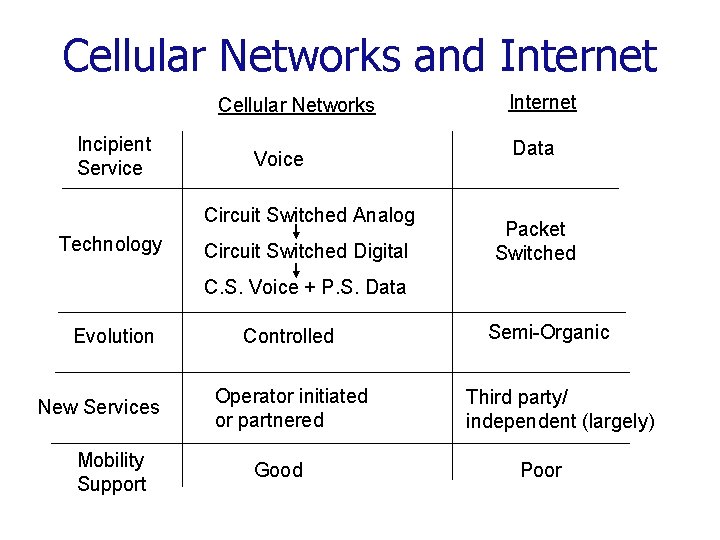
Cellular Networks and Internet Cellular Networks Incipient Service Voice Circuit Switched Analog Technology Circuit Switched Digital Internet Data Packet Switched C. S. Voice + P. S. Data Evolution New Services Mobility Support Controlled Operator initiated or partnered Good Semi-Organic Third party/ independent (largely) Poor
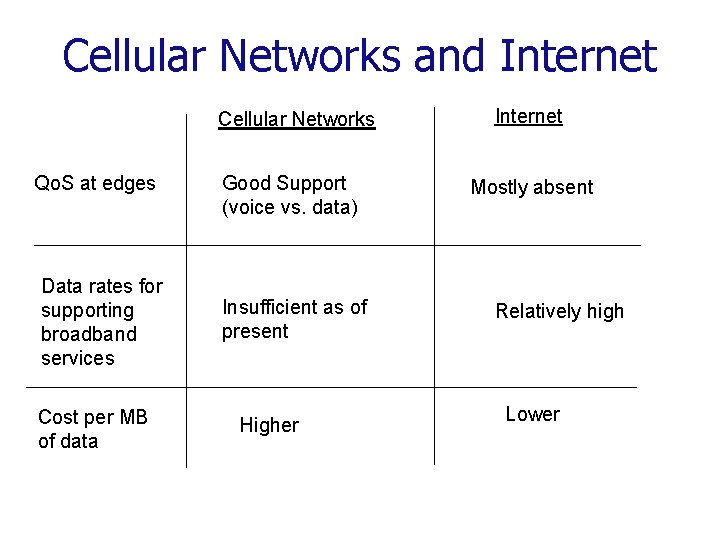
Cellular Networks and Internet Cellular Networks Qo. S at edges Data rates for supporting broadband services Cost per MB of data Good Support (voice vs. data) Insufficient as of present Higher Internet Mostly absent Relatively high Lower
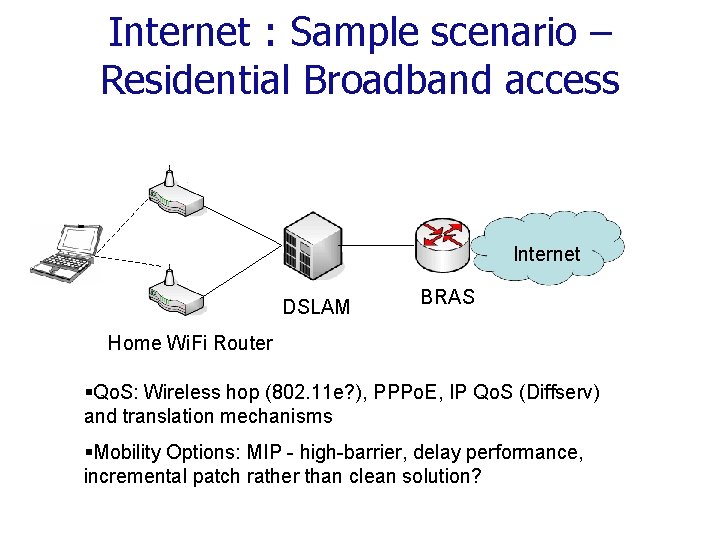
Internet : Sample scenario – Residential Broadband access Internet DSLAM BRAS Home Wi. Fi Router §Qo. S: Wireless hop (802. 11 e? ), PPPo. E, IP Qo. S (Diffserv) and translation mechanisms §Mobility Options: MIP - high-barrier, delay performance, incremental patch rather than clean solution?
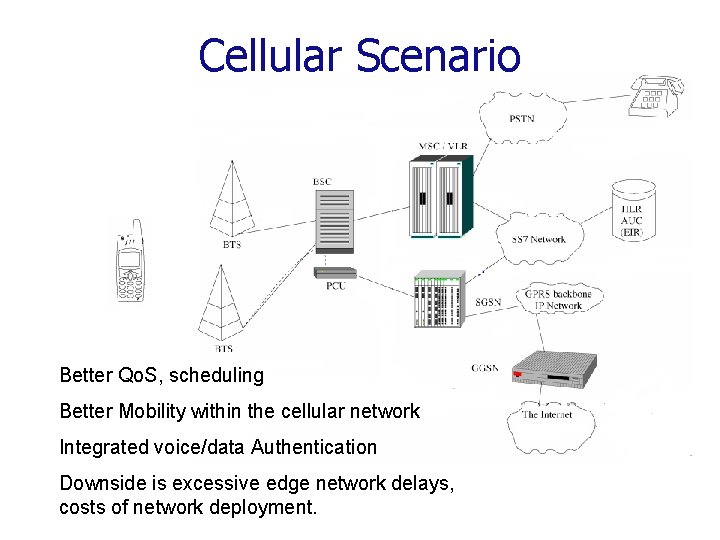
Cellular Scenario Better Qo. S, scheduling Better Mobility within the cellular network Integrated voice/data Authentication Downside is excessive edge network delays, costs of network deployment.
Agenda § Basics & Technology Evolution § Architecture and Functionality (GSM, 3 G and beyond) § Cellular future goals § Emerging trends Ø Alternative wireless access technologies Ø Convergence § Comparison with Internet and sample scenario studies § Economics of operation § From a clean slate
The Economics § 3 G spectrum licensing and migration cost § Telecom equipment vendors – economics of operation, meeting bids vs. system upgrades for technical innovation § Stiff competition for fixed and mobile segments of operators, drive towards services. § Interesting and sometimes conflicting dynamics for both fixed and mobile operators.
Agenda § Basics & Technology Evolution § Architecture and Functionality (GSM, 3 G and beyond) § Cellular future goals § Emerging trends Ø Alternative wireless access technologies Ø Convergence § Comparison with Internet and sample scenario studies § Economics of operation § From a clean slate
From a Clean Slate § Greater intelligence at edges of networks, eventually leading to just network elements of different sizes and capabilities § Functional homogeneity in network elements in terms of storage/caching, processing, networking capability. Such network element should likely Ø be multi-homed connected with heterogeneous technologies (including p 2 p, delay tolerant), Ø have intelligence for resource allocation, Qo. S Ø have interaction capability with other network elements (including user devices), Ø support mobility, handoffs Ø have ability to recognize needs of existing and new applications (HDTV, phone, streaming video) Ø be plug and play § Interfacing of applications/services (Qo. S specs) with underlying serving networks for fast and easy deployment. § Heterogeneity in access technologies amongst user carried devices honored and accepted by the network elements.
Options for operators § Sharing the spectrum/infrastructure costs? § New service models to forestall cost of upgrades § Good opportunity for fixed and mobile carriers to take initiative.
- Slides: 31