
INTRODUCTION TO CELLS Life is cellular Robert Hooke
INTRODUCTION TO CELLS Life is cellular

Robert Hooke naturalist, philosopher, inventor, architect. . (July 18, 1635 - March 3, 1703) ØIn 1665 he is the first person to use the term “cells” after looking at cork under a simple microscope.
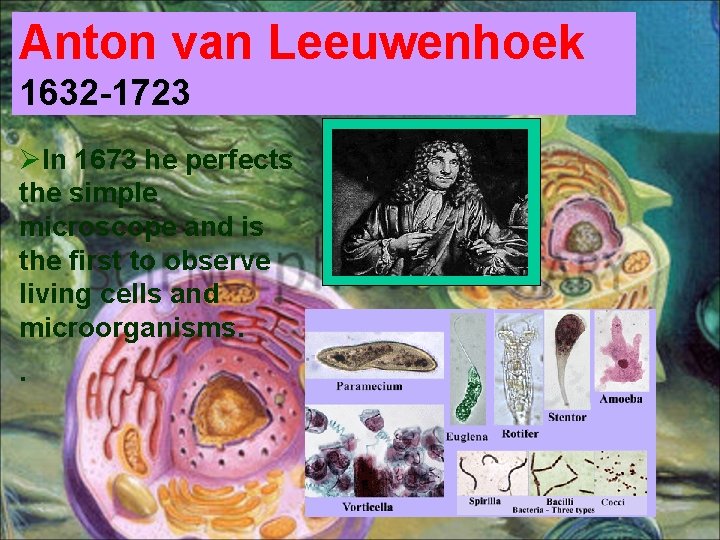
Anton van Leeuwenhoek 1632 -1723 ØIn 1673 he perfects the simple microscope and is the first to observe living cells and microorganisms. .

Cell Theory Matthias Schleiden concluded that all plants are made of cells (1838) Theodore Schwann concluded that all animals are made of cells (1839) Rudolf Virchow concluded that all cells came from pre-existing cells (1855) Cell Theory • all living things are made up of cells • cells are the basic units of structure and function in an organism • new cells are produced from existing cells
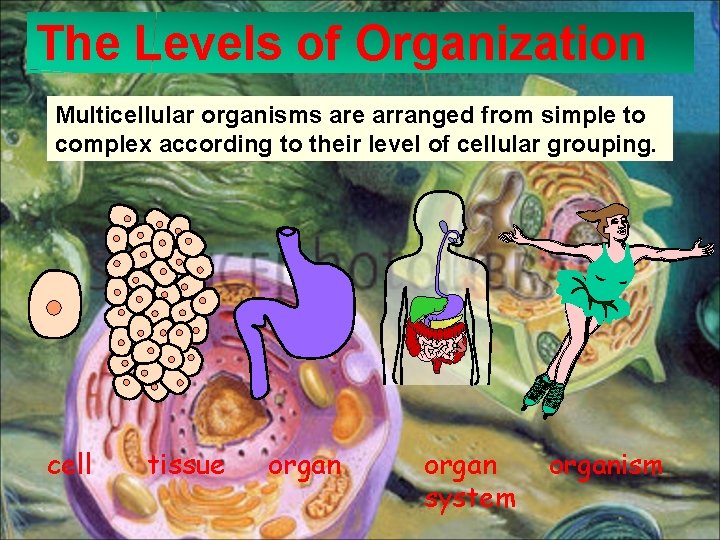
The Levels of Organization Multicellular organisms are arranged from simple to complex according to their level of cellular grouping. cell tissue organ system organism
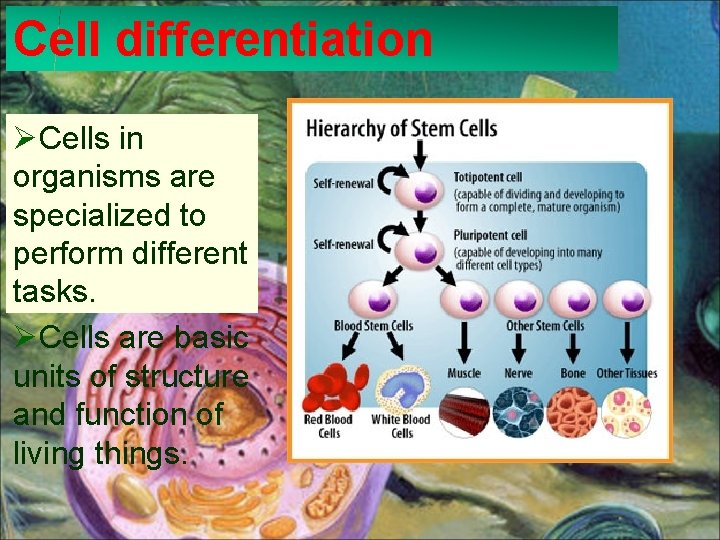
Cell differentiation ØCells in organisms are specialized to perform different tasks. ØCells are basic units of structure and function of living things.
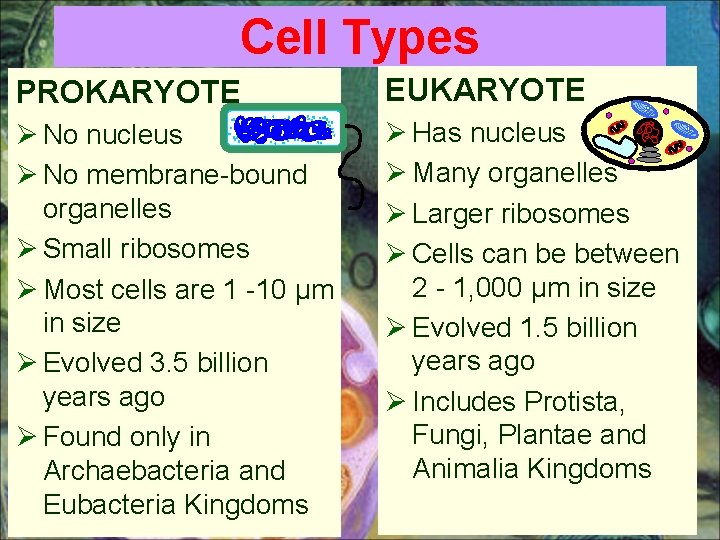
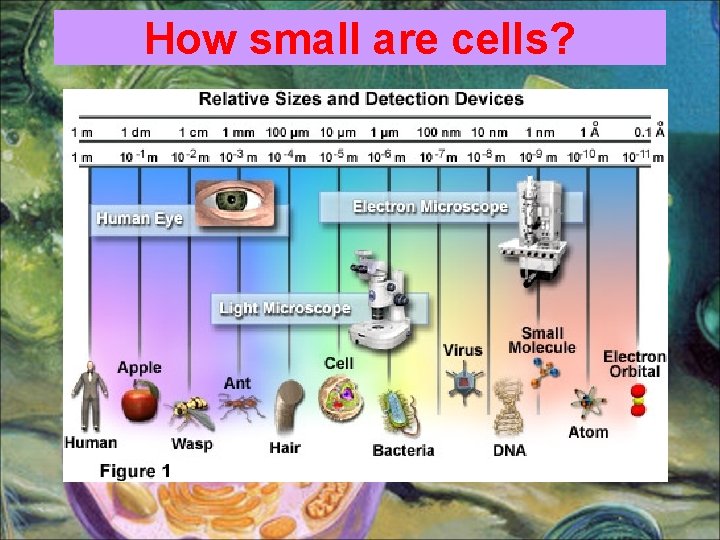
Cell Types PROKARYOTE EUKARYOTE Ø No nucleus Ø No membrane-bound organelles Ø Small ribosomes Ø Most cells are 1 -10 μm in size Ø Evolved 3. 5 billion years ago Ø Found only in Archaebacteria and Eubacteria Kingdoms Ø Has nucleus Ø Many organelles Ø Larger ribosomes Ø Cells can be between 2 - 1, 000 μm in size Ø Evolved 1. 5 billion years ago Ø Includes Protista, Fungi, Plantae and Animalia Kingdoms
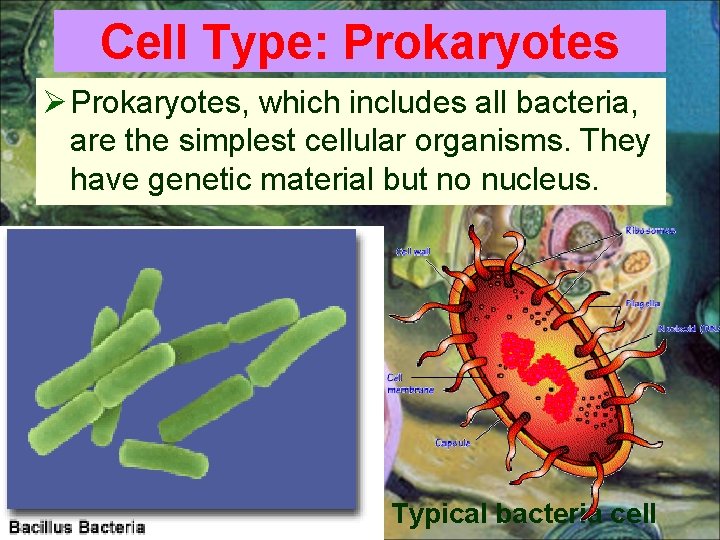
Cell Type: Prokaryotes Ø Prokaryotes, which includes all bacteria, are the simplest cellular organisms. They have genetic material but no nucleus. Typical bacteria cell
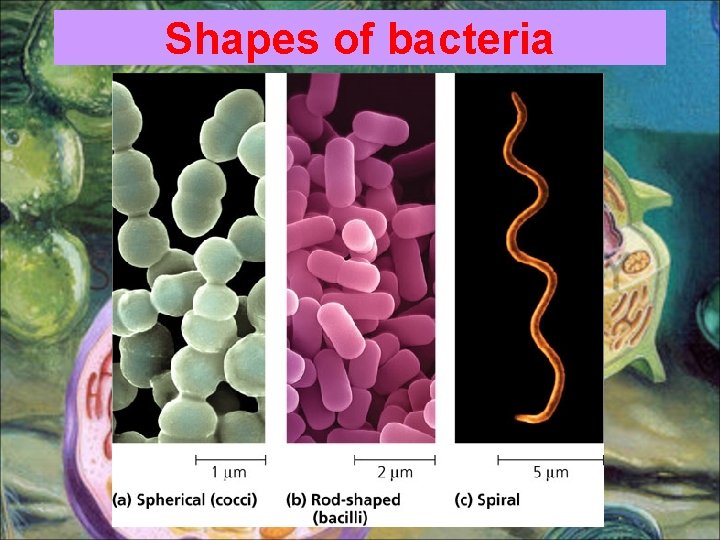
Shapes of bacteria
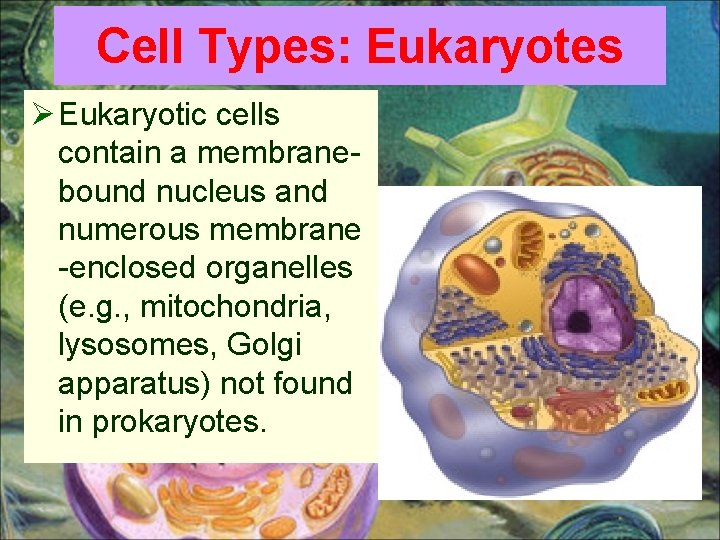
Cell Types: Eukaryotes Ø Eukaryotic cells contain a membranebound nucleus and numerous membrane -enclosed organelles (e. g. , mitochondria, lysosomes, Golgi apparatus) not found in prokaryotes.
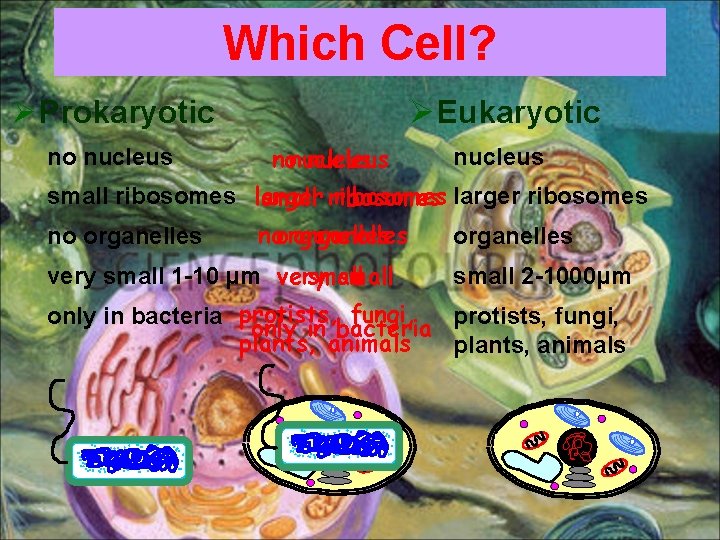
Which Cell? Ø Prokaryotic no nucleus Ø Eukaryotic nonucleus small ribosomes larger ribosomes small ribosomes no organelles noorganelles small very small 1 -10 μm very organelles small 2 -1000μm only in bacteria protists, fungi, only in bacteria plants, animals
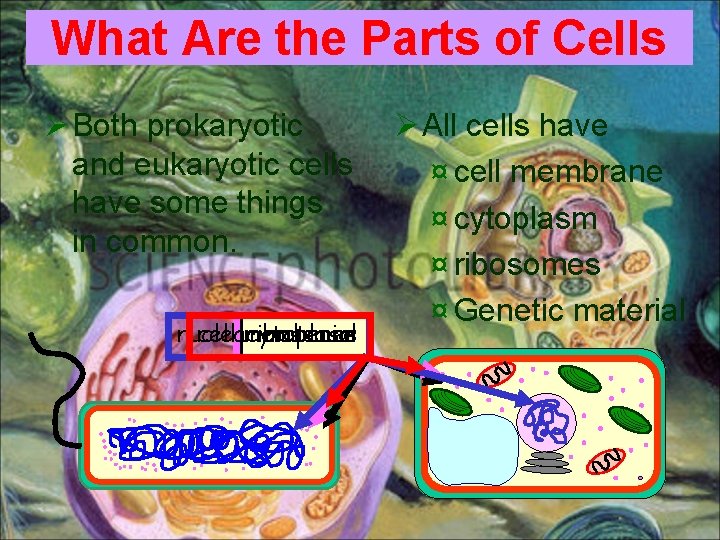
What Are the Parts of Cells Ø Both prokaryotic and eukaryotic cells have some things in common. nuclear cell membrane ribosomes cytoplasm material Ø All cells have ¤ cell membrane ¤ cytoplasm ¤ ribosomes ¤ Genetic material
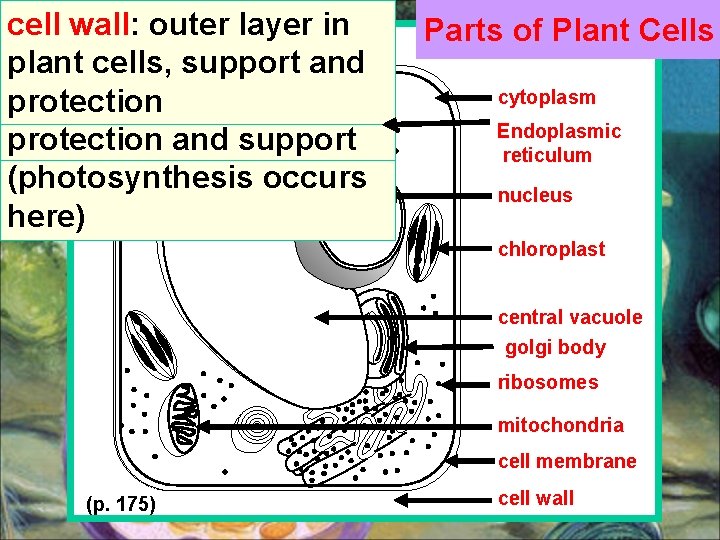
cytoplasm: nucleus: chloroplast: vacuole: ribosomes: mitochondria: cell membrane: wall: sac-like controls outer semi-liquid manufacture capture convert layer most in material cell energy structure proteins chemical regulates plant processes, cells, from that energy that what support sunlight fills stores enters contains stored theand cell hereditary water, in and protection food convert leaves salts, intoinformation the ATP it foods, into cell, (cellular etc (DNA) chemical respiration protection energy and occurs support (food), here) (photosynthesis occurs here) Parts of Plant Cells cytoplasm Endoplasmic reticulum nucleus chloroplast central vacuole golgi body ribosomes mitochondria cell membrane (p. 175) cell wall
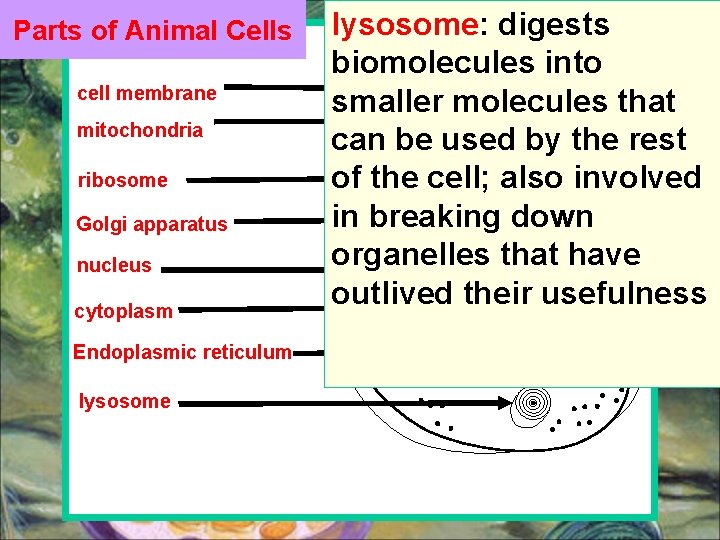
Parts of Animal Cells cell membrane mitochondria ribosome Golgi apparatus nucleus cytoplasm Endoplasmic reticulum lysosome: Golgi apparatus: digests Endoplasmic reticulum: modifies, biomolecules into and site wheresorts lipid packages smaller molecules proteins and components of thethat cell other can bematerials usedare by from the rest the membrane endoplasmic of the cell; also reticulum involved assembled, along with for in breaking storage in down the cell or proteins and other secretion organelles outside thatare have the materials that cell outlived exportedtheir fromusefulness the cell
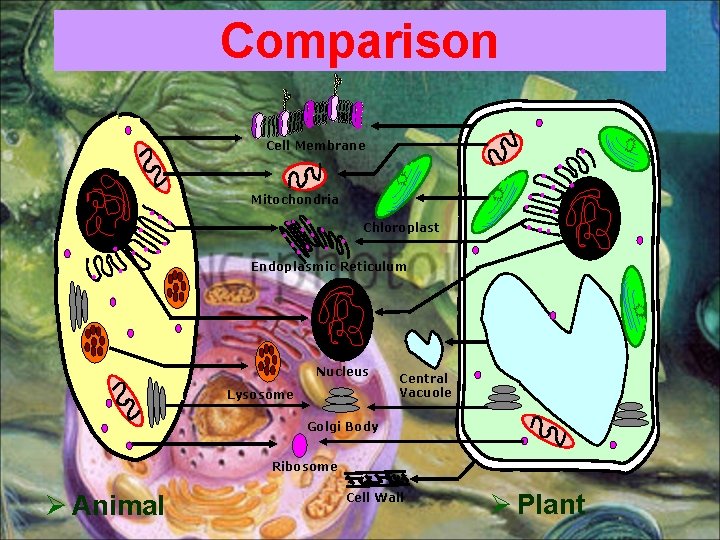
Comparison Cell Membrane Mitochondria Chloroplast Endoplasmic Reticulum Nucleus Lysosome Central Vacuole Golgi Body Ribosome Ø Animal Cell Wall Ø Plant
How small are cells?
- Slides: 16