
Introduction to Case study 6 Inward and outward
- Slides: 28
Introduction to Case study 6: Inward and outward Foreign affiliate trade in services statistics – “FATS” - Overview FATS statistics Workshop on Statistics of International Trade in Services Panama City, 13 -16 September 2005 By Matthias Reister (UNSD) UNSD/ International Trade Statistics Section (presentation based on the WTO/ OMC Training Module) 1
Outline of presentation 1. FATS as part of international trade in services 2. Guidelines and recommendations for FATS 3. Data sources and compilation issues 4. International data collection 5. Implementation recommendations 6. Progress and areas of improvement UNSD/ International Trade Statistics Section (presentation based on the WTO/ OMC Training Module) 2
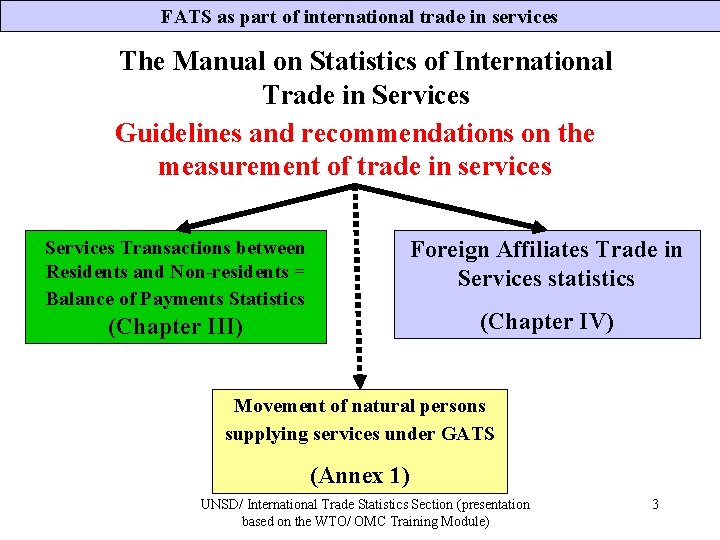
FATS as part of international trade in services The Manual on Statistics of International Trade in Services Guidelines and recommendations on the measurement of trade in services Services Transactions between Residents and Non-residents = Balance of Payments Statistics Foreign Affiliates Trade in Services statistics (Chapter IV) (Chapter III) Movement of natural persons supplying services under GATS (Annex 1) UNSD/ International Trade Statistics Section (presentation based on the WTO/ OMC Training Module) 3
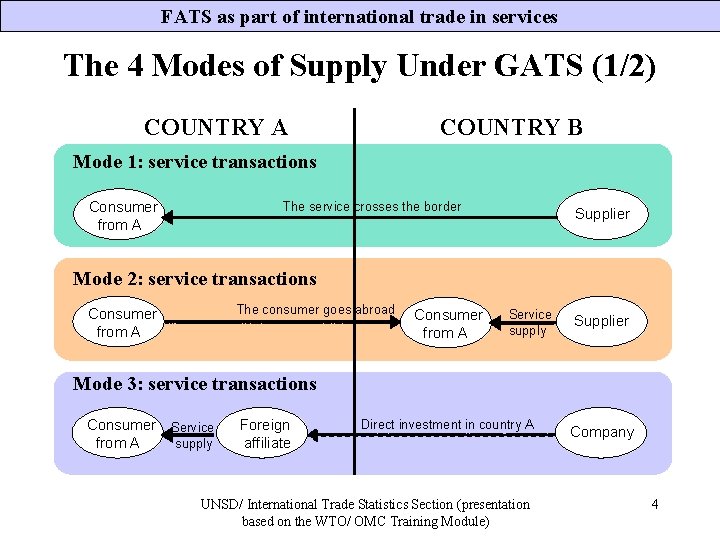
FATS as part of international trade in services The 4 Modes of Supply Under GATS (1/2) COUNTRY A COUNTRY B Mode 1: service transactions Consumer from A The service crosses the border Supplier Mode 2: service transactions The consumer goes abroad Consumer from A Service supply Supplier Mode 3: service transactions Consumer from A Service supply Foreign affiliate Direct investment in country A UNSD/ International Trade Statistics Section (presentation based on the WTO/ OMC Training Module) Company 4
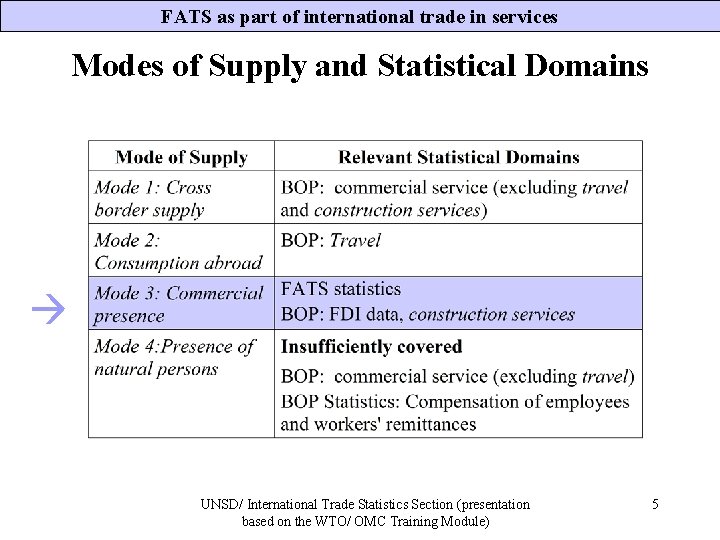
FATS as part of international trade in services Modes of Supply and Statistical Domains UNSD/ International Trade Statistics Section (presentation based on the WTO/ OMC Training Module) 5
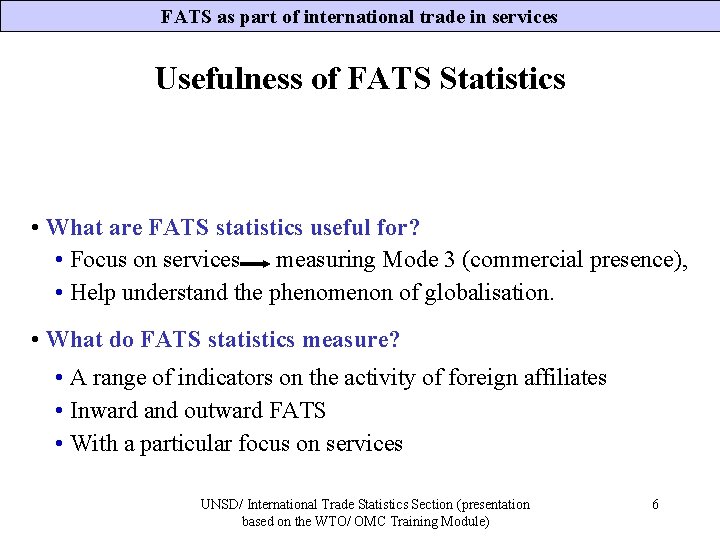
FATS as part of international trade in services Usefulness of FATS Statistics • What are FATS statistics useful for? • Focus on services measuring Mode 3 (commercial presence), • Help understand the phenomenon of globalisation. • What do FATS statistics measure? • A range of indicators on the activity of foreign affiliates • Inward and outward FATS • With a particular focus on services UNSD/ International Trade Statistics Section (presentation based on the WTO/ OMC Training Module) 6
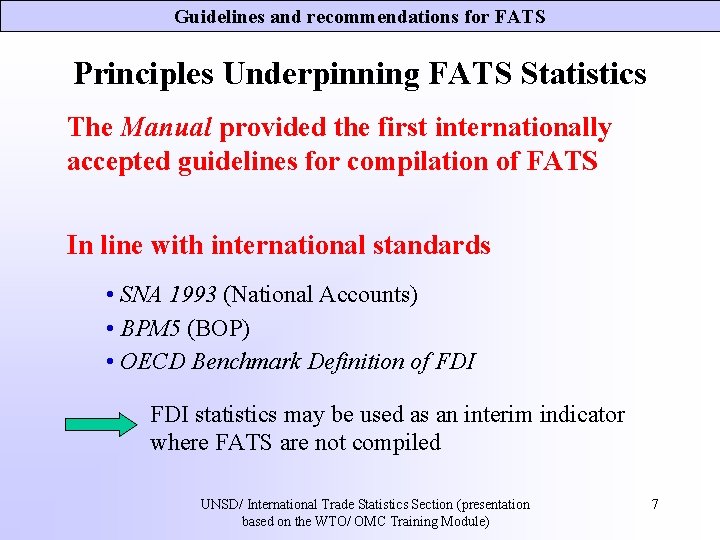
Guidelines and recommendations for FATS Principles Underpinning FATS Statistics The Manual provided the first internationally accepted guidelines for compilation of FATS In line with international standards • SNA 1993 (National Accounts) • BPM 5 (BOP) • OECD Benchmark Definition of FDI statistics may be used as an interim indicator where FATS are not compiled UNSD/ International Trade Statistics Section (presentation based on the WTO/ OMC Training Module) 7
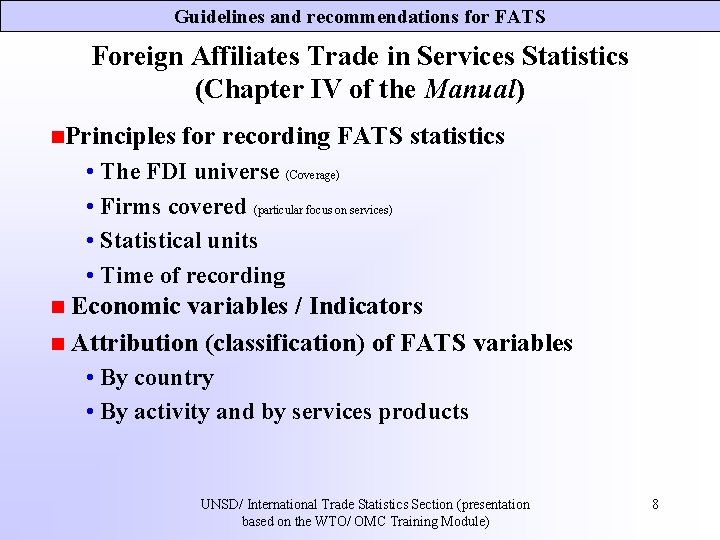
Guidelines and recommendations for FATS Foreign Affiliates Trade in Services Statistics (Chapter IV of the Manual) n. Principles for recording FATS statistics • The FDI universe (Coverage) • Firms covered (particular focus on services) • Statistical units • Time of recording Economic variables / Indicators n Attribution (classification) of FATS variables n • By country • By activity and by services products UNSD/ International Trade Statistics Section (presentation based on the WTO/ OMC Training Module) 8
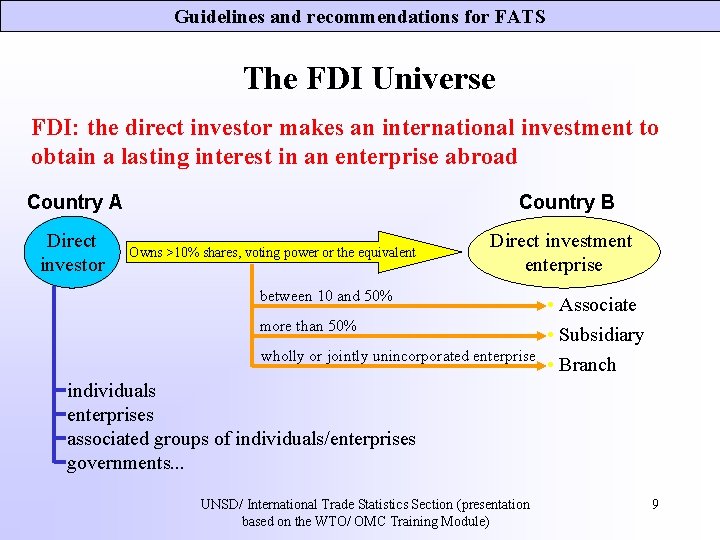
Guidelines and recommendations for FATS The FDI Universe FDI: the direct investor makes an international investment to obtain a lasting interest in an enterprise abroad Country A Direct investor Country B Owns >10% shares, voting power or the equivalent Direct investment enterprise between 10 and 50% more than 50% wholly or jointly unincorporated enterprise • Associate • Subsidiary • Branch individuals enterprises associated groups of individuals/enterprises governments. . . UNSD/ International Trade Statistics Section (presentation based on the WTO/ OMC Training Module) 9
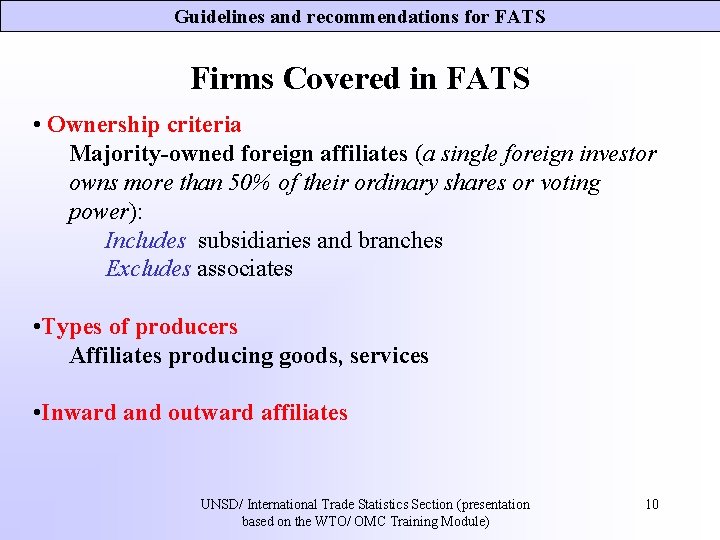
Guidelines and recommendations for FATS Firms Covered in FATS • Ownership criteria Majority-owned foreign affiliates (a single foreign investor owns more than 50% of their ordinary shares or voting power): Includes subsidiaries and branches Excludes associates • Types of producers Affiliates producing goods, services • Inward and outward affiliates UNSD/ International Trade Statistics Section (presentation based on the WTO/ OMC Training Module) 10
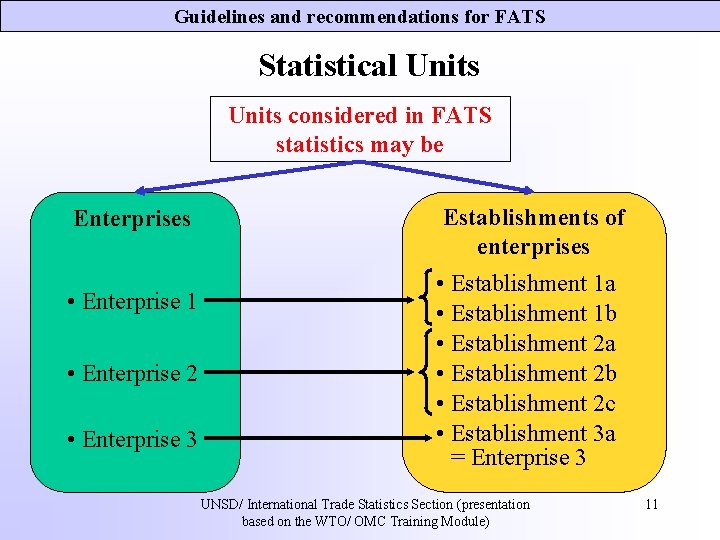
Guidelines and recommendations for FATS Statistical Units considered in FATS statistics may be Enterprises • Enterprise 1 • Enterprise 2 • Enterprise 3 Establishments of enterprises • Establishment 1 a • Establishment 1 b • Establishment 2 a • Establishment 2 b • Establishment 2 c • Establishment 3 a = Enterprise 3 UNSD/ International Trade Statistics Section (presentation based on the WTO/ OMC Training Module) 11
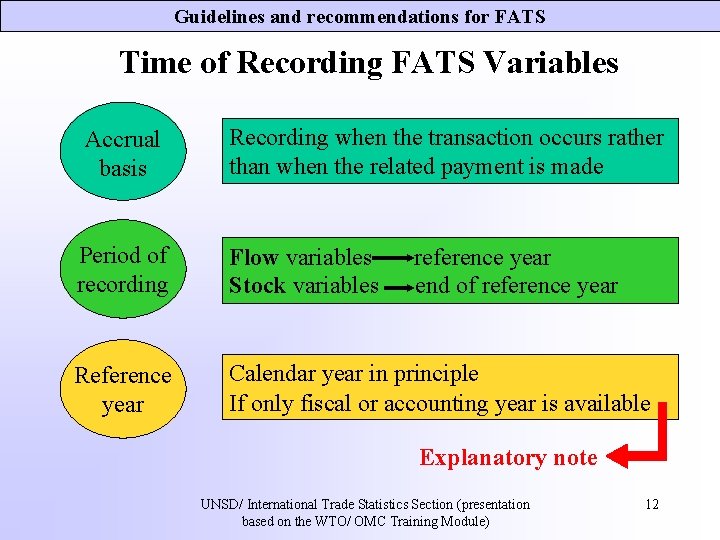
Guidelines and recommendations for FATS Time of Recording FATS Variables Accrual basis Recording when the transaction occurs rather than when the related payment is made Period of recording Flow variables Stock variables Reference year Calendar year in principle If only fiscal or accounting year is available reference year end of reference year Explanatory note UNSD/ International Trade Statistics Section (presentation based on the WTO/ OMC Training Module) 12
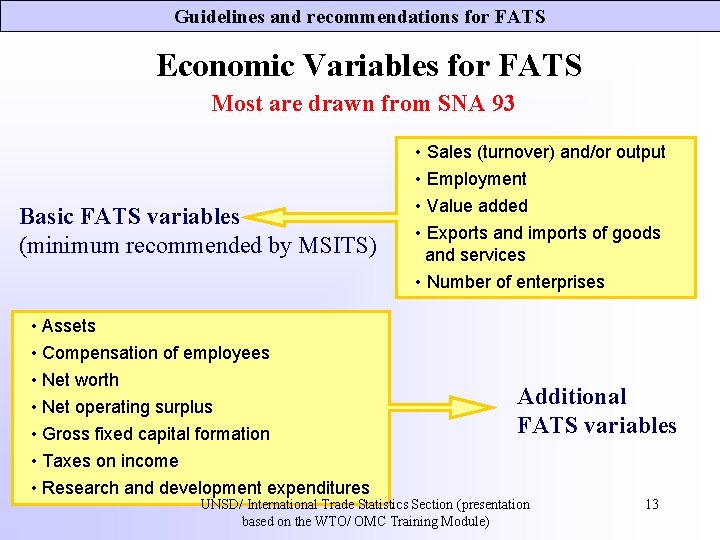
Guidelines and recommendations for FATS Economic Variables for FATS Most are drawn from SNA 93 Basic FATS variables (minimum recommended by MSITS) • Assets • Compensation of employees • Net worth • Net operating surplus • Gross fixed capital formation • Taxes on income • Research and development expenditures • Sales (turnover) and/or output • Employment • Value added • Exports and imports of goods and services • Number of enterprises Additional FATS variables UNSD/ International Trade Statistics Section (presentation based on the WTO/ OMC Training Module) 13
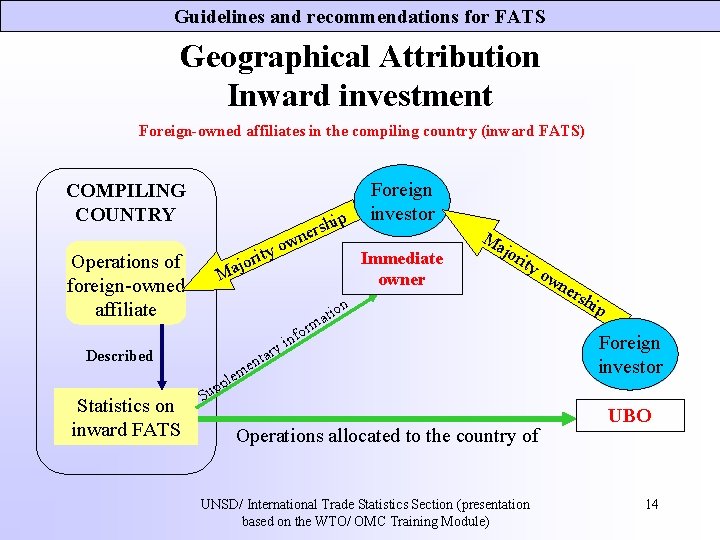
Guidelines and recommendations for FATS Geographical Attribution Inward investment Foreign-owned affiliates in the compiling country (inward FATS) COMPILING COUNTRY ip jori Operations of foreign-owned affiliate Ma Described Statistics on inward FATS w ty o m ple p u tar en sh ner nf yi Foreign investor Immediate owner Ma jor ity n tio or ma S Operations allocated to the country of UNSD/ International Trade Statistics Section (presentation based on the WTO/ OMC Training Module) ow ner shi p Foreign investor UBO 14
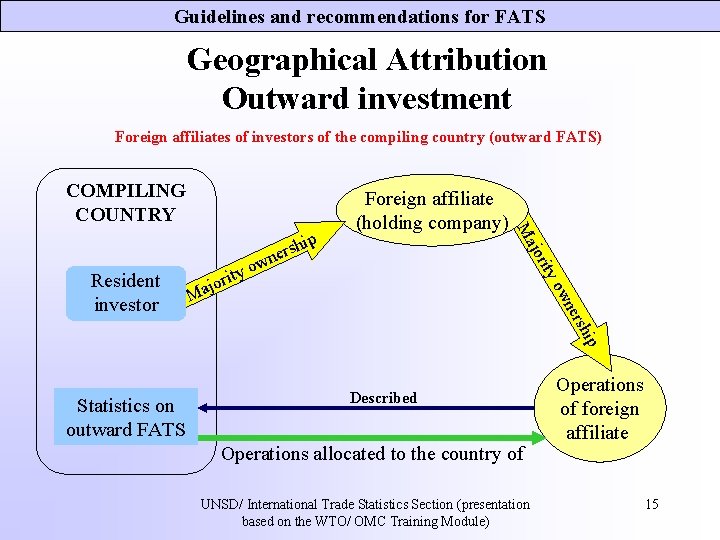
Guidelines and recommendations for FATS Geographical Attribution Outward investment Foreign affiliates of investors of the compiling country (outward FATS) COMPILING COUNTRY ity jor ow Ma Ma p shi ner ow Resident investor ty jori ip h s r ne Foreign affiliate (holding company) Statistics on outward FATS Described Operations allocated to the country of UNSD/ International Trade Statistics Section (presentation based on the WTO/ OMC Training Module) Operations of foreign affiliate 15
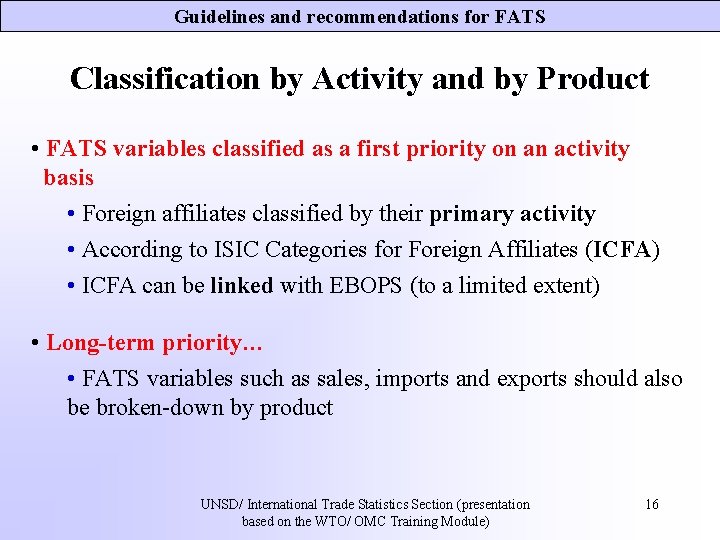
Guidelines and recommendations for FATS Classification by Activity and by Product • FATS variables classified as a first priority on an activity basis • Foreign affiliates classified by their primary activity • According to ISIC Categories for Foreign Affiliates (ICFA) • ICFA can be linked with EBOPS (to a limited extent) • Long-term priority… • FATS variables such as sales, imports and exports should also be broken-down by product UNSD/ International Trade Statistics Section (presentation based on the WTO/ OMC Training Module) 16
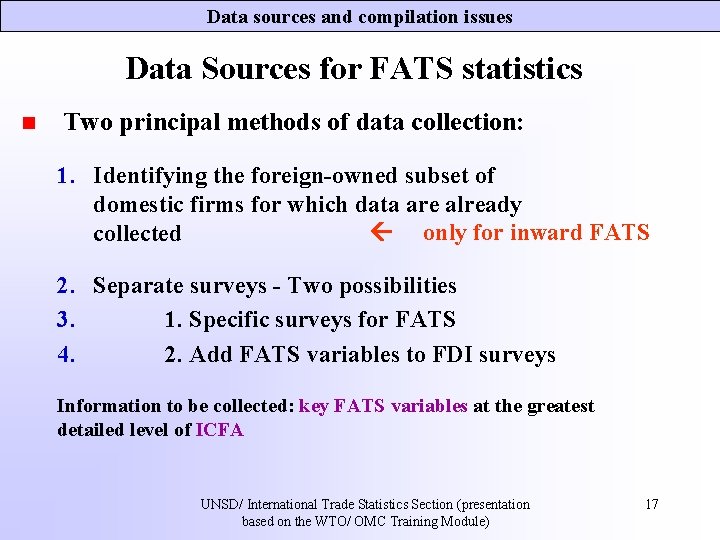
Data sources and compilation issues Data Sources for FATS statistics n Two principal methods of data collection: 1. Identifying the foreign-owned subset of domestic firms for which data are already only for inward FATS collected 2. Separate surveys - Two possibilities 3. 1. Specific surveys for FATS 4. 2. Add FATS variables to FDI surveys Information to be collected: key FATS variables at the greatest detailed level of ICFA UNSD/ International Trade Statistics Section (presentation based on the WTO/ OMC Training Module) 17
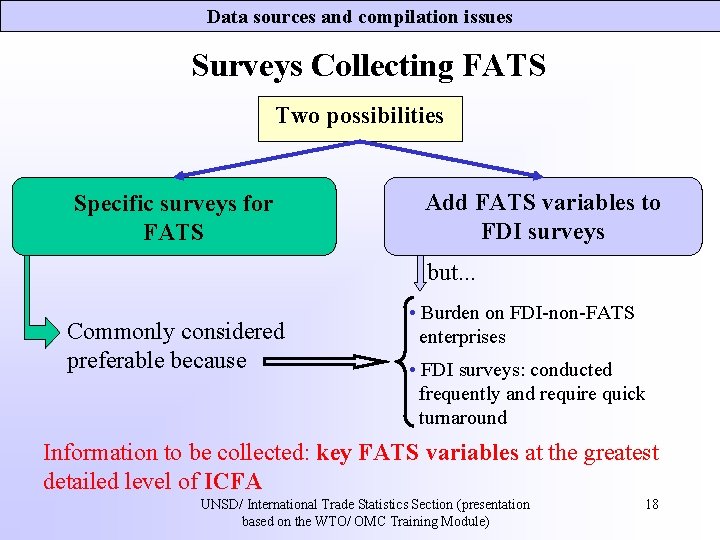
Data sources and compilation issues Surveys Collecting FATS Two possibilities Specific surveys for FATS Add FATS variables to FDI surveys but. . . Commonly considered preferable because • Burden on FDI-non-FATS enterprises • FDI surveys: conducted frequently and require quick turnaround Information to be collected: key FATS variables at the greatest detailed level of ICFA UNSD/ International Trade Statistics Section (presentation based on the WTO/ OMC Training Module) 18
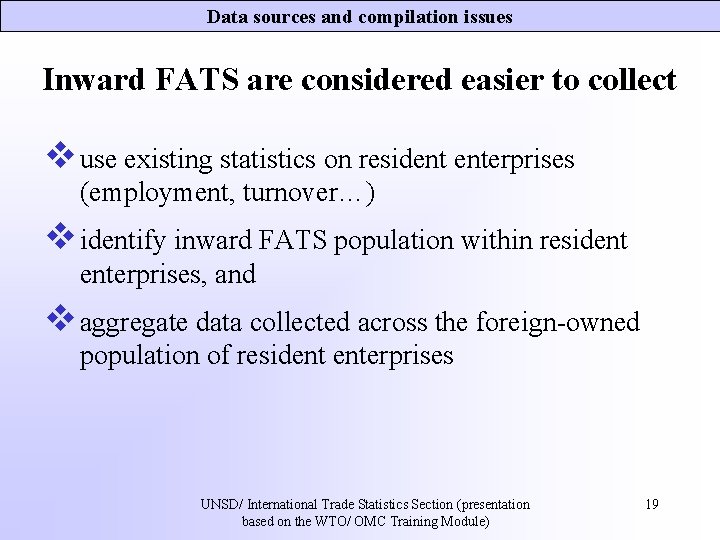
Data sources and compilation issues Inward FATS are considered easier to collect v use existing statistics on resident enterprises (employment, turnover…) v identify inward FATS population within resident enterprises, and v aggregate data collected across the foreign-owned population of resident enterprises UNSD/ International Trade Statistics Section (presentation based on the WTO/ OMC Training Module) 19
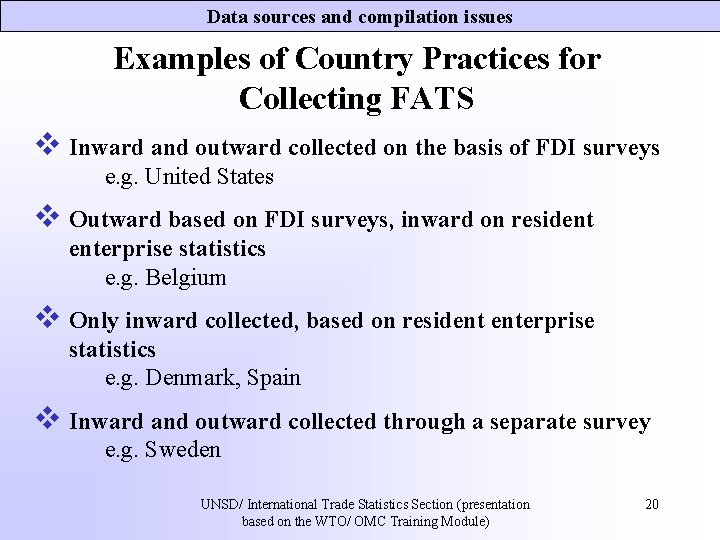
Data sources and compilation issues Examples of Country Practices for Collecting FATS v Inward and outward collected on the basis of FDI surveys e. g. United States v Outward based on FDI surveys, inward on resident enterprise statistics e. g. Belgium v Only inward collected, based on resident enterprise statistics e. g. Denmark, Spain v Inward and outward collected through a separate survey e. g. Sweden UNSD/ International Trade Statistics Section (presentation based on the WTO/ OMC Training Module) 20
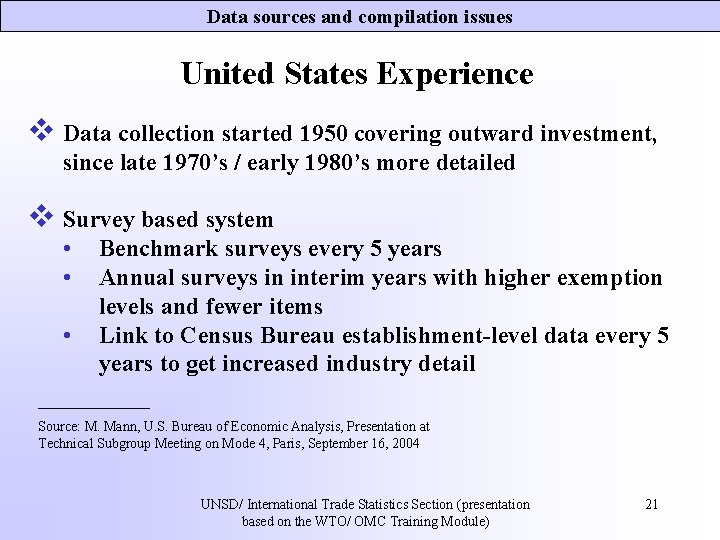
Data sources and compilation issues United States Experience v Data collection started 1950 covering outward investment, since late 1970’s / early 1980’s more detailed v Survey based system • • • Benchmark surveys every 5 years Annual surveys in interim years with higher exemption levels and fewer items Link to Census Bureau establishment-level data every 5 years to get increased industry detail ________ Source: M. Mann, U. S. Bureau of Economic Analysis, Presentation at Technical Subgroup Meeting on Mode 4, Paris, September 16, 2004 UNSD/ International Trade Statistics Section (presentation based on the WTO/ OMC Training Module) 21
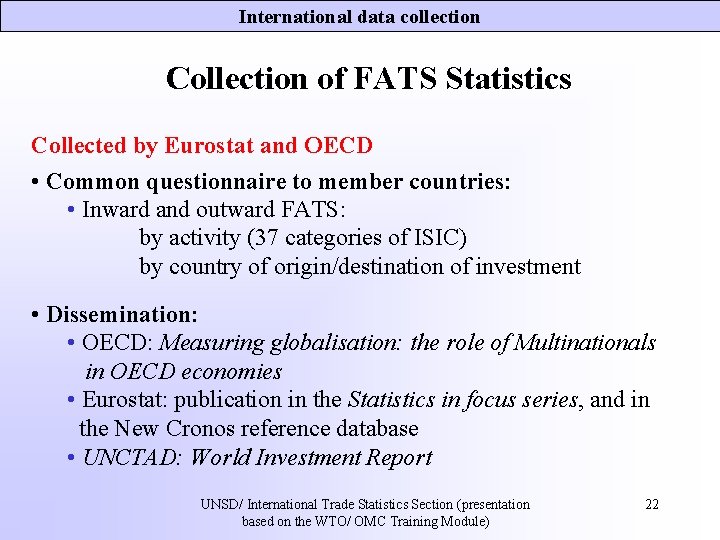
International data collection Collection of FATS Statistics Collected by Eurostat and OECD • Common questionnaire to member countries: • Inward and outward FATS: by activity (37 categories of ISIC) by country of origin/destination of investment • Dissemination: • OECD: Measuring globalisation: the role of Multinationals in OECD economies • Eurostat: publication in the Statistics in focus series, and in the New Cronos reference database • UNCTAD: World Investment Report UNSD/ International Trade Statistics Section (presentation based on the WTO/ OMC Training Module) 22
International data collection Availability of FATS Statistics UNSD/ International Trade Statistics Section (presentation based on the WTO/ OMC Training Module) 23
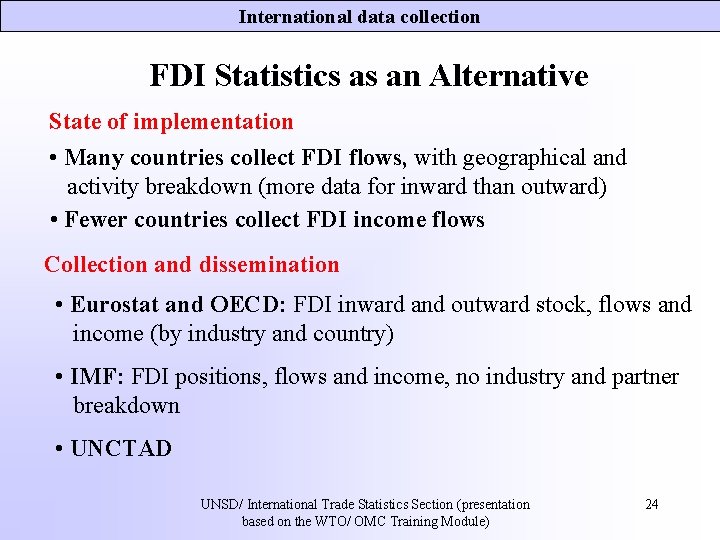
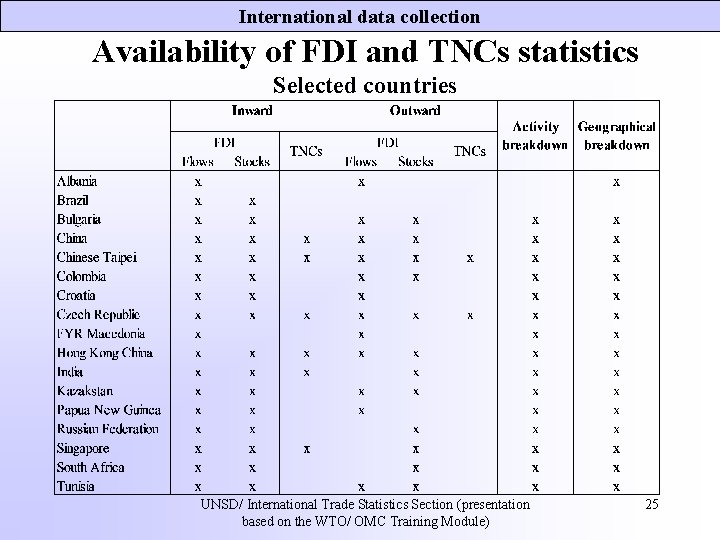
International data collection FDI Statistics as an Alternative State of implementation • Many countries collect FDI flows, with geographical and activity breakdown (more data for inward than outward) • Fewer countries collect FDI income flows Collection and dissemination • Eurostat and OECD: FDI inward and outward stock, flows and income (by industry and country) • IMF: FDI positions, flows and income, no industry and partner breakdown • UNCTAD UNSD/ International Trade Statistics Section (presentation based on the WTO/ OMC Training Module) 24
International data collection Availability of FDI and TNCs statistics Selected countries UNSD/ International Trade Statistics Section (presentation based on the WTO/ OMC Training Module) 25
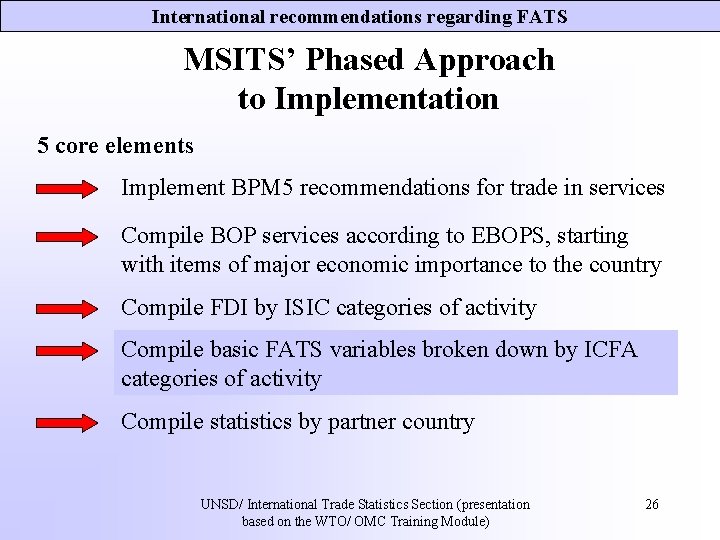
International recommendations regarding FATS MSITS’ Phased Approach to Implementation 5 core elements Implement BPM 5 recommendations for trade in services Compile BOP services according to EBOPS, starting with items of major economic importance to the country Compile FDI by ISIC categories of activity Compile basic FATS variables broken down by ICFA categories of activity Compile statistics by partner country UNSD/ International Trade Statistics Section (presentation based on the WTO/ OMC Training Module) 26
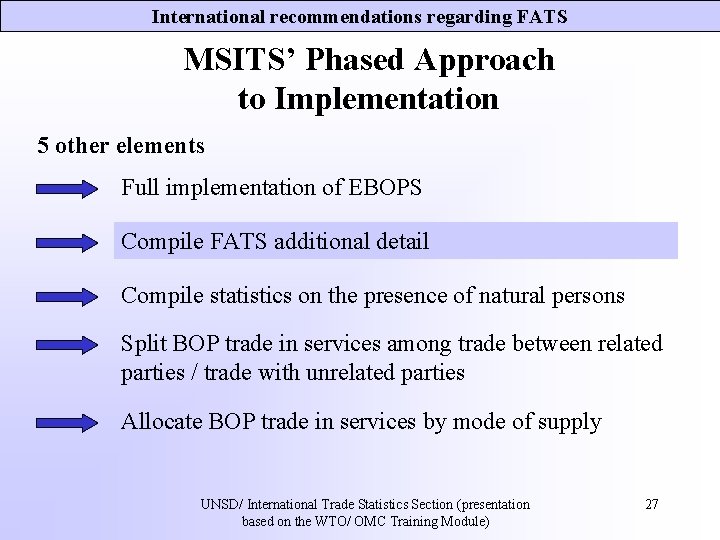
International recommendations regarding FATS MSITS’ Phased Approach to Implementation 5 other elements Full implementation of EBOPS Compile FATS additional detail Compile statistics on the presence of natural persons Split BOP trade in services among trade between related parties / trade with unrelated parties Allocate BOP trade in services by mode of supply UNSD/ International Trade Statistics Section (presentation based on the WTO/ OMC Training Module) 27
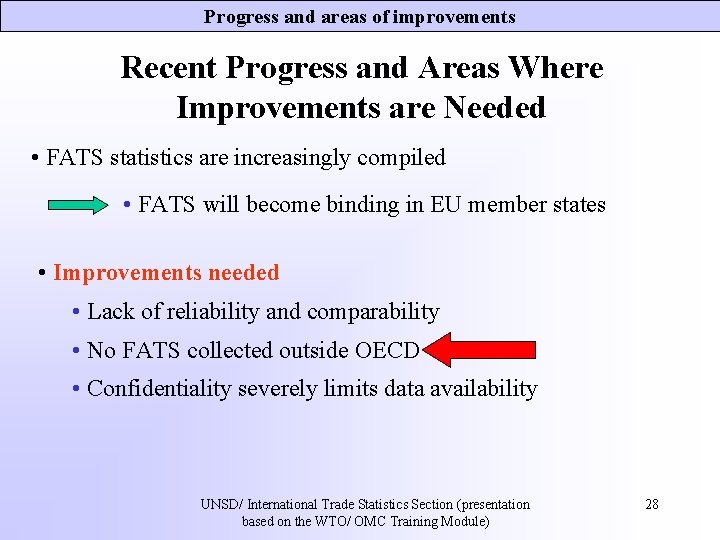
Progress and areas of improvements Recent Progress and Areas Where Improvements are Needed • FATS statistics are increasingly compiled • FATS will become binding in EU member states • Improvements needed • Lack of reliability and comparability • No FATS collected outside OECD • Confidentiality severely limits data availability UNSD/ International Trade Statistics Section (presentation based on the WTO/ OMC Training Module) 28