
Introduction to case management Session outline Overall purpose




- Slides: 25
Introduction to case management
Session outline • Overall purpose of the case management sessions • Introduction to case management - Participants’ experiences, Definition • Case management process - Stages of process, Details of each stage, Considerations • Key points
Overall purpose of case management sessions
Overall purpose of case management sessions • Participants understand the entire case management process for child survivors • Participants recognize the key differences between adult and child case management support • Participants know how to ensure children and carers are empowered and placed at the center of the case management process
Introduction to case management
What experience do you have in case management? • Who in this room provides case management support to children? • Who provides case management support to children who have been raped, or otherwise sexually abused? • What is your role in the process?
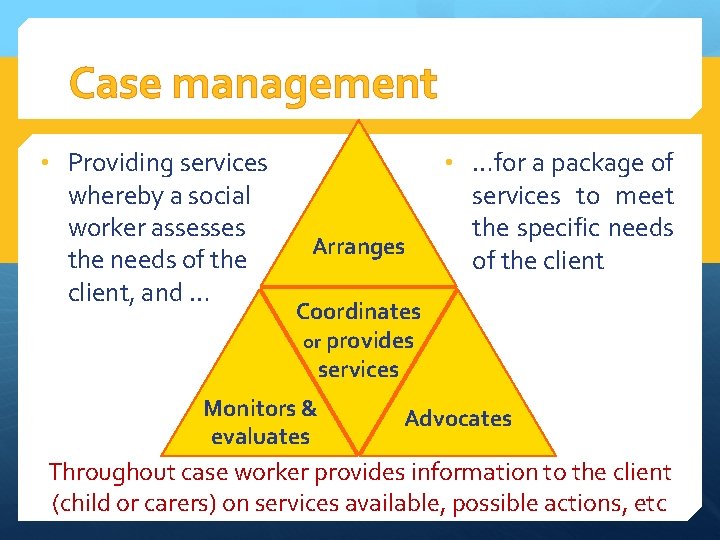
Case management • Providing services whereby a social worker assesses the needs of the client, and … • …for a package of Arranges services to meet the specific needs of the client Coordinates or provides services Monitors & evaluates Advocates Throughout case worker provides information to the client (child or carers) on services available, possible actions, etc
Caseworkers must have in-depth knowledge of the services agencies can provide, including: • for medical care, • safety assistance, • legal counseling and assistance, • and psychosocial services… And share this information with the child / carers, in order to empower children and help caregivers make informed choices in their best interest. This is part of informed consent process
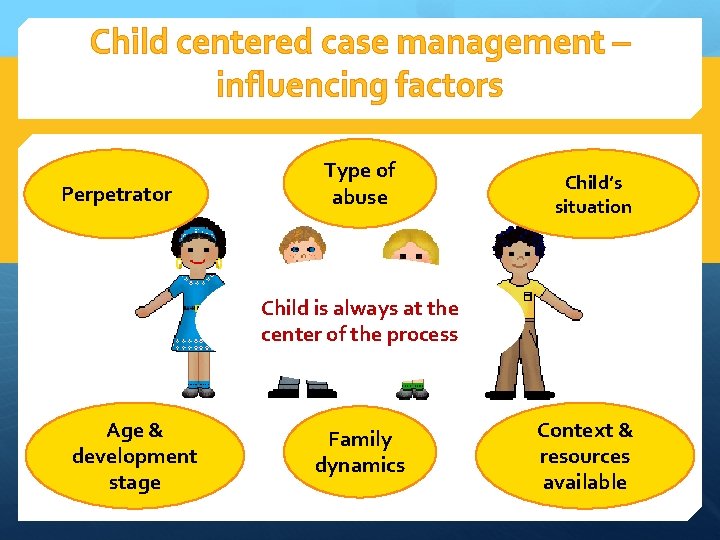
Child centered case management – influencing factors Perpetrator Type of abuse Child’s situation Child is always at the center of the process Age & development stage Family dynamics Context & resources available
Case management process
Stages of case management process activity
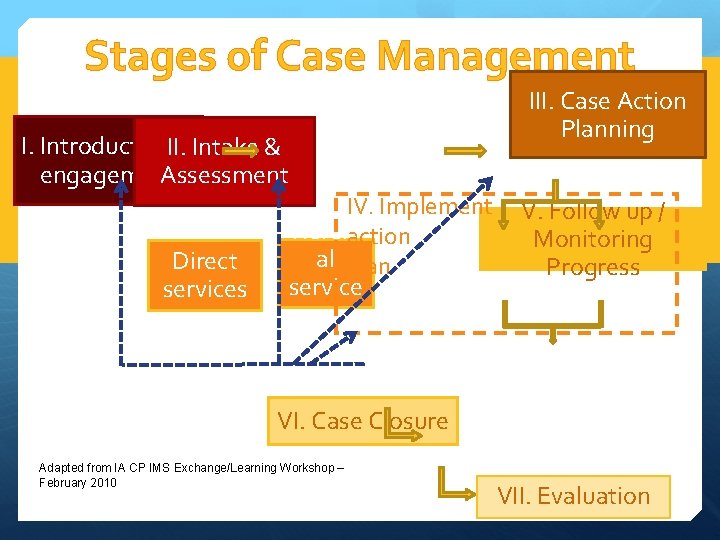
Stages of Case Management I. Introduction. II. &Intake & engagement Assessment Direct services IV. Implement Referraction al plan service s III. Case Action Planning V. Follow up / Monitoring Progress VI. Case Closure Adapted from IA CP IMS Exchange/Learning Workshop – February 2010 VII. Evaluation
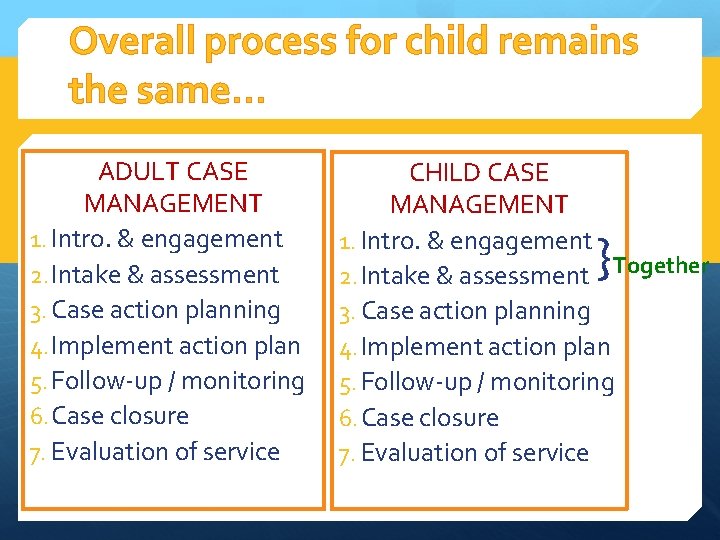
Overall process for child remains the same… ADULT CASE MANAGEMENT 1. Intro. & engagement 2. Intake & assessment 3. Case action planning 4. Implement action plan 5. Follow-up / monitoring 6. Case closure 7. Evaluation of service CHILD CASE MANAGEMENT 1. Intro. & engagement 2. Intake & assessment Together 3. Case action planning 4. Implement action plan 5. Follow-up / monitoring 6. Case closure 7. Evaluation of service }
But the details are different… • Interviewing / communicating with child survivors Intake & • Sharing information in way can be understood assessment • Informed consent, confidentiality procedures & best interest of child • Addressing mandatory reporting Develop • Balancing decision making roles action plan • Informed consent and referrals • Advocacy & accompaniment of child survivors • Involving caregivers/family in care & Implement treatment help the plan • Direct interventions provided (psychosocial support)
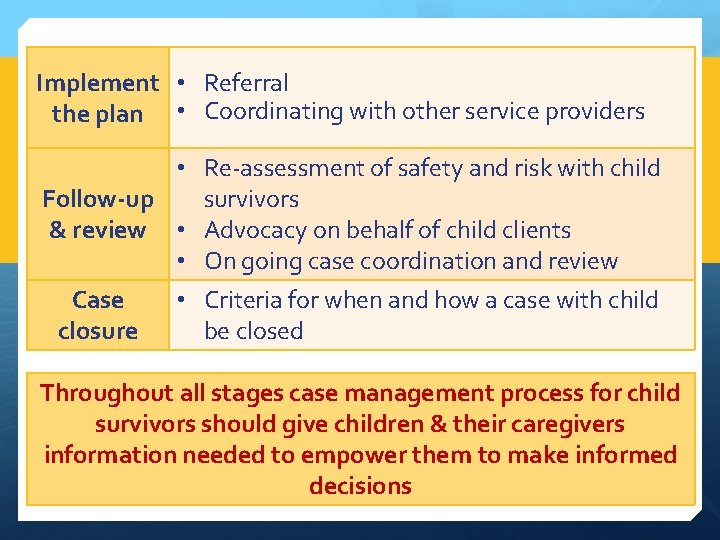
Implement • Referral the plan • Coordinating with other service providers • Re-assessment of safety and risk with child Follow-up survivors & review • Advocacy on behalf of child clients • On going case coordination and review Case • Criteria for when and how a case with child closure be closed Throughout all stages case management process for child survivors should give children & their caregivers information needed to empower them to make informed decisions
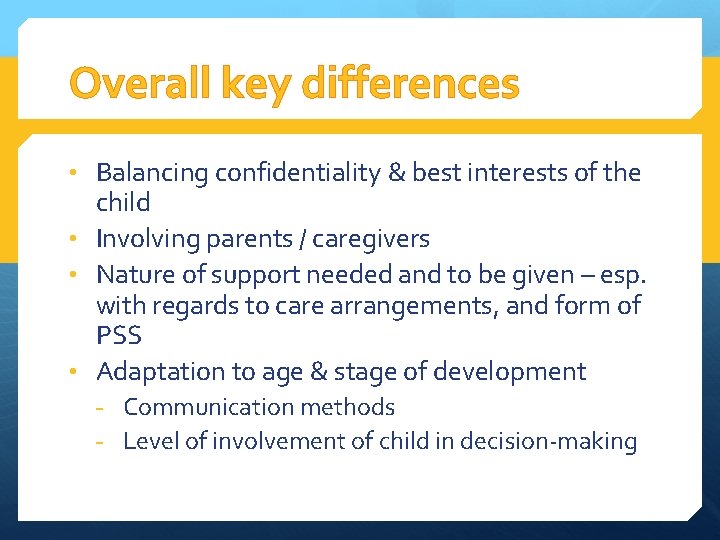
Overall key differences • Balancing confidentiality & best interests of the child • Involving parents / caregivers • Nature of support needed and to be given – esp. with regards to care arrangements, and form of PSS • Adaptation to age & stage of development - Communication methods - Level of involvement of child in decision-making
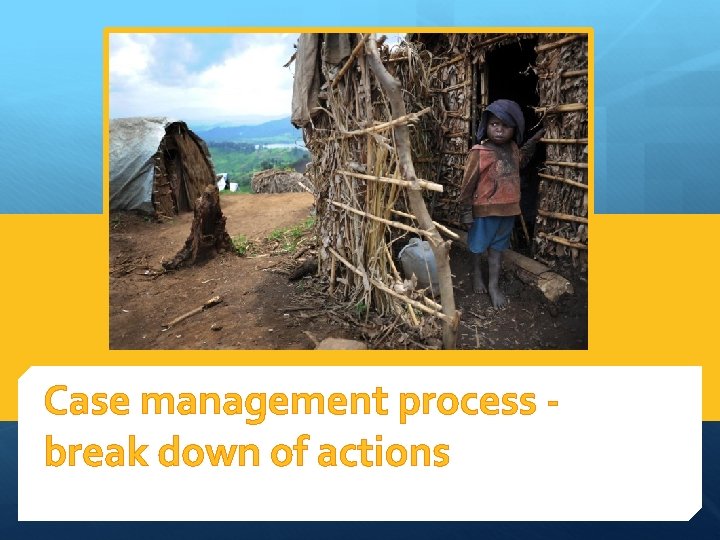
Case management process break down of actions
Group work • Participants break into 7 groups, 3 -4 participants each • Each group discuss assigned step of the process • Discuss the following questions: - What documentation happens during this stage? - Who do you need to talk to? - What has to happen to allow you to move from this stage to the next stage in the process? • 15 mins
Activity debrief • Complex process - Not always linear - Varies from one case to another • Decisions made through discussion: - In case meetings / conferences - With supervisor, with child and caregiver(s) - Child, & their wellbeing, is central • Each step of process requires documentation so we have record of all actions taken & avoid child repeating themselves – forms
Considerations
Things to consider at each stage of process At each stage ask ourselves these key questions: • What are the risks to the child’s safety? • What will achieve the ‘best interests of the child’? • At what level can the child participate at this stage? • Who else (other than child) should be consulted?
Things to consider at each stage of process, cont. • What decisions have been taken and why? • What resources can be used to assist the child? - What is your organization’s plan for intervention? - What other organizations have suitable resources/ support? • What is the timeline for action?
Key points
Key points • Decisions made in case management based on communication & discussion with range of stakeholders (importantly including the child, who is at the center of the process) • Empowerment, including through information sharing, important throughout • Documentation is a key component of case management process • Case management is not a linear process