
Introduction to Carbohydrates of medical importance General importance
Introduction to Carbohydrates of medical importance
General importance of carbohydrates Carbohydrates are initially synthesized in plants by photosynthesis. Carbohydrates are important for: 1 - Provide energy 2 - Store energy in the form of: starch (in plants) glycogen (in animals and humans) 3 - Supply carbon for synthesis of other compounds. 4 - Form structural components in cells and tissues.
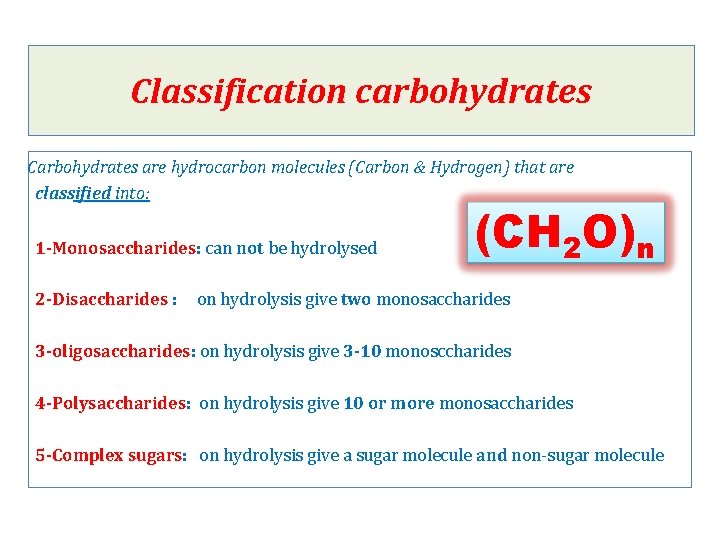
Classification carbohydrates Carbohydrates are hydrocarbon molecules (Carbon & Hydrogen) that are classified into: 1 -Monosaccharides: can not be hydrolysed 2 -Disaccharides : (CH 2 O)n on hydrolysis give two monosaccharides 3 -oligosaccharides: on hydrolysis give 3 -10 monosccharides 4 -Polysaccharides: on hydrolysis give 10 or more monosaccharides 5 -Complex sugars: on hydrolysis give a sugar molecule and non-sugar molecule
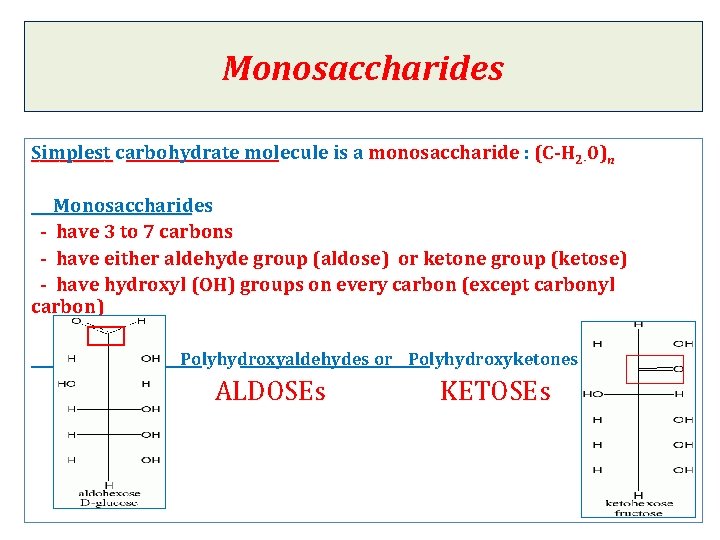
Monosaccharides Simplest carbohydrate molecule is a monosaccharide : (C-H 2 -0)n Monosaccharides - have 3 to 7 carbons - have either aldehyde group (aldose) or ketone group (ketose) - have hydroxyl (OH) groups on every carbon (except carbonyl carbon) Polyhydroxyaldehydes or Polyhydroxyketones ALDOSEs KETOSEs
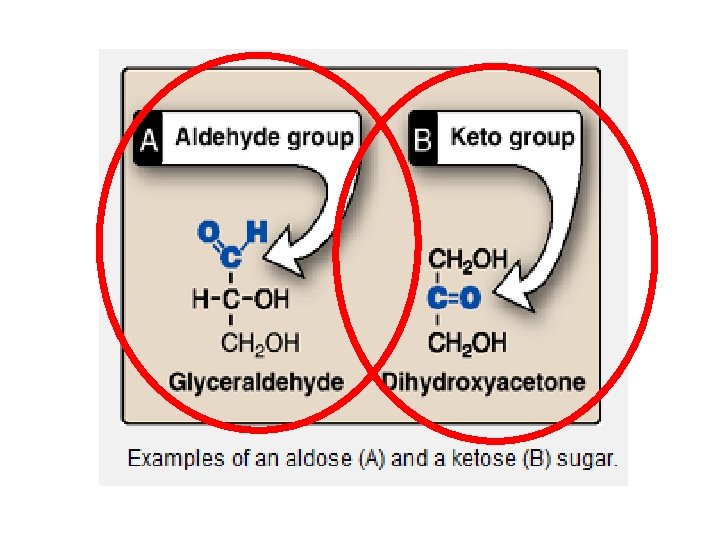
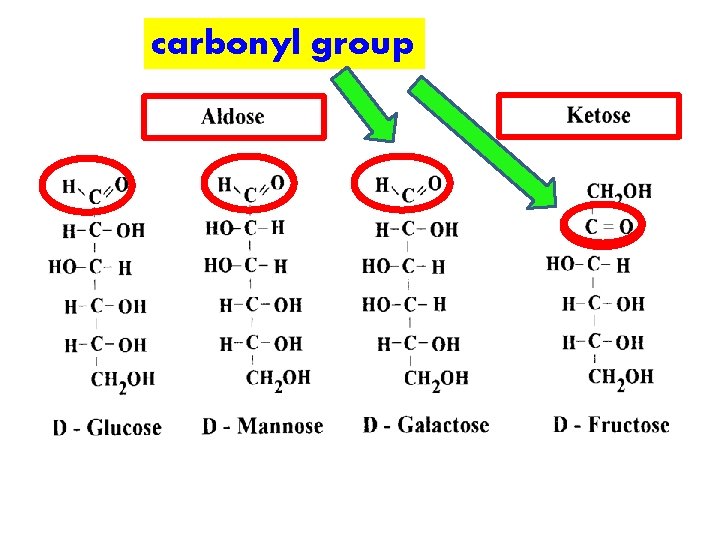
carbonyl group
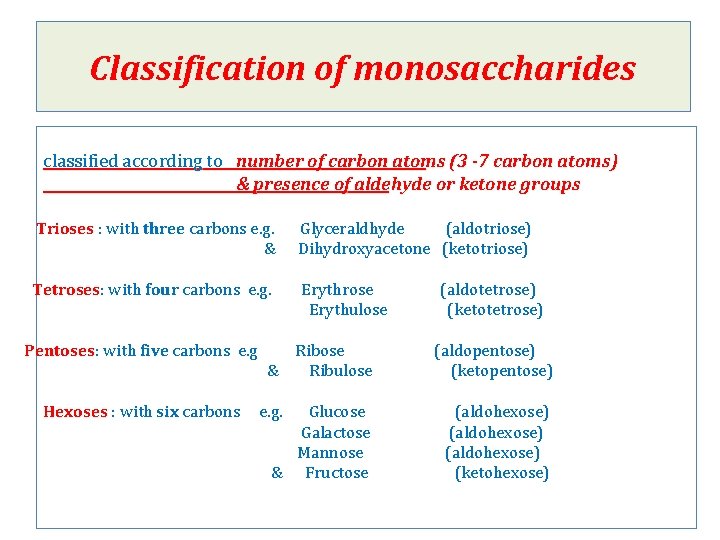
Classification of monosaccharides classified according to number of carbon atoms (3 -7 carbon atoms) & presence of aldehyde or ketone groups Trioses : with three carbons e. g. & Glyceraldhyde (aldotriose) Dihydroxyacetone (ketotriose) Tetroses: with four carbons e. g. Erythrose Erythulose Pentoses: with five carbons e. g Hexoses : with six carbons Ribose & Ribulose e. g. Glucose Galactose Mannose & Fructose (aldotetrose) (ketotetrose) (aldopentose) (ketopentose) (aldohexose) (ketohexose)
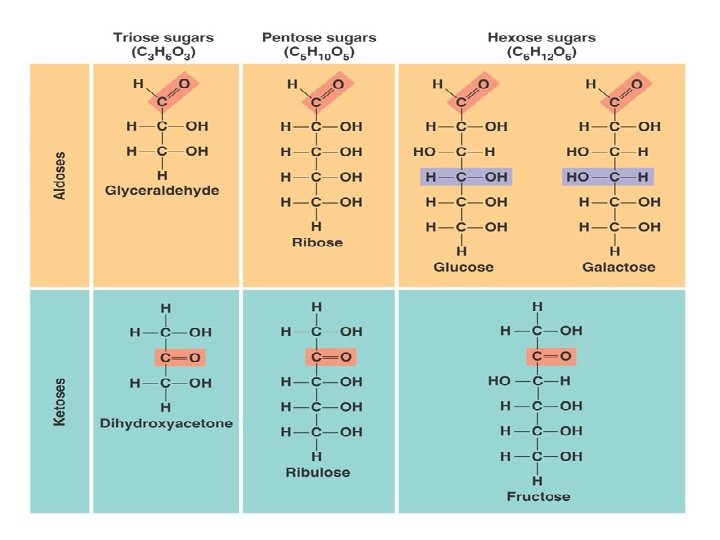
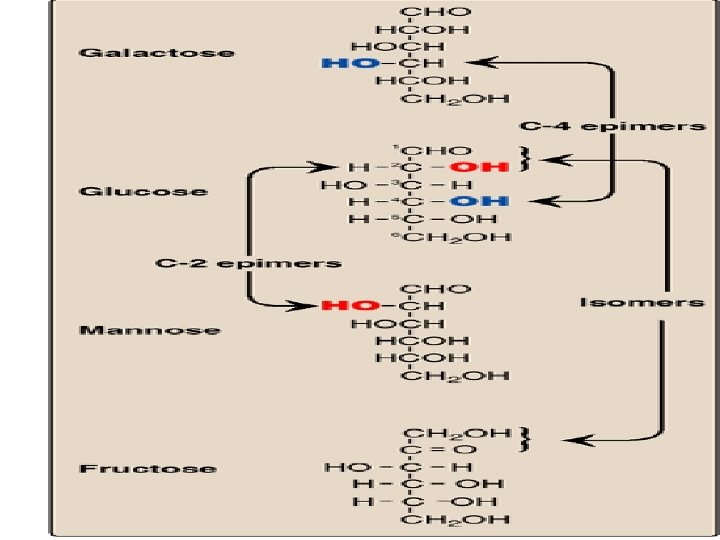
Isomers & Epimers in monosaccharides isomers: Compounds that have the same chemical formula but with different structures For example fructose, glucose, mannose and galactose are all isomers of each other having the same chemical formula C 6 H 12 O 6

Isomers & Epimers in monosaccharides epimers: Carbohydrate isomers that differ in configuration around only specific carbon atom (with the exception of carbonyl carbon) are defined as epimers of each other For example: glucose and galactose are C-4 epimers as their structures differ only in the position of –OH at carbon 4 Glucose and mannose are C-2 epimers N. B. glucose and fructose are isomers BUT NOT epimers ALL EPIMERS ARE ISOMERS BUT NOT ALL ISOMERS ARE EPIMERS
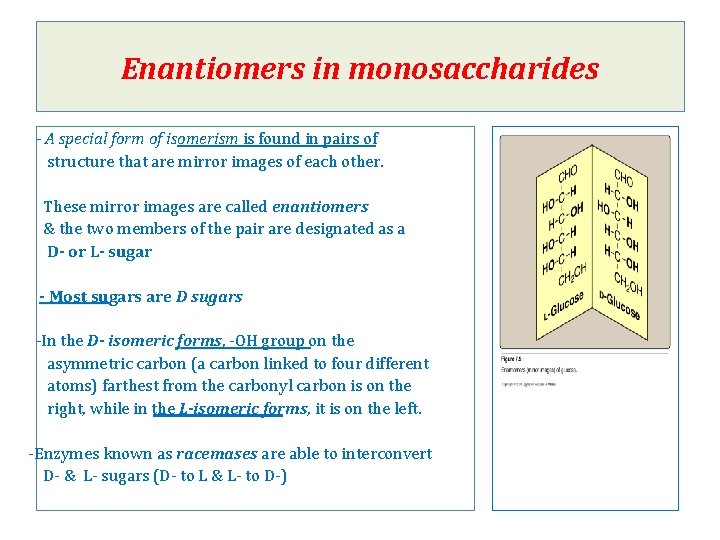
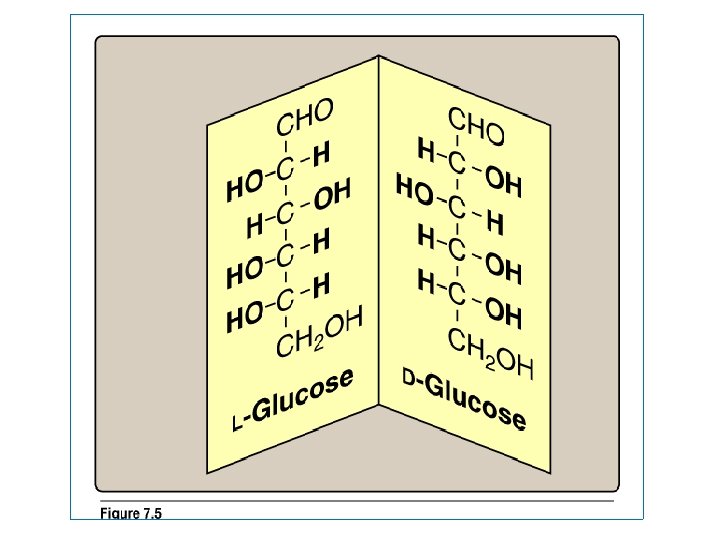
Enantiomers in monosaccharides - A special form of isomerism is found in pairs of structure that are mirror images of each other. These mirror images are called enantiomers & the two members of the pair are designated as a D- or L- sugar - Most sugars are D sugars -In the D- isomeric forms, -OH group on the asymmetric carbon (a carbon linked to four different atoms) farthest from the carbonyl carbon is on the right, while in the L-isomeric forms, it is on the left. -Enzymes known as racemases are able to interconvert D- & L- sugars (D- to L & L- to D-)
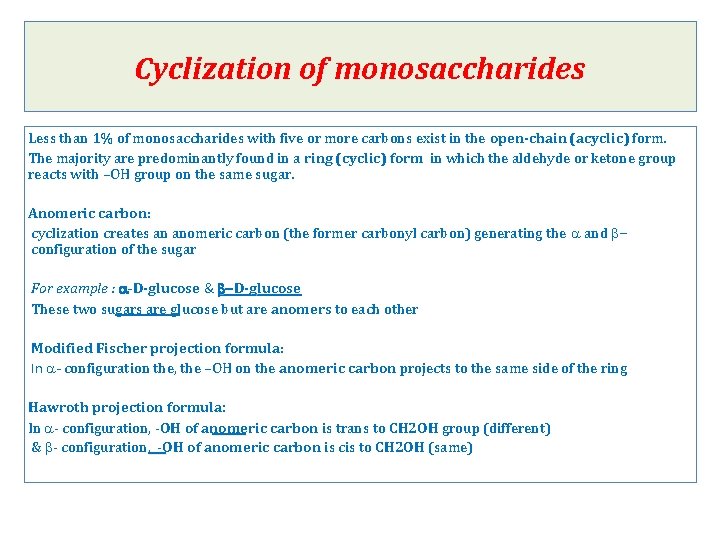
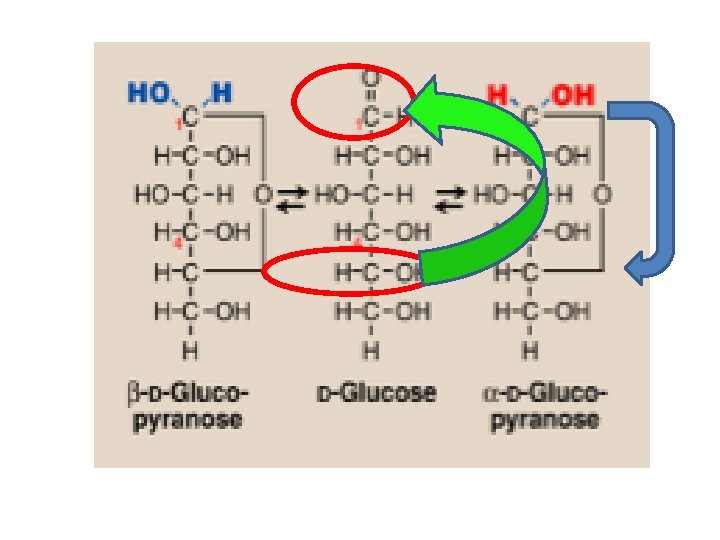
Cyclization of monosaccharides Less than 1% of monosaccharides with five or more carbons exist in the open-chain (acyclic) form. The majority are predominantly found in a ring (cyclic) form in which the aldehyde or ketone group reacts with –OH group on the same sugar. Anomeric carbon: cyclization creates an anomeric carbon (the former carbonyl carbon) generating the a and bconfiguration of the sugar For example : a-D-glucose & b-D-glucose These two sugars are glucose but are anomers to each other Modified Fischer projection formula: In a- configuration the, the –OH on the anomeric carbon projects to the same side of the ring Hawroth projection formula: In a- configuration, -OH of anomeric carbon is trans to CH 2 OH group (different) & b- configuration, -OH of anomeric carbon is cis to CH 2 OH (same)
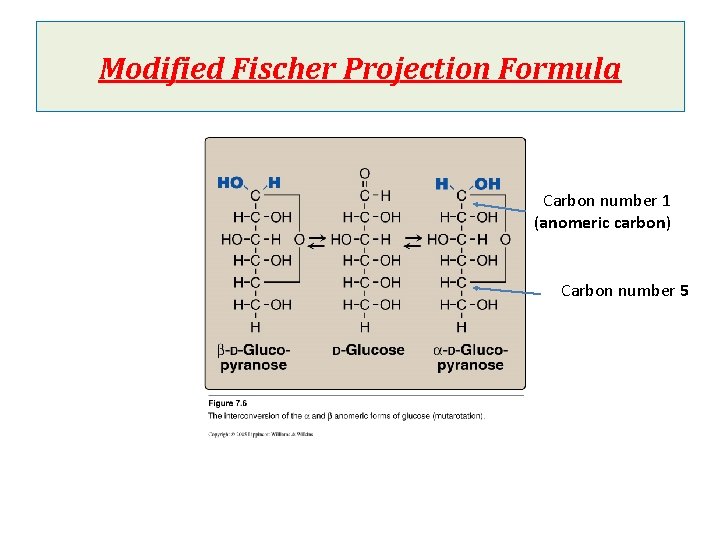
Modified Fischer Projection Formula Carbon number 1 (anomeric carbon) Carbon number 5
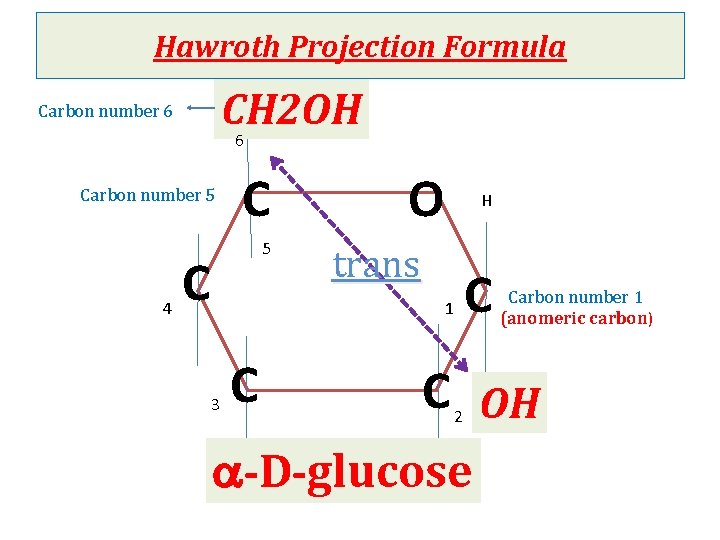
Hawroth Projection Formula CH 2 OH 6 Carbon number 5 4 C 5 C O H trans 1 3 C C Carbon number 1 (anomeric carbon) C OH 2 a-D-glucose
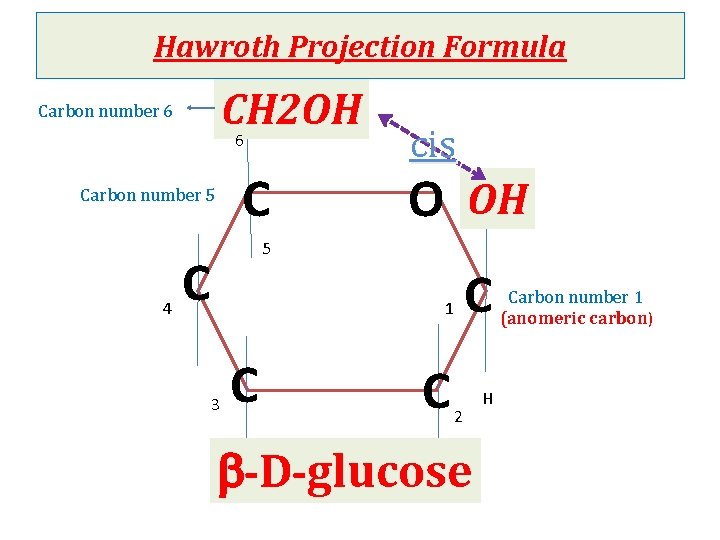
Hawroth Projection Formula CH 2 OH 6 Carbon number 6 C Carbon number 5 4 cis O OH 5 C 1 3 C C C 2 b-D-glucose H Carbon number 1 (anomeric carbon)
Dissacharides, oligo- & polysaccharides Monosaccharides can be joined by glycosidic bonds to form disaccharides (two units) oligosaccharides (3 -10 units) polysaccharides (more than 10 units) Important Disaccharides: lactose (glucose + galactose): found in milk sucrose (glucose + fructose): found in table sugar maltose (glucose + glucose): in malt Important Polysaccharides : glycogen (from animal sources) starch (from plant sources) cellulose (plant sources) The bonds that link monosaccharides are called glycosidic bonds
Polysaccharides 1 - Glycogen - It is a long and branched polysaccharide (glucose polymer) that humans and animals store in the liver and skeletal muscles - Main storage of carbohydrates in the body ----------------------------------------------------------2 - Starch - - It is available in plants. It is the main carbohydrate of diet Rich sources of starches: include potatoes, rice and wheat. - It is a polysaccharide (glucose polymers) made up of: 1 - amylose (outer layer of starch granules) molecules are linear (long but with no branches) 2 - amylopectin (inner layer of starch granules) molecules are long and with branches Humans and animals digest starch by hydrolysis by the enzyme amylase
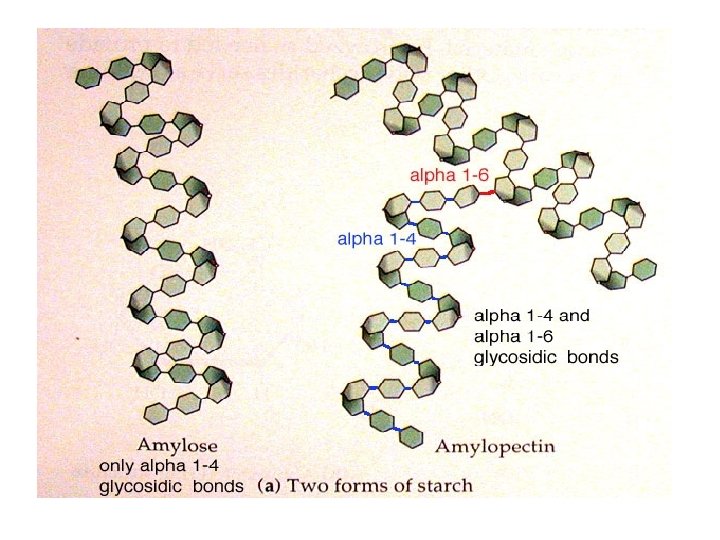
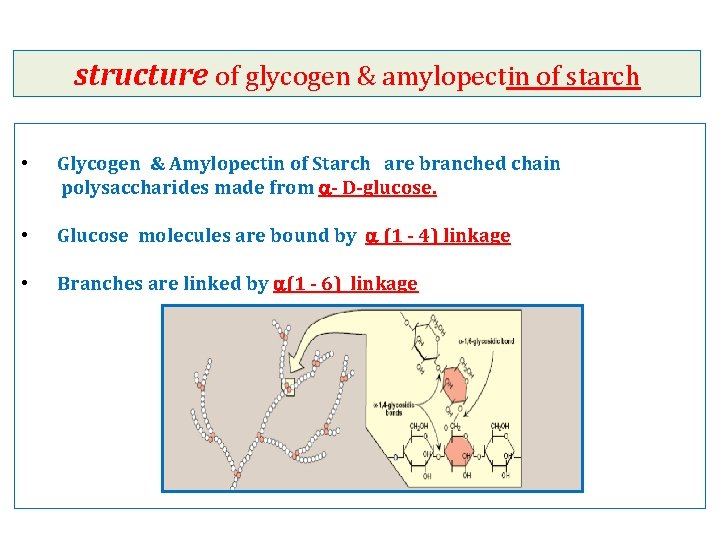
structure of glycogen & amylopectin of starch • Glycogen & Amylopectin of Starch are branched chain polysaccharides made from a- D-glucose. • Glucose molecules are bound by a (1 - 4) linkage • Branches are linked by a(1 - 6) linkage
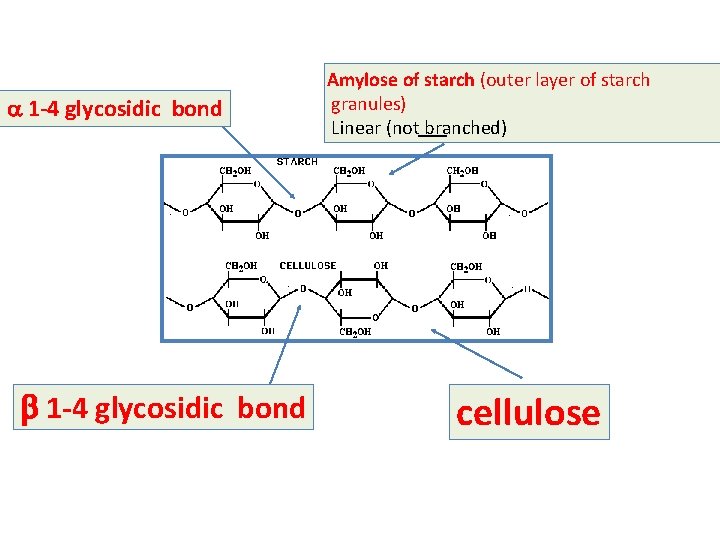
a 1 -4 glycosidic bond b 1 -4 glycosidic bond Amylose of starch (outer layer of starch granules) Linear (not branched) cellulose
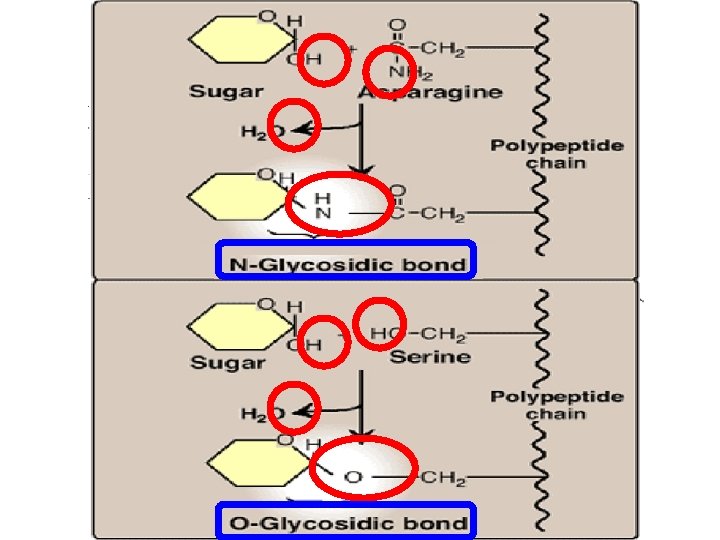
Complex carbohydrates Carbohydrates can be attached by glycosidic bonds to noncarbohydrate molecules including: 1 - purines and pyrimidines (in nucleic acids) 2 - proteins (in glycoproteins) 3 - lipids (glycolipids)
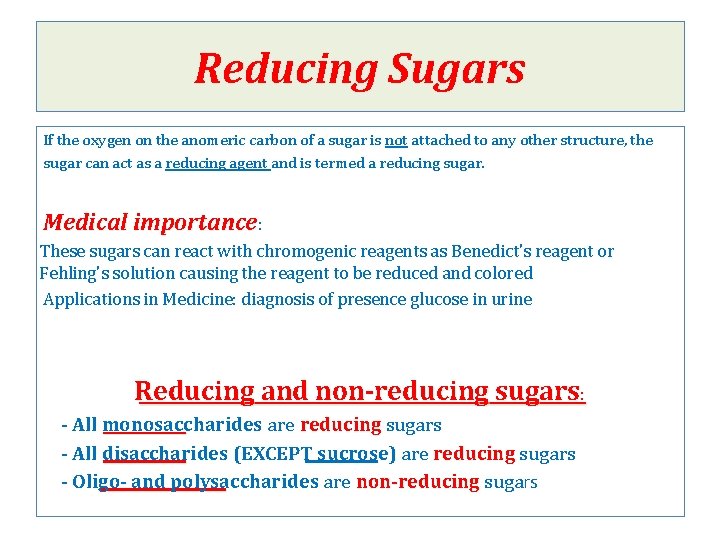
Reducing Sugars If the oxygen on the anomeric carbon of a sugar is not attached to any other structure, the sugar can act as a reducing agent and is termed a reducing sugar. Medical importance: These sugars can react with chromogenic reagents as Benedict's reagent or Fehling's solution causing the reagent to be reduced and colored Applications in Medicine: diagnosis of presence glucose in urine Reducing and non-reducing sugars: - All monosaccharides are reducing sugars - All disaccharides (EXCEPT sucrose) are reducing sugars - Oligo- and polysaccharides are non-reducing sugars
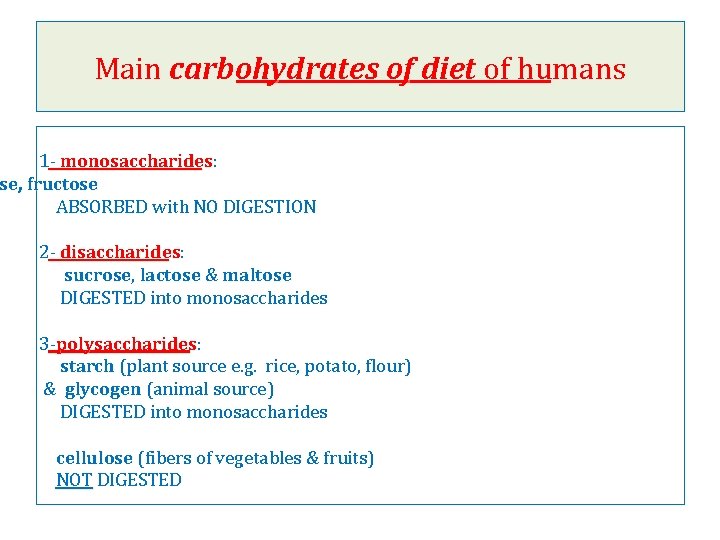
Main carbohydrates of diet of humans 1 - monosaccharides: se, fructose ose, ABSORBED with NO DIGESTION 2 - disaccharides: sucrose, lactose & maltose DIGESTED into monosaccharides 3 -polysaccharides: starch (plant source e. g. rice, potato, flour) & glycogen (animal source) DIGESTED into monosaccharides cellulose (fibers of vegetables & fruits) NOT DIGESTED
- Slides: 27