
Introduction to CaptureMarkRecapture Lab 5 Closed Population Models

Introduction to Capture-Mark-Recapture Lab 5 Closed Population Models

Install program MARK • Free software program for doing capture -mark- recapture • Served out of CSU, maintained by Gary White and Evan Cooch • Google “Program MARK” http: //www. phidot. org/software/mark/downloads/

Install RMark This is our link to run MARK from R. So install RMark and then attach the library install. packages(“RMark”) library(RMark) #Removes all objects stored in your workspace rm(list = ls())
Multi-sample CMR in RMark A capture-recapture data set on rabbits: Edwards, W. R. and L. L. Eberhardt 1967. Estimating cottontail abundance from live trapping data. J. Wildl. Manage. 31: 87 -96. ###read in data set ### data(edwards. eberhardt) ## assign the dataset a convenient name ### dat<-edwards. eberhardt
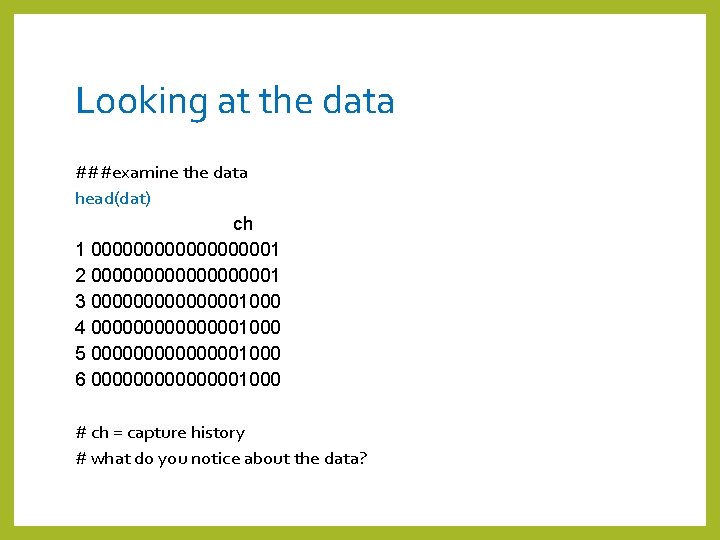
Looking at the data ###examine the data head(dat) ch 1 0000000001 2 0000000001 3 00000001000 4 00000001000 5 00000001000 6 00000001000 # ch = capture history # what do you notice about the data?
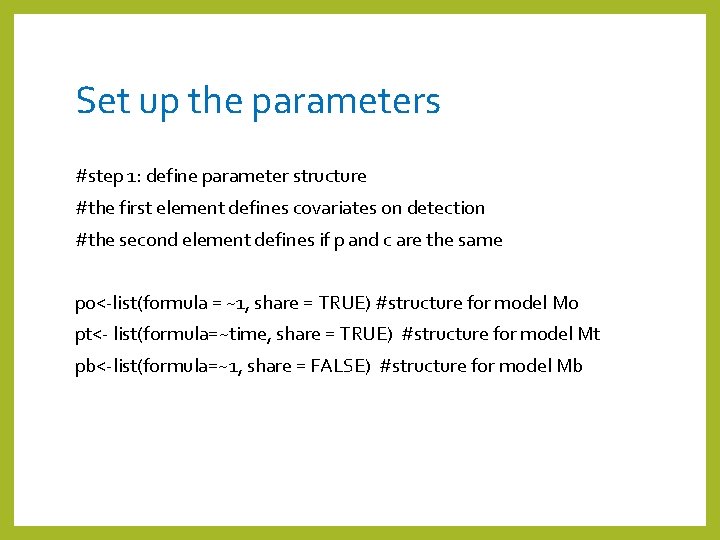
Set up the parameters #step 1: define parameter structure #the first element defines covariates on detection #the second element defines if p and c are the same p 0<-list(formula = ~1, share = TRUE) #structure for model M 0 pt<- list(formula=~time, share = TRUE) #structure for model Mt pb<-list(formula=~1, share = FALSE) #structure for model Mb
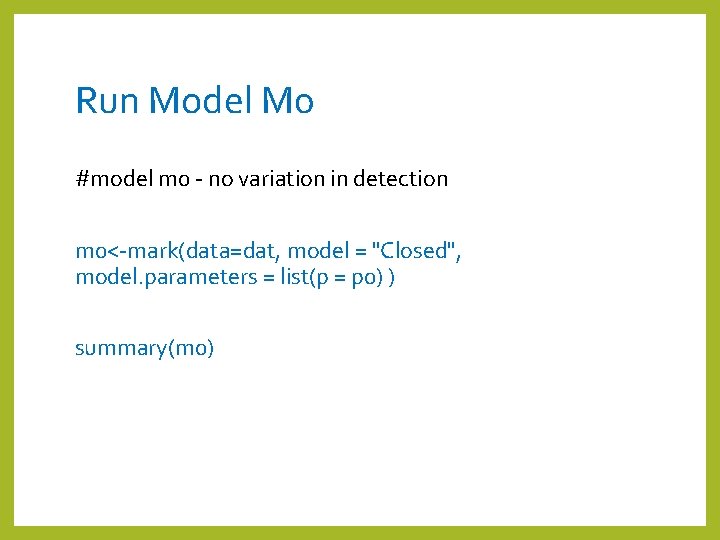
Run Model M 0 #model m 0 - no variation in detection m 0<-mark(data=dat, model = "Closed", model. parameters = list(p = p 0) ) summary(m 0)
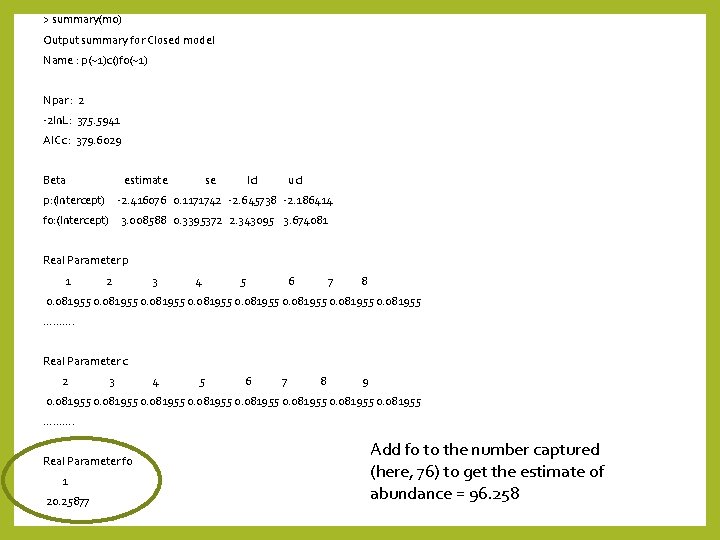
> summary(m 0) Output summary for Closed model Name : p(~1)c()f 0(~1) Npar : 2 -2 ln. L: 375. 5941 AICc : 379. 6029 Beta estimate se lcl ucl p: (Intercept) -2. 416076 0. 1171742 -2. 645738 -2. 186414 f 0: (Intercept) 3. 008588 0. 3395372 2. 343095 3. 674081 Real Parameter p 1 2 3 4 5 6 7 8 0. 081955 0. 081955 ………. Real Parameter c 2 3 4 5 6 7 8 9 0. 081955 0. 081955 ………. Real Parameter f 0 1 20. 25877 Add fo to the number captured (here, 76) to get the estimate of abundance = 96. 258
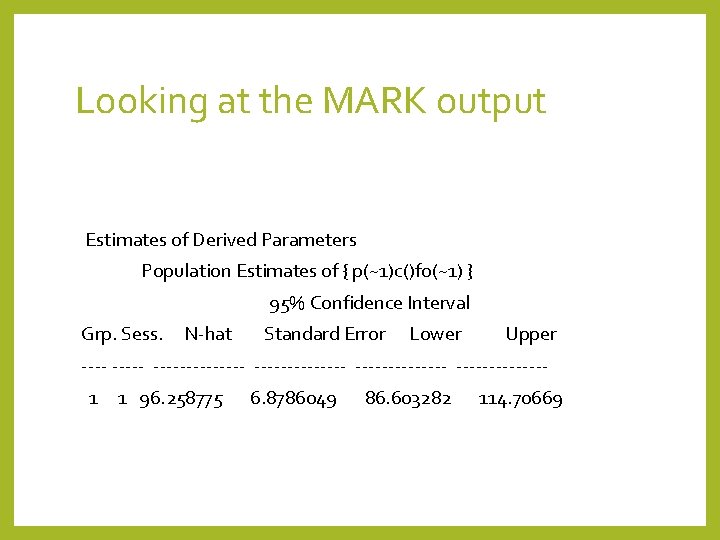
Looking at the MARK output Estimates of Derived Parameters Population Estimates of { p(~1)c()f 0(~1) } 95% Confidence Interval Grp. Sess. N-hat Standard Error Lower Upper ------------------1 1 96. 258775 6. 8786049 86. 603282 114. 70669
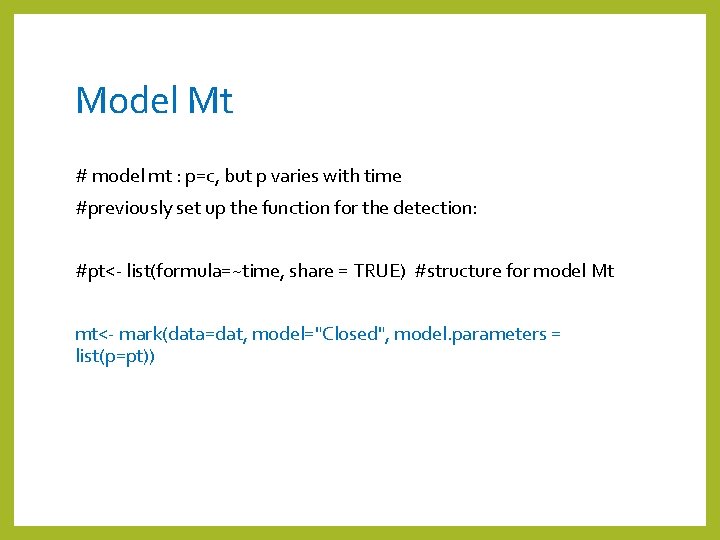
Model Mt # model mt : p=c, but p varies with time #previously set up the function for the detection: #pt<- list(formula=~time, share = TRUE) #structure for model Mt mt<- mark(data=dat, model="Closed", model. parameters = list(p=pt))
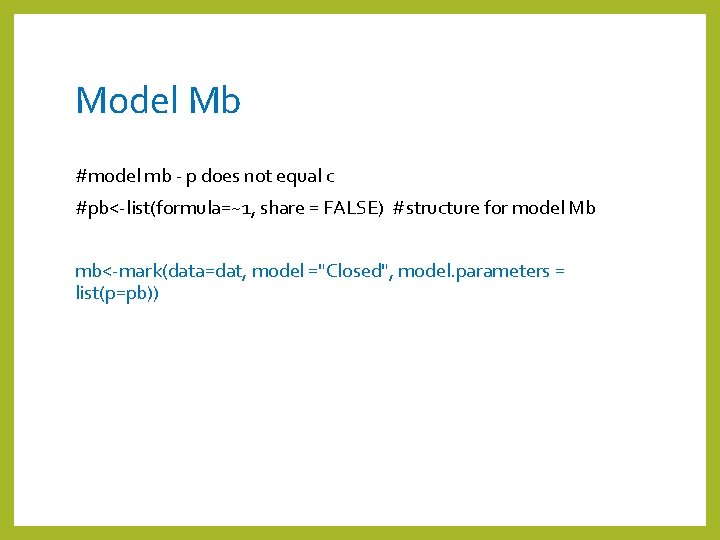
Model Mb #model mb - p does not equal c #pb<-list(formula=~1, share = FALSE) #structure for model Mb mb<-mark(data=dat, model ="Closed", model. parameters = list(p=pb))
Model selection by AIC #automatically collects all models; mlist<-collect. models() #creates a table with model results, sorted by AIC model. table(mlist) • NOTE: When comparing models with AIC using Rmark, it is important that you check the number of parameters and that you are only comparing models that are all analyzed with the same likelihood (full vs. conditional).
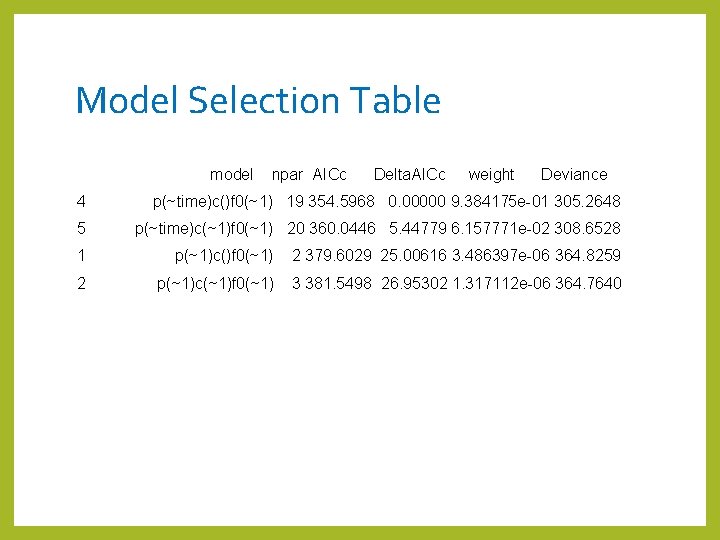
Model Selection Table model npar AICc Delta. AICc weight Deviance 4 p(~time)c()f 0(~1) 19 354. 5968 0. 00000 9. 384175 e-01 305. 2648 5 p(~time)c(~1)f 0(~1) 20 360. 0446 5. 44779 6. 157771 e-02 308. 6528 1 p(~1)c()f 0(~1) 2 379. 6029 25. 00616 3. 486397 e-06 364. 8259 2 p(~1)c(~1)f 0(~1) 3 381. 5498 26. 95302 1. 317112 e-06 364. 7640
Now onto the lab activity • Note: when you want to read in your own data from a text file, you must read the data into R using the following: dat<-import. chdata(“datafile. txt", header=T) • This will make your text file in the proper format for Mark to use.
- Slides: 14