
Introduction to CAPTE Accreditation Commission on Accreditation in


- Slides: 28
Introduction to CAPTE Accreditation Commission on Accreditation in Physical Therapy Education August 2020 ©CAPTE
Outcomes of the Developing Program Workshop • Explain the accreditation process • Provide hints about how to develop a powerful Application for Candidacy • Discuss the current interpretation of the 2016 Standards and Required Elements ©CAPTE
What is Accreditation? • Voluntary • Nongovernmental • Process of external quality review to scrutinize colleges, universities, and educational programs for quality assurance and quality improvement ©CAPTE
Purposes of Accreditation CHEA, 2012 • Accreditation serves the following purposes: – Assuring Quality – Access to Federal Funds – Easing Transfer – Engendering Private Sector Confidence ©CAPTE
CAPTE’s Definition of Quality Physical Therapy Education • Prepares graduates for – competent and ethical practice – career flexibility – values associated with the profession • Mandates an educational experience that prepares individuals for lifelong learning ©CAPTE
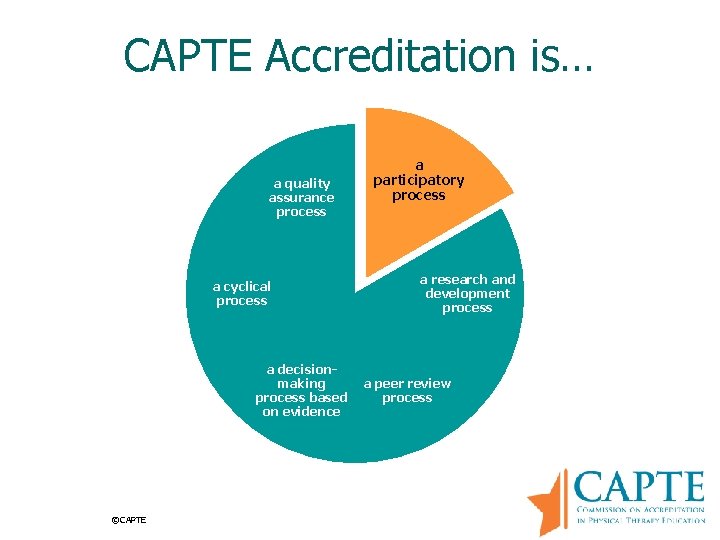
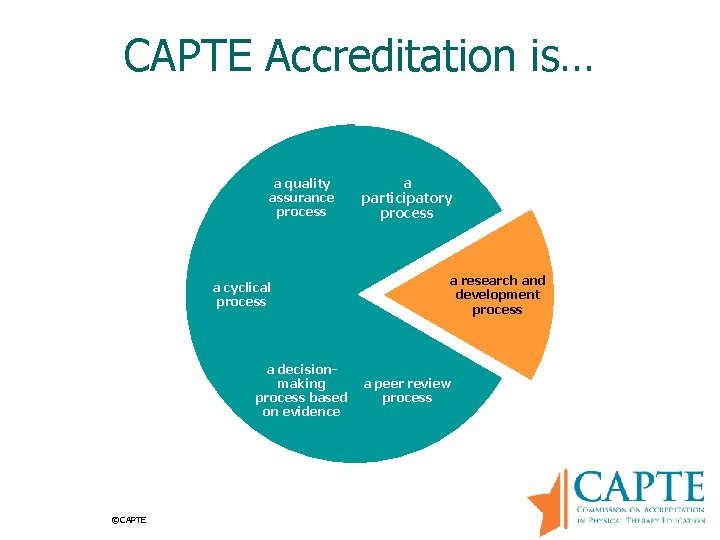
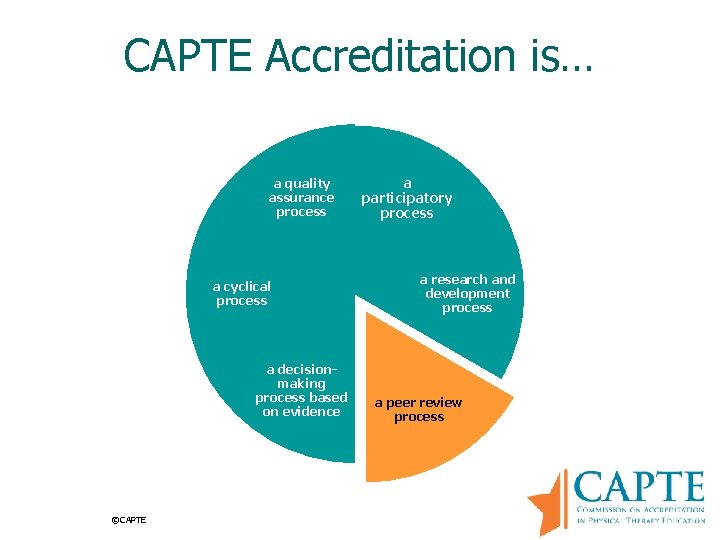
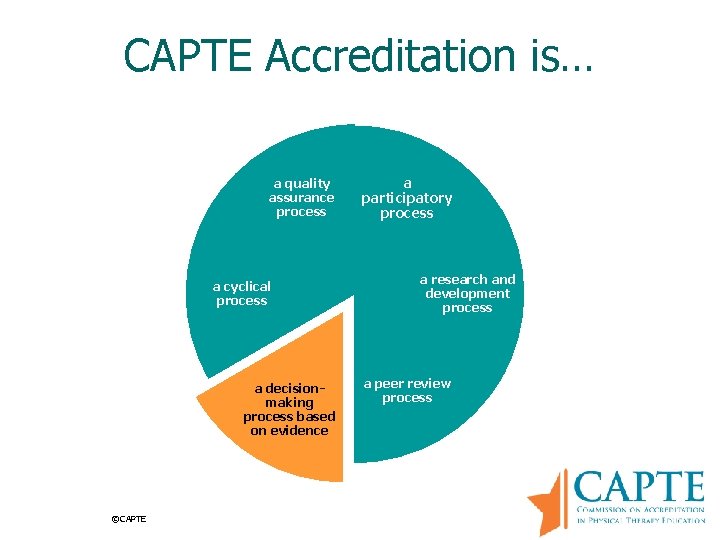
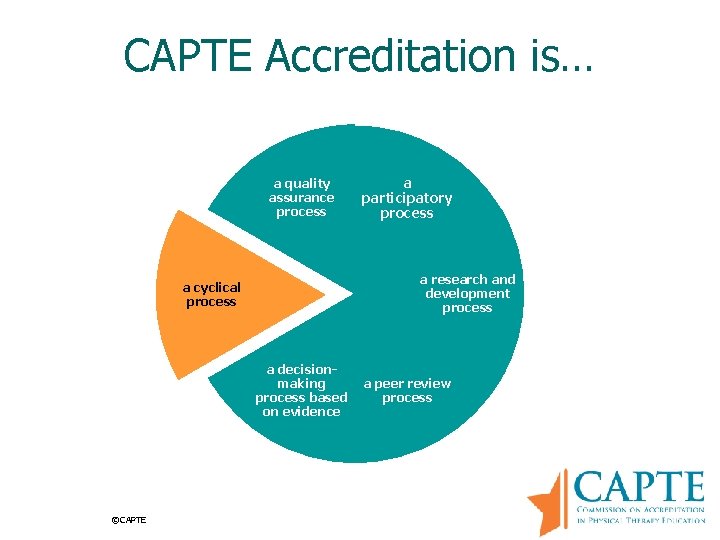
CAPTE Accreditation is… a quality assurance process a cyclical process a decisionmaking process based on evidence ©CAPTE a participatory process a research and development process a peer review process
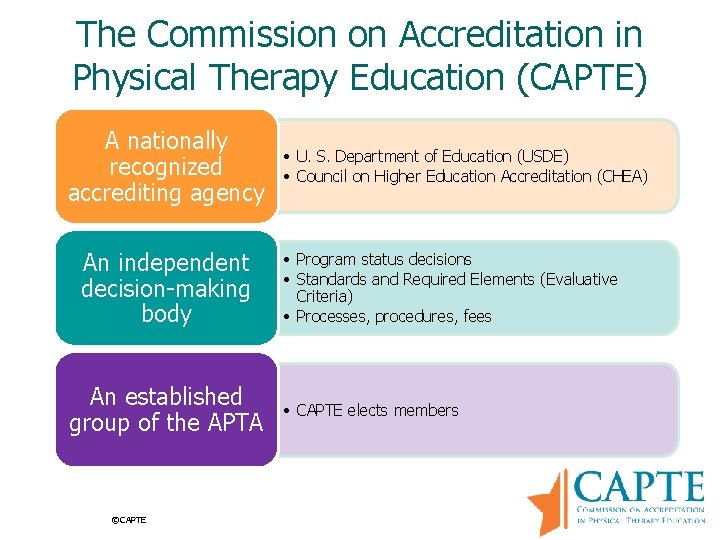
The Commission on Accreditation in Physical Therapy Education (CAPTE) A nationally recognized accrediting agency An independent decision-making body An established group of the APTA ©CAPTE • U. S. Department of Education (USDE) • Council on Higher Education Accreditation (CHEA) • Program status decisions • Standards and Required Elements (Evaluative Criteria) • Processes, procedures, fees • CAPTE elects members
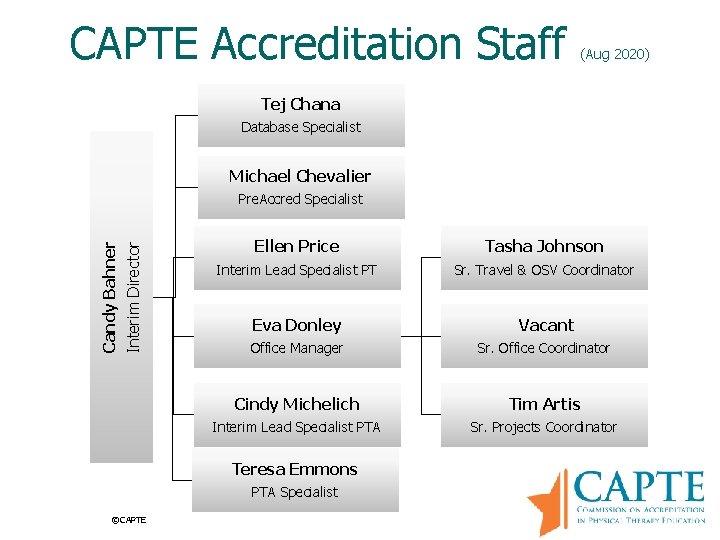
CAPTE Accreditation Staff (Aug 2020) Tej Chana Database Specialist Michael Chevalier Candy Bahner Interim Director Pre. Accred Specialist Ellen Price Tasha Johnson Interim Lead Specialist PT Sr. Travel & OSV Coordinator Eva Donley Vacant Office Manager Sr. Office Coordinator Cindy Michelich Tim Artis Interim Lead Specialist PTA Sr. Projects Coordinator Teresa Emmons PTA Specialist ©CAPTE
On-site Reviewers • Pool of 250+ trained individuals • Training – 3 -day training before doing visits • Distance Learning component • Workshop with mock visit – Periodic retraining • New Standards and Required Elements • Distance Learning ©CAPTE
Program & Institution • Agree to operate in a manner consistent with commonly accepted practices, i. e. , as described by Standards/Elements and identified procedures • Invite CAPTE to review the program • Engage in a candidate for accreditation process and prepare a Application for Candidacy • Host an on-site visit • Respond to the team’s report • Fix areas identified as unsatisfactory progress towards compliance. ©CAPTE
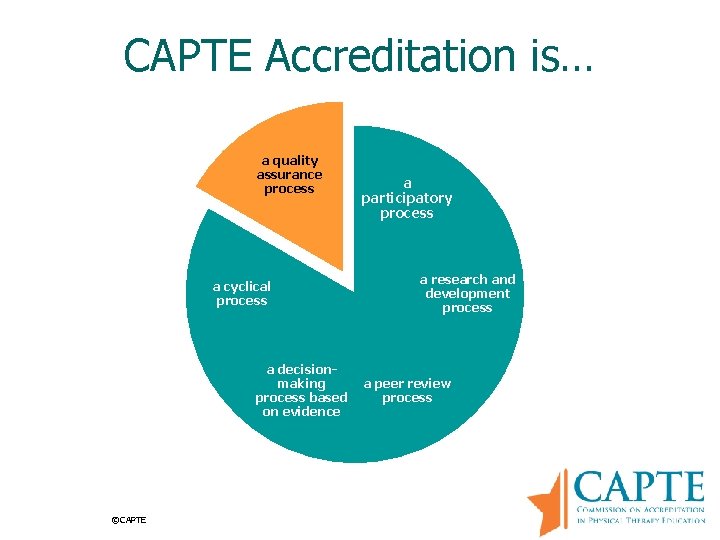
CAPTE Accreditation is… a quality assurance process a cyclical process a decisionmaking process based on evidence ©CAPTE a participatory process a research and development process a peer review process
The AFC process • Who should be involved – – – administrators consultants stakeholders Faculty Advisory committee ©CAPTE
The Process of Program Development • Timeline – Some activities should be on-going • Needs Assessment • Curriculum development • Hiring of qualified faculty – Begin early enough to • Conduct a thorough needs assessment • Gather the depth and breadth of clinical sites • Recruit/hire program director and other faculty ©CAPTE
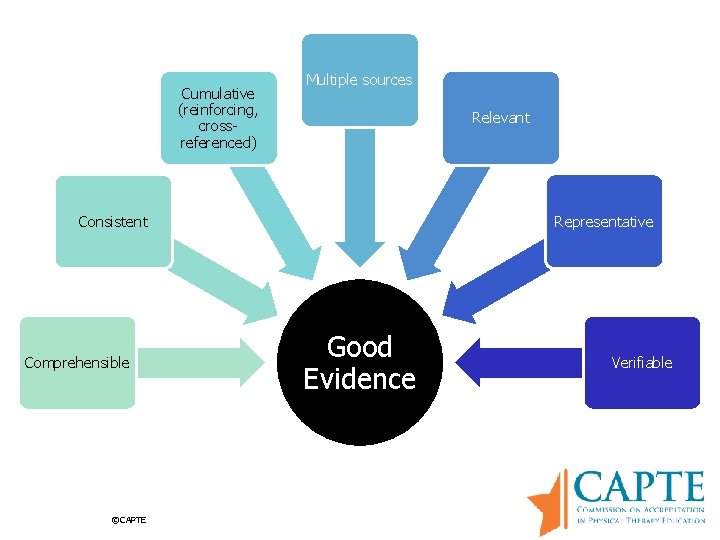
Cumulative (reinforcing, crossreferenced) Multiple sources Relevant Representative Consistent Comprehensible ©CAPTE Good Evidence Verifiable
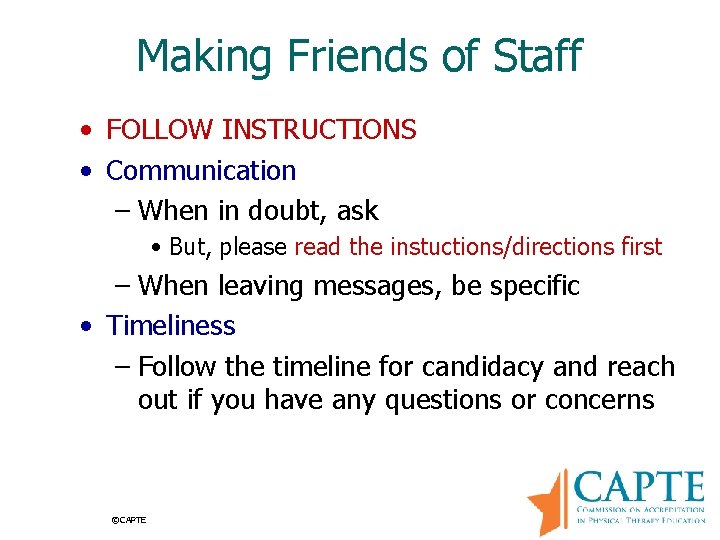
Making Friends of Staff • FOLLOW INSTRUCTIONS • Communication – When in doubt, ask • But, please read the instuctions/directions first – When leaving messages, be specific • Timeliness – Follow the timeline for candidacy and reach out if you have any questions or concerns ©CAPTE
CAPTE Accreditation is… a quality assurance process a cyclical process a decisionmaking process based on evidence ©CAPTE a participatory process a research and development process a peer review process
The Candidacy On-site Review Team • Usually two members – The on-site team for a physical therapist education program consists of two physical therapists who are PT educators Practitioner – The on-site team for a physical therapist assistant education program consists of a physical therapist (who is an educator), and a physical therapist assistant (who is an educator). ©CAPTE
CAPTE Actions Information used by CAPTE includes • Application for Candidacy • Candidacy Visit Report with Institution Response • Any additional material provided by program, that was requested by Accred Staff, Candidacy Reviewer or Commission • Comments from the team leader • Comments from the program director • Third-party comments (if submitted per required procedure) ©CAPTE
Types of Decisions • Developing Programs – Grant Candidate for Accreditation – Deny Candidacy for Accreditation – Withdraw Candidate for Accreditation ©CAPTE
Public Notice of Final Decisions • USDE requirement that notices of reasons for final adverse decisions be published • deny or withdraw candidacy – Decisions are posted on web page no later than 30 days after decisions are final – Notices are posted on web page no later than 60 days after decisions are final and include: • • • Status of the program Brief description of reasons for the decision If appropriate, history of previous decisions leading to the final decision Description of what options the program has Response from the program, if provided • CHEA expectation: reasons for decisions to grant or reaffirm accreditation be published – Front page of the Summary of Action will be posted on web no later than 60 days after the decision is final ©CAPTE
CAPTE Accreditation is… a quality assurance process a cyclical process a decisionmaking process based on evidence ©CAPTE a participatory process a research and development process a peer review process
CAPTE Accreditation is… a quality assurance process a research and development process a cyclical process a decisionmaking process based on evidence ©CAPTE a participatory process a peer review process
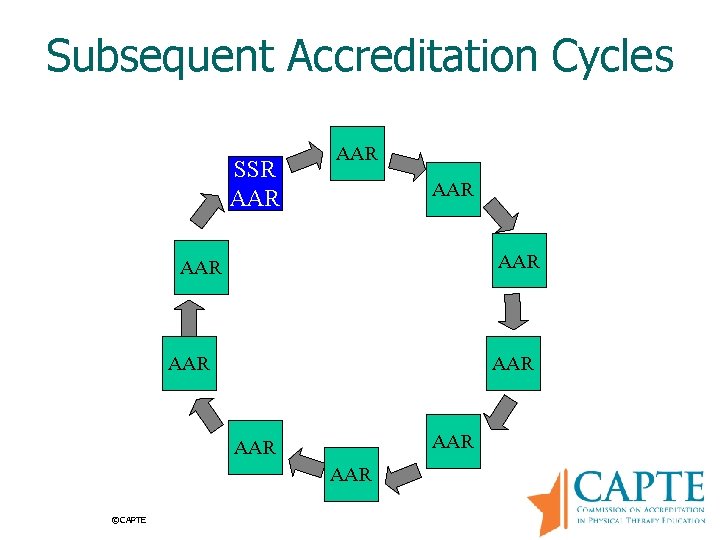
Subsequent Accreditation Cycles SSR AAR AAR AAR ©CAPTE
CAPTE Accreditation is… a quality assurance process a cyclical process a decisionmaking process based on evidence ©CAPTE a participatory process a research and development process a peer review process
Communication (1 of 2) • Most communication with programs is now via email only – Email addresses need to be correct for • PD • Dean / person PD reports to • CAO • CEO – Firewalls need to allow messages from capteonline. org and aptaaccred. apta. org – Trusted site ©CAPTE
Communication (2 of 2) Web Page: www. capteonline. org – – Resources for accredited and developing programs Access to the CAPTE Accreditation Portal Directory of Accredited Programs Recent CAPTE Actions, including reasons for probation and final adverse actions – CAPTE Accreditation Handbook – Aggregate Program Data (Fact Sheets) – What’s New (on webpage) Also: Access to Additional Needed Materials link above AFC grid on Portal ©CAPTE
Assessment Activities • Of the Team by – team members – program faculty & institutional administrators – staff • Of the Visit Report by – staff – CAPTE ©CAPTE • Of the Process by – program faculty & institutional administrators – team members – CAPTE – staff • Of CAPTE members by CAPTE members
Questions? ? Be sure to bring them to the Developing Program Workshop ©CAPTE