
Introduction to C elegans and RNA interference Why


- Slides: 34
Introduction to C. elegans and RNA interference
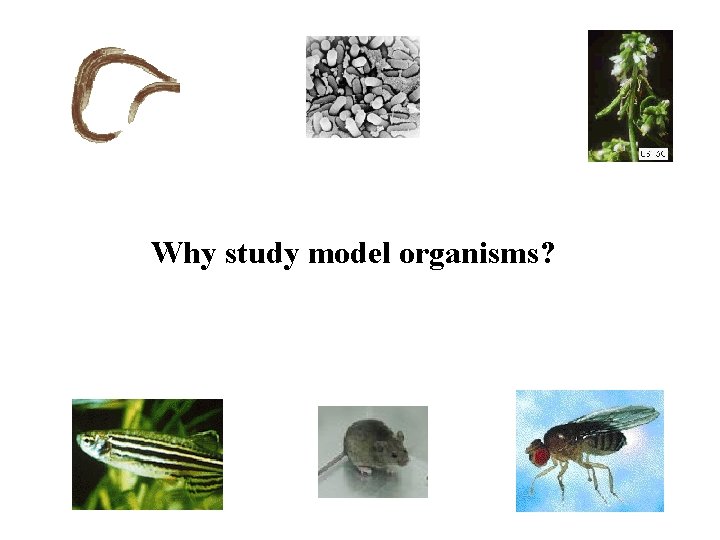
Why study model organisms?
The problem: • In order to understand biology, we need to learn about the function of the underlying genes • How can we find out what genes do? • We need a way to uncover these functions
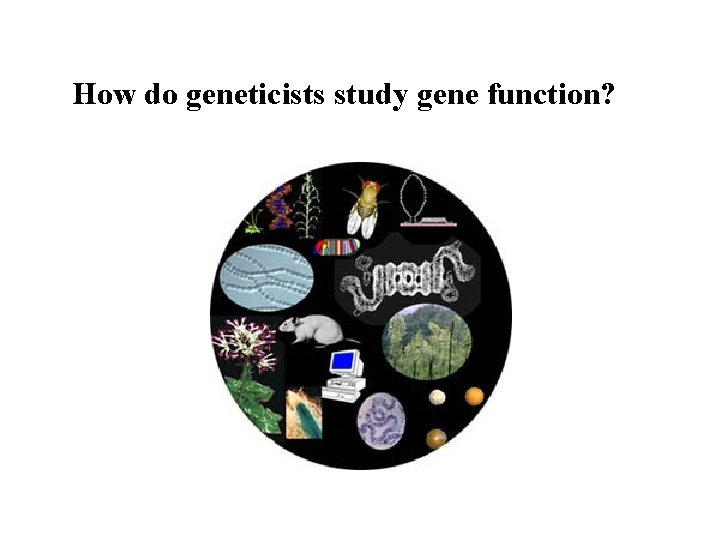
How do geneticists study gene function?
How do geneticists study gene function? Disrupt the gene and analyze the resulting phenotype Forward genetics: • Classical approach • A gene is identified by studying mutant phenotype and mutant alleles • The gene must be cloned for further functional analysis
How do geneticists study gene function? Disrupt the gene and analyze the resulting phenotype Reverse genetics: • Start with gene sequence information • Engineer a loss of function phenotype to evaluate gene to function
Forward Genetics Starting point: A mutant animal End point: Determine gene function • Have a mutant phenotype and wish to determine what gene sequence is associated with it • Allows identification of many genes involved in a given biological process • Mutations in essential genes are difficult to find • Works great in model organisms
What makes a good model organism? Ease of cultivation Rapid reproduction Small size
Why are mutants in model organisms useful?
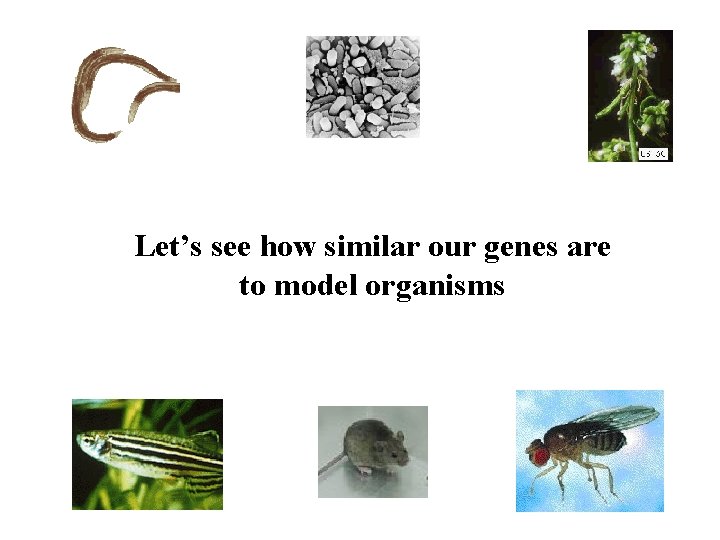
Let’s see how similar our genes are to model organisms
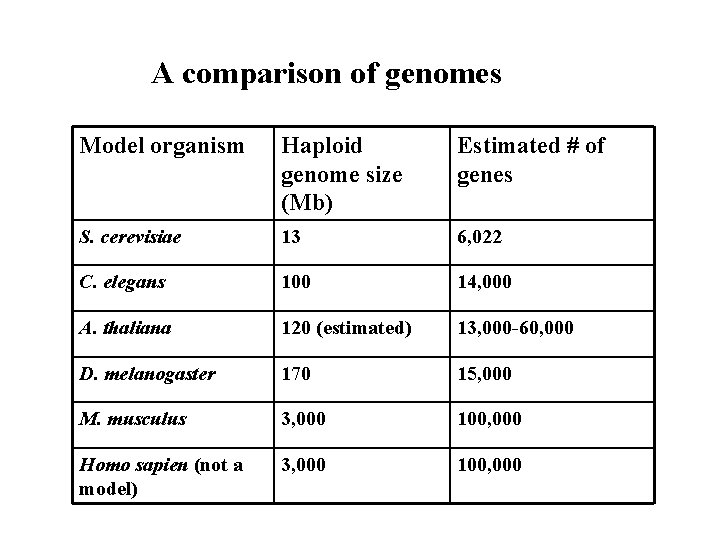
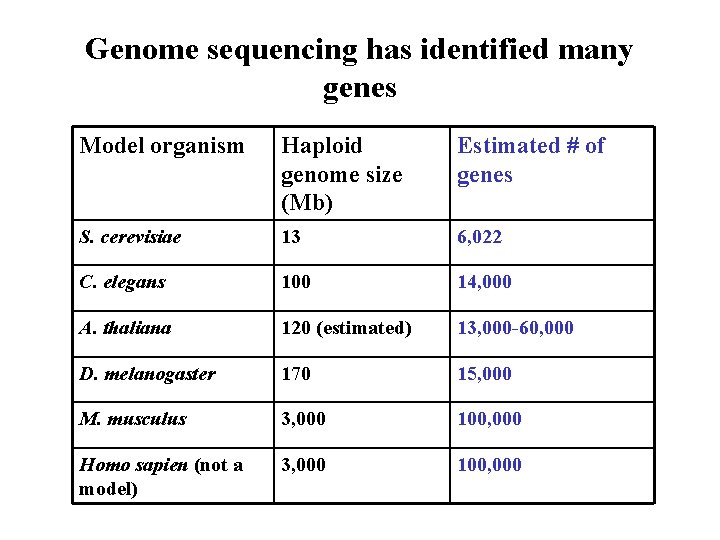
A comparison of genomes Model organism Haploid genome size (Mb) Estimated # of genes S. cerevisiae 13 6, 022 C. elegans 100 14, 000 A. thaliana 120 (estimated) 13, 000 -60, 000 D. melanogaster 170 15, 000 M. musculus 3, 000 100, 000 Homo sapien (not a model) 3, 000 100, 000
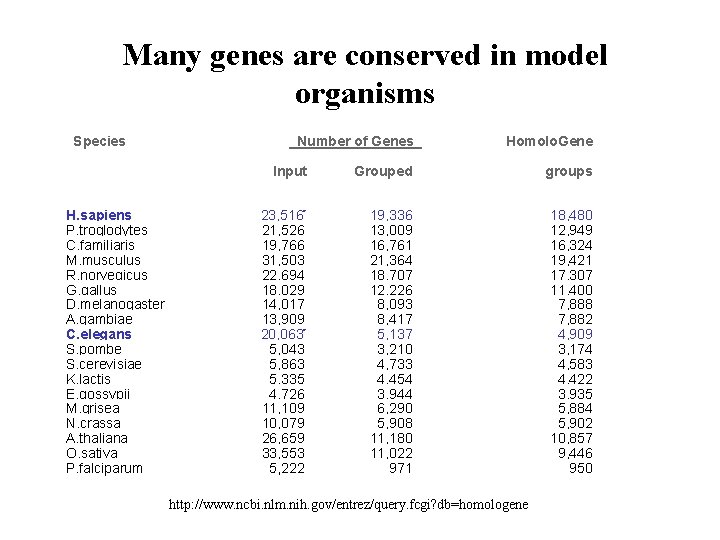
Many genes are conserved in model organisms Species Number of Genes Input Homolo. Gene Grouped groups H. sapiens 23, 516* P. troglodytes 21, 526 C. familiaris 19, 766 M. musculus 31, 503 R. norvegicus 22, 694 G. gallus 18, 029 D. melanogaster 14, 017 A. gambiae 13, 909 C. elegans 20, 063* S. pombe 5, 043 S. cerevisiae 5, 863 K. lactis 5, 335 E. gossypii 4, 726 M. grisea 11, 109 N. crassa 10, 079 A. thaliana 26, 659 O. sativa 33, 553 P. falciparum 5, 222 19, 336 13, 009 16, 761 21, 364 18, 707 12, 226 8, 093 8, 417 5, 137 3, 210 4, 733 4, 454 3, 944 6, 290 5, 908 11, 180 11, 022 971 http: //www. ncbi. nlm. nih. gov/entrez/query. fcgi? db=homologene 18, 480 12, 949 16, 324 19, 421 17, 307 11, 400 7, 888 7, 882 4, 909 3, 174 4, 583 4, 422 3, 935 5, 884 5, 902 10, 857 9, 446 950
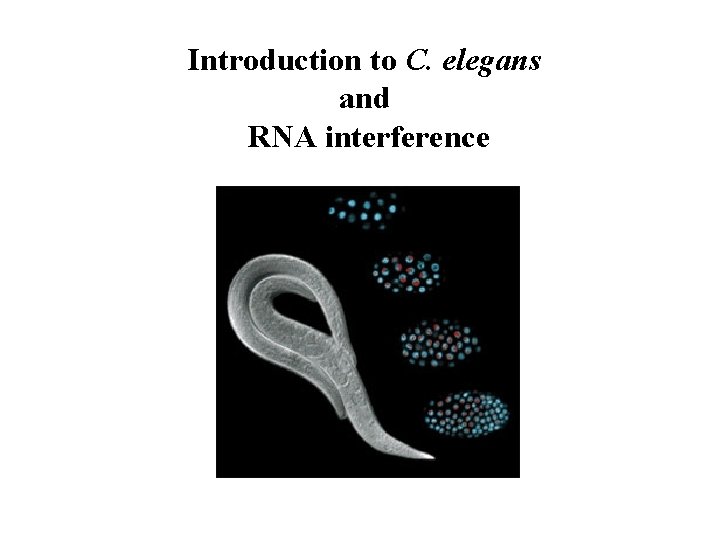
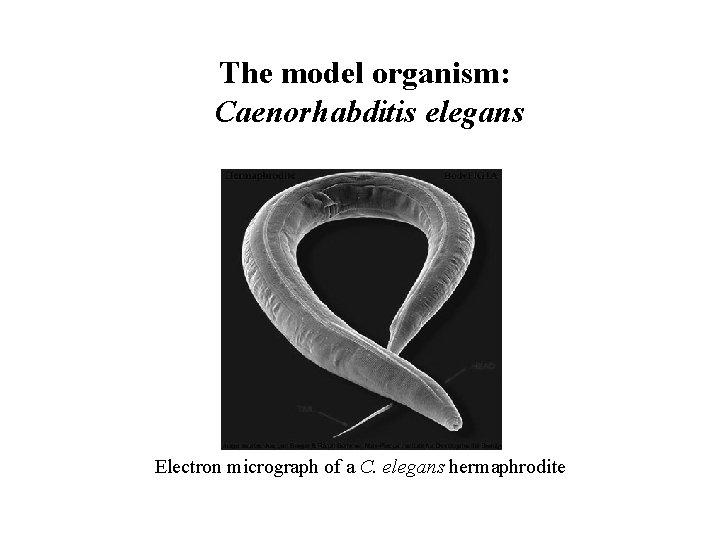
The model organism: Caenorhabditis elegans Electron micrograph of a C. elegans hermaphrodite
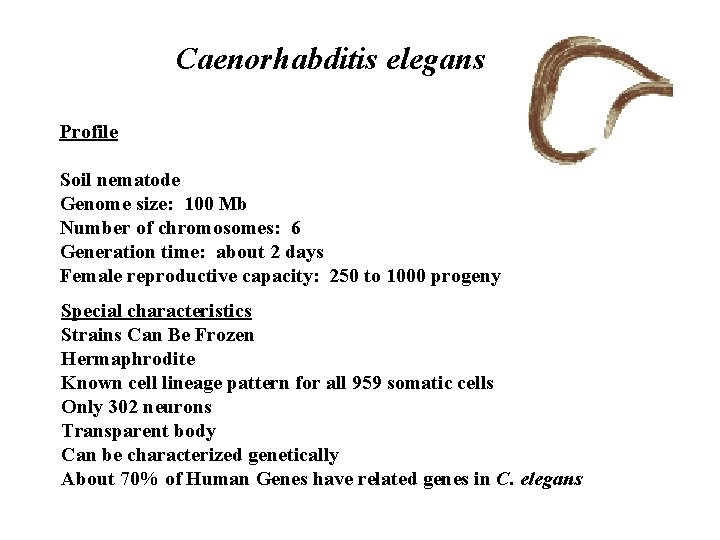
Caenorhabditis elegans Profile Soil nematode Genome size: 100 Mb Number of chromosomes: 6 Generation time: about 2 days Female reproductive capacity: 250 to 1000 progeny Special characteristics Strains Can Be Frozen Hermaphrodite Known cell lineage pattern for all 959 somatic cells Only 302 neurons Transparent body Can be characterized genetically About 70% of Human Genes have related genes in C. elegans
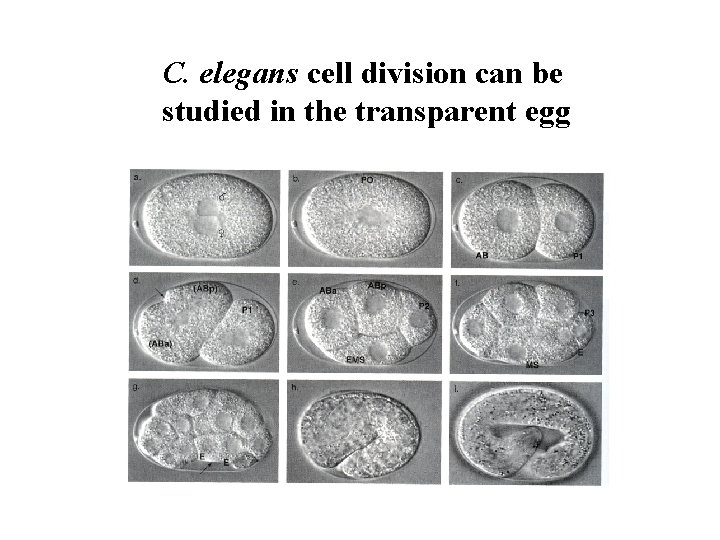
C. elegans cell division can be studied in the transparent egg
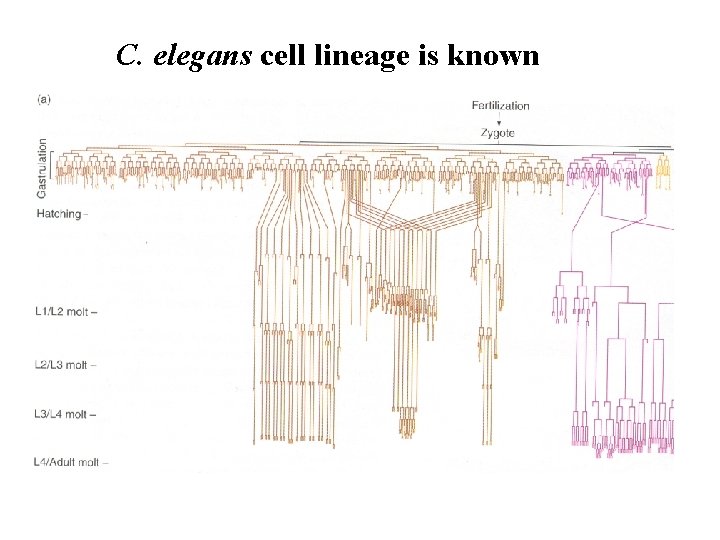
C. elegans cell lineage is known
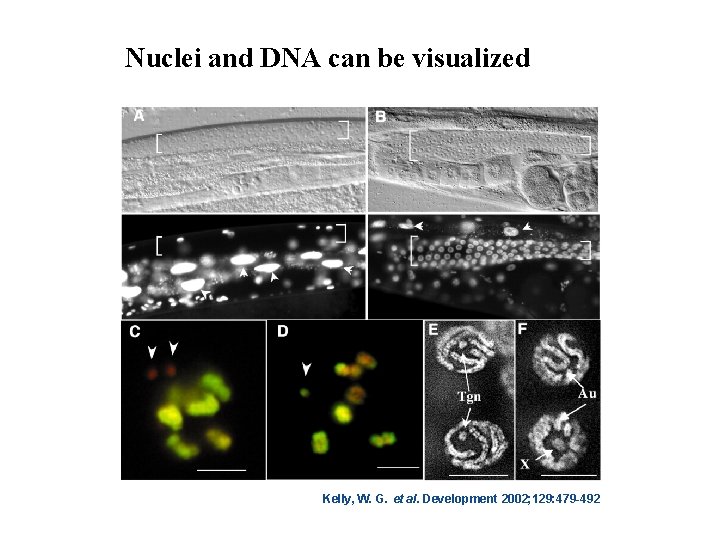
Nuclei and DNA can be visualized Kelly, W. G. et al. Development 2002; 129: 479 -492
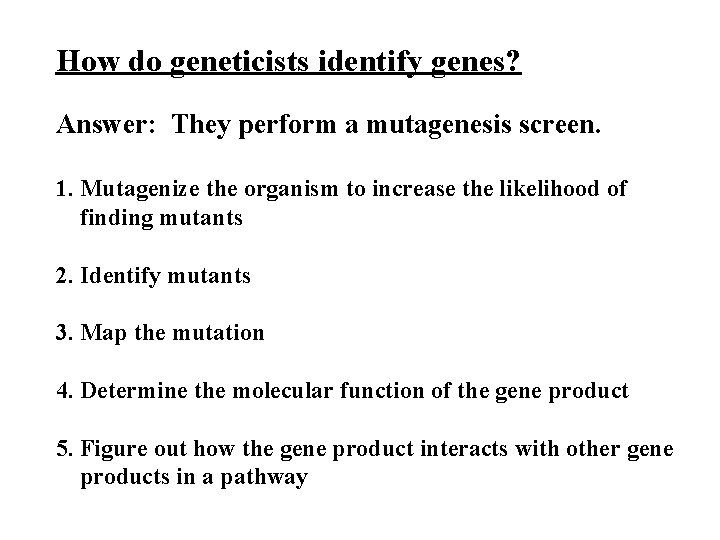
How do geneticists identify genes? Answer: They perform a mutagenesis screen. 1. Mutagenize the organism to increase the likelihood of finding mutants 2. Identify mutants 3. Map the mutation 4. Determine the molecular function of the gene product 5. Figure out how the gene product interacts with other gene products in a pathway
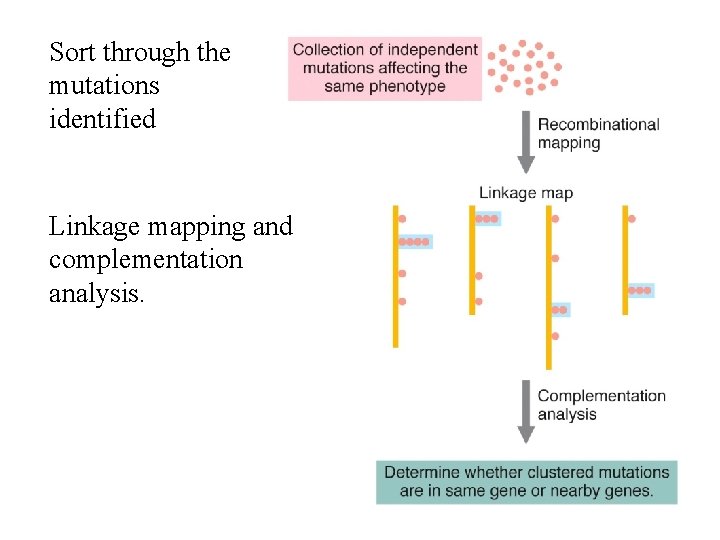
Sort through the mutations identified Linkage mapping and complementation analysis.
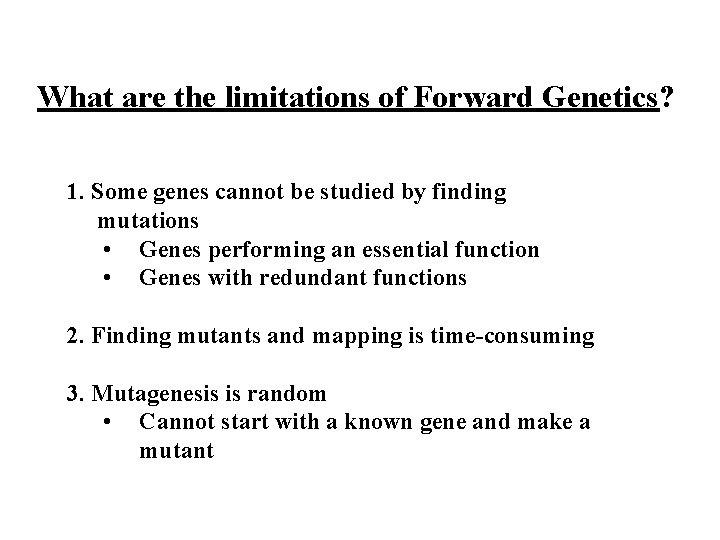
What are the limitations of Forward Genetics? 1. Some genes cannot be studied by finding mutations • Genes performing an essential function • Genes with redundant functions 2. Finding mutants and mapping is time-consuming 3. Mutagenesis is random • Cannot start with a known gene and make a mutant
Genome sequencing has identified many genes Model organism Haploid genome size (Mb) Estimated # of genes S. cerevisiae 13 6, 022 C. elegans 100 14, 000 A. thaliana 120 (estimated) 13, 000 -60, 000 D. melanogaster 170 15, 000 M. musculus 3, 000 100, 000 Homo sapien (not a model) 3, 000 100, 000
Can the function of a gene be studied when all we have is the DNA sequence?
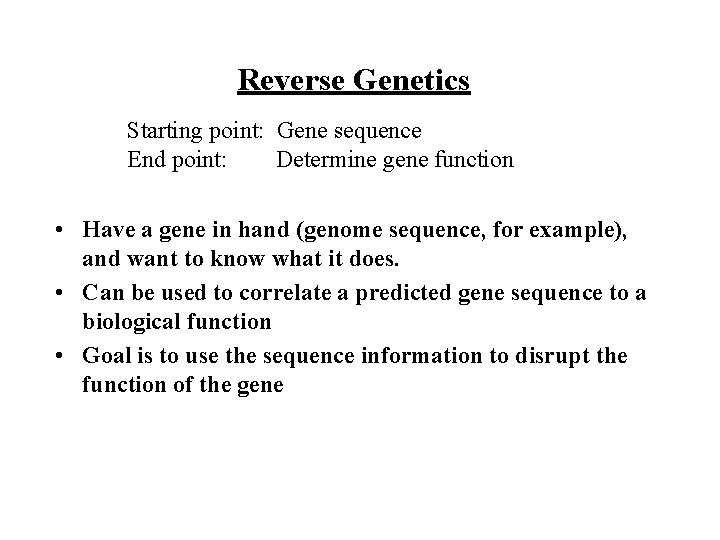
Reverse Genetics Starting point: Gene sequence End point: Determine gene function • Have a gene in hand (genome sequence, for example), and want to know what it does. • Can be used to correlate a predicted gene sequence to a biological function • Goal is to use the sequence information to disrupt the function of the gene
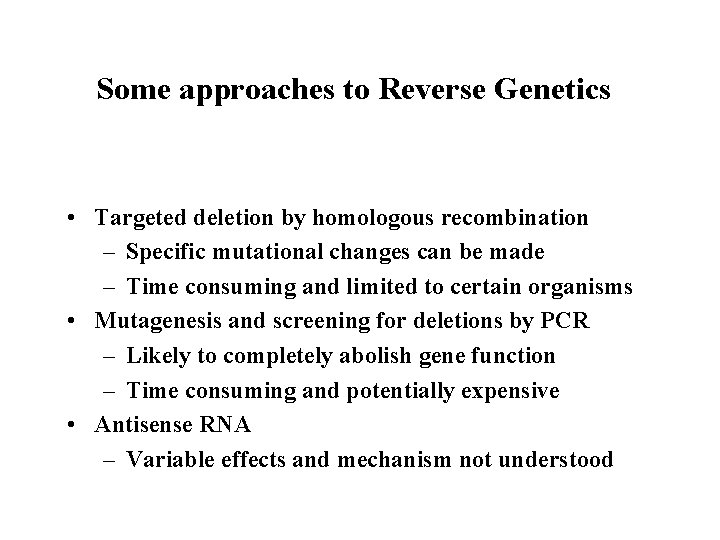
Some approaches to Reverse Genetics • Targeted deletion by homologous recombination – Specific mutational changes can be made – Time consuming and limited to certain organisms • Mutagenesis and screening for deletions by PCR – Likely to completely abolish gene function – Time consuming and potentially expensive • Antisense RNA – Variable effects and mechanism not understood
A new, fast, generally applicable technique was needed And the winner is…. . RNAi
How did we come to understand how RNAi works? Examining the antisense RNA technique revealed that the model for how it worked was wrong.
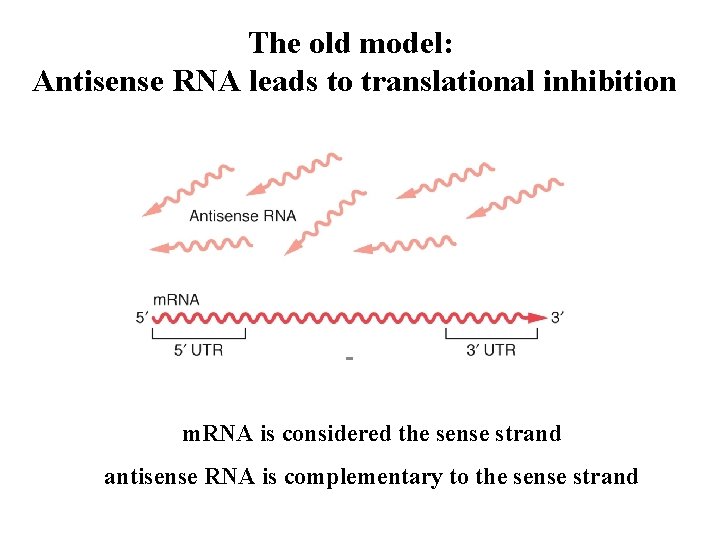
The old model: Antisense RNA leads to translational inhibition m. RNA is considered the sense strand antisense RNA is complementary to the sense strand
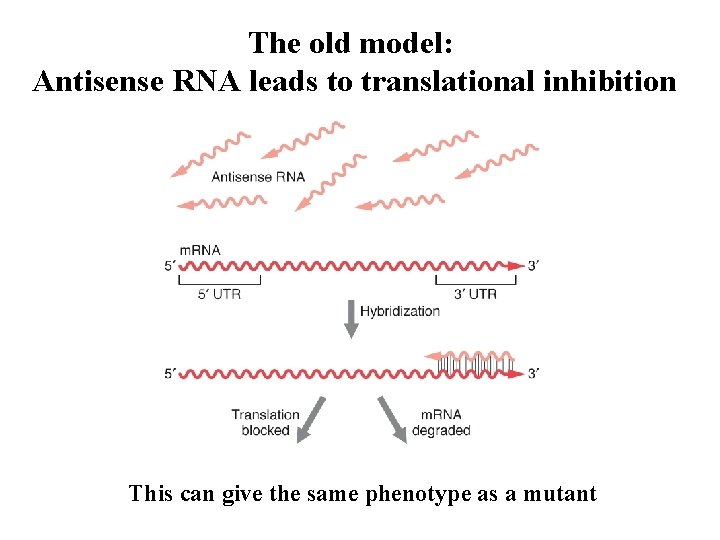
The old model: Antisense RNA leads to translational inhibition This can give the same phenotype as a mutant
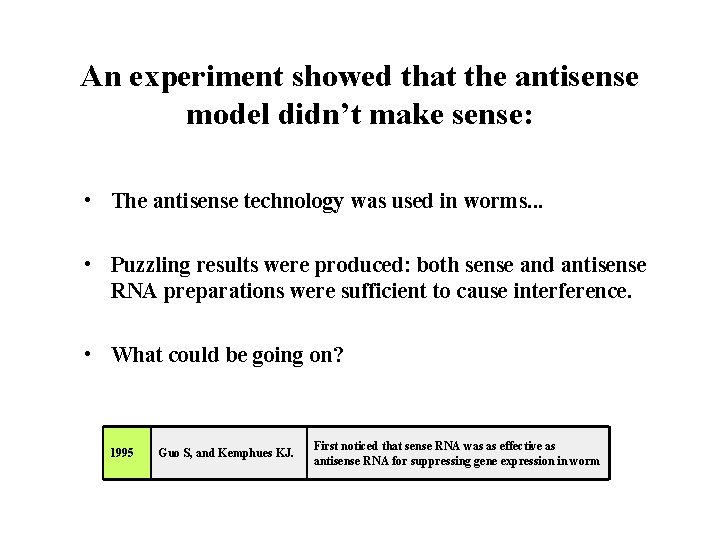
An experiment showed that the antisense model didn’t make sense: • The antisense technology was used in worms. . . • Puzzling results were produced: both sense and antisense RNA preparations were sufficient to cause interference. • What could be going on? 1995 Guo S, and Kemphues KJ. First noticed that sense RNA was as effective as antisense RNA for suppressing gene expression in worm
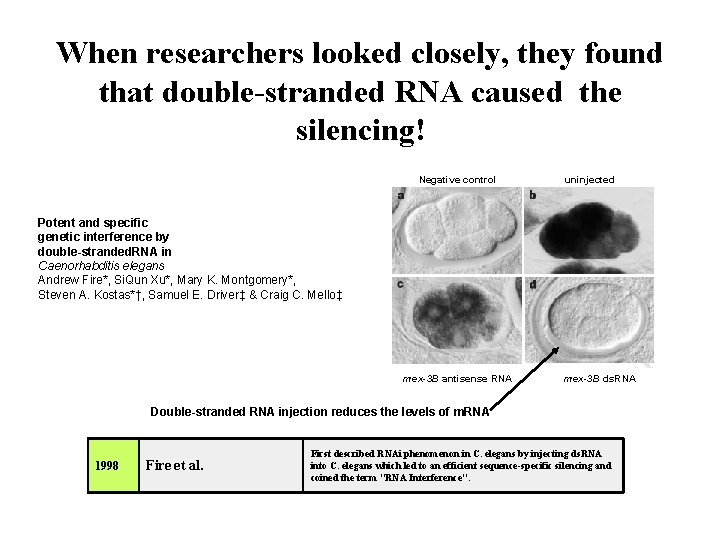
When researchers looked closely, they found that double-stranded RNA caused the silencing! Negative control uninjected Potent and specific genetic interference by double-stranded. RNA in Caenorhabditis elegans Andrew Fire*, Si. Qun Xu*, Mary K. Montgomery*, Steven A. Kostas*†, Samuel E. Driver‡ & Craig C. Mello‡ mex-3 B antisense RNA mex-3 B ds. RNA Double-stranded RNA injection reduces the levels of m. RNA 1998 Fire et al. First described RNAi phenomenon in C. elegans by injecting ds. RNA into C. elegans which led to an efficient sequence-specific silencing and coined the term "RNA Interference".
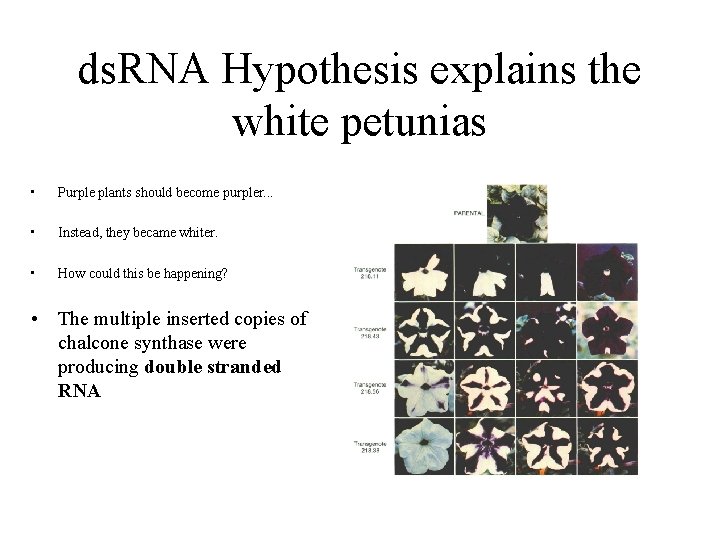
ds. RNA Hypothesis explains the white petunias • Purple plants should become purpler. . . • Instead, they became whiter. • How could this be happening? • The multiple inserted copies of chalcone synthase were producing double stranded RNA
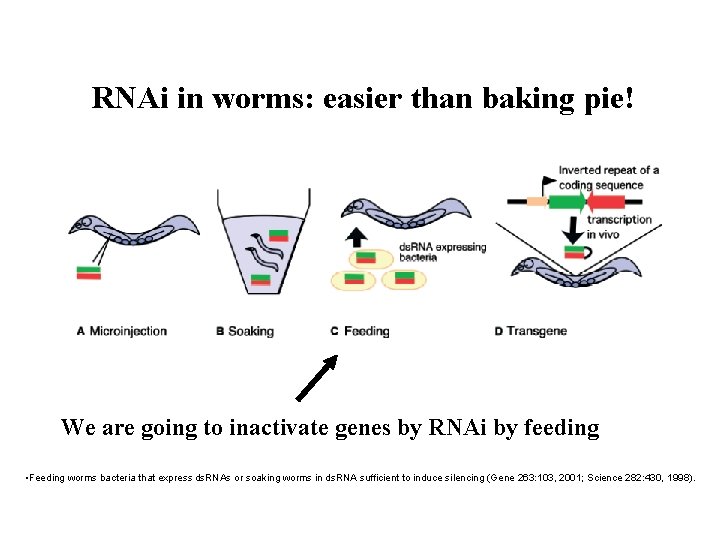
RNAi in worms: easier than baking pie! We are going to inactivate genes by RNAi by feeding • Feeding worms bacteria that express ds. RNAs or soaking worms in ds. RNA sufficient to induce silencing (Gene 263: 103, 2001; Science 282: 430, 1998).