
Introduction to Business Using Technology to Manage Business
Introduction to Business Using Technology to Manage Business Information
Module Learning Outcomes Recognize the roles of data and information technology in supporting business operations 17. 1: Discuss the role of technology in business 17. 2: Discuss ways in which information is used in business 17. 3: Compare the ways that businesses can manage information 17. 4: Identify security, privacy, and ethical issues affected by information technology

Technological Changes in Business
Learning Outcomes: Technological Changes in Business 17. 1: Discuss the role of technology in business 17. 1. 1: Describe the types of technology used in business 17. 1. 2: Explain how technology changes businesses 17. 1. 3: Explain business intelligence and its impact on business success
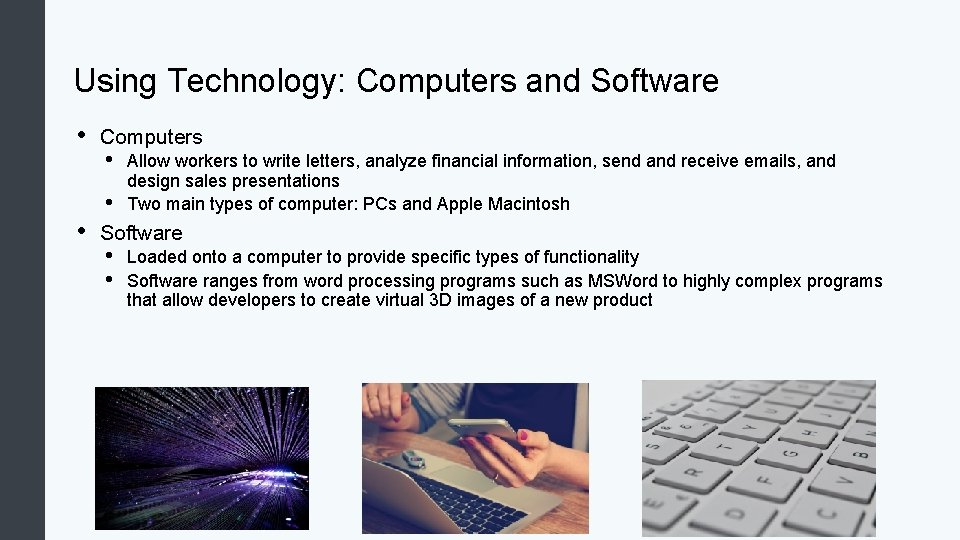
Using Technology: Computers and Software • • Computers • • Allow workers to write letters, analyze financial information, send and receive emails, and design sales presentations Two main types of computer: PCs and Apple Macintosh Software • • Loaded onto a computer to provide specific types of functionality Software ranges from word processing programs such as MSWord to highly complex programs that allow developers to create virtual 3 D images of a new product
Using Technology: Networking and Telephone Systems • • Networking • • Computers are often linked to form a network Allows people within an organization to share documents or information, provide a central repository to store documents, or for people to communicate using email within an office Telephone Systems • Automated attendants help callers find the employee they are seeking, check their account balance, place a service call, check on the status of an order allow businesses to provide a level of customer service without the caller ever interacting with an employee of the business.
Using Technology: Accounting Systems and Computer Aided Manufacturing Systems • Accounting Systems • • • Accounting systems keep track of every dollar a company spends along with every dollar of revenue Capable of tracking labor costs, inventory levels, asset value and other pieces of financial information that managers need in order to make decisions about business operations Computer Aided Manufacturing Systems • Use of software and computer-controlled machinery to automate the manufacturing process

Technology’s Influence on Business The technological revolution of the last 20 years has fundamentally changed the ways businesses do business with each other, their customers, their suppliers, and their business partners. How customers discover a business’s products, goods, and services is no longer bounded by geography.
Amazon Go For an example of the future of technology and business, look at Amazon’s latest venture – “Amazon Go”. Stores are partially-automated, with customers able to purchase products without being checked out by a cashier or using a self-checkout station.
Mobile Solutions, Cloud Computing, Extreme Customer Segmentation • • • Mobile Solutions • More people are using mobile devices to buy, sell, shop, find local businesses, and share their retail experiences with friends Cloud Computing • Allows businesses large and small to move some of their operation to third-party servers accessible via Internet connectivity Extreme Customer Segmentation • Something as simple as a Google account can let business know where their visitors are from, what browser they are using, how they found your website, what they do while on it, and how long they stay, and at which point they decide to leave
Connectivity and Social Impact • • Connectivity • The rise of mobile technology has blended almost seamlessly with communication software to create a hyper-real web of real time information Social Impact • The rise of social networking has figuratively shrunk the world and now users can connect without regard to geographical obstacle, financial background, or even social status
Class Discussion: Business Technology and You How has technology changed or influenced the way that you interact with the businesses you frequent?
Business Intelligence (BI) • • A technology-driven process for analyzing data and presenting useful information to help executives, managers and other end users make informed business decisions Advantages of BI: • • • Accelerating and improving decisionmaking Optimizing internal business processes Increasing operational efficiency Driving new revenues Gaining competitive advantage over business rivals
More about Business Intelligence (BI) • Business Intelligence: • • Is most effective when it combines external and internal data Empowers organizations to gain insight into new markets Helps organizations assess demand suitability of products and services for different market segments Helps organizations gauge the impact of marketing efforts Other ways a business can use BI to improve performance: • Business Process Management • Decision Making • Business Planning • Collaboration
Practice Question 1 Of the types of technology discussed, which category would be considered the most pervasive for business use? A. Telephone systems B. Software C. Accounting systems D. Computer aided manufacturing systems (CAM)
Practice Question 2 All of the following represent ways that technology has changed business EXCEPT: A. Social Networking B. Cloud Computing C. Management Paradigms D. Connectivity
How Businesses Use Information
Learning Outcomes: How Businesses Use Information 17. 2: Discuss ways in which information is used in business 17. 2. 1: Define and distinguish between “data” and “information” 17. 2. 2: Describe the types of data businesses collect 17. 2. 3: Explain the difference between data mining and data warehousing 17. 2. 4: Explain how businesses use information
Data vs. Information • • Data can be any character, text, word, number, and, if it’s not put into context, it means little or nothing to a human Information is data formatted in a manner that allows it to be utilized by human beings in some significant way An individual has an almost unlimited amount of data associated with him or herself It is not until data is formatted or compiled into something meaningful that business has information about the individual
Types of Business Data • Business Process Data • Physical-world Observations • Biological Data • Public Data • Personal Data
Business Data: Business Process and Physical-world Observations • • Business Process Data • • Businesses collect data regarding their business processes This data can range from collecting data on the number of days it takes their customers to pay invoices to the time it takes to assemble and package a product Physical-world Observations • This data is collected by the use of devices such as radio frequency identification (RFID), wireless remote cameras, GPS, sensor technology and wireless access points
Business Data: Biological, Public, and Personal • • Biological Data • Public Data • • • Voice and face recognition, retinal scans and biometric signatures are currently used primarily for security purposes, it may be possible in the future for this type of data to allow for product and service customization. Whenever you log onto the Internet, use instant messaging, send emails an electronic footprint is left behind. This data is considered to be “public”, and businesses collect, share and even sell this type of data every day. Personal Data • As we use technology, we provide a wealth of personal data that businesses can use, for example, Facebook
Data Mining and Warehousing • A data warehouse collects data from multiple sources (both internal and external) and stores the data to later be used in an analysis • • The primary purpose of a data warehouse is to store the data in a way that it can later be retrieved for use by the business Data Mining is not the process of getting specific pieces of data out of the data warehouse, but rather the goal of data mining is the identification of patterns and knowledge from large amounts of data
Class Discussion: Data Warehouse and BI Consider the capabilities of data warehouses and how the technology could be applied to solve complex tasks. How could it be used in the following industries? • Airline • Healthcare • Public Sector • Retail • Hospitality
Information and Primary Business Activities • • • Businesses use information to gain a competitive advantage A competitive advantage is what makes business’s goods and services superior to all of a customer’s other choices Primary Business Activities: • • • Inbound logistics Operations Outbound logistics Sales/Marketing Service
Primary Business Activities: Inbound Logistics and Operations • • Inbound Logistics • • These are the functions performed to bring in raw materials and other needed inputs Information can be used here to make these processes more efficient Operations • • Converting the raw materials into the final products or services Information can be used to provide more efficient processes and increase innovation through flows of information
Primary Business Activities: Outbound Logistics, Sales/Marketing, and Service • • • Outbound Logistics • • Functions required to get the product out to the customer Information can be used here to improve processes Sales/Marketing • • Functions that will entice buyers to purchase the products are part of sales and marketing Information can be used to innovate product design and reach customers like never before Service • Functions a business performs after the product has been purchased to maintain and enhance the product’s value are part of the service activity
Information and Support Activities • • The support activities are the functions in an organization that support, and cut across, all of the primary activities. The support activities are: • Firm infrastructure – includes organizational functions such as finance, accounting, and quality control, all of which depend on information • Human resource management – consists of recruiting, hiring, and other services needed to attract and retain employees • Procurement – these are activities involved in acquiring the raw materials used in the creation of products and services
Practice Question 3 What is the difference between “data” and “information”? A. Data needs to be stored in a database while information can be printed in reports, books and journals B. Data is information coming out of a computer, while information comes from television and newspapers C. Data is numerical in nature, while information is usually expressed in words D. Data is bits, bytes, characters, and values that mean little or nothing to a human being. Information is data expressed in a format that can be understood and utilized by people
Practice Question 4 What’s the difference between data warehousing and data mining? A. Data warehousing is concerned with the collection and storage of data while Data Mining is concerned with analyzing trends within that information B. Data warehousing and data mining are the same thing C. Data warehousing is a way to archive old information while data mining allows a user to lookup a specific fact D. Data warehousing is a strategy to keep data secure while data mining involved sharing information across a variety of networks
Practice Question 5 Thinking about the business and support activities outlined in this section, what would you consider to be the most important outcome of how businesses use information today? A. to improve sales and marketing B. to enhance the customer experience in order to gain competitive advantage C. to recruit and hire the best employees D. to better manage business processes
Information Networks
Learning Outcomes: Information Networks 17. 3: Compare the ways that businesses can manage information 17. 3. 1: Discuss how businesses can use the Internet to manage information 17. 3. 2: Discuss how businesses can use intranets and extranets to manage information 17. 3. 3: Discuss how businesses can use Virtual Private Networks (VPN’s) to manage information
How do today’s businesses manage information? • • • Once it’s grown beyond a handful of employees, a business needs a way of sharing information A business may have one or more computers to perform functions and store information Traditionally, a business would install a network (LAN) to allow computers to talk to one another and share information, but today’s businesses are looking to the cloud to provide a network solution
Cloud Computing • “Cloud computing” means performing computer tasks using services provided over the internet • When using cloud computing, a company’s data and applications are stored at an offsite data center that is then accessed via the Internet (the cloud)
Advantages of Cloud Computing • • • Cost Saving Speed of Delivery Scalable Employees Can Be Mobile Information Technology Staff
Cloud Computing: Cost Savings, Speed of Delivery, Scalable • • • Cost Savings • By “renting” software rather than buying it. In most instances, the monthly fee to “use” software is generally less than the combined cost of buying, installing, and maintaining the software internally Speed of Delivery • A cloud computing service provider can get applications up and running in a minimal time frame and often without interrupting normal business operations Scalable • By using cloud computing businesses are able to have exactly what they need at their disposal at any point in time
Cloud Computing: Employees Can Be Mobile, Information Technology Staff • Employees Can Be Mobile • • • The use of cloud computing frees workers from their desks and allows them to work wherever they are This mobility benefit also makes it easier for employees to collaborate on projects and connect with others in the company Information Technology Staff • By using cloud computing, businesses can reduce their human resource needs by shifting some of the work to outside vendors who have a staff of highly skilled individuals
Disadvantages to Cloud Computing • • • Disruption in Internet Service Security Service Provider System Crash
Cloud Computing: Disruption in Internet Service, Security, and Service Provider System Crash • • • Disruption in Internet Service • If the Internet is unavailable because of a disruption this could create serious problems for a business Security • Many companies are reluctant to trust cloud service providers with their data because they’re afraid it might become available to unauthorized individuals or criminals Service Provider System Crash • If the service provider experiences an outage, then the business is in effect cut off from its data and operations
Advantages of Intranets • • An intranet is a private network accessible only to an organization’s staff Advantages of Intranets: • • • Workforce productivity Enhanced collaboration Time Savings Reduced Cost Improved Communication
Intranets: Workforce Productivity and Enhanced Collaboration • • Workforce Productivity • Intranets can help users to locate and view information faster and use applications relevant to their roles and responsibilities Enhanced Collaboration • Being able to communicate in real-time through integrated third-party tools promotes the sharing of ideas and helps boost a business’ productivity
Intranets: Time Savings, Reduced Cost, and Improved Communication • • • Time Savings • Allow organizations to distribute information to employees on an as-needed basis in real time Reduced Costs • • Users can view information and data via web-browser rather than maintaining physical documents Saves company money on printing and duplicating Improved Communication • Intranets can serve as powerful tools for communication within an organization
Advantages of Extranets • • When outside parties are provided access to a subset of the information accessible from an organization’s intranet the intranet becomes an extranet Advantages of Extranets: • • • Building customer relations Reduced margin of error Timely and accurate Reduced inventory Flexibility
Extranets: Build Customer Relationships and Reduce Margin of Error • • Build Customer Relationships • Customers who are provided access to timely information about product availability, specifications and cost increase their efficiency Reduced Margin of Error • [Extranets] reduce a company’s margin of error thereby reducing or eliminating costly errors, especially with something as complex as processing orders from distributors and suppliers
Extranets: Timely and Accurate Information, Reduced Inventory, Flexibility • • • Timely and Accurate Information • Extranet offers a unique opportunity to quickly get information into the right hands before it’s out -of-date Reduced Inventory • By linking the inventory system directly to a supplier, businesses can process orders as soon as the system knows they are needed Flexibility • A well designed extranet allows remote and mobile staff to access core business information 24 hours a day, irrespective of location
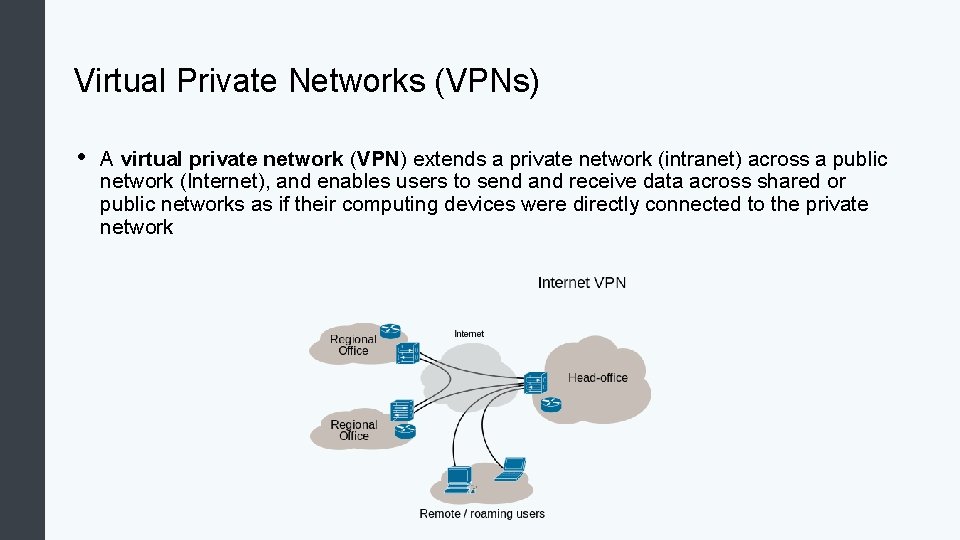
Virtual Private Networks (VPNs) • A virtual private network (VPN) extends a private network (intranet) across a public network (Internet), and enables users to send and receive data across shared or public networks as if their computing devices were directly connected to the private network
Security Advantages of VPNs • To ensure security, the VPN connection is established using encryption protocols and VPN users use authentication methods, including passwords or certificates, to gain access to the VPN • Security Advantages: • • • even if the network traffic was accessed, the attacker would only see encrypted data sender authentication is required to prevent unauthorized users from accessing the VPN messaging is designed to detect instances of tampering with transmitted messages
Practice Question 6 How do businesses use the Internet to manage information? A. Businesses use cloud (Internet) computing as the primary way to manage their information B. Businesses can use the Internet to send and receive mail C. Businesses can use the Internet to host their accounting systems D. Businesses can use the Internet to track customer activity
Practice Question 7 What is the primary difference between how businesses use intranets versus extranets? A. Intranets are secret networks used only by insiders while extranets are wide-open to the public B. Intranets utilize LAN and WAN technology while extranets only use LAN technology C. Intranets are networks for the use of internal employees only, while extranets allow customers and partners access to the network D. Businesses use both intranets and extranets to develop information about their competitors
Current Issues in IT
Learning Outcomes: Current Issues in IT 17. 4: Identify security, privacy, and ethical issues affected by information technology 17. 4. 1: Identify security issues associated with information technology 17. 4. 2: Identify privacy issues associated with information technology 17. 4. 3: Identify ethical issues associated with information technology
Security Issues in Information Technology • • Businesses stand to lose consumer confidence and respect if they allow unauthorized access of consumer data Despite the importance of protecting consumer data, breaches and hacks seem to be more and more common A February 2018 report by Mc. Afee estimates that cyber-crime costs the world over $800 billion or 0. 08% global GDP Some reasons cited for the growing cost of cyber-crime: • • • Quick adoption of new technologies by cyber-criminals Increased number of new users online Increased ease of committing a cyber-crime Expanding number of cyber-crime “centers” that now include Brazil, India, North Korea, and Vietnam Growing financial sophistication among top-tier cyber-criminals
Types of Security Issues in Information Technology • • • Viruses and Malicious Programs • A computer virus is a piece of computer code that is inserted into another program and lies dormant until triggered by an unsuspecting user Phishing • Phishing is when a scammer uses fraudulent emails or texts, or copycat websites to get you to share valuable personal information Denial of Service • A denial-of-service (Do. S) attack occurs when legitimate users are unable to access information systems, devices, or other network resources due to the actions of a malicious cyber threat actor
Ethical and Social Issues in Information Technology • Technoethics (TE) is an interdisciplinary research area concerned with all moral and • ethical aspects of technology in society Technoethical perspectives are constantly changing as technology advances into areas unseen by creators and users engage with technology in new ways • Technology, Business, and Your Data • Social Media: Employers want to use technology to help them screen applicants • and verify information about their workforce Information as a Business: Is it ethical for a business to collect data about a person and then sell that information to another business?
Class Discussion: Your Data • How do you feel about businesses collecting data about you? Is there some data you’re okay with them knowing? Is there some data you’re not okay with them knowing?
Practice Question 8 The following are information security issues EXCEPT: A. Viruses and malicious programs B. Phishing C. Denial of service D. Cyber currency
Practice Question 9 Name this area where information technology in the workplace can affect personal privacy: A. Photos or personal effects left in company cubicles B. Mileage accrued on company vehicles C. Emails or text messages sent to company -owned devices D. Food items left in break room refrigerators
Quick Review • • Describe the types of technology used in business Explain how technology changes business Explain Business Intelligence (BI) and its impact on business success. Define and distinguish between “data” and “information” Describe the different types of data businesses collect Explain the difference between data mining and data warehousing Explain how businesses use information Discuss how businesses can use the Internet to manage information
More Quick Review • • • Discuss how businesses can use intranets and extranets to manage information Discuss how businesses can use Virtual Private Networks (VPNs) to manage information Identify security issues associated with information technology Identify privacy issues associated with information technology Identify ethical issues associated with information technology
- Slides: 60