
INTRODUCTION TO BUSINESS TOPIC 2 BUSINESS STRUCTURES SUBTOPICS
INTRODUCTION TO BUSINESS TOPIC 2 – BUSINESS STRUCTURES
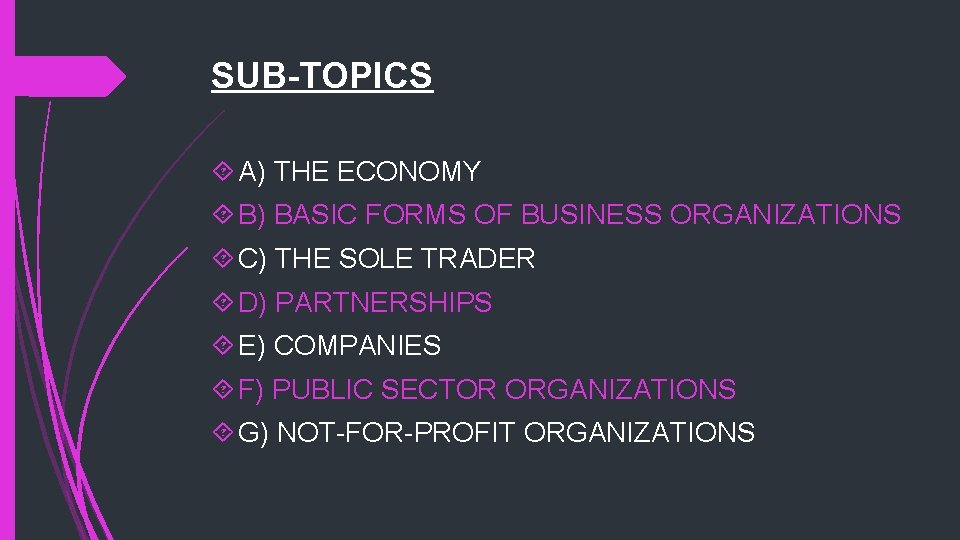
SUB-TOPICS A) THE ECONOMY B) BASIC FORMS OF BUSINESS ORGANIZATIONS C) THE SOLE TRADER D) PARTNERSHIPS E) COMPANIES F) PUBLIC SECTOR ORGANIZATIONS G) NOT-FOR-PROFIT ORGANIZATIONS
INTRO An Economy generally refers to the state of a country in terms of production and consumption of goods and services, the supply of money and the careful management of other resources Business takes place within an economic system according to what the market principles are There are basic features of an economy to be understood before studying the types of business organizations

A) THE ECONOMY MARKET ECONOMY • Provides flexibility and choice • Based on demand supply • No guarantee that what society wants will be produced • Some goods/services may be too large to be left to private sector • Consumer is king PLANNED ECONOMY • Producers are told what to produce • There is no competition

Sectors of the economy PRIMARY – Raw materials are produced SECONDARY – Raw materials are processed to make goods TERTIARY – Business services
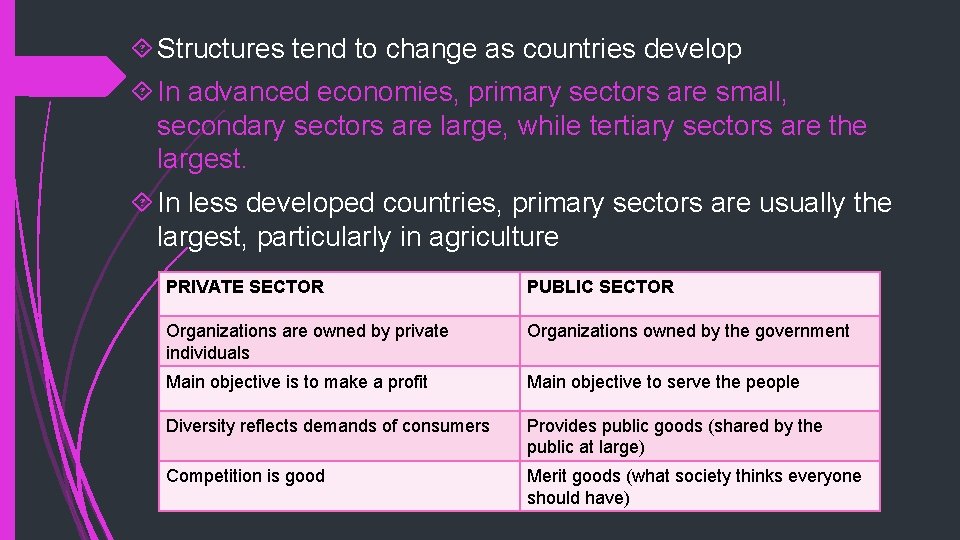
Structures tend to change as countries develop In advanced economies, primary sectors are small, secondary sectors are large, while tertiary sectors are the largest. In less developed countries, primary sectors are usually the largest, particularly in agriculture PRIVATE SECTOR PUBLIC SECTOR Organizations are owned by private individuals Organizations owned by the government Main objective is to make a profit Main objective to serve the people Diversity reflects demands of consumers Provides public goods (shared by the public at large) Competition is good Merit goods (what society thinks everyone should have)

B) BASIC FORMS OF BUSINESS ORGANIZATIONS PRIVATE SECTOR 1) Non-Corporate 2) Corporate ed t i m i 1) L bility Lia ited m i l n 2) U bility Lia Non. Corporate Sole Traders Public Ltd Companies Partnerships Private Ltd Companies
C) THE SOLE TRADER Owner provides resources and takes full responsibility Owner NOT separate from business and therefore has unlimited liability Small scale and are important to local communities
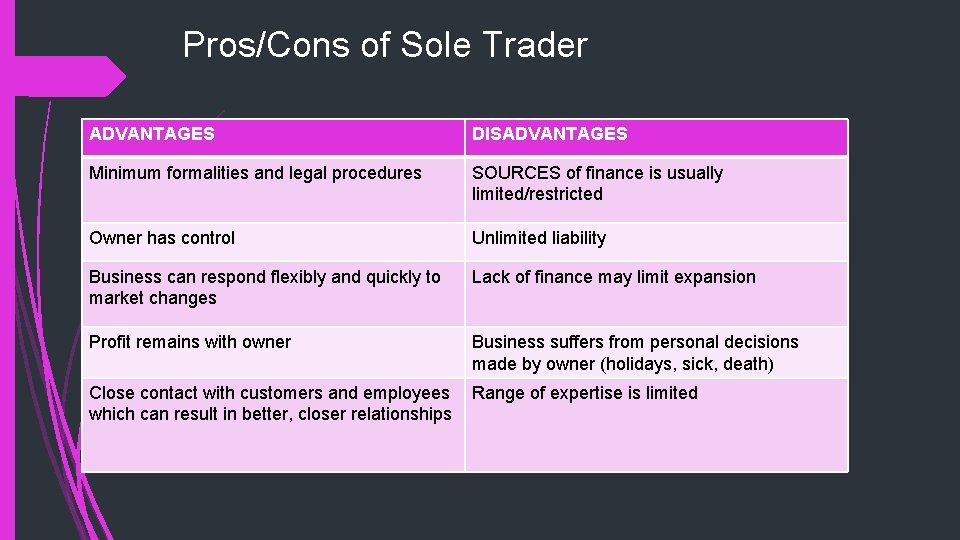
Pros/Cons of Sole Trader ADVANTAGES DISADVANTAGES Minimum formalities and legal procedures SOURCES of finance is usually limited/restricted Owner has control Unlimited liability Business can respond flexibly and quickly to market changes Lack of finance may limit expansion Profit remains with owner Business suffers from personal decisions made by owner (holidays, sick, death) Close contact with customers and employees which can result in better, closer relationships Range of expertise is limited
D) PARTNERSHIPS This type of business overcomes the disadvantages of sole traders as it increases financial resources and widens the range of expertise within the firm Definition: “The relationship which subsists between persons carrying on a business with a common view of profit” Partnership Act (1890) Characteristics and Features include: 1) Regulated by an agreement which covers the terms for capital, profit & losses, salaries and dissolution 2) There is a formal, written, deed of partnership
Characteristics & Features of a Partnership – (continued) All partners have unlimited liability All partners are jointly liable for obligations All partners share profits according to the agreement
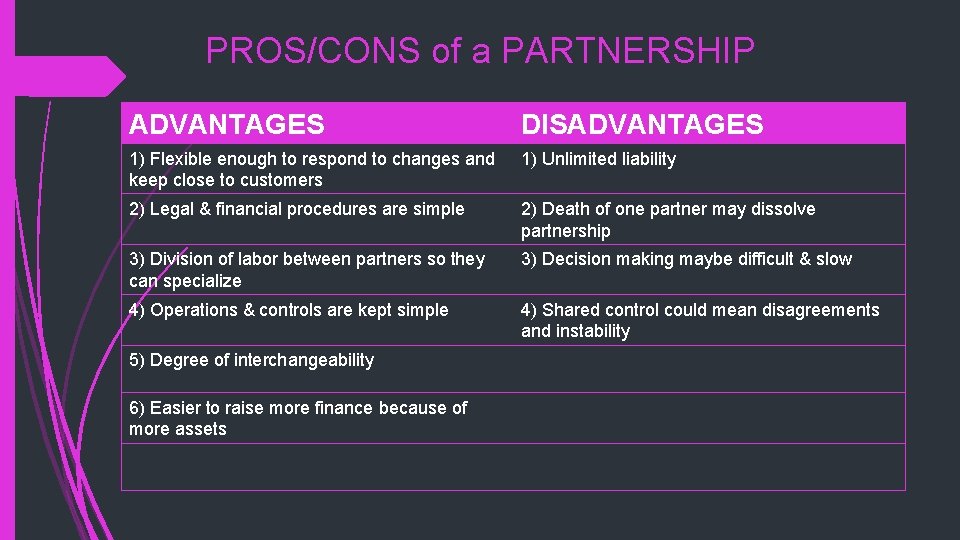
PROS/CONS of a PARTNERSHIP ADVANTAGES DISADVANTAGES 1) Flexible enough to respond to changes and keep close to customers 1) Unlimited liability 2) Legal & financial procedures are simple 2) Death of one partner may dissolve partnership 3) Division of labor between partners so they can specialize 3) Decision making maybe difficult & slow 4) Operations & controls are kept simple 4) Shared control could mean disagreements and instability 5) Degree of interchangeability 6) Easier to raise more finance because of more assets
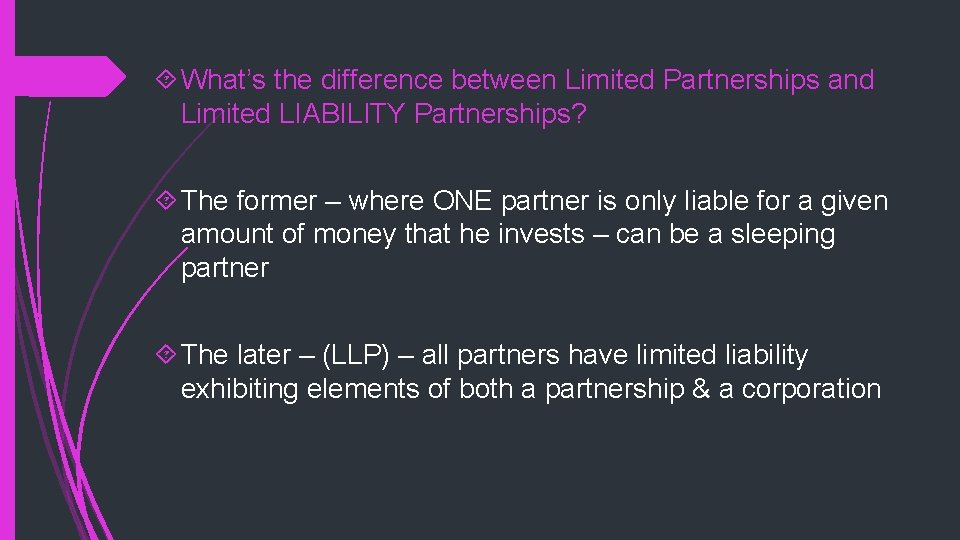
What’s the difference between Limited Partnerships and Limited LIABILITY Partnerships? The former – where ONE partner is only liable for a given amount of money that he invests – can be a sleeping partner The later – (LLP) – all partners have limited liability exhibiting elements of both a partnership & a corporation
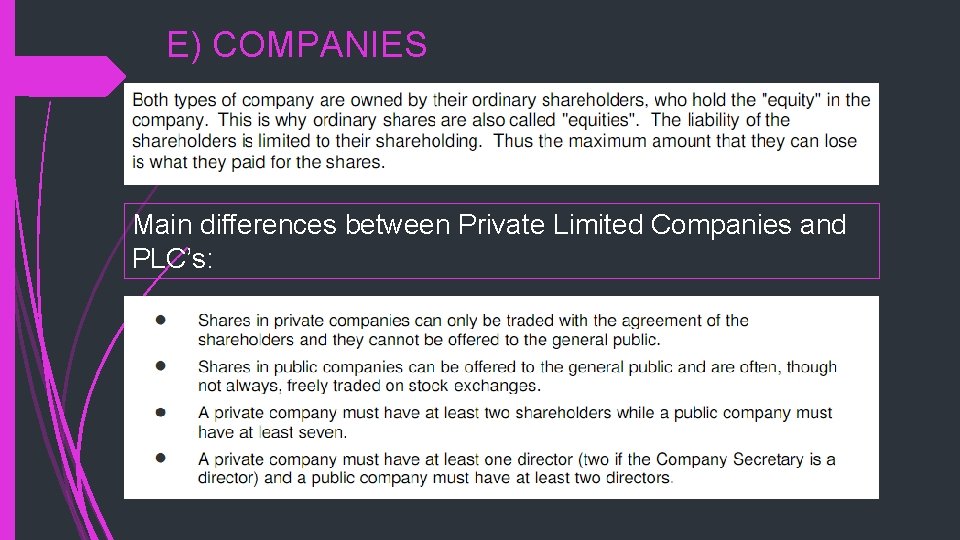
E) COMPANIES Main differences between Private Limited Companies and PLC’s:
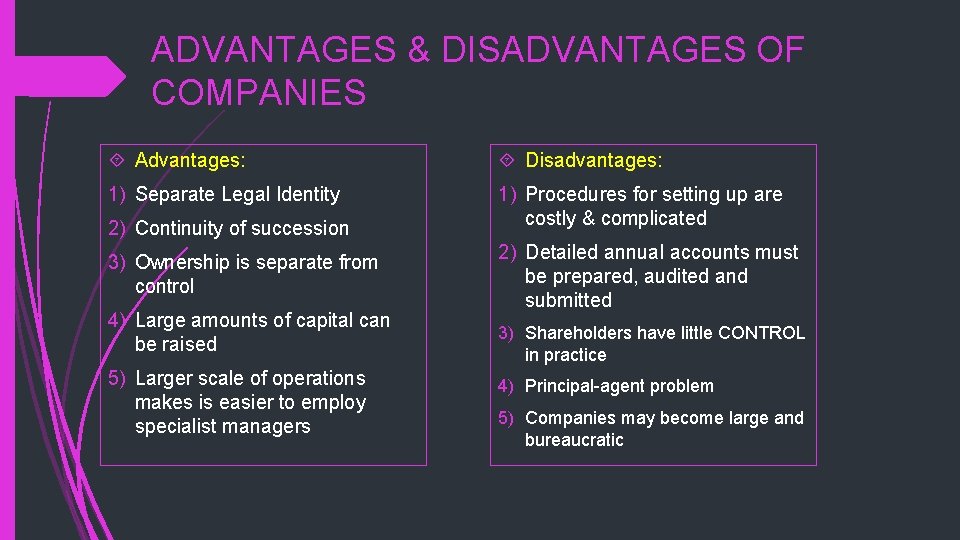
ADVANTAGES & DISADVANTAGES OF COMPANIES Advantages: Disadvantages: 1) Separate Legal Identity 1) Procedures for setting up are costly & complicated 2) Continuity of succession 3) Ownership is separate from control 4) Large amounts of capital can be raised 5) Larger scale of operations makes is easier to employ specialist managers 2) Detailed annual accounts must be prepared, audited and submitted 3) Shareholders have little CONTROL in practice 4) Principal-agent problem 5) Companies may become large and bureaucratic
F) PUBLIC SECTOR ORGANIZATIONS 1) Public Corporations – Public companies set up by Parliament (firms are taken into public ownership) 2) Local Authorities – Responsible for providing a wide range of public services 3) Government Agencies &/or 4) Quangos (resembling government, but it is a non government org, which could be funded by the government as it is responsible to a government minister)
The Public Enterprise & State Ownership Debate Some argue that government SHOULD become involved in business enterprises especially where: There may be natural monopolies Some activities are not-for-profit but are essential for the community Some activities should be free from political bias when in private hands Activities like defense should not be in private hands
Arguments against Public Enterprise & State Ownership Losses in public enterprise are paid for by taxpayers money and may encourage inefficiency and waste Public accountability may mean that innovation is stifled Political pressures mean decisions are made not for commercial reasons, rather, for political reasons Capital is provided by the government, when there are restrictions or cut in government spending, the national industry suffers
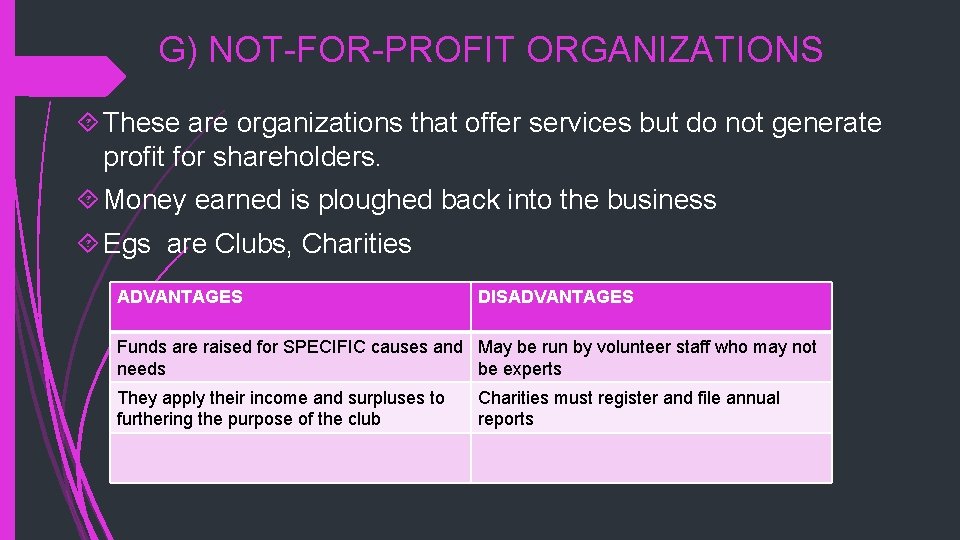
G) NOT-FOR-PROFIT ORGANIZATIONS These are organizations that offer services but do not generate profit for shareholders. Money earned is ploughed back into the business Egs are Clubs, Charities ADVANTAGES DISADVANTAGES Funds are raised for SPECIFIC causes and May be run by volunteer staff who may not needs be experts They apply their income and surpluses to furthering the purpose of the club Charities must register and file annual reports

The End
- Slides: 20