
Introduction to Business Rates South Ribble Borough Council

Introduction to Business Rates South Ribble Borough Council 11 th June 2019

The Principles of Rateable Occupation Robin Gibbons IRRV Tech Business Rates Manager - Bolton Council 11 June 2019 – South Ribble
Content • • • History of rates Legal position The 4 elements Leading Cases Scenarios
A Brief History of Rates • Poor Law Act 1601 • Paid for by levying rates on local ratepayers • System of rates to fund local government & services evolved over the centuries • General Rate Act 1967 • Local Government Finance Act 1988
The Legal Position • No statutory definition of rateable occupation • Local Government Finance Act 1988 - Section 43 the occupier will be liable for occupied rates for any day they are in occupation of all or part of the hereditament (for any day the hereditament appears in the rating list)
Rateable occupation • • S 65(2) LGFA 1988 – rules are same as General Rate Act 1967 Case law from as far back as 18 th century still relevant today R v St Pancras Assessment Committee (1877) John Laing & Son Ltd v Kingswood Area Assessment Committee (1949)
John Laing & Son Ltd v Kingswood Area Assessment Committee [1949] • Building contractors • Erected offices, canteens and other structures on an airfield where they were undertaking a contract • Deemed to be in rateable occupation of the huts despite the site being under the control of the Air Ministry (who occupied the airfield)
John Laing & Son Ltd v Kingswood Area Assessment Committee [1949] Outcome: Rateable occupation consists of four ‘ingredients’ all of which must be present to attract rate liability: 1. 2. 3. 4. There must be actual occupation The occupation must be exclusive to the occupier The occupation must be of some benefit to the occupier, and The occupation must not be for too transient a period The principles were approved by the Supreme Court (formerly the Appellate Committee of the House of Lords) in London CC v Wilkins (VO) [1956]

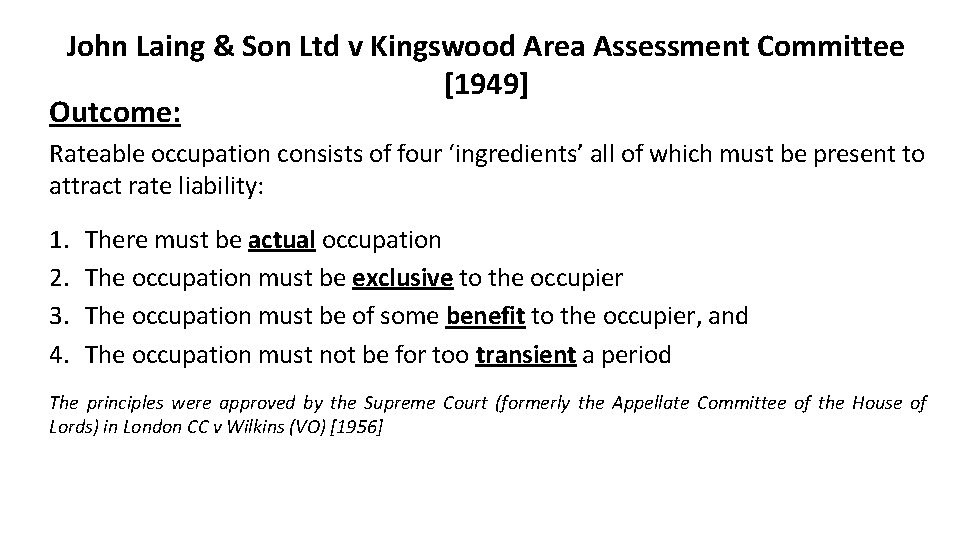
Rateable occupation? 1
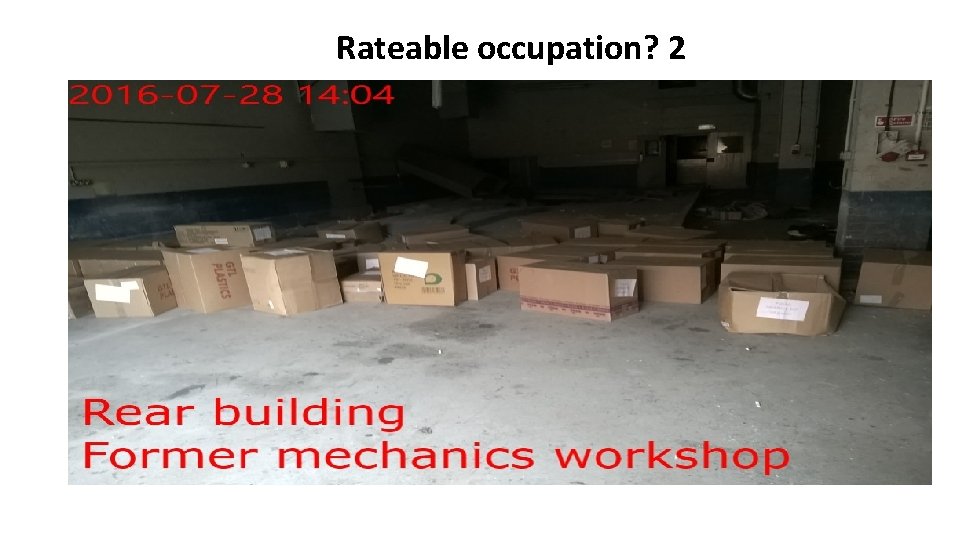
Rateable occupation? 2
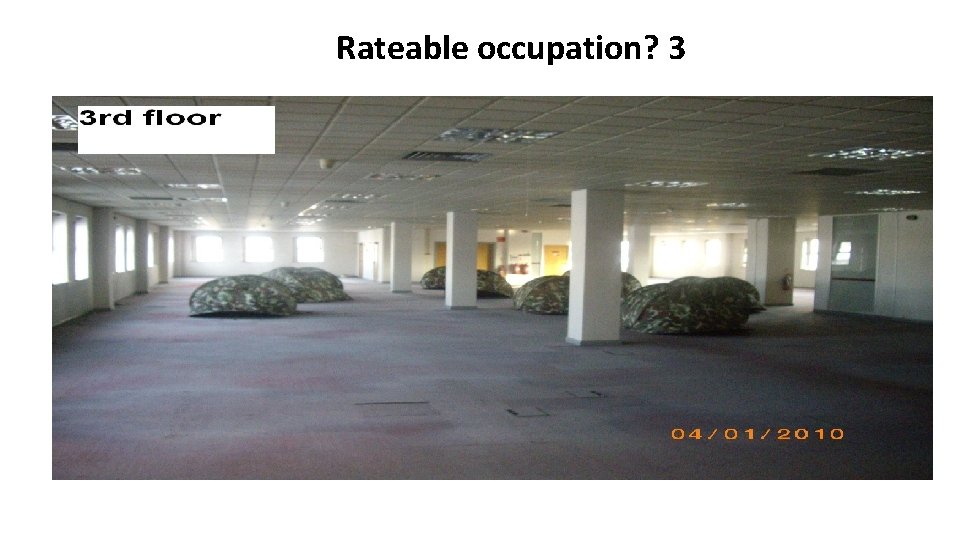
Rateable occupation? 3

Actual Occupation • Concerns the physical use of land or property, no matter how slight that use may be. • The mere intention to occupy is not sufficient • Neither, in itself, is the ownership of a legal title to the land or property.
Plant, Machinery & Equipment Section 65(5) Local Government Finance Act 1988 A hereditament not in use is to be treated as unoccupied if it would otherwise be treated as occupied only by reason of there being kept in or on it plant, machinery or equipment – – which was used in/on the hereditament when it was last in use, or – which is intended for use in or on the hereditament. (e. g. warehouse containing large ‘fixed’ processing equipment, or an office containing a range of desks and filing cabinets)
Sheafbank Property Trust PLC v Sheffield Metropolitan District Council [1988] • • • Company purchased a sports field, clubhouse and caretaker’s flat, together with contents which included a snooker table, music facilities, tables, chairs, bar, freezer, dishwasher, tv, fridge, settee and grass cutting equipment. The rating authority conceded these items were “plant, machinery or equipment” but argued that the high level of maintenance being carried on, indicated that rateable occupation existed. High Court held that the hereditament was to be treated as unoccupied, and that the proper approach for the authority to employ was to consider whether, but for the presence of plant, machinery or equipment, it would have found the premises to have been in rateable occupation.
Warehouses / reserved for future occupation R v Melladew [1907] • Warehouse left empty & the water had been cut off (but could be reconnected at any time). • Warehouse owner would have been prepared to let it or receive goods into it at any time providing half of the capacity was used. • Held that the intention to occupy must be viewed in context with the nature of the business and that it was an occupational hazard of a warehouseman that the premises could be vacant for some time. Held liable for rates for the whole period.
Illegal Occupation Tomlin v Westminster City Council [1989] • Squatters illegally occupied Cambodian Embassy • Held that actual occupation is irrespective of the title by which the property is occupied and the absence of title is immaterial. • More important to look at what is actually happening than what should be happening. • One of the squatters was found to have satisfied the test of actual occupation and was therefore rateable.
Ratford and Hayward (Receivers and Managers of Sabre Tooling Ltd) v Northavon District Council [1986] • Court of Appeal found that although the receivers had power to take possession they had no obligation to do so and that they only acted as agent for the company. • They are not liable for any rate liability whilst acting in their capacity as agent.
Actual Occupation – Additional Case Law • • • Overseers of Bootle v Liverpool Warehousing Co. [1901] Calmain Properties Ltd v Rotherham MBC [1989] Arbuckle Smith & Co. Ltd v Greenock Corporation [1960] Hampson (t/a Abbey Self Storage) v Newcastle Upon Tyne CC [1996] Hampstead BC v Associated Cinema Properties Ltd [1944] English, Scottish and Australian Bank Ltd v Dyer [1958] Southwark LBC v Briant Colour Printing Co. Ltd [1977] Kent CC v Ashford BC and Others [1999] Magon v Barking and Dagenham LBC [1999] JDE Plant Hire Ltd v Barking and Dagenham LBC [2000]

Exclusive Occupation • Each rateable occupier must be able to demonstrate exclusive occupation • It must be clear that the occupier has a use of the premises which is not shared by another • The occupier must be able to prevent another from using the premises for the same purpose. • There can still be exclusive occupation when the interests of the occupiers are subject to terms and conditions and others have distinct and independent use of the premises. • Paramount Control? • Degree of Control?
Westminster City Council v Southern Railway Co, Railway Assessment Authority and W H Smith & Sons Ltd [1936] • Should kiosks and shops on Victoria Station be included in the railway station assessment or be rated separately? • Held that they were capable of separate assessment • Decision focused on who had paramount control of the kiosks themselves rather than the station they were situated in. • If paramount control over the use of the property rests with either party this may lead to occupation. Control over access only would be insufficient to effect occupation. • Immaterial that right to occupy is by tenancy/lease/licence • Examine what is actually happening - not what should be
Blake v Hendon Corporation [1965] • • Bowling green within the grounds of a local public park Let out to a private bowls club Restricted access to the general public Held that the bowling green had exclusive occupation and was therefore liable.
Exclusive Occupation – Additional Case Law • • • Holywell Union v Halkyn District Mines Drainage Company [1895] William Press and Son Ltd v Cayford [1973] Cory and Others v Bristow [1977] Birmingham CC v Hughes and Knighton & Rhayader Rural DC [1957] Soldiers, Sailors & Airmen’s Families Assoc. v Merton Corporation [1966] Thomas (VO) v Witney Aquatic Co. Ltd [1972] Bartlett (VO) v Reservoir Aggregates Ltd [1985] Brook v National Coal Board [1975] Pennard Golf Club v Richards [1976] Greater Manchester PTE v Carter [1981] Thurrock BC v S. Walsh and Son Ltd [1999]
Beneficial Occupation • Doesn’t refer merely to benefit of a financial nature. • Occupier can derive benefit from the use of a hereditament even though the occupation may, in itself, be a financial liability • Public bodies - occupation will be considered to be beneficial if it enables them to carry out a statutory function. The test of beneficial occupation is not whether occupation would produce a profit but whether it is of value to the occupiers in terms of their willingness to pay a rent so as to enable the occupation to exist.
Public Use Land held by a local authority only as a custodian for the public at large does not give rise rateable occupation – no benefit can be obtained • Hare v Putney Overseers [1881] – Related to a bridge • Newham LBC v Hampsher [1970] – Street market • Lambeth Overseers v London CC [1897] – Parks
Willingness to Pay a Rent to Enable Occupation to Exist • Rent paid = beneficial occupation satisfied • Monkcom v Adams [1988] – Children’s trampoline site used for part of a year (every year). Lands Tribunal found beneficial occupation existed as a licence fee was paid in order to trade What about: • Tenancies where no rent is payable? • 6 week occupations enable a further period of empty exemption Test of beneficial occupation has to be satisfied for rateable occupation to exist
Makro Properties Ltd v Nuneaton BC [2012] • Makro Properties Ltd (MPL) and Makro Self Storage Wholesalers Ltd (MSSWL) v Nuneaton & Bedworth BC [2012] • MSSWL leased premises & occupied as a cash and carry until 1 June 2009. Lease surrendered 31 December 2009 • Between 25 November 2009 and 12 January 2010 some 16 pallets of MSSWL paperwork (which it was bound by law to retain) was stored there – no written agreement. • The pallets occupied approx 0. 2% of the floor space which exceeded 140, 000 sqft. • Between 12 January 2010 and 23 July 2010 the premises were empty.
Makro Properties Ltd v Nuneaton BC [2012] cont • On 23 July 2010 some further 40 pallets of MSSWL paperwork were delivered and stored there • Following the issue of a Magistrates Court summons the District Judge had ruled in favour of billing authority (granting a liability order for empty rates). • “the chattels were placed in the Coventry store by MSSWL with a view to incurring rateable liability for a short period (certainly not beneficial) so that it or MPL could avoid liability for a longer period. The potential avoidance of liability is the only 'benefit” • MSSWL appealed to High Court
Makro Properties Ltd v Nuneaton BC [2012] In his High Court ruling Judge Jarman stated: • “it cannot properly be said that the storage was of no practical benefit”. The documents were tax records they were bound by law to retain • “The fact that this storage could have been continued at other venues does not render storage at the warehouse of no practical benefit”. • Use as a warehouse wasn’t required for occupation to exist • The records must have been of some value to the occupier (legally required to be kept)
Effect of Makro Ruling • High Court Ruling stated the District Judge had accepted there was actual occupation albeit miniscule - the question was whethere was occupation of part of the premises or none of it • Proper approach - consider the use of the premises and intention behind it. Evidence of intention together with slight use could lead to inference of occupation • Minimal storage was actual occupation – rateable occupation exists • High Court rulings legally binding over all lower courts. Where a case comes before a Magistrates Court on the same facts they are legally bound to follow this ruling.
Sunderland City Council v Stirling Investment Properties LLP [2013] • 1500 sq m unit constructed for industrial warehousing with office accommodation – split into 2 hereditaments • Used by Complete Mobile Marketing Ltd from 20 May 2011 – 1 July 2011 inclusive (43 days) to locate a “blue tooth box” in. Lease for this period • The box, approx 100 x 50 mm, was placed in the corner of the premises to perform “marketing and advertising” functions • 6 months empty exemption once box was removed • District Judge held that the occupation was potentially of benefit to CMML (even though the occupation was not that of a warehouse) and that they were in rateable occupation
Sunderland City Council v Stirling Investment Properties LLP [2013] • In High Court - claimed occupation not beneficial as it was not occupied as a warehouse • High Court ruled CMML were in rateable occupation: There is “nothing in the legislation which limits the ability of a local authority to levy rates to occupation for a purpose which is identical to the description of the hereditament in the rating list” - mirrors Makro “Although the rent paid by them was nominal, the outgoings, in terms of their accepting liability for rates, were not. This reflects the value to them of the lease & their occupation of the premises” – goes against Laing?

R. (on the application of Principled Offsite Logistics Ltd) v Trafford Council [2018] • Whether ‘occupancy for its own sake, in furtherance of a rates avoidance scheme’ could satisfy beneficial occupation test • Trafford’s case - occupation for its own sake, without any separate purpose than to occupy, is not occupation in law and fact. There must be some additional purpose to use the premises for something • Goods were present (rather than stored) – little or no value • POLL - purpose of occupying a property need not be commercial to constitute rateable occupation
POLL Case cont • Not a Court of morals - “I must resist any temptation to find that the occupation has to be of “the right kind” to qualify as beneficial. But the occupation still has to be beneficial, in law and in fact, applying a morally neutral analysis” Kerr J • Must be occupation not just an impression of occupation • Consideration - Is beneficial occupation present where the value or benefit is the occupancy itself? • Kerr J stated “cannot see any good reason why, if ethics and morality are excluded from the discussion, the thing of value to the possessor should not be the occupancy itself”
Beneficial Occupation – Additional Case Law • • • R v School Board for London [1886] London CC v Erith and West Ham [1893] London CC v Hackney BCC [1928] Appleton v Westminster Corporation [1963] Hare v Putney Overseers [1881] Newham London BC v Hampsher [1970] Lambeth Overseers v London CC [1897] Kingston-Upon-Hull Corporation v Clayton (VO) [1961] Redbridge London BC v Wand [1970] Smith v St Albans City & DC [1977]
Transient Occupation Transience of occupation does not relate to short occupations, which generate liability on a daily basis, but to the time for which a hereditament exists Sir Robert Mc. Alpine & Sons Ltd v Payne [1969] • Building huts on site for six or seven months were found not to be rateable as it was deemed not long enough to satisfy the requirement of “permanence” London County Council v Wilkins [1956] • Builders huts that remained on site for over 12 months were held to be rateable
Case Law Hall v Darwen Corporation and Silcock Bros. (Amusements) Ltd [1957] • Had the right to hold a fair at any time on a piece of land. Only used it for this purpose for a week twice a year but were held to be in rateable occupation - sufficiently permanent. Hayes v Loyd [1985] • Supreme Court held that 2 fields which were part of a farm were not exempt from rating, since they were used for a point to point horse race meeting on Easter Monday each year

Any Questions?

Introduction to Business Rates Lancashire & Cheshire IRRV Association Reliefs and Exemptions A summary of the reliefs/exemptions available to ratepayers 11 th June 2019, South Ribble Borough Council David Holmes LL. B, FIRRV Compliance & Technical Manager Blackpool Council
Content • • Legal Framework European State Aid Mandatory Reliefs and Exemptions Discretionary Reliefs Hardship Relief Part Occupied Relief (s 44 A) Administrative / Funding Considerations
The legal position – the 1988 act Sections 43 and 45 of the Local Government Finance Act 1988 deal with mandatory reliefs – ie those reliefs which are required to be applied when the qualifying criteria is met. Section 44 A deals with hereditaments which are partly occupied/ Section 47 deals with the award of discretionary relief Section 49 deals with payment of Hardship Relief
The legal position – other The Non-Domestic Rating (Unoccupied Property) (England) Regulations 2008 provide the latest criteria for dealing with exemptions for empty properties. Section 69 of the Localism Act 2011 amended s. 47 of the LGFA 1988 and opened the door to grant relief to any ratepayer for any reason as the billing authority sees fit. European State Aid deminimis limits were introduced by Commission Regulation (EU) 1407/2013 and apply to all public bodies who administer tax relief on behalf of a European member state.

European State Aid Limits State aid is any advantage granted by public authorities through state resources on a selective basis to any organisations that could potentially distort competition and trade in the European Union (EU). State aid rules can apply to the following: • grants • loans • tax breaks • the use or sale of a state asset for free or at less than market price The rules can apply to funding given to charities, public authorities and other non-profit making bodies where they are involved in commercial activities. State Aid limits relief to € 200, 000 over 3 fiscal years (£ 177 k)
Mandatory • Empties • Small Business Rate Relief • Charitable • Rural settlements • Transitional (very briefly!)
Empty Property Exemptions • • • unoccupied for less than 3 months (time limited) unoccupied industrial hereditaments, for a period of less than 6 months (time limited) where the rateable value is less than £ 2, 900 where the owner is prohibited by law from occupying it or allowing it to be occupied where it is kept vacant by reason of action taken by or on behalf of the Crown or any local or public authority with a view to prohibiting the occupation of the hereditament or to acquiring it where it is the subject of a building preservation notice under the Planning (Listed Buildings and Conservation Areas) Act 1990 or is included in a list compiled under Section 1 of that Act where it is included in the schedule of monuments compiled under Section 1 of the Ancient Monuments and Archaeological Areas Act 1979 the owner is entitled to possession only in his capacity as the personal representative of a deceased person the owner is subject to bankruptcy proceedings the owner is subject to a winding up order, or which is being wound up voluntarily properties owned by charities - only if the property’s next use will be wholly or mainly for charitable purposes
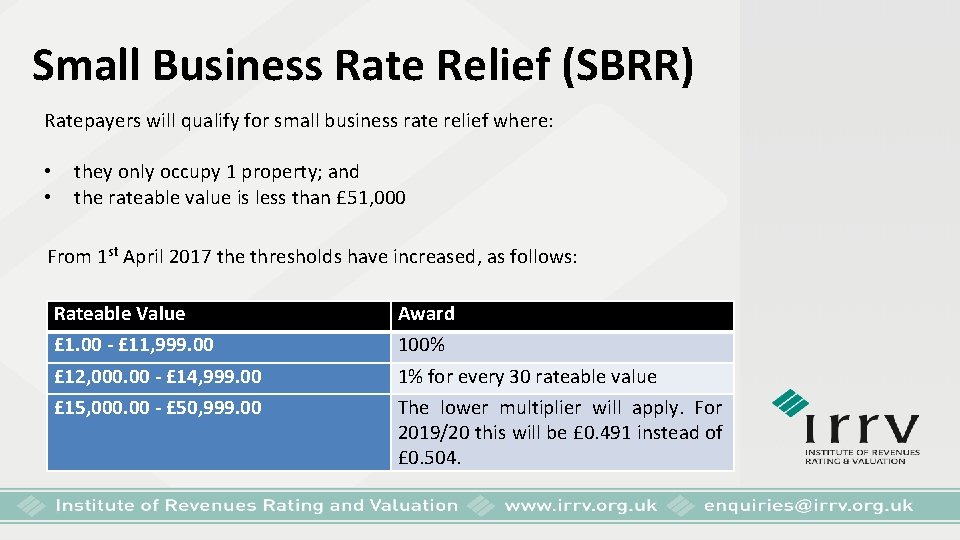
Small Business Rate Relief (SBRR) Ratepayers will qualify for small business rate relief where: • they only occupy 1 property; and • the rateable value is less than £ 51, 000 From 1 st April 2017 the thresholds have increased, as follows: Rateable Value £ 1. 00 - £ 11, 999. 00 £ 12, 000. 00 - £ 14, 999. 00 £ 15, 000. 00 - £ 50, 999. 00 Award 100% 1% for every 30 rateable value The lower multiplier will apply. For 2019/20 this will be £ 0. 491 instead of £ 0. 504.
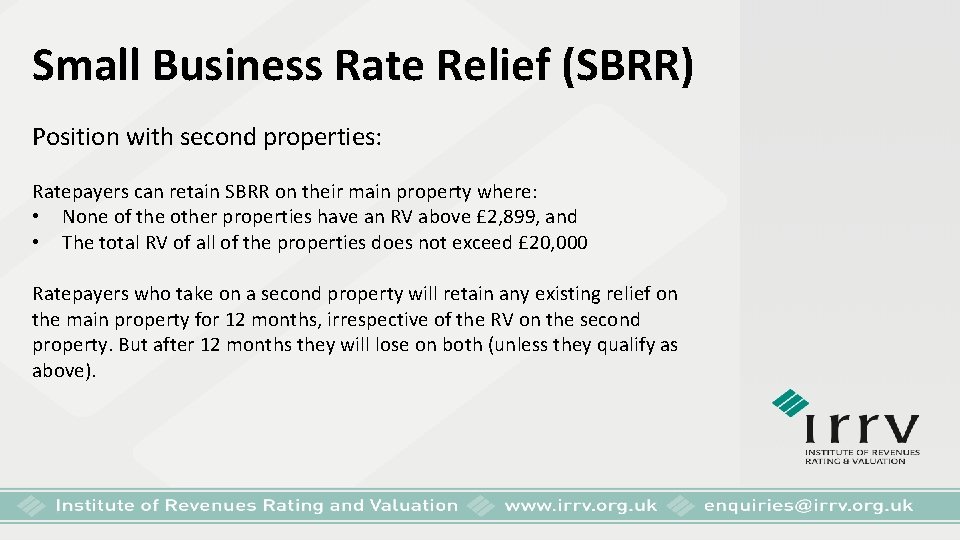
Small Business Rate Relief (SBRR) Position with second properties: Ratepayers can retain SBRR on their main property where: • None of the other properties have an RV above £ 2, 899, and • The total RV of all of the properties does not exceed £ 20, 000 Ratepayers who take on a second property will retain any existing relief on the main property for 12 months, irrespective of the RV on the second property. But after 12 months they will lose on both (unless they qualify as above).
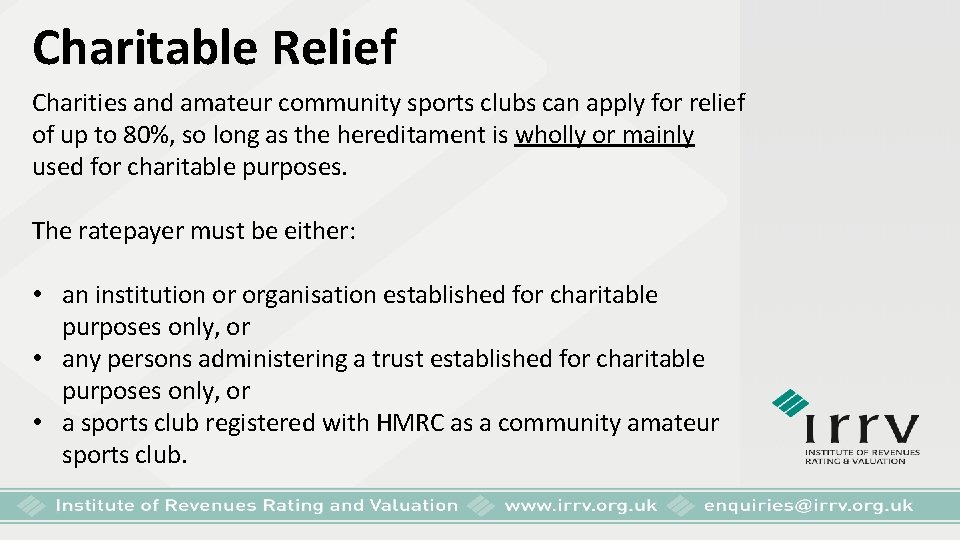
Charitable Relief Charities and amateur community sports clubs can apply for relief of up to 80%, so long as the hereditament is wholly or mainly used for charitable purposes. The ratepayer must be either: • an institution or organisation established for charitable purposes only, or • any persons administering a trust established for charitable purposes only, or • a sports club registered with HMRC as a community amateur sports club.

Rural Settlement Relief Ratepayers will qualify for rural relief where the business is in a rural settlement with a population below 3, 000. The scheme grants 100% relief. Ratepayers can receive rural rate relief if their business is: • the only village shop or post office with a rateable value of up to £ 8, 500, or • the only public house or petrol station with a rateable value of up to £ 12, 500
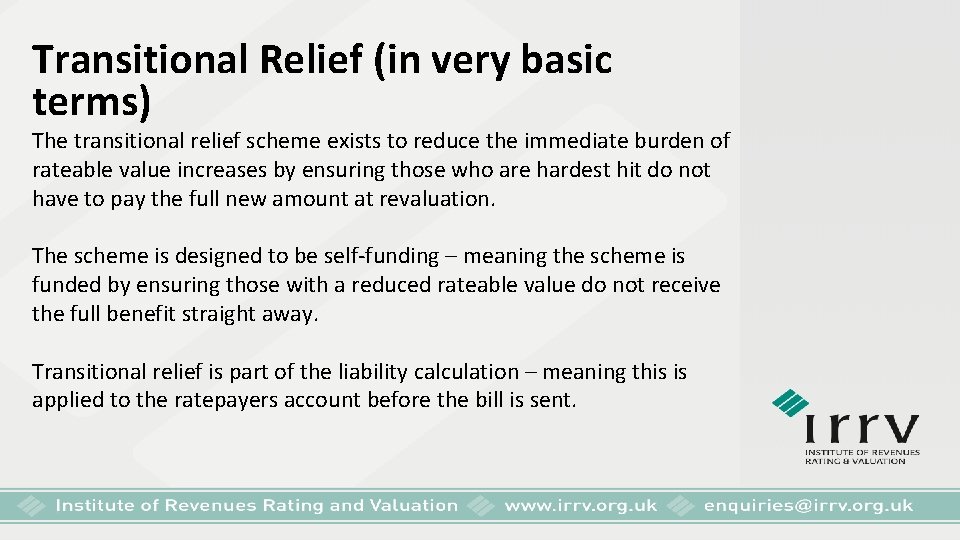
Transitional Relief (in very basic terms) The transitional relief scheme exists to reduce the immediate burden of rateable value increases by ensuring those who are hardest hit do not have to pay the full new amount at revaluation. The scheme is designed to be self-funding – meaning the scheme is funded by ensuring those with a reduced rateable value do not receive the full benefit straight away. Transitional relief is part of the liability calculation – meaning this is applied to the ratepayers account before the bill is sent.
Discretionary Reliefs • Top up for charities and not for profit • Top up for rural settlements • Retail Discount • Enterprise Zones • Local Newspapers • Revaluation Relief • Localism Relief • Relief for Public Conveniences (in the pipeline)

Top up for charities and not for profit Pursuant to s. 47(3) and s. 47(5) of the Local Government Finance Act 1988 (as amended) the billing authority make an award of up to 100% for charities and other organisations, where the following conditions apply: • a ratepayer is a charity or trustees of a charity, and the hereditament is wholly or mainly used for charitable purposes, or • the ratepayer is a community amateur sports club and is wholly or mainly used for the purposes of the club and other such clubs, or • all or part of the hereditament is occupied for the purposes of one or more institutions or other organisations none of which is established or conducted for profit and whose main objectives are charitable or are otherwise philanthropic or religious or concerned with education, social welfare, science, literature or the arts, or • the hereditament is wholly or mainly used for purposes of recreation, and all or part of it is occupied for the purposes of a club, society or other organisation not established or conducted for profit.
Top up for charities and not for profit Considerations when dealing with cases: Community Organisations: • the organisation is not part of a charging or precepting authority, and • the organisation has been specifically set up for the benefit of the young, the aged, the disabled or for ethnic minorities, or • the property is for the general use of the local community without any membership and/or subscription requirements and has no specific use except for the general benefit of the community, or • the aims of the organisation are to educate volunteers in emergency training for the benefit of the local community.
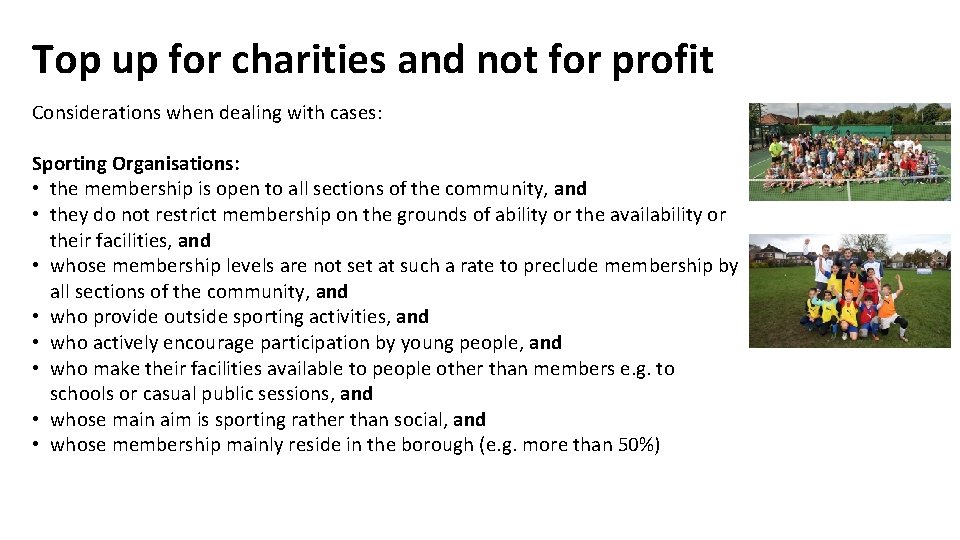
Top up for charities and not for profit Considerations when dealing with cases: Sporting Organisations: • the membership is open to all sections of the community, and • they do not restrict membership on the grounds of ability or the availability or their facilities, and • whose membership levels are not set at such a rate to preclude membership by all sections of the community, and • who provide outside sporting activities, and • who actively encourage participation by young people, and • who make their facilities available to people other than members e. g. to schools or casual public sessions, and • whose main aim is sporting rather than social, and • whose membership mainly reside in the borough (e. g. more than 50%)

Top up for rural settlements Billing authorities can also give relief of up to 100% to other rural businesses, where: • • • the rateable value is below £ 16, 500, and the hereditament is used for purposes which are of benefit to the local community; and it would be reasonable for the billing authority to award relief, having regard to the interests of persons liable to pay its Council Tax.

Retail Discount (2019/20 onwards) The Government announced in the 2018 Budget that it will provide a Retail Discount scheme for occupied retail properties with a rateable value of less than £ 51, 000 in each of the years 2019 -20 and 2020 -21, subject to state aid limits. The value of discount should be one third of the bill, and must be applied once mandatory reliefs and other discretionary reliefs have been applied. Properties that will benefit from the relief will be: • • • occupied hereditaments a rateable value of less than £ 51, 000 are wholly or mainly being used as shops, restaurants, cafes and drinking establishments. The relief is fully compensated under the s. 31 grants scheme.

Retail Discount (2019/20 onwards) Hereditaments that are being used for the sale of goods to visiting members of the public: • • • Shops (such as: florists, bakers, butchers, grocers, greengrocers, jewellers, stationers, off licences, chemists, newsagents, hardware stores, supermarkets, etc) Charity shops Opticians Post offices Furnishing shops/ display rooms (such as: carpet shops, double glazing, garage doors) Car/ caravan show rooms Second hand car lots Markets Petrol stations Garden centres Art galleries (where art is for sale/hire)

Retail Discount (2019/20 onwards) Hereditaments that are being used for the provision of the following services to visiting members of the public: • • • Hair and beauty services (such as: hair dressers, nail bars, beauty salons, tanning shops, etc) Shoe repairs/ key cutting Travel agents Ticket offices e. g. for theatre Dry cleaners Launderettes PC/ TV/ domestic appliance repair Funeral directors Photo processing Tool hire Car hire

Retail Discount (2019/20 onwards) Hereditaments that are being used for the sale of food and/ or drink to visiting members of the public: • • • Restaurants Takeaways Sandwich shops Coffee shops Pubs Bars

Retail Discount (2019/20 onwards) Hereditaments that are being used for the provision of the following services to visiting members of the public: • • • Financial services (e. g. banks, building societies, cash points, bureaux de change, payday lenders, betting shops, pawn brokers) Other services (e. g. estate agents, letting agents, employment agencies) Medical services (e. g. vets, dentists, doctors, osteopaths, chiropractors) Professional services (e. g. solicitors, accountants, insurance agents/ financial advisers, tutors) Post office sorting offices Hereditaments which are not reasonably accessible to visiting members of the public • • Premises where membership is required to gain entry (e. g. affiliated social clubs) Premises where payment is required to gain entry
Enterprise Zones The billing authority is able to grant business rate relief of up to £ 275 k over a maximum 5 year term (average £ 55 k pa) to any business which moves into a designated Enterprise Zone, subject to state aid limits. It is up to the billing authority to determine how much relief is available, and to whom. Most Enterprise Zones were designated in 2013, but a number have been designated in recent years. In Blackpool this was designated in 2017 – so the window for applications for relief will close in 2022. The relief is fully compensated under the s. 31 grants scheme.

Local Newspaper Relief The Government introduced a £ 1, 500 relief for office space occupied by local newspapers in England, up to a maximum of one discount per local newspaper title and per hereditament, and up to state aid limits, for 2 years from 1 April 2017. This was extended in the 2018 budget and will now apply until 31 st March 2020. The relief is to be specifically for local newspapers and by that we mean what would be considered to be a “traditional local newspaper. ” The relief will not be available to magazines. The relief is fully compensated under the s. 31 grants scheme.
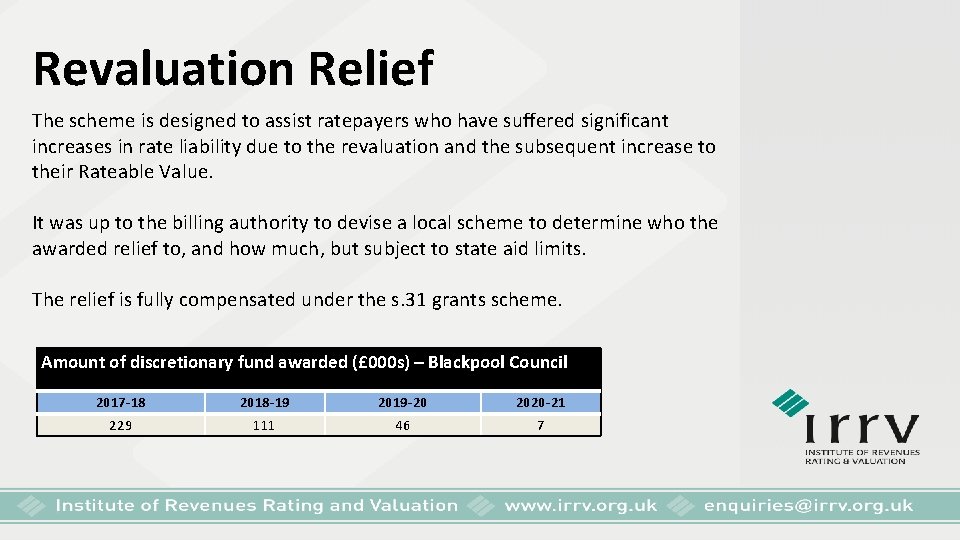
Revaluation Relief The scheme is designed to assist ratepayers who have suffered significant increases in rate liability due to the revaluation and the subsequent increase to their Rateable Value. It was up to the billing authority to devise a local scheme to determine who the awarded relief to, and how much, but subject to state aid limits. The relief is fully compensated under the s. 31 grants scheme. Amount of discretionary fund awarded (£ 000 s) – Blackpool Council 2017 -18 229 2018 -19 111 2019 -20 46 2020 -21 7
Localism Relief A billing authority may award relief on any cases where it has been asked to do so, and where the award would be clearly in the interest of the local Council Tax payer, and subject to state aid limits. The relief is available pursuant to s. 47 of the Local Government Finance Act 1988, as amended by s. 69 of the Localism Act 2011, and decisions are to be made on a case by case basis and dependant on the individual facts. This is often referred to as ‘Localism Relief’.
Hardship Relief Designed for a billing authority to provide discretionary assistance in exceptional and/or unexpected circumstance, but not to prop up a fundamentally failing business. • • • Decisions are to be made on a case by case basis and dependant on the individual facts. Awards should be considered where it is evident that doing so would be in the interests of the wider community. This can be because failure to grant the relief would result in the loss of a unique and regularly required service, and/or because the failure to grant relief would directly result in a significant loss of jobs in the local community. The Council may award hardship relief as a percentage of the total amount due, or as a single monetary value. The are no time limits to the award of hardship relief, but the relief is largely considered to be a ‘one-time’ award.
Hardship Relief How do you deal with applications? Suggested questions: • Details of how much is outstanding? • Details of their current financial circumstance, including details of any assets or security held, and including details of debts owed to other creditors? • Copies of their latest audited accounts? • Details of the company, such as the product sold, the customer base, numbers in the workforce? • The reason why they cannot pay their bill? • How much relief they require? • What would happen if no assistance was provided by the Council?
Part Occupied Property Relief (s 44 A) • The Ratepayer is liable for the full non-domestic rate whether a property is wholly occupied or only partly occupied. • Under s 44 A of the Local Government Finance Act 1988, where a property is partly occupied for a short time. • The Council has discretion to request that the Valuation Office apportion the rateable value of a property between the occupied and unoccupied parts; thereby reducing the amount payable.
Administrative / Funding Considerations Requirement for an application form? Decision making process – Do you have a relief policy? The role of the Section 151 Officer How much does the Council receive in return – and is this relevant? • Can refusals be appealed? Liability Order hearing or Judicial Review? • •

The Role of the Rating Agent Lancashire & Cheshire IRRV Association John Williams JLL

Who are JLL? • A ‘Commercial Real Estate Services Firm’ • Founded in London in 1783 • Listed on the New York Stock Exchange • Employs 88, 000 people in 300 offices over 80 countries
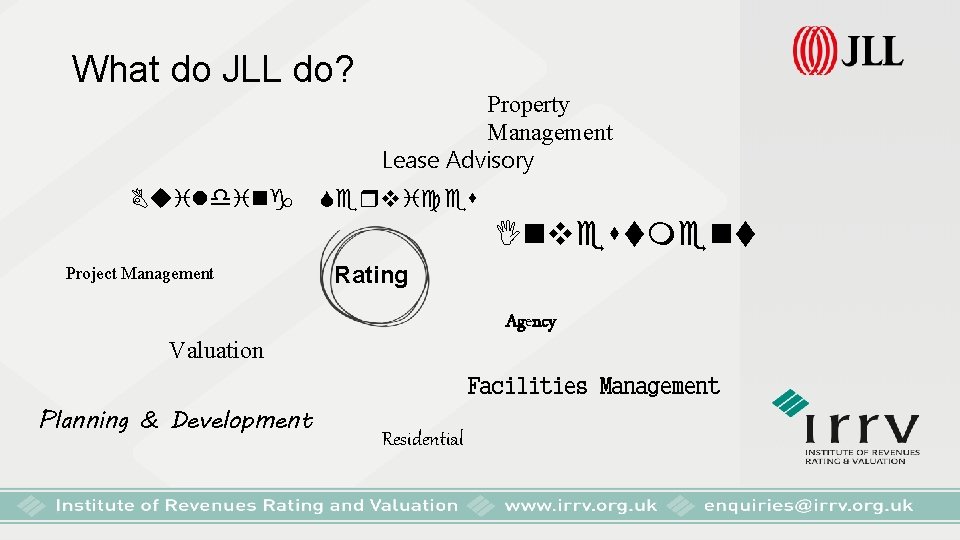
What do JLL do? Building Property Management Lease Advisory Services Investment Project Management Rating Agency Valuation Facilities Management Planning & Development Residential
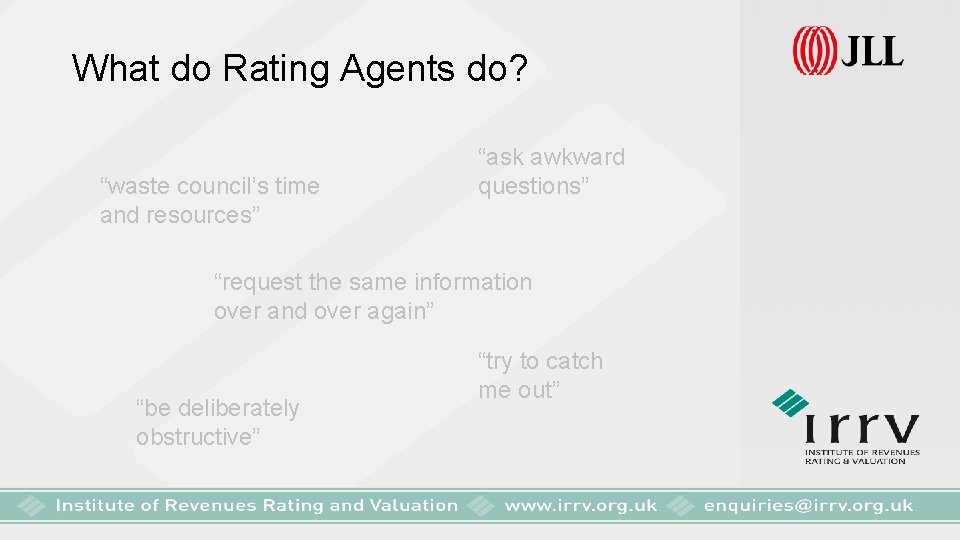
What do Rating Agents do? “waste council’s time and resources” “ask awkward questions” “request the same information over and over again” “be deliberately obstructive” “try to catch me out”
What do Rating Agents do? • Rates Liability Management • Rateable Value Appeals / Check Challenge Appeal • Rates Audits • Other Rating Work
Rates Liability Management • Notify Councils when properties become occupied or empty • Receive rates demands on behalf of the client • Check that the demands received are correct: • • • ratepayers name – correct legal entity dates of liability are correct empty relief (3 months / 6 months / land / listed building) transitional relief instalments provided • Arrange payment of correct bills • Investigate any recovery documents received: • • • client not liable? non-payment? allocation problem by council?
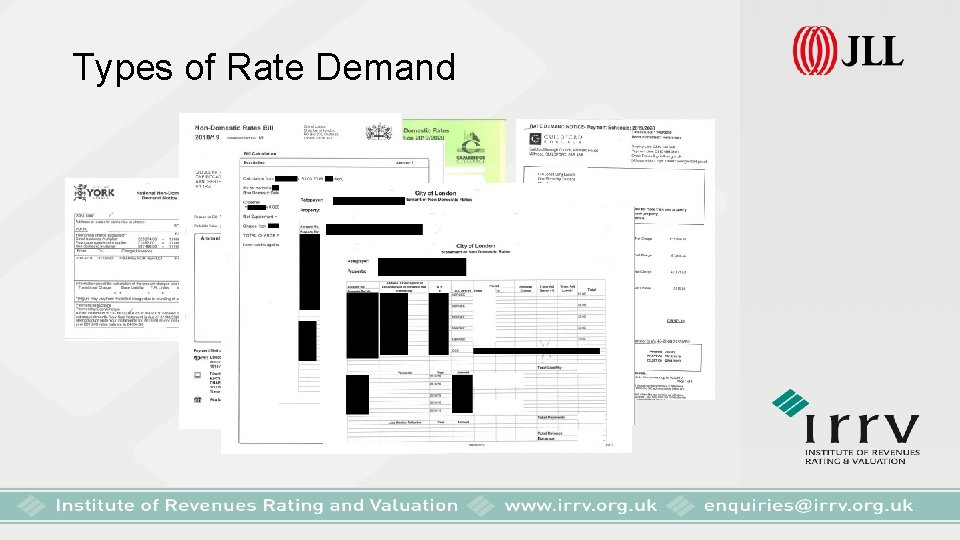
Types of Rate Demand
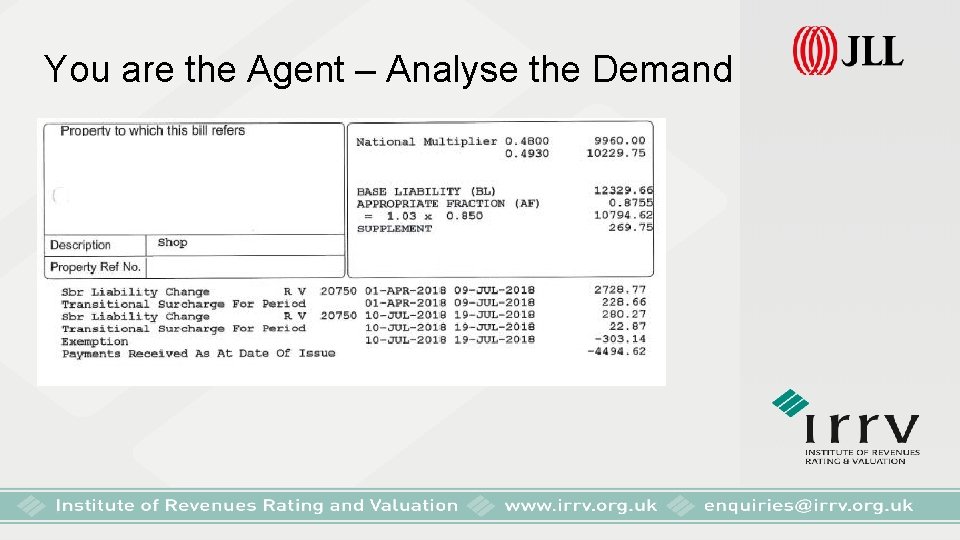
You are the Agent – Analyse the Demand
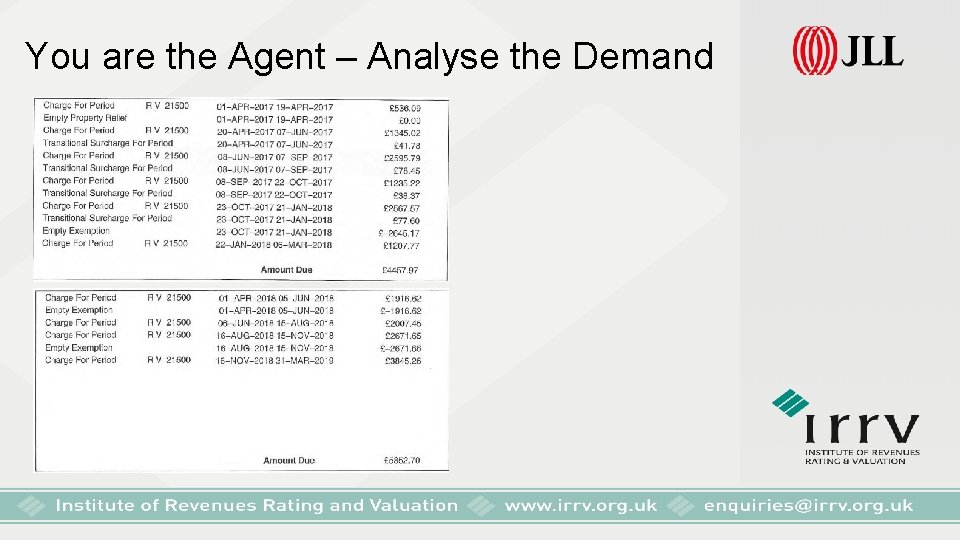
You are the Agent – Analyse the Demand
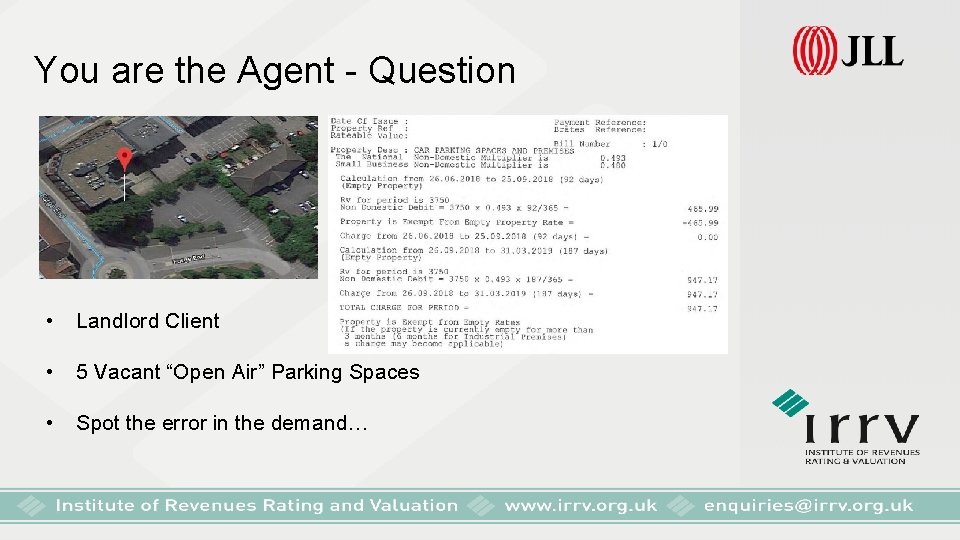
You are the Agent - Question • Landlord Client • 5 Vacant “Open Air” Parking Spaces • Spot the error in the demand…
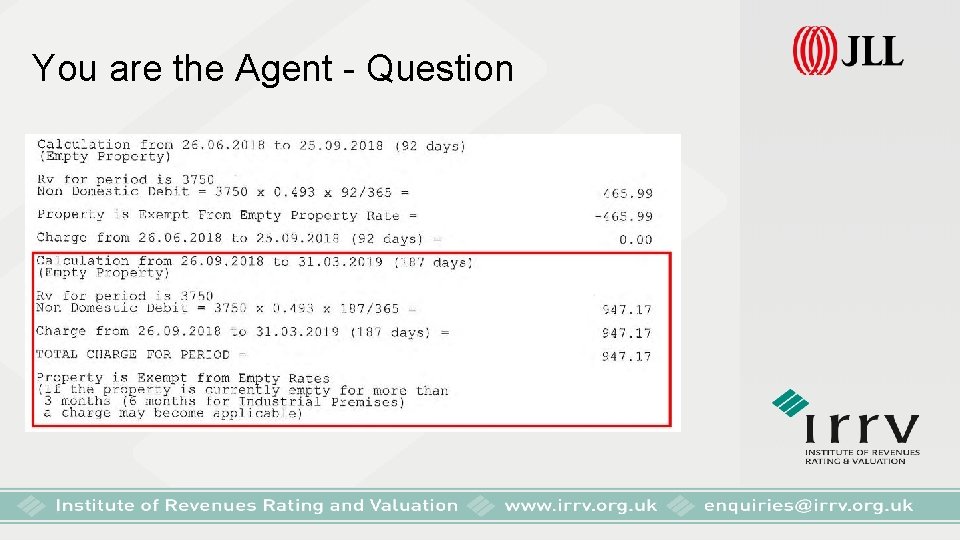
You are the Agent - Question
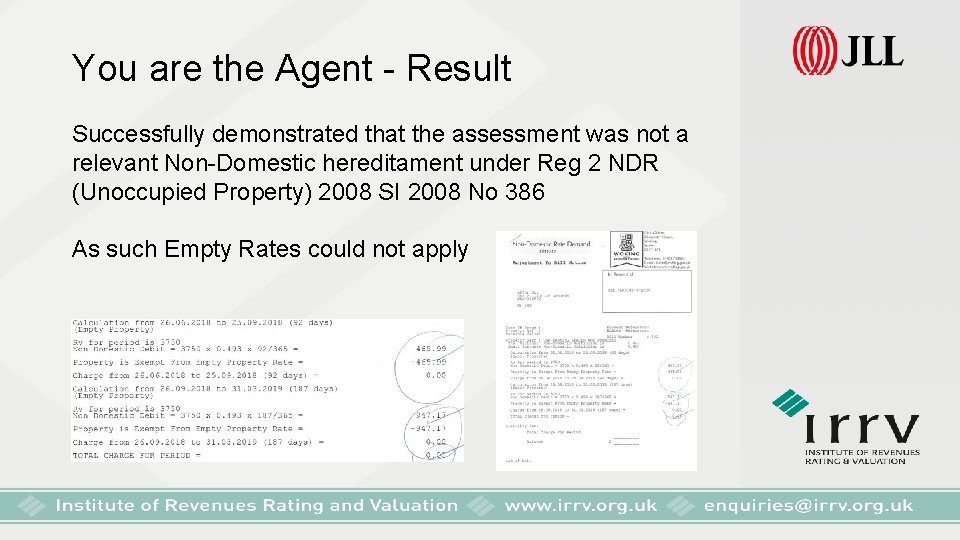
You are the Agent - Result Successfully demonstrated that the assessment was not a relevant Non-Domestic hereditament under Reg 2 NDR (Unoccupied Property) 2008 SI 2008 No 386 As such Empty Rates could not apply

Rateable Value Appeals / Check Challenge Appeal • This is work relating to the Rateable Value of a hereditament and is undertaken with the Valuation Office Agency • Common types of CCA that we submit relate to: • • • hereditaments undergoing refurbishment / ‘Monk’ cases Material Changes in Circumstance (MCC) hereditaments ‘beyond economic repair’ appeals against the ‘tone’ of valuation In general, Rating Agents seem to agree the principles behind CCA are a much needed improvement however the way that CCA has been implemented leaves much to be desired

You are the Agent - Question • A client approaches you following a fire at an industrial property they own. • Following the site being cleared of debris they are left with this… • What do you advise?
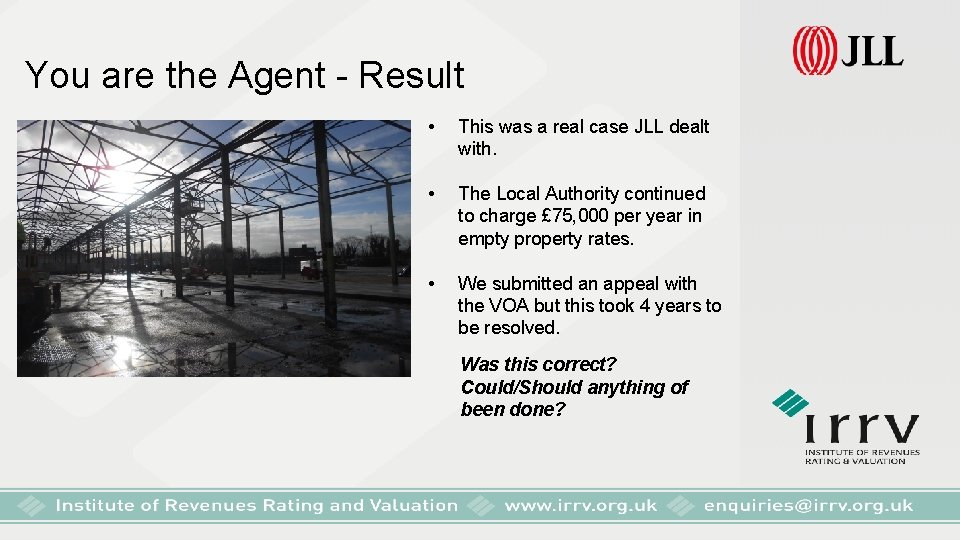
You are the Agent - Result • This was a real case JLL dealt with. • The Local Authority continued to charge £ 75, 000 per year in empty property rates. • We submitted an appeal with the VOA but this took 4 years to be resolved. Was this correct? Could/Should anything of been done?
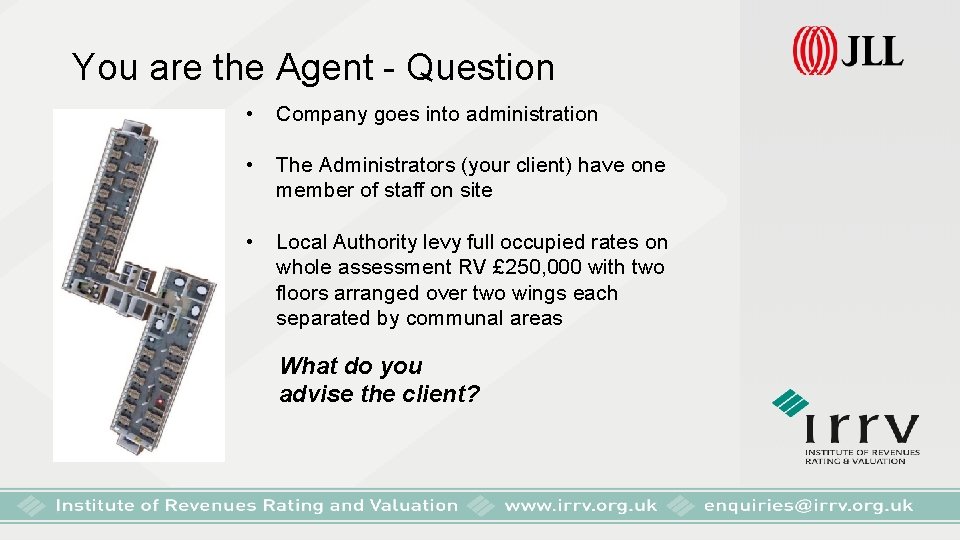
You are the Agent - Question • Company goes into administration • The Administrators (your client) have one member of staff on site • Local Authority levy full occupied rates on whole assessment RV £ 250, 000 with two floors arranged over two wings each separated by communal areas What do you advise the client?
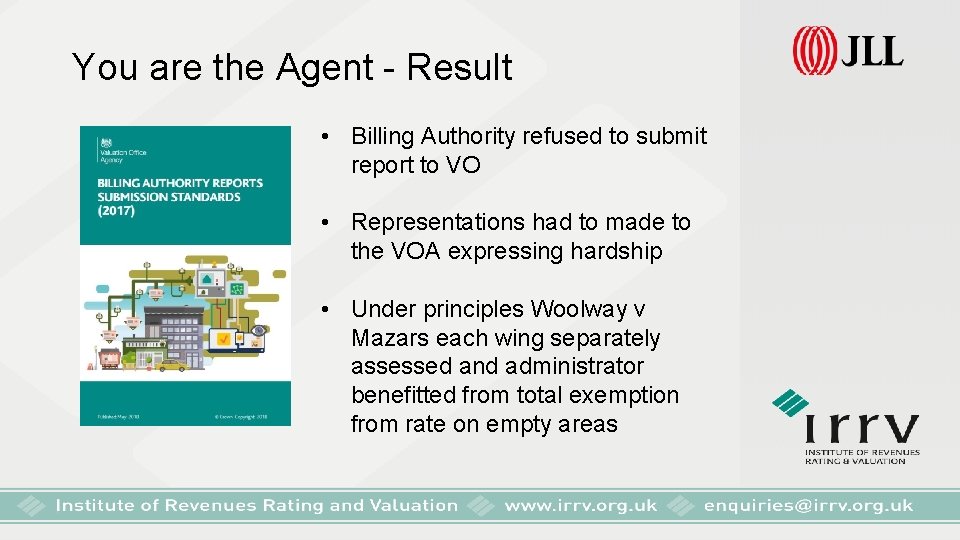
You are the Agent - Result • Billing Authority refused to submit report to VO • Representations had to made to the VOA expressing hardship • Under principles Woolway v Mazars each wing separately assessed and administrator benefitted from total exemption from rate on empty areas
Rates Audit • If an agent is newly instructed by a client then they may suggest they complete a Rates Audit. • We use this as an opportunity to review what has: • historically been paid • whether any exemptions or reliefs have been claimed • check whether any overpayments have been made or refunds unclaimed • We try and get as much information regarding this from clients however there are occasions when we rely on Local Authorities assistance. • Some of the time we are able to find the answers to our questions by using Local Authority’s ‘Opendata’.
Rates Audit • Who knows if their Local Authority publishes Opendata? • What information is included? • • list of non-individual ratepayers? list of credits? list of empty properties? List of small properties without SBRR? • Some authorities publish all this information other refuse to publish any • Next stop Information Commissioner’s Office (ICO)?

Other Rating Work • Rates Mitigation Advice • Completion Notices • Localism and New Developments • Estimated RVs for New Developments/Redevelopments • Continuous Professional Development Sessions for Clients and Colleagues

Any Questions? Thank you all… John Williams Associate - Rating JLL One Piccadilly Gardens, Manchester M 1 1 RG T +44 (0)161 828 6475 M +44 (0)7525 911934 John. Williams@eu. jll. com jll. co. uk


Business Rates Seminar Billing and Recovery Peter Haywood IRRV (Tech) MBA Account Manager – Destin Solutions
Multipliers • LGFA 1988 Schedule 7 • Two multipliers – SBR & Non-Domestic • From April 2018 the SBR multiplier has changed annually in line with the Consumer Price Index. Prior to April 2018 the multiplier changed in line with the Retail Price Index (which is usually a higher measure of inflation) • May be adjusted by Secretary of State • Must be expressed to 3 decimal places only • 2019/20 multiplier is 0. 491 (0. 480 in 18/19) – 49. 1 p in the £ • 2019/20 supplement set at 1. 3 p • Non-Domestic multiplier 2019/20 is 0. 504 – 50. 4 p in £ 94
Which Multiplier to Use SBR Multiplier • Occupied charges where RV of hereditament is below £ 51, 000 • SBR multiplier still used even if occupier doesn’t qualify for small business relief Non-Domestic Multiplier • Occupied charges with RV £ 51, 000 and above • Any empty charges 95
Billing • The Non-Domestic Rating (Collection and Enforcement) (Local Lists) Regulations 1989 SI 1058 • Liability to pay rates only arises once a demand notice has been issued by the Billing Authority (BA) • Regulation 5 (1) - Will be served as soon as practicable after multiplier determined but not before BA has set its council tax. • Encon Insulation (Nottingham) Ltd v Nottingham City Council (QBD) 1999 • BA failed to identify empty property was occupied until 1997/8 and issued back-dated demand to 1 April 1990 • BA found not to have investigated adequately (not visited) • Demand notices not served “as soon as practicable in the relevant year” • BA had failed in its statutory duty and rates to 31 March 1997 not payable 96
Demand Notices • Regulation 4 • BA required to serve demand notice each year • Different demand notices must be served for different financial years • Issued at least 14 days before first instalment due • Must specify the day in each month instalments are to be paid • No payment need be made unless a demand notice has been served • Digital and Online Billing – DCLG expect councils to have implemented or be moving towards this 97
Instalments Regulation 7 and Schedule 1 TWO alternative instalment schemes for payment of non domestic rates. • the Statutory Instalment Scheme i. e. monthly instalments or, • by agreement with the ratepayer 98
Statutory Scheme • 10 monthly instalments - first instalment at least 14 days after issue of demand notice • 10 monthly instalments where the demand notice is issued on or before 30 th April of the relevant year in question. • Issued between the 1 st May but before the 31 st December, the number of instalments applicable will be the number of WHOLE MONTHS LESS ONE. • Issued between the 1 st January and the 31 st March, the whole amount is payable in a SINGLE instalment on a day at least 14 days after the issue of the notice. • From April 2014 businesses can opt to pay over 12 months • Notice issued after 15 April number of instalments = number whole months left in year • Where a demand notice is issued after the end of the relevant year in question, there is NO ENTITLEMENT to instalments. Any amount due can be demanded in full 14 days after the issue of the notice. 99
Instalment Amounts • Divide amount payable by the number of instalments and rounding to the nearest "£ 1" • If required, the FIRST instalment is adjusted so that the amount demanded equals the amount due • If the calculation results in amounts ending in "50 p", all but ONE of the instalments could be rounded UP in this instance. • Where instalments would be LESS than £ 50 and whole amount due LESS than £ 100 the BA may request payment in a single instalment • If instalment LESS that £ 50 but whole amount due MORE THAN £ 100 number of instalments = amount due divided by £ 50 (whole £ 50’s only). 10 0
Payment By Agreement • Regulation 7 • A BA can agree a different payment arrangement to those covered by statutory scheme e. g. by allowing yearly, half yearly, quarterly payments etc. • Details of the anticipated payments should be clearly detailed on the demand notice, or adjustment notice (whichever is applicable). • Payment agreements are NOT subject to the statutory enforcement procedures (Regulation 8 & 11, C & E Regulations 1989 S. I 1058). • They should also be advised of enforcement action that will be taken by the B. A in the event of non-payment. 10 1
Joint & Several Liability • Exists where there is more than one owner or occupier of a hereditament • Demand notice may be served severally to each of any of the owners/occupiers concerned; or • Where owners/occupiers concerned are j/s liable as partners or trustees, jointly to the partnership or trust, a single notice can be given • If notice is given “severally” the BA must notify that fact to each person 10 2
Changes in Liability • Regulation 9 • If liability ends during the year a further demand notice must be issued showing the actual charges due to the date of vacation • Payable in full at least 14 days after issue of the notice. • If demand notice is issued after the end of the year to which it relates, full payment of the amount outstanding (less any credits or reliefs) is due in full any time 14 days after the notice is issued. • No right to withhold any payments due whilst awaiting an amendment to liability as a result of a change of circumstances. • Any resulting overpayment must either be refunded to the ratepayer, if requested, or if no request made the BA may credit the monies against a subsequent liability. 10 3
Adjustment Notices • Change of circumstance in the relevant year other than as a result of a vacation, the ratepayer will be notified of the amended estimated charge by the issue of an "ADJUSTMENT NOTICE“. • Where adjustment changes amount payable, and there is still a right to instalments, the remaining instalments should be amended accordingly. • Where no entitlement to instalments or only one instalment due and there is an increase in monies due, the increase from the original sum can be demanded in full any time 14 days after the notice has been issued. • Where there is a decrease the notice need only advise of the amended amount due immediately. • Where adjustment results in an overpayment, a notice must be issued advising of the credit and it should either be refunded if requested by the ratepayer, or it can be offset against future liability. 10 4
Contents of Demand Notices MUST INCLUDE: • • Address and description of the hereditament to which the notice relates the rateable value of each hereditament. the non domestic multipliers for the relevant year. a statement of the type of charge levied (whether occupied or unoccupied). • a statement of the days, if any, for which the ratepayer is eligible for any reliefs together with a statement of how the bill has been calculated. • Explanatory Notes must be provided online • Amounts due must still be paid even if demand notice invalid due to mistakenly missing any prescribed information 10 5
Non-Domestic Rating (Electronic Communications) (England) Order 2012 (SI 25) • The additional information will be treated as ‘supplied’ to a ratepayer where the billing authority makes that information available via a website and informs the ratepayers of how the information can be accessed i. e. in the explanatory notes which accompany bills; • authorities that choose to supply the additional information in this way must inform ratepayers that they can request a hardcopy of this information and; • must provide ratepayers with a hardcopy if so requested 10 6
Service of Demand Notices General Provisions - Section 233 of the Local Government Act 1972 Service may be effected by: • Handing the document to the person; • Leaving it at his proper address (person ‘s last known address or corporate body its registered or principal office) • In the case of a corporate body, by giving it to, or serving it on, the secretary or clerk to that body or, • In the case of a partnership, by giving it to, or serving it on, a partner or a person having control or management of the partnership business • Section 7 of the Interpretation Act 1978 provides that "proof of service by post is deemed to be taken as proof of delivery“. Therefore a bill is taken to be issued when it is posted, not received. • High Court Practice Directive – 1 st class post deemed to be delivered on second working day after posting and 2 nd class fourth working day. Specifically relates to High Court documents but generally accepted for all. 10 7
Service of Demand Notices Electronically • A demand notice may be served by electronic communication on a ratepayer who has agreed to accept electronic service • By email • Published on a website (if ratepayer notified it is there) • Notices shall be treated as served on the second business day after it was sent by e-mail or notification of its publication was given • A person may by notice in writing to the billing authority amend the address notifications are sent to or withdraw that notification to receive e-billing. • The regs do not give a ratepayer the right to have their demand notice served electronically, nor compel local authorities to use this method of service. They enable the BA to use electronic delivery for service, if it wants to, where the taxpayer has agreed and provided an e-mail address for that purpose. 10 8
The Further Notice Regulation 8 sets out the procedure to be followed when a liable person fails to make an instalment payment: • The BA shall serve a “FURTHER NOTICE“ (reminder) stating the instalments to be paid on the liable person(s) any time after an instalment falls due • The notice must state the aggregate amount of unpaid instalments • Arrears must be paid within 14 days • If the overdue instalments are paid the instalment scheme continues • If there is subsequent default a “REMINDER NOTICE” is issued under regulation 11 SI 1989/1058 requesting payment in full of the estimated amount. 10 9
The Reminder Notice Before applying for a Liability Order the BA must have issued a REMINDER NOTICE (final notice) stating the amount due. • No such notice is required if a FURTHER NOTICE has been issued in respect of the amount, which remains unpaid So a reminder notice need only be served when: • There is no right to instalments; or • A further notice has been issued and this is the second occasion an instalment has not been paid; or • All instalments have fallen due 11 0
The Liability Order Complaint Regulation 12 • If further and/or reminder notice has been issued, and all or some of the account remains unpaid, a BA may apply to the magistrates court for a liability order. • Must be commenced within 6 YEARS of the date of the first instalment falling due. • Commenced by laying a complaint at the Magistrates Court identifying the debtor's name and address, the period of liability, and the estimated, or actual amount that is payable but which has not been paid. • Requests that a summons be issued requiring the debtors appearance at court to give good reason why a liability order should not be granted to the BA. • Summons must be served at least 14 days before the hearing 11 1
The Liability Order Complaint • The Court of Protection, Civil Proceedings and Magistrates’ Courts Fees (Amendment) Order 2018 • Came into effect from July 2018 and provided that the Magistrates Court can charge the B. A a fee of £ 0. 50 for each application placed before them requesting a summons be issued. • Once satisfied that a summons can be issued, it should be properly signed by a Justice of the Peace, although Rule 3(3) of the Justices Clerks Rules 1970 S. I 231 provides that any summons may also be signed by a magistrates clerk. • The use of facsimile rubber stamps and digitised signatures is commonplace in most B. A's today and the validity of using them has been well tested in the higher courts, and has been deemed to be valid (R v Brentford Justices ex parte Catlin (1975) 11 2
The Summons The form and content of the summons is not prescribed regulations, but its layout should be agreed with the Magistrates' court clerk. Any summons should state: • Ratepayer’s name (or all names for J & S liability). • Address at which summons served. • Period of liability. • The address at which the liability has arisen if different from the one at which the summons served. • The address of the court. • Time and date of hearing. • Rate outstanding. • Costs. • Signature of the person receiving the complaint 11 3
Service of the Summons Under Regulation 13 a summons may be served on a person by: • Delivering it in person. • Leaving it at his usual or last known place of abode, or if a company, at its registered office. • Sending it by post to his usual or last known place of abode, or if a company, at its registered office. • Leaving at or sending by post to an address given by the person at which service will be accepted. • S 7 Interpretation Act 1978 - Proof of posting is proof of delivery • R v Liverpool CC ex parte Greaves (1979) - Summons not received is not a defence. General • If summons is returned to the BA the summons is deemed as NOT being served and the BA should not proceed with L/O application. • If an amount equal to the rate plus any costs is paid in full prior to the L/O hearing, the BA must accept payment and stop proceedings. • If payment excludes costs a L/O can be requested for the costs only. 11 4
The Hearing • PURPOSE – For the BA to satisfy the Justices that the amount is payable by the debtor and has not been paid. • At least 2 Justices or a District Judge must be present to hear case. • Section 223, LGA 1972 enables a B. A to authorise any officer by resolution to prosecute, attend or appear on its behalf in proceedings before a Magistrates' court. • A copy of this authorisation (relevant minute of the appropriate council meeting) should be available for inspection at all times. If it is not the original minute, the copy should be certified either under Section 41 of the Local Government Act 1976, or by a proper officer of the B. A under Section 229 of the LGA 1972. • The BA will be required to give evidence under oath to satisfy the court that it has properly set the charge, followed correct procedure and to confirm that the debtor has not paid. 11 5
Proof of Liability • An entry appears in the local rating list • Sum has been duly demanded i. e. demand notices have been issued in accordance with regulations • There has been a Failure To Pay • Further/Reminder Notices • The statutory time limits have elapsed • Balance including costs not paid or that the outstanding balance has been paid but not the costs • Complaint correctly made • Summons Issued 11 6
Magistrates Responsibility • Providing the B. A can show that the amount outstanding has been duly demanded and remains unpaid, the burden of proof to justify why a liability order should not be granted rests with the debtor. This is supported by the case; Des Salles D'Epinoix v Kensington & Chelsea LBC (1969). • The Magistrates do not have the power to REMIT the tax at this stage (Hackney LBC v Izbedski (1988), consider an individual’s personal financial circumstances for not paying, or instruct the B. A to take a certain type of enforcement action. • However, they do have the power to refuse to grant costs requested, or adjourn cases for further information. It should be stressed that the decision whether to adjourn MUST be taken by the clerk or the court, and NOT the B. A who should consider each request on its individual merits. 11 7
Valid Defences 11 8 Case law or Statutory Provision: • Procedures Invalid • Officer not authorised • No further or reminder notice issued • Defective computer evidence • Rate not demanded or incorrectly demanded • Instalments not calculated correctly • Less than 14 days notice between the issue and first instalment • Rate not charged in accordance with the Rating List • More than 6 years have elapsed since becoming due • Insolvency action has commenced • An Administration Order has been made by a County Court • Person rated is not in occupation • Description in the list includes parts not occupied by the ratepayer • Mandatory entitlement to relief
Not Valid Defences • • • A completion notice is incorrect Inability to Pay RV in the list is wrong VOA Appeal Outstanding Hackney LBC v Mott and Fairman (1994) – High Court confirmed magistrates court had no jurisdiction to determine validity of a rating list entry and that dispute of validity not a defence against enforcement Failure to Attend • Where a debtor fails to attend a hearing and makes no other valid representations the BA may apply for the L/O to be granted in their absence. 11 9

Any Questions?
Introduction to Business Rates Enforcing a Liability Order Paul Kelly FIRRV
Agenda Introduction Legislation Which Court? Enforcing the Judgment; or Enforcing the Liability Order
Introduction Current Climate; Empty Rates Avoidance; Importance of collecting Business Rates; Business Rates Retention.

Primary Legislation Local Government Finance Act 1988 Non-Domestic Rates Local Government Act 2003 Part 4 Business Improvement Districts Part 5 NNDR including SBR Rating (Empty Property) Act 2007 Major changes to EPR Abolished 100% open ended exemption of Industrial Premises 100% charges after exempt periods Local Government Finance Act 2012 Business Rates Retention Information sharing with HMRC!!!
Primary Legislation 2 Human Rights Act 1988 Article 6 – Everyone is entitled to a fair and public hearing within a reasonable timescale Summons served at least 14 days prior to hearing Be careful to make it clear to debtors interviewed at Court that they have a right to go before the Magistrates Tribunals, Courts and Enforcement Act 2007 Part 3 – Taking Control of Goods Schedule 12
Secondary Legislation Non-Domestic Rating (Collection and Enforcement) (Local Lists) Regulations 1989 (SI. 1989/1058) as amended • Billing, • Collection and • Enforcement Taking Control of Goods Regulations 2013 (SI. 2013/1984) The Process. (Compliance; Enforcement; and Sale) Taking Control of Goods (Fees) Regulations 2014 (SI. 2014/1) The Statutory Fees.
Policies and Codes of Practice • Covering the Statutory Process • Cover any discretions such as withdrawing costs or arrangements • Make clear the Process • In what circumstances - County Court or Magistrates Court • Make clear duty on Council to collect debt • Local Government Act 1999 - Best Value & Continuous Improvement • Vulnerable cases and management of such cases • Taking Control of Goods : National Standards • Corporate Debt Policy identifying which debts have priority. • Anti-Poverty Strategy
Court of Competent Jurisdiction Regulation 20 Non-Domestic Rating (Collection and Enforcement) (Local Lists) Regulations 1989 Provides the County Court (or High Court) as an alternative to Magistrates Court. Obtain a judgment not a Liability Order Cost of making claim is higher than Magistrates Court Potential to claim and charge interest (at 8%) May lead to an actual attendance and involve a hearing: <£ 10, 000 County Court; > £ 10, 000 High Court Advantage of Additional Remedies Cost of using Enforcement Remedies
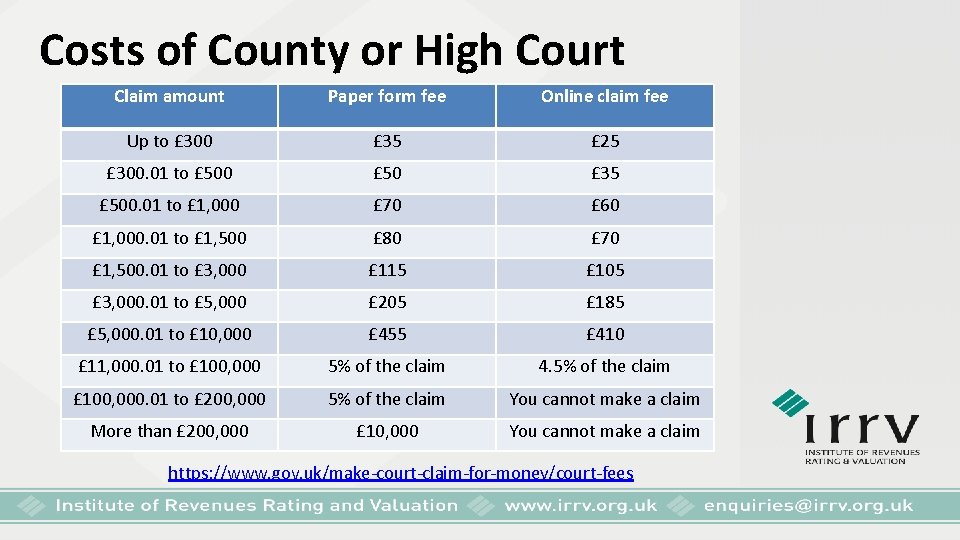
Costs of County or High Court Claim amount Paper form fee Online claim fee Up to £ 300 £ 35 £ 25 £ 300. 01 to £ 500 £ 50 £ 35 £ 500. 01 to £ 1, 000 £ 70 £ 60 £ 1, 000. 01 to £ 1, 500 £ 80 £ 70 £ 1, 500. 01 to £ 3, 000 £ 115 £ 105 £ 3, 000. 01 to £ 5, 000 £ 205 £ 185 £ 5, 000. 01 to £ 10, 000 £ 455 £ 410 £ 11, 000. 01 to £ 100, 000 5% of the claim 4. 5% of the claim £ 100, 000. 01 to £ 200, 000 5% of the claim You cannot make a claim More than £ 200, 000 £ 10, 000 You cannot make a claim https: //www. gov. uk/make-court-claim-for-money/court-fees
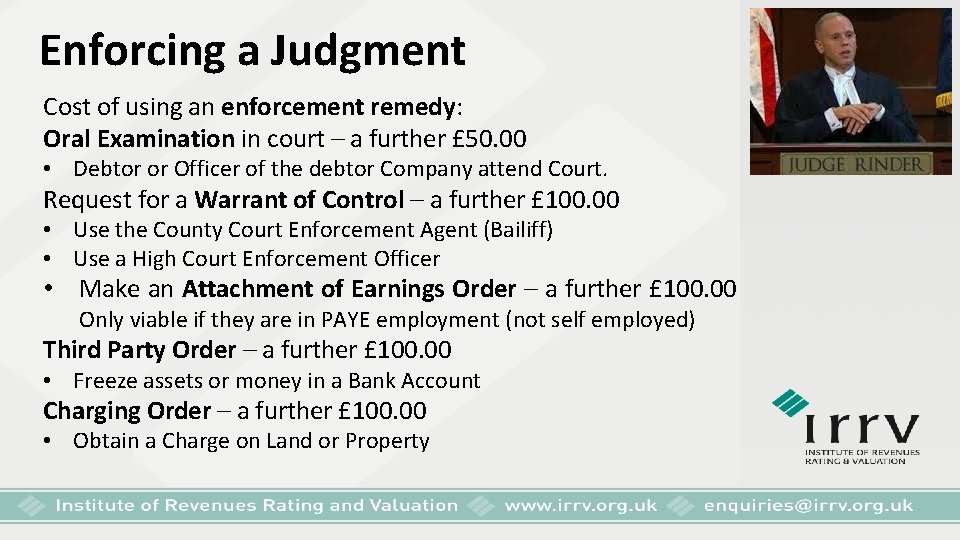
Enforcing a Judgment Cost of using an enforcement remedy: Oral Examination in court – a further £ 50. 00 • Debtor or Officer of the debtor Company attend Court. Request for a Warrant of Control – a further £ 100. 00 • Use the County Court Enforcement Agent (Bailiff) • Use a High Court Enforcement Officer • Make an Attachment of Earnings Order – a further £ 100. 00 Only viable if they are in PAYE employment (not self employed) Third Party Order – a further £ 100. 00 • Freeze assets or money in a Bank Account Charging Order – a further £ 100. 00 • Obtain a Charge on Land or Property
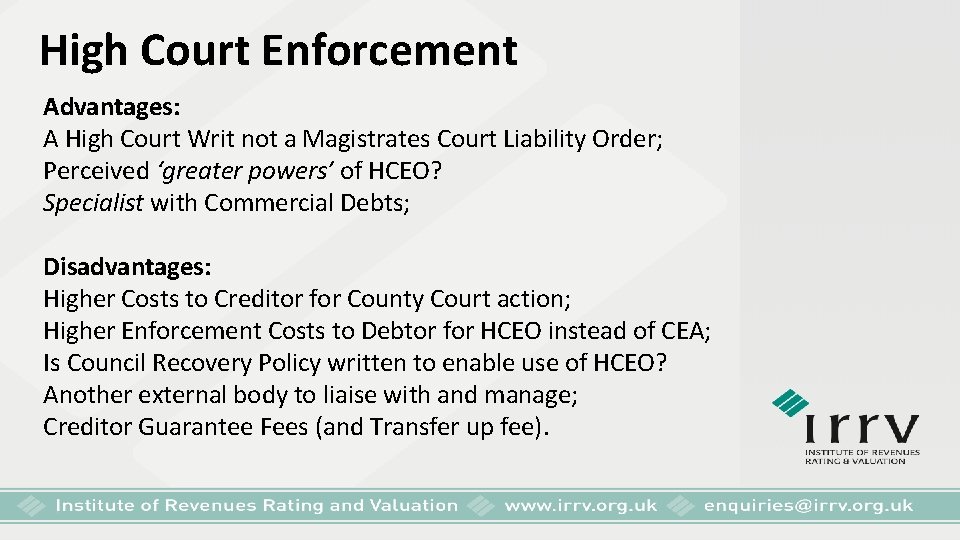
High Court Enforcement Advantages: A High Court Writ not a Magistrates Court Liability Order; Perceived ‘greater powers’ of HCEO? Specialist with Commercial Debts; Disadvantages: Higher Costs to Creditor for County Court action; Higher Enforcement Costs to Debtor for HCEO instead of CEA; Is Council Recovery Policy written to enable use of HCEO? Another external body to liaise with and manage; Creditor Guarantee Fees (and Transfer up fee).
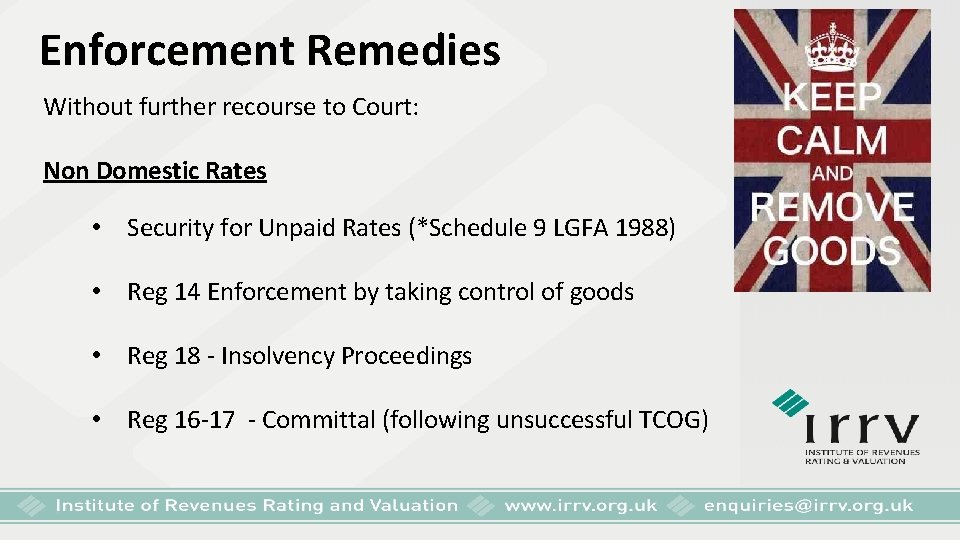
Enforcement Remedies Without further recourse to Court: Non Domestic Rates • Security for Unpaid Rates (*Schedule 9 LGFA 1988) • Reg 14 Enforcement by taking control of goods • Reg 18 - Insolvency Proceedings • Reg 16 -17 - Committal (following unsuccessful TCOG)
Security for Unpaid Rates Schedule 9 LGFA 1988 as amended by Sch 5 LG & Housing Act 1989 Reg 5 - The Non-Domestic Rating (Collection and Enforcement) (Local Lists) (Amendment and Miscellaneous Provision) Regulations 1991 Security for Unpaid Non Domestic Rates – Charge on Property The Billing Authority and a person liable to pay rates in respect of an occupied or unoccupied property may enter into an agreement that: a) Any interest that person has in the property is made subject to a charge to secure payment; and b) Whilst the charge remains, the authority will not take steps, for a specified period, to recover any payment in respect of the amount concerned. An agreement of this kind can only be made for a maximum of three (3) years. It may be extended if further amounts become due and it may also provide for the payment of interest on outstanding sums and for that interest to also be subject to a charge.
Taking Control of Goods LGFA 1988 Schedule 9 & Regulation 14 Distress - amended by: The Tribunals, Courts and Enforcement Act 2007 (Consequential, Transitional and Saving Provision) Order 2014 (SI 600/2014) “Where a liability order has been made, payment may be enforced by using the Schedule 12 procedure…” Schedule 3 – Charges Connected with Distress also amended by the Taking Control of Goods (Fees) Regulations 2014
Taking Control of Goods Regulations 2013 - (SI 1894) Published July 2013 set out the processes and procedures Compliance Stage Enforcement Stage Sale and Disposal Stage Provides details regarding Where, When and How a debt can be collected Incorporated best practice from the National Standards for Enforcement Agents; Clarity of Law for the ‘Modern Day’
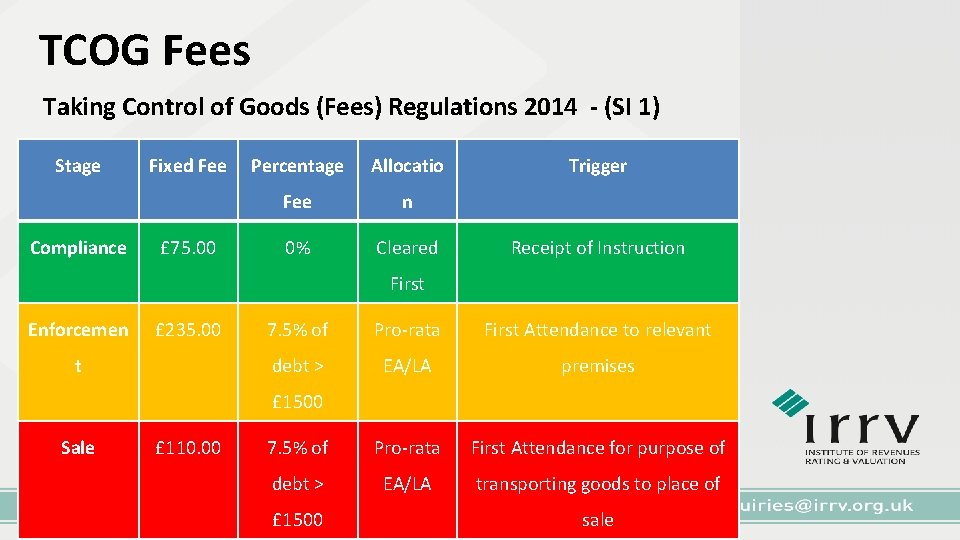
TCOG Fees Taking Control of Goods (Fees) Regulations 2014 - (SI 1) Stage Compliance Fixed Fee £ 75. 00 Percentage Allocatio Fee n 0% Cleared Trigger Receipt of Instruction First Enforcemen £ 235. 00 t 7. 5% of Pro-rata First Attendance to relevant debt > EA/LA premises 7. 5% of Pro-rata First Attendance for purpose of debt > EA/LA transporting goods to place of £ 1500 Sale £ 110. 00 £ 1500 sale
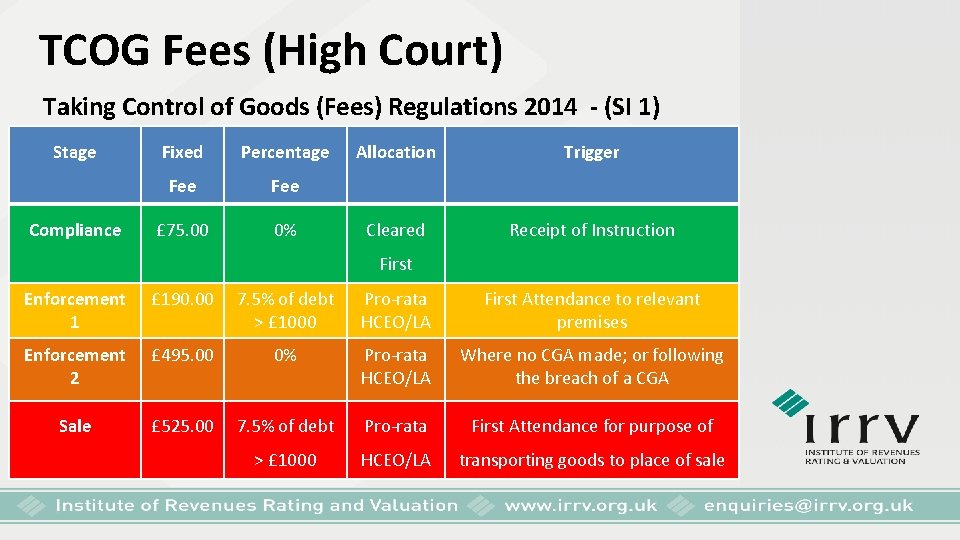
TCOG Fees (High Court) Taking Control of Goods (Fees) Regulations 2014 - (SI 1) Stage Compliance Fixed Percentage Fee £ 75. 00 0% Allocation Trigger Cleared Receipt of Instruction First Enforcement 1 £ 190. 00 7. 5% of debt > £ 1000 Pro-rata HCEO/LA First Attendance to relevant premises Enforcement 2 £ 495. 00 0% Pro-rata HCEO/LA Where no CGA made; or following the breach of a CGA Sale £ 525. 00 7. 5% of debt Pro-rata First Attendance for purpose of > £ 1000 HCEO/LA transporting goods to place of sale

Notice of Enforcement (NOE) - Must be given in writing; Prescribed Format: Name & Address; Reference No(s); Date of Notice; Details of LO/CCJ - enforcement power etc. ; Information about the debt: Amount of debt (plus interest if applicable); Costs incurred to date; Potential further costs. How and when to pay; Contact Tel No and Address; Opening Hours; Date by which payment must be made before progression to the next stage.
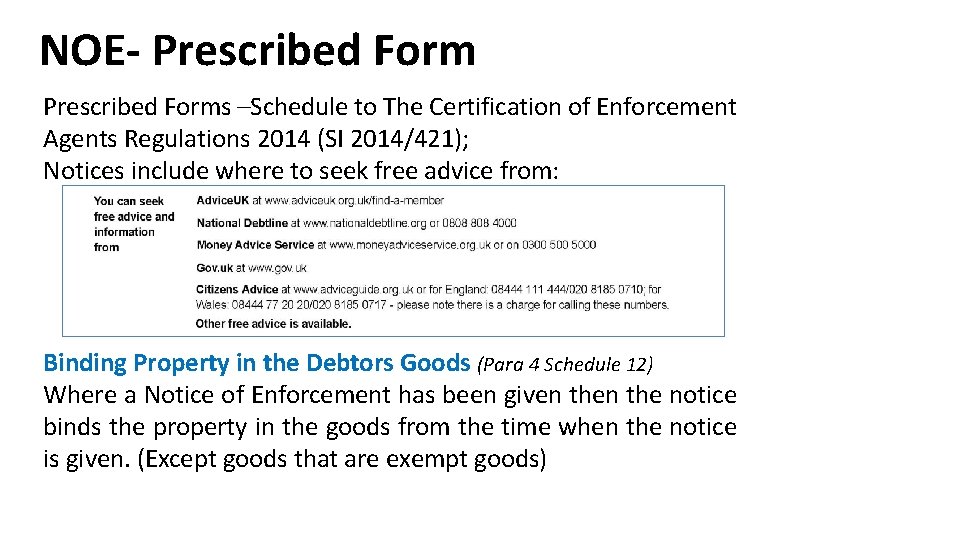
NOE- Prescribed Forms –Schedule to The Certification of Enforcement Agents Regulations 2014 (SI 2014/421); Notices include where to seek free advice from: Binding Property in the Debtors Goods (Para 4 Schedule 12) Where a Notice of Enforcement has been given the notice binds the property in the goods from the time when the notice is given. (Except goods that are exempt goods)
Minimum Period of Notice 7 Clear Days • Ignore Sundays • Bank Holiday • Good Friday or Christmas Day Court may order a shorter or no period of notice If the debtor may move or dispose of goods to defeat the process Application under the Part 84 Civil Procedure Rules http: //www. justice. gov. uk/courts/procedure-rules/civil/rules Regulation 6 of SI 2013/1894
Method of Giving Notice By Post addressed to the debtor at the place, or one of the places, where the debtor usually lives or carries on a trade or business; By Facsimile or other means of electronic communication; By delivery by hand through the letter box of the place, or one of the places, where the debtor usually lives or carries on a trade or business; Where the debtor is not an individual (but is, for example, a company, corporation or partnership), by delivering the notice to: • the place, or one of the places, where the debtor carries on a trade or business; or • the registered office of the company or partnership. Notice must be given by the enforcement agent or the enforcement agent’s office.

How Long is Compliance? Purpose of the regulations was to encourage flexibility and to empower the creditor in having involvement. Different debt types and levels of debt may lead to different agreements and guidelines between Creditor and Enforcement Agent FAST TRACK - Most authorities insist on the minimum 7 Clear Days following the Notice of Enforcement until a case progresses to Enforcement Stage. Business Rates Retention: most Councils are doing more proactive calling prior to obtaining a Liability Order. Exceptions for smaller business or closed liabilities…. . extended compliance schemes.
Time Limits 12 months beginning with the date of the giving notice of the Enforcement Notice; or 12 months after the breach of any arrangement May apply to the Courts for an extension (CPR Rules) *Applies to the ‘Warrant of Control’ (not the Liability Order) Regulation 9 – SI 2013/1984

How to take control There are four ways of taking control of goods • Securing goods on relevant premises; • Securing goods on a highway; • Removing the goods for sale or disposal; • Enter into a controlled goods agreement. Schedule 12 - Paragraph 13
Where you can take control An enforcement agent may take control of goods on premises that he has the power to enter or on a highway. Relevant premises are where the enforcement agent reasonably believes that they are the place, or one of the places, where the debtor: Usually lives; or Carries on a trade or business Subject to the above, they may take control of goods in England Wales, provided they are not exempt
When you can take control/enter premises 7 days a week Between 6 am and 9 pm Exceptions: Trade or Business Premises where visits can take place any hours that they are open to conduct their trade Where the Enforcement Agent has commenced taking control of goods Regulation 12 - 13 and 21 -22 SI 2013/1894
When you cannot take control The Debtor is a child (under the age of 16) A child or vulnerable person (where more than one or a combination of both) is the only person present The goods are also premises in which a child or vulnerable person is the only person present. Where the item belongs to the debtor is in the hands of or being operated by any person at the time, the agent may not take such action if the action is likely to result in a breach of the peace Regulation 10 SI 2013/1894
Exempt Goods Full details of Exempt Goods are contained within Regulation 4 of the Taking Control of Goods Regulations 2013 Previous Exemptions listed still exist covering: • Tools of the Trade; • Basic Domestic Needs; etc. Some interesting amendments and additions
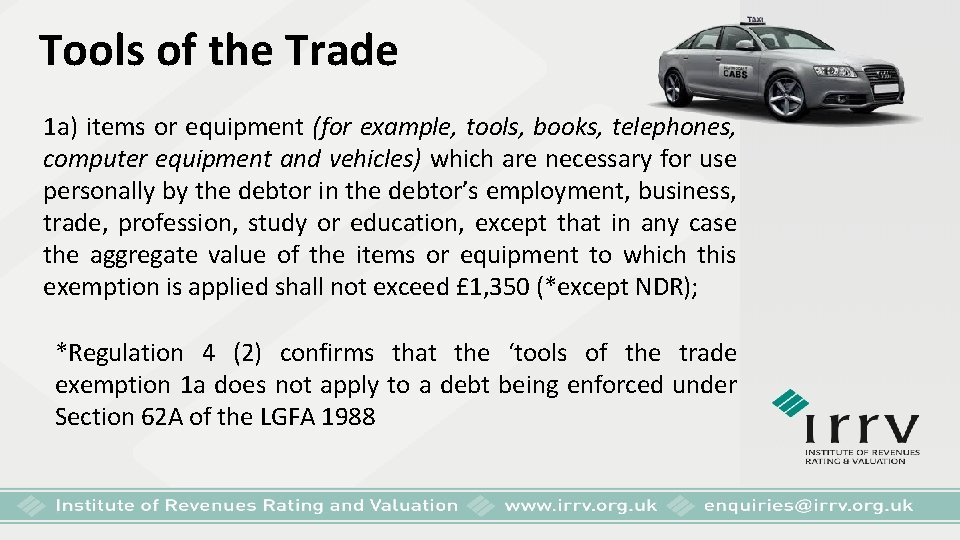
Tools of the Trade 1 a) items or equipment (for example, tools, books, telephones, computer equipment and vehicles) which are necessary for use personally by the debtor in the debtor’s employment, business, trade, profession, study or education, except that in any case the aggregate value of the items or equipment to which this exemption is applied shall not exceed £ 1, 350 (*except NDR); *Regulation 4 (2) confirms that the ‘tools of the trade exemption 1 a does not apply to a debt being enforced under Section 62 A of the LGFA 1988
Basic Domestic Needs 1 b) such clothing, bedding, furniture, household equipment, items and provisions as are reasonably required to satisfy the basic domestic needs of the debtor and every member of the debtor’s household, including (but not restricted to) — (i) a cooker or microwave; (ii) a refrigerator; (iii) a washing machine; (iv) a dining table large enough, and sufficient dining chairs, to seat the debtor and every member of the debtor’s household; ……………. .

Exempt Goods - Other Assistance dogs (including guide dogs, hearing dogs and dogs for disabled persons), sheep dogs, guard dogs or domestic pets; A vehicle on which a valid disabled person’s badge is displayed because it is used for, or in relation to which there are reasonable grounds for believing that it is used for, the carriage of a disabled person A vehicle (whether in public ownership or not) which is being used for, or in relation to which there are reasonable grounds for believing that it is used for, police, fire or ambulance purposes; and A vehicle displaying a valid British Medical Association badge or other health emergency badge because it is being used for, or in relation to which there are reasonable grounds for believing that it is used for, health emergency purposes.
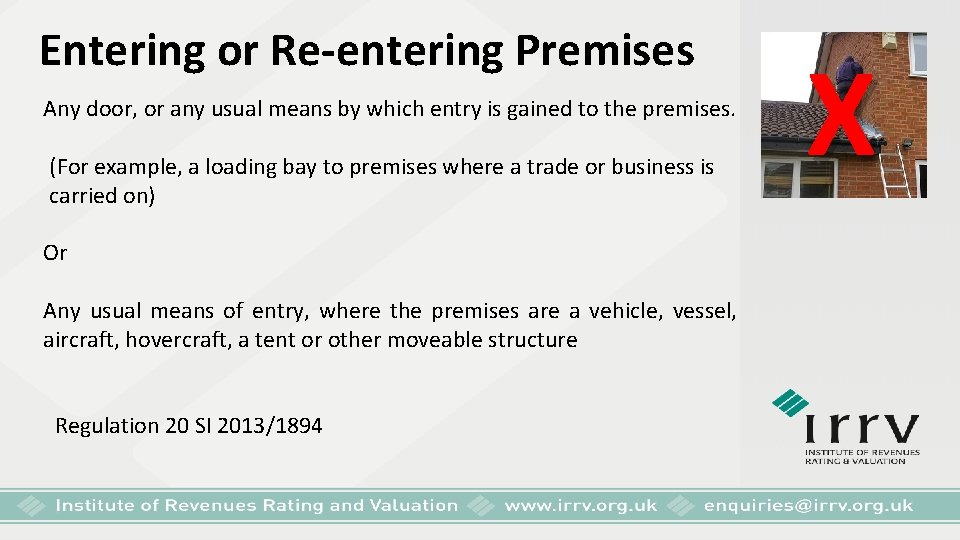
Entering or Re-entering Premises Any door, or any usual means by which entry is gained to the premises. (For example, a loading bay to premises where a trade or business is carried on) Or Any usual means of entry, where the premises are a vehicle, vessel, aircraft, hovercraft, a tent or other moveable structure Regulation 20 SI 2013/1894 X
Insolvency Proceedings Regulation 18 of the Non/-Domestic Rating (Collection and Enforcement) Regulations 1989 (SI 1989/1058) prescribe that: Where a liability order against an individual can petition for bankruptcy. Where a liability order has been made against a company, can commence winding up of companies by the court. Cost implications; Business Rates Retention Due Diligence is Key to Success!
Insolvency Partners Many firms (Insolvency Practitioners and Solicitors) willing to assist the Council (initially at no cost to the Council). Added Value: Insolvency Training (Free); Review of Top 10 NDR Non-Payers; Rates Avoidance ‘due diligence’ on alleged liable parties; Dormant Companies; ‘Patsies’ etc. Review of the Lease/License; Insolvency Act 1986 - S 238 – Transactions at an undervalue! Network and make useful contacts!
Committal Proceedings Regulation 16 of the Non/-Domestic Rating (Collection and Enforcement) Regulations 1989 (SI 1989/1058). • Must have attempted to ‘Take control of goods’; • Must be an individual; • Returned no goods or insufficient goods (Nulla Bona); • Wilful Refusal or Culpable Neglect must be proven; • Can be sent to prison for up to 3 months; • Cost of making the application £ 245. 00 (£ 5. 00 increase from April 2014)
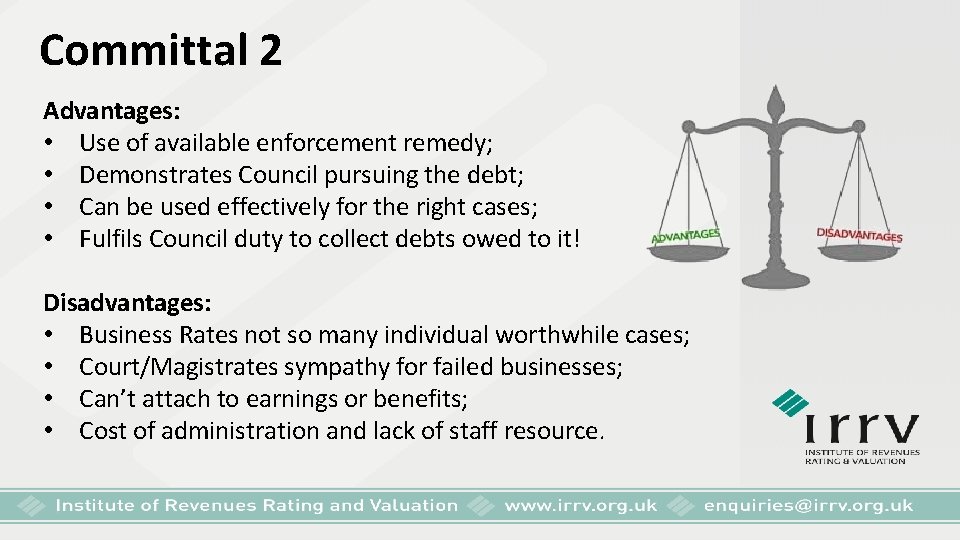
Committal 2 Advantages: • Use of available enforcement remedy; • Demonstrates Council pursuing the debt; • Can be used effectively for the right cases; • Fulfils Council duty to collect debts owed to it! Disadvantages: • Business Rates not so many individual worthwhile cases; • Court/Magistrates sympathy for failed businesses; • Can’t attach to earnings or benefits; • Cost of administration and lack of staff resource.

Questions? Email: pk@jacobsenforcement. com Tel: 0151 650 4988 Mob: 07973976813

Business Rates Avoidance & Collections Update Richard Kerr Lancashire & Cheshire IRRV Association
1. Update on current NDR avoidance schemes/cases 2. Liability / collection tips
MVL Schemes • Hurstwood cases • PAG 3 – Insolvency Service • Torbay challenge My Community Space • Ipswich case • Ceased trading? • Ongoing tenancies

PAPOA • Bolton & Birmingham appeals – Oct 19 • Ongoing disputes • New Chapter Limited Blue Tooth schemes • Reverse premiums/Principled • Review evidence of actual/beneficial/exclusive
UK VCP / Vericom Services • Lease and sub lease – recital re NDR mitigation • Vericom wound up by Swansea • Seeking IP appointment to investigate director misfeasance Store First • Main companies would up by insolvency service Apr 19 • VO split billing admin • Liability of trustees
Liability and Collection tips Occupied properties with serial Ltd Co tenants • Combined approach with EA/legal Serviced offices • Beware Laing & Kingswood v Contractual arrangements between the parties The Mc. Naughton tactic • The Energy Efficiency (Private Rented Sector)(E&W) Regs 2015 • Unlawful to let commercial properties with EPC rating of F or G Bankruptcy threshold issues? • S. 264 IA 1986 – 1 or more of creditors may present a petition
Liability and Collection tips LPA receivership • Will a liquidation sever the agency relationship with owner? S 27. Land Registration Act 2002 • Sale of freehold / lease of 7 years or more • Must be registered to be valid • Long lease – tenant gone? • Property sold Deceased accounts • Charging order and OFS (may require appointment of PR) • Insolvency Admin Order – claim on joint property transferred on survivorship? • Citation / creditor appointment of PR/executor
- Slides: 165