
Introduction to Business Economics 1 st of May

Introduction to Business Economics 1 st of May, 2021
Topics of this week • • What do economists study The problem with scarcity Consumption and production Branches of economics The circular flow of income Opportunity cost and rational choice 10 Principles of Economics
What do Economists Study? • Tackling the problem of scarcity • meaning of scarcity Scarcity is the excess of human wants over what can actually be produced. Example: resources, money Not every individual faces an equal problem of scarcity. • Two key elements of satisfying wants: Ø Production – how much to produce Ø Consumption – how sensitive consumer demand is to change in prices Time is the scarcity, and it's the commodity we can't create any more of. Jim Mitchell
Ceteris paribus • Is Latin for “all other things held constant” • In constructive models, economists make assumptions to eliminate unnecessary details to reduce the complexity of behaviour.
What do Economists Study? Role of the business economist • study of consumer behaviour • study of firms • factors of production • human resources – labour • natural resources – land raw materials • manufactured resources – capital Ø State of technology Business economists study the use of these resources by firms to meet consumer demand. Production therefore reduces the problem of scarcity related to consumption.
What do Economists Study? • Demand supply • actual and potential demand supply • the role of firms in satisfying demand • business economists’ study the role of firms in this process’ e. g. , Ø How they respond to demand Ø How to produce – input mix Ø How much to produce – majority of the firms are price taker
Dividing up the subject • Macroeconomics Ø Examines economy as a whole Ø Concerned with aggregate demand supply Ø Key macroeconomic variables? • Microeconomics Ø Study individual units: e. g. , households, firms and industries Ø Interrelationships btw these units in determining the pattern of production and distribution of goods and services. Economics is extremely useful as a form of employment for economists. John Kenneth Galbraith
Q Which one of the following is a microeconomic issue? A. The government spends more than it receives in tax revenue. B. House prices rise more rapidly. C. Unemployment rises. D. The Bank of England raises interest rates. E. Imports exceed exports.
Q Macroeconomics is a branch of economics which examines A. the economic behaviour of aggregates – income, employment, and output – on a national scale. B. the functioning of individual industries and the behaviour of individual decision-making units, that is, business firms and households. C. ways to understand behaviour and the operation of systems without making judgements. D. outcomes of economic behaviour, evaluates them as good or bad, and prescribes preferred courses of action.
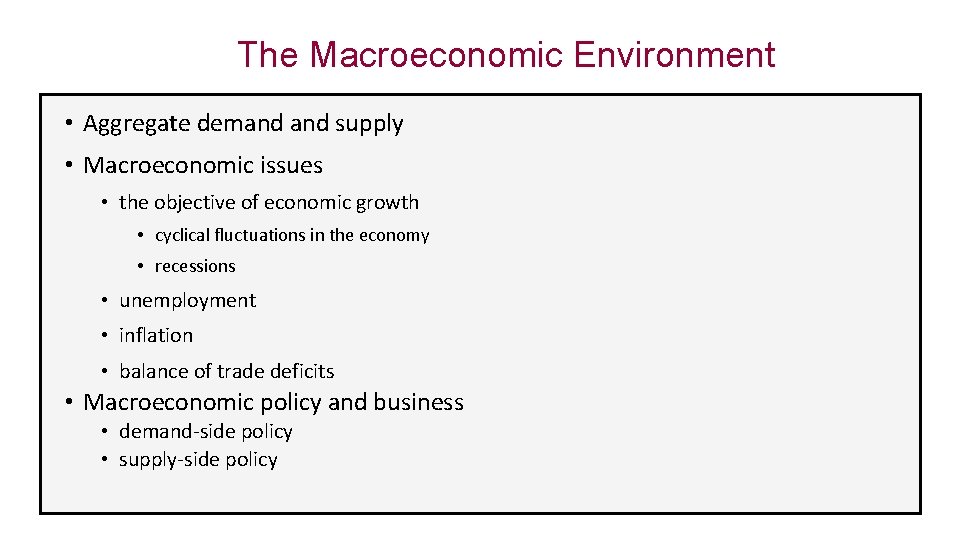
The Macroeconomic Environment • Aggregate demand supply • Macroeconomic issues • the objective of economic growth • cyclical fluctuations in the economy • recessions • unemployment • inflation • balance of trade deficits • Macroeconomic policy and business • demand-side policy • supply-side policy
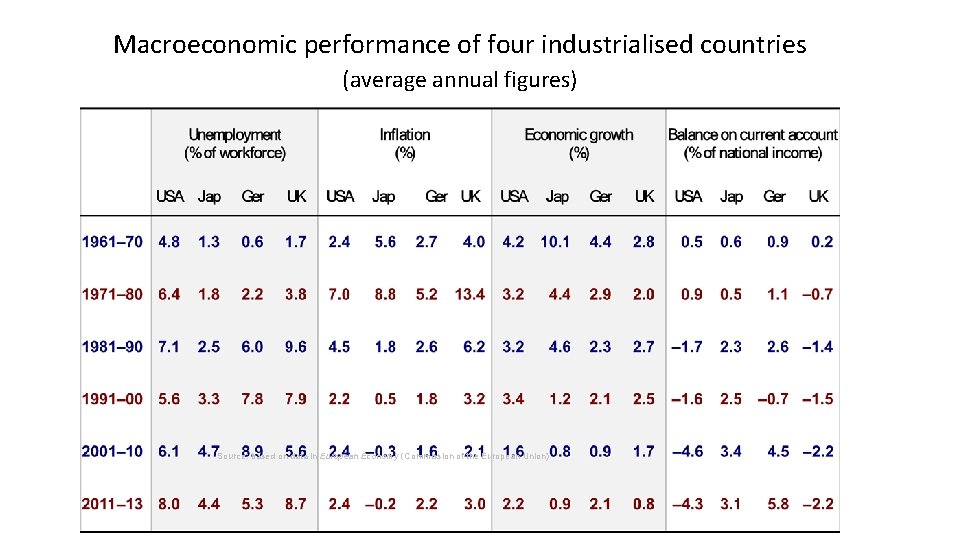
Macroeconomic performance of four industrialised countries (average annual figures) Source: based on data in European Economy (Commission of the European Union)
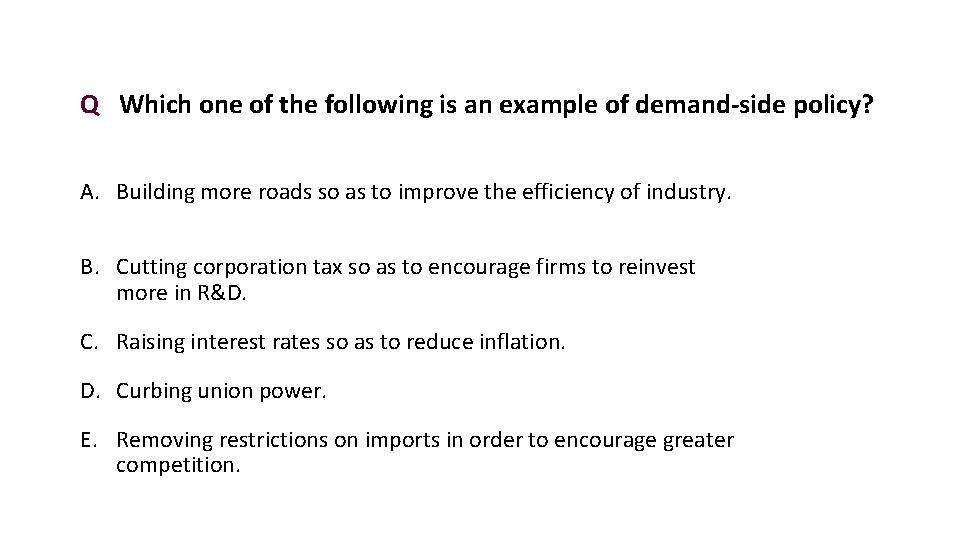
Q Which one of the following is an example of demand-side policy? A. Building more roads so as to improve the efficiency of industry. B. Cutting corporation tax so as to encourage firms to reinvest more in R&D. C. Raising interest rates so as to reduce inflation. D. Curbing union power. E. Removing restrictions on imports in order to encourage greater competition.
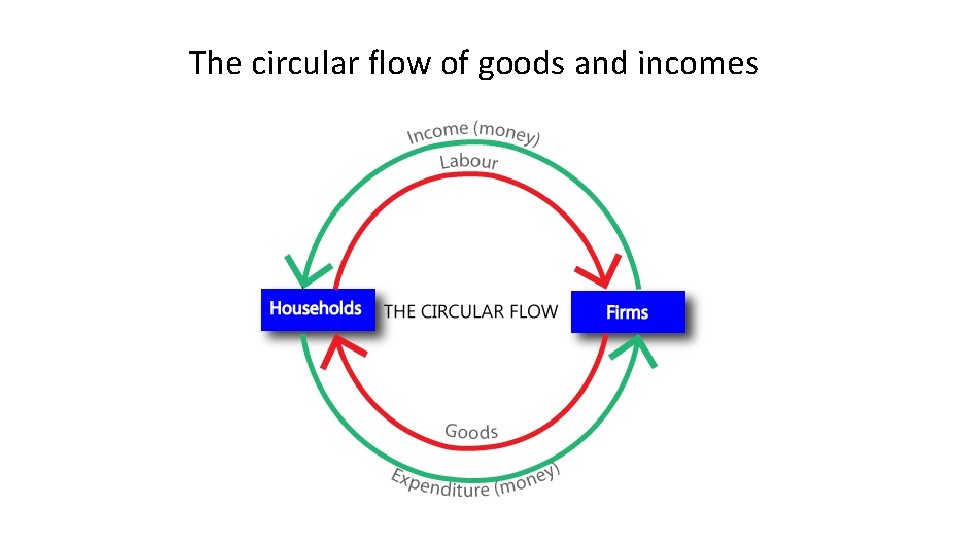
The circular flow of goods and incomes
Microeconomic Choices • Microeconomics and choice • What? • How? • For whom? • Choice and opportunity cost • Opportunity cost – the cost of any activity measured in terms of best alternative forgone. • Rational choices – Weighting up the benefits of any activity against its opportunity cost
Factors that changed the world we live in • Democracy • The Limited Liability Company • Patent Rights • Literacy and Education is the most powerful weapon which you can use to change the world. Nelson Mandela
Positive vs normative economics • Positive economics • Descriptive statements, claims how the world is. (Scientists) • Normative economics • Prescriptive statements claims how the world ought to be. (Policy Advisors)
Forces at play in the real world. • Economic – Supply and Demand • Social – Religion and Culture • Political – Governments.
10 1 – People Face Trade Offs Principles of Economics • Efficiency – Getting the maximum benefit of scarce resources • Equality – Benefits are distributed equally amongst the population. A family is a risky venture, because the greater the love, the greater the loss. . . That's the trade-off. But I'll take it all. Brad Pitt
10 2: the cost of something is what you gave up to get it. Principles of Economics • Opportunity Cost – The next best alternative that is given up when you choose something. In economics, one of the most important concepts is 'opportunity cost' - the idea that once you spend your money on something, you can't spend it again on something else. Malcolm Turnbull
10 3: Rational people think on the margin. Principles of Economics • Rational people – people who systematically and purposefully do the best they can do to achieve their objectives. • Marginal changes – small incremental adjustments to a plan of action. • Marginal Benefit > Marginal Cost = decision will be made.
10 4: People respond to incentives. Principles of Economics • Incentive – something that induces people to act. • Unintended consequences. Call it what you will, incentives are what get people to work harder. Nikita Khrushchev
10 5: Trade can make everyone better • Country X produces 10 apples and has $100 • Country Y produces 10 oranges and has $100 • Both apples and oranges cost $10 each • Country X wants 3 oranges • Country Y wants 7 apples. • Everyone benefits with trade. Principles of Economics
10 6: Markets are usually a good way to organize economic activity. • Market economy • Competitive market • Command economy • Soviet style economics • Government decides what/how/to whom Principles of Economics
10 7: Governments can sometimes improve market outcomes. Principles of Economics • Market failure – a situation in which a market left to its own fails to allocate resources efficiently. Government's first duty is to protect the people, not run their lives. Ronald Reagan
8: a country’s standard of living depends on its ability to produce goods and services. 10 Principles of Economics • Productivity: the quantity of goods and services produced by each output of labor. • The only way to increase the standard of living is through increasing productivity. The productivity of work is not the responsibility of the worker but of the manager. Peter Drucker On my desk I have three screens, synchronized to form a single desktop. I can drag items from one screen to the next. Once you have that large display area, you'll never go back, because it has a direct impact on productivity. Bill Gates
10 9: Prices rise when the government prints too much money. Principles of Economics • Inflation: An increase in the overall levels of prices in the economy. Inflation is when you pay fifteen dollars for the ten-dollar haircut you used to get for five dollars when you had hair. Sam Ewing
10: society faces a short run trade off between unemployment and inflation. 10 Principles of Economics • Inflation occurs when the government prints money. • When money is created there is a need to spend it which thereby increase demand. • Higher demand means that firms can charge more, and in the short run encourages firms to higher more employees. • More hiring = lower unemployment.
- Slides: 27