
Introduction to British Parliamentary Debating Rachmat Nurcahyo M
Introduction to British Parliamentary Debating Rachmat Nurcahyo, M. A. rachmat_nurcahyo@uny. ac. id
Teams l 4 teams: ¡Opening Government (Prime Minister, Deputy Prime Minister) ¡Opening Opposition (Leader of Opposition, Deputy Leader of Opposition) ¡Closing Government (Government Member, Government Whip) ¡Closing Opposition (Opposition Member and Opposition Whip)
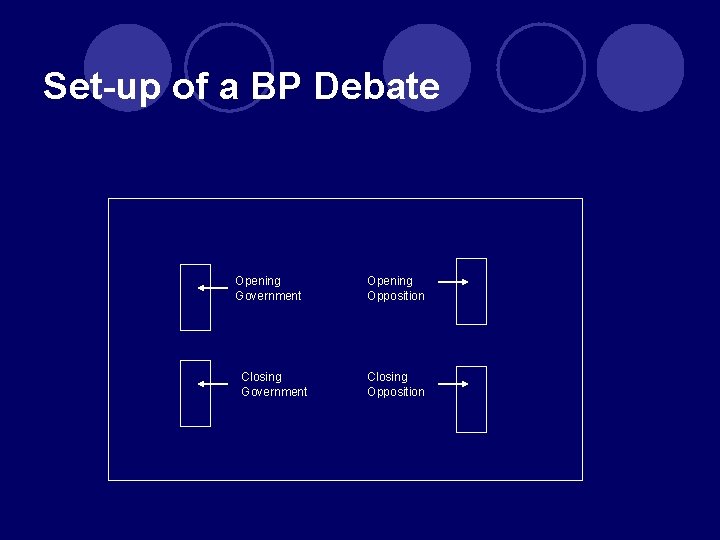
Set-up of a BP Debate Opening Government Closing Government Opening Opposition Closing Opposition
Format of BP Debate l Only 1 motion is announced for each round. l All teams have 20 minutes to casebuild started right after the Motion Launch l The government must propose the motion. l The opposition must negate the motion and present an alternative (ie. the status quo or counter model). l Each speaker has 7 minutes to speak. l Points of Information (POI) are allowed between the 2 nd and 6 th minute.
Roles - Opening Government l The OG has to set up the debate – ie. present the context/problem, define the motion, set a parameter, propose a model (if necessary). l The PM and DPM should present different arguments – ie. through a split. l The PM and DPM should present logically consistent arguments. l The OG should present the bulk of the government’s case.
Roles - Opening Opposition l The OO should negate the motion and present an alternative – ie. the status quo or counter model. l The LO and DLO should present different arguments – ie. through a split. l The LO and DLO should present logically consistent arguments. l The OO should present the bulk of the opposition’s case.
Roles - Closing Government and Closing Opposition l Closing teams should aim to: ¡Move the debate to a different area. ¡Be distinct from the opening teams. l Both GM and OM should present an extension – ie. new arguments, deeper analysis. l Both GW and OW should deliver rebuttals and replies. No new materials/arguments!
- Slides: 7